Letter 't' Tracing and Matching Worksheet for Preschoolers
Tracing, matching, and writing the letter 't' gives children ages 3-5 repeated exposure to one of the more frequent letters in early reading vocabulary, building both the motor memory for its cross-stroke shape and the sound-to-symbol connection for its sharp /t/ sound. Matching pictures that start with 't' to the letter itself reinforces that recognition beyond just the written form, connecting it to real objects and words. This kind of combined tracing-and-matching practice suits how young children learn best: through repetition across slightly different tasks.
Part of the pack
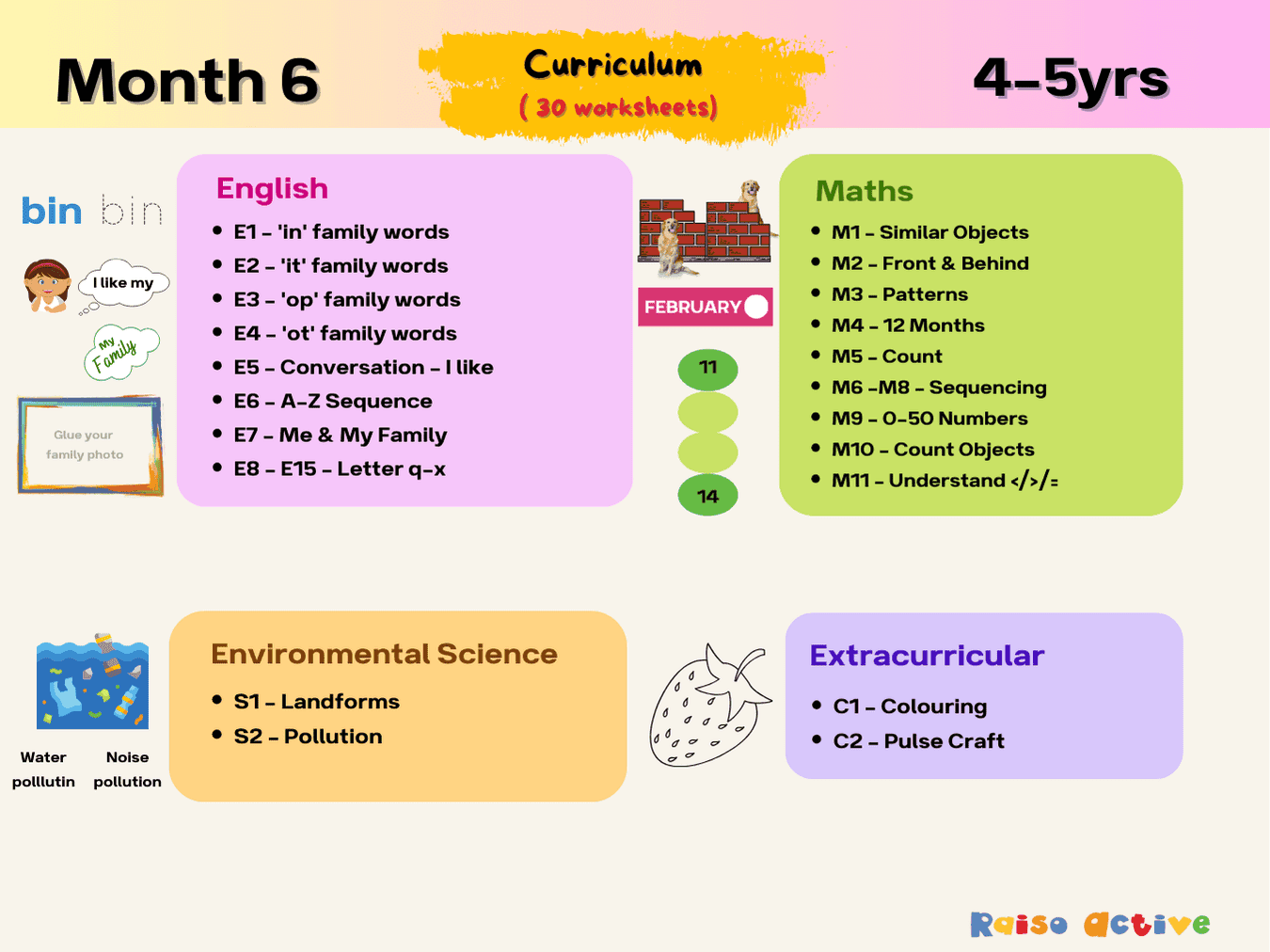
Month 6: Preschool multi-subject foundational skills | Ages 4-5
This is page 14 of the pack. Ages 4-5 · Pre-KAges 4-5 · ReceptionAges 4-5 · LKGAges 4-5
Made for your child
A whole activity pack made with their name
60 pages to spot, build, trace and write their own name, plus pages about their favourites, feelings and family. See a free preview with their name.
Make an All About Me packFree preview · free for members
Or start free: a name tracing sheet with their nameCurriculum
- Writing > Letter Tracing A-Z
How to use this worksheet
Begin by tracing the letter 't,' guiding your child's pencil down the vertical line and then across the horizontal stroke while saying the /t/ sound aloud. Move to the matching section, asking your child to draw a line connecting the letter 't' to pictures of objects that start with that sound, like a turtle or a tree. Finally, have your child trace and write the letter 't' once more on the practice lines at the bottom of the page, saying the sound each time they write it.
Materials needed
- Pencil
- Crayons
Extension activities
- 1Search the house for objects that start with 't,' like a towel or a table, and make a short list together.
- 2Practice writing the letter 't' in sand, salt, or shaving cream to build muscle memory without a pencil.
- 3Play an 'I Spy' game looking only for objects that start with the /t/ sound.
- 4Cut out the matched pictures and turn them into a simple memory-matching game.
- 5Read a short book together and count how many words on a page start with 't.'

Written by
Hemsweta Jain · Teacher Cheena
MBA and Early Childhood Educator, teaching since 2014 · Founder of RaisoActive, Mumbai
Every RaisoActive worksheet is designed and checked by the founder before publishing.
Published · Last reviewed
More from Month 6: Preschool multi-subject foundational skills | Ages 4-5
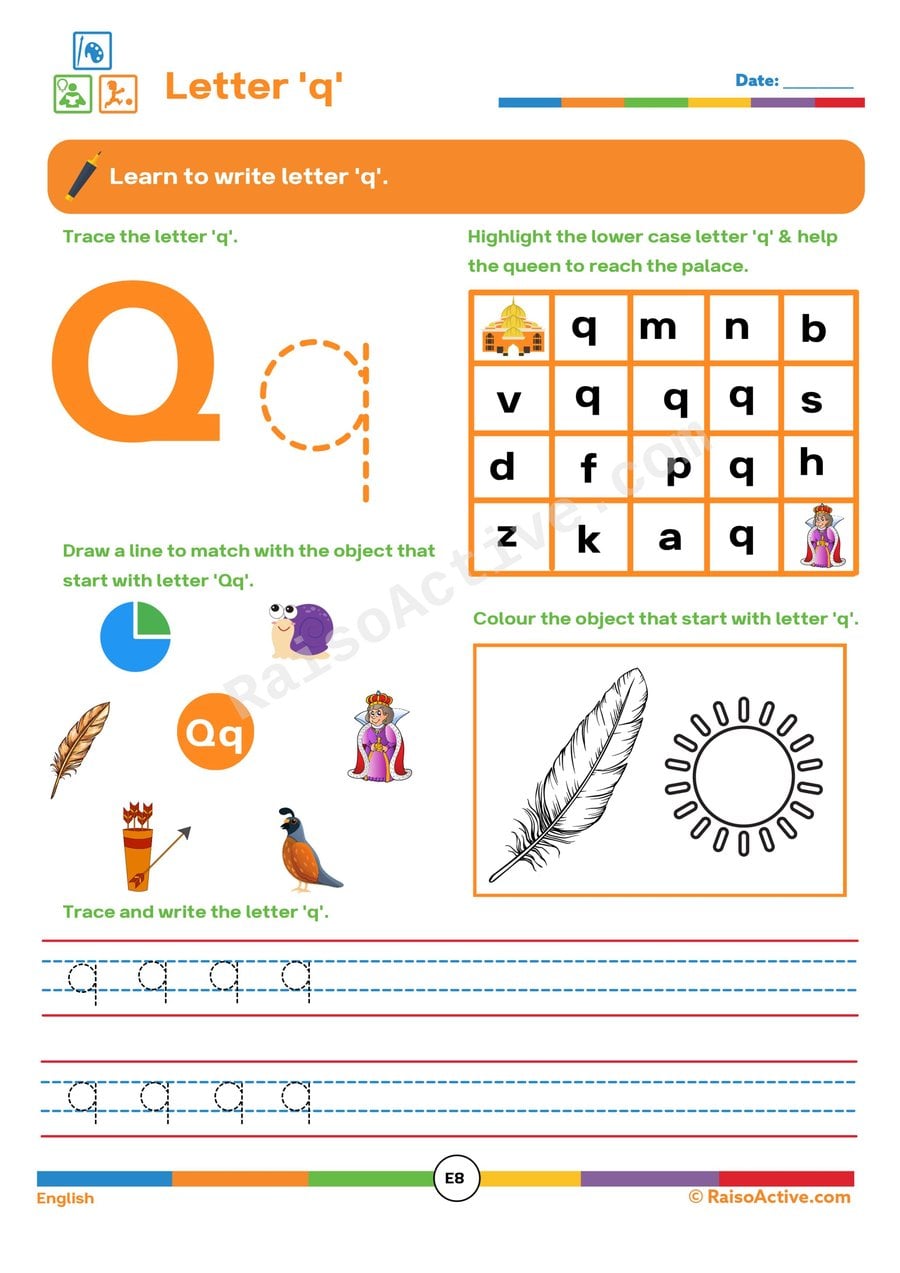
Letter 'q' Worksheet: Trace, Match, and Color!
Ages 3-5 · Preschool–Pre-KAges 3-5 · Nursery–ReceptionAges 3-5 · Nursery–LKGAges 3-5
This worksheet builds letter recognition for 'q' in both its uppercase and lowercase forms for children ages 3-5, a letter that's often trickier than most since it almost always pairs with 'u' and rarely appears alone in early vocabulary. Tracing the letter strengthens the fine motor control for its distinctive tail stroke, while matching and highlighting activities reinforce visual recognition across a busy grid. Helping the queen reach the palace through a simple letter-hunt maze adds a playful, motivating goal to an otherwise repetitive tracing task.

Front and Behind Worksheet: Identifying Positional Words
Ages 3-5 · Preschool–Pre-KAges 3-5 · Nursery–ReceptionAges 3-5 · Nursery–LKGAges 3-5
Understanding 'front' and 'behind' gives children ages 3-5 the spatial vocabulary they need to follow instructions and describe the world around them accurately, an important stepping stone toward later concepts like ordinal position and basic geometry. This worksheet asks them to apply the words to specific pictures rather than just hear them in passing, which cements the connection between the word and the physical relationship it describes. Positional language like this also supports following multi-step directions at home and in the classroom.
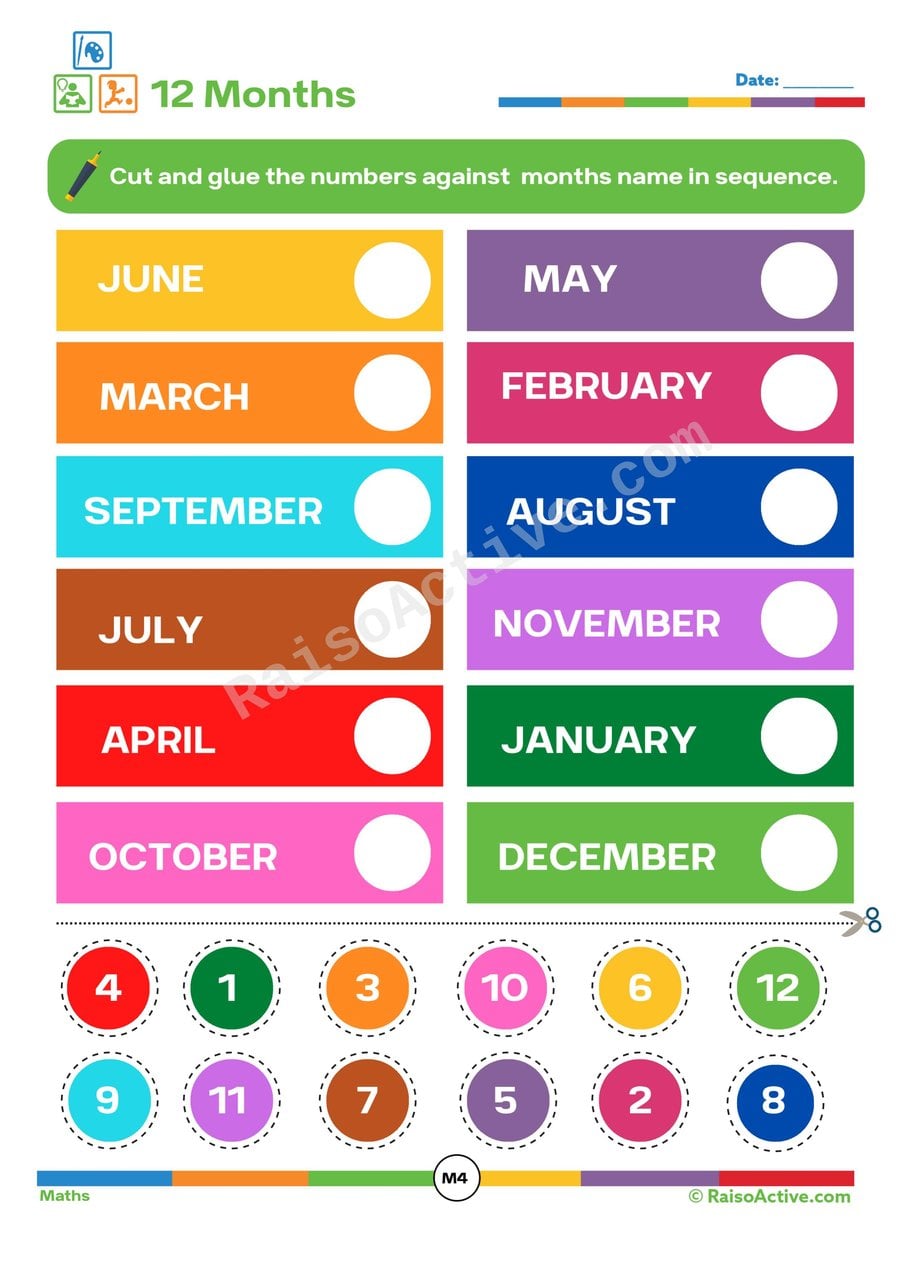
Months of the Year Matching Worksheet for Kids
Ages 4-5 · Pre-KAges 4-5 · ReceptionAges 4-5 · LKGAges 4-5
Matching numbers to month names introduces children ages 4-5 to the idea that the calendar has a fixed, meaningful order, which supports early time-concept development alongside their growing number recognition. This cut-and-paste format adds a fine motor and sequencing challenge, since children must locate the correct number piece among several options before gluing it into place. Learning the months by their order also lays groundwork for talking about birthdays, holidays, and seasons throughout the year.
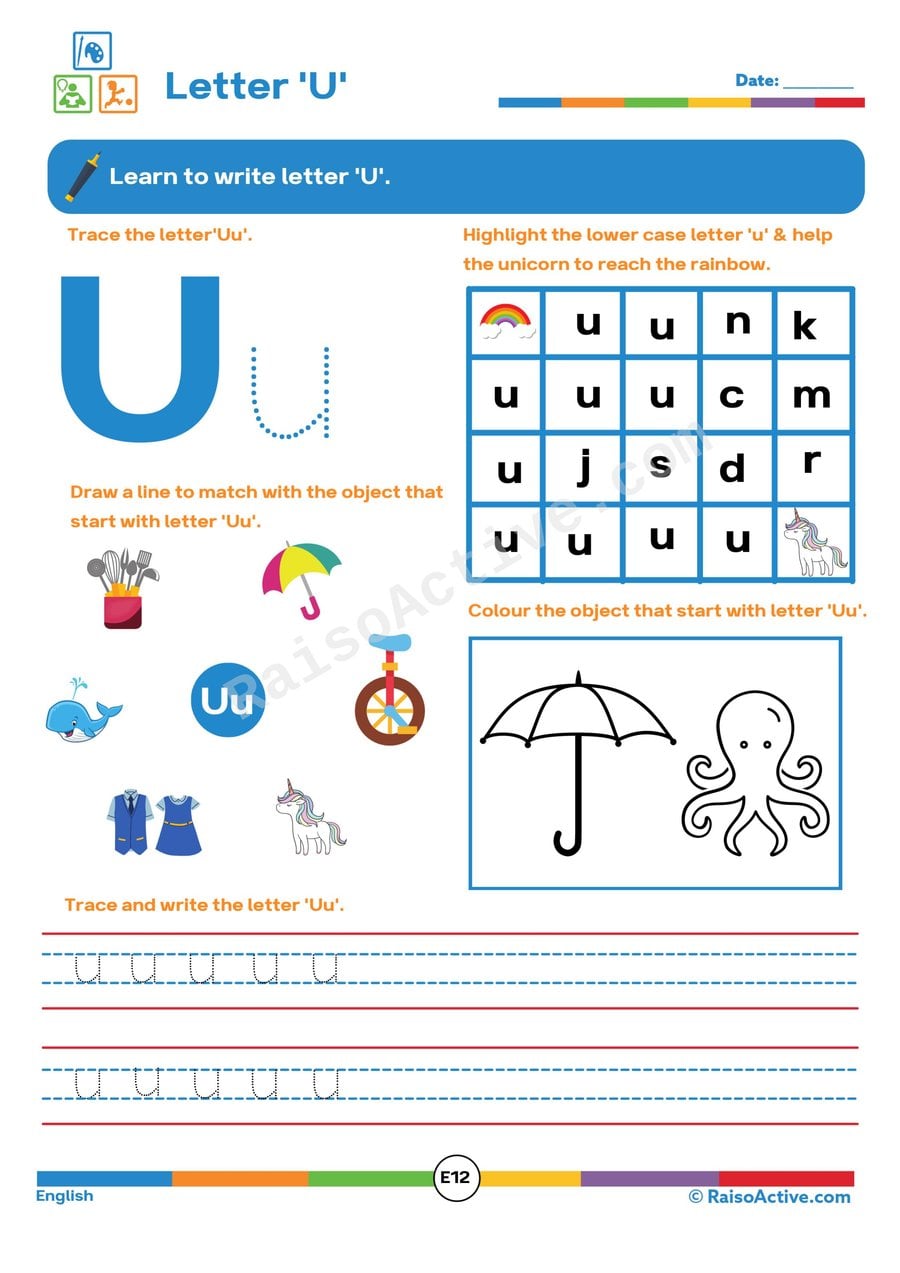
Letter 'U' Worksheet: Trace, Match, and Color!
Ages 3-5 · Preschool–Pre-KAges 3-5 · Nursery–ReceptionAges 3-5 · Nursery–LKGAges 3-5
Tracing, matching, and coloring the letter 'U' gives children ages 3-5 focused repetition on a rounded letter shape while building the sound-symbol connection for its short /u/ sound, as in 'umbrella' or 'up.' Matching pictures that start with 'U' to the letter reinforces recognition beyond the written form, tying it to real, familiar objects. Combining tracing, matching, and coloring in a single page suits a preschooler's need for varied, short activities rather than one long repetitive drill.

Sequencing Numbers Train Worksheet for Preschoolers
Ages 4-5 · Pre-KAges 4-5 · ReceptionAges 4-5 · LKGAges 4-5
This train-themed worksheet asks children ages 4-5 to fill in missing numbers within a given sequence, which builds a much deeper number sense than simply counting from one — they must recognize what number comes before or after a given value anywhere in the run. Practicing sequencing this way strengthens working memory and prepares children for later mental math skills like skip counting and addition. The train-car format also keeps the abstract task of ordering numbers visually organized and engaging.

Learn the Letter 'x' Worksheet: Tracing, Matching, and Coloring Fun!
Ages 4-5 · Pre-KAges 4-5 · ReceptionAges 4-5 · LKGAges 4-5
This worksheet builds recognition of the less common letter x through tracing both uppercase and lowercase forms, then reinforces that recognition through matching pictures and highlighting the letter within a grid. For ages 4-5, letter x is genuinely rare at the start of everyday words, so this worksheet leans on strong examples like 'x-ray' to build familiarity despite limited real-world exposure.
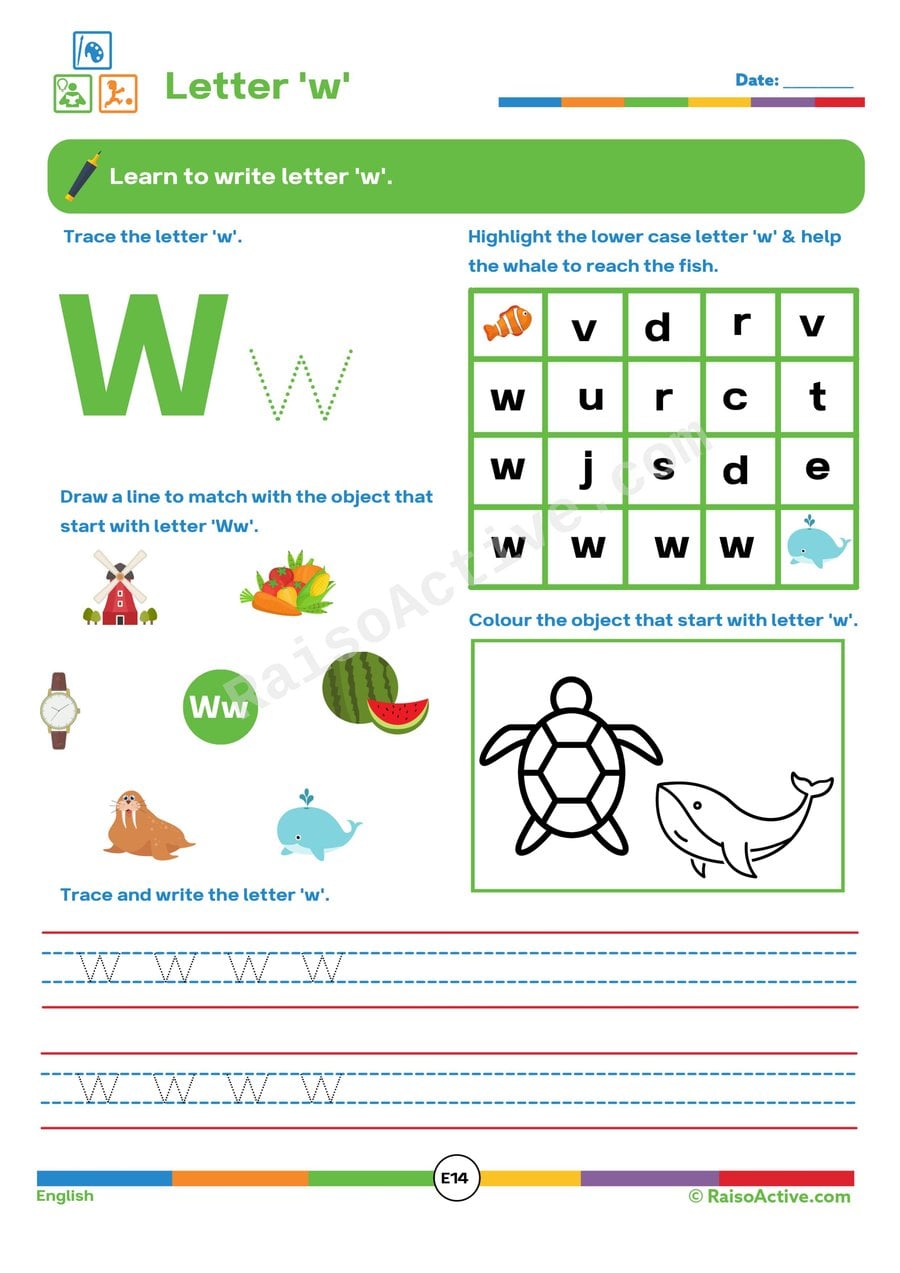
Letter 'w' Worksheet: Trace, Match, and Color!
Ages 3-5 · Preschool–Pre-KAges 3-5 · Nursery–ReceptionAges 3-5 · Nursery–LKGAges 3-5
Tracing, matching, and highlighting the letter 'w' gives children ages 3-5 practice with one of the more visually complex lowercase letters, made up of four connected diagonal strokes rather than a single simple shape. Matching pictures that start with 'w' to the letter reinforces the /w/ sound-to-symbol link, while scanning a letter grid to highlight every 'w' builds visual search skills alongside letter recognition. This combination of tracing, matching, searching, and coloring keeps the practice varied enough to hold a young child's attention across the full page.

Ot Word Family Worksheet: Read, Trace, and Identify!
Ages 4-6 · Pre-K–KindergartenAges 4-6 · Reception–Year 1Ages 4-6 · LKG–UKGAges 4-6
Reading, tracing, and identifying words from the 'ot' family — like pot, dot, and hot — helps children ages 4-6 see how changing the first letter of a word while keeping the same ending produces a whole new word, reinforcing the pattern-based phonics strategy known as word families. Tracing each word while reading it connects handwriting practice directly to reading practice, and identifying the matching picture afterward checks genuine comprehension rather than rote letter-sounding. Word family practice like this builds the foundation for decoding many more words independently later on.
Related worksheets

Letter Dd Tracing and Matching Worksheet for Preschoolers
Ages 3-5 · Preschool–Pre-KAges 3-5 · Nursery–ReceptionAges 3-5 · Nursery–LKGAges 3-5
Children ages 3-5 practice writing the letter Dd through guided tracing, then apply that recognition by finding Dd hidden in a letter grid and identifying pictures that start with the sound. Moving from writing the letter to spotting it among other letters, and then to hearing it at the start of real words, builds a well-rounded, multi-sense understanding of the letter D.

Letter L Tracing Worksheet for Preschoolers: Learn to Write!
Ages 3-5 · Preschool–Pre-KAges 3-5 · Nursery–ReceptionAges 3-5 · Nursery–LKGAges 3-5
This worksheet helps children ages 3-5 practice tracing the letter L's simple straight-line strokes while identifying words that start with the letter L, giving early success with one of the more approachable letters to write. Because L uses just two straight strokes, it's often a confidence-building letter for children still building fine motor control.
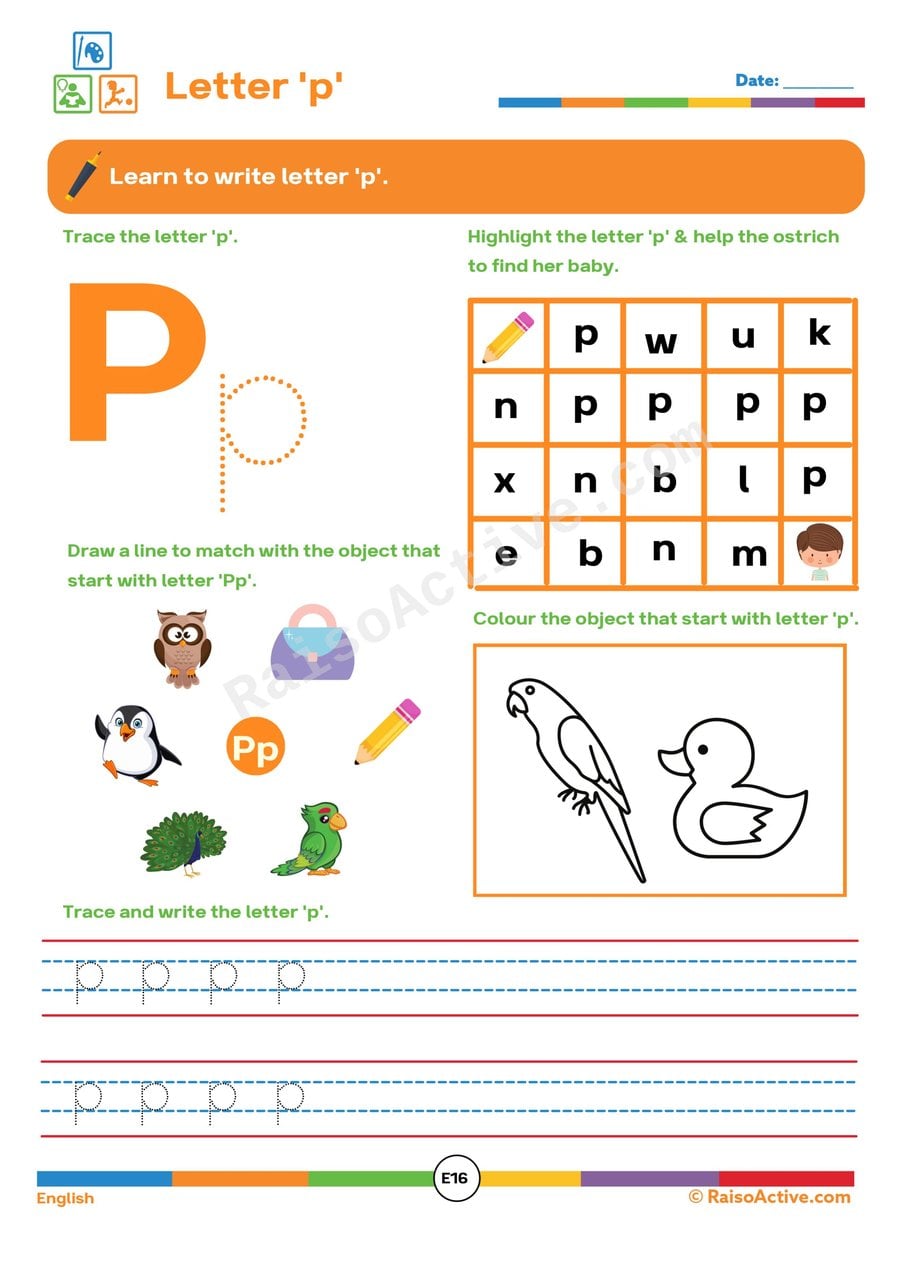
Letter 'p' Fun: Trace, Find, and Color the Letter 'p'!
Ages 3-5 · Preschool–Pre-KAges 3-5 · Nursery–ReceptionAges 3-5 · Nursery–LKGAges 3-5
Tracing both uppercase and lowercase 'p' builds handwriting muscle memory for children ages 3-5, while searching for the letter in a word search sharpens visual discrimination between similar letter shapes. Matching and coloring objects that start with 'p' rounds out the practice by linking the written letter to its spoken sound and real-world examples.

Trace and Identify the Letter 'G' Worksheet for Preschoolers
Ages 4-5 · Pre-KAges 4-5 · ReceptionAges 4-5 · LKGAges 4-5
This worksheet helps children ages 4-5 build the pencil control needed to form the letter G while also practicing visual search skills as they locate every G hidden among other letters. Coloring pictures that start with G ties the abstract letter shape to concrete, familiar words, strengthening the letter-sound connection.

Letter K Tracing and Coloring Worksheet for Preschoolers
Ages 3-5 · Preschool–Pre-KAges 3-5 · Nursery–ReceptionAges 3-5 · Nursery–LKGAges 3-5
This worksheet builds recognition and formation of the letter K in both uppercase and lowercase forms through tracing, coloring, and identifying words that start with K, like 'kite' or 'kangaroo.' For three- to five-year-olds, working through both letter cases together, plus circling the letter among distractors, strengthens visual discrimination alongside handwriting practice.

Letter B Tracing and Identification Worksheet for Preschoolers
Ages 3-5 · Preschool–Pre-KAges 3-5 · Nursery–ReceptionAges 3-5 · Nursery–LKGAges 3-5
This worksheet helps children ages 3-5 practice tracing and writing the letter B, identifying B among other letters, and recognizing objects that start with the letter B. Circling the correct letter within a small group builds the visual scanning skill children need before they can read words fluently.

Letter Y Tracing and Recognition Worksheet for Preschoolers
Ages 3-5 · Preschool–Pre-KAges 3-5 · Nursery–ReceptionAges 3-5 · Nursery–LKGAges 3-5
This worksheet builds recognition and formation of the letter Y through guided tracing practice and by identifying pictures of words that start with Y, like 'yarn' or 'yo-yo.' For three- to five-year-olds, tracing first with a finger and then with a pencil builds the motor memory needed before a child can form the letter confidently on their own.

Letter S Tracing Worksheet: Learn to Write and Identify the Letter S!
Ages 3-5 · Preschool–Pre-KAges 3-5 · Nursery–ReceptionAges 3-5 · Nursery–LKGAges 3-5
This worksheet helps children ages 3-5 learn to recognize and write the letter S, both uppercase and lowercase, using its distinctive curving stroke, while also practicing identifying words that start with the letter S. Because S makes a long, continuous hissing sound that's easy to isolate, this letter is often one of the more approachable sounds for early phonics practice.
Guides for this topic

Best Worksheets for 3-Year-Olds: What Works and What to Avoid
What works on worksheets for 3-year-olds: short sessions, crayons, tracing lines, matching, cutting, a free weekly plan, and signs one is too advanced.
Documenting Learning Without Drowning in Data: A Practical Guide for Parents and Teachers
Learn practical ways to document your child's learning without overwhelm. Simple portfolios, observation tips, and printable trackers for ages 1-8.

How to Help Your Child with Letter Reversals: A Complete Guide for Parents and Teachers
Letter reversals are normal until age 7-8. Learn the best multisensory strategies, anchor letter tricks, and activities to help children write b, d, p, and q correctly.
Reviews
Every worksheet for ages 3–5, no watermark
Members download the full library of 1,000+ worksheets and every activity pack without watermarks or daily limits. One year costs ₹999 in India or $20 elsewhere.
See membership plansOr download any worksheet free with a watermark (5 a day).