Fun Activities for Kids: Parent's Guide to Learning Through Play
This parent's guide gives caregivers of children ages 3-5 a set of play-based activities focused on phonics and sentence-building, translating early literacy concepts into hands-on games rather than seated worksheet time. Learning through play, such as storytelling or naming body parts during movement, helps young children absorb language concepts without the pressure of a formal lesson. Covering both phonics and sentence-building in one guide gives caregivers flexibility to match the activity to their child's mood and energy level.
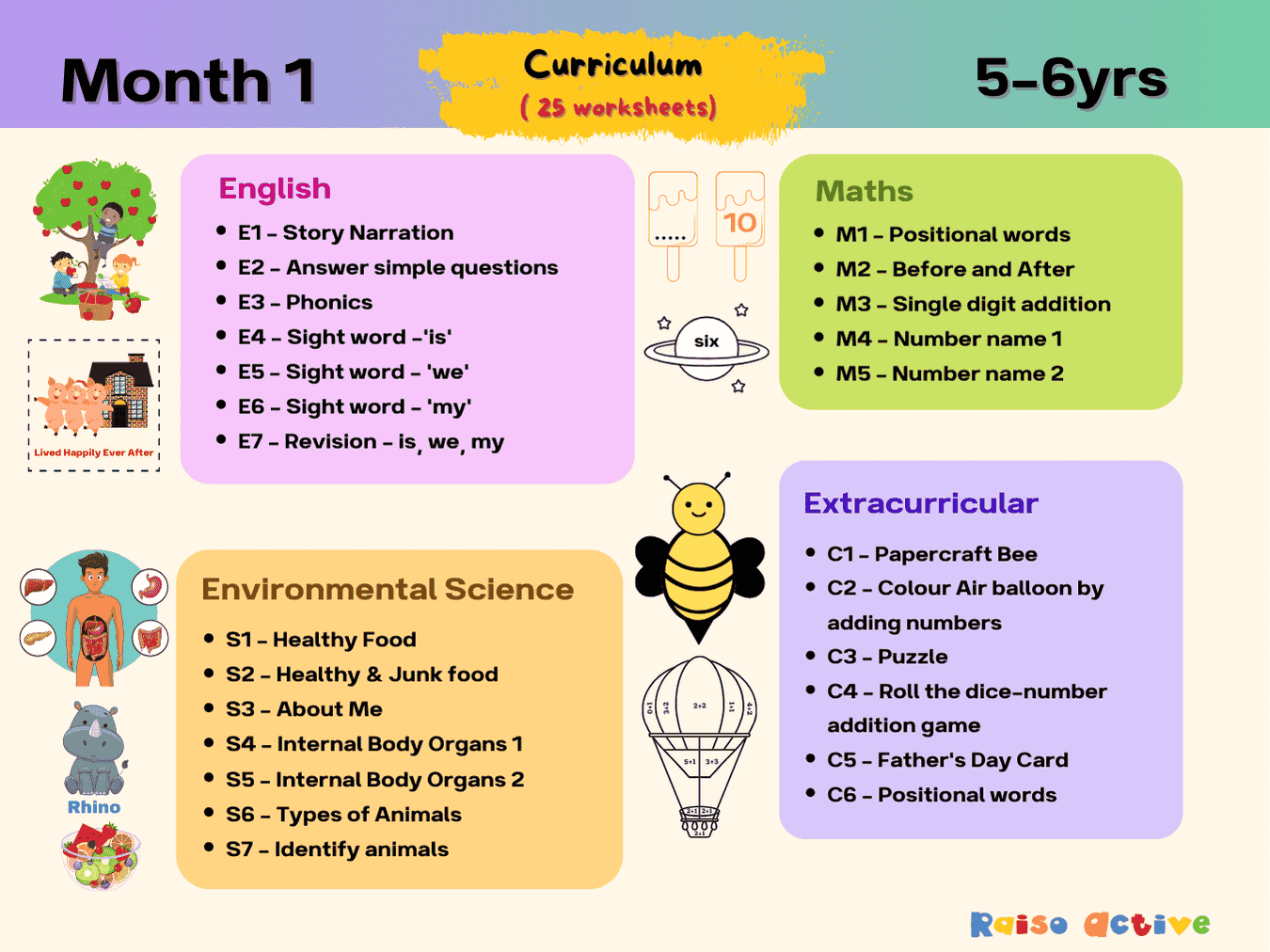
Part of the pack
Month 1: Learning & Development | Ages 5-6
This is page 2 of the pack. Ages 5-6 · KindergartenAges 5-6 · Year 1Ages 5-6 · UKGAges 5-6
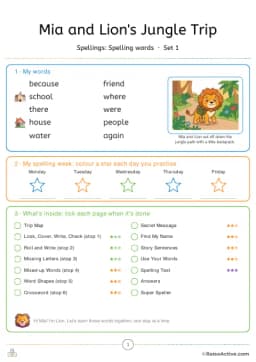
Made for your child
Spelling practice, made for your child
Their own spelling words turned into a pack: trace or look-cover-write-check, roll and write, a secret picture code, a word search, a crossword and a test, with their name in it.
Make a spelling packFree preview · free for members
Or start free: a word search with sight wordsCurriculum
- Phonics - Letter Sounds > Beginning Sounds
How to use this worksheet
Read through the guide's activity options first and choose one that matches how much time and energy you have that day. Gather any simple materials the chosen activity calls for before starting with your child. Follow the instructions step by step, allowing your child to lead as much of the talking and doing as possible. Repeat favorite activities on different days, since repetition helps young children internalize phonics and sentence patterns.
Extension activities
- 1Tell a simple story together, taking turns adding one sentence each.
- 2Play a body-parts naming game while getting dressed or during bath time.
- 3Practice simple addition using snacks or toys as counters during snack time.
- 4Make up silly sentences together using a chosen sound or letter.
- 5Turn a favorite activity from the guide into a short bedtime routine.

Written by
Hemsweta Jain · Teacher Cheena
MBA and Early Childhood Educator, teaching since 2014 · Founder of RaisoActive, Mumbai
Every RaisoActive worksheet is designed and checked by the founder before publishing.
Published · Last reviewed
More from Month 1: Learning & Development | Ages 5-6
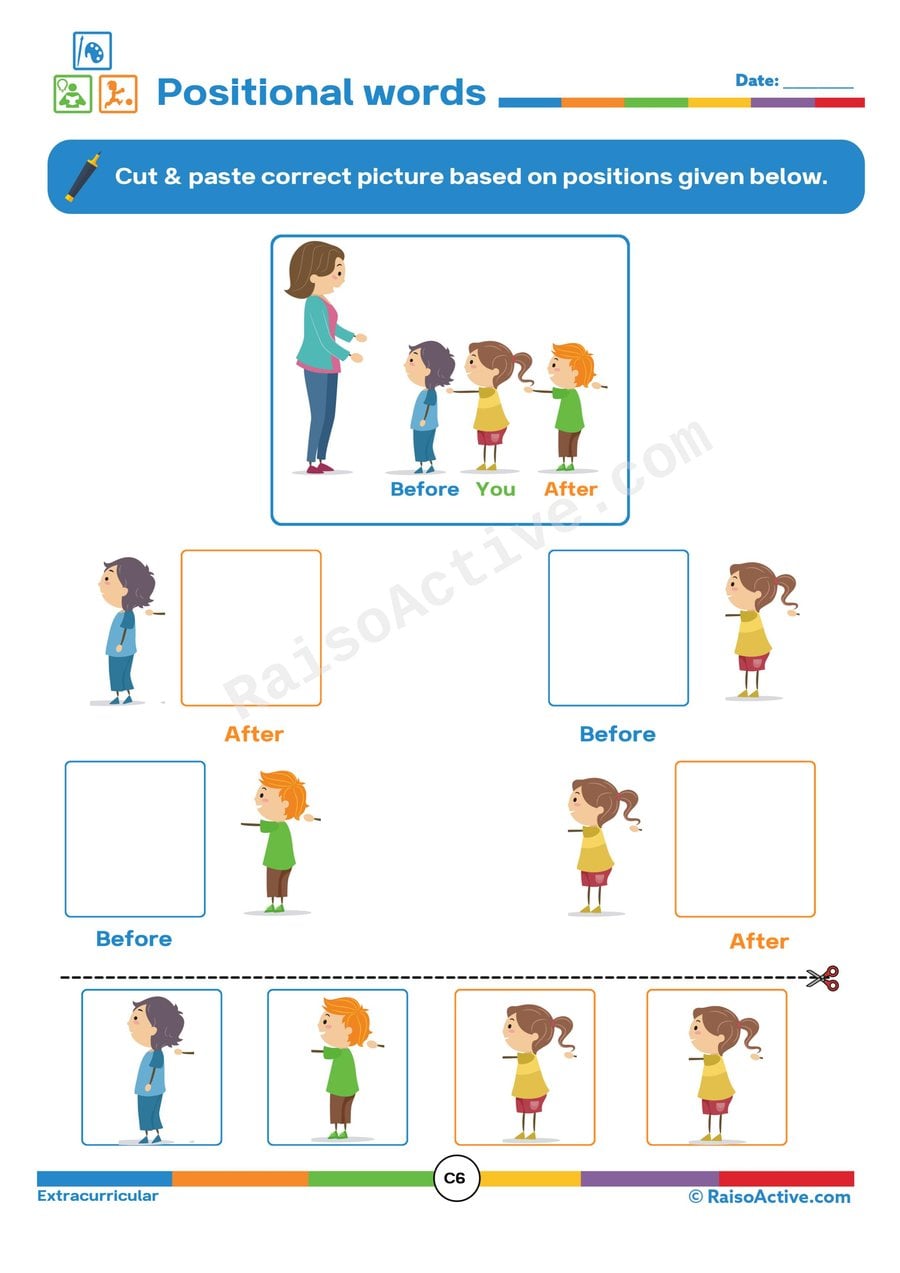
Positional Words Worksheet: Before, You, and After!
Ages 3-5 · Preschool–Pre-KAges 3-5 · Nursery–ReceptionAges 3-5 · Nursery–LKGAges 3-5
This cut-and-paste worksheet teaches children ages 3-5 to apply the positional words 'before' and 'after' to a sequence of objects or people, connecting an abstract language concept to a visual, hands-on task. Understanding order words like these is an important building block for later skills such as retelling stories in sequence and understanding time concepts like yesterday and tomorrow. Choosing and placing the correct picture also reinforces careful listening and following two-step directions.

Domestic vs. Wild Animals Sorting Worksheet for Preschoolers
Ages 3-5 · Preschool–Pre-KAges 3-5 · Nursery–ReceptionAges 3-5 · Nursery–LKGAges 3-5
Sorting animal pictures into domestic and wild categories teaches children ages 3-5 early classification skills, requiring them to consider a shared trait, like whether an animal lives with humans or in the wild, rather than just naming individual animals. This kind of categorization is a foundational science and logical-thinking skill, since sorting by an abstract rule is more advanced than simply identifying objects one at a time. Cutting and gluing the animals into their correct groups also adds fine motor practice to the sorting task.

Sight Words Worksheet: Practice with 'is', 'we', and 'my'
Ages 4-6 · Pre-K–KindergartenAges 4-6 · Reception–Year 1Ages 4-6 · LKG–UKGAges 4-6
This worksheet challenges children ages 4-6 to choose the correct sight word from a small word bank — 'is,' 'we,' or 'my' — to complete a sentence, rather than simply tracing or copying a single word. Selecting the right word based on sentence meaning requires a deeper level of reading comprehension than earlier single-word practice, since children must understand what each sentence is saying before choosing correctly. Writing the chosen word from memory also builds spelling recall for these common words.

Healthy Eating Worksheet: Fruit Salad and Vegetable Soup!
Ages 3-5 · Preschool–Pre-KAges 3-5 · Nursery–ReceptionAges 3-5 · Nursery–LKGAges 3-5
This matching worksheet helps children ages 3-5 build food vocabulary by identifying pictures of fruits and vegetables and sorting them into the correct category — fruit salad ingredients or vegetable soup ingredients. Learning to classify foods by type, not just by whether they're healthy, supports early categorization skills that apply across many other subjects, from animals to shapes. The cooking-themed framing also connects the sorting task to a familiar, everyday context children may have experienced at home.

Phonics Fun: Matching Letters and Words Worksheet for Preschoolers
Ages 4-5 · Pre-KAges 4-5 · ReceptionAges 4-5 · LKGAges 4-5
Identifying the beginning sound of a pictured word and writing the matching letter teaches children ages 4-5 phonemic awareness, the ability to isolate individual sounds within spoken words, which is one of the strongest predictors of future reading success. Saying each word aloud after writing the letter reinforces the connection between the printed letter and its spoken sound, closing the loop between listening, writing, and speaking. This worksheet moves children from simply recognizing letters to actively applying letter-sound knowledge, a more advanced early literacy skill.
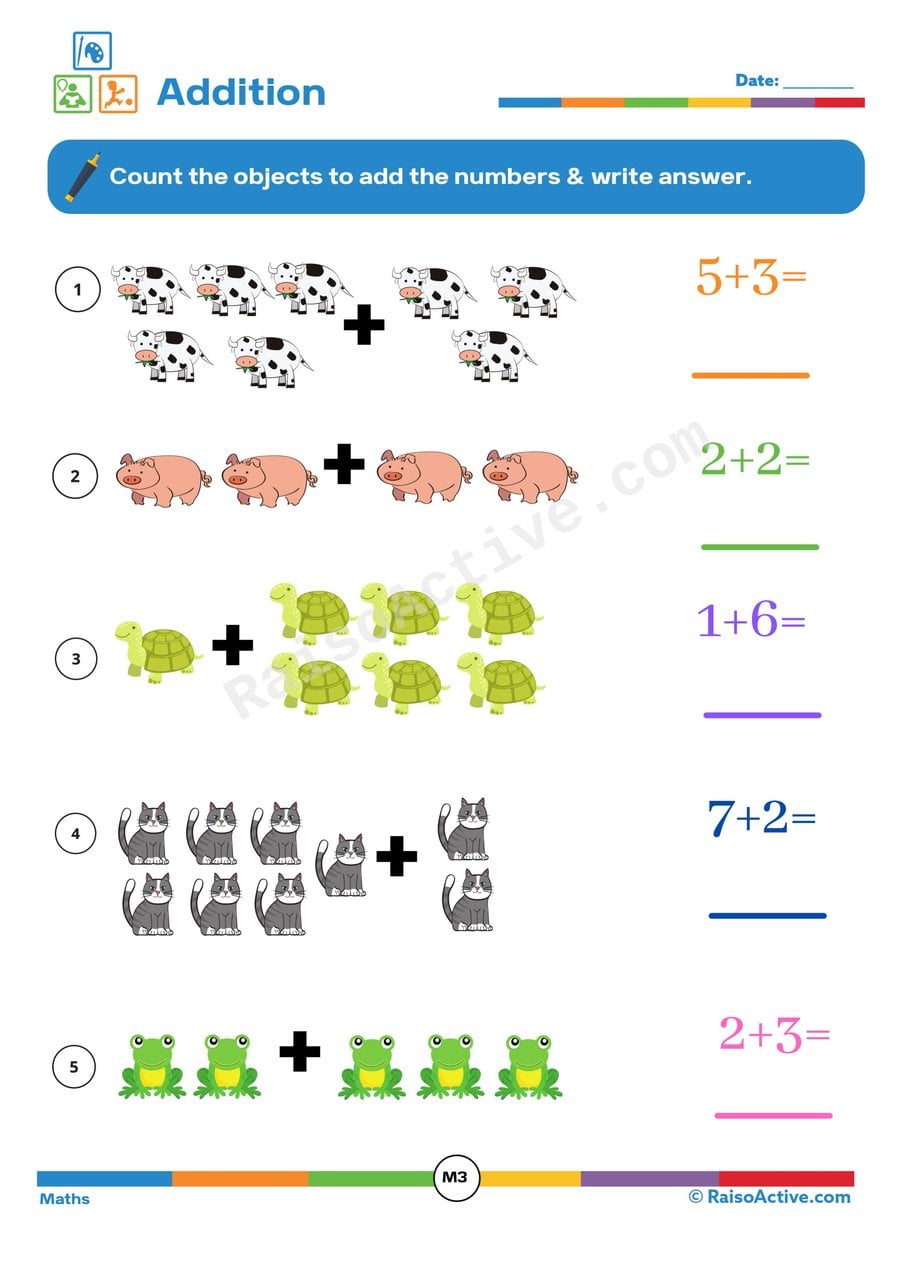
Addition Worksheet: Count and Add Objects!
Ages 4-6 · Pre-K–KindergartenAges 4-6 · Reception–Year 1Ages 4-6 · LKG–UKGAges 4-6
Counting two groups of pictured objects and writing their combined total introduces children ages 4-6 to addition as a concrete, visual process before they work with numbers alone. Because the objects are drawn out rather than represented only by digits, children can physically point and count to verify their answer, building confidence in early math reasoning. Repeated practice with this picture-based format helps children internalize what a plus sign means before they're expected to solve equations without visual support.
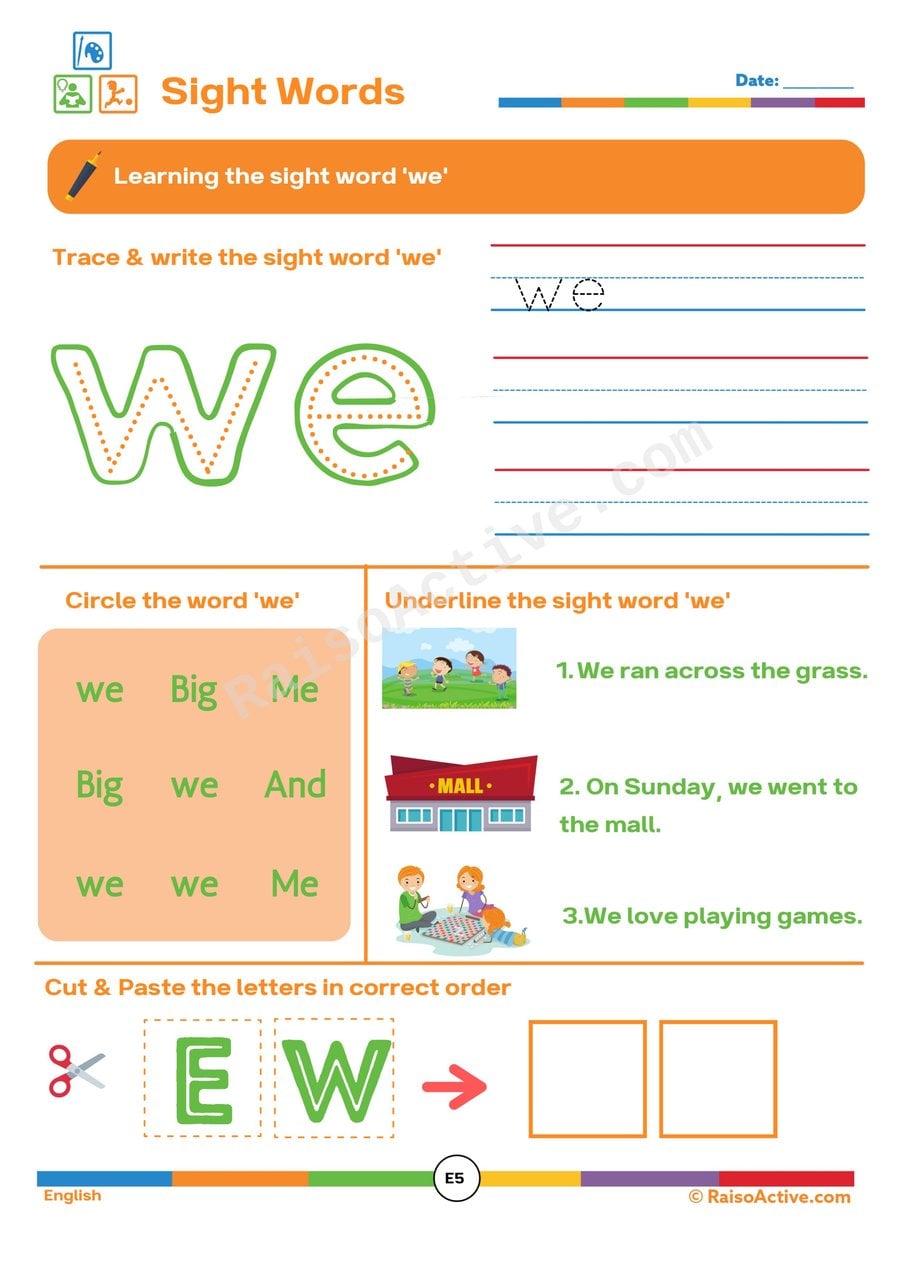
Sight Word 'We' Worksheet: Trace, Write, and Find!
Ages 3-5 · Preschool–Pre-KAges 3-5 · Nursery–ReceptionAges 3-5 · Nursery–LKGAges 3-5
This worksheet builds deep familiarity with the sight word 'we' in children ages 3-5 through four different practice formats — tracing, independent writing, circling, and finding the word within sentences — layered onto a single page. Repeating the same word across so many formats in one sitting is specifically designed to move 'we' from a word your child sounds out each time into one they recognize instantly on sight.

Learn the Sight Word 'My' - Tracing, Writing, and Matching Worksheet
Ages 3-5 · Preschool–Pre-KAges 3-5 · Nursery–ReceptionAges 3-5 · Nursery–LKGAges 3-5
This worksheet builds sight-word fluency for the word 'my' in children ages 3-5 through a combination of tracing, independent writing, fill-in-the-blank sentences, and a matching activity. Working with the same word across several different formats helps cement recognition, since 'my' is a high-frequency word that appears constantly in early reading material but doesn't follow simple phonics patterns. The matching component adds a visual-recognition check to confirm the word sticks even without tracing cues.
Related worksheets

Parent's Guide: Fun Activities for Adjectives, Conjunctions, and More!
Ages 3-5 · Preschool–Pre-KAges 3-5 · Nursery–ReceptionAges 3-5 · Nursery–LKGAges 3-5
This parent's guide bundles hands-on activities around adjectives, conjunctions, measurement, and recycling, giving children ages 3-5 exposure to both language concepts and early science-adjacent skills within everyday, low-prep activities. Combining grammar practice with physical tasks like measuring height or building a planter helps abstract concepts, like what a conjunction is, become grounded in something concrete and memorable.

Parent's Guide: Fun Activities for Early Learning
Ages 3-5 · Preschool–Pre-KAges 3-5 · Nursery–ReceptionAges 3-5 · Nursery–LKGAges 3-5
This parent guide brings together five activities spanning punctuation, moon phases, subject and predicate, the solar system, and counting and addition, giving children ages 3-5 a broad sampler of language arts, science, and math concepts through hands-on materials like Oreo biscuits and a flashlight. Working across such different topics in one guide helps children practice shifting attention between subjects, a skill that supports the more structured subject-switching they'll encounter in school.

Parent's Guide: Fun Activities for Letter Recognition, Conversation & More!
Ages 3-5 · Preschool–Pre-KAges 3-5 · Nursery–ReceptionAges 3-5 · Nursery–LKGAges 3-5
This guide is a collection of hands-on activities parents can use to build letter recognition, phonics awareness, basic conversation skills, and spatial vocabulary in three- to five-year-olds through everyday play rather than worksheet drills. Because it's built around games like hiding letters or setting up a pretend shop, it teaches these early literacy and language skills through movement and imagination, which holds young children's attention far longer than seated tasks.

Parent's Guide: Fun Activities for Early Readers and Number Learners!
Ages 3-5 · Preschool–Pre-KAges 3-5 · Nursery–ReceptionAges 3-5 · Nursery–LKGAges 3-5
This parent guide brings together a set of activity ideas that build two foundational skills at once for children ages 3-5: early reading, through short sentences and sight words, and early number sense, through counting, adding, and subtracting within a comfortable range. Rather than a single worksheet task, it gives caregivers a roadmap of small, achievable practice moments that fit naturally into daily routines. Following a guide like this helps parents pace learning appropriately instead of jumping into material that's too advanced too soon.

Family Words Worksheet: Picture Matching and Word Recognition
Ages 4-6 · Pre-K–KindergartenAges 4-6 · Reception–Year 1Ages 4-6 · LKG–UKGAges 4-6
Children ages 4-6 practice recognizing and reading words from the 'family' word group, like 'candle' becoming 'candle-family' patterns or similar word-family endings, by matching written words to their corresponding pictures. Word family practice builds phonics pattern recognition, helping children read new words faster by spotting familiar chunks within them.

Speak Sentences: A Fun Sentence Building Worksheet!
Ages 4-6 · Pre-K–KindergartenAges 4-6 · Reception–Year 1Ages 4-6 · LKG–UKGAges 4-6
Reading a single word on each stair step and turning it into a full spoken sentence helps children ages 4-6 practice expanding a vocabulary word into a grammatically complete thought, an important bridge between word recognition and sentence-level language. The staircase, climb-to-the-top format adds a sense of progress and motivation, encouraging children to keep going even when a particular word is tricky to build a sentence around. This oral sentence-building practice also lays groundwork for later independent sentence writing.
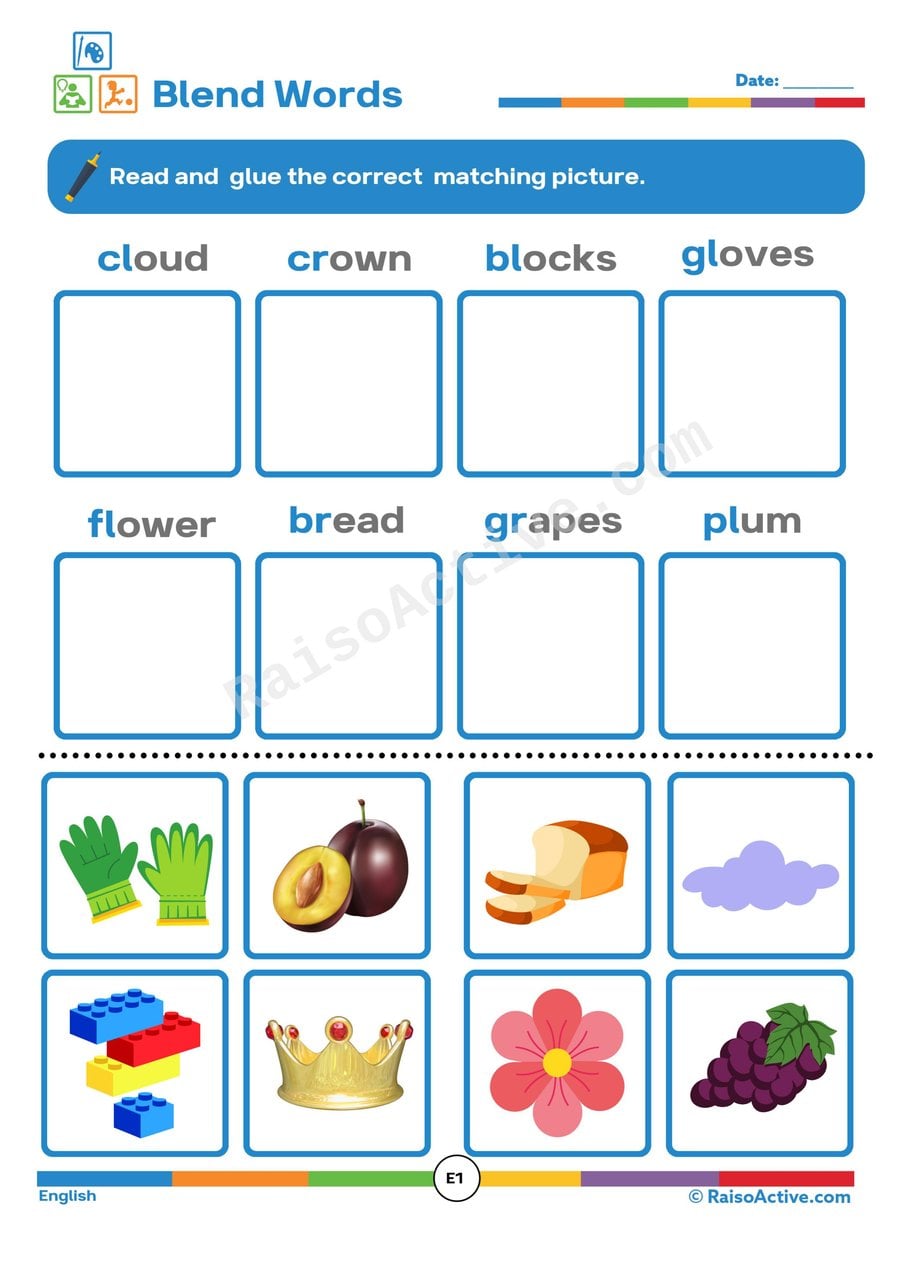
Blend Words Matching Worksheet for Preschoolers
Ages 4-5 · Pre-KAges 4-5 · ReceptionAges 4-5 · LKGAges 4-5
Children ages 4-5 practice reading consonant blend words — words that start with two consonant sounds blended together, like 'bl' or 'st' — and connecting them to the correct picture through a cut-and-paste matching activity. Blends are a step up in difficulty from single beginning sounds, since children must hear and produce two consonant sounds smoothly together, an important milestone on the way to more advanced phonics.

Keeping Our Environment Clean Worksheet for Kids
Ages 3-5 · Preschool–Pre-KAges 3-5 · Nursery–ReceptionAges 3-5 · Nursery–LKGAges 3-5
This worksheet builds early environmental awareness in children ages 3-5 by having them evaluate pictured actions — like throwing litter in a bin versus littering on the ground — and mark each one as good or bad for the environment. Making this judgment call requires children to connect a specific action to a broader consequence, an early form of cause-and-effect reasoning applied to environmental responsibility. Introducing this concept young helps normalize caring for shared spaces as a natural part of daily behavior rather than an abstract adult concern.
Guides for this topic

Documenting Learning Without Drowning in Data: A Practical Guide for Parents and Teachers
Learn practical ways to document your child's learning without overwhelm. Simple portfolios, observation tips, and printable trackers for ages 1-8.

When Should My Child Learn to Read? Is Kindergarten Too Early? A Complete Guide to Reading Readiness
Discover the research-backed optimal age for reading, key readiness signs, and why pushing too early can backfire. A complete guide for parents of children aged 3-8.
What Phonics Program Works Best for Homeschooling? A Complete Guide to Choosing the Right Approach
Compare top phonics programs for homeschooling — Jolly Phonics, Read Write Inc, Explode the Code — plus a DIY approach with worksheets. Find what works for your child.
Reviews
Every worksheet for ages 3–5, no watermark
Members download the full library of 1,000+ worksheets and every activity pack without watermarks or daily limits. One year costs ₹999 in India or $20 elsewhere.
See membership plansOr download any worksheet free with a watermark (5 a day).