Keeping Our Environment Clean Worksheet for Kids
This worksheet builds early environmental awareness in children ages 3-5 by having them evaluate pictured actions — like throwing litter in a bin versus littering on the ground — and mark each one as good or bad for the environment. Making this judgment call requires children to connect a specific action to a broader consequence, an early form of cause-and-effect reasoning applied to environmental responsibility. Introducing this concept young helps normalize caring for shared spaces as a natural part of daily behavior rather than an abstract adult concern.
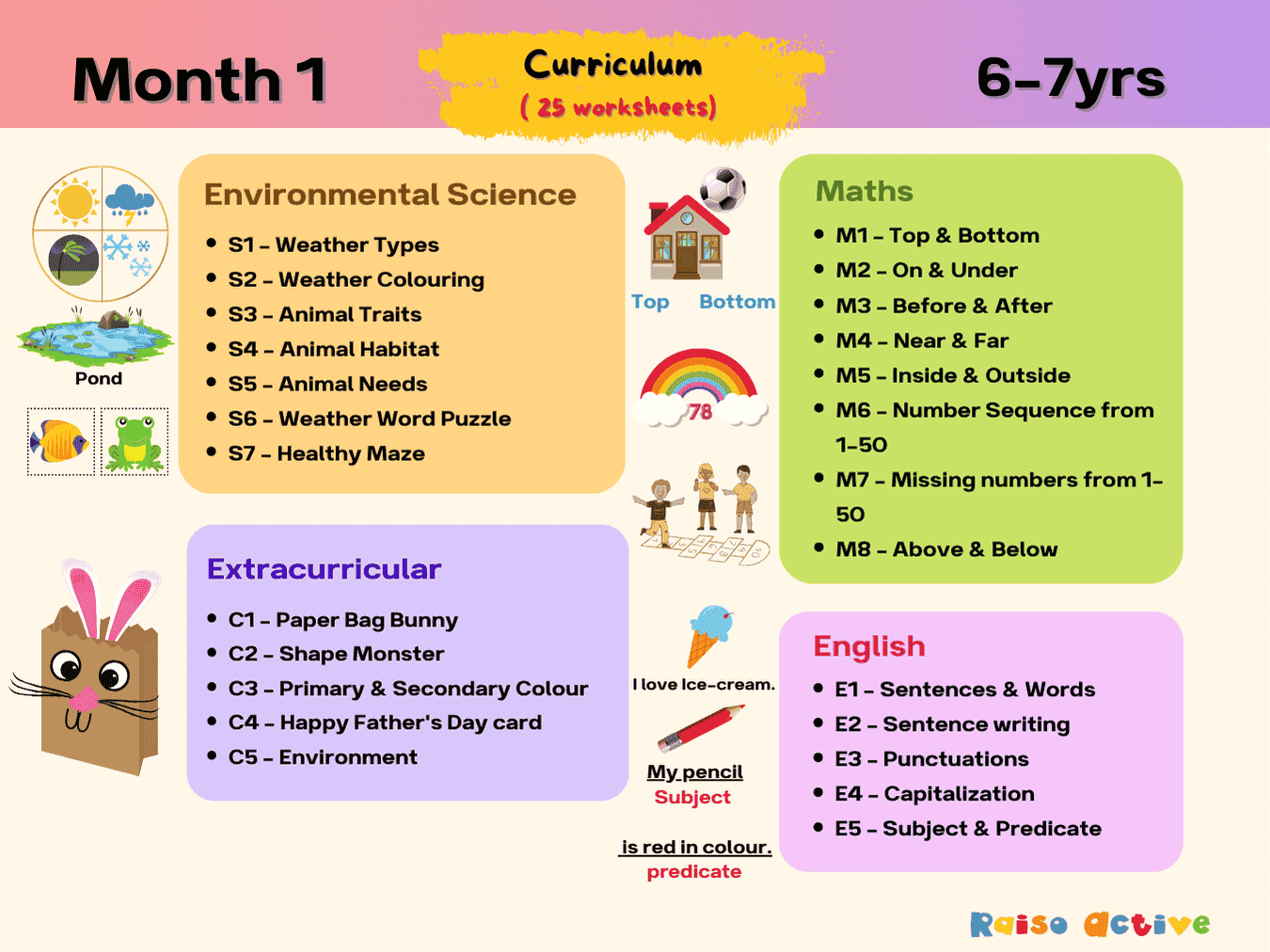
Part of the pack
Month 1: Learning & Development | Ages 6-7
This is page 28 of the pack. Ages 6-7 · Grade 1Ages 6-7 · Year 2Ages 6-7 · Class 1Ages 6-7
Made for your child
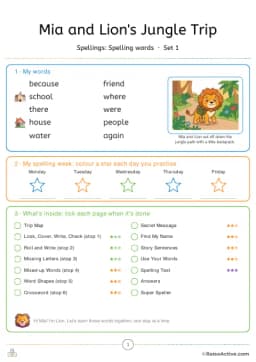
Spelling practice, made for your child
Their own spelling words turned into a pack: trace or look-cover-write-check, roll and write, a secret picture code, a word search, a crossword and a test, with their name in it.
Make a spelling packFree preview · free for members
Or start free: a word search with sight wordsCurriculum
- Earth & Environment > Environment Awareness
How to use this worksheet
Look at each picture together and read the accompanying statement describing the action shown. Ask your child whether the action helps keep the environment clean or makes it dirty. If it's a good action, have them tick the box; if it's a bad action, have them cross it out. Continue through the page, discussing what could be done differently for any 'bad action' pictures.
Materials needed
- Pencil
- Crayons
Extension activities
- 1Discuss other ways to keep the environment clean, like recycling or picking up litter on a walk.
- 2Draw pictures of clean environments, like a tidy park or a clean beach.
- 3Go on a short neighborhood cleanup walk, picking up litter with gloves and a bag.
- 4Sort household recycling together, talking about why sorting matters.
- 5Create a family pledge listing small actions everyone will do to help the environment.

Written by
Hemsweta Jain · Teacher Cheena
MBA and Early Childhood Educator, teaching since 2014 · Founder of RaisoActive, Mumbai
Every RaisoActive worksheet is designed and checked by the founder before publishing.
Published · Last reviewed
More from Month 1: Learning & Development | Ages 6-7

Inside or Outside Sorting Worksheet for Preschoolers
Ages 3-5 · Preschool–Pre-KAges 3-5 · Nursery–ReceptionAges 3-5 · Nursery–LKGAges 3-5
This worksheet teaches children ages 3-5 to apply the spatial concepts of 'inside' and 'outside' by sorting pictures of objects into the location where they typically belong. Deciding where an object usually belongs requires children to draw on their own real-world experience and apply it to a new sorting task, strengthening both spatial vocabulary and everyday reasoning. This kind of applied sorting is more demanding than simply naming inside or outside items when shown a single picture.

Color Mixing Fun: Primary and Secondary Colors Worksheet
Ages 3-5 · Preschool–Pre-KAges 3-5 · Nursery–ReceptionAges 3-5 · Nursery–LKGAges 3-5
This hands-on painting activity teaches children ages 3-5 the basics of color theory by having them paint the three primary colors first, then physically mix pairs of them to discover the secondary colors that result. Watching red and yellow blend into orange, or blue and yellow become green, right in front of them makes color mixing feel like a small science experiment rather than an abstract fact to memorize.
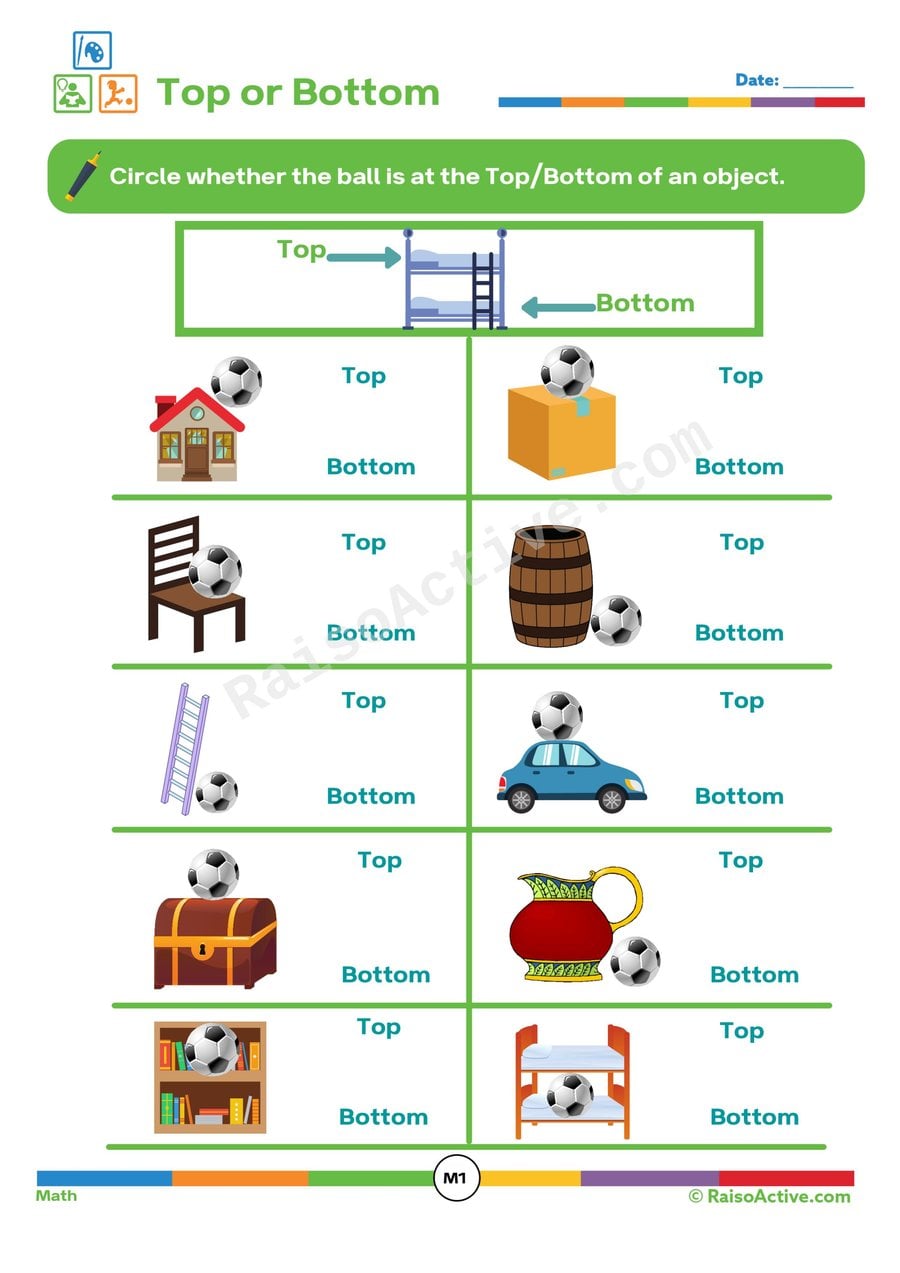
Top or Bottom? Fun Worksheet for Kids!
Ages 3-5 · Preschool–Pre-KAges 3-5 · Nursery–ReceptionAges 3-5 · Nursery–LKGAges 3-5
Deciding whether a ball is positioned at the top or bottom of another object teaches children ages 3-5 the spatial concepts of 'top' and 'bottom,' foundational positional vocabulary that supports later skills like reading a page from top to bottom or following multi-step directions. This worksheet asks children to look carefully at a picture and make a judgment about relative position, which strengthens visual-spatial reasoning alongside vocabulary development. Positional words like these are often first understood through pictures before children can reliably use them in their own speech.

Subject and Predicate Sorting Worksheet for Preschoolers
Ages 4-5 · Pre-KAges 4-5 · ReceptionAges 4-5 · LKGAges 4-5
This worksheet introduces children ages 4-5 to a basic building block of sentence grammar, teaching them that every sentence has a subject — who or what it's about — and a predicate — what that subject does or is. Sorting sentence fragments into these two categories helps children start to notice sentence structure, which supports both reading comprehension and their own sentence writing later on. This early grammar awareness lays groundwork for more formal sentence study in kindergarten and beyond.

Weather Color by Number Worksheet for Preschoolers
Ages 3-5 · Preschool–Pre-KAges 3-5 · Nursery–ReceptionAges 3-5 · Nursery–LKGAges 3-5
This color-by-number activity has children ages 3-5 practice matching numerals to a color key while completing a weather-themed picture, combining number recognition with color recognition and the fine motor control needed for careful, contained coloring. Because each numbered section must be colored correctly for the picture to look right, children get immediate visual feedback on whether their number identification was accurate. The weather theme also gives a natural opportunity to talk about the picture's subject once it's revealed.
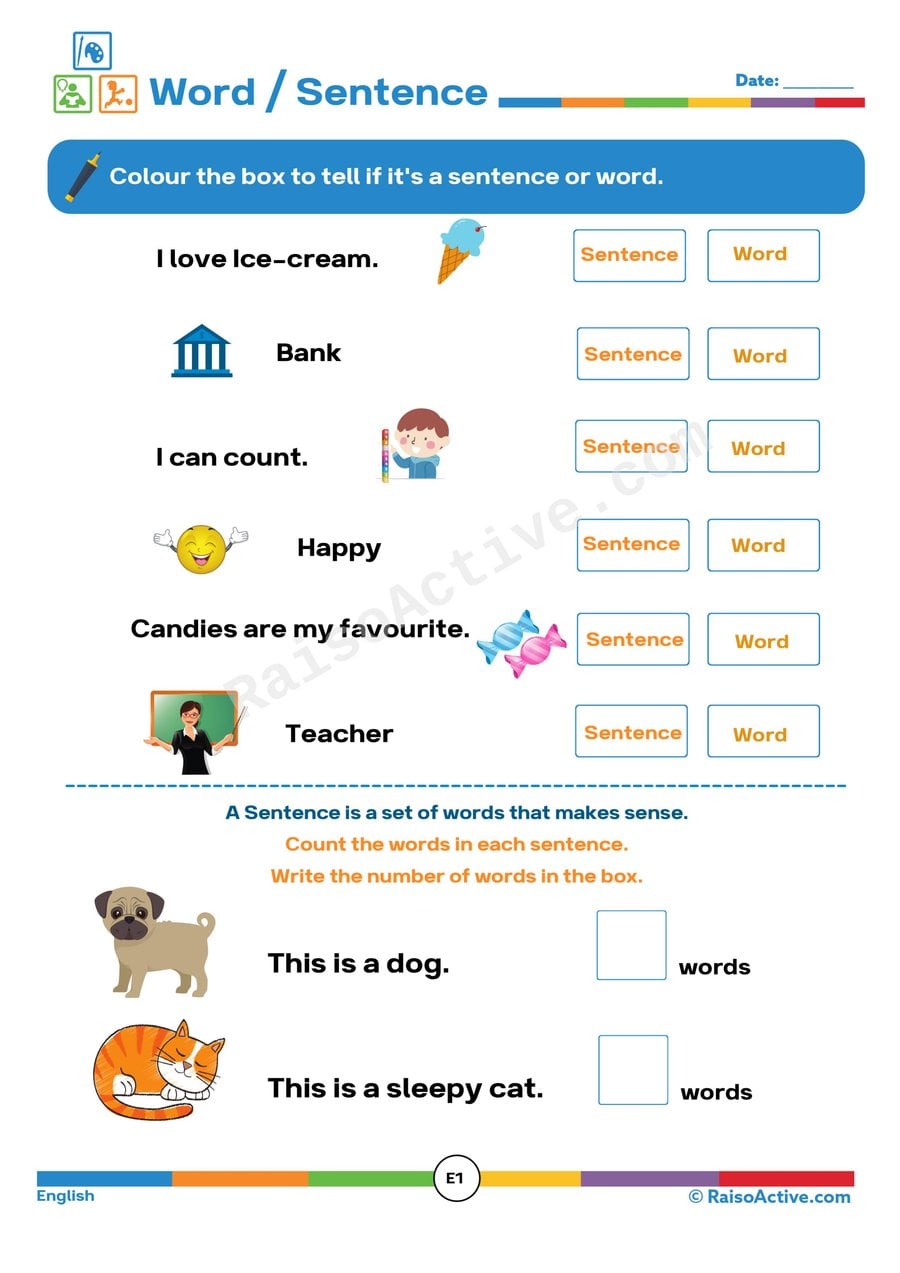
Month 1: Learning & Development | Ages 6-7 - Page 4
Ages 6-7 · Grade 1Ages 6-7 · Year 2Ages 6-7 · Class 1Ages 6-7
This overview page maps out everything covered in Month 1 of the ages 6-7 learning program, giving both children and parents a clear picture of what skills, from reading comprehension to number work to critical thinking, will be practiced across the month. Previewing a table of contents like this helps children ages 6-7 build early organizational awareness, understanding that learning happens in a structured sequence rather than as one-off, disconnected activities. Knowing what's coming also builds anticipation and motivation heading into each week's worksheets.

Paper Bag Bunny Craft Worksheet for Preschoolers
Ages 3-5 · Preschool–Pre-KAges 3-5 · Nursery–ReceptionAges 3-5 · Nursery–LKGAges 3-5
This paper bag craft has children ages 3-5 follow a multi-step sequence of instructions — attaching a pom pom nose, spoon ears, googly eyes, and whisker details — while practicing the fine motor control needed to place and glue small materials precisely. Because the craft uses several different textures and materials in one project, children also get sensory-rich practice beyond typical paper-and-crayon activities. Successfully completing each step in order builds confidence in following sequential, multi-part directions.

Capitalization Worksheet: Practice Writing Sentences Correctly!
Ages 4-6 · Pre-K–KindergartenAges 4-6 · Reception–Year 1Ages 4-6 · LKG–UKGAges 4-6
This worksheet teaches children ages 4-6 the rule that sentences begin with a capital letter, along with an introduction to capitalizing proper nouns like names and places. Rewriting sentences correctly, rather than just circling errors, gives children active practice applying the capitalization rule themselves, which builds the habit more effectively than passive correction exercises.
Related worksheets

Family Relations Worksheet: Learn About Family Members!
Ages 3-5 · Preschool–Pre-KAges 3-5 · Nursery–ReceptionAges 3-5 · Nursery–LKGAges 3-5
Writing the correct family member name next to each person on a family tree helps children ages 3-5 understand family relationships and structure, connecting a written word to a specific role like mother, father, or sibling. This early exposure to family trees also introduces the idea of organizing information visually, a skill used across many later school subjects.

My Family Worksheet: Learn About Family Members!
Ages 3-5 · Preschool–Pre-KAges 3-5 · Nursery–ReceptionAges 3-5 · Nursery–LKGAges 3-5
Writing the names of family members next to their pictures helps children ages 3-5 connect written words to real relationships in their own lives, combining early handwriting practice with meaningful, personal vocabulary. Because the content is about their own family, this worksheet tends to feel especially engaging and easy to talk about.

My School Cut and Paste Worksheet for Preschoolers
Ages 3-5 · Preschool–Pre-KAges 3-5 · Nursery–ReceptionAges 3-5 · Nursery–LKGAges 3-5
Cutting out school-related pictures and pasting them into the correct spaces on a school building teaches children ages 3-5 vocabulary for familiar school spaces, like a classroom or playground, while also strengthening spatial matching and fine motor cutting and pasting skills. This activity helps children who are new to school, or preparing to start, connect words to places they'll actually encounter.
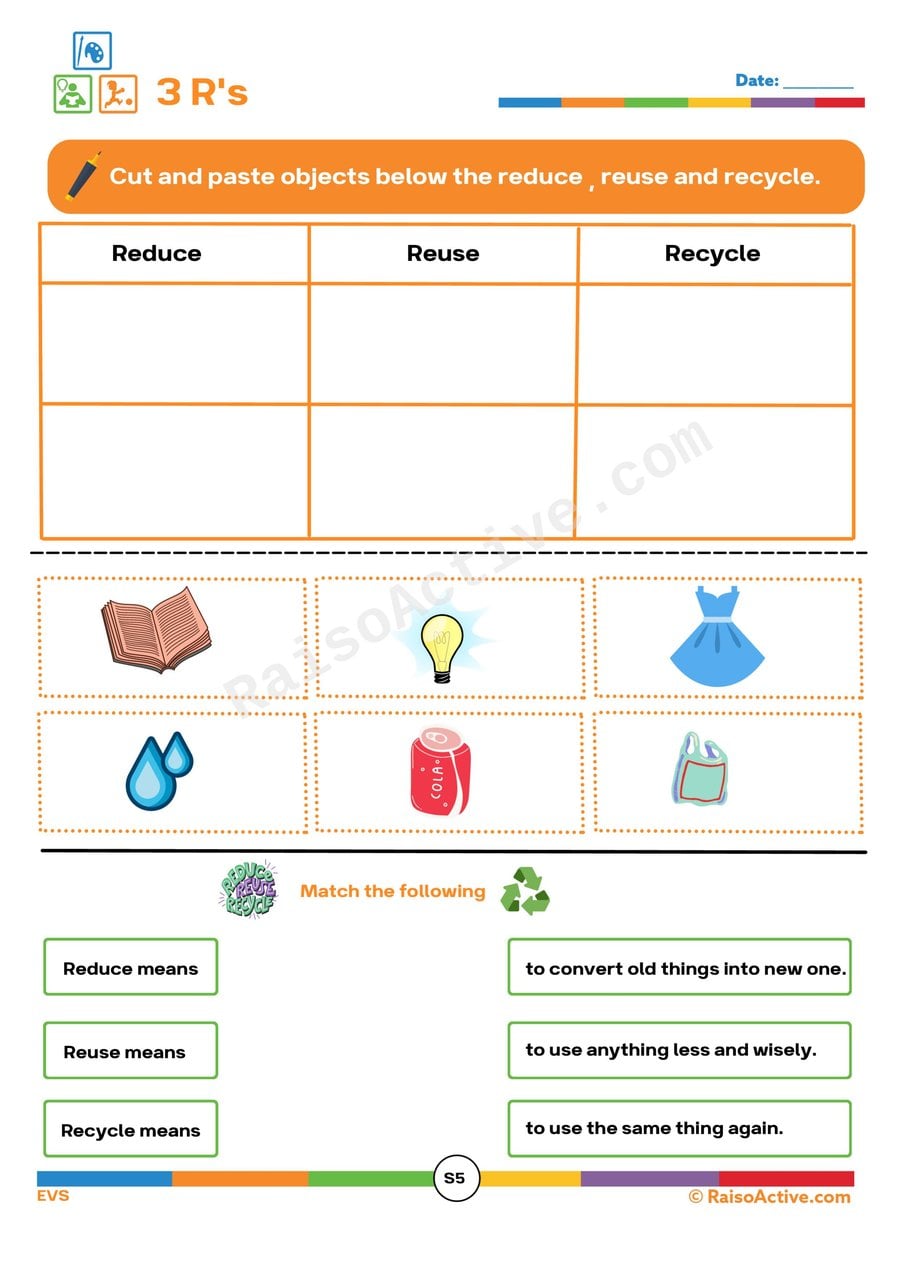
Reduce, Reuse, Recycle Worksheet for Kids
Ages 4-6 · Pre-K–KindergartenAges 4-6 · Reception–Year 1Ages 4-6 · LKG–UKGAges 4-6
Children ages 4-6 learn the three pillars of environmental responsibility — reduce, reuse, and recycle — by sorting pictures of everyday items into the correct category and matching each term to its definition. This worksheet builds early environmental literacy and categorical thinking, asking children to consider not just what an item is, but what should happen to it once it's no longer needed. It's a concrete entry point into sustainability concepts that will expand in later grades.
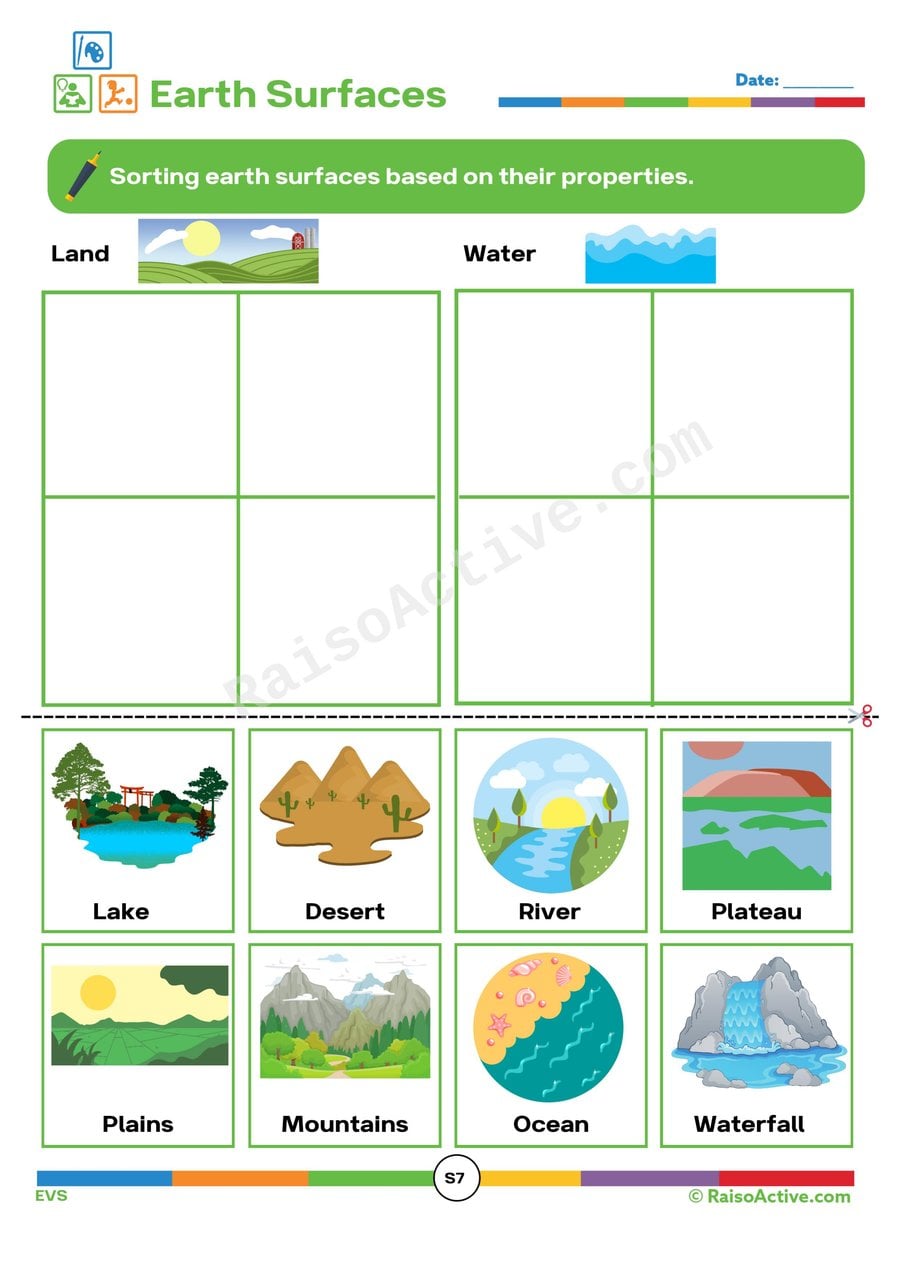
Earth Surfaces Sorting Worksheet for Kids
Ages 4-6 · Pre-K–KindergartenAges 4-6 · Reception–Year 1Ages 4-6 · LKG–UKGAges 4-6
Sorting pictures into 'land' and 'water' categories builds early classification skills and basic earth science vocabulary for children ages 4-6, helping them notice physical differences between surfaces they see in daily life.
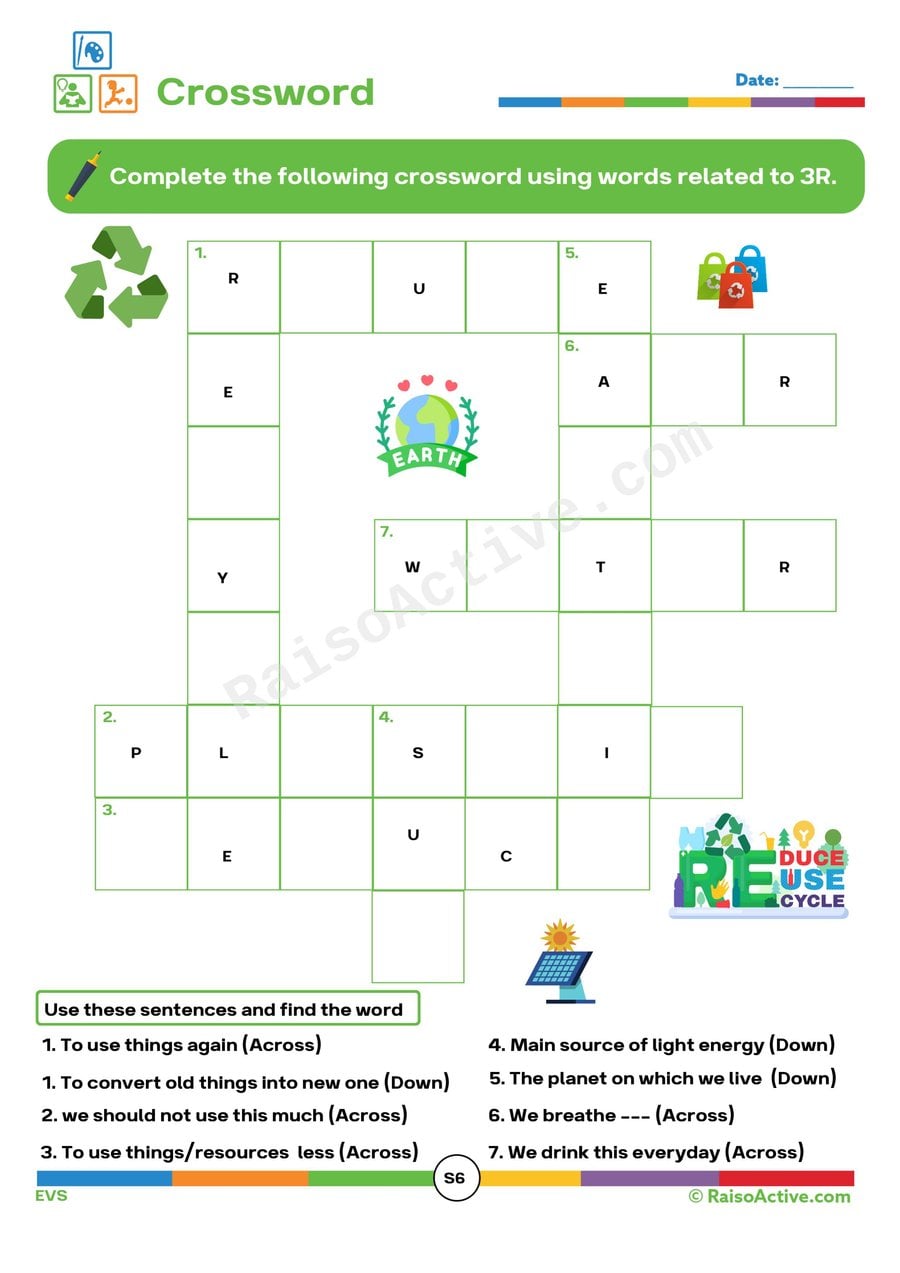
3R Crossword Puzzle Worksheet for Kids
Ages 4-6 · Pre-K–KindergartenAges 4-6 · Reception–Year 1Ages 4-6 · LKG–UKGAges 4-6
This crossword puzzle challenges children ages 4-6 to connect vocabulary about reducing, reusing, and recycling to its written spelling, reinforcing environmental concepts through reading and word-building rather than picture matching alone. Using clues to determine the correct word and then filling in letter boxes practices phonics, spelling, and logical deduction together, since letters that cross with other answers must match on both words.

Earth Day Sorting Worksheet: Good vs. Bad for the Environment!
Ages 4-6 · Pre-K–KindergartenAges 4-6 · Reception–Year 1Ages 4-6 · LKG–UKGAges 4-6
Sorting pictures of everyday actions into 'good for the environment' and 'bad for the environment' introduces children ages 4-6 to cause-and-effect reasoning about human impact, an early building block for environmental awareness and responsible habits.
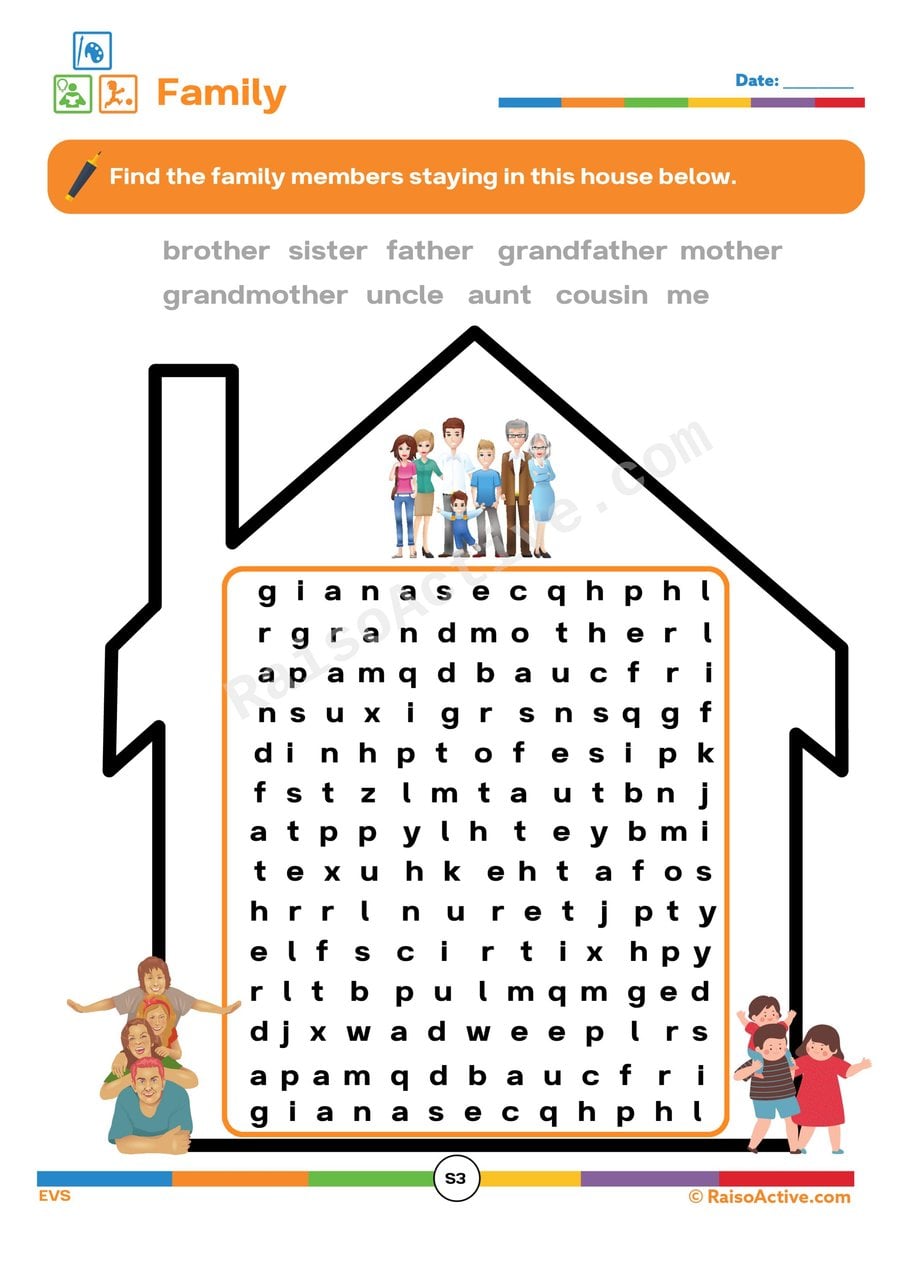
Family Word Search Worksheet for Kids
Ages 4-6 · Pre-K–KindergartenAges 4-6 · Reception–Year 1Ages 4-6 · LKG–UKGAges 4-6
Searching a grid for hidden family member words like mother, father, and sister builds vocabulary and visual scanning skills for children ages 4-6, requiring them to track letters carefully across rows, columns, and sometimes diagonals. This kind of focused letter tracking is excellent early practice for the visual attention reading fluency depends on later.
Guides for this topic

Documenting Learning Without Drowning in Data: A Practical Guide for Parents and Teachers
Learn practical ways to document your child's learning without overwhelm. Simple portfolios, observation tips, and printable trackers for ages 1-8.

Age-Appropriate Problem-Solving Activities: Building Critical Thinkers from the Ground Up
Discover fun, age-appropriate problem-solving activities for children ages 1-8. Build critical thinking, logic, and reasoning skills through play-based learning.
Critical Thinking Activities That Actually Work for Young Children: Building Tomorrow's Thinkers Today
Discover proven critical thinking activities for young children. Age-wise logic games, questioning techniques, and hands-on ideas to build thinking skills at home.
Reviews
Every worksheet for ages 3–5, no watermark
Members download the full library of 1,000+ worksheets and every activity pack without watermarks or daily limits. One year costs ₹999 in India or $20 elsewhere.
See membership plansOr download any worksheet free with a watermark (5 a day).