Subject and Predicate Sorting Worksheet for Preschoolers
This worksheet introduces children ages 4-5 to a basic building block of sentence grammar, teaching them that every sentence has a subject — who or what it's about — and a predicate — what that subject does or is. Sorting sentence fragments into these two categories helps children start to notice sentence structure, which supports both reading comprehension and their own sentence writing later on. This early grammar awareness lays groundwork for more formal sentence study in kindergarten and beyond.
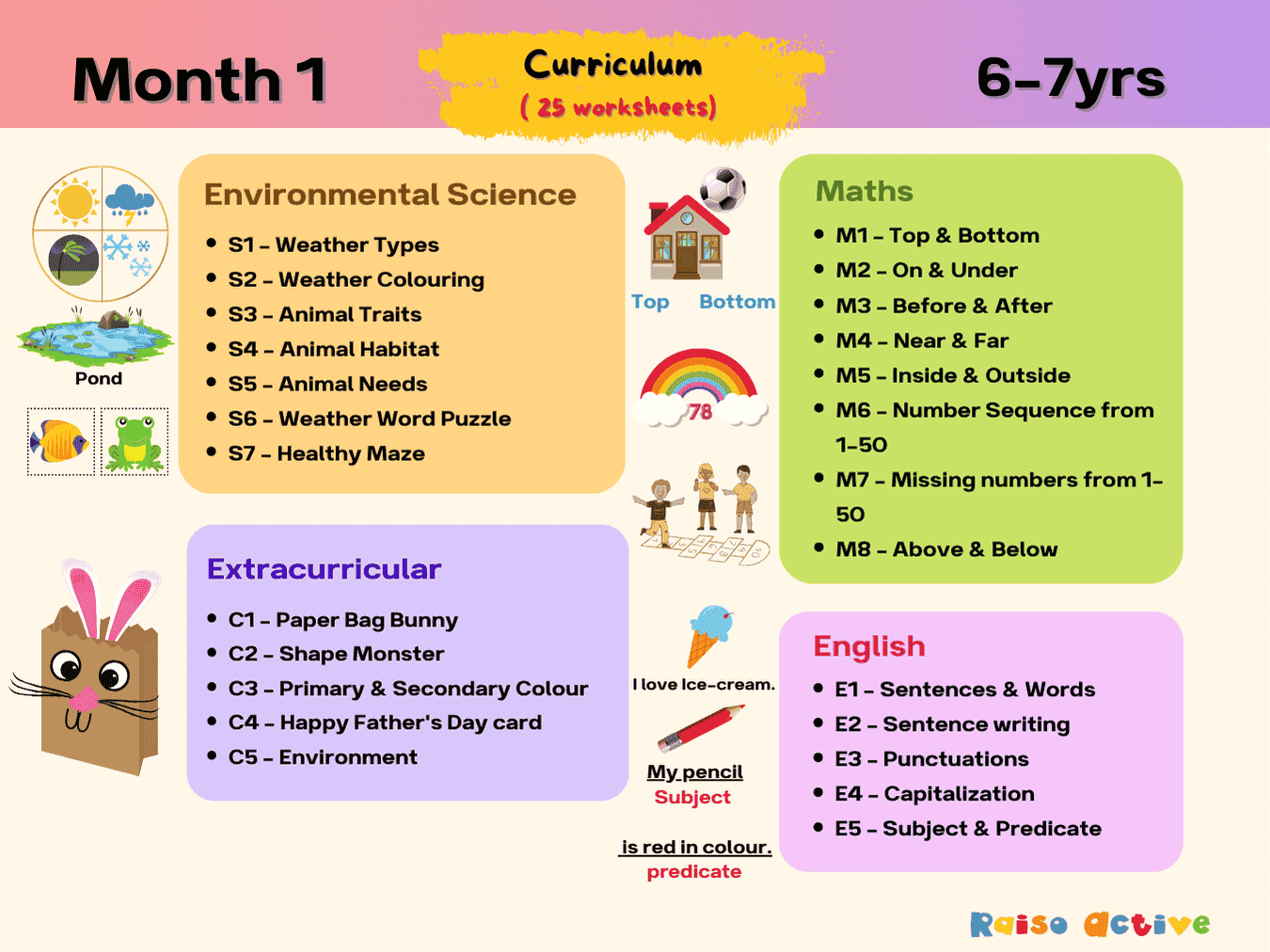
Part of the pack
Month 1: Learning & Development | Ages 6-7
This is page 8 of the pack. Ages 6-7 · Grade 1Ages 6-7 · Year 2Ages 6-7 · Class 1Ages 6-7
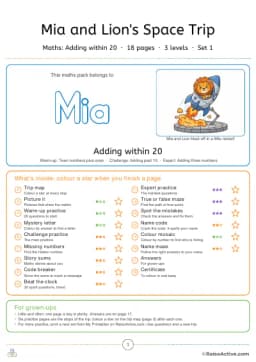
Made for your child
Numbers to 20, made for your child
A maths pack with your child's name in it: pictures that explain, practice at three levels, puzzles and story sums about them. Print a new set whenever they finish.
Make a maths packFree preview · free for members
Curriculum
- Grammar > Nouns & Grammar
How to use this worksheet
Read a complete example sentence together and point out which part tells who or what it's about, and which part tells what that subject is doing. Have your child cut out the sentence-part boxes from the bottom of the page using child-safe scissors. For each cut-out piece, read it aloud together and decide whether it's a subject or a predicate before gluing it into the correct column. Once every piece is sorted, read a few subject-predicate pairs back together to hear them as complete sentences.
Materials needed
- Scissors
- Glue
- Pencil
Extension activities
- 1Create your own sentences, identifying the subject and predicate.
- 2Draw a picture to match one of the sentences.
- 3Play a mix-and-match game, combining different subject and predicate cards to make silly new sentences.
- 4Point out the subject and predicate in a sentence from a favorite picture book.
- 5Take turns saying a subject aloud and having the other person add a matching predicate.

Written by
Hemsweta Jain · Teacher Cheena
MBA and Early Childhood Educator, teaching since 2014 · Founder of RaisoActive, Mumbai
Every RaisoActive worksheet is designed and checked by the founder before publishing.
Published · Last reviewed
More from Month 1: Learning & Development | Ages 6-7

Capitalization Worksheet: Practice Writing Sentences Correctly!
Ages 4-6 · Pre-K–KindergartenAges 4-6 · Reception–Year 1Ages 4-6 · LKG–UKGAges 4-6
This worksheet teaches children ages 4-6 the rule that sentences begin with a capital letter, along with an introduction to capitalizing proper nouns like names and places. Rewriting sentences correctly, rather than just circling errors, gives children active practice applying the capitalization rule themselves, which builds the habit more effectively than passive correction exercises.

Animal Action Cards: Fun Movement Worksheet for Kids!
Ages 3-5 · Preschool–Pre-KAges 3-5 · Nursery–ReceptionAges 3-5 · Nursery–LKGAges 3-5
These animal action cards get children ages 3-5 moving as they follow simple instructions, like hopping like a rabbit or slithering like a snake, combining gross motor development with listening and instruction-following skills. Because each card requires reading or recalling a specific action tied to a specific animal, children also reinforce animal vocabulary and movement-based descriptive language. Turning learning into physical movement is especially valuable for this age group, whose attention and retention often improve dramatically when a body movement is involved.

Hopscotch Numbers 1-50 Worksheet: Fill in the Missing Numbers!
Ages 4-6 · Pre-K–KindergartenAges 4-6 · Reception–Year 1Ages 4-6 · LKG–UKGAges 4-6
This hopscotch-themed worksheet gives children ages 4-6 practice filling in missing numbers within the 1-50 range, extending their number sequencing beyond the more commonly rehearsed 1-20 range and building familiarity with two-digit number patterns like the '20s' or '30s.' Framing the numbers as a hopscotch grid connects the paper activity to a familiar physical game, helping children mentally picture themselves counting forward as they move up the grid. This kind of extended-range practice is an important bridge toward comfortable counting to 100.

Healthy Maze Worksheet for Kids: Help the Girl Find Healthy Food!
Ages 3-5 · Preschool–Pre-KAges 3-5 · Nursery–ReceptionAges 3-5 · Nursery–LKGAges 3-5
This maze worksheet combines fine motor path-tracing with healthy-eating awareness for children ages 3-5, as they guide a character through a maze while avoiding unhealthy food obstacles to reach a healthy treat. Embedding a decision-making theme into the maze, rather than a neutral path, gives children a reason to think about food choices while also practicing visual scanning and planning. This combination makes an abstract nutrition lesson feel like part of a fun, goal-directed game.

Handprint Father's Day Card Craft Worksheet for Kids
Ages 3-5 · Preschool–Pre-KAges 3-5 · Nursery–ReceptionAges 3-5 · Nursery–LKGAges 3-5
Painting a handprint and turning it into a Father's Day card gives children ages 3-5 a sensory, hands-on art experience while also creating a lasting keepsake that captures their current hand size. Writing or dictating a message for dad afterward adds an early writing or storytelling component, helping children practice expressing appreciation and affection in words. This project blends fine motor and sensory play with an emotional, relationship-building purpose that goes beyond typical coloring practice.
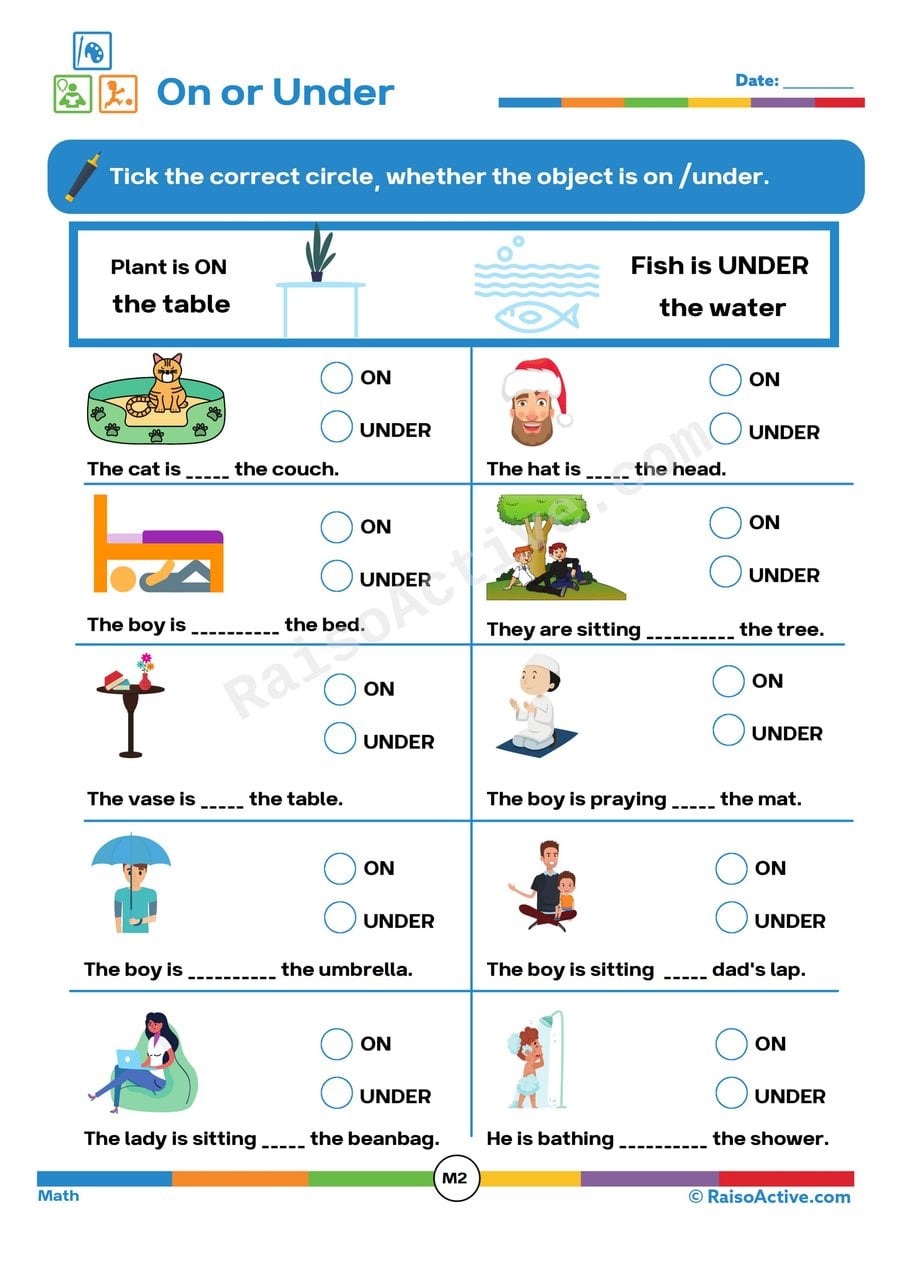
On or Under Worksheet: Where is the Object?
Ages 3-5 · Preschool–Pre-KAges 3-5 · Nursery–ReceptionAges 3-5 · Nursery–LKGAges 3-5
Reading a short sentence describing an object's location and then ticking the picture that matches teaches children ages 3-5 to connect spoken or written prepositions, 'on' and 'under,' to a visual representation, strengthening both listening comprehension and spatial vocabulary. This worksheet requires children to hold a sentence in mind and compare it against a picture, which is a slightly more advanced skill than simply naming a position they can already see. Understanding prepositions like these supports later reading comprehension, since so many simple stories depend on describing where things are.

Animal Needs Worksheet for Kids: Matching and Identifying
Ages 3-5 · Preschool–Pre-KAges 3-5 · Nursery–ReceptionAges 3-5 · Nursery–LKGAges 3-5
This worksheet helps children ages 3-5 understand and articulate the basic survival needs of animals — food, water, air, shelter — by completing sentences with the correct need word and then circling matching pictures. Requiring both a writing and a circling response means children practice the vocabulary in two different formats, reinforcing recall from multiple angles. This groundwork in animal needs also supports later, more complex science concepts about habitats and ecosystems.
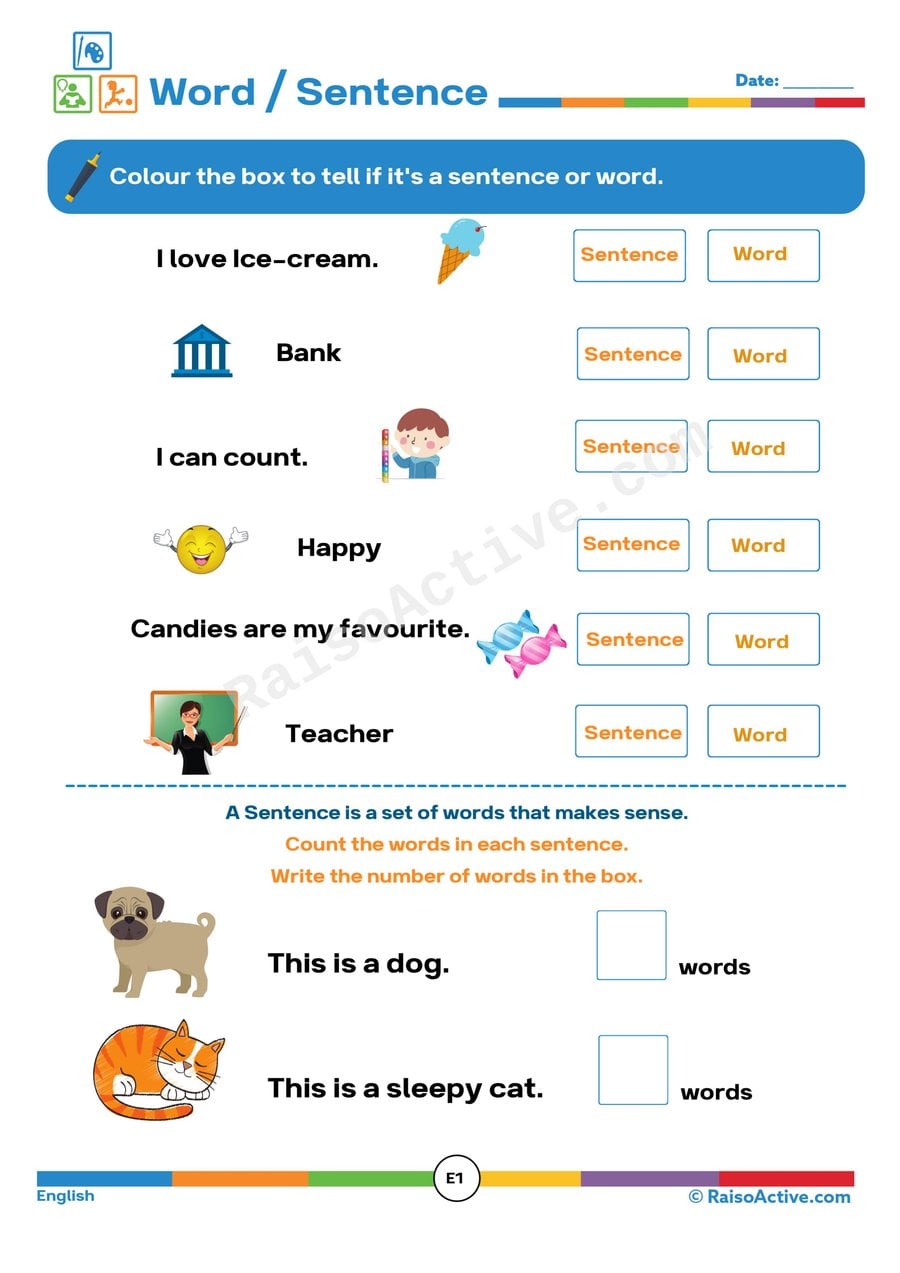
Month 1: Learning & Development | Ages 6-7 - Page 4
Ages 6-7 · Grade 1Ages 6-7 · Year 2Ages 6-7 · Class 1Ages 6-7
This overview page maps out everything covered in Month 1 of the ages 6-7 learning program, giving both children and parents a clear picture of what skills, from reading comprehension to number work to critical thinking, will be practiced across the month. Previewing a table of contents like this helps children ages 6-7 build early organizational awareness, understanding that learning happens in a structured sequence rather than as one-off, disconnected activities. Knowing what's coming also builds anticipation and motivation heading into each week's worksheets.
Related worksheets

Noun, Pronoun, or Adjective? Match the Words! Worksheet for Kids
Ages 4-6 · Pre-K–KindergartenAges 4-6 · Reception–Year 1Ages 4-6 · LKG–UKGAges 4-6
This worksheet introduces children ages 4-6 to three foundational parts of speech — nouns, pronouns, and adjectives — by asking them to sort individual words into the correct grammatical category. Learning to tell these word types apart early gives children a vocabulary for talking about language itself, which supports both reading comprehension and their own sentence writing later on. Matching words to pictures also keeps an abstract grammar concept grounded in something concrete and visual.

A and The Worksheet: Practice with Nouns and Articles
Ages 3-5 · Preschool–Pre-KAges 3-5 · Nursery–ReceptionAges 3-5 · Nursery–LKGAges 3-5
Choosing between the articles 'a' and 'the' before a noun builds early grammar awareness for children ages 3-5, helping them notice a small but important word choice that changes how a sentence sounds and reads.
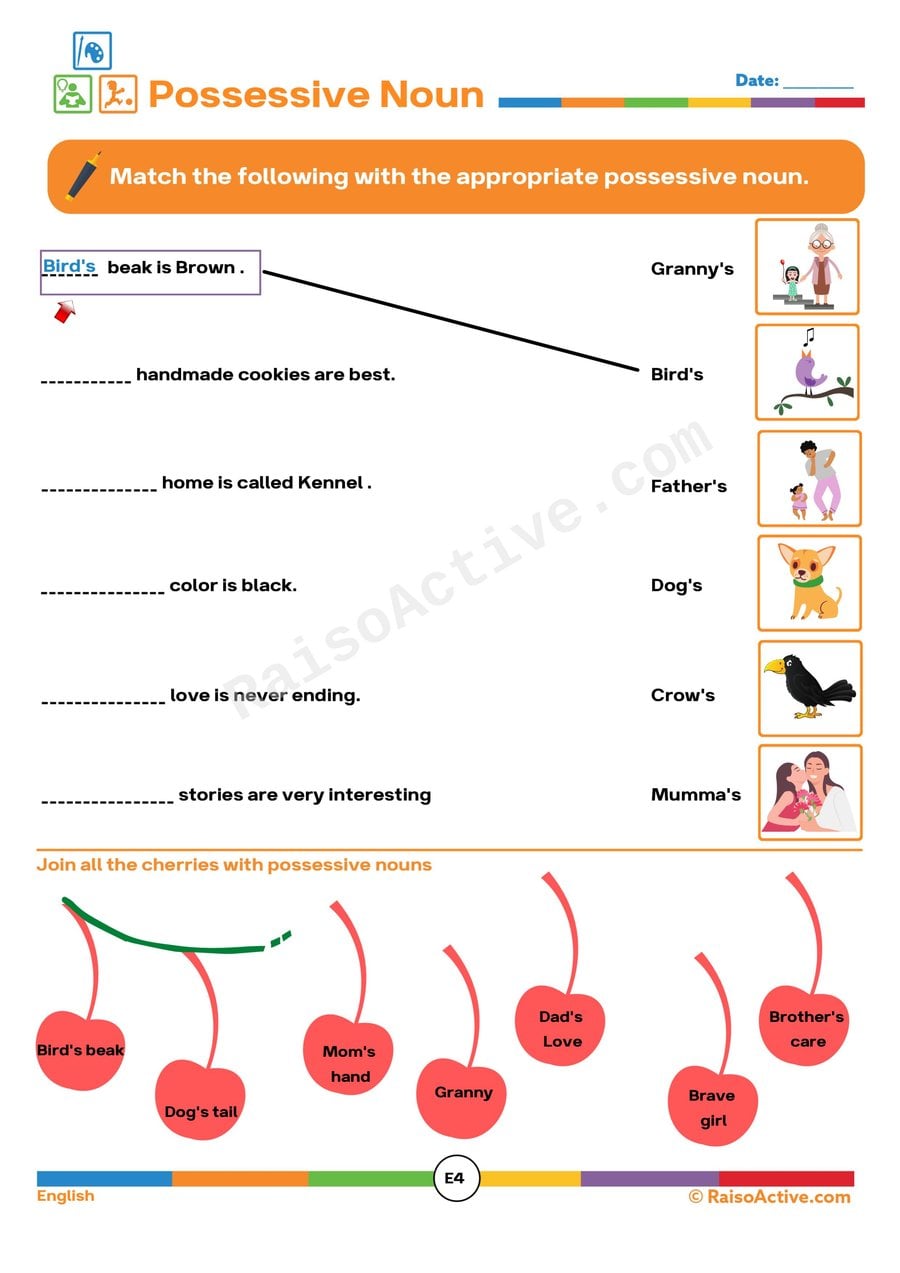
Possessive Noun Matching Worksheet for Kids
Ages 4-6 · Pre-K–KindergartenAges 4-6 · Reception–Year 1Ages 4-6 · LKG–UKGAges 4-6
Children ages 4-6 learn to identify possessive nouns, like 'the dog's bone' or 'Mia's book', which show ownership using an apostrophe and 's'. Matching possessive phrases to their meaning builds early grammar awareness that will later support correct sentence writing and reading comprehension. The cherry-connecting activity adds a playful visual-tracking layer to reinforce the matching skill.

Parent's Guide: Learning Pronouns, Place Value, and More!
Ages 4-6 · Pre-K–KindergartenAges 4-6 · Reception–Year 1Ages 4-6 · LKG–UKGAges 4-6
This parent's guide brings together pronoun flashcards, tens-and-ones block arranging, family tree drawing, and a simple taste exploration, giving children ages 4-6 varied practice across grammar, place value, and sensory vocabulary in one flexible session. Because each section targets a different skill, the guide lets you follow whatever your child is most curious about that day.

Parent's Guide: Nouns, Pronouns, and Energy Exploration!
Ages 3-5 · Preschool–Pre-KAges 3-5 · Nursery–ReceptionAges 3-5 · Nursery–LKGAges 3-5
This parent guide bundles together two very different early-learning areas — basic grammar concepts like nouns and pronouns, and an introduction to energy sources — giving children ages 3-5 a varied set of short activities rather than one long worksheet. Identifying pronouns builds early grammatical awareness, helping children notice that words like 'he,' 'she,' and 'it' stand in for names they already know. The energy exploration section introduces very early science vocabulary by asking children to notice which everyday objects use energy, connecting an abstract concept to familiar household items.
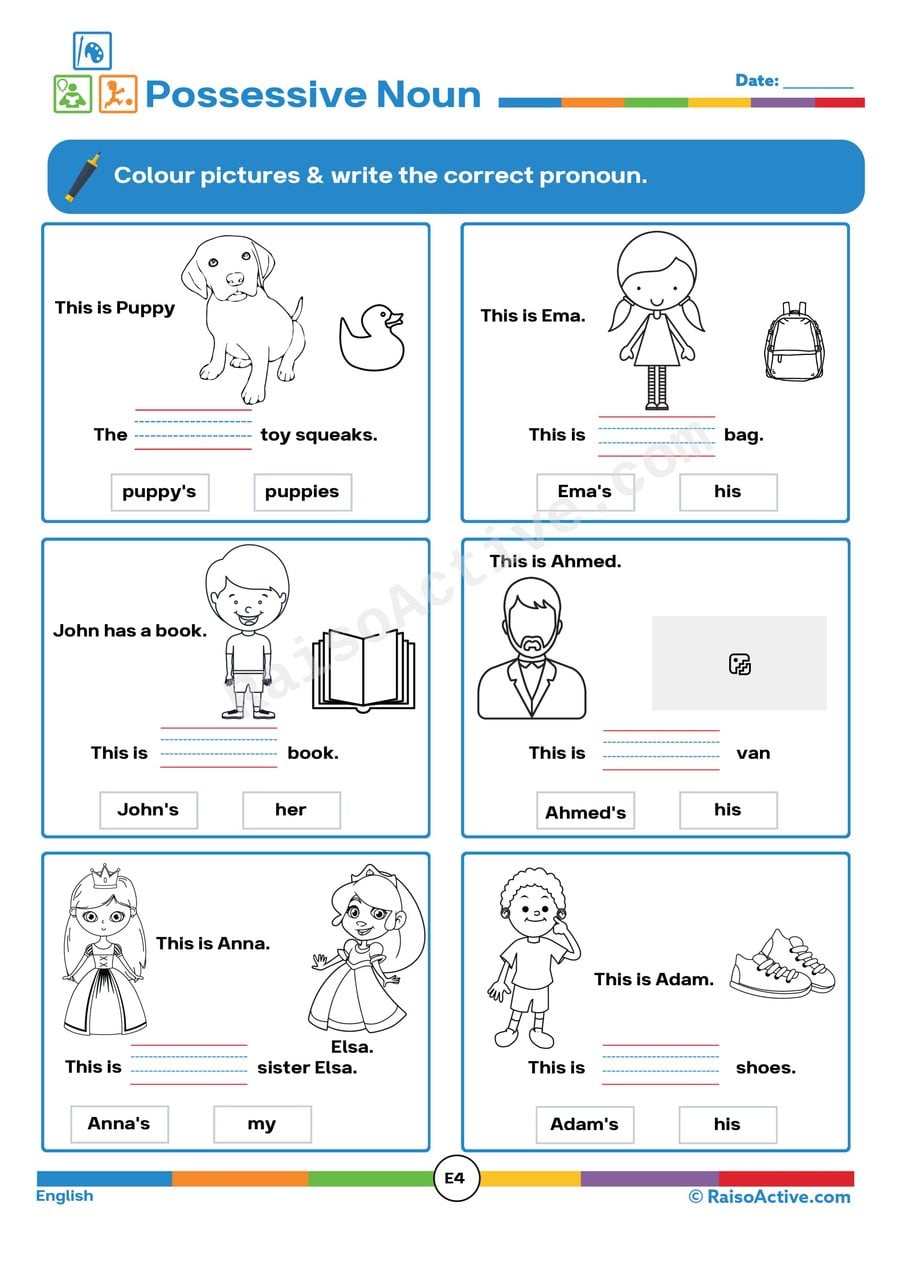
Possessive Nouns Worksheet: Color and Write!
Ages 4-6 · Pre-K–KindergartenAges 4-6 · Reception–Year 1Ages 4-6 · LKG–UKGAges 4-6
Children ages 4-6 practice forming possessive nouns, learning to add an apostrophe and 's' to show that something belongs to someone, like 'the dog's bone.' This is a specific grammar rule that children will use constantly once they start writing about ownership in their own sentences.

Possessive Noun Worksheet: Practice with Examples!
Ages 4-6 · Pre-K–KindergartenAges 4-6 · Reception–Year 1Ages 4-6 · LKG–UKGAges 4-6
Possessive nouns, words like 'the dog's bone' that show ownership, introduce children to how a small change, adding an apostrophe and 's', shifts the meaning of a whole sentence, an early lesson in how grammar carries specific information. For ages four to six, recognizing possession in sentences also supports reading comprehension, since misunderstanding who owns what can confuse the meaning of a story.

Proper Noun Practice Worksheet for Early Learners
Ages 4-6 · Pre-K–KindergartenAges 4-6 · Reception–Year 1Ages 4-6 · LKG–UKGAges 4-6
This worksheet introduces children ages 4-6 to the concept of proper nouns — specific names for people, places, or things — by having them choose or write the correct proper noun to complete each sentence. Understanding the difference between a general word like 'city' and a specific name like 'Mumbai' is an early grammar concept that also supports capitalization rules children will need once they start writing independently.
Guides for this topic

Documenting Learning Without Drowning in Data: A Practical Guide for Parents and Teachers
Learn practical ways to document your child's learning without overwhelm. Simple portfolios, observation tips, and printable trackers for ages 1-8.

Age-Appropriate Problem-Solving Activities: Building Critical Thinkers from the Ground Up
Discover fun, age-appropriate problem-solving activities for children ages 1-8. Build critical thinking, logic, and reasoning skills through play-based learning.

Montessori Activities for 3-4 Year Olds: A Complete Guide to Purposeful Learning
Discover practical Montessori activities for 3-4 year olds — practical life, sensorial, language, and maths — with Indian kitchen adaptations and budget shelf ideas.
Reviews
Every worksheet for ages 4–5, no watermark
Members download the full library of 1,000+ worksheets and every activity pack without watermarks or daily limits. One year costs ₹999 in India or $20 elsewhere.
See membership plansOr download any worksheet free with a watermark (5 a day).