Healthy Maze Worksheet for Kids: Help the Girl Find Healthy Food!
This maze worksheet combines fine motor path-tracing with healthy-eating awareness for children ages 3-5, as they guide a character through a maze while avoiding unhealthy food obstacles to reach a healthy treat. Embedding a decision-making theme into the maze, rather than a neutral path, gives children a reason to think about food choices while also practicing visual scanning and planning. This combination makes an abstract nutrition lesson feel like part of a fun, goal-directed game.
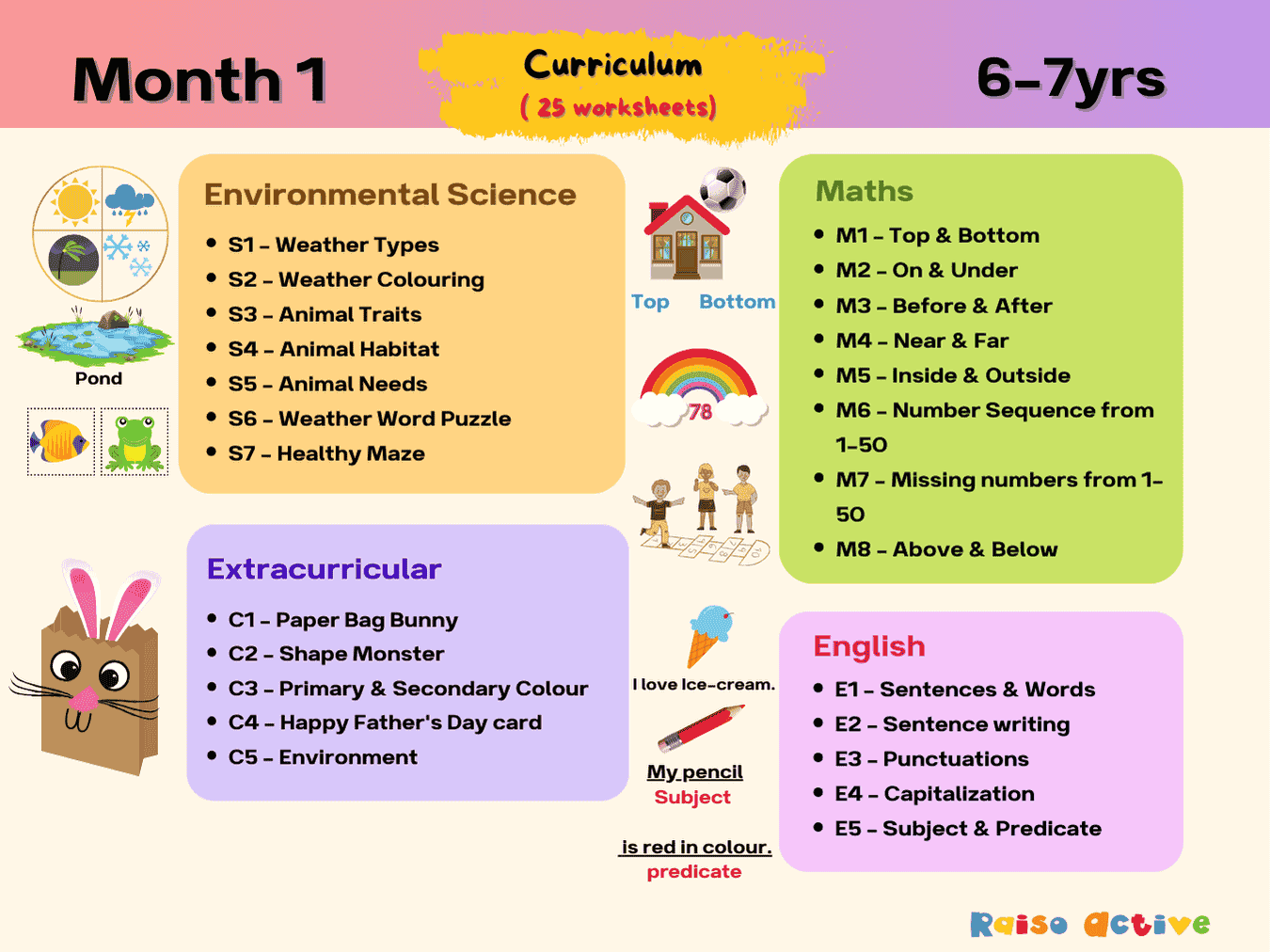
Part of the pack
Month 1: Learning & Development | Ages 6-7
This is page 23 of the pack. Ages 6-7 · Grade 1Ages 6-7 · Year 2Ages 6-7 · Class 1Ages 6-7
Curriculum
- Health & Hygiene > Healthy Eating
How to use this worksheet
Point out the girl at the start of the maze and the healthy food waiting at the end. Have your child trace a path with their finger first, noticing which foods along the way look unhealthy so they can be avoided. Once a good path is found, hand them a pencil and have them trace the final route from start to finish, staying within the maze lines. As they trace, ask them to name the healthy and unhealthy foods they pass along the way.
Materials needed
- Pencil
- Crayons
Extension activities
- 1Discuss different types of healthy foods.
- 2Draw their own healthy meal.
- 3Make a healthy snack together, like a fruit skewer, after finishing the maze.
- 4Play a 'healthy or not' sorting game with pictures cut from a grocery flyer.
- 5Create a simple new maze together using healthy foods as the goal at the end.

Written by
Hemsweta Jain · Teacher Cheena
MBA and Early Childhood Educator, teaching since 2014 · Founder of RaisoActive, Mumbai
Every RaisoActive worksheet is designed and checked by the founder before publishing.
Published · Last reviewed
More from Month 1: Learning & Development | Ages 6-7

Before and After Numbers Worksheet for Preschoolers
Ages 4-6 · Pre-K–KindergartenAges 4-6 · Reception–Year 1Ages 4-6 · LKG–UKGAges 4-6
This number sequencing worksheet asks children ages 4-6 to identify the numbers that come immediately before and after a given number, strengthening their mental number line and reinforcing the concept that numbers exist in a fixed, ordered sequence. This before-and-after reasoning is more demanding than simple counting because it requires children to move both forward and backward from a starting point. Building this flexible number sense supports later addition and subtraction, which both rely on moving confidently along a mental number line.

Weather Color by Number Worksheet for Preschoolers
Ages 3-5 · Preschool–Pre-KAges 3-5 · Nursery–ReceptionAges 3-5 · Nursery–LKGAges 3-5
This color-by-number activity has children ages 3-5 practice matching numerals to a color key while completing a weather-themed picture, combining number recognition with color recognition and the fine motor control needed for careful, contained coloring. Because each numbered section must be colored correctly for the picture to look right, children get immediate visual feedback on whether their number identification was accurate. The weather theme also gives a natural opportunity to talk about the picture's subject once it's revealed.

My Name is: Sentence Building Worksheet for Early Learners
Ages 3-5 · Preschool–Pre-KAges 3-5 · Nursery–ReceptionAges 3-5 · Nursery–LKGAges 3-5
This sentence-building activity asks children ages 3-5 to cut apart puzzle pieces of words and arrange them in the correct order to form a complete sentence, giving hands-on practice with sentence structure before they write full sentences independently. Physically manipulating word pieces lets children experiment with word order and self-correct by reading the sentence aloud, which is more forgiving than committing straight to writing. Copying the assembled sentence onto lines afterward then bridges the gap from arranging words to writing them from scratch.

Keeping Our Environment Clean Worksheet for Kids
Ages 3-5 · Preschool–Pre-KAges 3-5 · Nursery–ReceptionAges 3-5 · Nursery–LKGAges 3-5
This worksheet builds early environmental awareness in children ages 3-5 by having them evaluate pictured actions — like throwing litter in a bin versus littering on the ground — and mark each one as good or bad for the environment. Making this judgment call requires children to connect a specific action to a broader consequence, an early form of cause-and-effect reasoning applied to environmental responsibility. Introducing this concept young helps normalize caring for shared spaces as a natural part of daily behavior rather than an abstract adult concern.
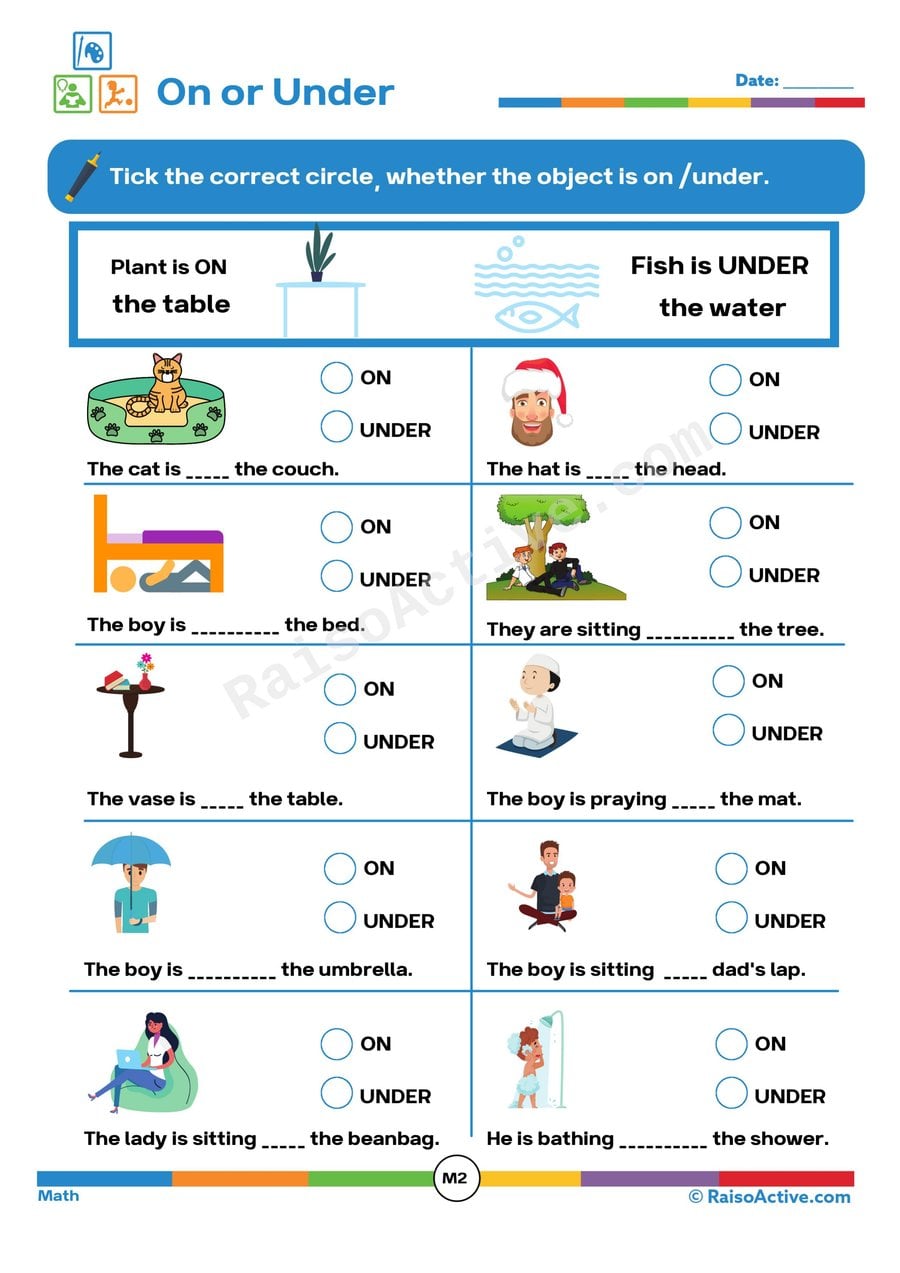
On or Under Worksheet: Where is the Object?
Ages 3-5 · Preschool–Pre-KAges 3-5 · Nursery–ReceptionAges 3-5 · Nursery–LKGAges 3-5
Reading a short sentence describing an object's location and then ticking the picture that matches teaches children ages 3-5 to connect spoken or written prepositions, 'on' and 'under,' to a visual representation, strengthening both listening comprehension and spatial vocabulary. This worksheet requires children to hold a sentence in mind and compare it against a picture, which is a slightly more advanced skill than simply naming a position they can already see. Understanding prepositions like these supports later reading comprehension, since so many simple stories depend on describing where things are.

Animal Action Cards: Fun Movement Worksheet for Kids!
Ages 3-5 · Preschool–Pre-KAges 3-5 · Nursery–ReceptionAges 3-5 · Nursery–LKGAges 3-5
These animal action cards get children ages 3-5 moving as they follow simple instructions, like hopping like a rabbit or slithering like a snake, combining gross motor development with listening and instruction-following skills. Because each card requires reading or recalling a specific action tied to a specific animal, children also reinforce animal vocabulary and movement-based descriptive language. Turning learning into physical movement is especially valuable for this age group, whose attention and retention often improve dramatically when a body movement is involved.

Capitalization Worksheet: Practice Writing Sentences Correctly!
Ages 4-6 · Pre-K–KindergartenAges 4-6 · Reception–Year 1Ages 4-6 · LKG–UKGAges 4-6
This worksheet teaches children ages 4-6 the rule that sentences begin with a capital letter, along with an introduction to capitalizing proper nouns like names and places. Rewriting sentences correctly, rather than just circling errors, gives children active practice applying the capitalization rule themselves, which builds the habit more effectively than passive correction exercises.

Punctuation Practice Worksheet for Early Learners
Ages 4-6 · Pre-K–KindergartenAges 4-6 · Reception–Year 1Ages 4-6 · LKG–UKGAges 4-6
Children ages 4-6 learn to distinguish between statements and questions by deciding whether each sentence needs a period or a question mark, an early step in understanding how punctuation changes meaning and tone. Recognizing the difference between a question and a statement also supports reading fluency, since readers naturally use rising or falling intonation depending on the punctuation at the end of a sentence.
Related worksheets
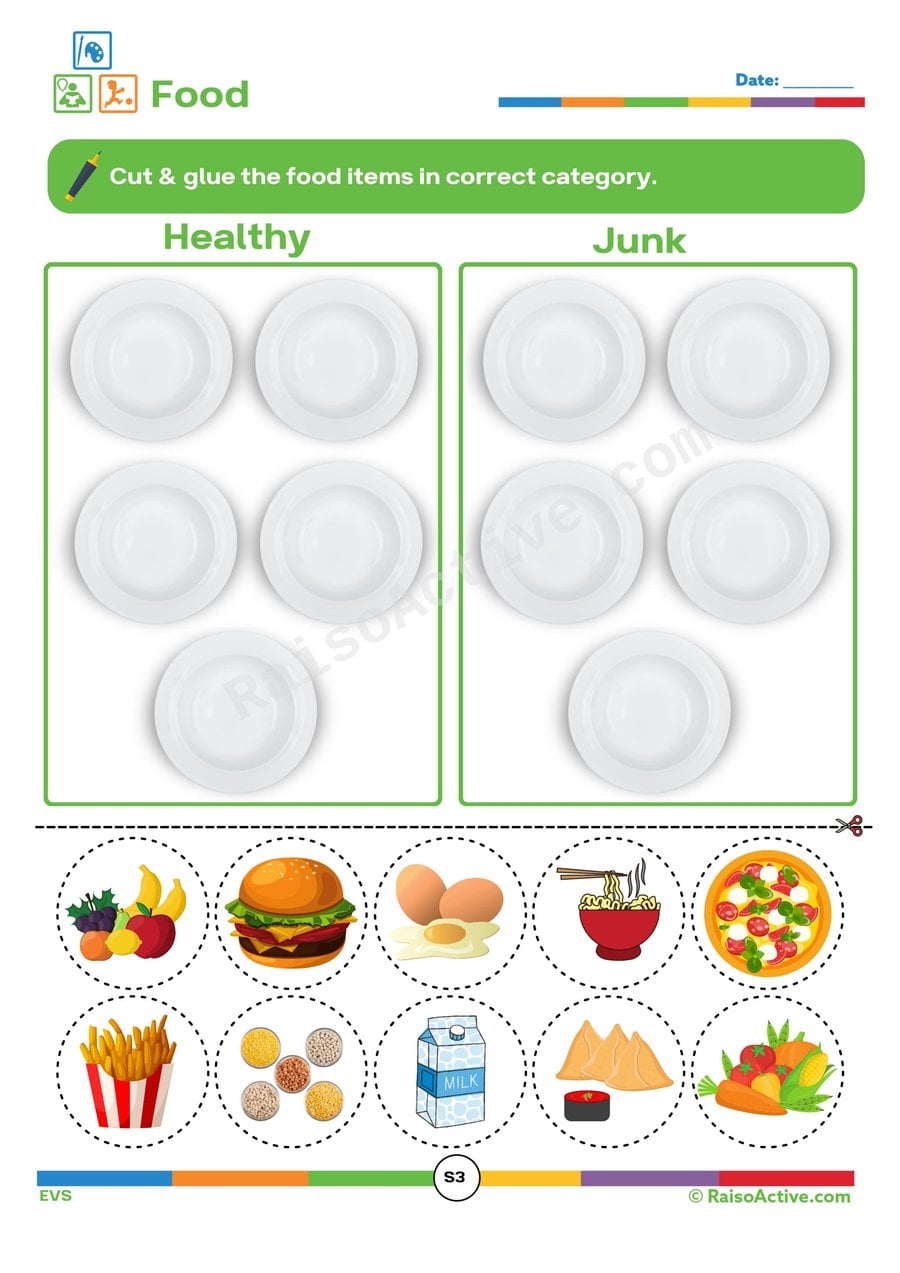
Healthy vs. Junk Food Sorting Worksheet for Kids
Ages 3-5 · Preschool–Pre-KAges 3-5 · Nursery–ReceptionAges 3-5 · Nursery–LKGAges 3-5
This worksheet asks children ages 3-5 to cut out pictures of different foods and sort them into 'Healthy' and 'Junk' categories, building early nutrition awareness alongside classification skills. Learning to categorize foods by type — rather than just naming them — introduces the idea that food choices matter for the body, a concept children will build on throughout their lives.

Food Pyramid Worksheet: Learn About Healthy Eating!
Ages 3-5 · Preschool–Pre-KAges 3-5 · Nursery–ReceptionAges 3-5 · Nursery–LKGAges 3-5
This worksheet introduces children ages 3-5 to the food pyramid as a visual guide for balanced eating, helping them understand that different food groups should be eaten in different amounts. Filling in the blanks about food groups and serving sizes builds early nutrition literacy and reinforces the idea that a healthy diet includes variety, not just favorite foods.

Food Bingo Worksheet: Identify Healthy and Unhealthy Foods!
Ages 3-5 · Preschool–Pre-KAges 3-5 · Nursery–ReceptionAges 3-5 · Nursery–LKGAges 3-5
This bingo-style activity helps children ages 3-5 practice distinguishing healthy foods from unhealthy ones by physically placing tokens on matching pictures, turning nutrition education into an active game rather than a lecture. Scanning the board for matches also reinforces visual search skills similar to those used in matching and memory games. Because bingo requires a full row to win, children stay motivated to keep scanning and comparing even after finding a few matches.
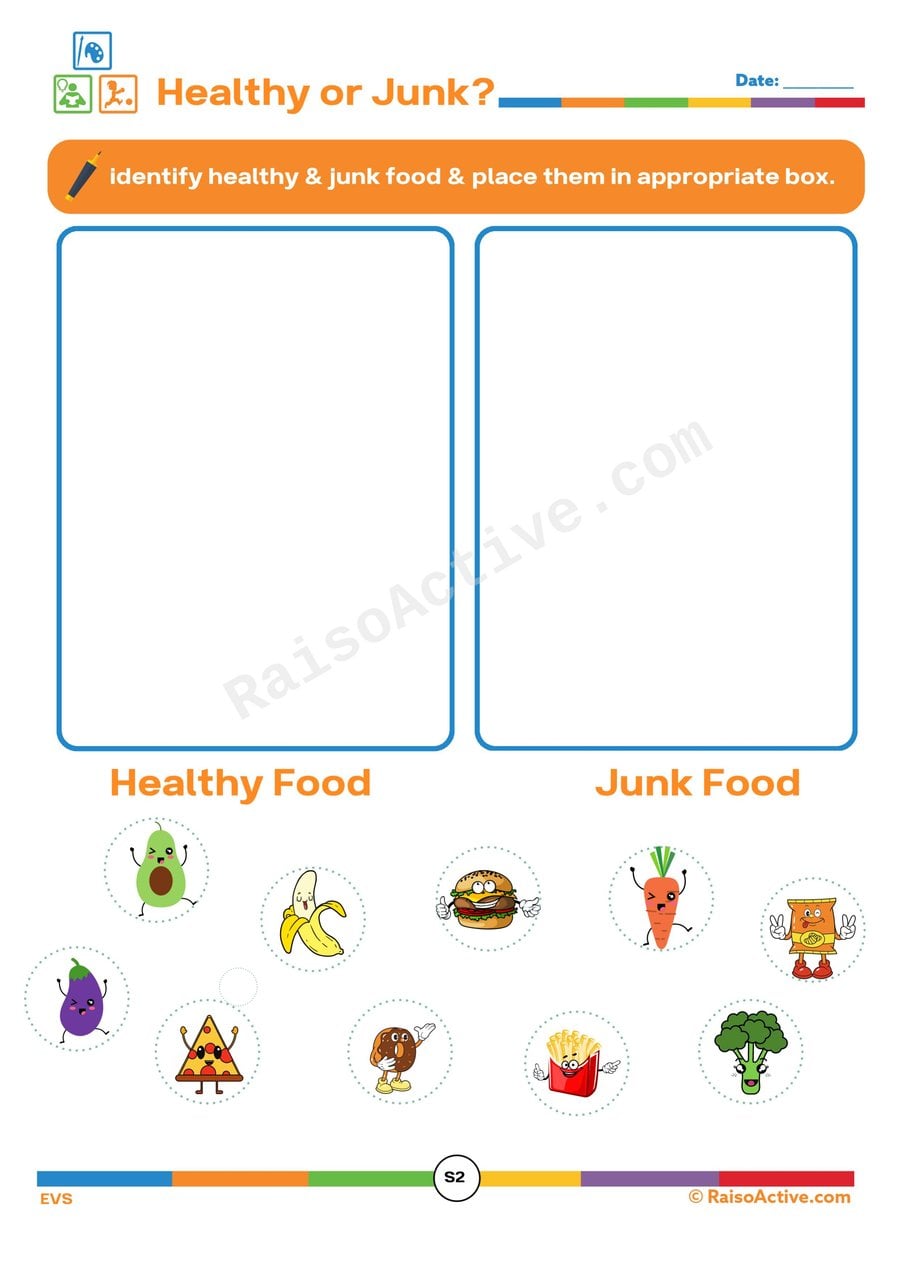
Healthy Food Sorting Worksheet for Preschoolers
Ages 3-5 · Preschool–Pre-KAges 3-5 · Nursery–ReceptionAges 3-5 · Nursery–LKGAges 3-5
Sorting food pictures into 'Healthy' and 'Junk Food' boxes teaches children ages 3-5 to classify items by a shared characteristic, an early categorization skill that underlies later science and math thinking. At the same time, it introduces basic nutrition concepts — that fruits, vegetables, and whole foods nourish the body differently than sugary or fried treats. Talking through each choice also builds vocabulary around food and health.

My Plate: Cut and Paste Food Groups Worksheet for Kids
Ages 3-6 · Preschool–KindergartenAges 3-6 · Nursery–Year 1Ages 3-6 · Nursery–UKGAges 3-6
Children ages 3-6 learn about balanced nutrition by cutting out pictures of different foods and pasting each one onto the correct section of a plate diagram representing food groups like fruits, vegetables, grains, and proteins. This hands-on sorting activity introduces the idea that a healthy meal includes a variety of food types, an early building block for lifelong healthy eating habits.

Healthy Eating Worksheet: Fruit Salad and Vegetable Soup!
Ages 3-5 · Preschool–Pre-KAges 3-5 · Nursery–ReceptionAges 3-5 · Nursery–LKGAges 3-5
This matching worksheet helps children ages 3-5 build food vocabulary by identifying pictures of fruits and vegetables and sorting them into the correct category — fruit salad ingredients or vegetable soup ingredients. Learning to classify foods by type, not just by whether they're healthy, supports early categorization skills that apply across many other subjects, from animals to shapes. The cooking-themed framing also connects the sorting task to a familiar, everyday context children may have experienced at home.

Healthy vs. Unhealthy Eating Habits Worksheet for Kids
Ages 3-5 · Preschool–Pre-KAges 3-5 · Nursery–ReceptionAges 3-5 · Nursery–LKGAges 3-5
This worksheet helps children ages 3-5 begin distinguishing between healthy and unhealthy food choices by matching specific foods to a healthy or unhealthy person, building early awareness of how eating habits connect to wellbeing. Making this connection concrete and visual, rather than abstract, gives young children a first foothold in nutrition concepts well before they can understand more detailed health information.
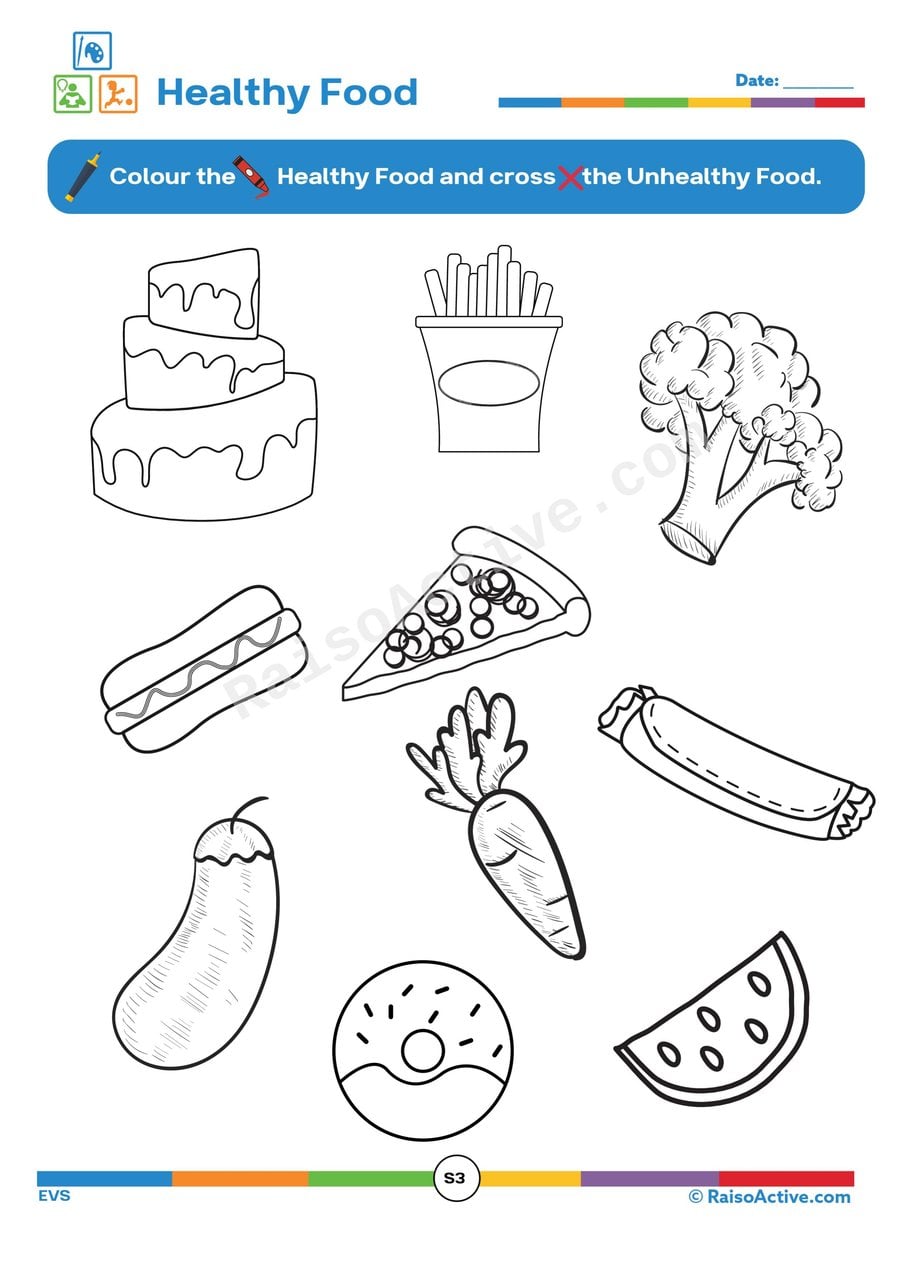
Healthy Food Fun: Color and Cross Out Worksheet
Ages 3-5 · Preschool–Pre-KAges 3-5 · Nursery–ReceptionAges 3-5 · Nursery–LKGAges 3-5
This worksheet builds nutrition awareness in children ages 3-5 by having them make an active choice about each pictured food — coloring the healthy ones and crossing out the unhealthy ones — rather than passively looking at a list. Requiring two different physical responses for two categories reinforces the distinction more strongly than a single sorting action would. Talking through the reasoning behind each choice also builds early critical thinking about cause and effect between food choices and health.
Guides for this topic

Age-Appropriate Problem-Solving Activities: Building Critical Thinkers from the Ground Up
Discover fun, age-appropriate problem-solving activities for children ages 1-8. Build critical thinking, logic, and reasoning skills through play-based learning.
Critical Thinking Activities That Actually Work for Young Children: Building Tomorrow's Thinkers Today
Discover proven critical thinking activities for young children. Age-wise logic games, questioning techniques, and hands-on ideas to build thinking skills at home.

Preparing Your Child for a Rapidly Changing World: Essential Skills for Future Success
Discover the essential 21st century skills your child needs for future success. Practical tips on creativity, critical thinking, digital literacy & emotional intelligence for ages 1-8.
Reviews
Every worksheet for ages 3–5, no watermark
Members download the full library of 1,000+ worksheets and every activity pack without watermarks or daily limits. One year costs ₹999 in India or $20 elsewhere.
See membership plansOr download any worksheet free with a watermark (5 a day).