On or Under Worksheet: Where is the Object?
Reading a short sentence describing an object's location and then ticking the picture that matches teaches children ages 3-5 to connect spoken or written prepositions, 'on' and 'under,' to a visual representation, strengthening both listening comprehension and spatial vocabulary. This worksheet requires children to hold a sentence in mind and compare it against a picture, which is a slightly more advanced skill than simply naming a position they can already see. Understanding prepositions like these supports later reading comprehension, since so many simple stories depend on describing where things are.
Part of the pack
Month 1: Learning & Development | Ages 6-7
This is page 10 of the pack. Ages 6-7 · Grade 1Ages 6-7 · Year 2Ages 6-7 · Class 1Ages 6-7
Made for your child
Counting to 10, made for your child
A maths pack with your child's name in it: pictures that explain, practice at three levels, puzzles and story sums about them. Print a new set whenever they finish.
Make a maths packFree preview · free for members
Curriculum
- Spatial Sense > Spatial Concepts
How to use this worksheet
Read the sentence for the first picture aloud together, emphasizing the word 'on' or 'under.' Look at the picture and ask your child whether it matches what the sentence describes. Have your child tick the circle next to the picture that correctly shows the object's location as described in the sentence. Continue through each sentence and picture pair on the page, encouraging your child to reread the sentence if they're unsure before answering.
Materials needed
- Pencil
- Eraser
Extension activities
- 1Place a toy on and under different pieces of furniture and describe its location using a full sentence each time.
- 2Play a listening game where you say 'the ball is under the chair' and your child has to act it out.
- 3Read a picture book and pause to describe where an object is using the words on or under.
- 4Draw a picture of a table with an object either on or under it, then write a matching sentence.
- 5Hide a small toy on or under something in the room and give your child a sentence clue to find it.

Written by
Hemsweta Jain · Teacher Cheena
MBA and Early Childhood Educator, teaching since 2014 · Founder of RaisoActive, Mumbai
Every RaisoActive worksheet is designed and checked by the founder before publishing.
Published · Last reviewed
More from Month 1: Learning & Development | Ages 6-7

Sheep's Barnyard Adventure: A Fun Counting and Movement Worksheet
Ages 4-6 · Pre-K–KindergartenAges 4-6 · Reception–Year 1Ages 4-6 · LKG–UKGAges 4-6
This board-game-style worksheet helps children ages 4-6 practice counting and number recognition by rolling a die and moving a sheep piece along a numbered path, following simple instructions at each stop. Turning counting practice into a game with chance and movement keeps children engaged far longer than a static worksheet, while still reinforcing accurate counting and number sequence recognition along the path.

Animal Habitats Cut and Paste Worksheet for Preschoolers
Ages 3-5 · Preschool–Pre-KAges 3-5 · Nursery–ReceptionAges 3-5 · Nursery–LKGAges 3-5
Children ages 3-5 learn about different animal habitats — like the ocean, forest, or desert — by cutting out animal pictures and pasting each one into its correct home environment. Matching an animal to where it actually lives builds early science classification skills and introduces the idea that living things are adapted to survive in specific environments, a concept children will revisit in more depth throughout school.
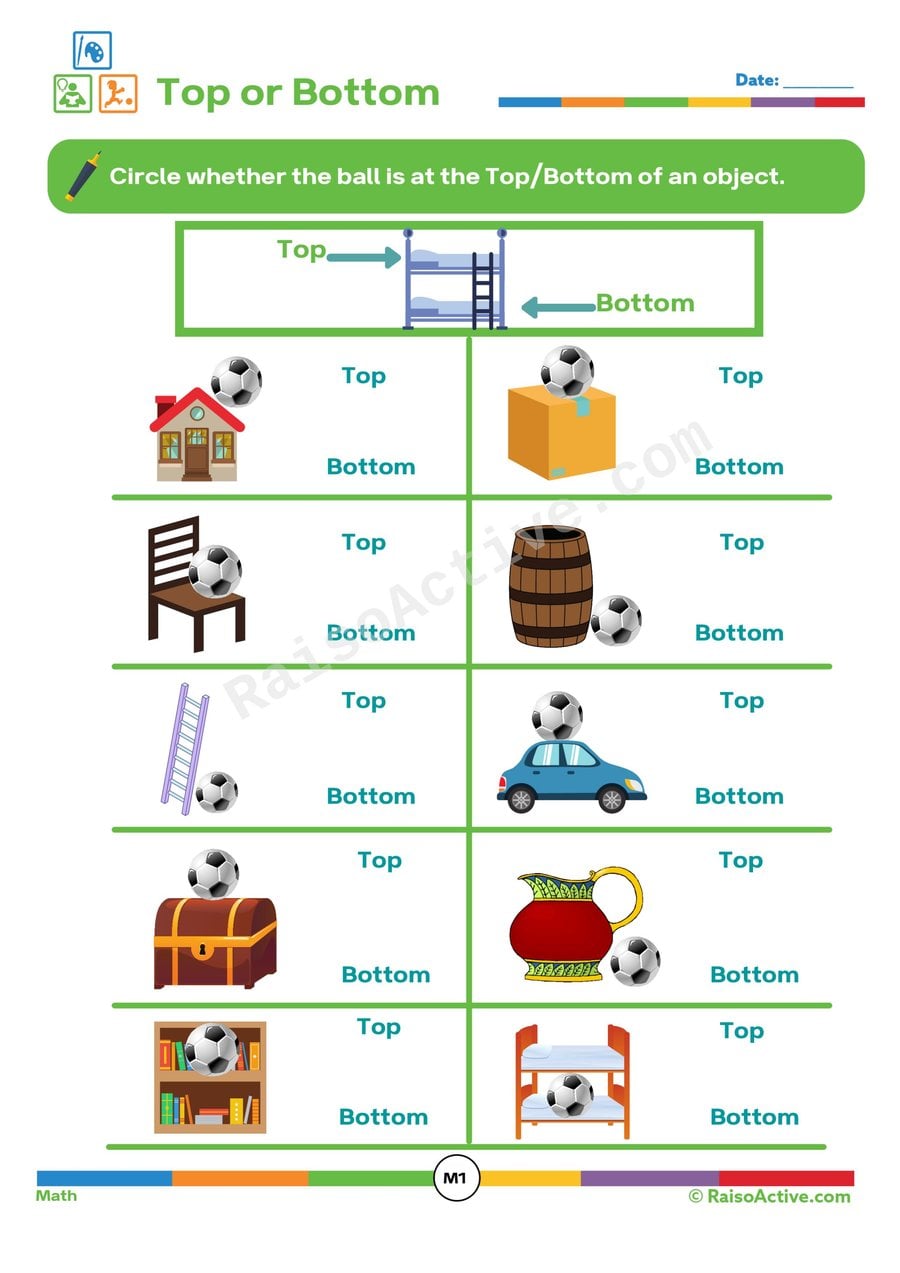
Top or Bottom? Fun Worksheet for Kids!
Ages 3-5 · Preschool–Pre-KAges 3-5 · Nursery–ReceptionAges 3-5 · Nursery–LKGAges 3-5
Deciding whether a ball is positioned at the top or bottom of another object teaches children ages 3-5 the spatial concepts of 'top' and 'bottom,' foundational positional vocabulary that supports later skills like reading a page from top to bottom or following multi-step directions. This worksheet asks children to look carefully at a picture and make a judgment about relative position, which strengthens visual-spatial reasoning alongside vocabulary development. Positional words like these are often first understood through pictures before children can reliably use them in their own speech.

Animal Needs Worksheet for Kids: Matching and Identifying
Ages 3-5 · Preschool–Pre-KAges 3-5 · Nursery–ReceptionAges 3-5 · Nursery–LKGAges 3-5
This worksheet helps children ages 3-5 understand and articulate the basic survival needs of animals — food, water, air, shelter — by completing sentences with the correct need word and then circling matching pictures. Requiring both a writing and a circling response means children practice the vocabulary in two different formats, reinforcing recall from multiple angles. This groundwork in animal needs also supports later, more complex science concepts about habitats and ecosystems.

Color Mixing Fun: Primary and Secondary Colors Worksheet
Ages 3-5 · Preschool–Pre-KAges 3-5 · Nursery–ReceptionAges 3-5 · Nursery–LKGAges 3-5
This hands-on painting activity teaches children ages 3-5 the basics of color theory by having them paint the three primary colors first, then physically mix pairs of them to discover the secondary colors that result. Watching red and yellow blend into orange, or blue and yellow become green, right in front of them makes color mixing feel like a small science experiment rather than an abstract fact to memorize.

Paper Bag Bunny Craft Worksheet for Preschoolers
Ages 3-5 · Preschool–Pre-KAges 3-5 · Nursery–ReceptionAges 3-5 · Nursery–LKGAges 3-5
This paper bag craft has children ages 3-5 follow a multi-step sequence of instructions — attaching a pom pom nose, spoon ears, googly eyes, and whisker details — while practicing the fine motor control needed to place and glue small materials precisely. Because the craft uses several different textures and materials in one project, children also get sensory-rich practice beyond typical paper-and-crayon activities. Successfully completing each step in order builds confidence in following sequential, multi-part directions.

Animal Action Cards: Fun Movement Worksheet for Kids!
Ages 3-5 · Preschool–Pre-KAges 3-5 · Nursery–ReceptionAges 3-5 · Nursery–LKGAges 3-5
These animal action cards get children ages 3-5 moving as they follow simple instructions, like hopping like a rabbit or slithering like a snake, combining gross motor development with listening and instruction-following skills. Because each card requires reading or recalling a specific action tied to a specific animal, children also reinforce animal vocabulary and movement-based descriptive language. Turning learning into physical movement is especially valuable for this age group, whose attention and retention often improve dramatically when a body movement is involved.

Keeping Our Environment Clean Worksheet for Kids
Ages 3-5 · Preschool–Pre-KAges 3-5 · Nursery–ReceptionAges 3-5 · Nursery–LKGAges 3-5
This worksheet builds early environmental awareness in children ages 3-5 by having them evaluate pictured actions — like throwing litter in a bin versus littering on the ground — and mark each one as good or bad for the environment. Making this judgment call requires children to connect a specific action to a broader consequence, an early form of cause-and-effect reasoning applied to environmental responsibility. Introducing this concept young helps normalize caring for shared spaces as a natural part of daily behavior rather than an abstract adult concern.
Related worksheets

Above and Below Worksheet: Counting and Spatial Reasoning for Kids
Ages 4-6 · Pre-K–KindergartenAges 4-6 · Reception–Year 1Ages 4-6 · LKG–UKGAges 4-6
This worksheet combines spatial reasoning and counting for children ages 4-6, asking them to identify whether objects are positioned above or below a reference point and then use that understanding to answer counting questions. Understanding relative position words like 'above' and 'below' supports later skills in reading diagrams, maps, and graphs. Pairing the concept with counting also reinforces that spatial language can describe quantities, not just single objects.
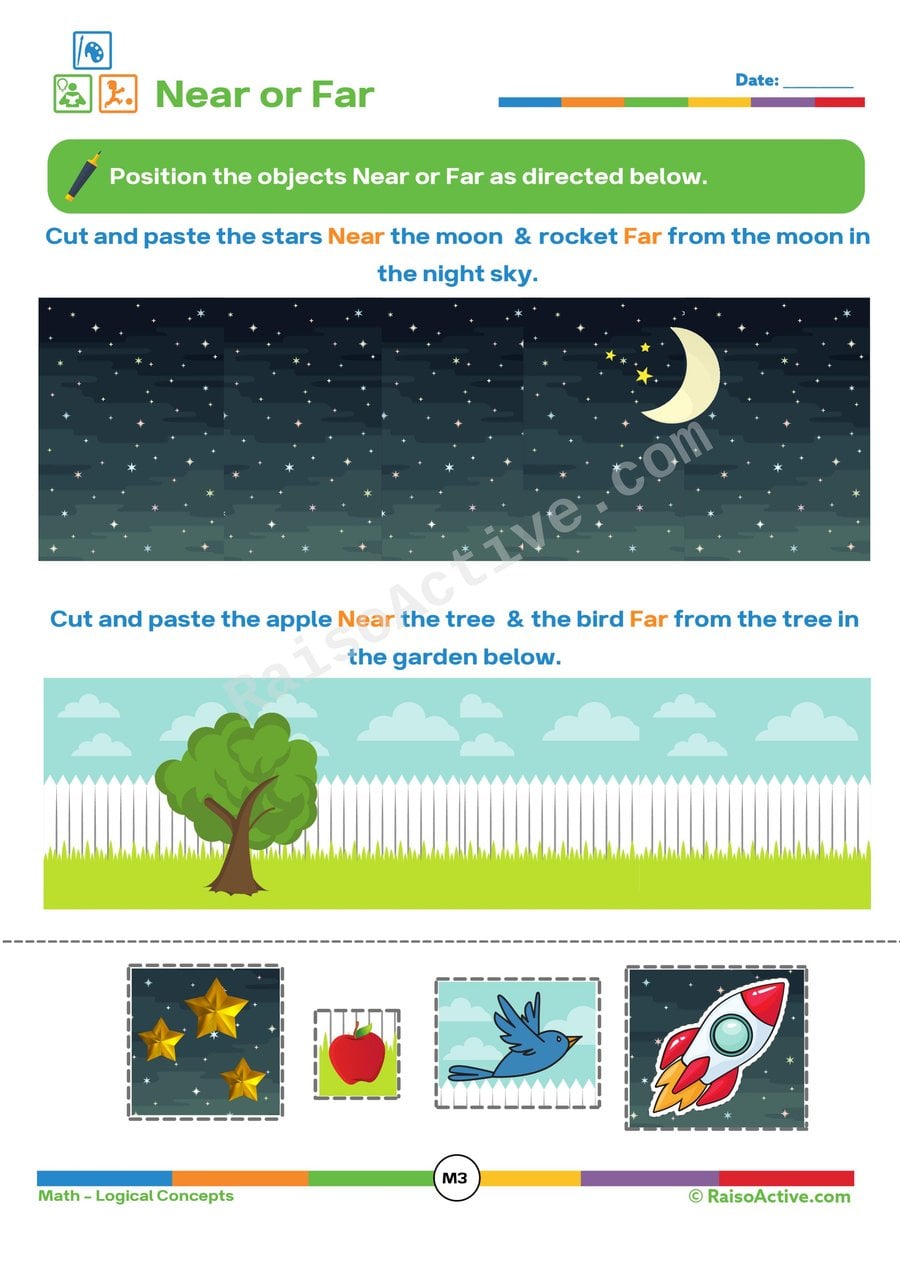
Near or Far Worksheet: Cut and Paste Fun!
Ages 3-5 · Preschool–Pre-KAges 3-5 · Nursery–ReceptionAges 3-5 · Nursery–LKGAges 3-5
Cutting and pasting objects into 'near' and 'far' positions relative to a fixed point, like a moon or a tree, gives children ages 3-5 concrete practice applying spatial vocabulary rather than just hearing the words in passing. This hands-on placement task requires children to think about relative distance, an early step toward more advanced spatial reasoning and measurement concepts. The specific, varied instructions across the page — near the moon, far from the moon, near the tree, far from the tree — also build careful listening and multi-step following of directions.

Front and Behind Worksheet: Identifying Positional Words
Ages 3-5 · Preschool–Pre-KAges 3-5 · Nursery–ReceptionAges 3-5 · Nursery–LKGAges 3-5
Understanding 'front' and 'behind' gives children ages 3-5 the spatial vocabulary they need to follow instructions and describe the world around them accurately, an important stepping stone toward later concepts like ordinal position and basic geometry. This worksheet asks them to apply the words to specific pictures rather than just hear them in passing, which cements the connection between the word and the physical relationship it describes. Positional language like this also supports following multi-step directions at home and in the classroom.
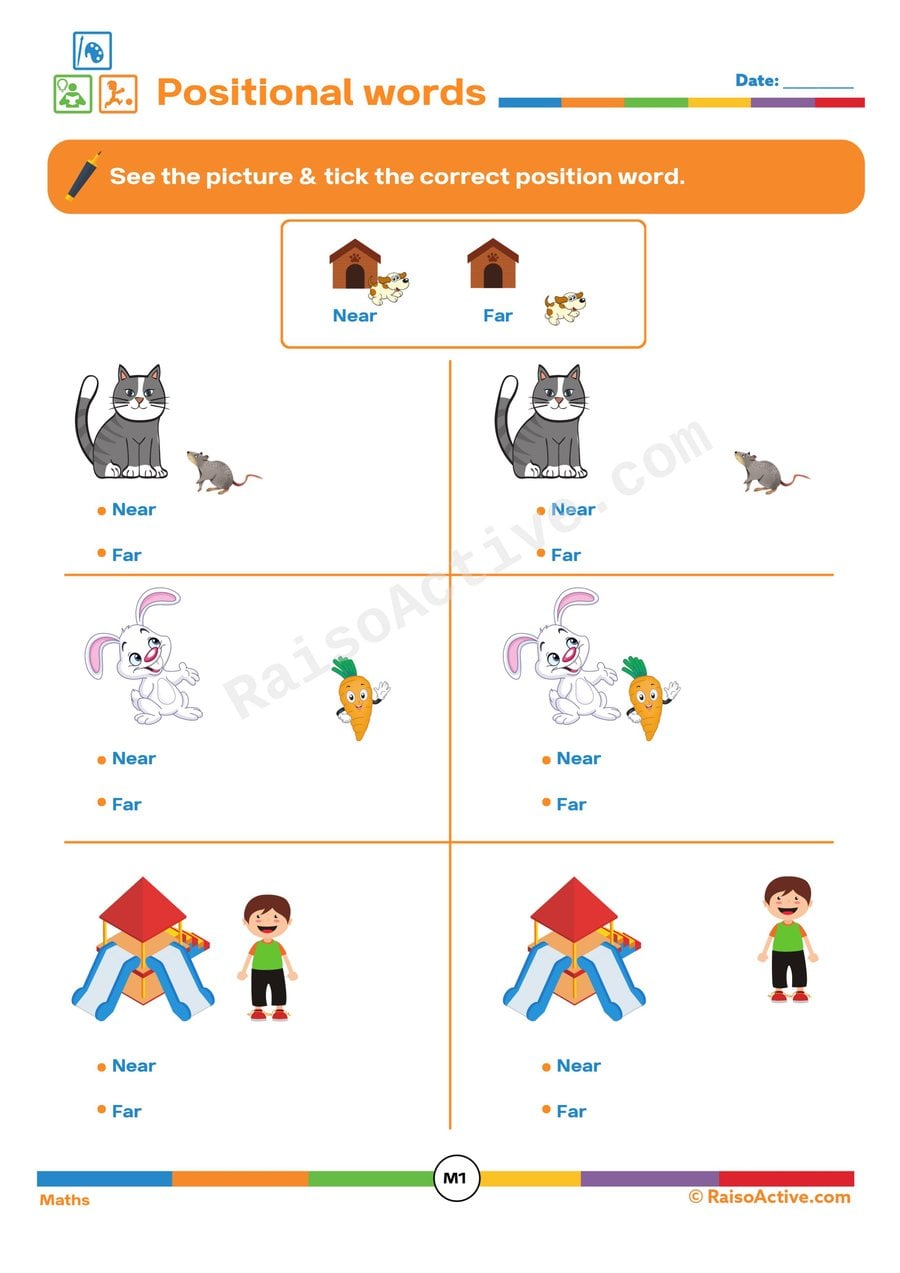
Positional Words Worksheet: Near and Far
Ages 3-5 · Preschool–Pre-KAges 3-5 · Nursery–ReceptionAges 3-5 · Nursery–LKGAges 3-5
This worksheet introduces children ages 3-5 to the positional concepts of 'near' and 'far,' asking them to look at a picture and tick the word that correctly describes an object's distance from a reference point. Positional vocabulary like this is an important building block for spatial reasoning and later geometry and direction-following skills. Because near and far are relative concepts rather than fixed labels, this practice also builds flexible thinking about how position depends on comparison.

Over and Under Worksheet: Identifying Object Positions
Ages 3-5 · Preschool–Pre-KAges 3-5 · Nursery–ReceptionAges 3-5 · Nursery–LKGAges 3-5
This worksheet helps children ages 3-5 learn and identify the spatial concepts of 'over' and 'under' by examining pictures and deciding which positional word correctly describes what they see. Practicing this distinction builds the vocabulary foundation children need to follow multi-step directions involving location.

Front or Behind Sorting Worksheet for Preschoolers
Ages 3-5 · Preschool–Pre-KAges 3-5 · Nursery–ReceptionAges 3-5 · Nursery–LKGAges 3-5
Positional words like 'front' and 'behind' describe relationships between objects rather than the objects themselves, which makes them a genuinely trickier concept for a 3-5 year old than sorting by color or size. Deciding where each picture belongs and sorting it into the right box builds early spatial reasoning that later supports following multi-step directions and understanding maps or diagrams.
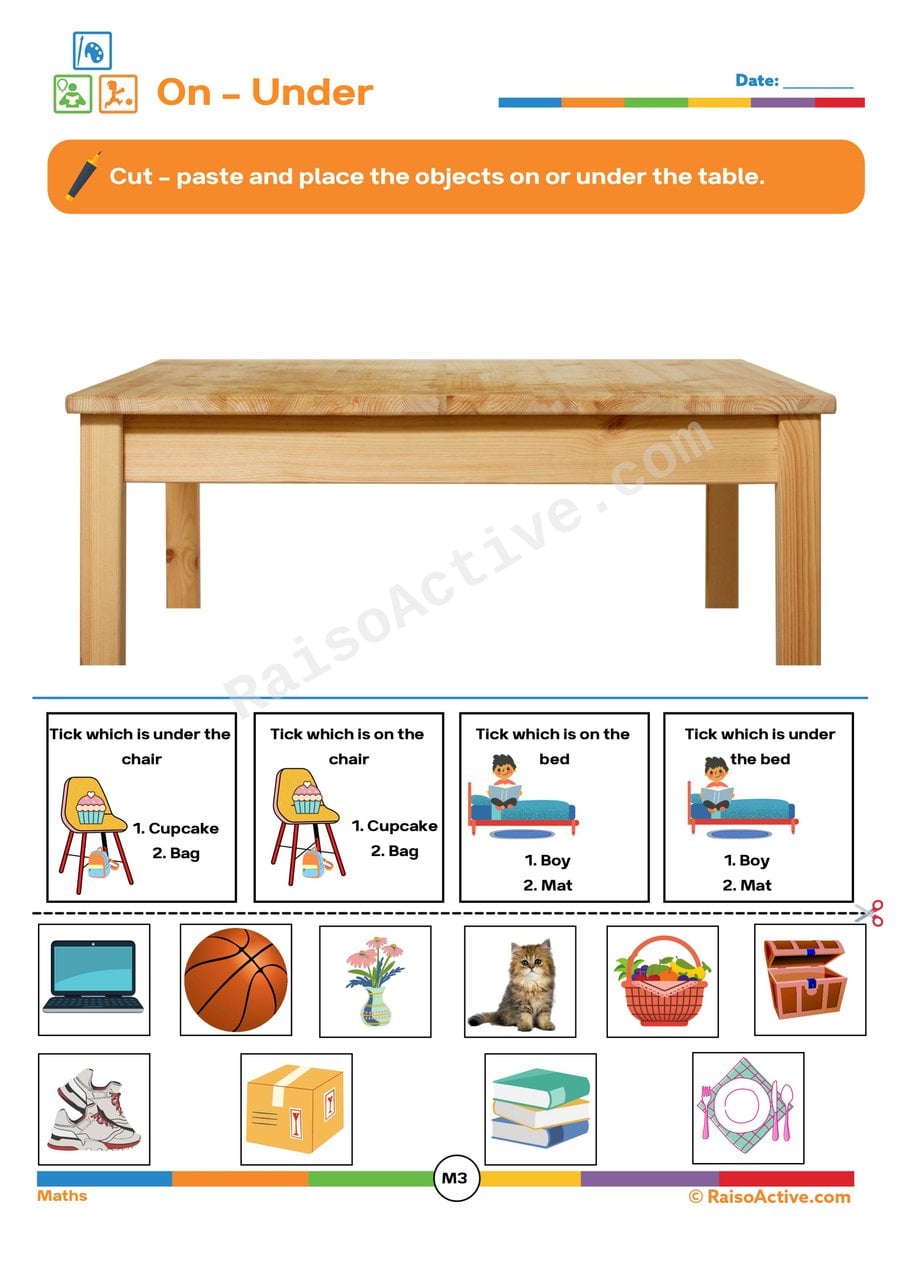
On and Under Worksheet: Table Placement Fun!
Ages 3-5 · Preschool–Pre-KAges 3-5 · Nursery–ReceptionAges 3-5 · Nursery–LKGAges 3-5
Cutting out pictures and gluing them either on or under a table teaches children ages 3-5 the spatial prepositions 'on' and 'under' by requiring them to physically place an object according to a specific instruction rather than just hearing the words. This hands-on placement task builds spatial reasoning and reinforces receptive language, since children must correctly interpret which word means which position before acting on it. Prepositions like these are often tricky to grasp through listening alone, so the visual, hands-on nature of this worksheet makes the concept concrete.

Open and Close Worksheet: Circle the Open and Closed Objects!
Ages 3-5 · Preschool–Pre-KAges 3-5 · Nursery–ReceptionAges 3-5 · Nursery–LKGAges 3-5
Children ages 3-5 build early categorization skills by identifying whether pictured objects, like a door, a box, or a jar, are open or closed. This concept requires observing a physical state and applying a descriptive word correctly, an important early step in building descriptive vocabulary. Recognizing open versus closed also has practical safety value, connecting worksheet learning to real-world awareness.
Guides for this topic

Best Worksheets for 3-Year-Olds: What Works and What to Avoid
What works on worksheets for 3-year-olds: short sessions, crayons, tracing lines, matching, cutting, a free weekly plan, and signs one is too advanced.

Age-Appropriate Problem-Solving Activities: Building Critical Thinkers from the Ground Up
Discover fun, age-appropriate problem-solving activities for children ages 1-8. Build critical thinking, logic, and reasoning skills through play-based learning.
Critical Thinking Activities That Actually Work for Young Children: Building Tomorrow's Thinkers Today
Discover proven critical thinking activities for young children. Age-wise logic games, questioning techniques, and hands-on ideas to build thinking skills at home.
Reviews
Every worksheet for ages 3–5, no watermark
Members download the full library of 1,000+ worksheets and every activity pack without watermarks or daily limits. One year costs ₹999 in India or $20 elsewhere.
See membership plansOr download any worksheet free with a watermark (5 a day).