Above and Below Worksheet: Counting and Spatial Reasoning for Kids
This worksheet combines spatial reasoning and counting for children ages 4-6, asking them to identify whether objects are positioned above or below a reference point and then use that understanding to answer counting questions. Understanding relative position words like 'above' and 'below' supports later skills in reading diagrams, maps, and graphs. Pairing the concept with counting also reinforces that spatial language can describe quantities, not just single objects.
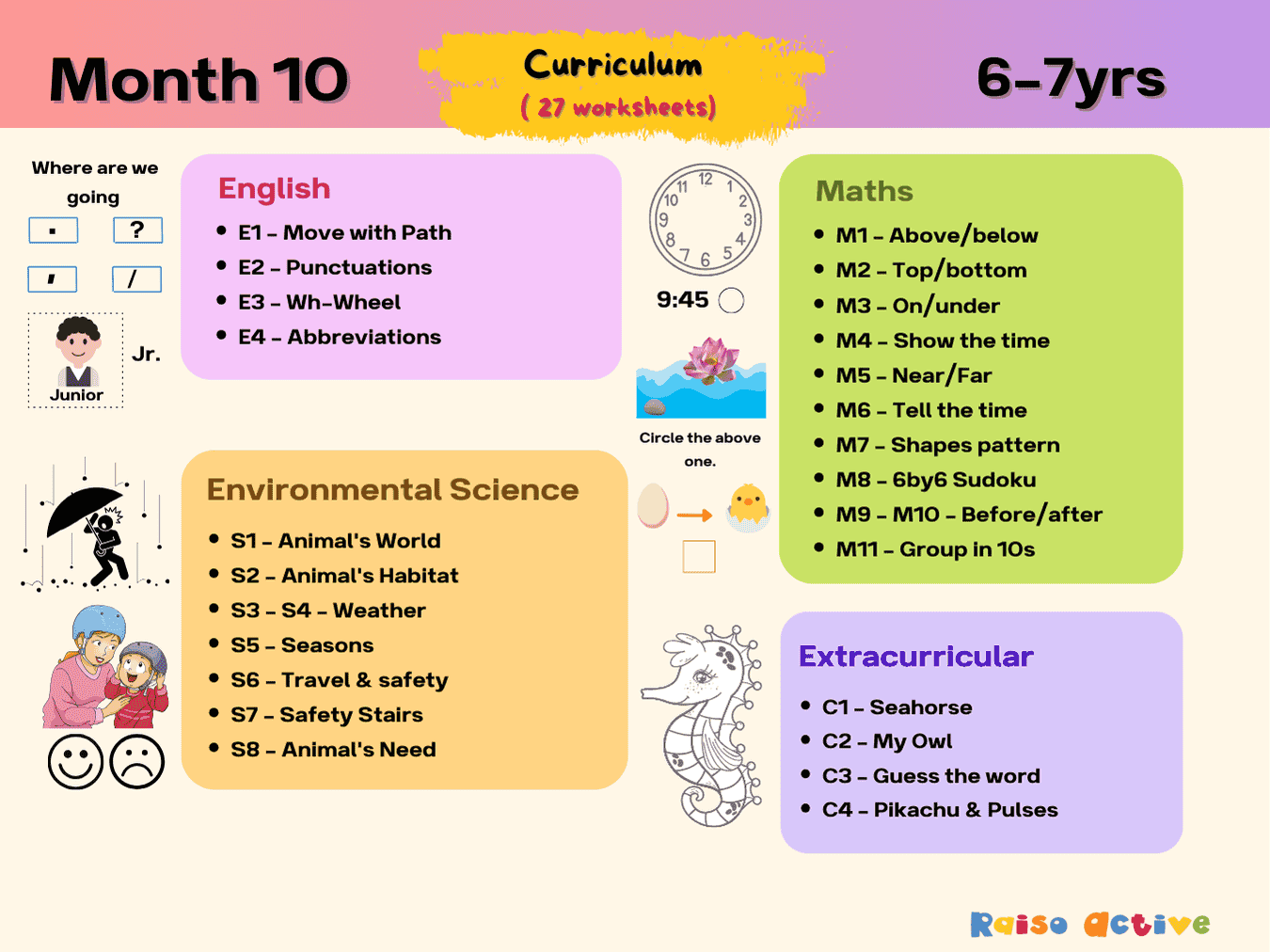
Part of the pack
Month 10: Learning & Development | Ages 6-7
This is page 8 of the pack. Ages 6-7 · Grade 1Ages 6-7 · Year 2Ages 6-7 · Class 1Ages 6-7
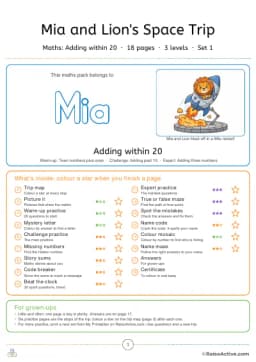
Made for your child
Counting to 10, made for your child
A maths pack with your child's name in it: pictures that explain, practice at three levels, puzzles and story sums about them. Print a new set whenever they finish.
Make a maths packFree preview · free for members
Curriculum
- Spatial Sense > Spatial Concepts
How to use this worksheet
Look at the picture together and identify the reference object your child will compare everything else to. Read each question aloud, asking your child to decide whether the object described is above or below the reference point. Have your child circle the correct object based on its position, then count how many objects fit each category if the question asks for a total. Go through each question one at a time, pointing to the picture to check the answer together.
Materials needed
- Pencil
- Crayons
Extension activities
- 1Go on a scavenger hunt and find objects that are above and below other objects.
- 2Draw a picture and label objects as above or below.
- 3Stack books or blocks and ask your child what is above and below a chosen item.
- 4Play 'Simon Says' using above and below directions, like 'put your hands above your head.'
- 5Count objects on a bookshelf, sorting them into what's above and below the middle shelf.

Written by
Hemsweta Jain · Teacher Cheena
MBA and Early Childhood Educator, teaching since 2014 · Founder of RaisoActive, Mumbai
Every RaisoActive worksheet is designed and checked by the founder before publishing.
Published · Last reviewed
More from Month 10: Learning & Development | Ages 6-7

Before and After Shapes Worksheet: Coloring and Identifying Shapes
Ages 3-5 · Preschool–Pre-KAges 3-5 · Nursery–ReceptionAges 3-5 · Nursery–LKGAges 3-5
This worksheet combines shape identification with sequencing for children ages 3-5, asking them to color shapes accurately and then determine which shape comes before or after a given one in a sequence. Applying 'before' and 'after' to shapes rather than pictures of events pushes children to think about order in a more abstract way. Coloring within defined shape outlines also builds hand control and attention to boundaries.
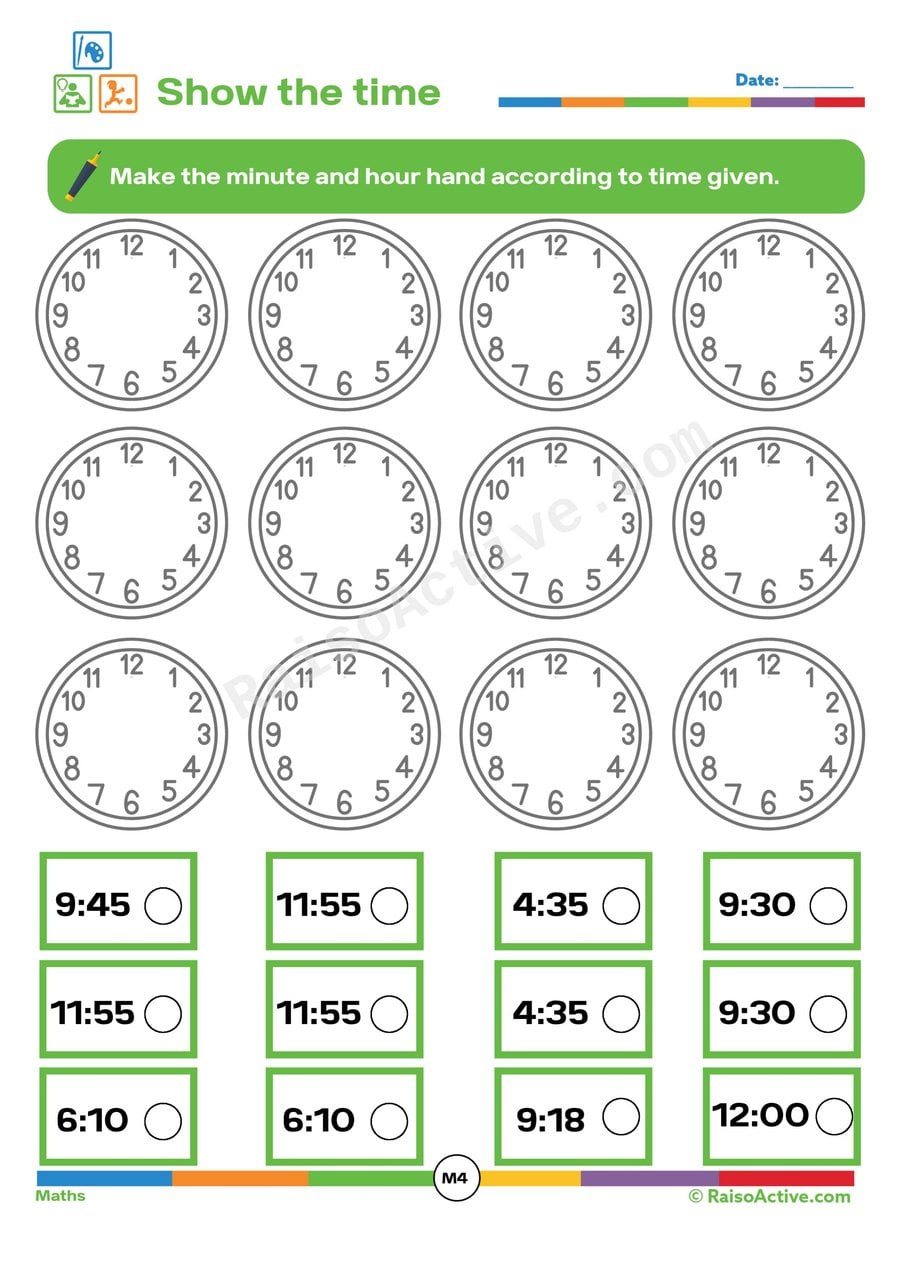
Time Telling Fun: Draw the Clock Hands! (3-5 Years)
Ages 3-5 · Preschool–Pre-KAges 3-5 · Nursery–ReceptionAges 3-5 · Nursery–LKGAges 3-5
This clock-hands activity teaches children ages 3-5 the very first steps of telling time by having them draw the hour and minute hands onto a blank clock face to match a given time. Because young children at this age typically focus on hour-level time recognition, the worksheet builds foundational awareness of how a clock's two hands work together before introducing the more complex idea of minutes. Repeated practice drawing hands in the correct position and length also reinforces fine motor control alongside the time concept.

Near and Far Worksheet: Identifying and Connecting Objects
Ages 3-5 · Preschool–Pre-KAges 3-5 · Nursery–ReceptionAges 3-5 · Nursery–LKGAges 3-5
This worksheet introduces children ages 3-5 to the comparative spatial concepts of 'near' and 'far' by having them draw connecting lines based on relative distance in a picture. Understanding proximity words builds an early vocabulary foundation for describing the physical world, which later supports map reading and measurement concepts. The connect-the-line format also reinforces visual tracking and following printed instructions accurately.

Punctuation Fun: Practice Using Punctuation Marks!
Ages 4-6 · Pre-K–KindergartenAges 4-6 · Reception–Year 1Ages 4-6 · LKG–UKGAges 4-6
Choosing the correct punctuation mark to complete a sentence teaches children ages 4-6 that periods, question marks, and other marks change how a sentence should be read and understood, not just how it looks on paper. Matching sentences to their correct punctuation marks reinforces this by requiring children to recognize the tone or purpose of a sentence, whether it's a statement, a question, or an exclamation. This early grammar practice builds the foundation for reading with expression and writing complete, correctly punctuated sentences later on.

Before and After Worksheet for Kids: Sequencing Activities
Ages 3-5 · Preschool–Pre-KAges 3-5 · Nursery–ReceptionAges 3-5 · Nursery–LKGAges 3-5
This worksheet helps children ages 3-5 practice sequencing by identifying which picture logically comes before and which comes after a given event. Understanding cause-and-effect order is an early comprehension skill that supports retelling stories and understanding daily routines. Combining a tick-the-answer section with a cut-and-paste section gives repeated practice with the same concept in two different formats.

Shape Pattern Cut and Paste Worksheet for Preschoolers
Ages 3-5 · Preschool–Pre-KAges 3-5 · Nursery–ReceptionAges 3-5 · Nursery–LKGAges 3-5
This worksheet asks children ages 3-5 to identify the rule in a repeating shape pattern and select the correct cut-out shape to complete it, combining shape recognition with early sequencing logic. Recognizing and continuing patterns strengthens the kind of predictive thinking that later supports skip counting and multiplication concepts. Precisely cutting and placing each small shape piece also builds fine motor control.

Superhero Grouping in Tens: A Fun Counting Worksheet for Preschoolers!
Ages 4-5 · Pre-KAges 4-5 · ReceptionAges 4-5 · LKGAges 4-5
Using a superhero theme, this worksheet helps children ages 4-5 practice counting objects accurately and matching a counted group to its written number, an early step toward understanding place value through grouping in tens. Circling objects according to a given number afterward reinforces the connection between a numeral and the actual quantity it represents, rather than just reciting numbers in order.
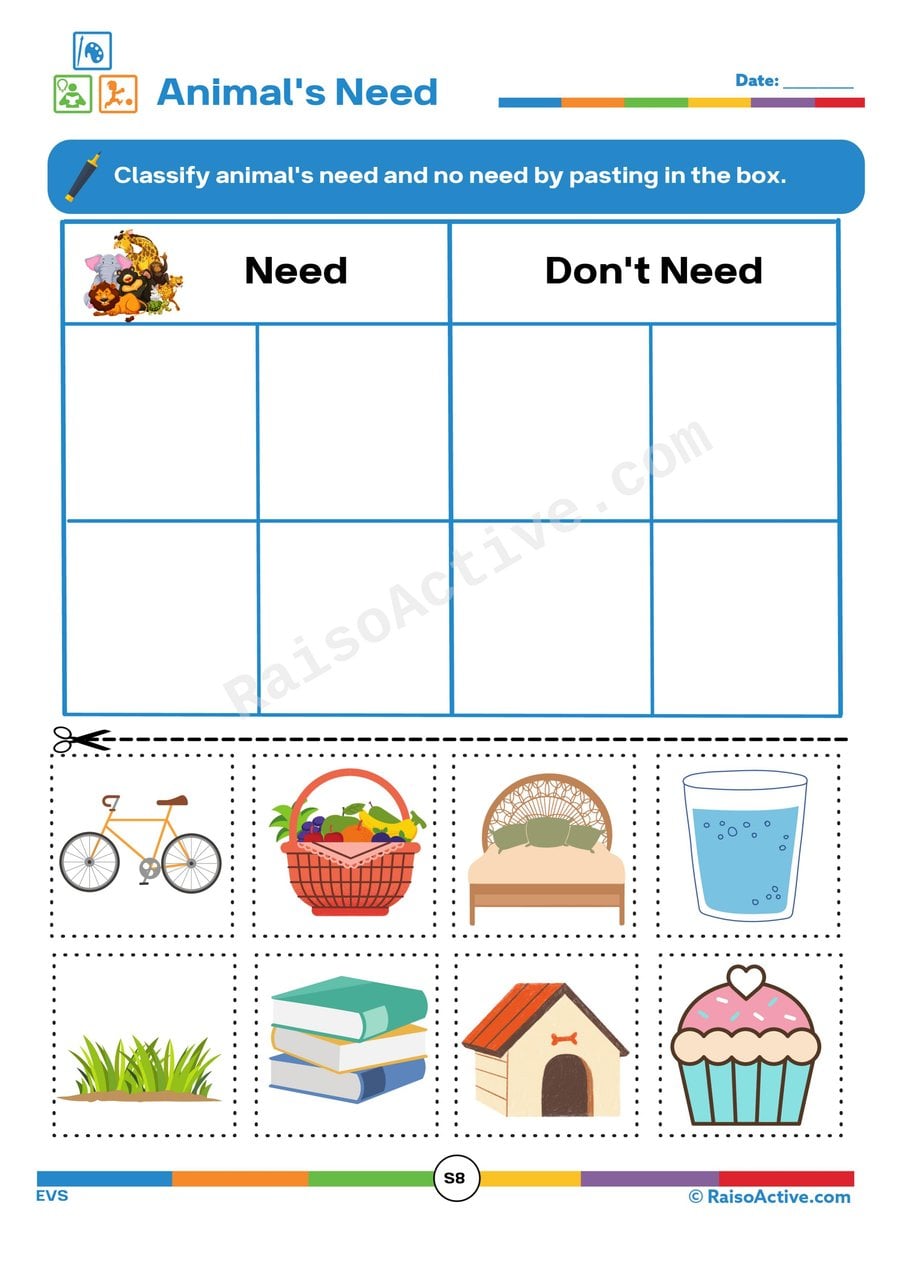
Animal Needs Sorting Worksheet for Preschoolers
Ages 3-5 · Preschool–Pre-KAges 3-5 · Nursery–ReceptionAges 3-5 · Nursery–LKGAges 3-5
This sorting activity helps children ages 3-5 understand that animals have specific survival needs — food, water, shelter, air — by cutting out picture cards and classifying each one as something an animal 'needs' or 'doesn't need.' Making this distinction requires children to reason about cause and effect in a simple form: what happens to an animal without food or water. This early exposure to classification and survival needs lays groundwork for more formal life science concepts children will encounter in later grades.
Related worksheets

Above and Below Worksheet: Identifying Object Positions
Ages 3-5 · Preschool–Pre-KAges 3-5 · Nursery–ReceptionAges 3-5 · Nursery–LKGAges 3-5
Positional words like 'above' and 'below' give three-to-five-year-olds a vocabulary for describing where things are in space, a skill that underpins everything from map reading to following multi-step instructions later on. This activity page asks children to look closely at a scene and decide whether each object sits above or below a reference point, sharpening visual scanning and the ability to hold a spatial rule in mind while checking multiple items against it.

Front and Behind Animals Worksheet: Identify Positions!
Ages 3-5 · Preschool–Pre-KAges 3-5 · Nursery–ReceptionAges 3-5 · Nursery–LKGAges 3-5
Preschoolers ages 3-5 build early spatial reasoning by identifying which pictured animals are positioned 'in front of' an object, a positional concept that requires comparing the relative location of two things in a scene. Understanding front-and-behind relationships lays groundwork for later concepts like map reading, following multi-step directions, and geometry. Circling only the correctly positioned animals also sharpens visual attention and careful looking.
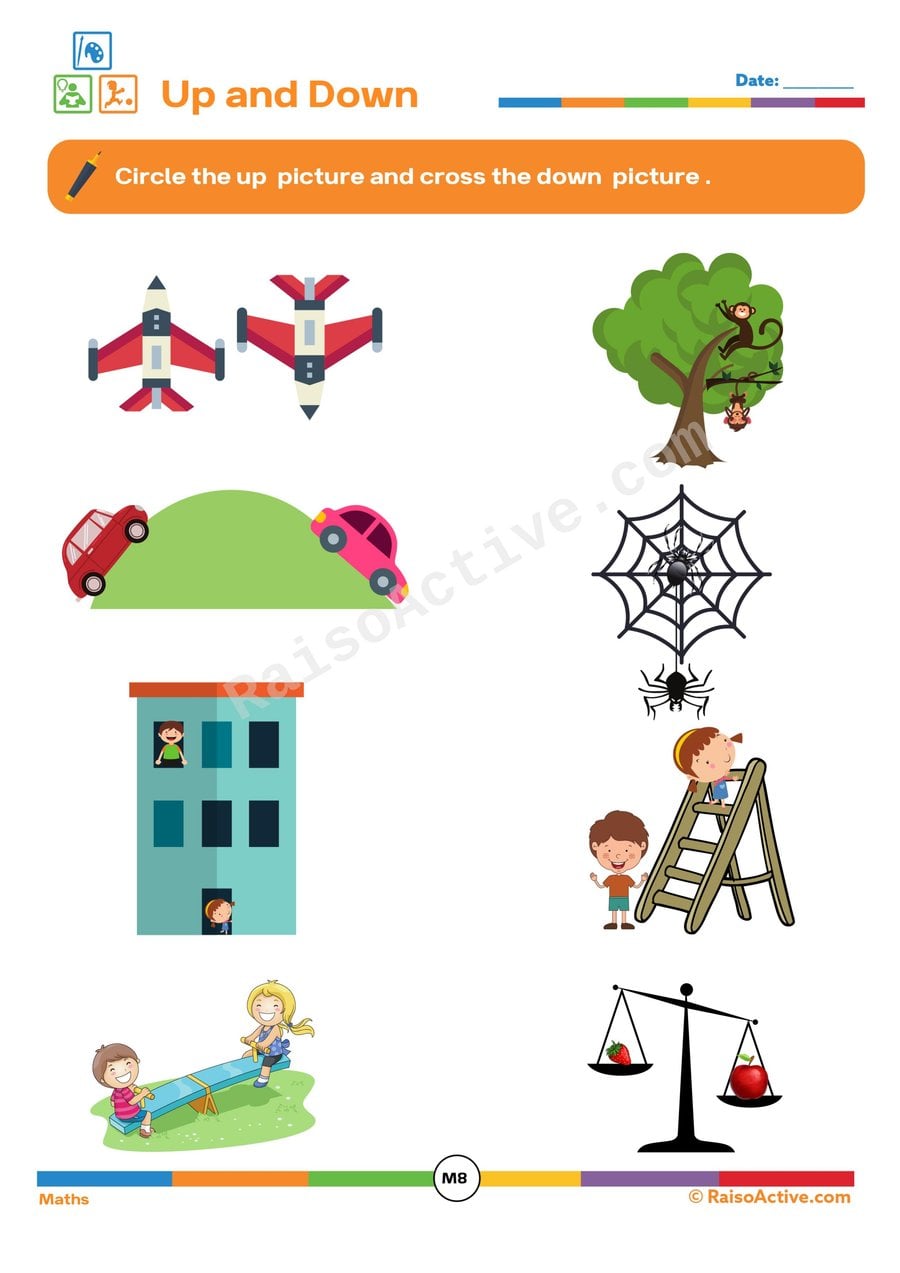
Up and Down Worksheet: Circle the Up Picture!
Ages 3-5 · Preschool–Pre-KAges 3-5 · Nursery–ReceptionAges 3-5 · Nursery–LKGAges 3-5
This worksheet helps children ages 3-5 understand the concepts of 'up' and 'down' by examining pairs of pictures and identifying which one shows something moving or positioned upward. Comparing two opposite pictures side by side also builds early skills in noticing contrast and difference, which supports later comparison-based reasoning in math and science.

Open and Close Worksheet: Circle the Open and Closed Objects!
Ages 3-5 · Preschool–Pre-KAges 3-5 · Nursery–ReceptionAges 3-5 · Nursery–LKGAges 3-5
Children ages 3-5 build early categorization skills by identifying whether pictured objects, like a door, a box, or a jar, are open or closed. This concept requires observing a physical state and applying a descriptive word correctly, an important early step in building descriptive vocabulary. Recognizing open versus closed also has practical safety value, connecting worksheet learning to real-world awareness.
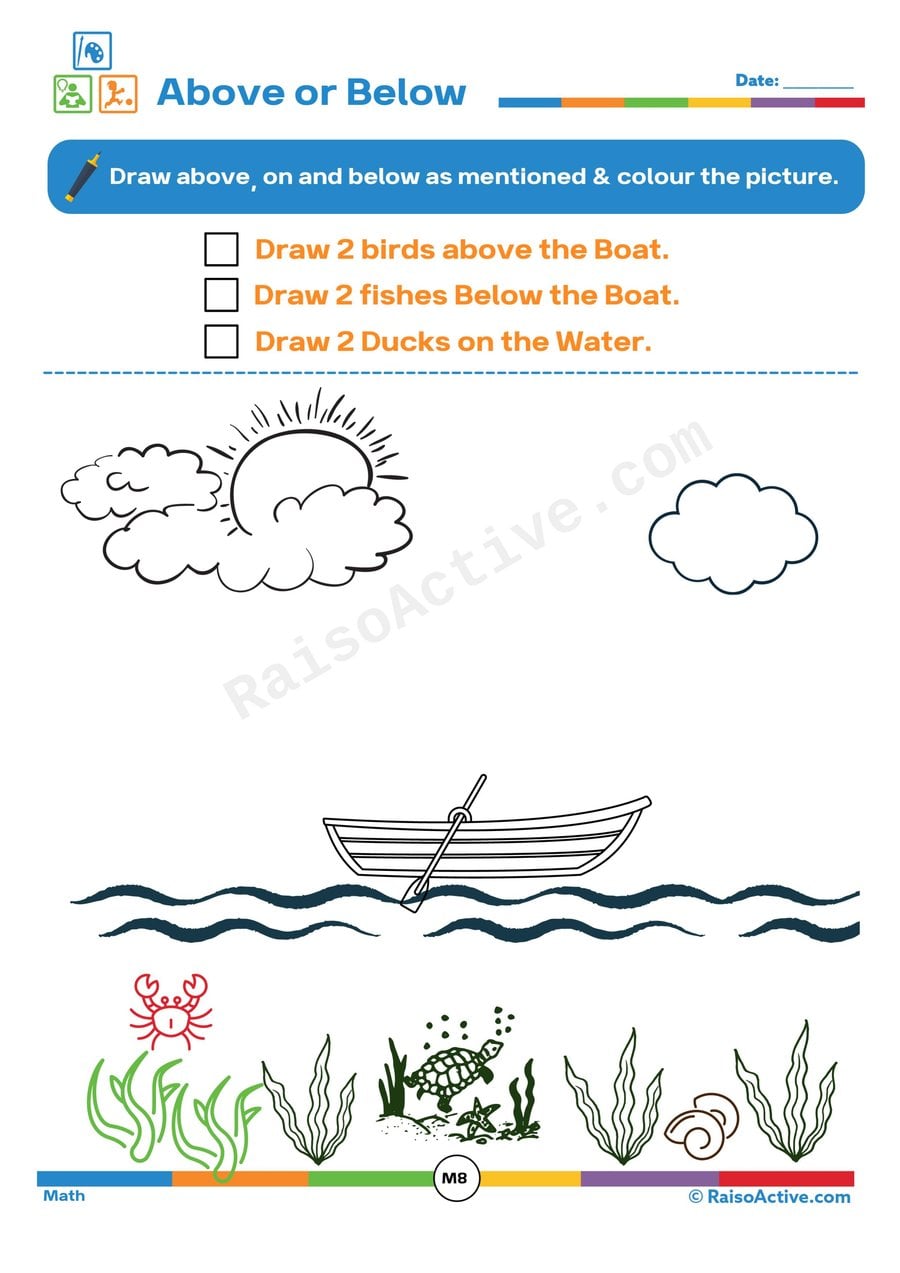
Above or Below Worksheet: Draw and Color!
Ages 3-5 · Preschool–Pre-KAges 3-5 · Nursery–ReceptionAges 3-5 · Nursery–LKGAges 3-5
This worksheet asks children ages 3-5 to apply the positional concepts of 'above,' 'below,' and 'on' by actively drawing new objects into a scene rather than simply pointing or circling. Drawing an item in a specific spatial position, like a bird above a boat, requires children to translate a verbal instruction into an accurate visual placement, which is a more demanding test of spatial understanding than passive matching. Coloring the finished scene afterward adds a satisfying creative finish to the activity.
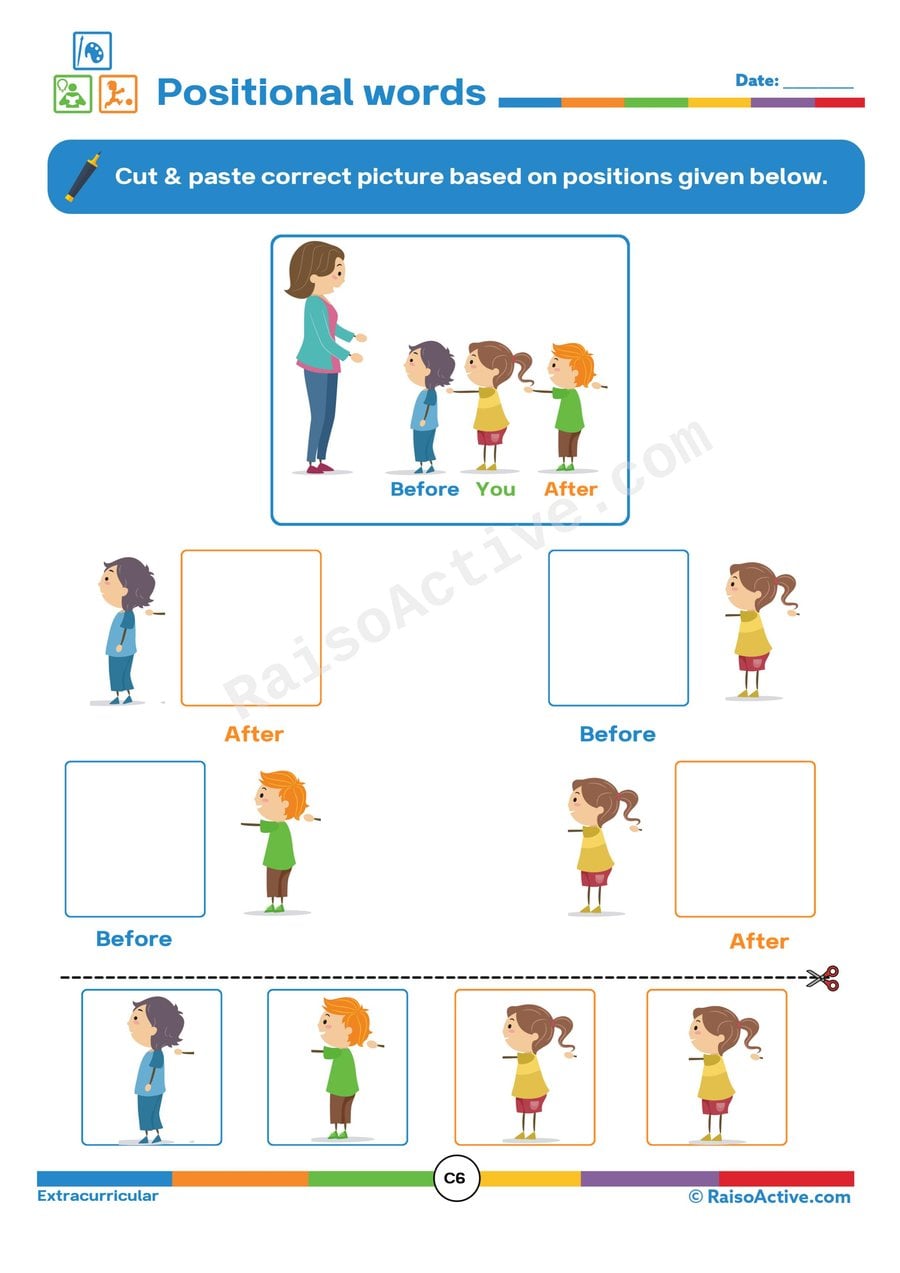
Positional Words Worksheet: Before, You, and After!
Ages 3-5 · Preschool–Pre-KAges 3-5 · Nursery–ReceptionAges 3-5 · Nursery–LKGAges 3-5
This cut-and-paste worksheet teaches children ages 3-5 to apply the positional words 'before' and 'after' to a sequence of objects or people, connecting an abstract language concept to a visual, hands-on task. Understanding order words like these is an important building block for later skills such as retelling stories in sequence and understanding time concepts like yesterday and tomorrow. Choosing and placing the correct picture also reinforces careful listening and following two-step directions.

Above and Below Worksheet: Identifying Objects' Positions
Ages 3-5 · Preschool–Pre-KAges 3-5 · Nursery–ReceptionAges 3-5 · Nursery–LKGAges 3-5
Understanding positional words like 'above' and 'below' helps children ages 3-5 build the spatial vocabulary that later supports following multi-step directions, reading maps, and even understanding math concepts like number lines. This worksheet asks children to look closely at a scene and judge the position of different objects relative to one another, which sharpens visual observation alongside language development. Marking each object with a tick or a cross also introduces early symbol-based recording, a small step toward more formal worksheet conventions used in later grades.

Inside or Outside Sorting Worksheet for Preschoolers
Ages 3-5 · Preschool–Pre-KAges 3-5 · Nursery–ReceptionAges 3-5 · Nursery–LKGAges 3-5
This worksheet teaches children ages 3-5 to apply the spatial concepts of 'inside' and 'outside' by sorting pictures of objects into the location where they typically belong. Deciding where an object usually belongs requires children to draw on their own real-world experience and apply it to a new sorting task, strengthening both spatial vocabulary and everyday reasoning. This kind of applied sorting is more demanding than simply naming inside or outside items when shown a single picture.
Guides for this topic

Number Formation Rhymes 0–9 and How to Fix Reversals
Original number formation rhymes for 0–9, the correct stroke order for each digit, why 3, 5 and 7 get reversed most often, and multisensory fixes that work.

Age-Appropriate Problem-Solving Activities: Building Critical Thinkers from the Ground Up
Discover fun, age-appropriate problem-solving activities for children ages 1-8. Build critical thinking, logic, and reasoning skills through play-based learning.
Critical Thinking Activities That Actually Work for Young Children: Building Tomorrow's Thinkers Today
Discover proven critical thinking activities for young children. Age-wise logic games, questioning techniques, and hands-on ideas to build thinking skills at home.
Reviews
Every worksheet for ages 4–6, no watermark
Members download the full library of 1,000+ worksheets and every activity pack without watermarks or daily limits. One year costs ₹999 in India or $20 elsewhere.
See membership plansOr download any worksheet free with a watermark (5 a day).