Shape Pattern Cut and Paste Worksheet for Preschoolers
This worksheet asks children ages 3-5 to identify the rule in a repeating shape pattern and select the correct cut-out shape to complete it, combining shape recognition with early sequencing logic. Recognizing and continuing patterns strengthens the kind of predictive thinking that later supports skip counting and multiplication concepts. Precisely cutting and placing each small shape piece also builds fine motor control.
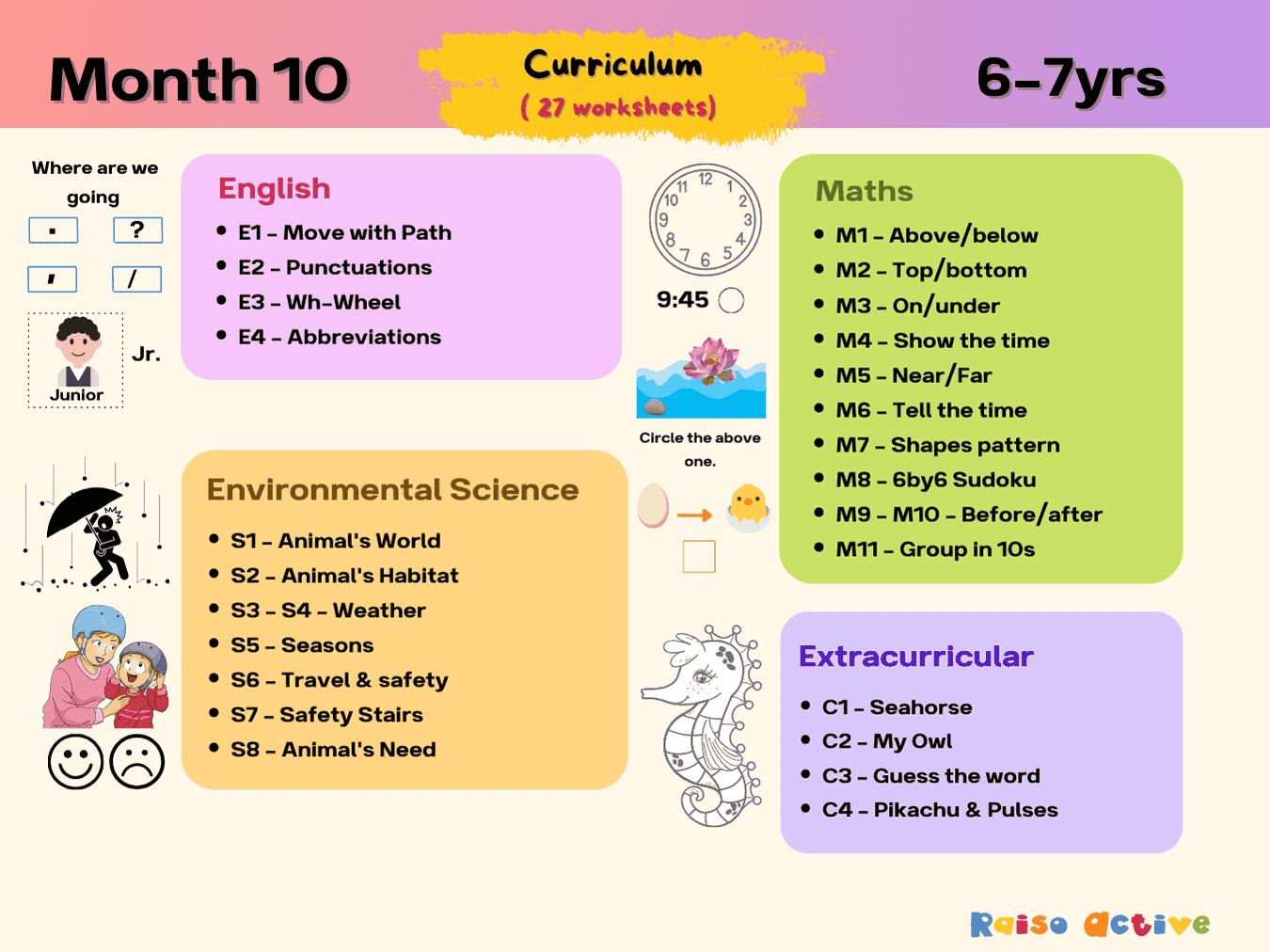
Part of the pack
Month 10: Learning & Development | Ages 6-7
This is page 14 of the pack. Ages 6-7 · Grade 1Ages 6-7 · Year 2Ages 6-7 · Class 1Ages 6-7
Curriculum
- Patterns > Patterns
How to use this worksheet
Look at the pattern in the first row together and say each shape name aloud in the order it appears. Ask your child what shape should logically come next before they search through the shape pieces at the bottom of the page. Have them cut out the correct shape and glue it into the blank box to complete that row's pattern. Repeat for each remaining pattern row, checking together that every completed sequence makes sense.
Materials needed
- Scissors
- Glue
- Pencil
Extension activities
- 1Create your own shape patterns using different colored shapes.
- 2Find shape patterns in the classroom or at home.
- 3Use the shapes to build a picture.
- 4String cut-out shapes onto yarn in a repeating pattern to make a simple garland.
- 5Play a pattern guessing game where you start a sequence and your child predicts the next three items.

Written by
Hemsweta Jain · Teacher Cheena
MBA and Early Childhood Educator, teaching since 2014 · Founder of RaisoActive, Mumbai
Every RaisoActive worksheet is designed and checked by the founder before publishing.
Published · Last reviewed
More from Month 10: Learning & Development | Ages 6-7
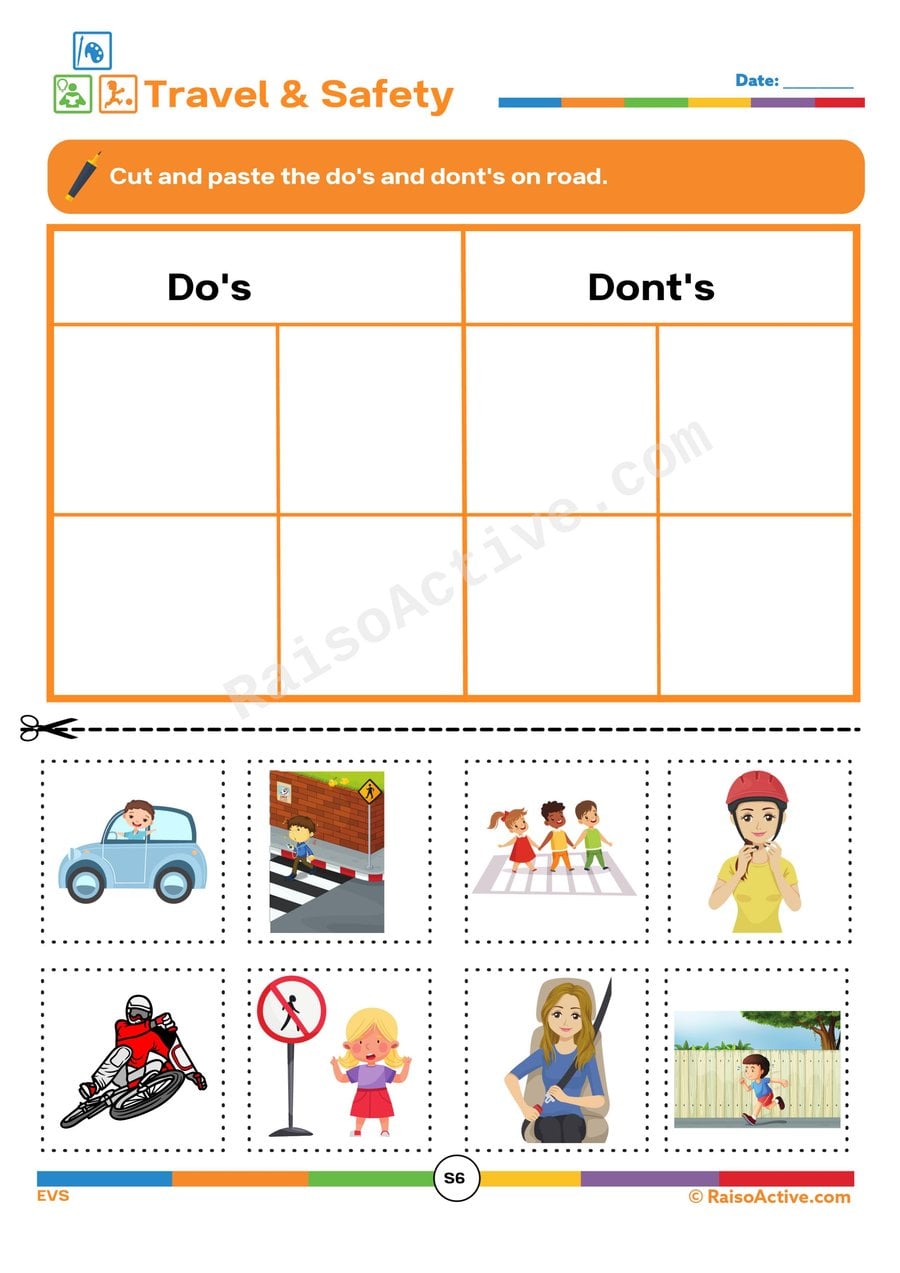
Road Safety Cut and Paste Worksheet for Kids
Ages 3-5 · Preschool–Pre-KAges 3-5 · Nursery–ReceptionAges 3-5 · Nursery–LKGAges 3-5
Children ages 3-5 practice identifying safe versus unsafe behaviors near roads and traffic by sorting pictures into 'Do's' and 'Don'ts' columns, building early safety awareness alongside basic classification skills. Talking through why each picture belongs in its column helps children move beyond simply memorizing rules toward actually understanding the reasoning behind road safety.

6x6 Sudoku Puzzle: Picture Matching Worksheet for Kids
Ages 4-6 · Pre-K–KindergartenAges 4-6 · Reception–Year 1Ages 4-6 · LKG–UKGAges 4-6
This picture-based sudoku worksheet introduces children ages 4-6 to an early form of logical deduction, teaching them that each picture can appear only once in every row and column of the grid. Working out where a picture must go by process of elimination builds problem-solving and visual-scanning skills well beyond simple matching. Cutting and placing the small picture pieces precisely also strengthens fine motor coordination.

Top and Bottom Fun: Observe and Tick the Correct Position!
Ages 3-5 · Preschool–Pre-KAges 3-5 · Nursery–ReceptionAges 3-5 · Nursery–LKGAges 3-5
Children ages 3-5 build spatial reasoning and positional vocabulary as they observe pictures and decide whether an object is positioned at the top or the bottom. Understanding positional words like 'top' and 'bottom' supports children's ability to follow multi-step directions and later helps with concepts like graphing and map reading.
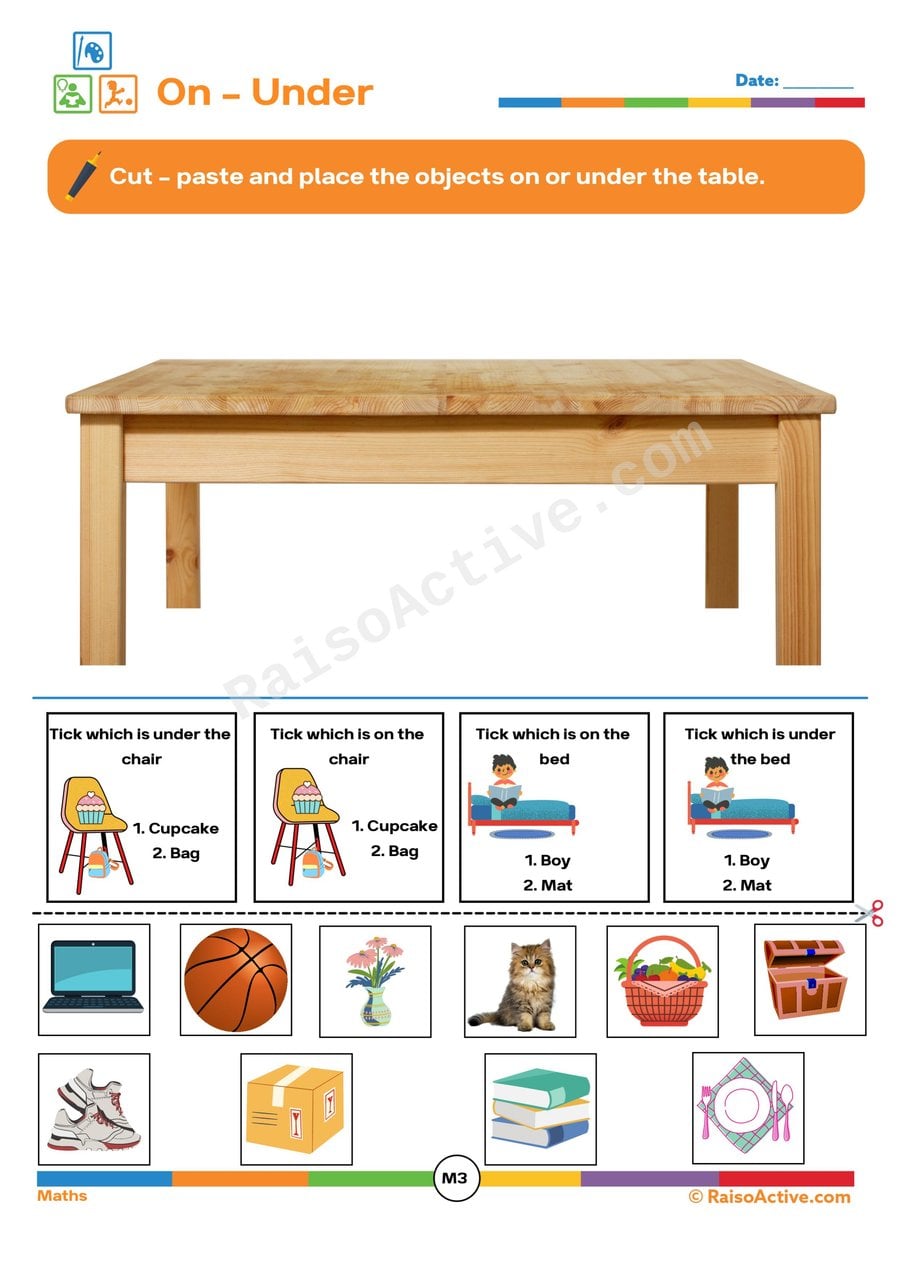
On and Under Worksheet: Table Placement Fun!
Ages 3-5 · Preschool–Pre-KAges 3-5 · Nursery–ReceptionAges 3-5 · Nursery–LKGAges 3-5
Cutting out pictures and gluing them either on or under a table teaches children ages 3-5 the spatial prepositions 'on' and 'under' by requiring them to physically place an object according to a specific instruction rather than just hearing the words. This hands-on placement task builds spatial reasoning and reinforces receptive language, since children must correctly interpret which word means which position before acting on it. Prepositions like these are often tricky to grasp through listening alone, so the visual, hands-on nature of this worksheet makes the concept concrete.

Near and Far Worksheet: Identifying and Connecting Objects
Ages 3-5 · Preschool–Pre-KAges 3-5 · Nursery–ReceptionAges 3-5 · Nursery–LKGAges 3-5
This worksheet introduces children ages 3-5 to the comparative spatial concepts of 'near' and 'far' by having them draw connecting lines based on relative distance in a picture. Understanding proximity words builds an early vocabulary foundation for describing the physical world, which later supports map reading and measurement concepts. The connect-the-line format also reinforces visual tracking and following printed instructions accurately.

Animal's World: Sorting Animals by Land, Water, and Air - Printable Worksheet
Ages 4-6 · Pre-K–KindergartenAges 4-6 · Reception–Year 1Ages 4-6 · LKG–UKGAges 4-6
This sorting worksheet teaches children ages 4-6 to classify animals into three habitat categories — land, water, and air — based on where each animal naturally lives and moves. Classifying by habitat rather than by appearance alone encourages children to think about an animal's features, like fins, wings, or legs, and connect them to function. This three-way sort is more complex than a simple two-category sort, building more advanced categorization skills.

Superhero Grouping in Tens: A Fun Counting Worksheet for Preschoolers!
Ages 4-5 · Pre-KAges 4-5 · ReceptionAges 4-5 · LKGAges 4-5
Using a superhero theme, this worksheet helps children ages 4-5 practice counting objects accurately and matching a counted group to its written number, an early step toward understanding place value through grouping in tens. Circling objects according to a given number afterward reinforces the connection between a numeral and the actual quantity it represents, rather than just reciting numbers in order.

Punctuation Fun: Practice Using Punctuation Marks!
Ages 4-6 · Pre-K–KindergartenAges 4-6 · Reception–Year 1Ages 4-6 · LKG–UKGAges 4-6
Choosing the correct punctuation mark to complete a sentence teaches children ages 4-6 that periods, question marks, and other marks change how a sentence should be read and understood, not just how it looks on paper. Matching sentences to their correct punctuation marks reinforces this by requiring children to recognize the tone or purpose of a sentence, whether it's a statement, a question, or an exclamation. This early grammar practice builds the foundation for reading with expression and writing complete, correctly punctuated sentences later on.
Related worksheets

3D Shapes Worksheet: Explore and Learn with Playdough!
Ages 4-6 · Pre-K–KindergartenAges 4-6 · Reception–Year 1Ages 4-6 · LKG–UKGAges 4-6
This worksheet teaches children ages 4-6 the basic components of 3D shapes — vertices, edges, and faces — by having them count each feature on shapes like cubes and cones, then build matching shapes out of playdough. Physically constructing a shape and counting its parts by hand builds a far deeper understanding of geometry than looking at flat pictures alone, since children can touch and rotate what they've made.

Clothing Pattern Match Worksheet for Preschoolers
Ages 3-5 · Preschool–Pre-KAges 3-5 · Nursery–ReceptionAges 3-5 · Nursery–LKGAges 3-5
This worksheet has children ages 3-5 study repeating patterns on clothing items — stripes, polka dots, or checks — and match each item to its identical twin, building visual discrimination and early pattern-sequencing skills. Distinguishing between similar-looking patterns also sharpens attention to detail, a skill that later supports letter and word recognition.
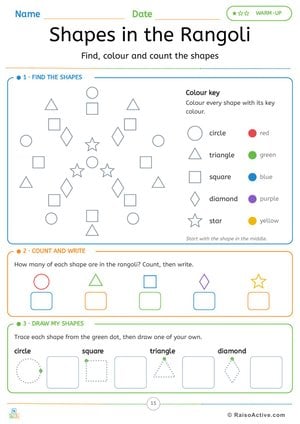
Shapes in the Rangoli: Find, Colour, Count and Trace
Ages 4-6 · Pre-K–KindergartenAges 4-6 · Reception–Year 1Ages 4-6 · LKG–UKGAges 4-6
Children colour five shapes in a rangoli using a colour key, count how many of each there are, then trace a circle, square, triangle and diamond and draw one of their own.

Kai and the Stuck Kite: A Feelings Story with a Pull-Tab Slider
Ages 4-6 · Pre-K–KindergartenAges 4-6 · Reception–Year 1Ages 4-6 · LKG–UKGAges 4-6
Children listen to a short story where Kai feels sad, then angry, then calm after balloon breaths, and finally happy. They answer at their own level and build a feelings slider.

Pinwheel Breathing Buddy: Make a Pinwheel and Spin It with Slow Breaths
Ages 4-6 · Pre-K–KindergartenAges 4-6 · Reception–Year 1Ages 4-6 · LKG–UKGAges 4-6
Children colour and build a pinwheel, then use it to feel the difference between fast and slow breaths. Three breath games ask which breath spins it smoothly and how they feel after.
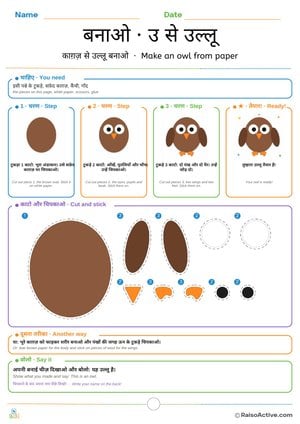
Make a Paper Owl: Hindi Letter उ Craft | बनाओ · उ से उल्लू
Ages 3-7 · Preschool–Grade 1Ages 3-7 · Nursery–Year 2Ages 3-7 · Nursery–Class 1Ages 3-7
Children cut out the pieces, put them together following three step pictures and make a paper owl. Saying the word उल्लू as they make it links the sound उ to something they built themselves.

My Pocket Calm Book: A Mini Book of Six Calm Tools
Ages 4-6 · Pre-K–KindergartenAges 4-6 · Reception–Year 1Ages 4-6 · LKG–UKGAges 4-6
Children make a pocket-sized book with six calm tools: balloon breath, flower and candle, turtle pause, squeeze and let go, shake it out, and hug and talk. They tick 'I tried it!' as they practise.

Navratri Mix and Pattern: Mixing Colours and Bead Patterns
Ages 4-6 · Pre-K–KindergartenAges 4-6 · Reception–Year 1Ages 4-6 · LKG–UKGAges 4-6
Children learn which two colours mix to make green, orange, purple and grey, continue colour patterns on beads and read a simple chart to answer questions.
Guides for this topic

Pre-Writing Strokes in Order: From Standing Lines to Loops (With Printable Patterns)
The developmental order of pre-writing strokes, from vertical lines to loops, and why practicing them in sequence makes letter formation much easier to learn.

Age-Appropriate Problem-Solving Activities: Building Critical Thinkers from the Ground Up
Discover fun, age-appropriate problem-solving activities for children ages 1-8. Build critical thinking, logic, and reasoning skills through play-based learning.

Fostering Creativity in Structured Learning: The Perfect Balance for Young Minds
Learn how to blend creativity with structured learning for children ages 1-8. Practical strategies, activities, and printable worksheets for parents and teachers.
Reviews
Every worksheet for ages 3–5, no watermark
Members download the full library of 1,000+ worksheets and every activity pack without watermarks or daily limits. One year costs ₹999 in India or $20 elsewhere.
See membership plansOr download any worksheet free with a watermark (5 a day).