Superhero Grouping in Tens: A Fun Counting Worksheet for Preschoolers!
Using a superhero theme, this worksheet helps children ages 4-5 practice counting objects accurately and matching a counted group to its written number, an early step toward understanding place value through grouping in tens. Circling objects according to a given number afterward reinforces the connection between a numeral and the actual quantity it represents, rather than just reciting numbers in order.
Part of the pack
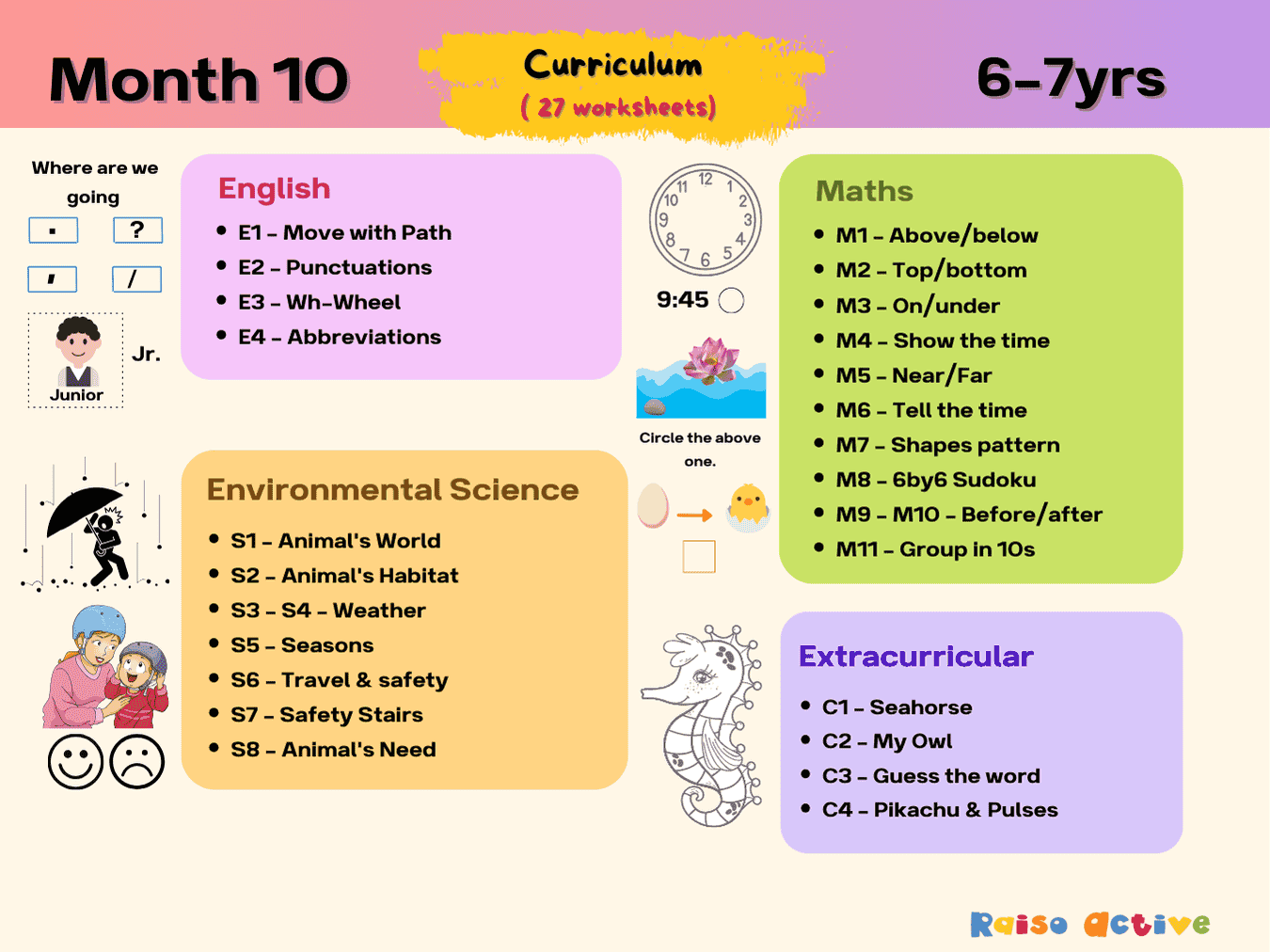
Month 10: Learning & Development | Ages 6-7
This is page 18 of the pack. Ages 6-7 · Grade 1Ages 6-7 · Year 2Ages 6-7 · Class 1Ages 6-7
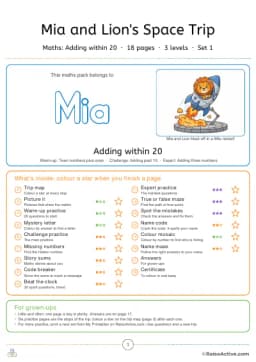
Made for your child
Counting to 10, made for your child
A maths pack with your child's name in it: pictures that explain, practice at three levels, puzzles and story sums about them. Print a new set whenever they finish.
Make a maths packFree preview · free for members
Curriculum
- Number Sense > Counting 1-20
How to use this worksheet
Look at one group of superhero objects at a time and count them aloud together, pointing to each one as you go. Match the counted group to the correct number written on the right side of the page. Once matching is complete, look at the circling section — read the number given and have your child circle that exact quantity of objects, counting carefully as they circle to avoid circling too many or too few.
Materials needed
- Pencil
- Crayons
Extension activities
- 1Have your child find and count groups of ten toys or objects around the house.
- 2Use small manipulatives, like coins or blocks, to physically build groups of ten and count them together.
- 3Draw different superhero objects and have your child group them into sets of ten, counting as they go.
- 4Play a counting relay where your child collects and counts out a specific number of items as fast as they can.

Written by
Hemsweta Jain · Teacher Cheena
MBA and Early Childhood Educator, teaching since 2014 · Founder of RaisoActive, Mumbai
Every RaisoActive worksheet is designed and checked by the founder before publishing.
Published · Last reviewed
More from Month 10: Learning & Development | Ages 6-7

Safety Stairs Worksheet: Matching Traffic Signs and Following Directions
Ages 3-5 · Preschool–Pre-KAges 3-5 · Nursery–ReceptionAges 3-5 · Nursery–LKGAges 3-5
This worksheet builds road safety awareness in children ages 3-5 while also practicing sign recognition, visual matching, and following a multi-step path from start to finish. Matching sign names to sign shapes teaches children to recognize traffic signs by both their look and their meaning, a real-world reading skill that supports their safety once they're out walking or biking.

Guess the Word: Cut and Paste Worksheet for Early Learners
Ages 3-5 · Preschool–Pre-KAges 3-5 · Nursery–ReceptionAges 3-5 · Nursery–LKGAges 3-5
This cut-and-paste activity asks children ages 3-5 to look at picture clues, say the words aloud, and paste the correct picture to complete a combined word, giving them early practice in visual word-building and vocabulary expansion. Working with picture combinations helps children understand that some words are made by joining two smaller ideas together, a concept that supports later compound word recognition in reading. Saying each word out loud before pasting also builds the habit of connecting spoken language to printed or pictured words.

Near and Far Worksheet: Identifying and Connecting Objects
Ages 3-5 · Preschool–Pre-KAges 3-5 · Nursery–ReceptionAges 3-5 · Nursery–LKGAges 3-5
This worksheet introduces children ages 3-5 to the comparative spatial concepts of 'near' and 'far' by having them draw connecting lines based on relative distance in a picture. Understanding proximity words builds an early vocabulary foundation for describing the physical world, which later supports map reading and measurement concepts. The connect-the-line format also reinforces visual tracking and following printed instructions accurately.
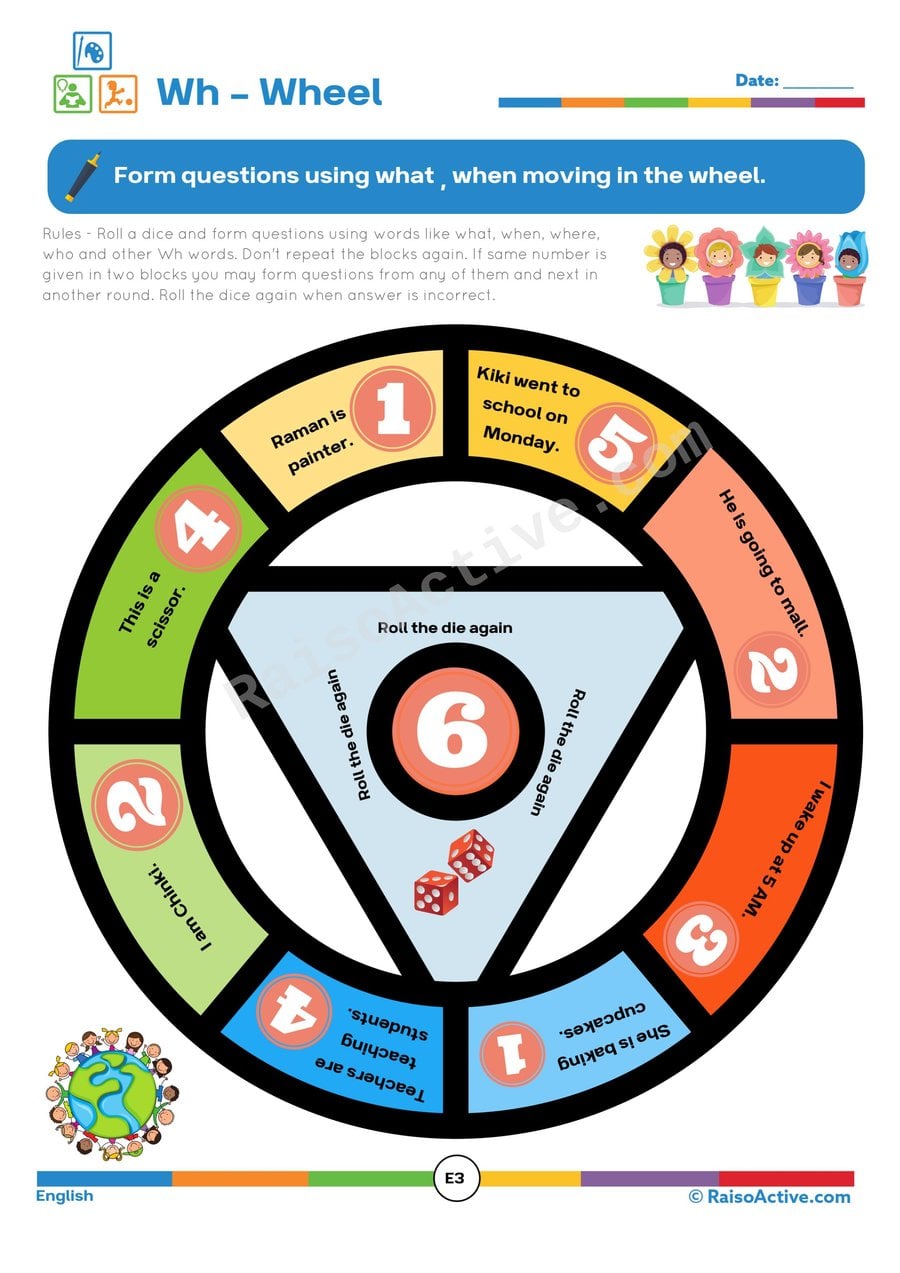
Wh- Wheel Worksheet: Question Formation Fun!
Ages 4-6 · Pre-K–KindergartenAges 4-6 · Reception–Year 1Ages 4-6 · LKG–UKGAges 4-6
This wheel activity helps children ages 4-6 practice forming questions using the five 'wh-' words — what, when, where, who, and why — a key building block for both conversational language and reading comprehension. Rolling a die to land on a random prompt keeps the practice playful and unpredictable, encouraging children to generate original questions rather than repeating memorized ones.
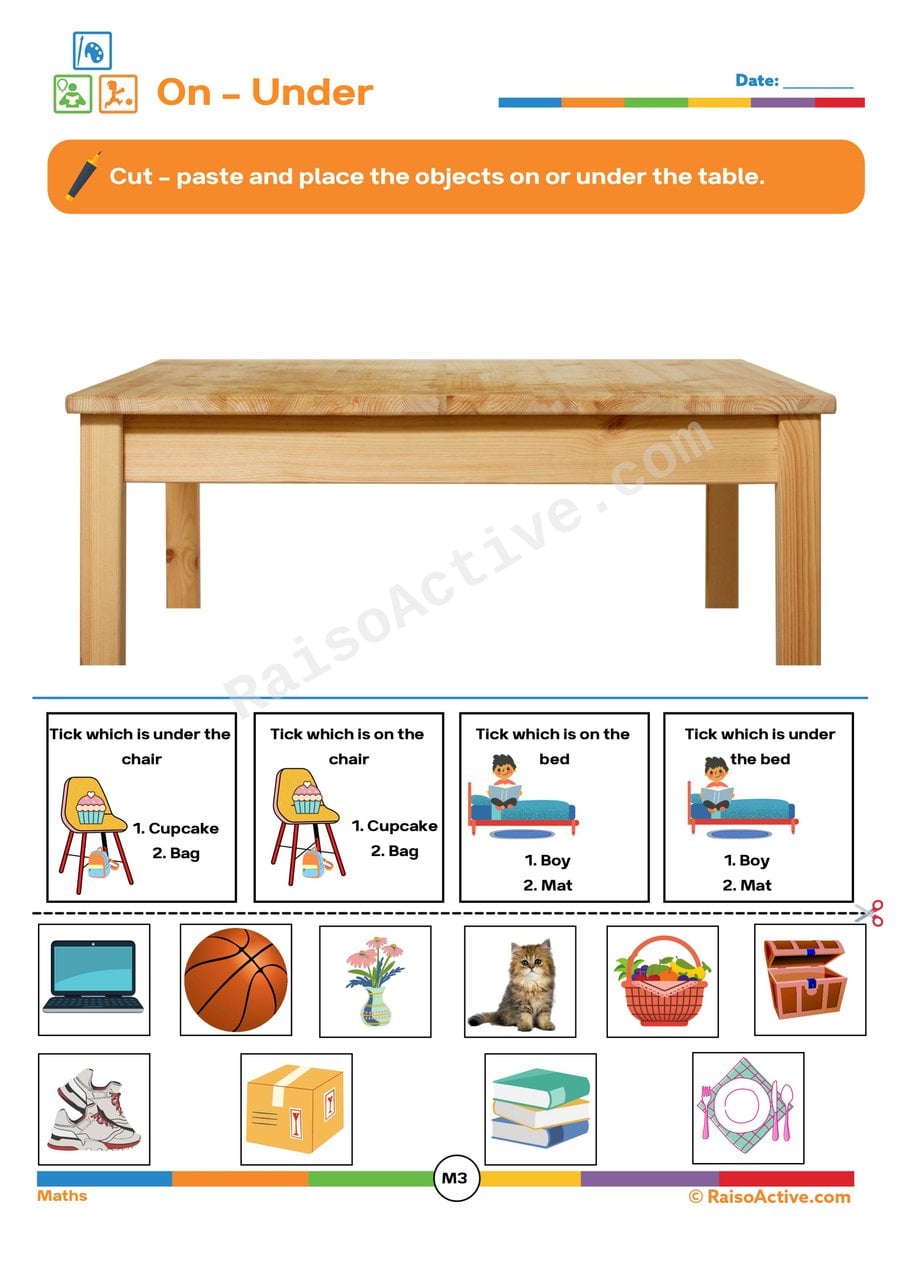
On and Under Worksheet: Table Placement Fun!
Ages 3-5 · Preschool–Pre-KAges 3-5 · Nursery–ReceptionAges 3-5 · Nursery–LKGAges 3-5
Cutting out pictures and gluing them either on or under a table teaches children ages 3-5 the spatial prepositions 'on' and 'under' by requiring them to physically place an object according to a specific instruction rather than just hearing the words. This hands-on placement task builds spatial reasoning and reinforces receptive language, since children must correctly interpret which word means which position before acting on it. Prepositions like these are often tricky to grasp through listening alone, so the visual, hands-on nature of this worksheet makes the concept concrete.

Punctuation Fun: Practice Using Punctuation Marks!
Ages 4-6 · Pre-K–KindergartenAges 4-6 · Reception–Year 1Ages 4-6 · LKG–UKGAges 4-6
Choosing the correct punctuation mark to complete a sentence teaches children ages 4-6 that periods, question marks, and other marks change how a sentence should be read and understood, not just how it looks on paper. Matching sentences to their correct punctuation marks reinforces this by requiring children to recognize the tone or purpose of a sentence, whether it's a statement, a question, or an exclamation. This early grammar practice builds the foundation for reading with expression and writing complete, correctly punctuated sentences later on.

Weather Worksheet: Match the Weather to the Number!
Ages 3-5 · Preschool–Pre-KAges 3-5 · Nursery–ReceptionAges 3-5 · Nursery–LKGAges 3-5
This matching activity asks children ages 3-5 to connect weather pictures — sun, rain, clouds, snow — to numbered labels, combining early reading of weather vocabulary with number-symbol association. Recognizing that a picture, a word, and a number can all represent the same idea builds the kind of flexible symbolic thinking children will later use in reading and math alike. Weather is also a topic children experience daily, which makes the vocabulary immediately meaningful rather than abstract.

Shape Pattern Cut and Paste Worksheet for Preschoolers
Ages 3-5 · Preschool–Pre-KAges 3-5 · Nursery–ReceptionAges 3-5 · Nursery–LKGAges 3-5
This worksheet asks children ages 3-5 to identify the rule in a repeating shape pattern and select the correct cut-out shape to complete it, combining shape recognition with early sequencing logic. Recognizing and continuing patterns strengthens the kind of predictive thinking that later supports skip counting and multiplication concepts. Precisely cutting and placing each small shape piece also builds fine motor control.
Related worksheets
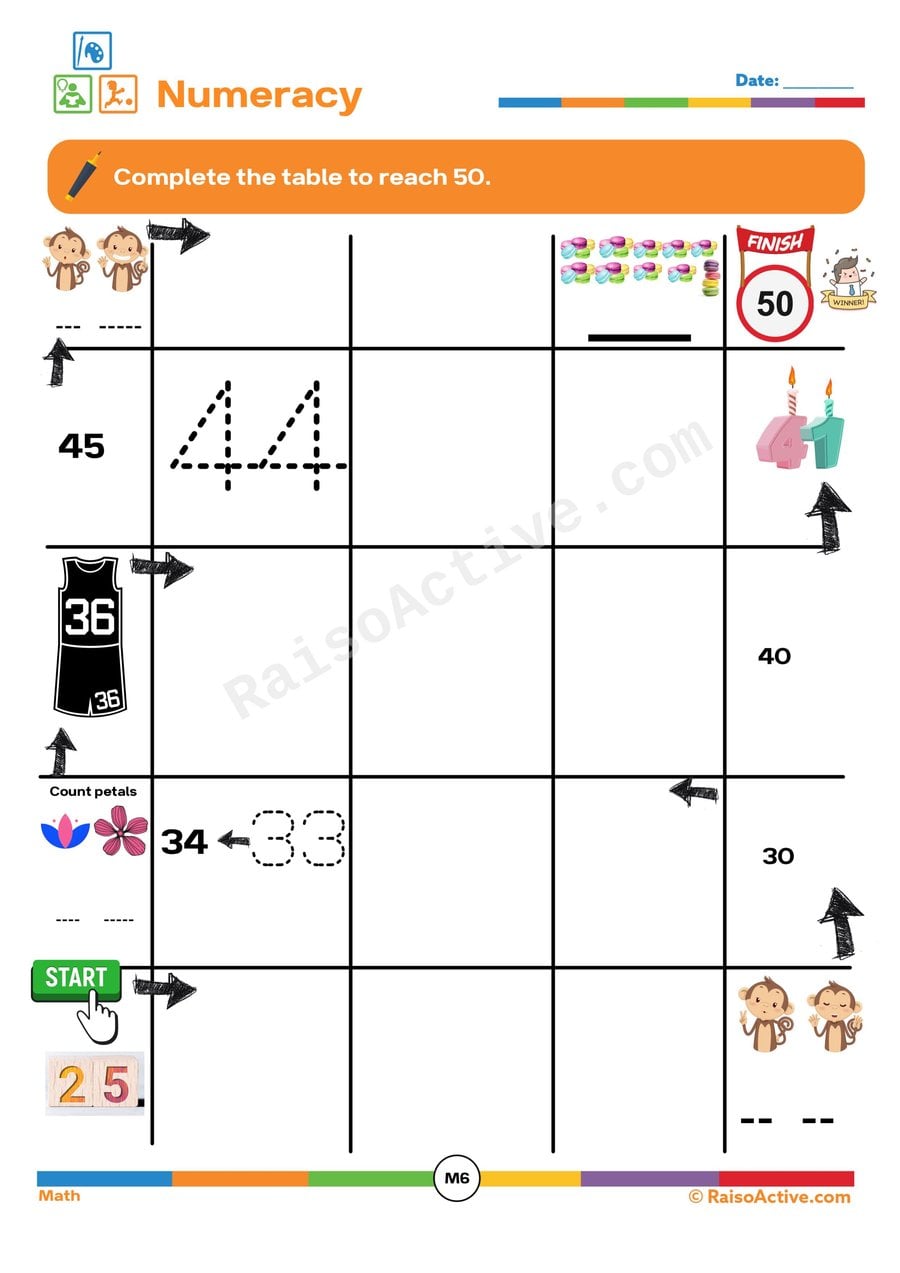
Reach 50! A Fun Numeracy Worksheet for Kids
Ages 4-5 · Pre-KAges 4-5 · ReceptionAges 4-5 · LKGAges 4-5
Filling in a number sequence toward a target like 50 gives children ages 4-5 practice with number order and pattern continuation over a longer stretch than they might attempt in casual counting, building stamina alongside numeracy. Starting partway through the sequence, at 25, also asks children to pick up counting from a non-zero starting point, which is a slightly more advanced skill than counting from one every time. Successfully completing the full path to 50 gives children a strong, visible sense of accomplishment tied to a meaningful numerical milestone.

Big and Small Fish Counting Worksheet for Preschoolers
Ages 3-5 · Preschool–Pre-KAges 3-5 · Nursery–ReceptionAges 3-5 · Nursery–LKGAges 3-5
This worksheet helps children aged 3-5 develop crucial early numeracy by practicing one-to-one correspondence as they count specific groups of fish. Children will also strengthen their observation skills by distinguishing between 'big' and 'small' fish, a foundational step in understanding comparative sizes and classification. This combination builds both number sense and pre-mathematical reasoning.

Caterpillar Counting Adventure: Connect the Dots Worksheet
Ages 4-6 · Pre-K–KindergartenAges 4-6 · Reception–Year 1Ages 4-6 · LKG–UKGAges 4-6
Ages 4-6 practice counting in sequence up to 50 by connecting numbered dots that form a caterpillar shape, combining number recognition with fine motor line control. Counting this high in order builds confidence with larger numbers beyond the more common 1-20 range most preschool worksheets cover. The connect-the-dots format also rewards persistence, since the picture only fully forms once every number has been found correctly.

Count the Owls and Chicks! A Fun Counting Worksheet for Preschoolers
Ages 3-5 · Preschool–Pre-KAges 3-5 · Nursery–ReceptionAges 3-5 · Nursery–LKGAges 3-5
Counting groups of owls and chicks and circling the matching number builds one-to-one correspondence for children ages 3-5, the core skill of touching or pointing to each item exactly once while counting. Working with two different characters in the same activity also teaches children to reset their count for each new group rather than carrying a total over, an easy mistake at this age. This repeated counting-and-matching format across the page builds both accuracy and counting stamina.
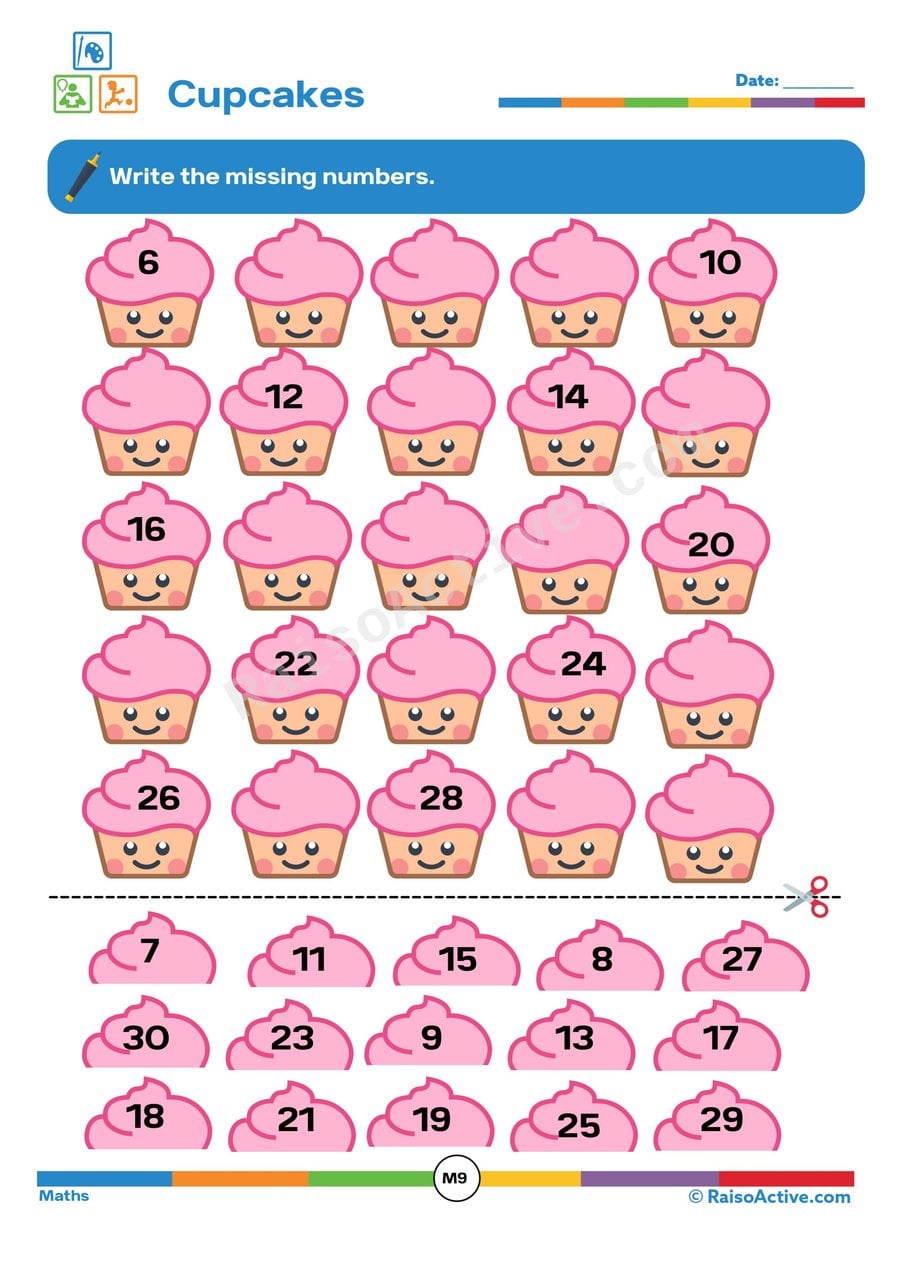
Cupcake Counting Worksheet: Missing Numbers!
Ages 4-6 · Pre-K–KindergartenAges 4-6 · Reception–Year 1Ages 4-6 · LKG–UKGAges 4-6
This worksheet strengthens number sequencing for children ages 4-6 as they study a row of numbered cupcakes and figure out which numbers are missing from the sequence, then write them in. Identifying a gap in a number sequence requires understanding the pattern of counting well enough to predict what's missing, a step beyond simply counting forward.

Above and Below the Sea Worksheet: Counting Objects
Ages 3-5 · Preschool–Pre-KAges 3-5 · Nursery–ReceptionAges 3-5 · Nursery–LKGAges 3-5
This worksheet combines counting practice with the positional concepts of 'above' and 'below,' asking children to count separate groups of objects located in different parts of an ocean scene. For ages 3-5, connecting counting to spatial position adds an extra layer of thinking beyond simple one-to-one counting, reinforcing both numeracy and early positional vocabulary.
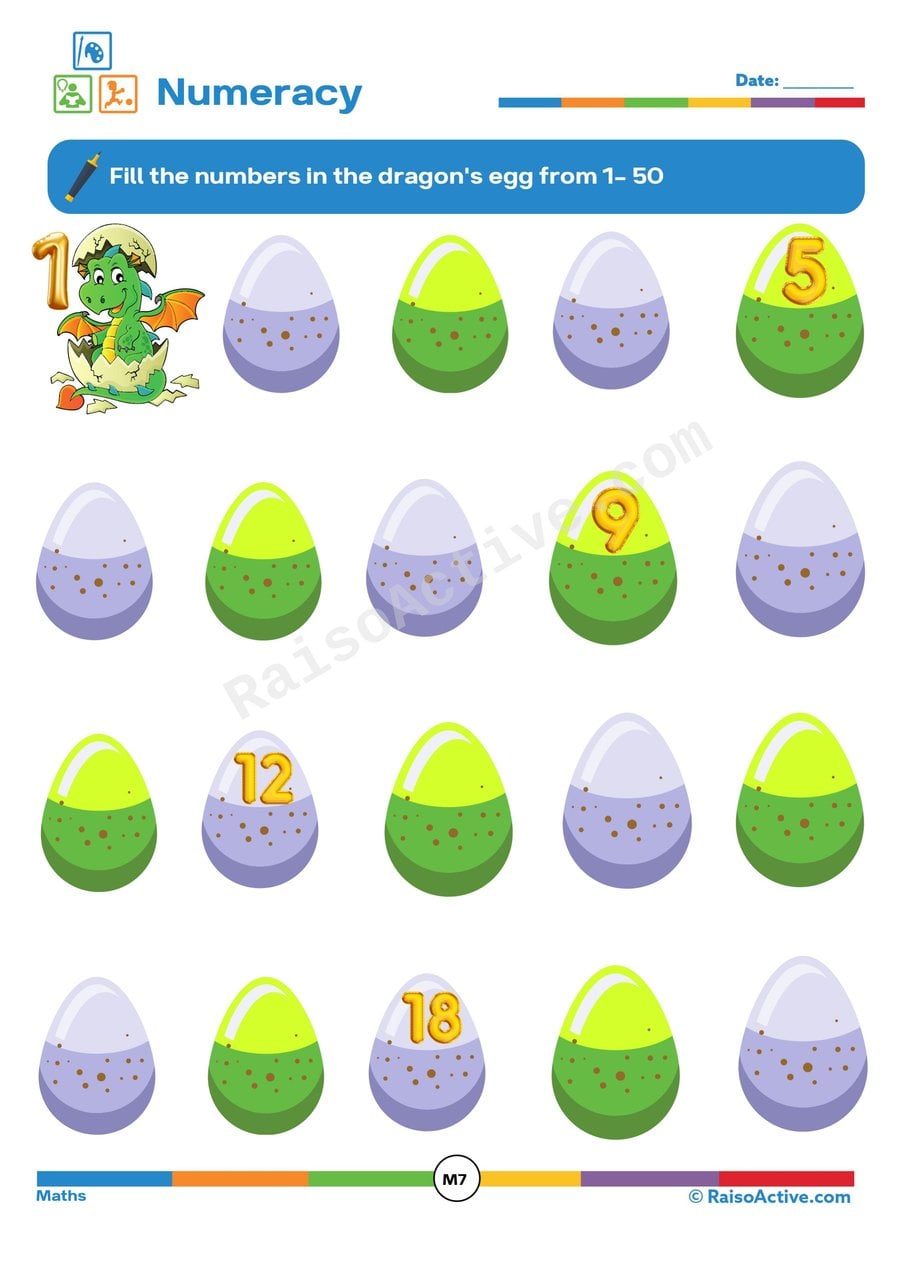
Dragon Egg Numbers: Counting to 50 Worksheet
Ages 4-6 · Pre-K–KindergartenAges 4-6 · Reception–Year 1Ages 4-6 · LKG–UKGAges 4-6
Filling in the missing numbers across a run of dragon eggs stretches a 4-6 year old's counting range well past the more common 1-20 practice, into territory where number patterns — like how every decade starts a new '_1, _2, _3' pattern — start to become visible. It's a strong bridge activity between rote counting and genuinely understanding how the number system is built.

Count and Match: A Fun Numeracy Worksheet for Preschoolers!
Ages 3-5 · Preschool–Pre-KAges 3-5 · Nursery–ReceptionAges 3-5 · Nursery–LKGAges 3-5
This worksheet combines two foundational counting skills for children ages 3-5: counting a group of objects and writing the total, and then matching that same quantity to an equivalent group elsewhere on the page. Writing the numeral after counting reinforces that a number symbol represents an actual quantity, not just a word to memorize. Matching equal groups afterward adds an extra layer of number sense, showing children that the same quantity can look different depending on what's being counted.
Guides for this topic

Number Formation Rhymes 0–9 and How to Fix Reversals
Original number formation rhymes for 0–9, the correct stroke order for each digit, why 3, 5 and 7 get reversed most often, and multisensory fixes that work.

Age-Appropriate Problem-Solving Activities: Building Critical Thinkers from the Ground Up
Discover fun, age-appropriate problem-solving activities for children ages 1-8. Build critical thinking, logic, and reasoning skills through play-based learning.
Critical Thinking Activities That Actually Work for Young Children: Building Tomorrow's Thinkers Today
Discover proven critical thinking activities for young children. Age-wise logic games, questioning techniques, and hands-on ideas to build thinking skills at home.
Reviews
Every worksheet for ages 4–5, no watermark
Members download the full library of 1,000+ worksheets and every activity pack without watermarks or daily limits. One year costs ₹999 in India or $20 elsewhere.
See membership plansOr download any worksheet free with a watermark (5 a day).