Count and Match: A Fun Numeracy Worksheet for Preschoolers!
This worksheet combines two foundational counting skills for children ages 3-5: counting a group of objects and writing the total, and then matching that same quantity to an equivalent group elsewhere on the page. Writing the numeral after counting reinforces that a number symbol represents an actual quantity, not just a word to memorize. Matching equal groups afterward adds an extra layer of number sense, showing children that the same quantity can look different depending on what's being counted.
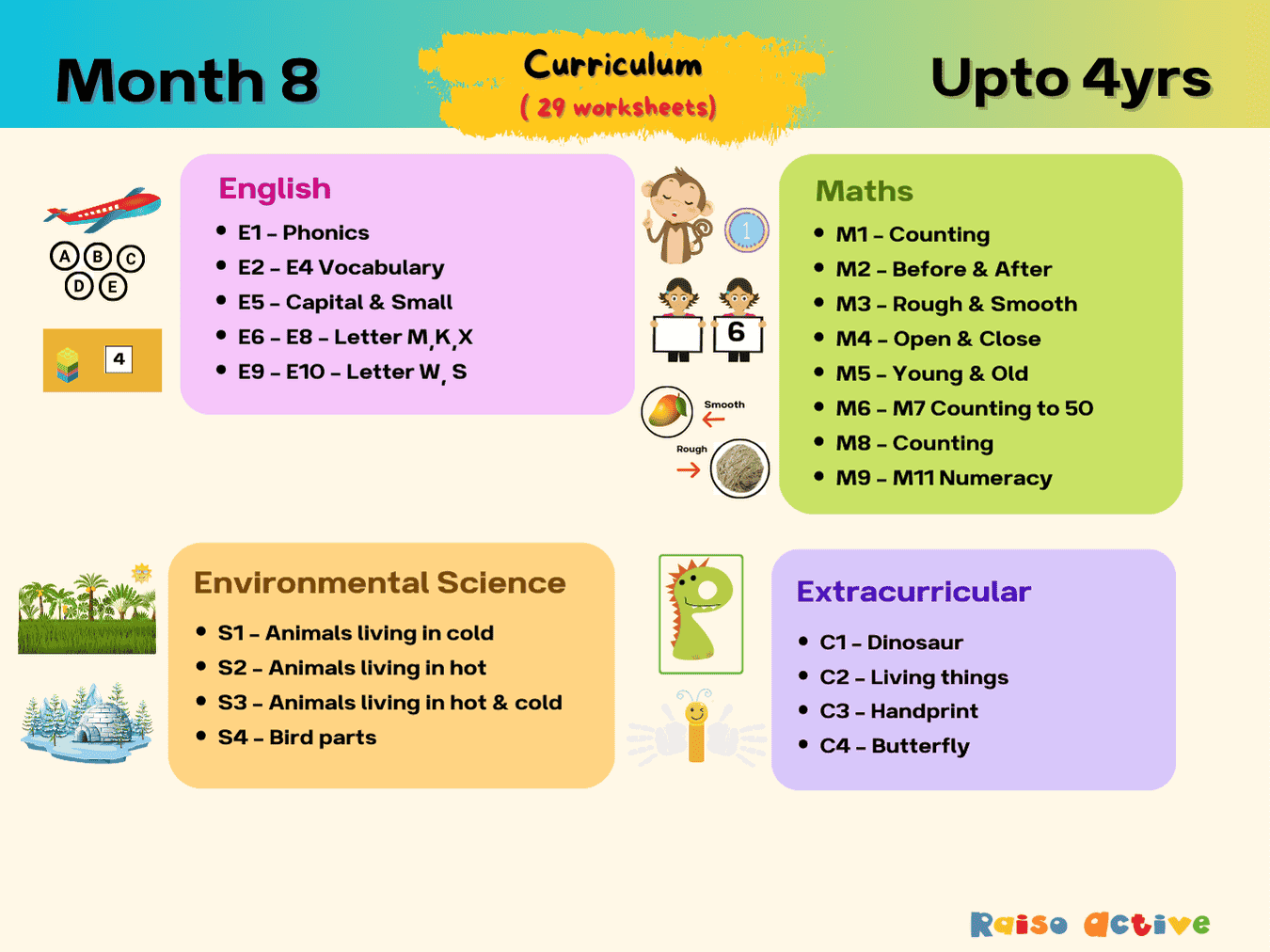
Part of the pack
Month 8: Phonics, Math, Science, Creativity | Ages Up to 4
This is page 24 of the pack. Ages 3-5 · Preschool–Pre-KAges 3-5 · Nursery–ReceptionAges 3-5 · Nursery–LKGAges 3-5

Made for your child
Counting to 10, made for your child
A maths pack with your child's name in it: pictures that explain, practice at three levels, puzzles and story sums about them. Print a new set whenever they finish.
Make a maths packFree preview · free for members
Curriculum
- Number Sense > Counting 1-20
How to use this worksheet
Have your child count the objects in the first group out loud, touching each one as they count to avoid double-counting. Ask them to write the total number in the box below that group. Repeat this process for each group of objects on the left side of the page. Once all the totals are written, have your child match each group on the left to the group on the right that has the same number of objects.
Materials needed
- Pencil
- Eraser
Extension activities
- 1Have the child draw their own sets of objects and write the corresponding numbers underneath.
- 2Use real-life objects to practice counting and matching, like matching a set of five spoons to five forks.
- 3Play a simple counting bingo game using small numbers your child has already mastered.
- 4Sort a mixed pile of buttons or beads into small groups and count each group together.

Written by
Hemsweta Jain · Teacher Cheena
MBA and Early Childhood Educator, teaching since 2014 · Founder of RaisoActive, Mumbai
Every RaisoActive worksheet is designed and checked by the founder before publishing.
Published · Last reviewed
More from Month 8: Phonics, Math, Science, Creativity | Ages Up to 4

Living Things: Color the Smiles! A Fun Sorting Worksheet
Ages 3-5 · Preschool–Pre-KAges 3-5 · Nursery–ReceptionAges 3-5 · Nursery–LKGAges 3-5
Preschoolers ages 3-5 build foundational science classification skills by distinguishing living things from non-living things, indicated by coloring a smiley face only on the items that are alive. This concept requires children to think beyond appearance and consider whether something grows, breathes, or needs food, an abstract but essential early science idea. The playful smiley-face format keeps a genuinely tricky classification concept approachable and fun.
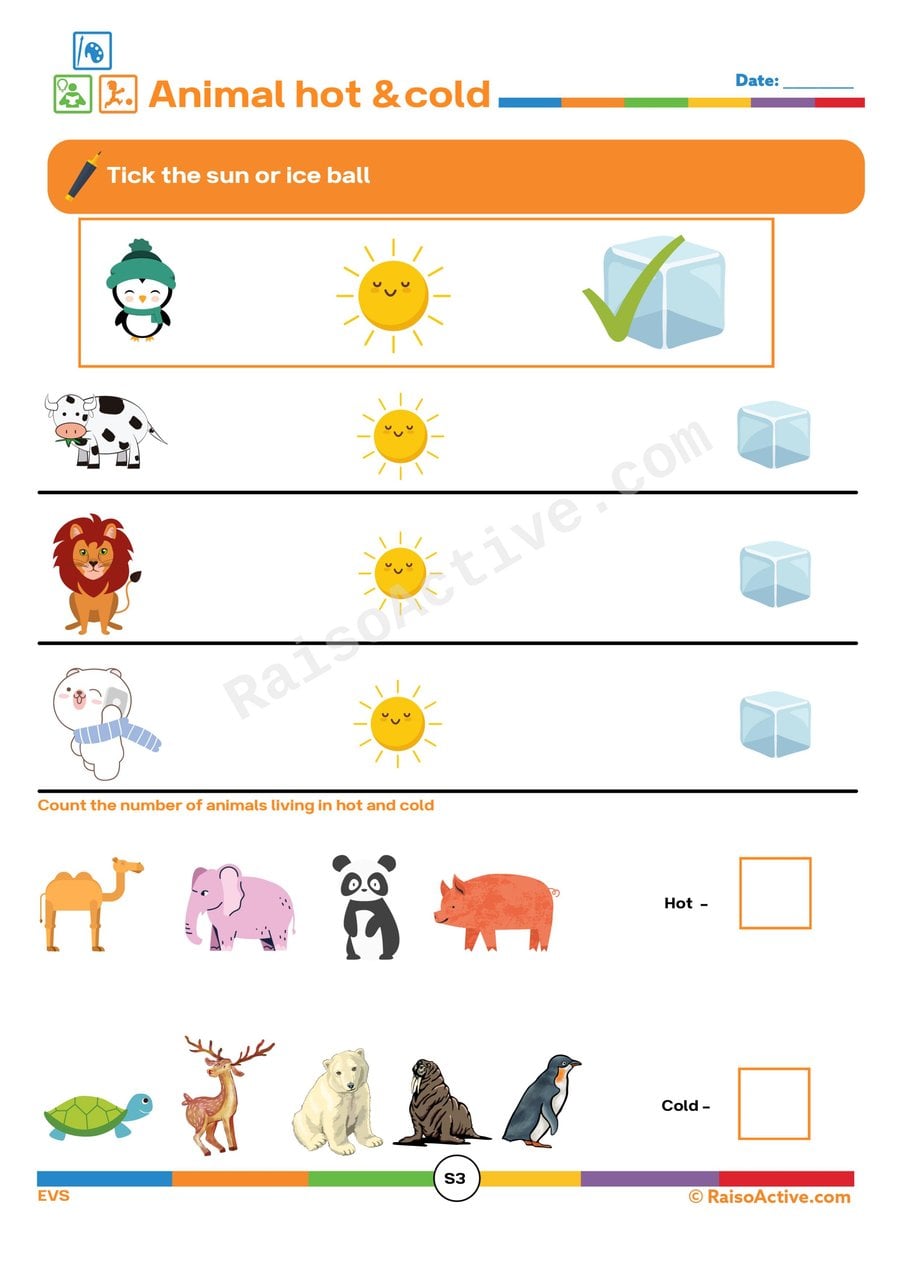
Animal Hot and Cold Worksheet for Preschoolers
Ages 3-5 · Preschool–Pre-KAges 3-5 · Nursery–ReceptionAges 3-5 · Nursery–LKGAges 3-5
This worksheet asks children to reason about which environment, hot or cold, best suits a given animal, then apply a counting task on top of that sorting decision. Combining habitat reasoning with counting practice keeps two important skill areas, science classification and numeracy, active in the same activity, which helps preschoolers see connections across subjects rather than treating them separately.

Dino Shapes: Cut and Paste Worksheet for Preschoolers
Ages 3-5 · Preschool–Pre-KAges 3-5 · Nursery–ReceptionAges 3-5 · Nursery–LKGAges 3-5
Preschoolers ages 3-5 practice recognizing and counting triangles while cutting them out and pasting them onto a dinosaur outline to complete the picture. This combines shape identification with precise cutting and gluing, building fine motor control alongside early geometry skills. Counting the triangles before cutting also reinforces one-to-one correspondence in a playful, purposeful context.

Bird Parts Cut and Paste Worksheet for Preschoolers
Ages 3-5 · Preschool–Pre-KAges 3-5 · Nursery–ReceptionAges 3-5 · Nursery–LKGAges 3-5
Children ages 3-5 learn the names of specific bird body parts — such as wings, beak, tail, and feathers — by cutting out labels and pasting them next to the correct part of a bird illustration. This activity builds early scientific vocabulary and observational skills, teaching children to notice distinct features rather than viewing an animal as one shape. The cutting and pasting also develops the scissor control and hand-eye coordination needed for fine motor growth.

Open and Close Worksheet: Circle the Open and Closed Objects!
Ages 3-5 · Preschool–Pre-KAges 3-5 · Nursery–ReceptionAges 3-5 · Nursery–LKGAges 3-5
Children ages 3-5 build early categorization skills by identifying whether pictured objects, like a door, a box, or a jar, are open or closed. This concept requires observing a physical state and applying a descriptive word correctly, an important early step in building descriptive vocabulary. Recognizing open versus closed also has practical safety value, connecting worksheet learning to real-world awareness.

Caterpillar Counting Adventure: Connect the Dots Worksheet
Ages 4-6 · Pre-K–KindergartenAges 4-6 · Reception–Year 1Ages 4-6 · LKG–UKGAges 4-6
Ages 4-6 practice counting in sequence up to 50 by connecting numbered dots that form a caterpillar shape, combining number recognition with fine motor line control. Counting this high in order builds confidence with larger numbers beyond the more common 1-20 range most preschool worksheets cover. The connect-the-dots format also rewards persistence, since the picture only fully forms once every number has been found correctly.
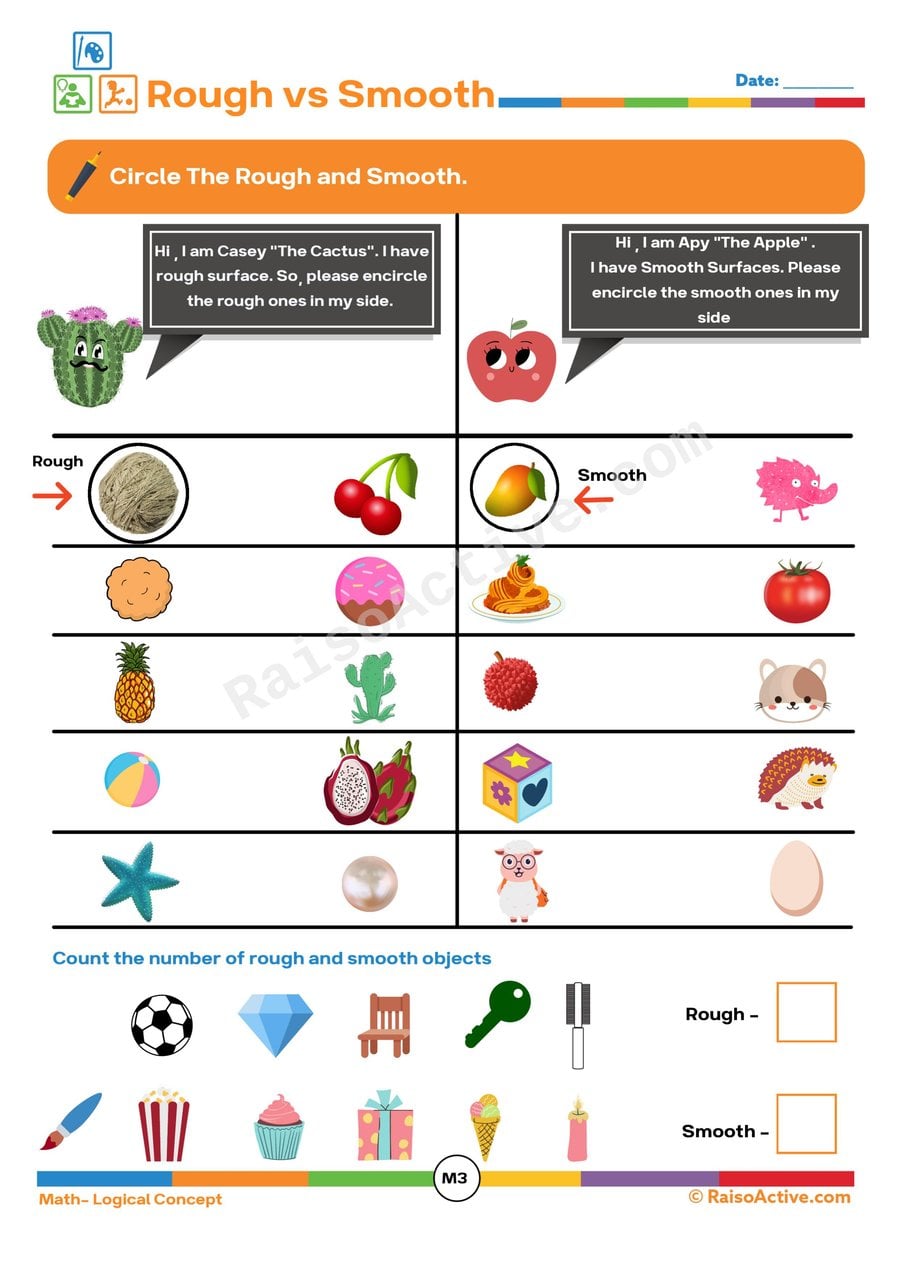
Rough vs. Smooth Worksheet: Circle and Count!
Ages 3-5 · Preschool–Pre-KAges 3-5 · Nursery–ReceptionAges 3-5 · Nursery–LKGAges 3-5
Preschoolers ages 3-5 build early scientific observation by identifying and comparing rough versus smooth textures among a set of pictured objects, engaging their sense of touch conceptually even through a visual worksheet. Counting the rough and smooth objects afterward links this sensory classification to basic number practice. Learning to sort by texture is an early step toward broader material-properties understanding in science.

Phonics Fun: Match the Letter to the Object Worksheet
Ages 4-5 · Pre-KAges 4-5 · ReceptionAges 4-5 · LKGAges 4-5
This worksheet asks children to connect a printed letter to a picture whose name starts with that letter's sound, then reinforces the connection a second time through color-coded circles, a repetition that research on phonics instruction shows helps move sound-letter pairs from short-term recognition into lasting memory. For four and five year olds, this dual task also builds sustained attention across a slightly longer worksheet than a single matching exercise.
Related worksheets

Count and Circle: Counting Objects Worksheet for Preschoolers
Ages 3-5 · Preschool–Pre-KAges 3-5 · Nursery–ReceptionAges 3-5 · Nursery–LKGAges 3-5
Counting a group of objects and then matching that quantity to its written numeral is the heart of early numeracy for ages 3-5, and this worksheet makes children complete both halves of that skill in one task rather than just counting aloud. Circling the correct number among several choices also adds a light decision-making step, requiring them to compare their counted total against multiple printed numbers. This combination of counting and number recognition is foundational for all later arithmetic.

Count and Write: Fun Counting Worksheet for Preschoolers
Ages 3-5 · Preschool–Pre-KAges 3-5 · Nursery–ReceptionAges 3-5 · Nursery–LKGAges 3-5
This counting worksheet has children ages 3-5 count small groups of objects and write the matching numeral in a box, directly linking the physical act of counting to the written symbol that represents a quantity. Writing the number immediately after counting — rather than just counting aloud — reinforces that numerals are a shorthand for real, countable amounts.

Count the Owls and Chicks! A Fun Counting Worksheet for Preschoolers
Ages 3-5 · Preschool–Pre-KAges 3-5 · Nursery–ReceptionAges 3-5 · Nursery–LKGAges 3-5
Counting groups of owls and chicks and circling the matching number builds one-to-one correspondence for children ages 3-5, the core skill of touching or pointing to each item exactly once while counting. Working with two different characters in the same activity also teaches children to reset their count for each new group rather than carrying a total over, an easy mistake at this age. This repeated counting-and-matching format across the page builds both accuracy and counting stamina.

Big and Small Fish Counting Worksheet for Preschoolers
Ages 3-5 · Preschool–Pre-KAges 3-5 · Nursery–ReceptionAges 3-5 · Nursery–LKGAges 3-5
This worksheet helps children aged 3-5 develop crucial early numeracy by practicing one-to-one correspondence as they count specific groups of fish. Children will also strengthen their observation skills by distinguishing between 'big' and 'small' fish, a foundational step in understanding comparative sizes and classification. This combination builds both number sense and pre-mathematical reasoning.

Above and Below the Sea Worksheet: Counting Objects
Ages 3-5 · Preschool–Pre-KAges 3-5 · Nursery–ReceptionAges 3-5 · Nursery–LKGAges 3-5
This worksheet combines counting practice with the positional concepts of 'above' and 'below,' asking children to count separate groups of objects located in different parts of an ocean scene. For ages 3-5, connecting counting to spatial position adds an extra layer of thinking beyond simple one-to-one counting, reinforcing both numeracy and early positional vocabulary.
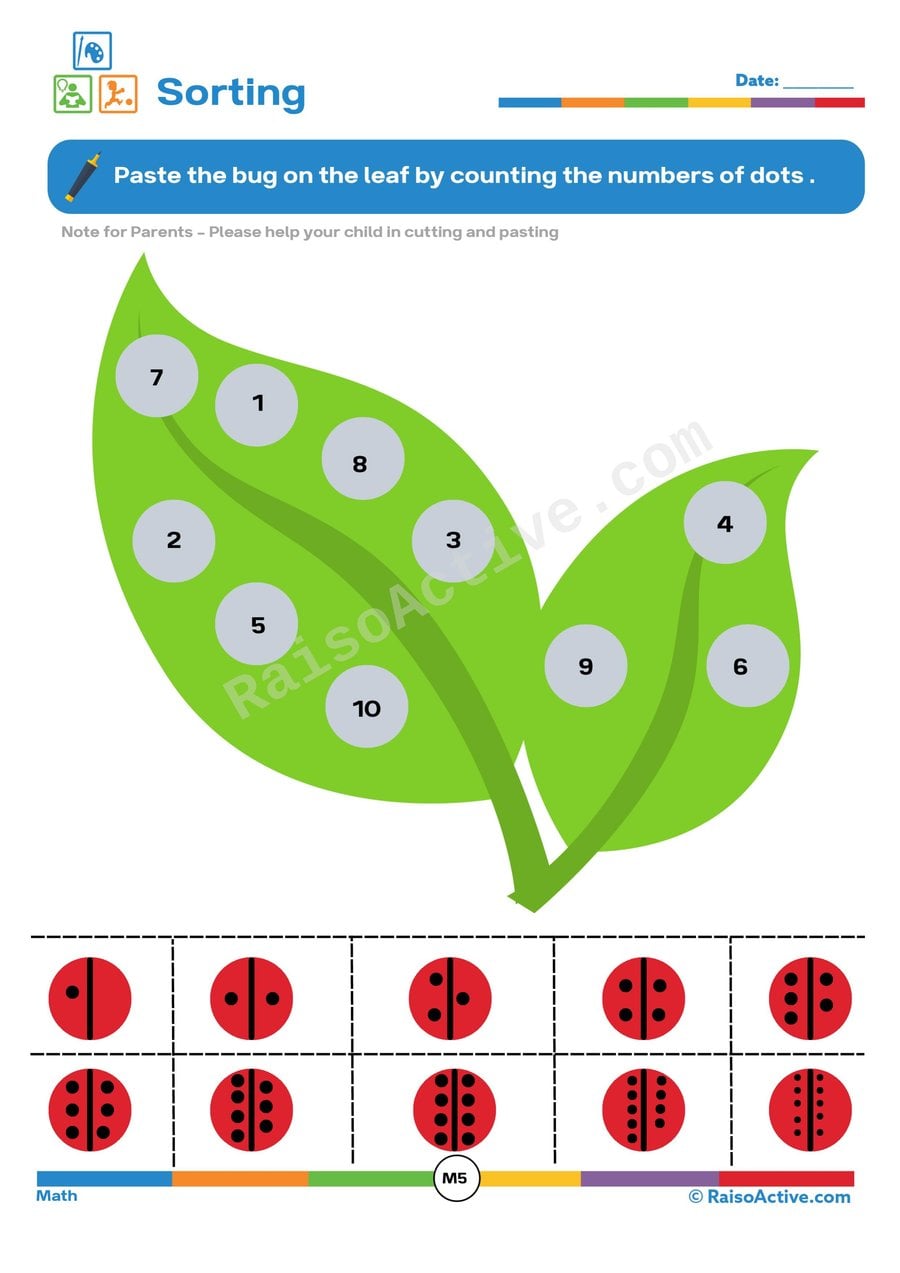
Ladybug Dot Counting Worksheet for Preschoolers
Ages 3-5 · Preschool–Pre-KAges 3-5 · Nursery–ReceptionAges 3-5 · Nursery–LKGAges 3-5
Children ages 3-5 practice one-to-one correspondence by counting the dots on each ladybug and matching that total to the correct numbered leaf, a core early numeracy skill that connects a printed number to an actual quantity. The cutting and pasting also strengthens fine motor control needed for later writing tasks.

Counting Fun: Circle the Correct Number Worksheet
Ages 4-5 · Pre-KAges 4-5 · ReceptionAges 4-5 · LKGAges 4-5
This worksheet builds one-to-one correspondence in children ages 4-5 as they count a group of objects and then match that count to the correct written numeral among several choices. Choosing from multiple numeral options, rather than just writing a number, also sharpens numeral recognition since similar-looking numbers can be easy to confuse.

Up and Down Worksheet: Counting and Writing Practice for Preschoolers
Ages 3-5 · Preschool–Pre-KAges 3-5 · Nursery–ReceptionAges 3-5 · Nursery–LKGAges 3-5
Children ages 3-5 combine spatial reasoning with counting practice by counting steps or elements going up and down, then writing the totals. Understanding 'up' and 'down' as directional concepts supports later skills like reading graphs, climbing stairs safely, and following spatial instructions. Writing the counted numbers afterward reinforces number formation alongside the counting itself.
Guides for this topic

Number Formation Rhymes 0–9 and How to Fix Reversals
Original number formation rhymes for 0–9, the correct stroke order for each digit, why 3, 5 and 7 get reversed most often, and multisensory fixes that work.

Best Worksheets for 3-Year-Olds: What Works and What to Avoid
What works on worksheets for 3-year-olds: short sessions, crayons, tracing lines, matching, cutting, a free weekly plan, and signs one is too advanced.
Christmas and Winter Activities That Combine Fun and Learning: Creating Magical Educational Experiences
Discover Christmas and winter activities that combine festive fun with real learning. Crafts, counting, literacy, and printable worksheets for ages 2 to 8 — perfect for home and school.
Reviews
Every worksheet for ages 3–5, no watermark
Members download the full library of 1,000+ worksheets and every activity pack without watermarks or daily limits. One year costs ₹999 in India or $20 elsewhere.
See membership plansOr download any worksheet free with a watermark (5 a day).