Count and Write: Fun Counting Worksheet for Preschoolers
This counting worksheet has children ages 3-5 count small groups of objects and write the matching numeral in a box, directly linking the physical act of counting to the written symbol that represents a quantity. Writing the number immediately after counting — rather than just counting aloud — reinforces that numerals are a shorthand for real, countable amounts.
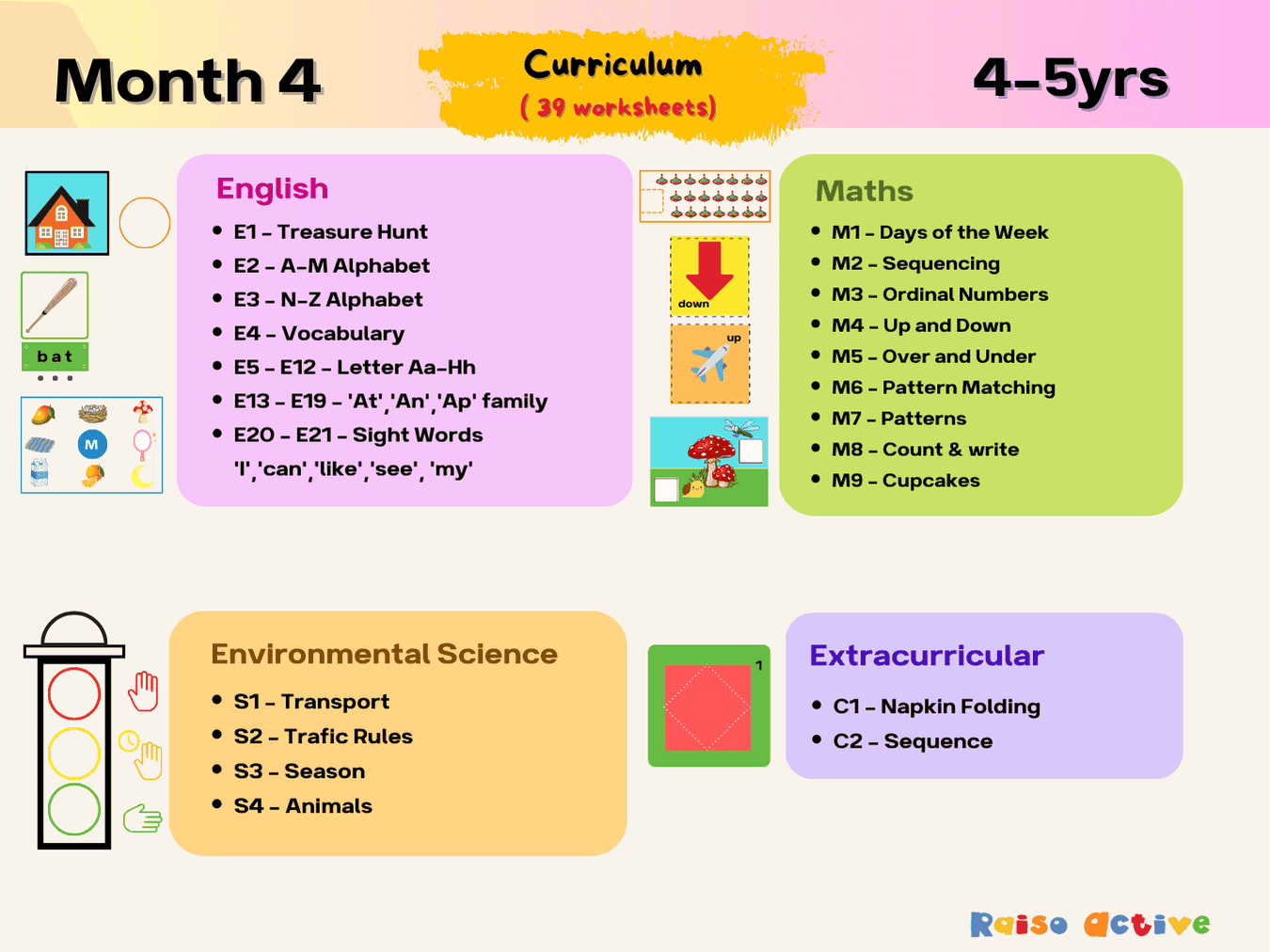
Part of the pack
Month 4: Learning & Development | Ages 4-5
This is page 35 of the pack. Ages 4-5 · Pre-KAges 4-5 · ReceptionAges 4-5 · LKGAges 4-5

Made for your child
Counting to 10, made for your child
A maths pack with your child's name in it: pictures that explain, practice at three levels, puzzles and story sums about them. Print a new set whenever they finish.
Make a maths packFree preview · free for members
Curriculum
- Number Sense > Counting 1-20
How to use this worksheet
Look at the first group of objects together and have your child count them one at a time, touching each object as they count. Once they reach the total, have them write that number in the box provided. Repeat the process for each remaining group on the page, checking that the written numeral matches the counted amount each time.
Materials needed
- Pencil
- Eraser
Extension activities
- 1Set out small snacks, like crackers or grapes, and have your child count and write down the amount before eating them.
- 2Create your own sets of drawn objects for your child to count and label with the correct number.
- 3Practice counting backward from ten together as a quick daily routine.
- 4Use dice during a board game and have your child write down the number rolled each turn.
- 5Count steps, claps, or jumps together and write the final total down afterward.

Written by
Hemsweta Jain · Teacher Cheena
MBA and Early Childhood Educator, teaching since 2014 · Founder of RaisoActive, Mumbai
Every RaisoActive worksheet is designed and checked by the founder before publishing.
Published · Last reviewed
More from Month 4: Learning & Development | Ages 4-5

Treasure Hunt: Alphabetical Order Worksheet for Preschoolers
Ages 3-5 · Preschool–Pre-KAges 3-5 · Nursery–ReceptionAges 3-5 · Nursery–LKGAges 3-5
This connect-the-letters worksheet has children ages 3-5 trace a path from A to Z in strict alphabetical order to help a character find hidden treasure, combining full alphabet sequencing practice with sustained fine motor control as they draw one long connected line. Successfully sequencing the entire alphabet in order, rather than just naming letters individually, is a meaningful milestone in early literacy.

N-Z Alphabet Worksheet: Missing Letters and Picture Matching
Ages 4-6 · Pre-K–KindergartenAges 4-6 · Reception–Year 1Ages 4-6 · LKG–UKGAges 4-6
This worksheet continues alphabet mastery for children ages 4-6 by having them fill in missing letters from N to Z and match each one to a corresponding picture, extending the sequencing and picture-matching skills used in the first half of the alphabet into the second half. Completing both halves of the alphabet across companion worksheets like this builds full, confident recall of all 26 letters in order.
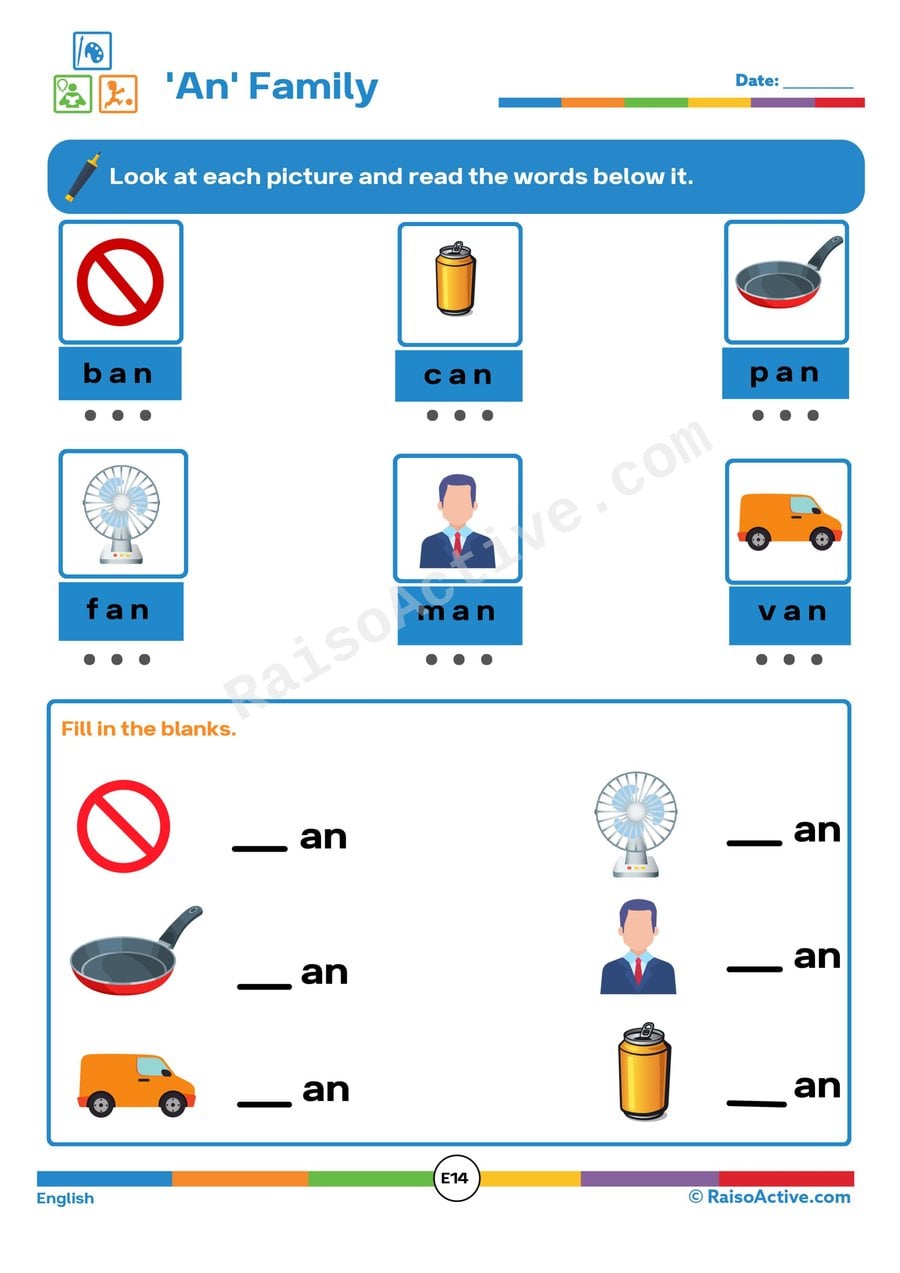
An Family Word Worksheet: Read, Match, and Write!
Ages 4-6 · Pre-K–KindergartenAges 4-6 · Reception–Year 1Ages 4-6 · LKG–UKGAges 4-6
This worksheet builds on word-family recognition by focusing on 'an' words like can, fan, and man, helping children ages 4-6 see that swapping the first letter of a familiar ending creates a whole new word. Practicing this pattern strengthens decoding skills and builds reading confidence, since children start recognizing chunks of words rather than sounding out every single letter.
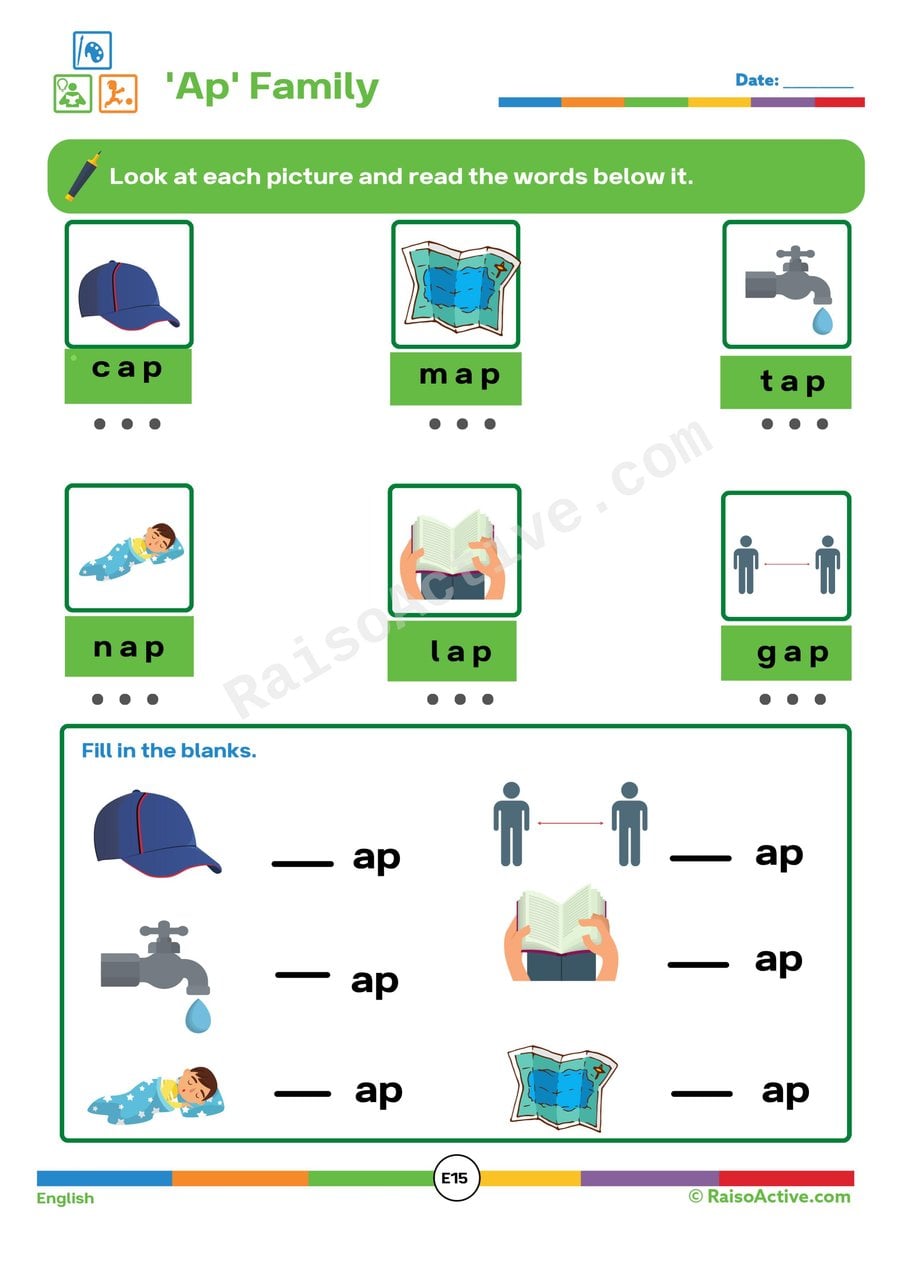
Ap Family Worksheet: Read and Fill in the Blanks!
Ages 4-5 · Pre-KAges 4-5 · ReceptionAges 4-5 · LKGAges 4-5
Continuing the word-family approach, this worksheet helps children ages 4-5 read and complete 'ap' words such as cap, map, and tap by filling in a missing letter, reinforcing the pattern that a shared ending sound can appear across many different words. This kind of practice builds decoding speed and phonics confidence ahead of more independent reading.
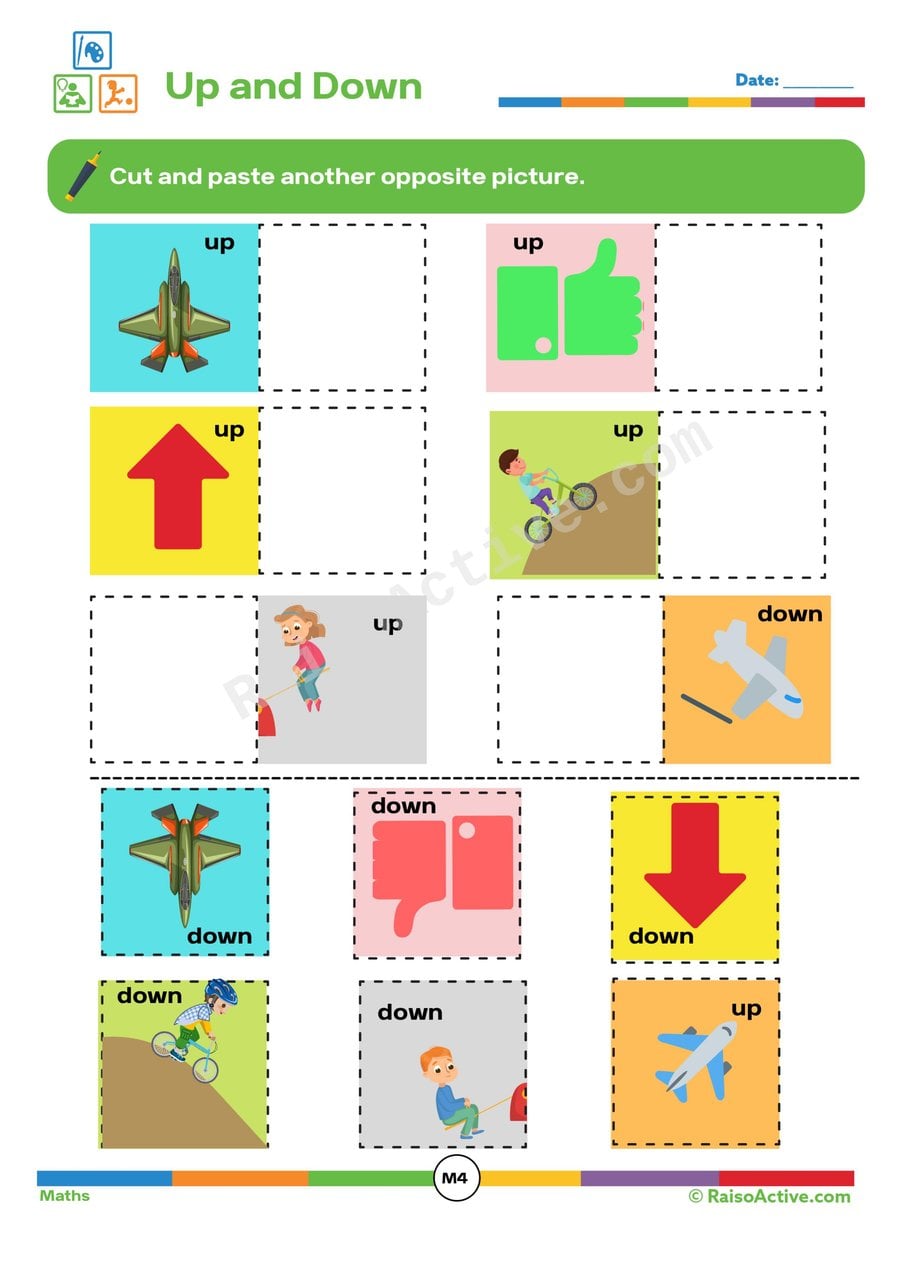
Up and Down Worksheet: Cut and Paste Opposites!
Ages 3-5 · Preschool–Pre-KAges 3-5 · Nursery–ReceptionAges 3-5 · Nursery–LKGAges 3-5
Children ages 3-5 build spatial vocabulary and comparative reasoning as they identify pictures representing 'up' and match them to their opposite, 'down,' by cutting and pasting. Understanding opposite pairs like up/down strengthens both language development and the early logical thinking needed to compare and categorize.

Gg Letter Tracing and Recognition Worksheet for Preschoolers
Ages 3-5 · Preschool–Pre-KAges 3-5 · Nursery–ReceptionAges 3-5 · Nursery–LKGAges 3-5
This worksheet helps children ages 3-5 practice writing both uppercase and lowercase Gg while training them to recognize the letter in different fonts and contexts, an important skill since printed letters don't always look identical to handwritten ones. Identifying pictures that start with Gg also builds phonemic awareness, linking the letter's shape to its 'guh' sound.
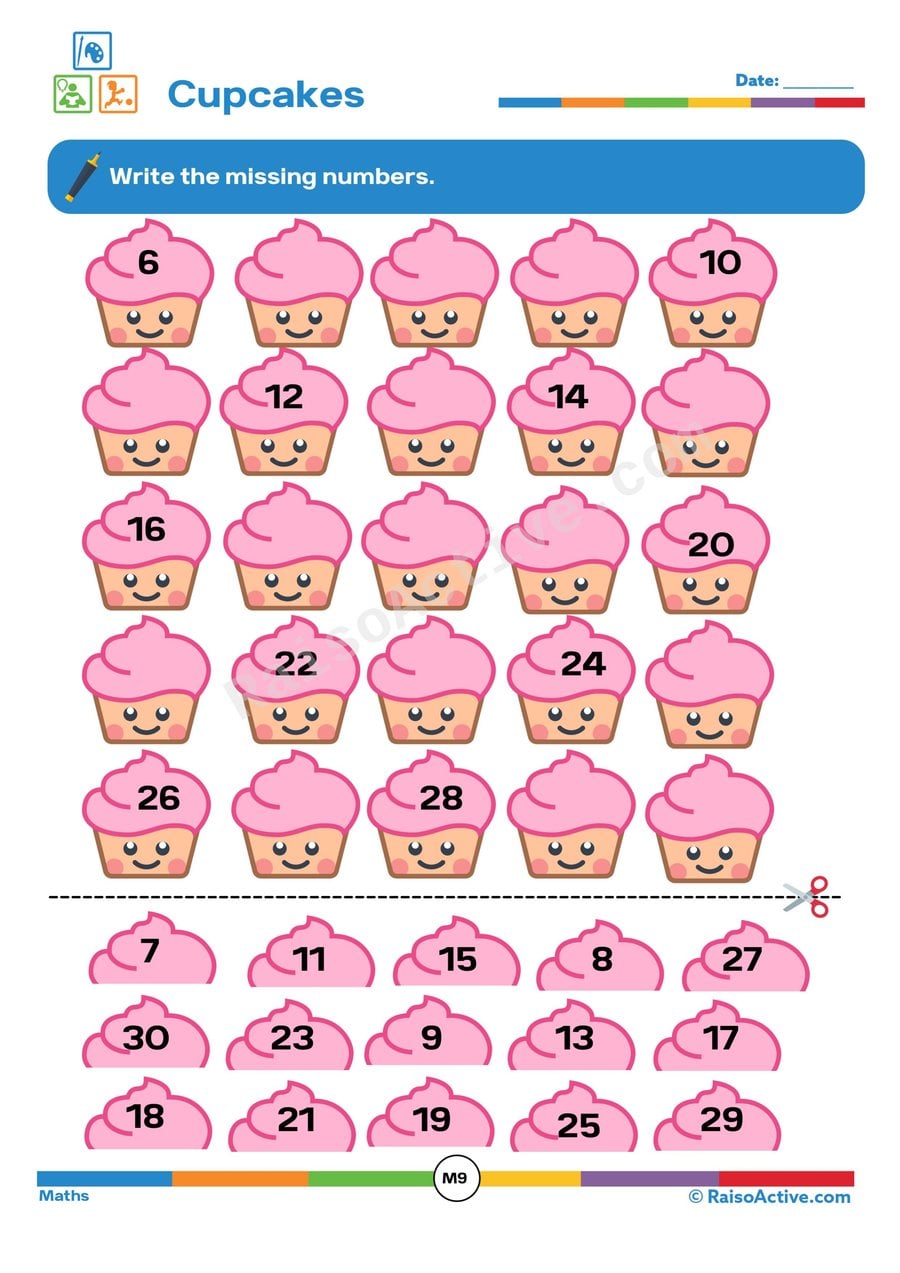
Cupcake Counting Worksheet: Missing Numbers!
Ages 4-6 · Pre-K–KindergartenAges 4-6 · Reception–Year 1Ages 4-6 · LKG–UKGAges 4-6
This worksheet strengthens number sequencing for children ages 4-6 as they study a row of numbered cupcakes and figure out which numbers are missing from the sequence, then write them in. Identifying a gap in a number sequence requires understanding the pattern of counting well enough to predict what's missing, a step beyond simply counting forward.

Sequencing Worksheet: Count, Write, and Paste Numbers!
Ages 4-6 · Pre-K–KindergartenAges 4-6 · Reception–Year 1Ages 4-6 · LKG–UKGAges 4-6
This worksheet combines three numeracy skills in one activity: counting a group of objects, writing the matching numeral, and then physically arranging number sets in the correct sequence. For four- to six-year-olds, connecting a quantity to its written symbol and then to its place in order builds the number sense that underlies later addition and subtraction work.
Related worksheets

Up and Down Worksheet: Counting and Writing Practice for Preschoolers
Ages 3-5 · Preschool–Pre-KAges 3-5 · Nursery–ReceptionAges 3-5 · Nursery–LKGAges 3-5
Children ages 3-5 combine spatial reasoning with counting practice by counting steps or elements going up and down, then writing the totals. Understanding 'up' and 'down' as directional concepts supports later skills like reading graphs, climbing stairs safely, and following spatial instructions. Writing the counted numbers afterward reinforces number formation alongside the counting itself.

Counting Fun: Circle the Correct Number Worksheet
Ages 4-5 · Pre-KAges 4-5 · ReceptionAges 4-5 · LKGAges 4-5
This worksheet builds one-to-one correspondence in children ages 4-5 as they count a group of objects and then match that count to the correct written numeral among several choices. Choosing from multiple numeral options, rather than just writing a number, also sharpens numeral recognition since similar-looking numbers can be easy to confuse.

Counting Fun: Number Names Worksheet for Preschoolers!
Ages 4-5 · Pre-KAges 4-5 · ReceptionAges 4-5 · LKGAges 4-5
This number-names worksheet pushes children from simply counting objects to connecting a quantity with its written word, a step that bridges early numeracy with beginning literacy. Ages four and five are ready to start recognizing that 'three' is both a group of three dots and a specific string of letters, which strengthens both number sense and sight-word recognition.

Counting Fun: Match the Numbers Worksheet for Preschoolers!
Ages 3-5 · Preschool–Pre-KAges 3-5 · Nursery–ReceptionAges 3-5 · Nursery–LKGAges 3-5
This worksheet layers three related counting skills, counting a group of objects, matching that group to its printed numeral, and matching the numeral to a set of fingers, so children see the same quantity represented three different ways. Seeing one number expressed as objects, digits, and fingers helps cement true number sense rather than just memorized counting words.

Big and Small Fish Counting Worksheet for Preschoolers
Ages 3-5 · Preschool–Pre-KAges 3-5 · Nursery–ReceptionAges 3-5 · Nursery–LKGAges 3-5
This worksheet helps children aged 3-5 develop crucial early numeracy by practicing one-to-one correspondence as they count specific groups of fish. Children will also strengthen their observation skills by distinguishing between 'big' and 'small' fish, a foundational step in understanding comparative sizes and classification. This combination builds both number sense and pre-mathematical reasoning.

Count and Circle: Counting Objects Worksheet for Preschoolers
Ages 3-5 · Preschool–Pre-KAges 3-5 · Nursery–ReceptionAges 3-5 · Nursery–LKGAges 3-5
Counting a group of objects and then matching that quantity to its written numeral is the heart of early numeracy for ages 3-5, and this worksheet makes children complete both halves of that skill in one task rather than just counting aloud. Circling the correct number among several choices also adds a light decision-making step, requiring them to compare their counted total against multiple printed numbers. This combination of counting and number recognition is foundational for all later arithmetic.

Caterpillar Counting Adventure: Connect the Dots Worksheet
Ages 4-6 · Pre-K–KindergartenAges 4-6 · Reception–Year 1Ages 4-6 · LKG–UKGAges 4-6
Ages 4-6 practice counting in sequence up to 50 by connecting numbered dots that form a caterpillar shape, combining number recognition with fine motor line control. Counting this high in order builds confidence with larger numbers beyond the more common 1-20 range most preschool worksheets cover. The connect-the-dots format also rewards persistence, since the picture only fully forms once every number has been found correctly.

Count the Owls and Chicks! A Fun Counting Worksheet for Preschoolers
Ages 3-5 · Preschool–Pre-KAges 3-5 · Nursery–ReceptionAges 3-5 · Nursery–LKGAges 3-5
Counting groups of owls and chicks and circling the matching number builds one-to-one correspondence for children ages 3-5, the core skill of touching or pointing to each item exactly once while counting. Working with two different characters in the same activity also teaches children to reset their count for each new group rather than carrying a total over, an easy mistake at this age. This repeated counting-and-matching format across the page builds both accuracy and counting stamina.
Guides for this topic

Number Formation Rhymes 0–9 and How to Fix Reversals
Original number formation rhymes for 0–9, the correct stroke order for each digit, why 3, 5 and 7 get reversed most often, and multisensory fixes that work.

Documenting Learning Without Drowning in Data: A Practical Guide for Parents and Teachers
Learn practical ways to document your child's learning without overwhelm. Simple portfolios, observation tips, and printable trackers for ages 1-8.

Coding Activities for Preschoolers: Building Tomorrow's Thinkers Today
Discover 15+ unplugged and screen-based coding activities for preschoolers that build sequencing, logic, and problem-solving skills through play. NEP 2020 aligned.
Reviews
Every worksheet for ages 3–5, no watermark
Members download the full library of 1,000+ worksheets and every activity pack without watermarks or daily limits. One year costs ₹999 in India or $20 elsewhere.
See membership plansOr download any worksheet free with a watermark (5 a day).