Ladybug Dot Counting Worksheet for Preschoolers
Children ages 3-5 practice one-to-one correspondence by counting the dots on each ladybug and matching that total to the correct numbered leaf, a core early numeracy skill that connects a printed number to an actual quantity. The cutting and pasting also strengthens fine motor control needed for later writing tasks.

Part of the pack
Month 12: Learning & Development | Ages Up to 4
This is page 15 of the pack. Ages 2-4 · PreschoolAges 2-4 · NurseryAges 2-4

Made for your child
Counting to 10, made for your child
A maths pack with your child's name in it: pictures that explain, practice at three levels, puzzles and story sums about them. Print a new set whenever they finish.
Make a maths packFree preview · free for members
Curriculum
- Counting > Counting Basics
How to use this worksheet
Have your child cut out each ladybug piece carefully along the dotted lines. For each ladybug, ask them to count the dots on its back aloud, pointing to each one as they count. Once they know the total, have them find the leaf with the matching number and glue the ladybug onto that leaf, repeating the process for every ladybug on the page.
Materials needed
- Scissors
- Glue
- Pencil
Extension activities
- 1Draw your own ladybugs with different numbers of dots and challenge your child to count and label them.
- 2Use small buttons or pom-poms to represent dots and practice counting sets before matching them to numbers.
- 3Go on a garden or park walk to look for real ladybugs or other bugs and count their spots if visible.
- 4Play a matching game with number cards and small groups of counters, pairing the correct amounts together.

Written by
Hemsweta Jain · Teacher Cheena
MBA and Early Childhood Educator, teaching since 2014 · Founder of RaisoActive, Mumbai
Every RaisoActive worksheet is designed and checked by the founder before publishing.
Published · Last reviewed
More from Month 12: Learning & Development | Ages Up to 4
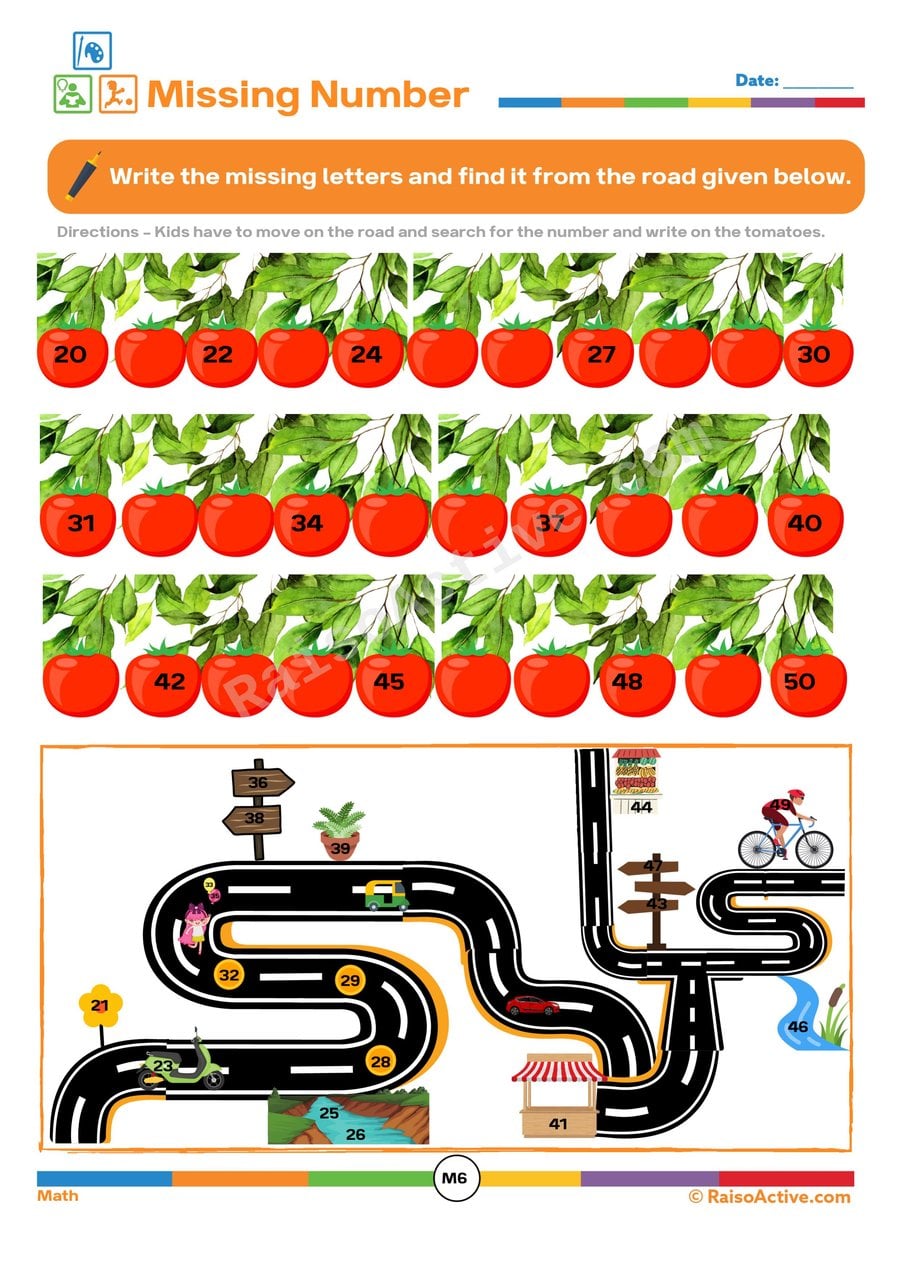
Missing Number Road Trip Worksheet for Kids
Ages 4-6 · Pre-K–KindergartenAges 4-6 · Reception–Year 1Ages 4-6 · LKG–UKGAges 4-6
Children ages 4-6 practice number sequencing by identifying which numbers are missing from a road of tomatoes, a skill that requires understanding what comes before and after a given number in counting order. This strengthens number recognition and prepares children to count confidently without needing to start from one every time.

Living or Non-Living? A Fun Sorting Worksheet for Preschoolers
Ages 3-5 · Preschool–Pre-KAges 3-5 · Nursery–ReceptionAges 3-5 · Nursery–LKGAges 3-5
This sorting worksheet introduces children ages 3-5 to one of science's foundational classification concepts: distinguishing living things from non-living things. Deciding whether to tick or cross each picture pushes children to apply criteria — does it grow, move, breathe, or need food — rather than sort by appearance alone, an early form of scientific reasoning. This distinction also builds vocabulary they'll use throughout later nature and biology topics.

Parent's Guide: Fun Activities for Early Learners!
Ages 3-5 · Preschool–Pre-KAges 3-5 · Nursery–ReceptionAges 3-5 · Nursery–LKGAges 3-5
This parent's guide bundles several hands-on activities — letter matching, sorting, art, and simple crafts like paper cup animals — that build early literacy, fine motor skills, and creativity for children ages 3-5 through play rather than worksheets.

Cut and Paste a Turtle Worksheet for Preschoolers
Ages 3-5 · Preschool–Pre-KAges 3-5 · Nursery–ReceptionAges 3-5 · Nursery–LKGAges 3-5
Children ages 3-5 build fine motor precision and shape recognition by cutting out individual geometric pieces and assembling them into a complete turtle picture. Because each shape must be correctly identified and positioned — the oval for the shell, circles for the head and legs — this activity trains spatial reasoning alongside scissor and gluing skills. Completing a recognizable image from separate parts also strengthens whole-to-part visual thinking.

Traffic Signals Cut and Paste Worksheet for Preschoolers
Ages 3-5 · Preschool–Pre-KAges 3-5 · Nursery–ReceptionAges 3-5 · Nursery–LKGAges 3-5
Children ages 3-5 learn to recognize red, yellow, and green traffic signals and connect each color to its meaning, an early road-safety skill that also reinforces color recognition and matching. Understanding what each signal means builds real-world safety awareness they'll use as pedestrians and passengers.
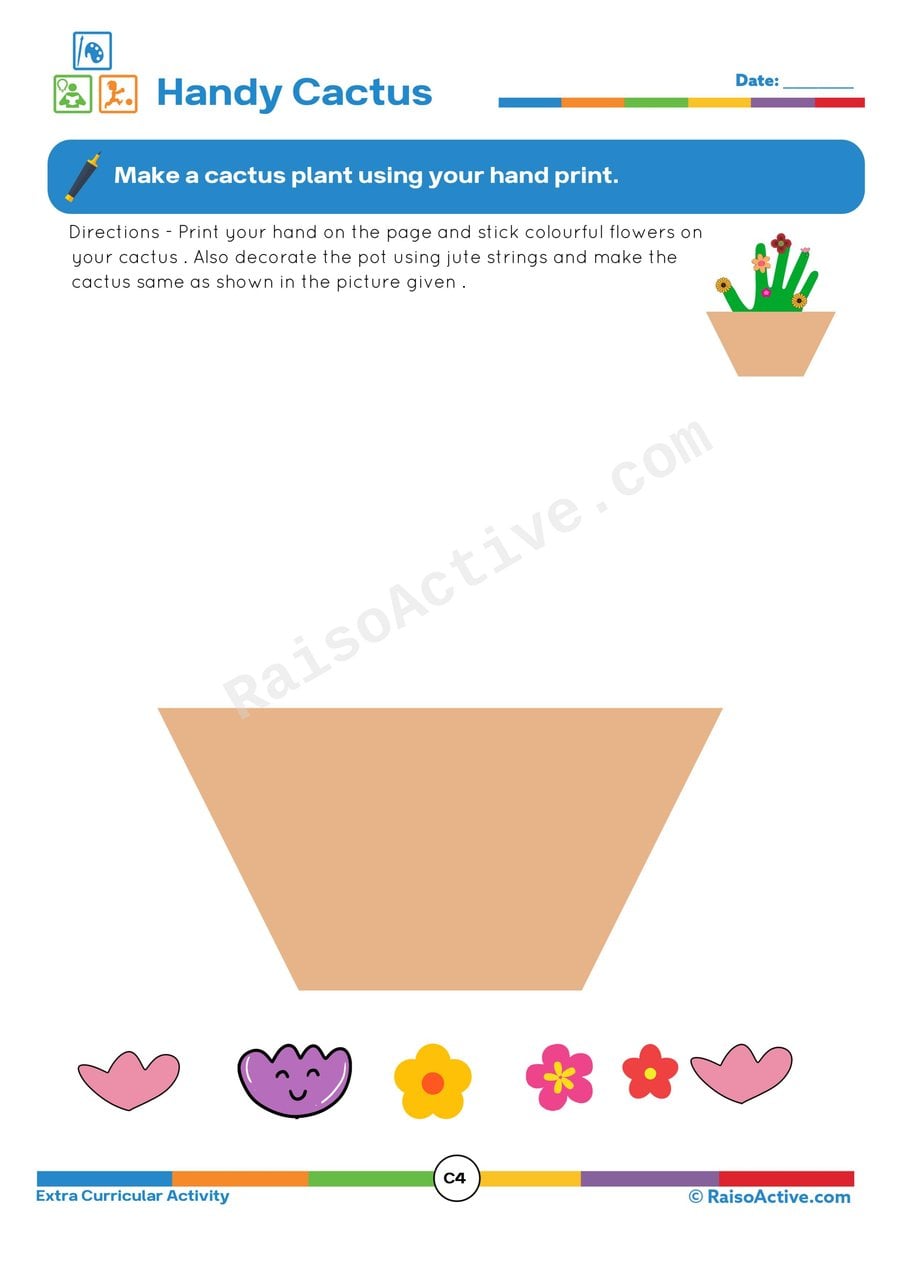
Handprint Cactus Craft Worksheet for Kids
Ages 3-5 · Preschool–Pre-KAges 3-5 · Nursery–ReceptionAges 3-5 · Nursery–LKGAges 3-5
Tracing and decorating a handprint into cactus shapes builds fine motor control and following-directions skills for children ages 3-5, since they must coordinate cutting, gluing, and arranging several craft pieces to match a shown example.

Number Path Adventure: Write Numbers 1-20 Worksheet
Ages 4-6 · Pre-K–KindergartenAges 4-6 · Reception–Year 1Ages 4-6 · LKG–UKGAges 4-6
Children ages 4-6 practice writing numerals in correct sequence as they fill in missing numbers along a path of stepping stones from 1 to 20. This strengthens number-order memory and numeral formation together, both needed before a child can count on reliably or recognize number patterns like the teens. Following a winding path also adds a light visual-tracking challenge that keeps attention on the correct next stone.

Phonics Fun: Circle the Beginning Letter Worksheet for Kids
Ages 4-6 · Pre-K–KindergartenAges 4-6 · Reception–Year 1Ages 4-6 · LKG–UKGAges 4-6
This 'Circle the Beginning Letter' worksheet strengthens phoneme-grapheme correspondence for children ages 4-6, teaching them to connect the sound they hear at the start of a word to its written letter. Naming each picture aloud and choosing among several letter options builds auditory discrimination, a skill that predicts later decoding success. It also reinforces letter recognition by asking children to distinguish the target letter from visually similar distractors.
Related worksheets

Big and Small Fish Counting Worksheet for Preschoolers
Ages 3-5 · Preschool–Pre-KAges 3-5 · Nursery–ReceptionAges 3-5 · Nursery–LKGAges 3-5
This worksheet helps children aged 3-5 develop crucial early numeracy by practicing one-to-one correspondence as they count specific groups of fish. Children will also strengthen their observation skills by distinguishing between 'big' and 'small' fish, a foundational step in understanding comparative sizes and classification. This combination builds both number sense and pre-mathematical reasoning.
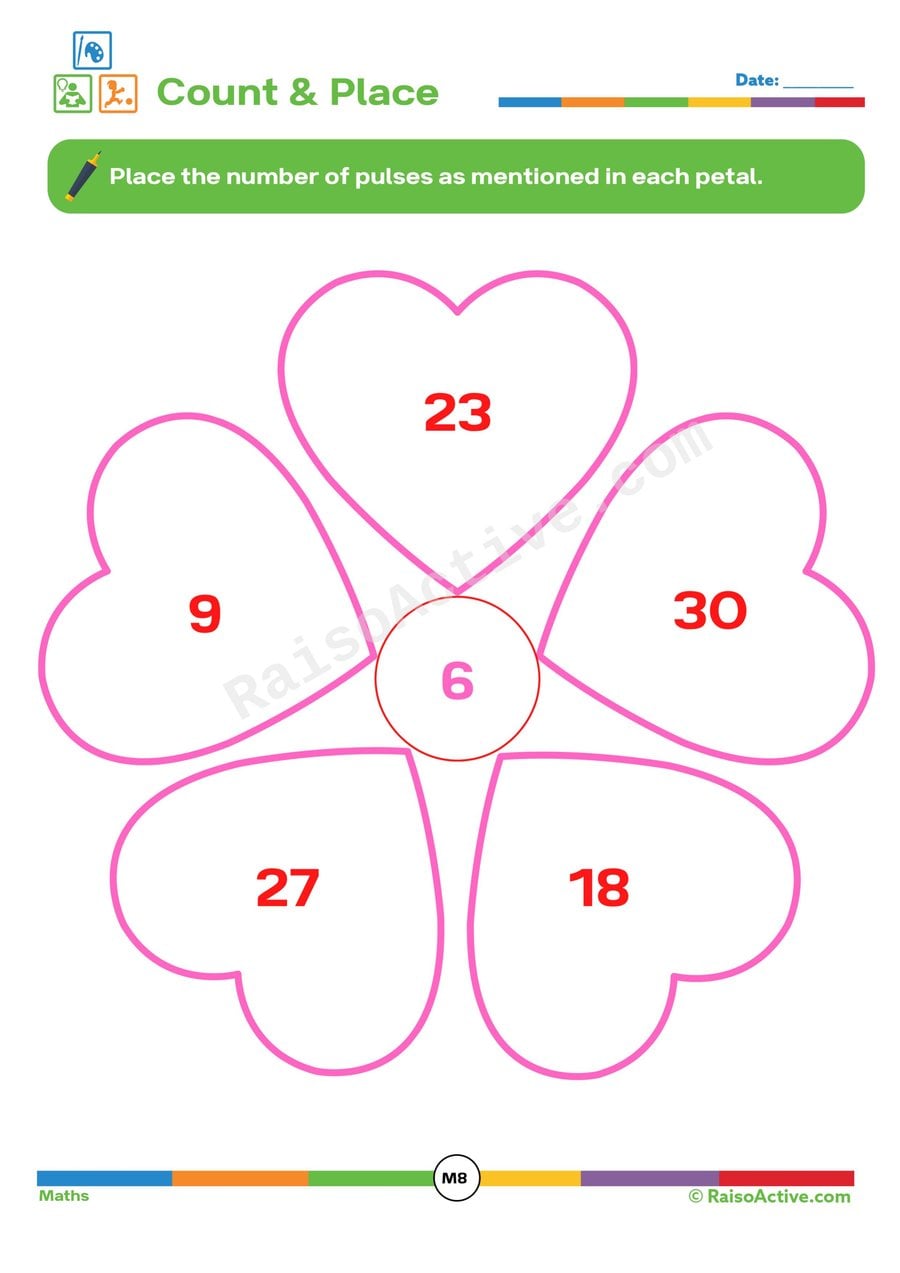
Count and Place: Heart Petals Worksheet
Ages 4-5 · Pre-KAges 4-5 · ReceptionAges 4-5 · LKGAges 4-5
Counting the marks in each heart-shaped petal and writing the matching number builds one-to-one correspondence for children ages 4-5, ensuring they touch or point to each mark exactly once as they count. This petal-by-petal counting also strengthens number formation practice as children write each total by hand.

Above and Below the Sea Worksheet: Counting Objects
Ages 3-5 · Preschool–Pre-KAges 3-5 · Nursery–ReceptionAges 3-5 · Nursery–LKGAges 3-5
This worksheet combines counting practice with the positional concepts of 'above' and 'below,' asking children to count separate groups of objects located in different parts of an ocean scene. For ages 3-5, connecting counting to spatial position adds an extra layer of thinking beyond simple one-to-one counting, reinforcing both numeracy and early positional vocabulary.
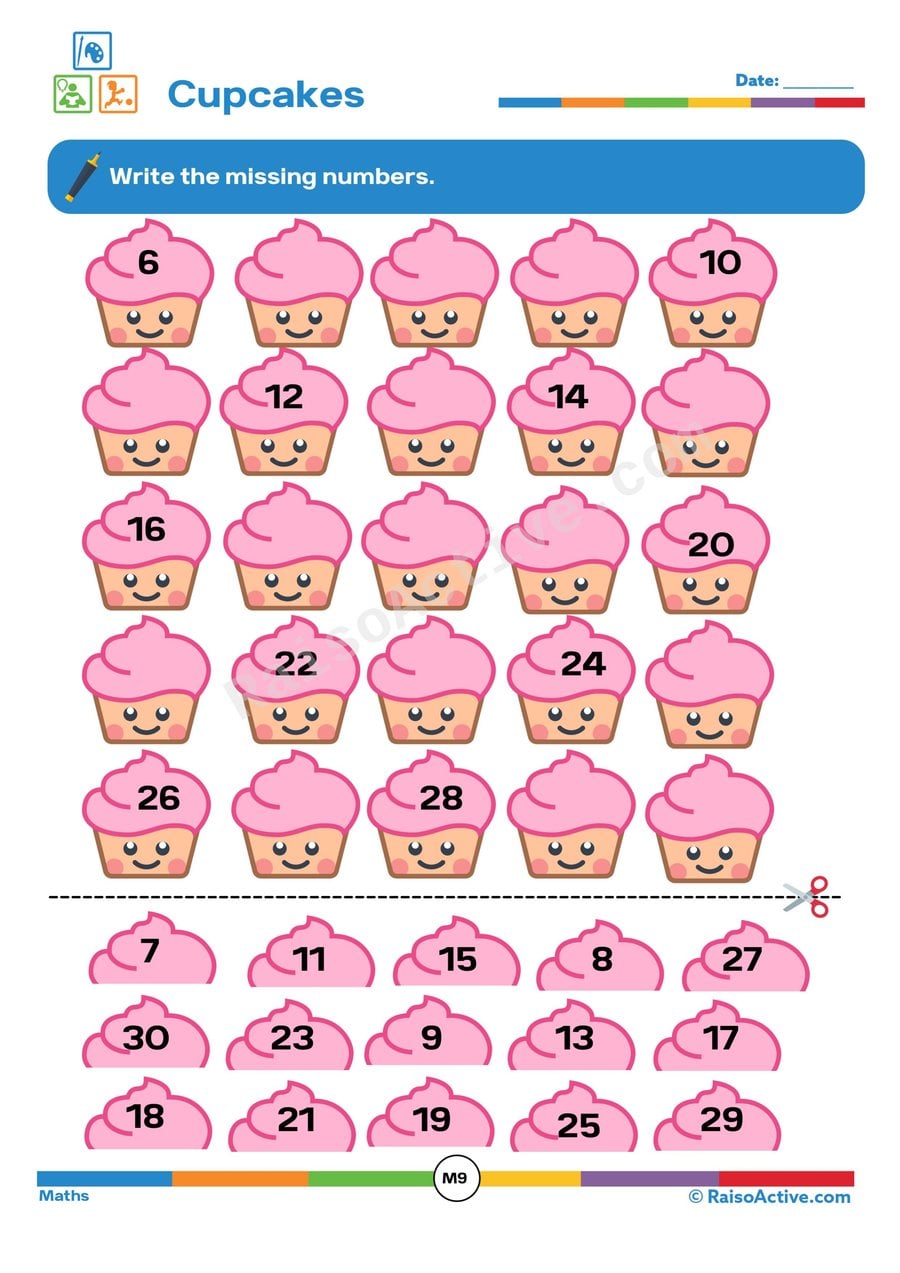
Cupcake Counting Worksheet: Missing Numbers!
Ages 4-6 · Pre-K–KindergartenAges 4-6 · Reception–Year 1Ages 4-6 · LKG–UKGAges 4-6
This worksheet strengthens number sequencing for children ages 4-6 as they study a row of numbered cupcakes and figure out which numbers are missing from the sequence, then write them in. Identifying a gap in a number sequence requires understanding the pattern of counting well enough to predict what's missing, a step beyond simply counting forward.

Counting Fun: Circle the Correct Number Worksheet
Ages 4-5 · Pre-KAges 4-5 · ReceptionAges 4-5 · LKGAges 4-5
This worksheet builds one-to-one correspondence in children ages 4-5 as they count a group of objects and then match that count to the correct written numeral among several choices. Choosing from multiple numeral options, rather than just writing a number, also sharpens numeral recognition since similar-looking numbers can be easy to confuse.

Count the Sweet Treats! A Fun Counting Worksheet for Preschoolers
Ages 3-5 · Preschool–Pre-KAges 3-5 · Nursery–ReceptionAges 3-5 · Nursery–LKGAges 3-5
Preschoolers ages 3-5 practice one-to-one correspondence by counting groups of sweet treats, like cupcakes or candies, and writing the total number for each group. Counting appealing, familiar objects like treats keeps motivation high while reinforcing the core skill of matching each counted item to exactly one number word. Writing the resulting number afterward connects the counting process to number symbol recognition.

Counting Fun: Match the Numbers Worksheet for Preschoolers!
Ages 3-5 · Preschool–Pre-KAges 3-5 · Nursery–ReceptionAges 3-5 · Nursery–LKGAges 3-5
This worksheet layers three related counting skills, counting a group of objects, matching that group to its printed numeral, and matching the numeral to a set of fingers, so children see the same quantity represented three different ways. Seeing one number expressed as objects, digits, and fingers helps cement true number sense rather than just memorized counting words.

Duckling Number Fun: Coloring Numbers 0-20 Worksheet
Ages 4-6 · Pre-K–KindergartenAges 4-6 · Reception–Year 1Ages 4-6 · LKG–UKGAges 4-6
This worksheet helps children ages 4-6 practice recognizing numerals from 0 to 20 in sequence as they color a path of boxes to help a duck reach its ducklings, turning number recognition into a purposeful, story-driven task. Coloring the boxes in strict numerical order also reinforces the idea that numbers build one after another, supporting later skip-counting and number-line skills.
Guides for this topic

Number Formation Rhymes 0–9 and How to Fix Reversals
Original number formation rhymes for 0–9, the correct stroke order for each digit, why 3, 5 and 7 get reversed most often, and multisensory fixes that work.

Best Worksheets for 3-Year-Olds: What Works and What to Avoid
What works on worksheets for 3-year-olds: short sessions, crayons, tracing lines, matching, cutting, a free weekly plan, and signs one is too advanced.
Christmas and Winter Activities That Combine Fun and Learning: Creating Magical Educational Experiences
Discover Christmas and winter activities that combine festive fun with real learning. Crafts, counting, literacy, and printable worksheets for ages 2 to 8 — perfect for home and school.
Reviews
Every worksheet for ages 3–5, no watermark
Members download the full library of 1,000+ worksheets and every activity pack without watermarks or daily limits. One year costs ₹999 in India or $20 elsewhere.
See membership plansOr download any worksheet free with a watermark (5 a day).