Count and Place: Heart Petals Worksheet
Counting the marks in each heart-shaped petal and writing the matching number builds one-to-one correspondence for children ages 4-5, ensuring they touch or point to each mark exactly once as they count. This petal-by-petal counting also strengthens number formation practice as children write each total by hand.
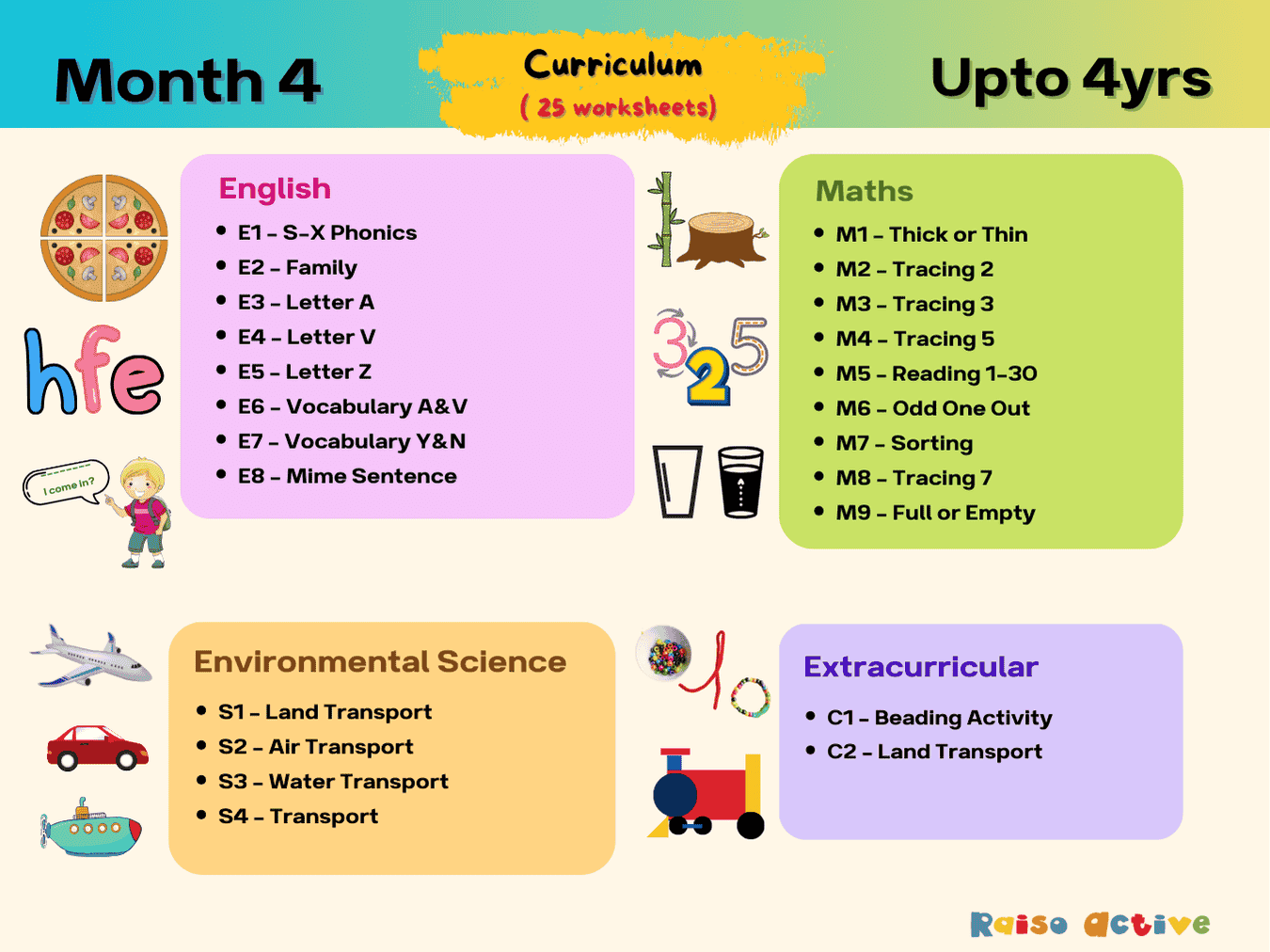
Part of the pack
Month 4: Learning & Development | Ages Up to 4
This is page 19 of the pack. Ages 2-4 · PreschoolAges 2-4 · NurseryAges 2-4

Made for your child
Counting to 10, made for your child
A maths pack with your child's name in it: pictures that explain, practice at three levels, puzzles and story sums about them. Print a new set whenever they finish.
Make a maths packFree preview · free for members
Curriculum
- Counting > Counting Basics
How to use this worksheet
Look at the first petal together and count the marks inside it slowly, pointing to each one as you go. Have your child write the total number they counted inside that petal. Move through each remaining petal the same way, encouraging your child to double-check their count before writing the number.
Materials needed
- Pencil
- Eraser
Extension activities
- 1Draw the matching number of dots or small objects next to a few of the numbers your child wrote.
- 2Use counters or buttons to represent the numbers found in each petal for hands-on reinforcement.
- 3Make your own heart-petal counting page with a new set of numbers.
- 4Count the petals on a real or paper flower together.
- 5Practice counting a mixed pile of small objects and grouping them to match numbers from the worksheet.

Written by
Hemsweta Jain · Teacher Cheena
MBA and Early Childhood Educator, teaching since 2014 · Founder of RaisoActive, Mumbai
Every RaisoActive worksheet is designed and checked by the founder before publishing.
Published · Last reviewed
More from Month 4: Learning & Development | Ages Up to 4

Animal Homes Cut and Paste Worksheet for Preschoolers
Ages 3-5 · Preschool–Pre-KAges 3-5 · Nursery–ReceptionAges 3-5 · Nursery–LKGAges 3-5
Cutting out animal home pictures and pasting each one next to its matching animal teaches children ages 3-5 to connect an animal with where it lives, building categorization skills alongside new vocabulary like nest, den, or kennel. This hands-on matching also strengthens fine motor control through repeated cutting and pasting.

Animal Sorting Worksheet: Wild vs. Domestic Animals
Ages 3-5 · Preschool–Pre-KAges 3-5 · Nursery–ReceptionAges 3-5 · Nursery–LKGAges 3-5
Sorting animal pictures into wild and domestic categories teaches children ages 3-5 an early form of classification, deciding where an animal belongs based on how it lives rather than its size or appearance alone. Cutting and pasting the animals also builds fine motor precision while reinforcing new animal vocabulary along the way.
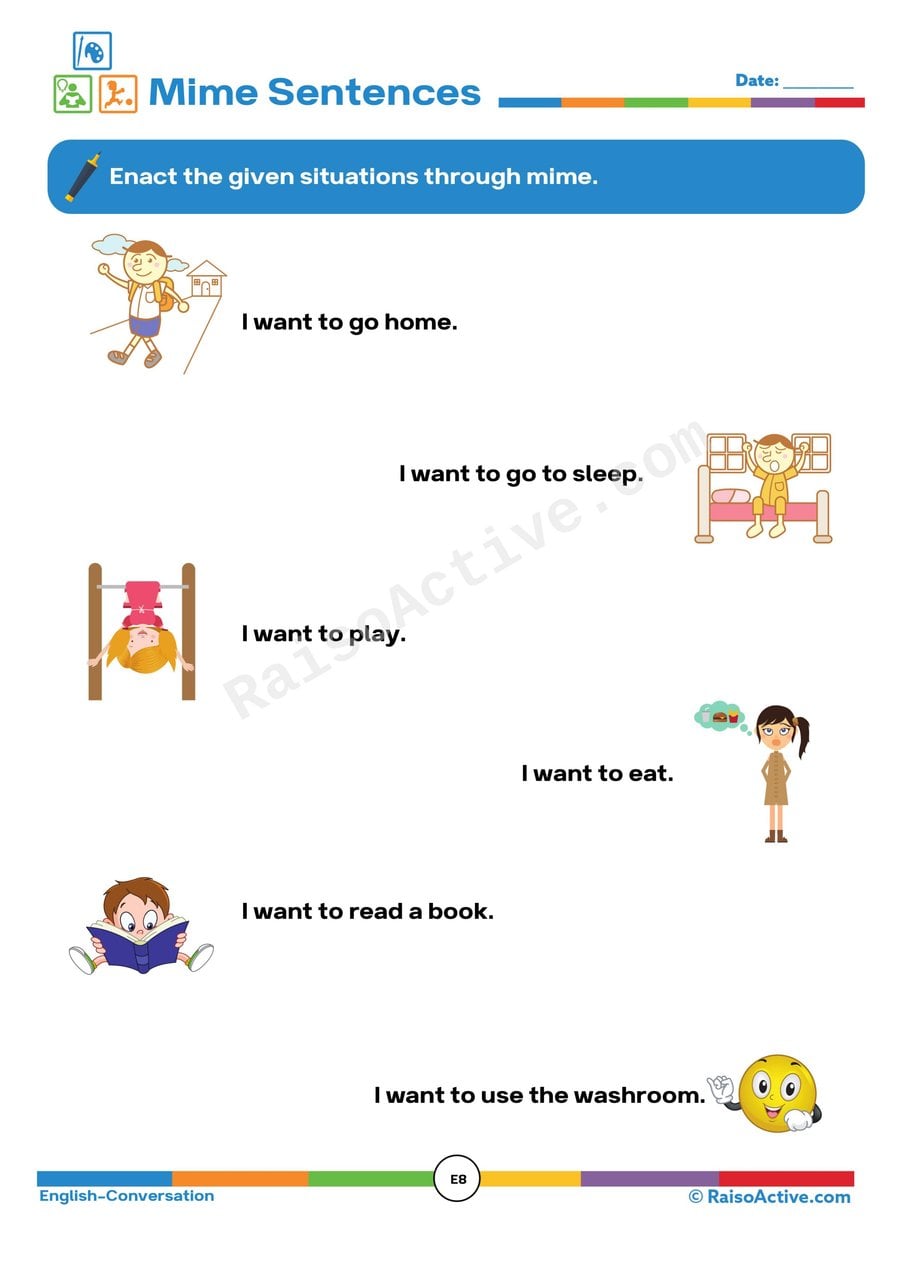
Mime Sentences Worksheet: Act Out Actions!
Ages 3-5 · Preschool–Pre-KAges 3-5 · Nursery–ReceptionAges 3-5 · Nursery–LKGAges 3-5
Reading a sentence and then acting it out through mime teaches children ages 3-5 to connect written or spoken language with physical expression, deepening comprehension of action verbs in a memorable, embodied way. This kind of kinesthetic practice also builds confidence with performance and body awareness alongside early reading skills.
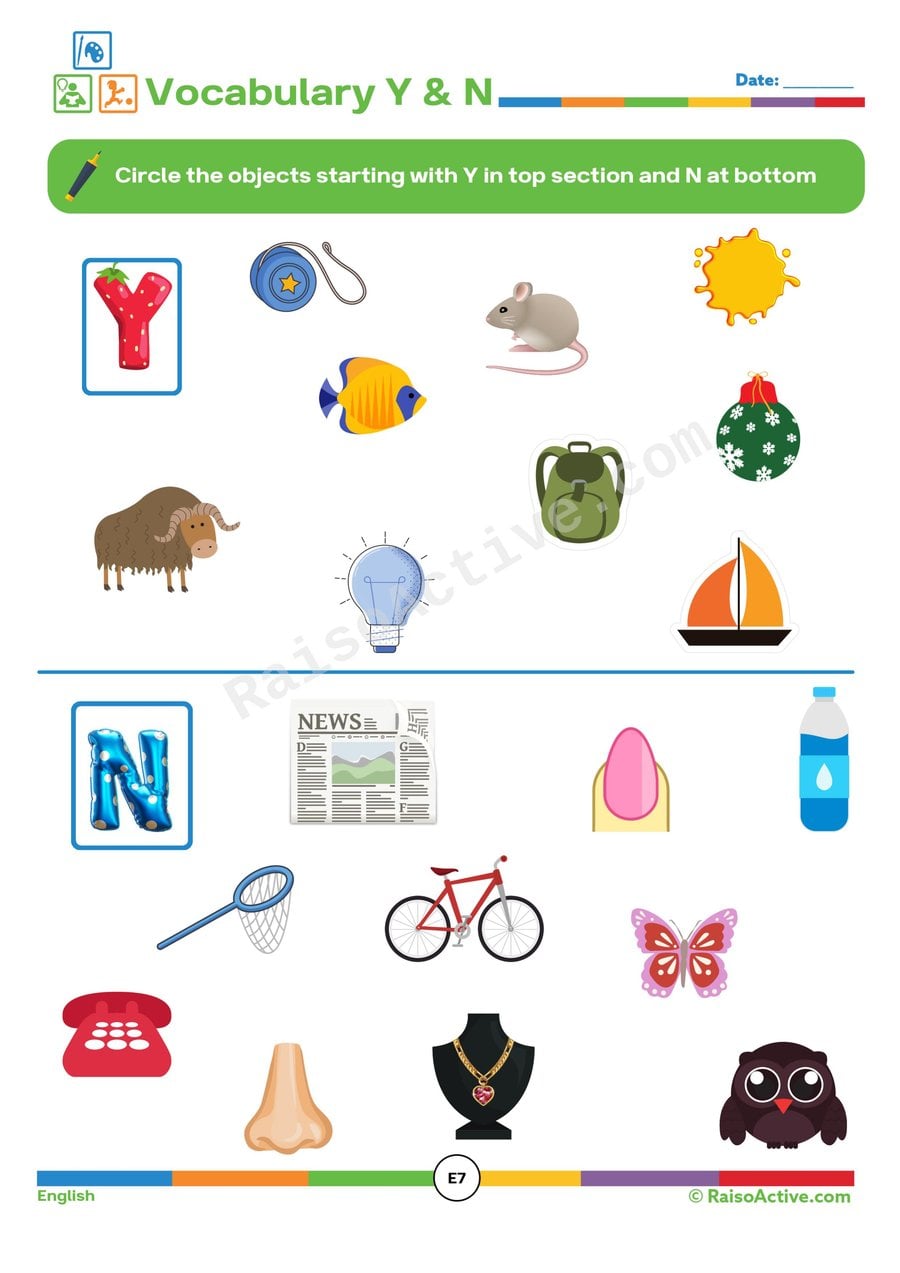
Y and N Vocabulary Worksheet: Circle the Objects!
Ages 3-5 · Preschool–Pre-KAges 3-5 · Nursery–ReceptionAges 3-5 · Nursery–LKGAges 3-5
Deciding whether a pictured object starts with Y or N helps children ages 3-5 practice initial sound discrimination between two distinct consonant sounds, building both vocabulary and listening skills. Circling in the correct top or bottom section adds a simple visual organization step that reinforces the category each object belongs to.
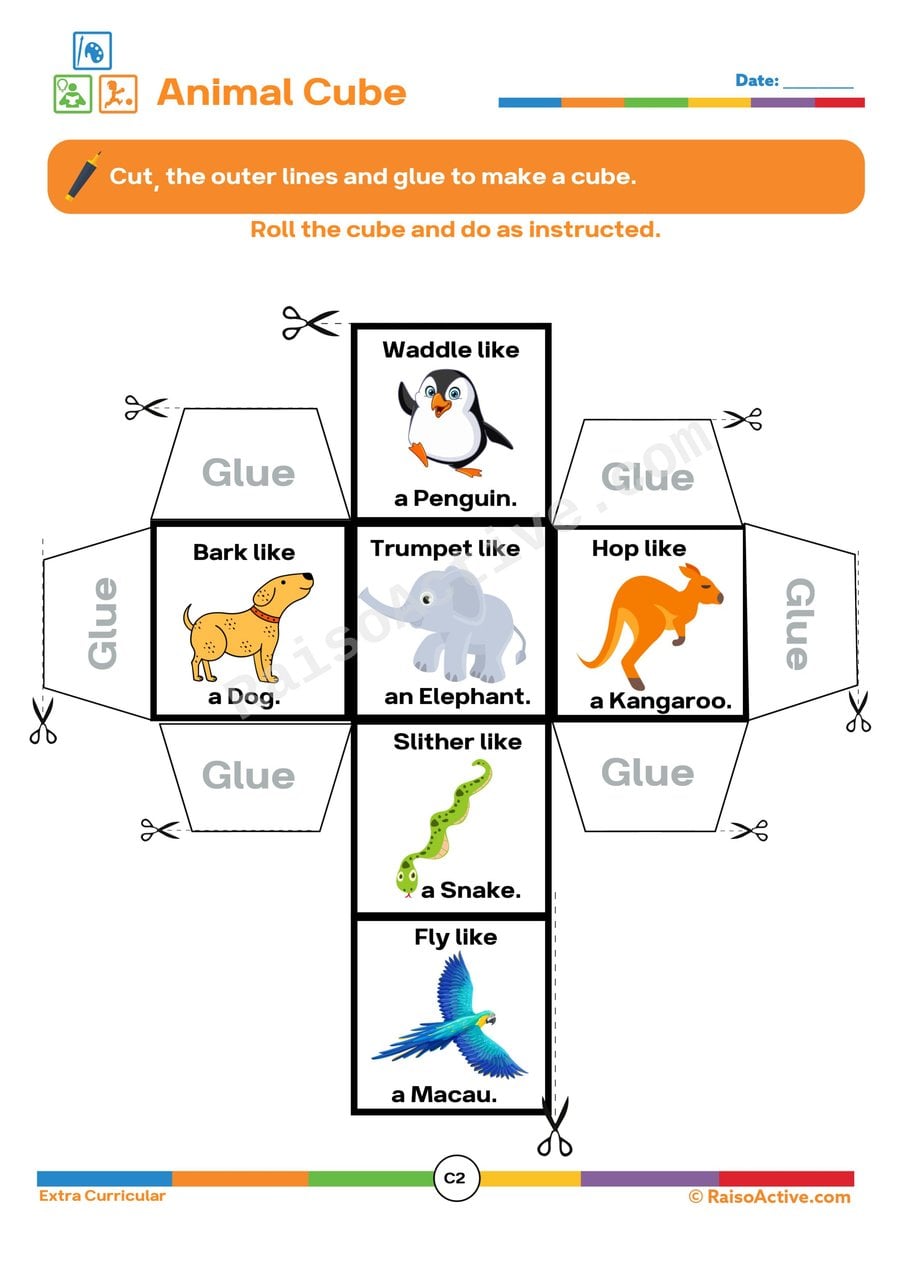
Animal Cube: Cut, Glue, and Learn!
Ages 3-5 · Preschool–Pre-KAges 3-5 · Nursery–ReceptionAges 3-5 · Nursery–LKGAges 3-5
Children ages 3-5 practice following a multi-step assembly sequence as they cut out a net, fold it, and glue the tabs to build a 3D cube featuring different animals, then use it as a game piece to review animal names and sounds. Assembling a flat shape into a 3D object also introduces early spatial reasoning about how 2D shapes fold into 3D forms.
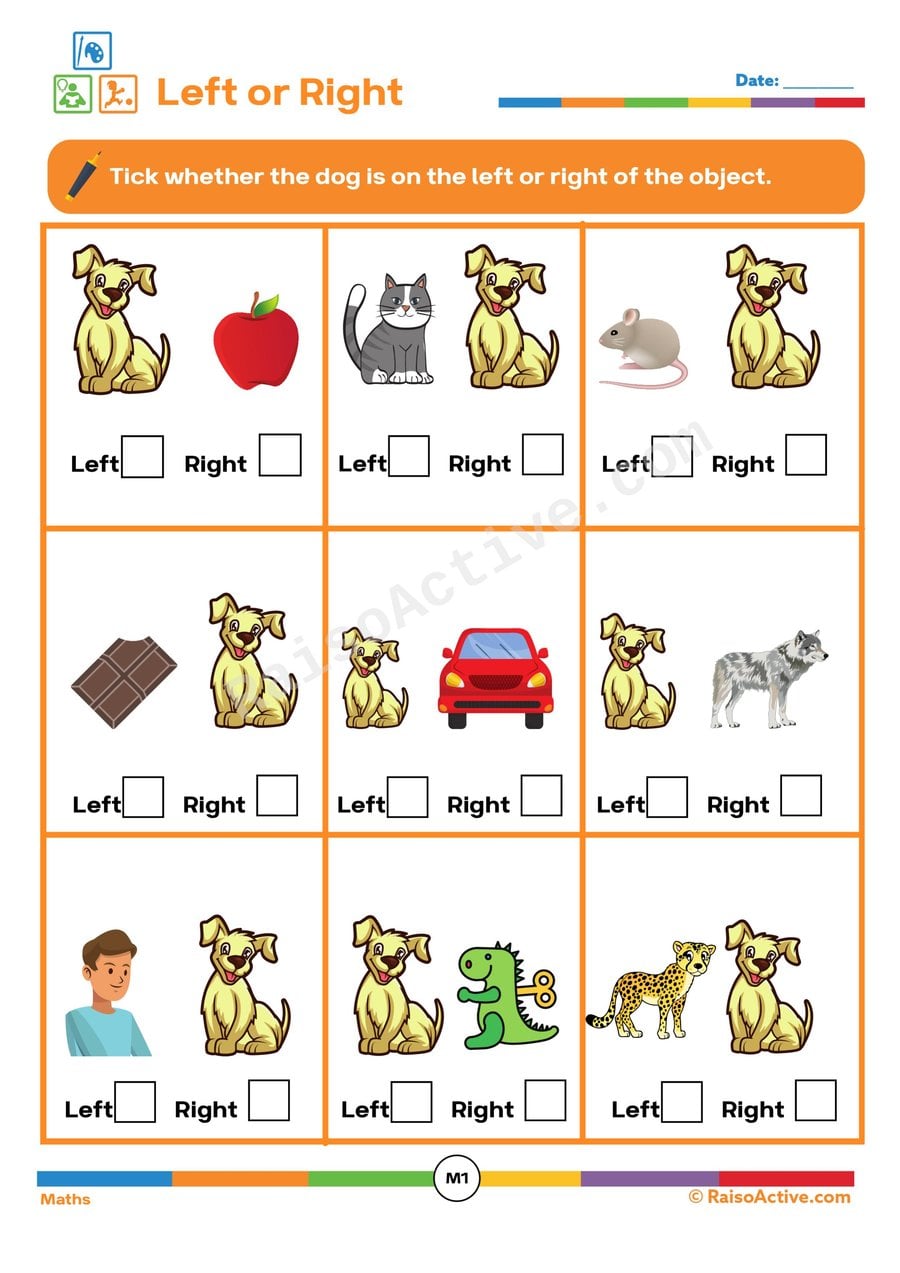
Left or Right Worksheet: Where is the Dog?
Ages 3-5 · Preschool–Pre-KAges 3-5 · Nursery–ReceptionAges 3-5 · Nursery–LKGAges 3-5
Children ages 3-5 build an early sense of directionality as they determine whether the dog sits to the left or right of another object in each picture. This 'left' and 'right' vocabulary is a foundational spatial-reasoning skill that later supports reading direction, map use, and following multi-step instructions. Naming a location relative to another object also strengthens comparative thinking.

Animal Food Matching Worksheet for Preschoolers
Ages 3-5 · Preschool–Pre-KAges 3-5 · Nursery–ReceptionAges 3-5 · Nursery–LKGAges 3-5
This worksheet teaches children ages 3-5 which foods different animals eat by matching each animal to its correct food, building early classification skills and expanding their vocabulary around animals and diets. Learning that a rabbit eats carrots while a bird eats worms also introduces the idea that living things have different needs, a first step toward basic life-science thinking.

Trace and Write the Number 0 Worksheet for Preschoolers
Ages 3-5 · Preschool–Pre-KAges 3-5 · Nursery–ReceptionAges 3-5 · Nursery–LKGAges 3-5
This worksheet gives children ages 3-5 focused practice forming the number 0, building the fine motor control and pencil grip needed for handwriting while reinforcing that 0 represents 'none' or an empty group. Tracing the curved stroke repeatedly also helps children internalize the shape through muscle memory, which supports faster, more confident number writing later.
Related worksheets
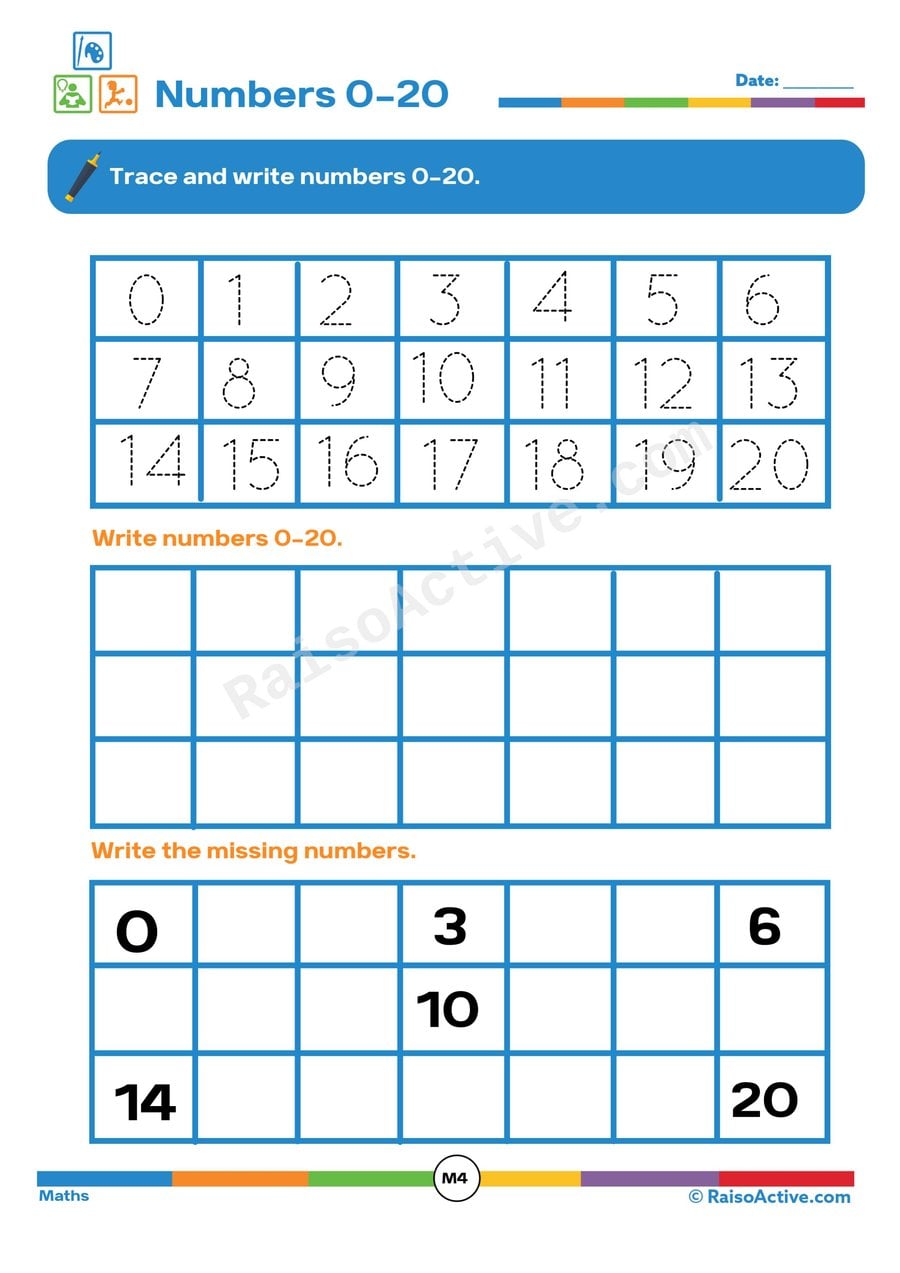
Trace and Write Numbers 0-20 Worksheet
Ages 4-6 · Pre-K–KindergartenAges 4-6 · Reception–Year 1Ages 4-6 · LKG–UKGAges 4-6
This worksheet extends number formation practice across the full range from 0 to 20, giving children repeated tracing and writing practice on both single-digit and two-digit numerals. For four- to six-year-olds, moving past 10 into the teens and twenties is an important milestone, since it introduces the idea that numbers can be built from combinations of digits rather than each needing its own unique symbol.

Up and Down Worksheet: Counting and Writing Practice for Preschoolers
Ages 3-5 · Preschool–Pre-KAges 3-5 · Nursery–ReceptionAges 3-5 · Nursery–LKGAges 3-5
Children ages 3-5 combine spatial reasoning with counting practice by counting steps or elements going up and down, then writing the totals. Understanding 'up' and 'down' as directional concepts supports later skills like reading graphs, climbing stairs safely, and following spatial instructions. Writing the counted numbers afterward reinforces number formation alongside the counting itself.
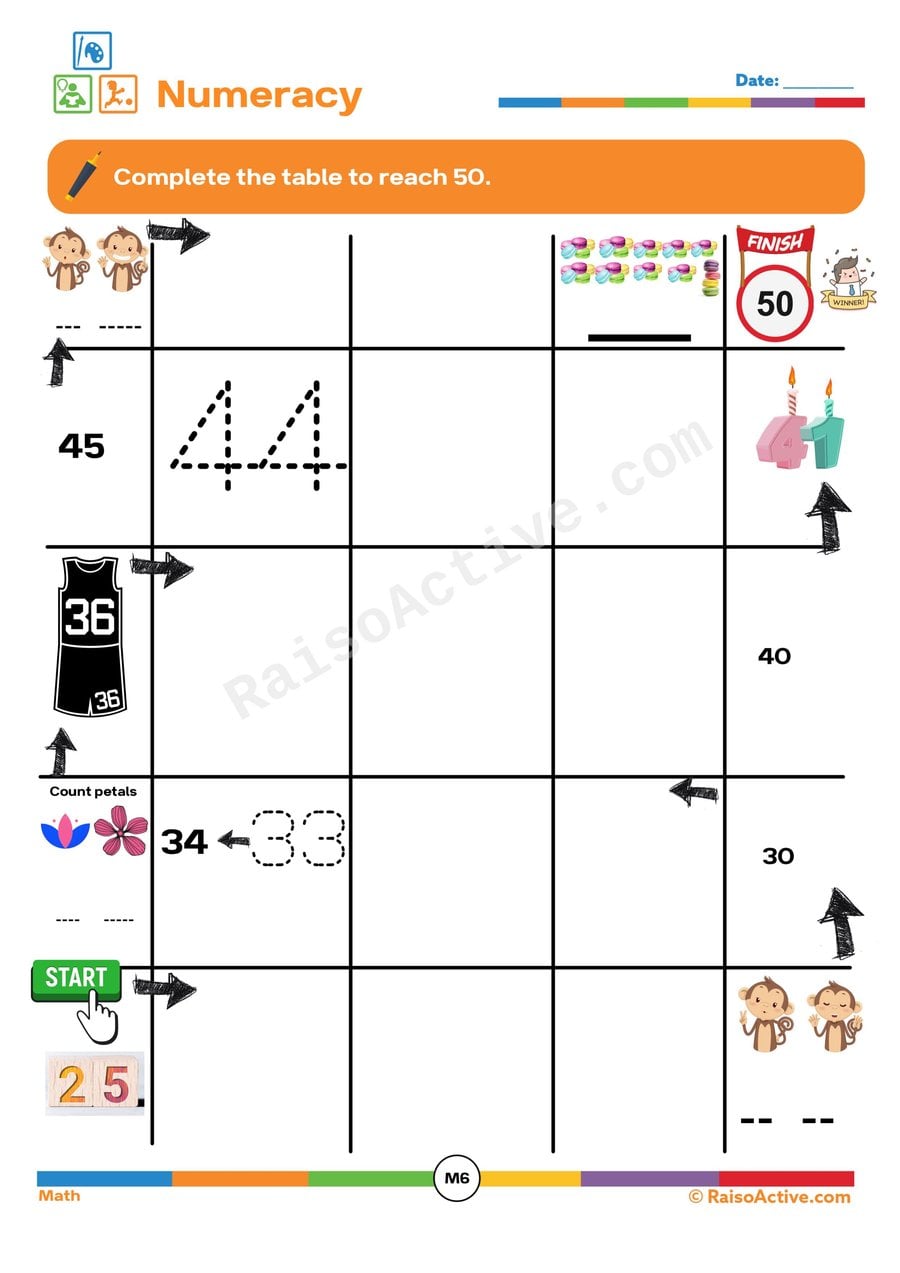
Reach 50! A Fun Numeracy Worksheet for Kids
Ages 4-5 · Pre-KAges 4-5 · ReceptionAges 4-5 · LKGAges 4-5
Filling in a number sequence toward a target like 50 gives children ages 4-5 practice with number order and pattern continuation over a longer stretch than they might attempt in casual counting, building stamina alongside numeracy. Starting partway through the sequence, at 25, also asks children to pick up counting from a non-zero starting point, which is a slightly more advanced skill than counting from one every time. Successfully completing the full path to 50 gives children a strong, visible sense of accomplishment tied to a meaningful numerical milestone.

Caterpillar Counting Adventure: Connect the Dots Worksheet
Ages 4-6 · Pre-K–KindergartenAges 4-6 · Reception–Year 1Ages 4-6 · LKG–UKGAges 4-6
Ages 4-6 practice counting in sequence up to 50 by connecting numbered dots that form a caterpillar shape, combining number recognition with fine motor line control. Counting this high in order builds confidence with larger numbers beyond the more common 1-20 range most preschool worksheets cover. The connect-the-dots format also rewards persistence, since the picture only fully forms once every number has been found correctly.

Count the Sweet Treats! A Fun Counting Worksheet for Preschoolers
Ages 3-5 · Preschool–Pre-KAges 3-5 · Nursery–ReceptionAges 3-5 · Nursery–LKGAges 3-5
Preschoolers ages 3-5 practice one-to-one correspondence by counting groups of sweet treats, like cupcakes or candies, and writing the total number for each group. Counting appealing, familiar objects like treats keeps motivation high while reinforcing the core skill of matching each counted item to exactly one number word. Writing the resulting number afterward connects the counting process to number symbol recognition.

Counting Fun: Circle the Correct Number Worksheet
Ages 4-5 · Pre-KAges 4-5 · ReceptionAges 4-5 · LKGAges 4-5
This worksheet builds one-to-one correspondence in children ages 4-5 as they count a group of objects and then match that count to the correct written numeral among several choices. Choosing from multiple numeral options, rather than just writing a number, also sharpens numeral recognition since similar-looking numbers can be easy to confuse.

Counting Fun: Match the Numbers Worksheet for Preschoolers!
Ages 3-5 · Preschool–Pre-KAges 3-5 · Nursery–ReceptionAges 3-5 · Nursery–LKGAges 3-5
This worksheet layers three related counting skills, counting a group of objects, matching that group to its printed numeral, and matching the numeral to a set of fingers, so children see the same quantity represented three different ways. Seeing one number expressed as objects, digits, and fingers helps cement true number sense rather than just memorized counting words.

Superhero Grouping in Tens: A Fun Counting Worksheet for Preschoolers!
Ages 4-5 · Pre-KAges 4-5 · ReceptionAges 4-5 · LKGAges 4-5
Using a superhero theme, this worksheet helps children ages 4-5 practice counting objects accurately and matching a counted group to its written number, an early step toward understanding place value through grouping in tens. Circling objects according to a given number afterward reinforces the connection between a numeral and the actual quantity it represents, rather than just reciting numbers in order.
Guides for this topic

Number Formation Rhymes 0–9 and How to Fix Reversals
Original number formation rhymes for 0–9, the correct stroke order for each digit, why 3, 5 and 7 get reversed most often, and multisensory fixes that work.

Christmas and Winter Activities That Combine Fun and Learning: Creating Magical Educational Experiences
Discover Christmas and winter activities that combine festive fun with real learning. Crafts, counting, literacy, and printable worksheets for ages 2 to 8 — perfect for home and school.
Age-Appropriate Halloween Learning Activities: Balancing Spooks and Skills for Young Learners
Discover fun, age-appropriate Halloween learning activities for young children. Spooky crafts, counting games, literacy ideas, and printable worksheets for ages 2 to 8.
Reviews
Every worksheet for ages 4–5, no watermark
Members download the full library of 1,000+ worksheets and every activity pack without watermarks or daily limits. One year costs ₹999 in India or $20 elsewhere.
See membership plansOr download any worksheet free with a watermark (5 a day).