Number Path Adventure: Write Numbers 1-20 Worksheet
Children ages 4-6 practice writing numerals in correct sequence as they fill in missing numbers along a path of stepping stones from 1 to 20. This strengthens number-order memory and numeral formation together, both needed before a child can count on reliably or recognize number patterns like the teens. Following a winding path also adds a light visual-tracking challenge that keeps attention on the correct next stone.

Part of the pack
Month 12: Learning & Development | Ages Up to 4
This is page 19 of the pack. Ages 2-4 · PreschoolAges 2-4 · NurseryAges 2-4

Made for your child
Counting to 10, made for your child
A maths pack with your child's name in it: pictures that explain, practice at three levels, puzzles and story sums about them. Print a new set whenever they finish.
Make a maths packFree preview · free for members
Curriculum
- Number Sense > Number Sequencing
How to use this worksheet
Start at stone number 1 and count aloud together along the path, noticing which stones already have numbers filled in and which are blank. When you reach a blank stone, ask your child what number comes next in the sequence before they write it in. Continue stone by stone all the way to 20, pausing at the tricky teen numbers (13, 14, 15) to sound them out together. Once finished, count the whole path aloud from 1 to 20 one more time to reinforce the sequence.
Materials needed
- Pencil
- Eraser
Extension activities
- 1Chalk a hopscotch-style number path outside from 1 to 20 and have your child hop along while counting aloud.
- 2Hide number cards 1-20 around a room and have your child collect and order them.
- 3Use a number line or ruler to point out how each number is one more than the last.
- 4Build a tower with one more block added for each number counted, up to 20.

Written by
Hemsweta Jain · Teacher Cheena
MBA and Early Childhood Educator, teaching since 2014 · Founder of RaisoActive, Mumbai
Every RaisoActive worksheet is designed and checked by the founder before publishing.
Published · Last reviewed
More from Month 12: Learning & Development | Ages Up to 4
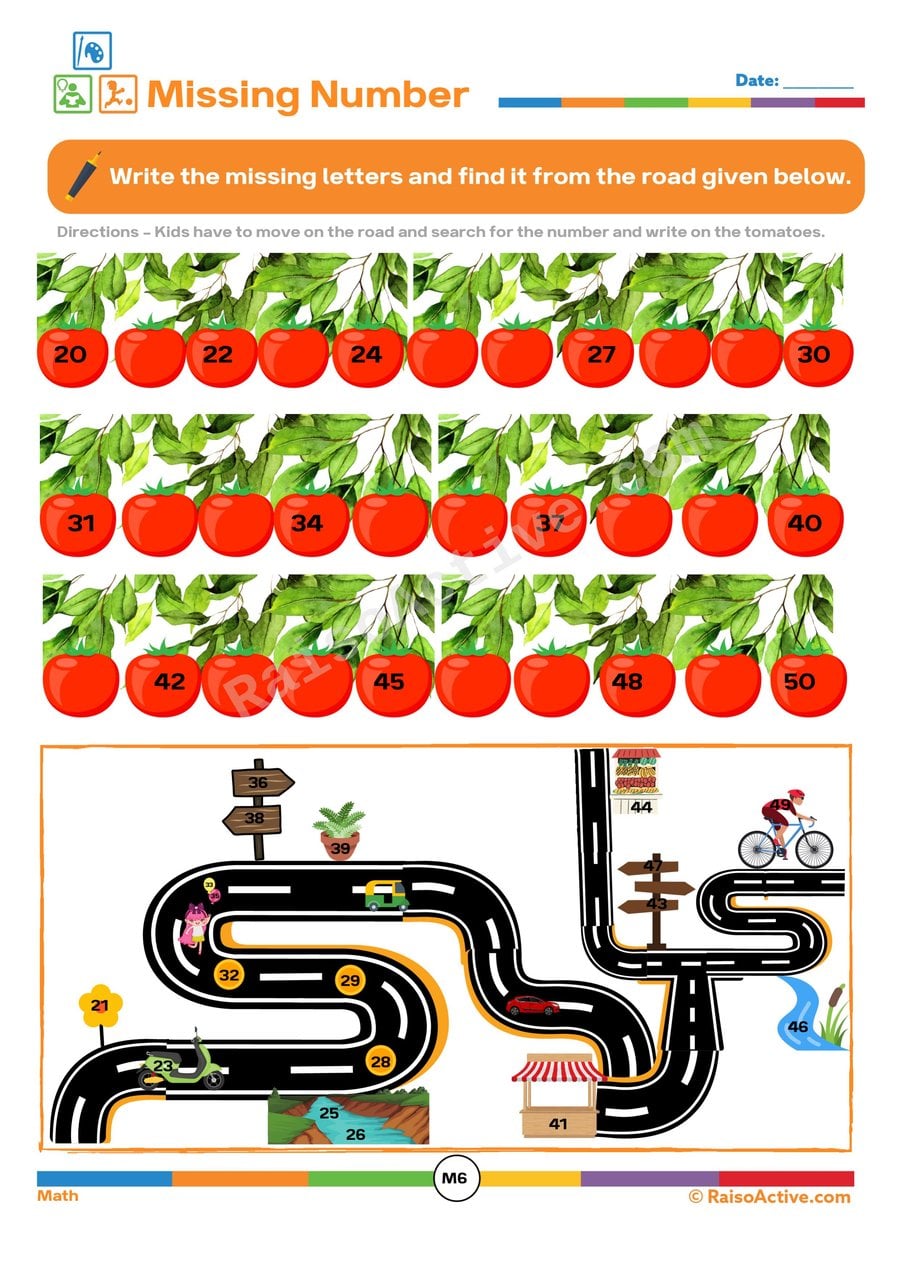
Missing Number Road Trip Worksheet for Kids
Ages 4-6 · Pre-K–KindergartenAges 4-6 · Reception–Year 1Ages 4-6 · LKG–UKGAges 4-6
Children ages 4-6 practice number sequencing by identifying which numbers are missing from a road of tomatoes, a skill that requires understanding what comes before and after a given number in counting order. This strengthens number recognition and prepares children to count confidently without needing to start from one every time.

Traffic Signals Cut and Paste Worksheet for Preschoolers
Ages 3-5 · Preschool–Pre-KAges 3-5 · Nursery–ReceptionAges 3-5 · Nursery–LKGAges 3-5
Children ages 3-5 learn to recognize red, yellow, and green traffic signals and connect each color to its meaning, an early road-safety skill that also reinforces color recognition and matching. Understanding what each signal means builds real-world safety awareness they'll use as pedestrians and passengers.

Before and After: Counting and Sequencing Worksheet
Ages 4-6 · Pre-K–KindergartenAges 4-6 · Reception–Year 1Ages 4-6 · LKG–UKGAges 4-6
Spinning a wheel to find the number that follows a given number, then writing it in the 'after' column, builds number sequencing skills for children ages 4-6 while the matching step connects the abstract number to a picture representation.

Rainbow Sequence Cut and Paste Worksheet for Preschoolers
Ages 4-6 · Pre-K–KindergartenAges 4-6 · Reception–Year 1Ages 4-6 · LKG–UKGAges 4-6
Children ages 4-6 practice numerical sequencing by arranging rainbow picture pieces in the correct numbered order, while also building fine motor control through cutting and gluing. Combining sequencing with a cut-and-paste format makes an abstract ordering skill into a tactile, visual task.

Alphabet Games Worksheet: Match the Letters to the Games!
Ages 4-6 · Pre-K–KindergartenAges 4-6 · Reception–Year 1Ages 4-6 · LKG–UKGAges 4-6
This worksheet helps children ages 4-6 practice beginning-sound letter recognition by matching alphabet cards to pictures of games whose names start with that letter. Placing a letter card on its matching game picture, rather than simply circling an answer, adds a hands-on sorting element that keeps the activity active and physical rather than purely paper-based.

Many vs. Few: Object Counting Worksheet for Preschoolers
Ages 3-5 · Preschool–Pre-KAges 3-5 · Nursery–ReceptionAges 3-5 · Nursery–LKGAges 3-5
This worksheet builds early quantity comparison skills as children ages 3-5 look at groups of objects and decide whether each group shows 'many' or 'few.' Beyond simple counting, this task develops relative reasoning — understanding that quantity is judged by comparison, not just a fixed number — which lays groundwork for later concepts like greater than and less than. Circling the correct group also reinforces visual scanning and attention to detail.

Caterpillar Activity Worksheet: Follow Instructions and Move!
Ages 3-5 · Preschool–Pre-KAges 3-5 · Nursery–ReceptionAges 3-5 · Nursery–LKGAges 3-5
This worksheet helps children ages 3-5 practice following multi-step instructions while getting active, as they move along a caterpillar's body and perform a different physical action in each circle, such as jumping or spinning. Combining movement with sequential instructions builds gross motor skills, listening comprehension, and the ability to hold a sequence of directions in mind.

Cut and Paste a Turtle Worksheet for Preschoolers
Ages 3-5 · Preschool–Pre-KAges 3-5 · Nursery–ReceptionAges 3-5 · Nursery–LKGAges 3-5
Children ages 3-5 build fine motor precision and shape recognition by cutting out individual geometric pieces and assembling them into a complete turtle picture. Because each shape must be correctly identified and positioned — the oval for the shell, circles for the head and legs — this activity trains spatial reasoning alongside scissor and gluing skills. Completing a recognizable image from separate parts also strengthens whole-to-part visual thinking.
Related worksheets

Caterpillar Number Sequencing Worksheet for Preschoolers
Ages 3-5 · Preschool–Pre-KAges 3-5 · Nursery–ReceptionAges 3-5 · Nursery–LKGAges 3-5
This worksheet helps children ages 3-5 practice number recognition and sequencing skills by cutting out numbered circles and arranging them in the correct order to build a caterpillar's body. The hands-on cut-and-paste format adds fine motor practice to the numeracy task, since children must precisely place each circle in its correct spot.
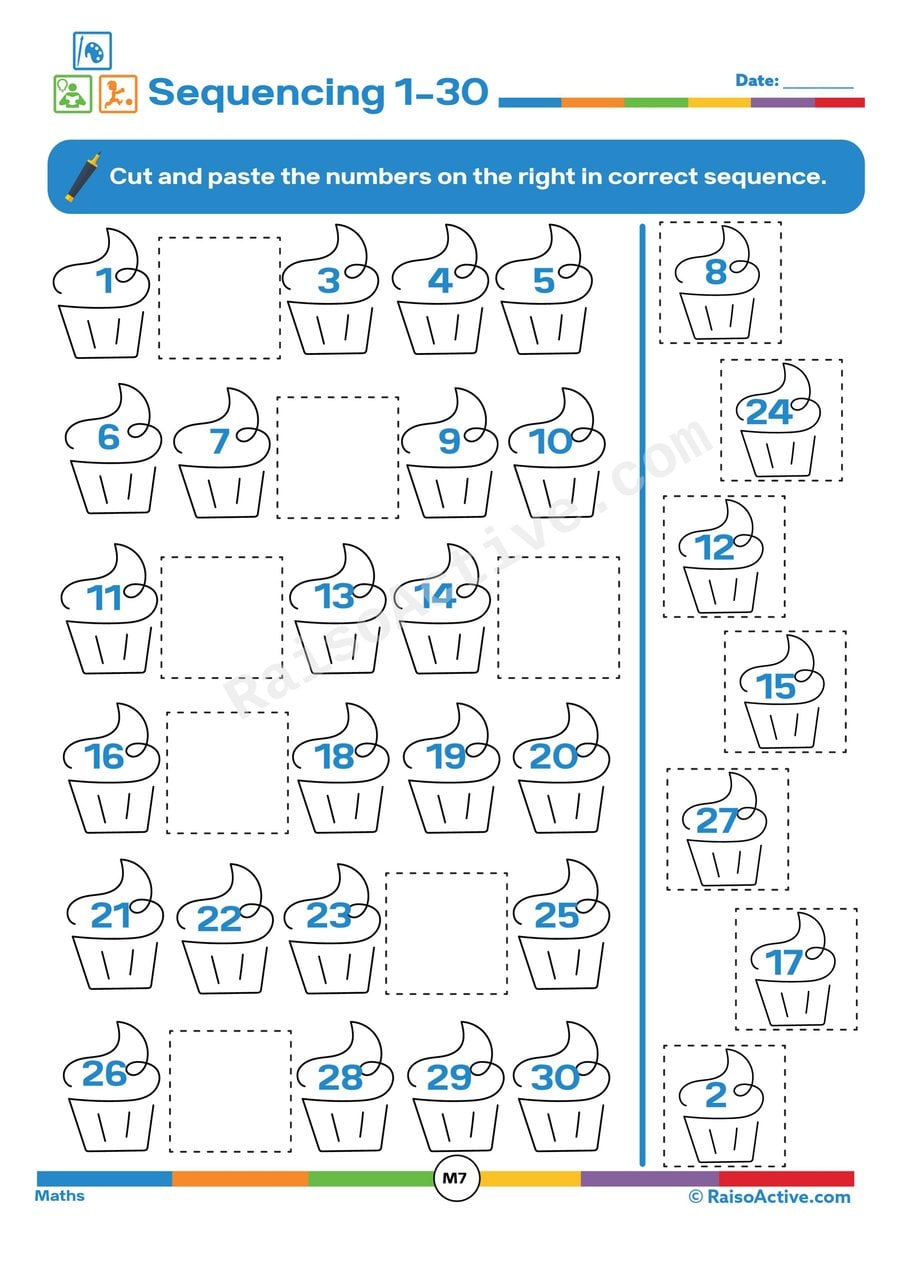
Cupcake Number Sequencing Worksheet 1-30
Ages 4-6 · Pre-K–KindergartenAges 4-6 · Reception–Year 1Ages 4-6 · LKG–UKGAges 4-6
Children ages 4-6 practice number sequencing from 1 to 30 by cutting out numeral pieces and pasting them onto cupcakes in ascending order, reinforcing both number recognition and the logic of 'what comes next' in the counting sequence. This bridges the gap between counting by rote and truly understanding number order, an essential step before children can skip-count or do simple addition.

Recite Numbers Worksheet: Connect the Dots and Practice Number Sequencing!
Ages 3-5 · Preschool–Pre-KAges 3-5 · Nursery–ReceptionAges 3-5 · Nursery–LKGAges 3-5
Children ages 3-5 practice number sequencing and recitation as they connect numbered dots in order to reveal a hidden picture, reinforcing both number recognition and the ability to count forward smoothly without skipping. Saying each number aloud while connecting it also builds the verbal counting fluency children need before they can count objects accurately.
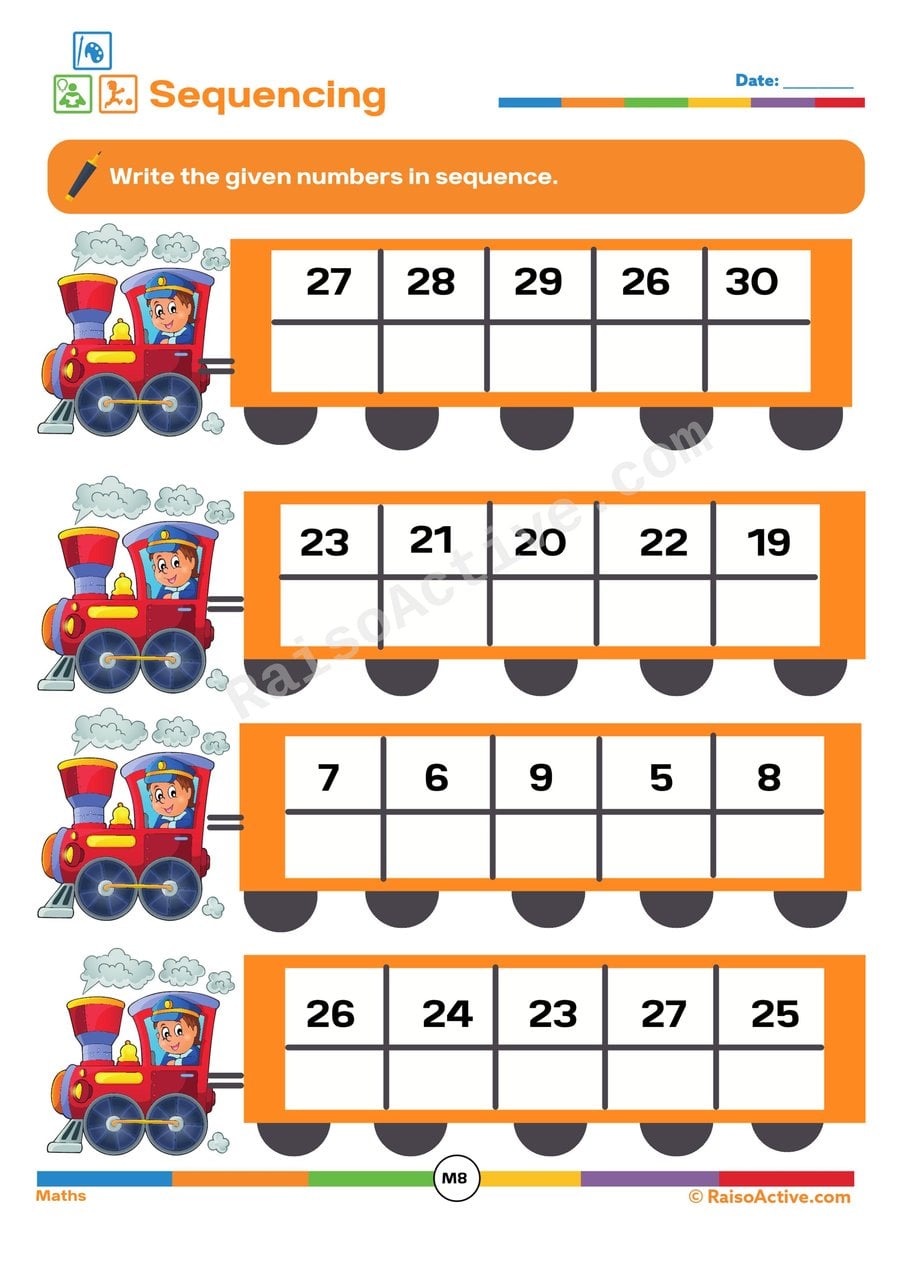
Number Sequencing Train Worksheet for Kids
Ages 4-6 · Pre-K–KindergartenAges 4-6 · Reception–Year 1Ages 4-6 · LKG–UKGAges 4-6
This train-themed sequencing worksheet challenges children ages 4-6 to fill in missing numbers scattered throughout a sequence, requiring them to recognize number order well enough to identify a gap anywhere in the run rather than only counting forward from the start. This deeper sequencing skill supports later math concepts like skip counting, addition, and number lines. Writing the missing numbers by hand, rather than just saying them aloud, also reinforces number formation alongside number order.

Beehive Number Fun: Missing Numbers 0-30 Worksheet
Ages 4-6 · Pre-K–KindergartenAges 4-6 · Reception–Year 1Ages 4-6 · LKG–UKGAges 4-6
Filling in missing numbers along a beehive path gives 4-6 year olds practice with the full 0-30 number sequence, a meaningful stretch beyond the more common 1-10 or 1-20 ranges seen in earlier counting worksheets. Because the missing numbers are scattered rather than all at the end, your child has to actually understand what number comes next at multiple points in the sequence, rather than simply continuing a count from a known starting point.
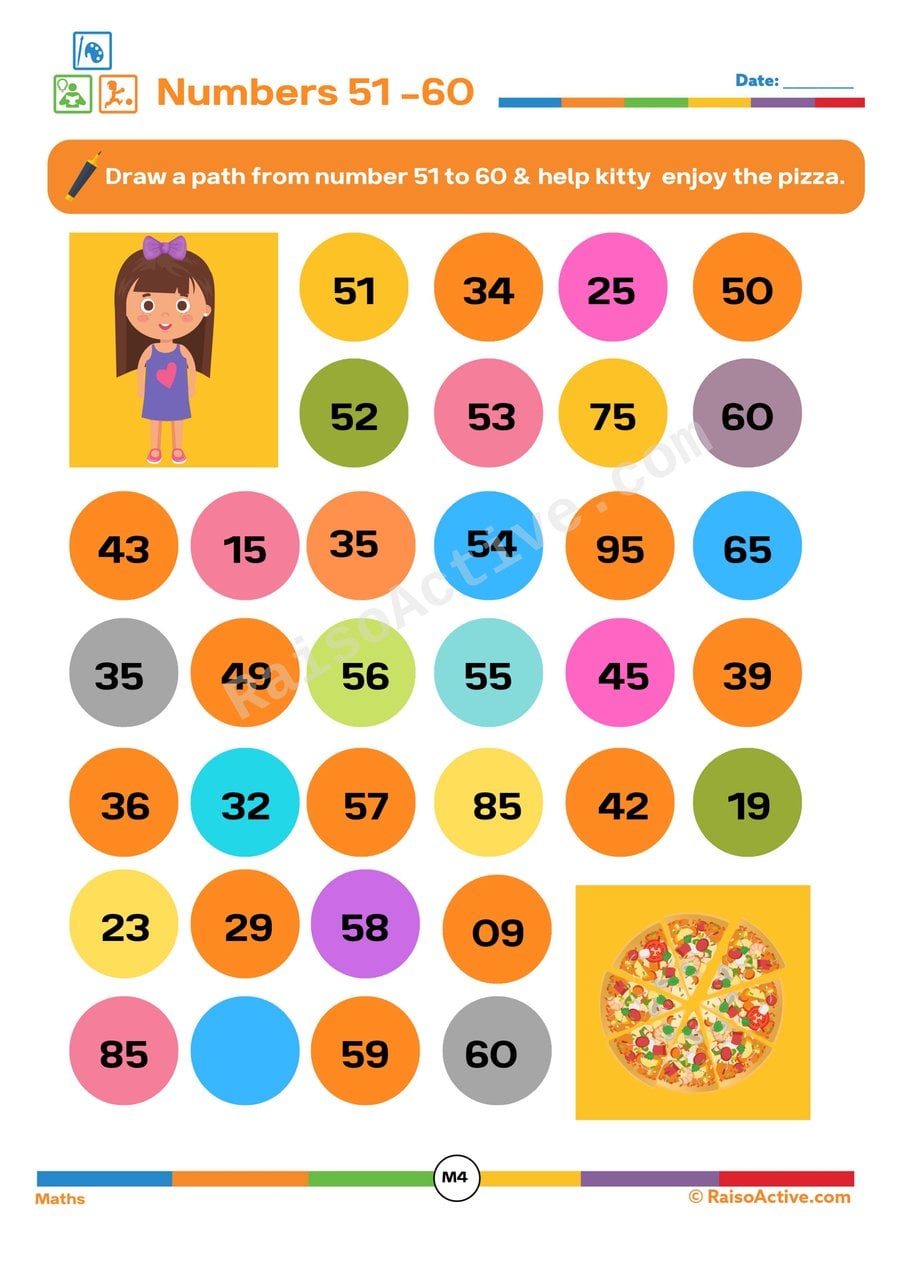
Pizza Path: Numbers 51-60 Worksheet for Kids
Ages 4-5 · Pre-KAges 4-5 · ReceptionAges 4-5 · LKGAges 4-5
Connecting the dots from 51 to 60 in order pushes children ages 4-5 beyond the more familiar 1-20 range, helping them recognize two-digit numbers and understand that counting sequences continue predictably into higher decades. This dot-to-dot format turns number recognition into a rewarding visual payoff, since a hidden pizza picture only appears once every number is found and connected correctly. It's a motivating way to practice number order without it feeling like repetitive drilling.

Number Sequencing Worksheet: Practice Counting and Ordering Numbers!
Ages 4-5 · Pre-KAges 4-5 · ReceptionAges 4-5 · LKGAges 4-5
This worksheet gives children ages 4-5 focused practice writing numerals in order by filling in the missing numbers within several different counting sequences. Unlike simple counting aloud, writing each numeral by hand forces children to connect the spoken number word to its correct written symbol, reinforcing both number recognition and early handwriting control.
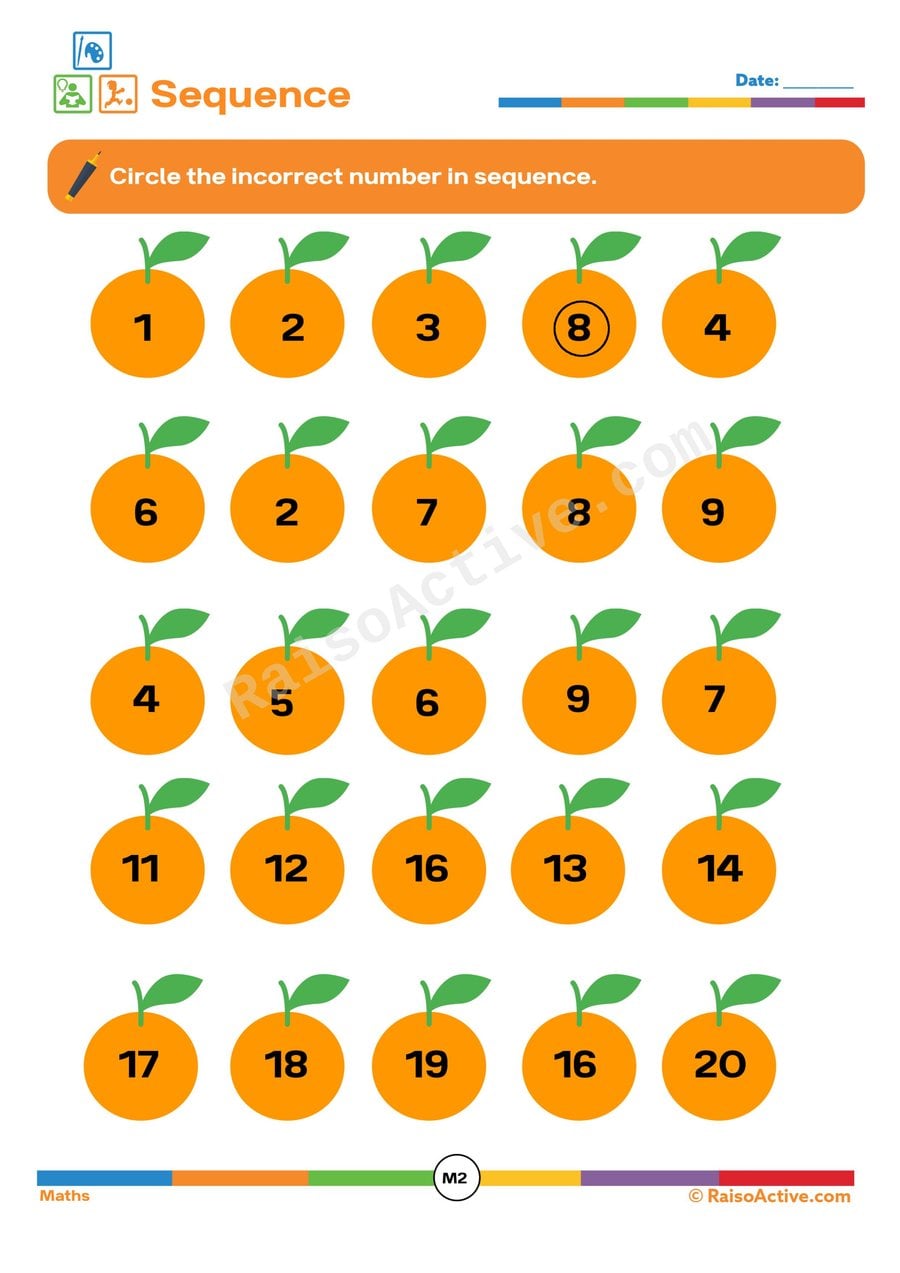
Sequence Worksheet: Find the Incorrect Number!
Ages 4-5 · Pre-KAges 4-5 · ReceptionAges 4-5 · LKGAges 4-5
This worksheet sharpens number pattern recognition by having children scan a row of numbers in sequence and spot the one number that breaks the pattern. For four- and five-year-olds, this kind of 'odd one out' task requires holding the counting sequence in mind while comparing it against what's actually written, building both number sense and early attention to detail.
Guides for this topic

Number Formation Rhymes 0–9 and How to Fix Reversals
Original number formation rhymes for 0–9, the correct stroke order for each digit, why 3, 5 and 7 get reversed most often, and multisensory fixes that work.

Documenting Learning Without Drowning in Data: A Practical Guide for Parents and Teachers
Learn practical ways to document your child's learning without overwhelm. Simple portfolios, observation tips, and printable trackers for ages 1-8.

How to Help Your Child with Letter Reversals: A Complete Guide for Parents and Teachers
Letter reversals are normal until age 7-8. Learn the best multisensory strategies, anchor letter tricks, and activities to help children write b, d, p, and q correctly.
Reviews
Every worksheet for ages 4–6, no watermark
Members download the full library of 1,000+ worksheets and every activity pack without watermarks or daily limits. One year costs ₹999 in India or $20 elsewhere.
See membership plansOr download any worksheet free with a watermark (5 a day).