Safety Stairs Worksheet: Matching Traffic Signs and Following Directions
This worksheet builds road safety awareness in children ages 3-5 while also practicing sign recognition, visual matching, and following a multi-step path from start to finish. Matching sign names to sign shapes teaches children to recognize traffic signs by both their look and their meaning, a real-world reading skill that supports their safety once they're out walking or biking.
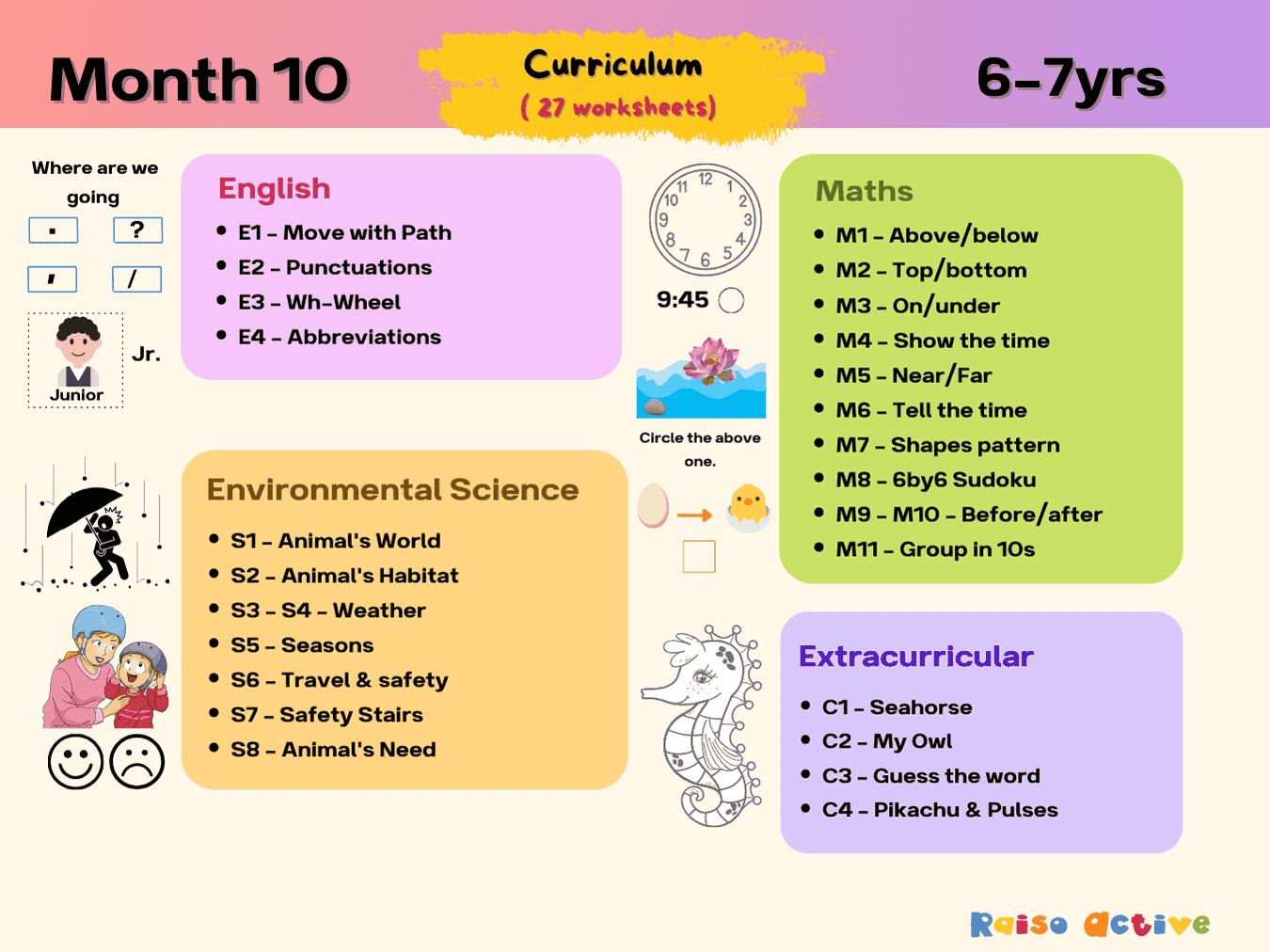
Part of the pack
Month 10: Learning & Development | Ages 6-7
This is page 25 of the pack. Ages 6-7 · Grade 1Ages 6-7 · Year 2Ages 6-7 · Class 1Ages 6-7

Made for your child
Counting to 10, made for your child
A maths pack with your child's name in it: pictures that explain, practice at three levels, puzzles and story sums about them. Print a new set whenever they finish.
Make a maths packFree preview · free for members
Curriculum
- Safety > Road Safety
How to use this worksheet
Start by following the path from start to finish together, talking about what's happening at each step along the stairs. Look at the traffic signs shown and read their names aloud, having your child draw a line matching each name to the correct sign. Then look at the safety scenarios and have your child color the smiley faces to show whether each situation is safe or unsafe, before cutting and pasting the remaining cards into place.
Materials needed
- Pencil
- Scissors
- Glue
- Crayons
Extension activities
- 1Discuss other traffic signs you see in your neighborhood and talk about what each one means.
- 2Create a pretend traffic scene at home using toy cars, blocks, and homemade paper signs.
- 3Go on a walk and point out real traffic signs, asking your child to name them as you pass.
- 4Role-play being a pedestrian and a crossing guard, using the signs from the worksheet as prompts.

Written by
Hemsweta Jain · Teacher Cheena
MBA and Early Childhood Educator, teaching since 2014 · Founder of RaisoActive, Mumbai
Every RaisoActive worksheet is designed and checked by the founder before publishing.
Published · Last reviewed
More from Month 10: Learning & Development | Ages 6-7
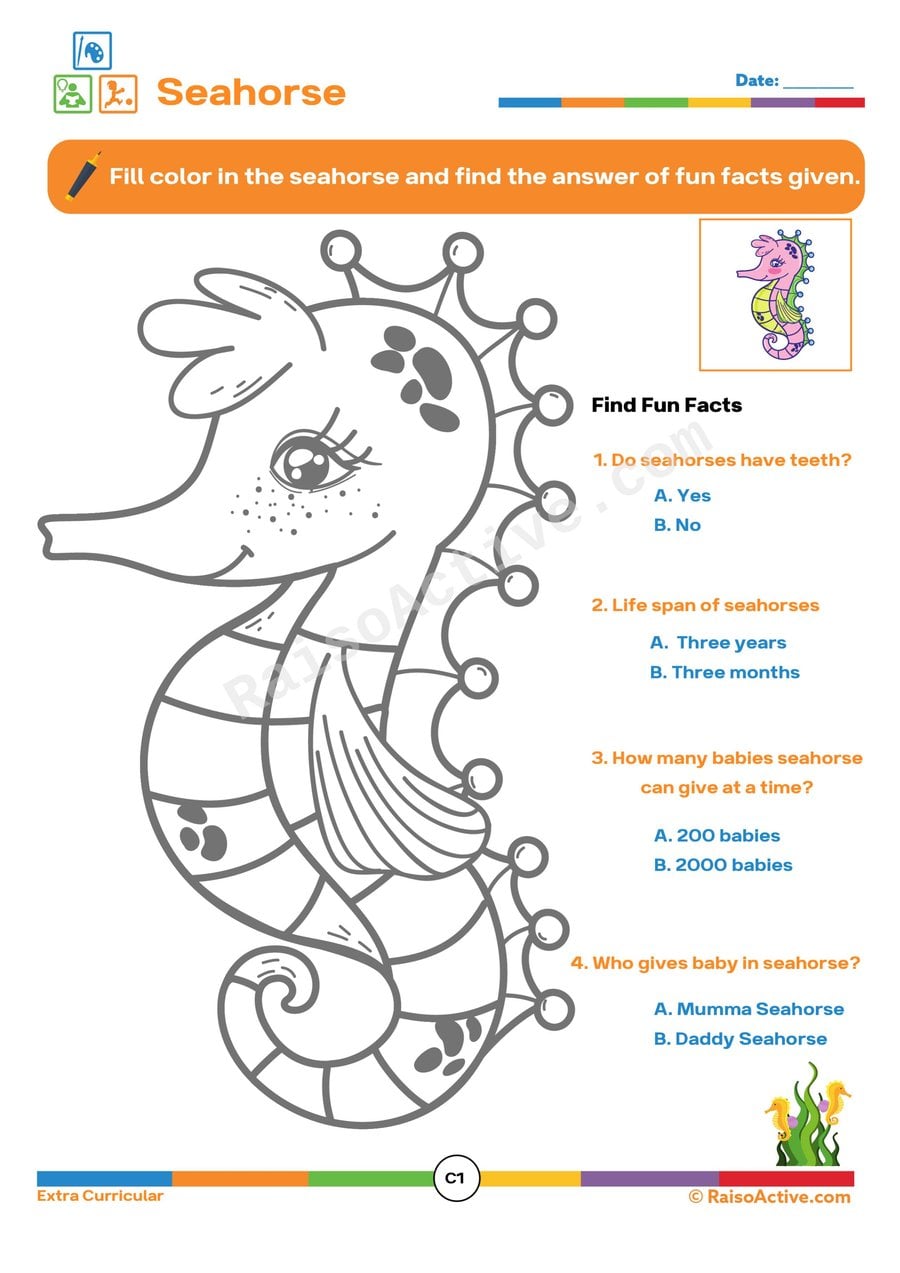
Seahorse Fun Facts Worksheet for Kids
Ages 3-5 · Preschool–Pre-KAges 3-5 · Nursery–ReceptionAges 3-5 · Nursery–LKGAges 3-5
This worksheet combines coloring practice with early reading comprehension by having children ages 3-5 color a seahorse illustration and then answer simple fact-based questions about it by circling the correct choice. Learning specific facts about an unusual sea creature — like that seahorses swim upright or that males carry the eggs — builds background science knowledge that supports later reading comprehension in nonfiction texts. The coloring portion also keeps fine motor practice woven into a subject-focused activity.

6x6 Sudoku Puzzle: Picture Matching Worksheet for Kids
Ages 4-6 · Pre-K–KindergartenAges 4-6 · Reception–Year 1Ages 4-6 · LKG–UKGAges 4-6
This picture-based sudoku worksheet introduces children ages 4-6 to an early form of logical deduction, teaching them that each picture can appear only once in every row and column of the grid. Working out where a picture must go by process of elimination builds problem-solving and visual-scanning skills well beyond simple matching. Cutting and placing the small picture pieces precisely also strengthens fine motor coordination.

Weather Worksheet: Match the Weather to the Number!
Ages 3-5 · Preschool–Pre-KAges 3-5 · Nursery–ReceptionAges 3-5 · Nursery–LKGAges 3-5
This matching activity asks children ages 3-5 to connect weather pictures — sun, rain, clouds, snow — to numbered labels, combining early reading of weather vocabulary with number-symbol association. Recognizing that a picture, a word, and a number can all represent the same idea builds the kind of flexible symbolic thinking children will later use in reading and math alike. Weather is also a topic children experience daily, which makes the vocabulary immediately meaningful rather than abstract.

Before and After Worksheet for Kids: Sequencing Activities
Ages 3-5 · Preschool–Pre-KAges 3-5 · Nursery–ReceptionAges 3-5 · Nursery–LKGAges 3-5
This worksheet helps children ages 3-5 practice sequencing by identifying which picture logically comes before and which comes after a given event. Understanding cause-and-effect order is an early comprehension skill that supports retelling stories and understanding daily routines. Combining a tick-the-answer section with a cut-and-paste section gives repeated practice with the same concept in two different formats.
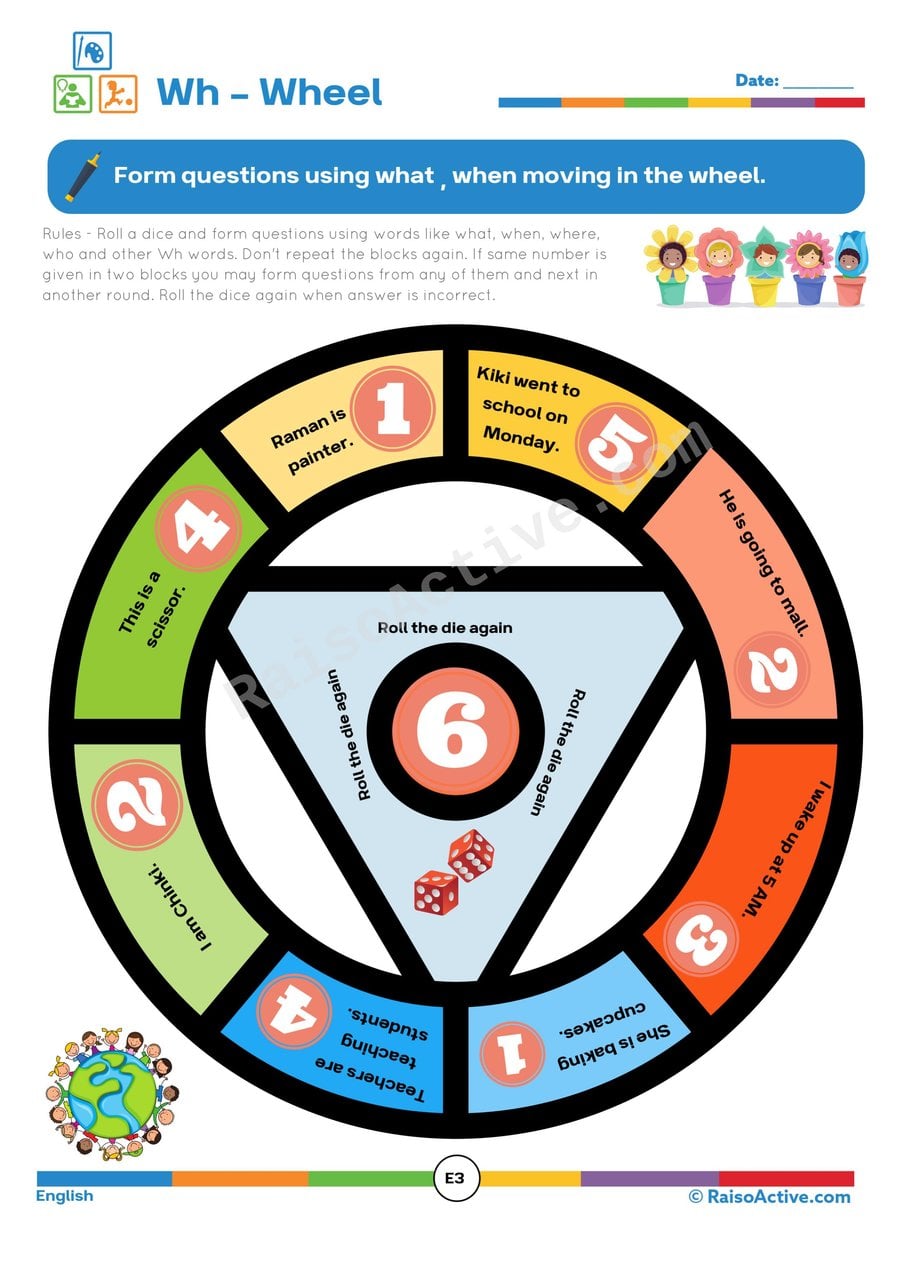
Wh- Wheel Worksheet: Question Formation Fun!
Ages 4-6 · Pre-K–KindergartenAges 4-6 · Reception–Year 1Ages 4-6 · LKG–UKGAges 4-6
This wheel activity helps children ages 4-6 practice forming questions using the five 'wh-' words — what, when, where, who, and why — a key building block for both conversational language and reading comprehension. Rolling a die to land on a random prompt keeps the practice playful and unpredictable, encouraging children to generate original questions rather than repeating memorized ones.

Abbreviations Worksheet: Matching and Writing Practice
Ages 4-6 · Pre-K–KindergartenAges 4-6 · Reception–Year 1Ages 4-6 · LKG–UKGAges 4-6
This worksheet introduces children ages 4-6 to common abbreviations — like Mr., Dr., or St. — by having them match each shortened form to the correct sentence context and then write it in correctly. Understanding that some words have a shortened written form is an important early literacy concept, since abbreviations appear constantly in books, signs, and everyday writing. Practicing both matching and writing reinforces the connection between recognizing an abbreviation and producing it correctly from memory.

Animal's World: Sorting Animals by Land, Water, and Air - Printable Worksheet
Ages 4-6 · Pre-K–KindergartenAges 4-6 · Reception–Year 1Ages 4-6 · LKG–UKGAges 4-6
This sorting worksheet teaches children ages 4-6 to classify animals into three habitat categories — land, water, and air — based on where each animal naturally lives and moves. Classifying by habitat rather than by appearance alone encourages children to think about an animal's features, like fins, wings, or legs, and connect them to function. This three-way sort is more complex than a simple two-category sort, building more advanced categorization skills.

Above and Below Worksheet: Counting and Spatial Reasoning for Kids
Ages 4-6 · Pre-K–KindergartenAges 4-6 · Reception–Year 1Ages 4-6 · LKG–UKGAges 4-6
This worksheet combines spatial reasoning and counting for children ages 4-6, asking them to identify whether objects are positioned above or below a reference point and then use that understanding to answer counting questions. Understanding relative position words like 'above' and 'below' supports later skills in reading diagrams, maps, and graphs. Pairing the concept with counting also reinforces that spatial language can describe quantities, not just single objects.
Related worksheets

Traffic Rules Worksheet: Cut and Glue the Traffic Signs!
Ages 3-5 · Preschool–Pre-KAges 3-5 · Nursery–ReceptionAges 3-5 · Nursery–LKGAges 3-5
Cutting out traffic sign pictures and matching them to their correct labels builds early sign recognition and vocabulary for children ages 3-5, connecting a familiar shape and color to its real-world safety meaning.

Traffic Rules Worksheet for Kids: Learn Road Safety!
Ages 3-5 · Preschool–Pre-KAges 3-5 · Nursery–ReceptionAges 3-5 · Nursery–LKGAges 3-5
This worksheet builds children ages 3-5's understanding of basic traffic rules, including who controls traffic, where it's safe to cross, and what each traffic light color means, through a combination of circling correct answers and coloring a traffic signal. Learning these rules early helps children build genuine road safety awareness rather than just memorized instructions.

Road Safety Signs Matching Worksheet for Preschoolers
Ages 3-5 · Preschool–Pre-KAges 3-5 · Nursery–ReceptionAges 3-5 · Nursery–LKGAges 3-5
Matching road safety signs teaches 3-5 year olds to recognize specific shapes, colors, and symbols and connect them to their real-world meaning — an early form of symbol literacy that matters well beyond the worksheet, since these are signs your child will actually encounter on walks and car rides. Coloring the signs first, then matching them, reinforces visual recognition through repetition before the matching task asks them to recall each sign's identity without color cues alone.

Traffic Signals Cut and Paste Worksheet for Preschoolers
Ages 3-5 · Preschool–Pre-KAges 3-5 · Nursery–ReceptionAges 3-5 · Nursery–LKGAges 3-5
Children ages 3-5 learn to recognize red, yellow, and green traffic signals and connect each color to its meaning, an early road-safety skill that also reinforces color recognition and matching. Understanding what each signal means builds real-world safety awareness they'll use as pedestrians and passengers.
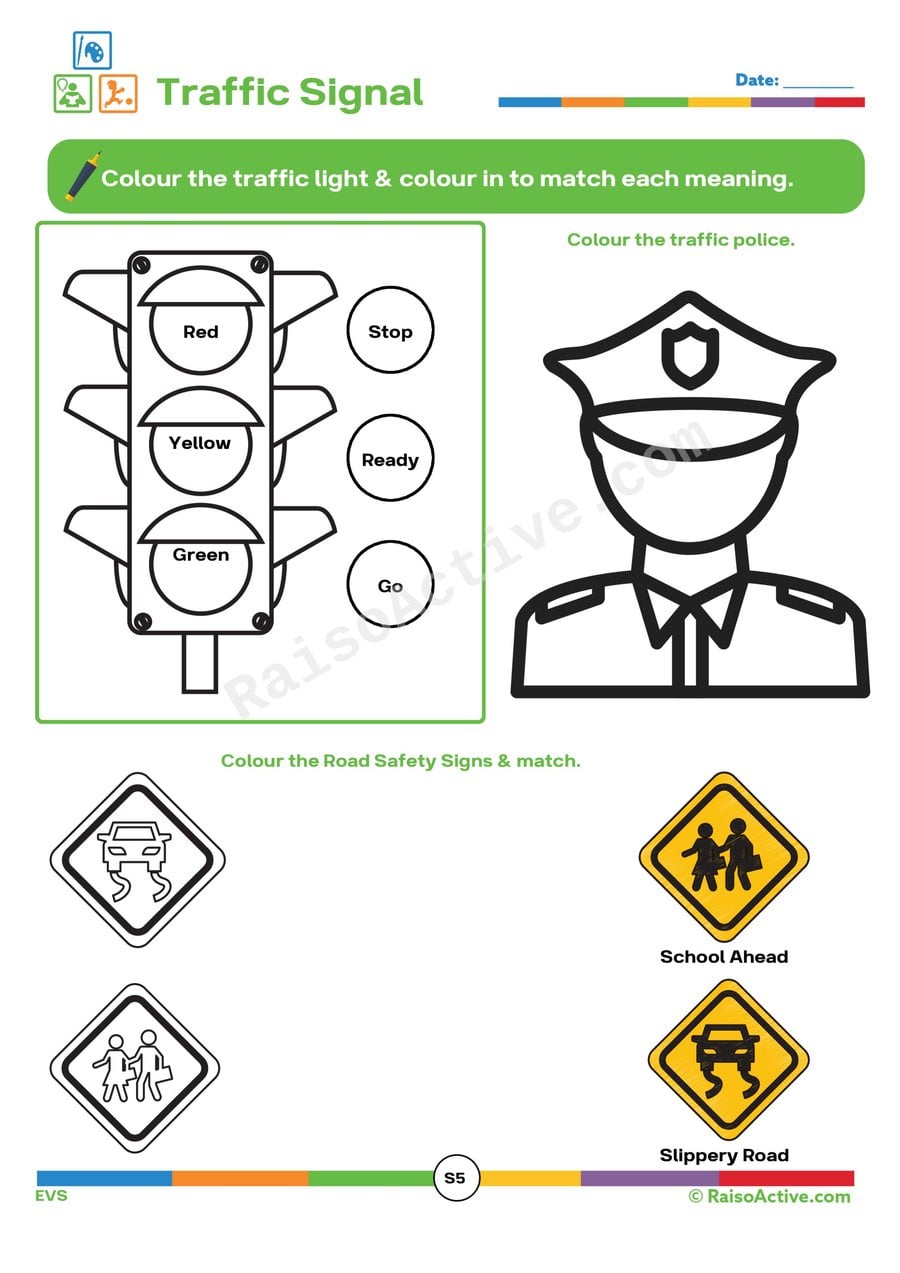
Traffic Signal Fun: Color and Match the Meanings!
Ages 3-5 · Preschool–Pre-KAges 3-5 · Nursery–ReceptionAges 3-5 · Nursery–LKGAges 3-5
Coloring traffic lights and matching words to their meanings teaches children ages 3-5 that colors carry specific, important messages in the real world, an early and practical form of symbol recognition and road safety awareness. Matching written words to the correct traffic light or road sign also reinforces early reading skills by connecting simple vocabulary to something visually familiar from everyday outings. Understanding what red, yellow, and green mean at a traffic light gives children knowledge they can apply immediately as pedestrians and future road users.

Road Safety Worksheet for Kids: Fill-in-the-Blanks
Ages 3-5 · Preschool–Pre-KAges 3-5 · Nursery–ReceptionAges 3-5 · Nursery–LKGAges 3-5
This worksheet teaches children ages 3-5 essential road safety vocabulary and rules — like looking both ways, using crosswalks, and obeying traffic signals — by having them choose the correct word to complete each safety-related sentence. Learning these rules in a reading and writing context, rather than just hearing them, helps reinforce safety habits that protect children in real traffic situations.

Safe Walker Worksheet: Following Pedestrian Rules for Kids
Ages 3-5 · Preschool–Pre-KAges 3-5 · Nursery–ReceptionAges 3-5 · Nursery–LKGAges 3-5
This worksheet teaches children ages 3-5 the core rules of safe pedestrian behavior — looking both ways, using crosswalks, and holding an adult's hand — by having them read simple instructions and fill in the correct safety word. Learning these specific rules early builds habits that matter for real-world safety long before a child is old enough to cross streets independently.

Road Safety Worksheet for Preschoolers: Safe Travel Fun!
Ages 3-5 · Preschool–Pre-KAges 3-5 · Nursery–ReceptionAges 3-5 · Nursery–LKGAges 3-5
Identifying safe versus unsafe travel behaviors by ticking pictures and circling thumbs up or thumbs down builds early critical thinking about real-world safety for children ages 3-5, connecting classroom learning to a practical life skill.
Guides for this topic

Best Worksheets for 3-Year-Olds: What Works and What to Avoid
What works on worksheets for 3-year-olds: short sessions, crayons, tracing lines, matching, cutting, a free weekly plan, and signs one is too advanced.
Documenting Learning Without Drowning in Data: A Practical Guide for Parents and Teachers
Learn practical ways to document your child's learning without overwhelm. Simple portfolios, observation tips, and printable trackers for ages 1-8.

Age-Appropriate Problem-Solving Activities: Building Critical Thinkers from the Ground Up
Discover fun, age-appropriate problem-solving activities for children ages 1-8. Build critical thinking, logic, and reasoning skills through play-based learning.
Reviews
Every worksheet for ages 3–5, no watermark
Members download the full library of 1,000+ worksheets and every activity pack without watermarks or daily limits. One year costs ₹999 in India or $20 elsewhere.
See membership plansOr download any worksheet free with a watermark (5 a day).