6x6 Sudoku Puzzle: Picture Matching Worksheet for Kids
This picture-based sudoku worksheet introduces children ages 4-6 to an early form of logical deduction, teaching them that each picture can appear only once in every row and column of the grid. Working out where a picture must go by process of elimination builds problem-solving and visual-scanning skills well beyond simple matching. Cutting and placing the small picture pieces precisely also strengthens fine motor coordination.
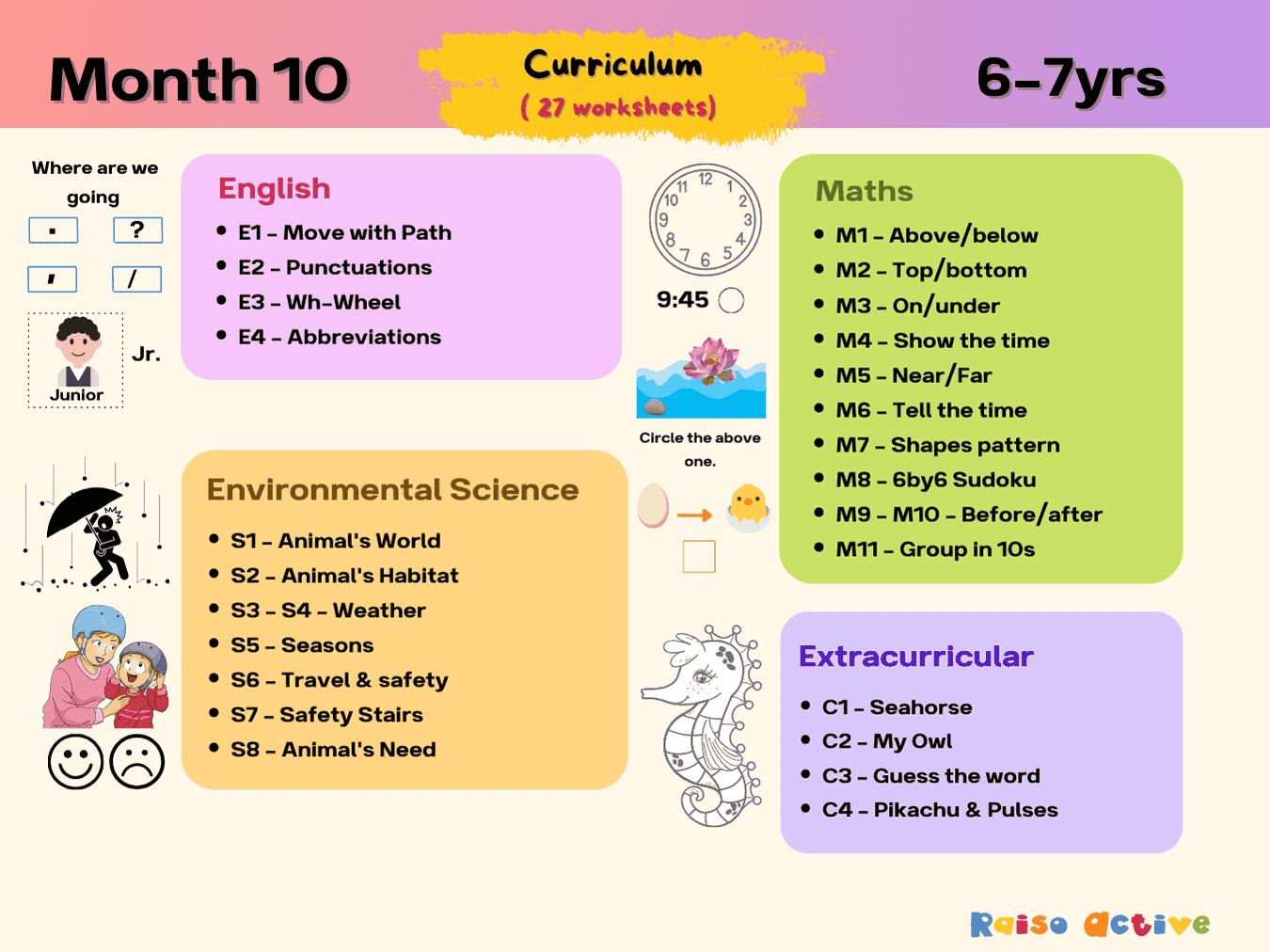
Part of the pack
Month 10: Learning & Development | Ages 6-7
This is page 15 of the pack. Ages 6-7 · Grade 1Ages 6-7 · Year 2Ages 6-7 · Class 1Ages 6-7
Curriculum
- Cognitive - Attention > Visual Discrimination
How to use this worksheet
Look at the grid together and point out that each row and column should contain one of every picture, with none repeating. Have your child cut out the pictures from the strip at the bottom of the page using child-safe scissors. For each empty square, ask your child to scan its row and column to figure out which picture is missing before gluing it into place. Work through the grid gradually, checking after each row that no picture appears twice.
Materials needed
- Scissors
- Glue
- Pencil
Extension activities
- 1Create your own Sudoku puzzles with different pictures.
- 2Use the same pictures to create a memory matching game.
- 3Try a simpler 4x4 picture sudoku grid first if the 6x6 grid feels overwhelming.
- 4Turn it into a floor game using large paper squares and toy pieces instead of cut-outs.
- 5Time how long it takes to solve the puzzle and try to beat that time on a fresh grid.

Written by
Hemsweta Jain · Teacher Cheena
MBA and Early Childhood Educator, teaching since 2014 · Founder of RaisoActive, Mumbai
Every RaisoActive worksheet is designed and checked by the founder before publishing.
Published · Last reviewed
More from Month 10: Learning & Development | Ages 6-7

Before and After Shapes Worksheet: Coloring and Identifying Shapes
Ages 3-5 · Preschool–Pre-KAges 3-5 · Nursery–ReceptionAges 3-5 · Nursery–LKGAges 3-5
This worksheet combines shape identification with sequencing for children ages 3-5, asking them to color shapes accurately and then determine which shape comes before or after a given one in a sequence. Applying 'before' and 'after' to shapes rather than pictures of events pushes children to think about order in a more abstract way. Coloring within defined shape outlines also builds hand control and attention to boundaries.

Near and Far Worksheet: Identifying and Connecting Objects
Ages 3-5 · Preschool–Pre-KAges 3-5 · Nursery–ReceptionAges 3-5 · Nursery–LKGAges 3-5
This worksheet introduces children ages 3-5 to the comparative spatial concepts of 'near' and 'far' by having them draw connecting lines based on relative distance in a picture. Understanding proximity words builds an early vocabulary foundation for describing the physical world, which later supports map reading and measurement concepts. The connect-the-line format also reinforces visual tracking and following printed instructions accurately.

Animal's World: Sorting Animals by Land, Water, and Air - Printable Worksheet
Ages 4-6 · Pre-K–KindergartenAges 4-6 · Reception–Year 1Ages 4-6 · LKG–UKGAges 4-6
This sorting worksheet teaches children ages 4-6 to classify animals into three habitat categories — land, water, and air — based on where each animal naturally lives and moves. Classifying by habitat rather than by appearance alone encourages children to think about an animal's features, like fins, wings, or legs, and connect them to function. This three-way sort is more complex than a simple two-category sort, building more advanced categorization skills.
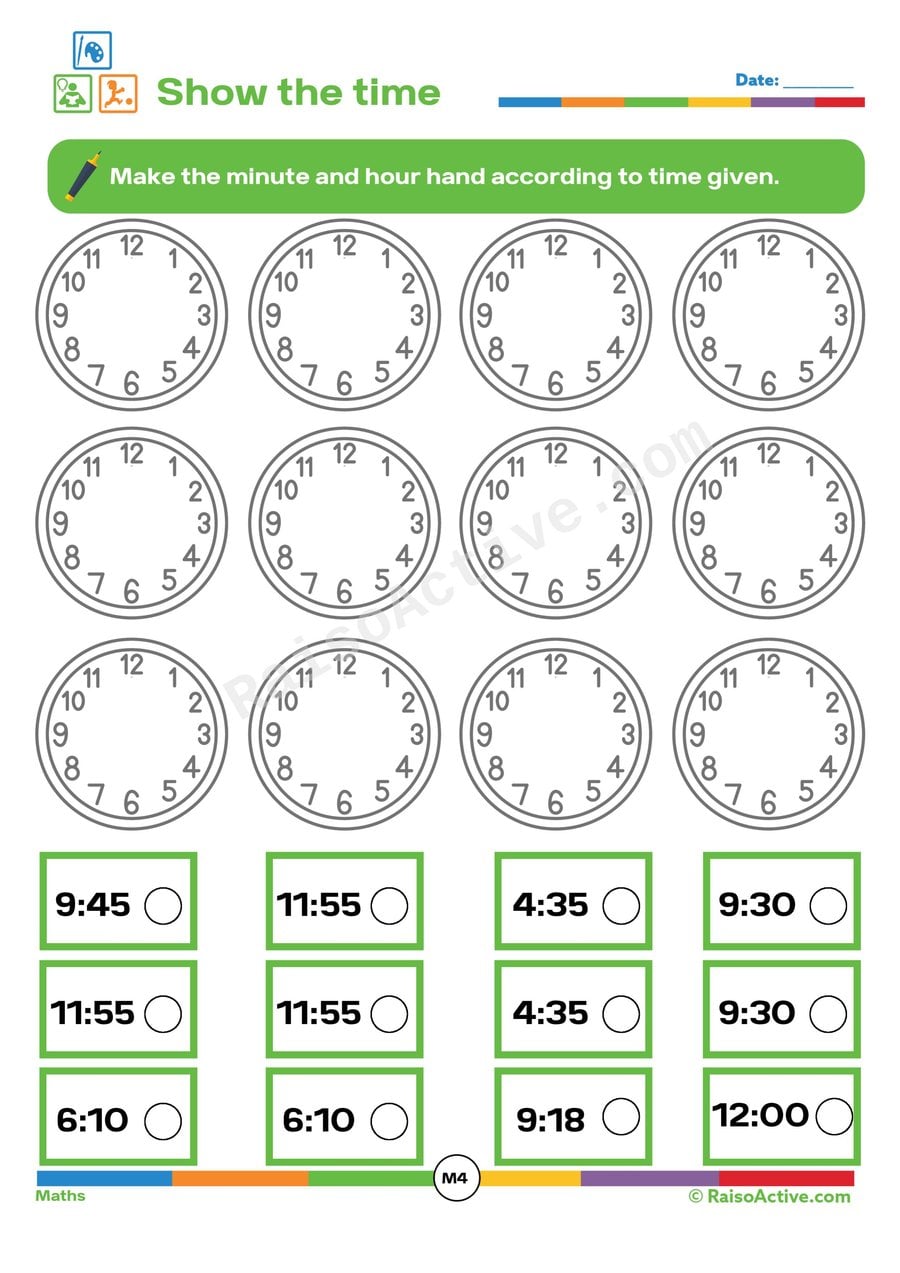
Time Telling Fun: Draw the Clock Hands! (3-5 Years)
Ages 3-5 · Preschool–Pre-KAges 3-5 · Nursery–ReceptionAges 3-5 · Nursery–LKGAges 3-5
This clock-hands activity teaches children ages 3-5 the very first steps of telling time by having them draw the hour and minute hands onto a blank clock face to match a given time. Because young children at this age typically focus on hour-level time recognition, the worksheet builds foundational awareness of how a clock's two hands work together before introducing the more complex idea of minutes. Repeated practice drawing hands in the correct position and length also reinforces fine motor control alongside the time concept.
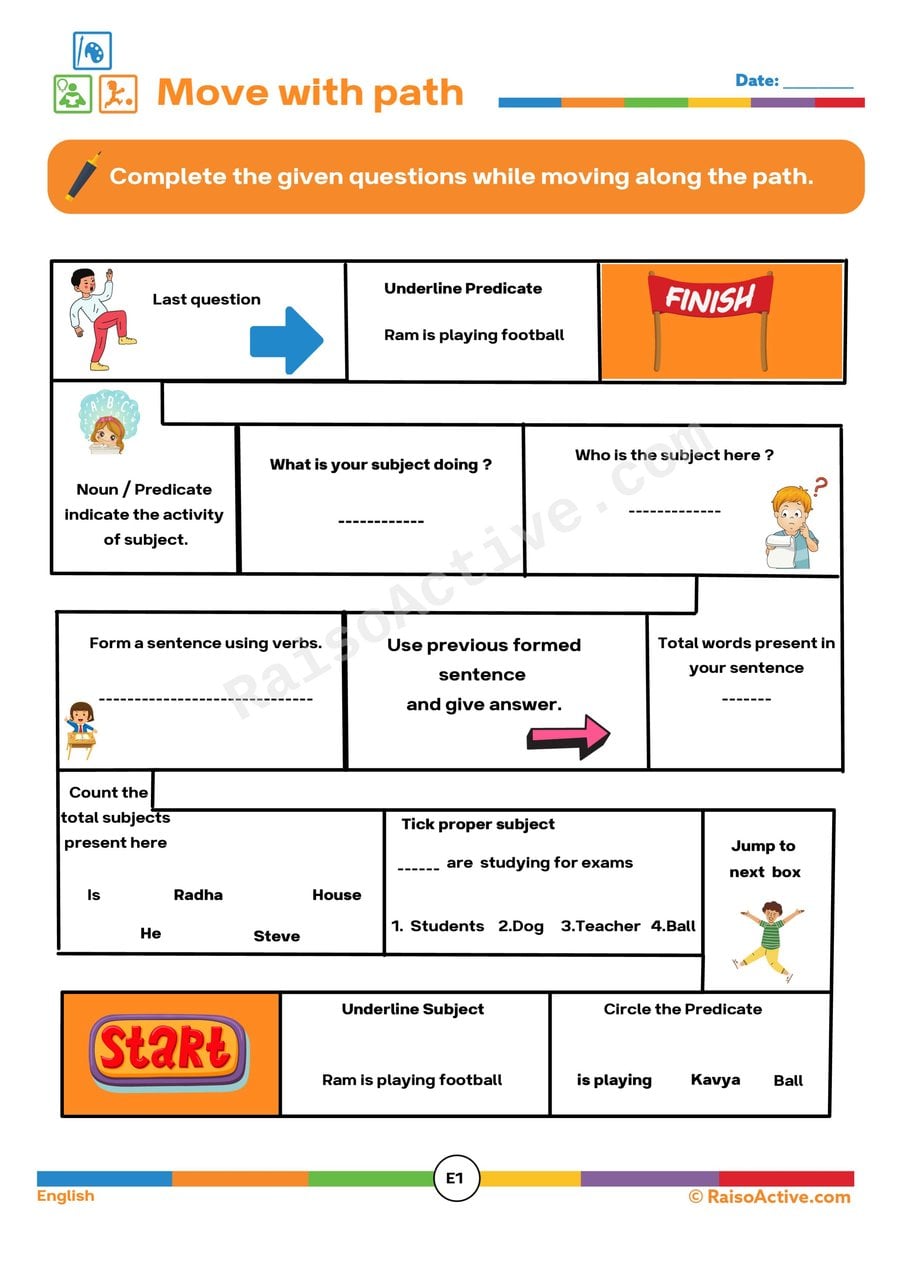
Move with Path Worksheet: Sentence Structure Fun!
Ages 4-6 · Pre-K–KindergartenAges 4-6 · Reception–Year 1Ages 4-6 · LKG–UKGAges 4-6
This path-based activity teaches children ages 4-6 the basic building blocks of a sentence — subject and predicate — by having them move through a series of boxes, underlining predicates and identifying subjects along the way. Framing grammar as a physical path to follow makes an abstract concept more concrete for early learners. By the end, children practice not just identifying sentence parts but also constructing new sentences of their own, moving from recognition to active use.

Parent's Guide: Fun Revision Activities for Early Learners!
Ages 3-5 · Preschool–Pre-KAges 3-5 · Nursery–ReceptionAges 3-5 · Nursery–LKGAges 3-5
This revision guide pulls together several previously learned concepts — the butterfly life cycle, shadow drawing, simple coding logic, and art and craft skills — giving children ages 3-5 a chance to revisit and strengthen ideas rather than encounter them for the first time. Spaced repetition like this is proven to help young children retain concepts longer than a single exposure. Mixing very different skill types in one guide also keeps the review sessions varied and engaging rather than repetitive.

Pikachu Pulses Worksheet: Following Instructions and Coloring Fun!
Ages 3-5 · Preschool–Pre-KAges 3-5 · Nursery–ReceptionAges 3-5 · Nursery–LKGAges 3-5
This activity helps children ages 3-5 practice following multi-step color instructions and strengthens pincer grip and fine motor precision as they place small dried lentils onto specific sections of a Pikachu outline. Working with tiny materials like lentils demands more finger control than crayons or markers, making this a genuinely challenging and rewarding fine motor exercise.

Abbreviations Worksheet: Matching and Writing Practice
Ages 4-6 · Pre-K–KindergartenAges 4-6 · Reception–Year 1Ages 4-6 · LKG–UKGAges 4-6
This worksheet introduces children ages 4-6 to common abbreviations — like Mr., Dr., or St. — by having them match each shortened form to the correct sentence context and then write it in correctly. Understanding that some words have a shortened written form is an important early literacy concept, since abbreviations appear constantly in books, signs, and everyday writing. Practicing both matching and writing reinforces the connection between recognizing an abbreviation and producing it correctly from memory.
Related worksheets
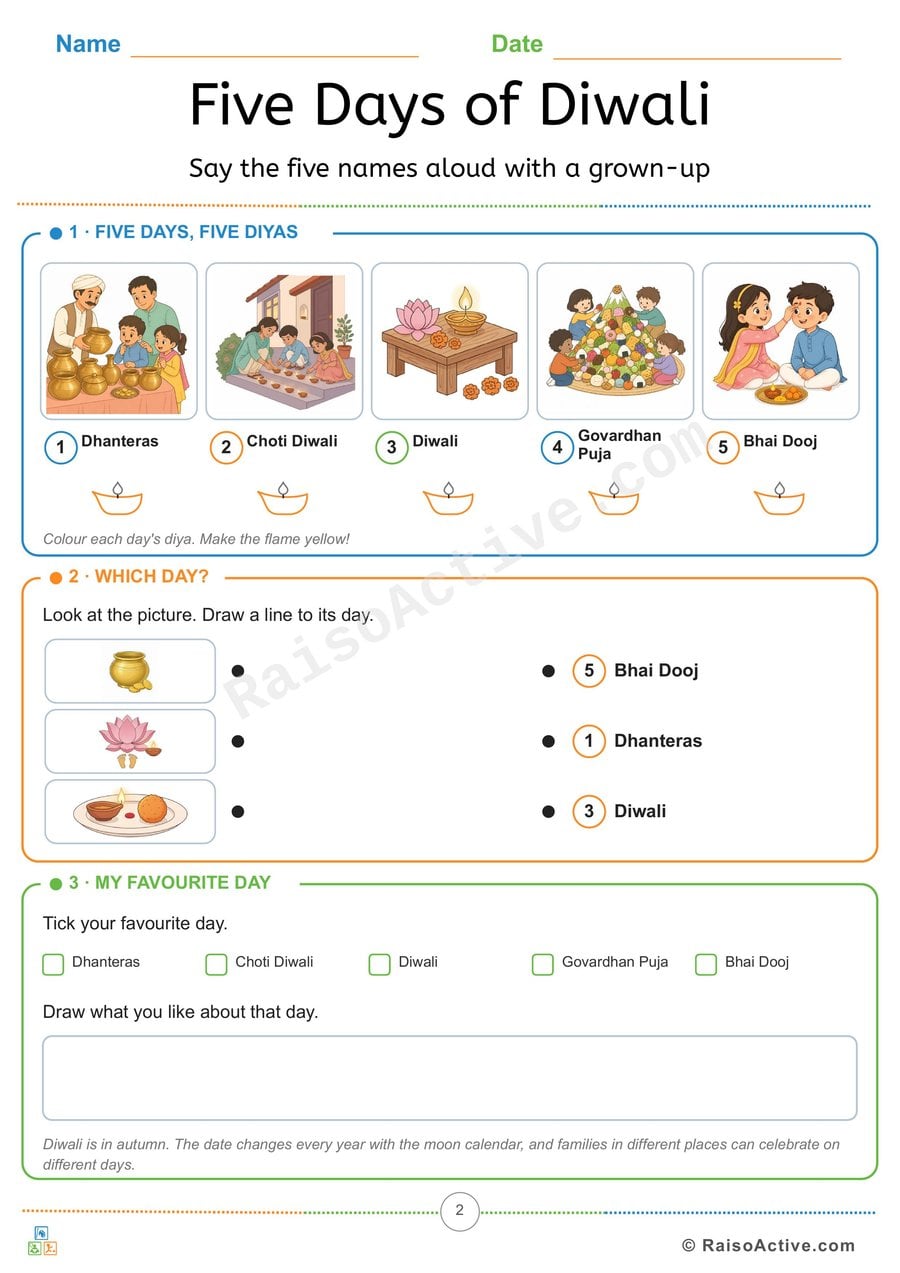
Five Days of Diwali: Dhanteras to Bhai Dooj Picture Match
Ages 4-6 · Pre-K–KindergartenAges 4-6 · Reception–Year 1Ages 4-6 · LKG–UKGAges 4-6
Children meet the five days of Diwali in order: Dhanteras, Choti Diwali, Diwali, Govardhan Puja and Bhai Dooj. They match a picture to each day, colour a diya for every day and say the names aloud with a grown-up.

Sequencing Worksheet for Kids: First, Next, Last
Ages 4-7 · Pre-K–Grade 1Ages 4-7 · Reception–Year 2Ages 4-7 · LKG–Class 1Ages 4-7
Children put three-step stories in order using first, next and last, then work backwards to find what came before a picture. This builds sequencing, time vocabulary and cause and effect thinking.

Feelings Faces Worksheet: Match, Trace and Circle the Happy Faces
Ages 4-6 · Pre-K–KindergartenAges 4-6 · Reception–Year 1Ages 4-6 · LKG–UKGAges 4-6
Children link everyday moments (bubbles, ice cream, blocks, a storm, a gift) to the face that shows the feeling, trace four feelings words and count happy faces.

Festivals of Many Faiths: Places of Worship and Greetings
Ages 4-8 · Pre-K–Grade 2Ages 4-8 · Reception–Year 3Ages 4-8 · LKG–Class 2Ages 4-8
Children learn that India is home to many faiths, each with its own festivals, places of worship and festival greetings.

Navratri Picture Cards: Cut-Out Memory Match Game
Ages 4-6 · Pre-K–KindergartenAges 4-6 · Reception–Year 1Ages 4-6 · LKG–UKGAges 4-6
Children learn six Navratri words, match each picture to its word and clue, and practise memory and cutting skills.

States of Matter Worksheet: Exploring Solids, Liquids, and Gases!
Ages 4-6 · Pre-K–KindergartenAges 4-6 · Reception–Year 1Ages 4-6 · LKG–UKGAges 4-6
This worksheet introduces children ages 4-6 to the three states of matter — solid, liquid, and gas — by having them examine images and sort each one into its correct category. Learning to classify familiar objects (like ice, water, and steam) by their physical state builds early scientific reasoning, since children must look past an object's identity and focus on its underlying properties.
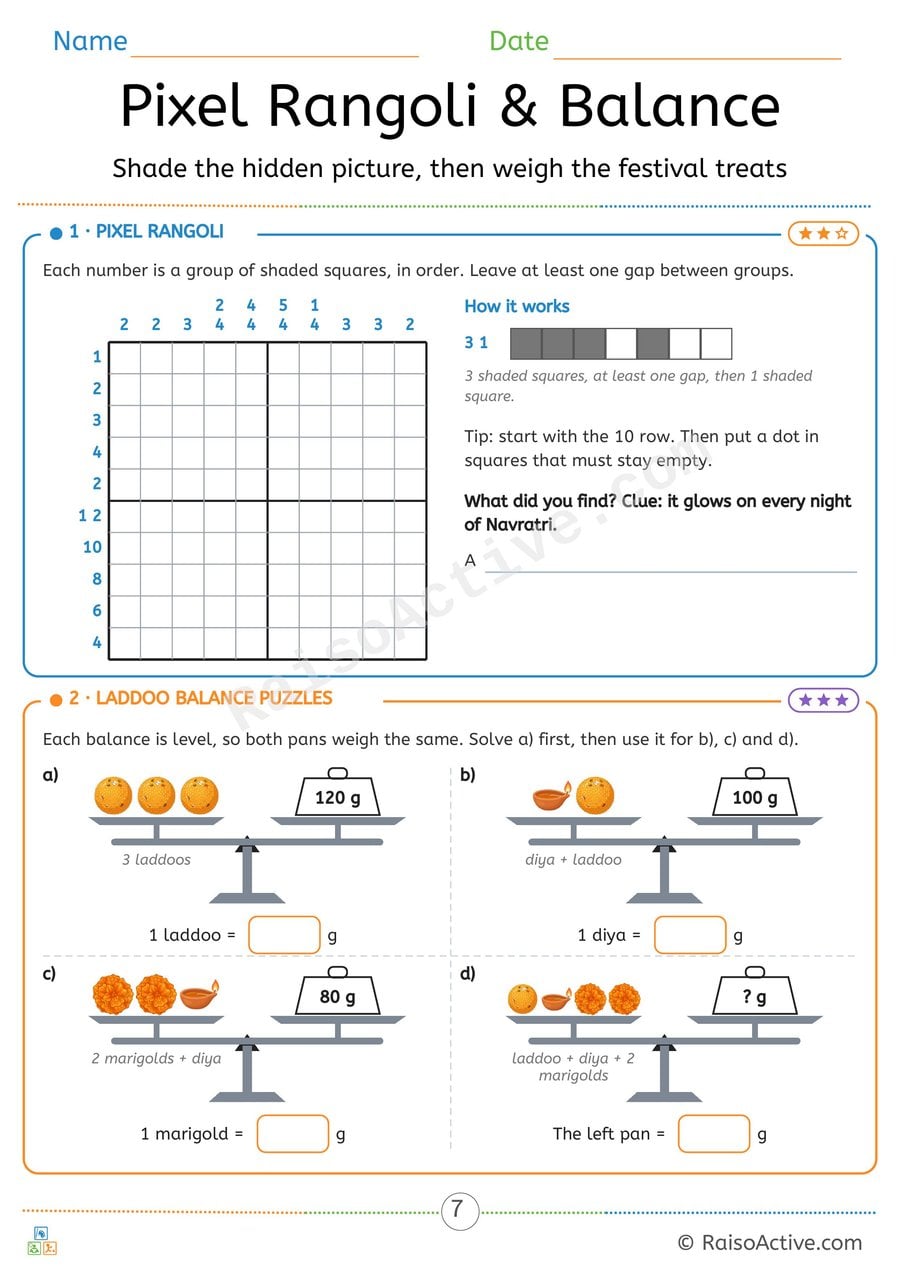
Pixel Rangoli and Laddoo Balance Puzzles for Navratri
Ages 7-11 · Grade 2–Grade 3Ages 7-11 · Year 3–Year 4Ages 7-11 · Class 2–Class 3Ages 7-11
Children use row and column clues to shade a 10 x 10 grid and reveal a hidden festival picture, then solve four balance puzzles in grams, using each answer to work out the next: a first step into algebra.
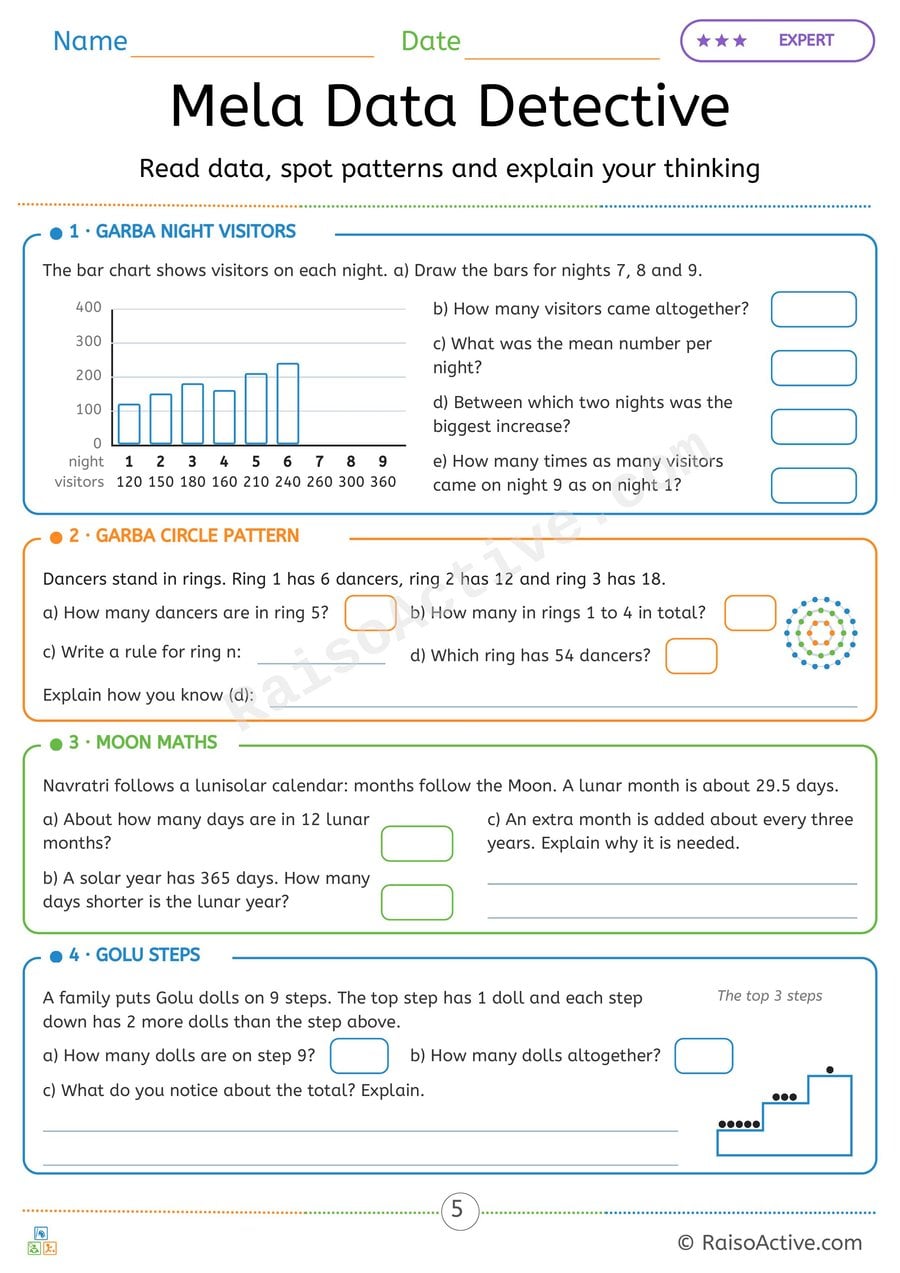
Mela Data Detective: Navratri Bar Chart, Patterns and Moon Maths
Ages 7-11 · Grade 2–Grade 3Ages 7-11 · Year 3–Year 4Ages 7-11 · Class 2–Class 3Ages 7-11
Children complete a bar chart of nine nights of visitors, find the total, the mean and the biggest increase, find and explain the rule for a growing pattern of dancers, compare a lunar year with a solar year, and add the dolls on nine Golu steps to discover a square number.
Guides for this topic

Best Worksheets for 3-Year-Olds: What Works and What to Avoid
What works on worksheets for 3-year-olds: short sessions, crayons, tracing lines, matching, cutting, a free weekly plan, and signs one is too advanced.

Age-Appropriate Problem-Solving Activities: Building Critical Thinkers from the Ground Up
Discover fun, age-appropriate problem-solving activities for children ages 1-8. Build critical thinking, logic, and reasoning skills through play-based learning.
Fostering Creativity in Structured Learning: The Perfect Balance for Young Minds
Learn how to blend creativity with structured learning for children ages 1-8. Practical strategies, activities, and printable worksheets for parents and teachers.
Reviews
Every worksheet for ages 4–6, no watermark
Members download the full library of 1,000+ worksheets and every activity pack without watermarks or daily limits. One year costs ₹999 in India or $20 elsewhere.
See membership plansOr download any worksheet free with a watermark (5 a day).