Pikachu Pulses Worksheet: Following Instructions and Coloring Fun!
This activity helps children ages 3-5 practice following multi-step color instructions and strengthens pincer grip and fine motor precision as they place small dried lentils onto specific sections of a Pikachu outline. Working with tiny materials like lentils demands more finger control than crayons or markers, making this a genuinely challenging and rewarding fine motor exercise.
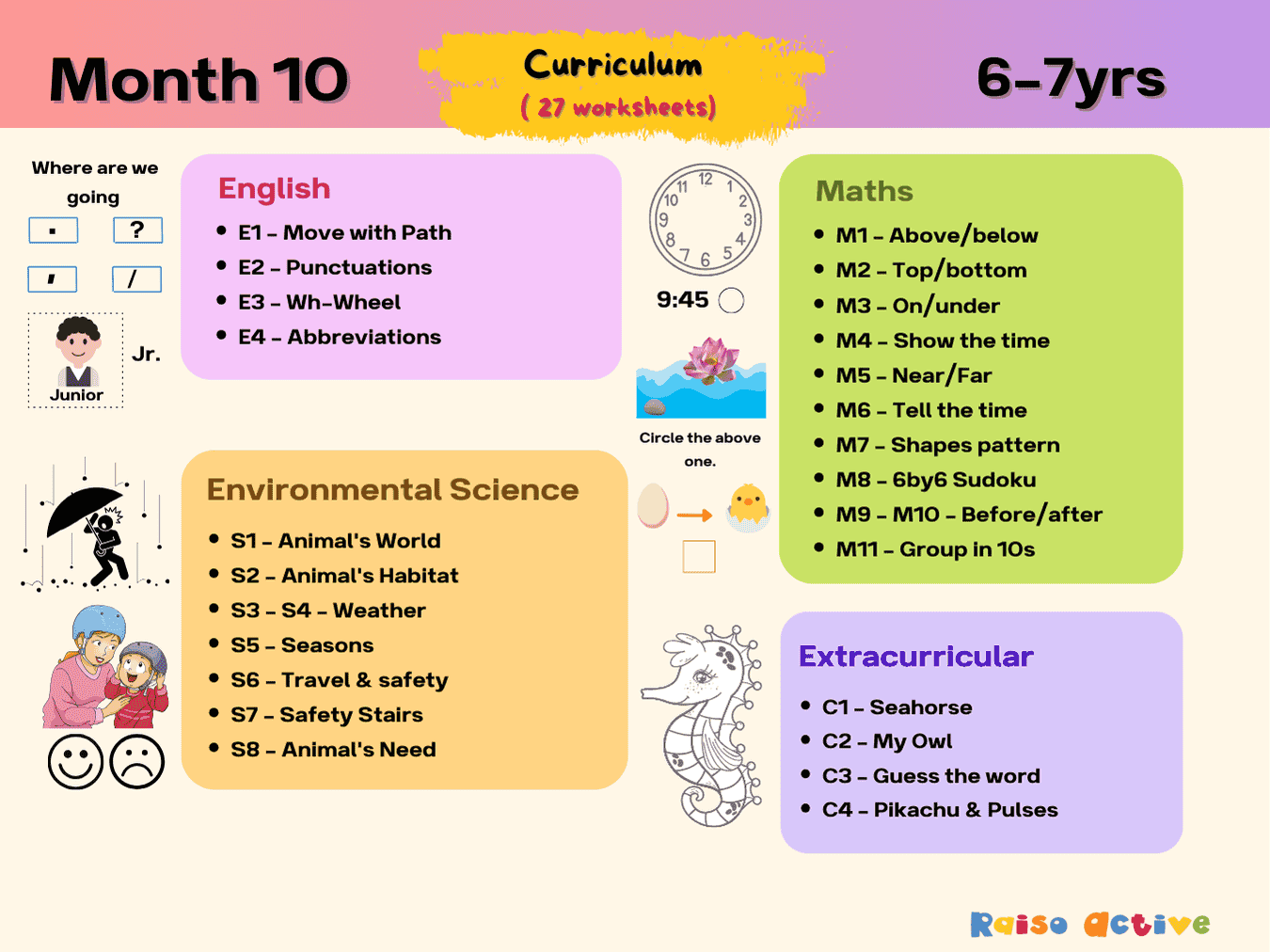
Part of the pack
Month 10: Learning & Development | Ages 6-7
This is page 30 of the pack. Ages 6-7 · Grade 1Ages 6-7 · Year 2Ages 6-7 · Class 1Ages 6-7
Made for your child
A whole activity pack made with their name
60 pages to spot, build, trace and write their own name, plus pages about their favourites, feelings and family. See a free preview with their name.
Make an All About Me packFree preview · free for members
Or start free: a name tracing sheet with their nameCurriculum
- Fine Motor > Scissor Skills & Cutting
How to use this worksheet
Read the color instructions together before starting, identifying which lentil color goes on which part of the Pikachu image — red lentils for the red sections, yellow for the yellow sections, and black gram lentils for the black sections. Apply a thin layer of glue to one section at a time rather than the whole picture at once, and have your child place the lentils by hand, pressing gently to help them stick. Work through the image section by section, checking the color instructions again before starting each new area.
Materials needed
- Printed worksheet
- Red lentils (Masoor dal)
- Yellow lentils (Moong dal)
- Black gram lentils (Urad dal)
- Glue
Extension activities
- 1Have the child draw their own Pikachu or favorite character and color it with crayons instead of lentils.
- 2Discuss the different colors and types of pulses used, and where lentils come from and how they're eaten.
- 3Create a collage using different types of dried lentils, beans, or grains to explore textures and colors.
- 4Sort a small bowl of mixed lentils by color as a quick pre-activity warm-up.

Written by
Hemsweta Jain · Teacher Cheena
MBA and Early Childhood Educator, teaching since 2014 · Founder of RaisoActive, Mumbai
Every RaisoActive worksheet is designed and checked by the founder before publishing.
Published · Last reviewed
More from Month 10: Learning & Development | Ages 6-7

Help the Girl Find Her Way in the Rainy Weather Maze Worksheet
Ages 3-5 · Preschool–Pre-KAges 3-5 · Nursery–ReceptionAges 3-5 · Nursery–LKGAges 3-5
This maze worksheet builds fine motor control and visual planning in children ages 3-5 as they trace a path for a girl through a rainy-weather scene, collecting items she needs along the way. Because the maze is themed around gathering specific rain gear, it adds a light problem-solving layer on top of standard maze navigation, encouraging children to think about which path leads to the items that actually make sense for the weather.

Animal Habitats Matching Worksheet for Preschoolers
Ages 3-5 · Preschool–Pre-KAges 3-5 · Nursery–ReceptionAges 3-5 · Nursery–LKGAges 3-5
This worksheet helps children ages 3-5 connect specific animals to their natural homes, reinforcing early science vocabulary around habitats like forests, oceans, and deserts. Matching an animal to its habitat circle first, then cutting and pasting the same animal into a corresponding box, gives two rounds of practice with the same concept using different formats. This repetition helps solidify the animal-habitat pairing in memory.
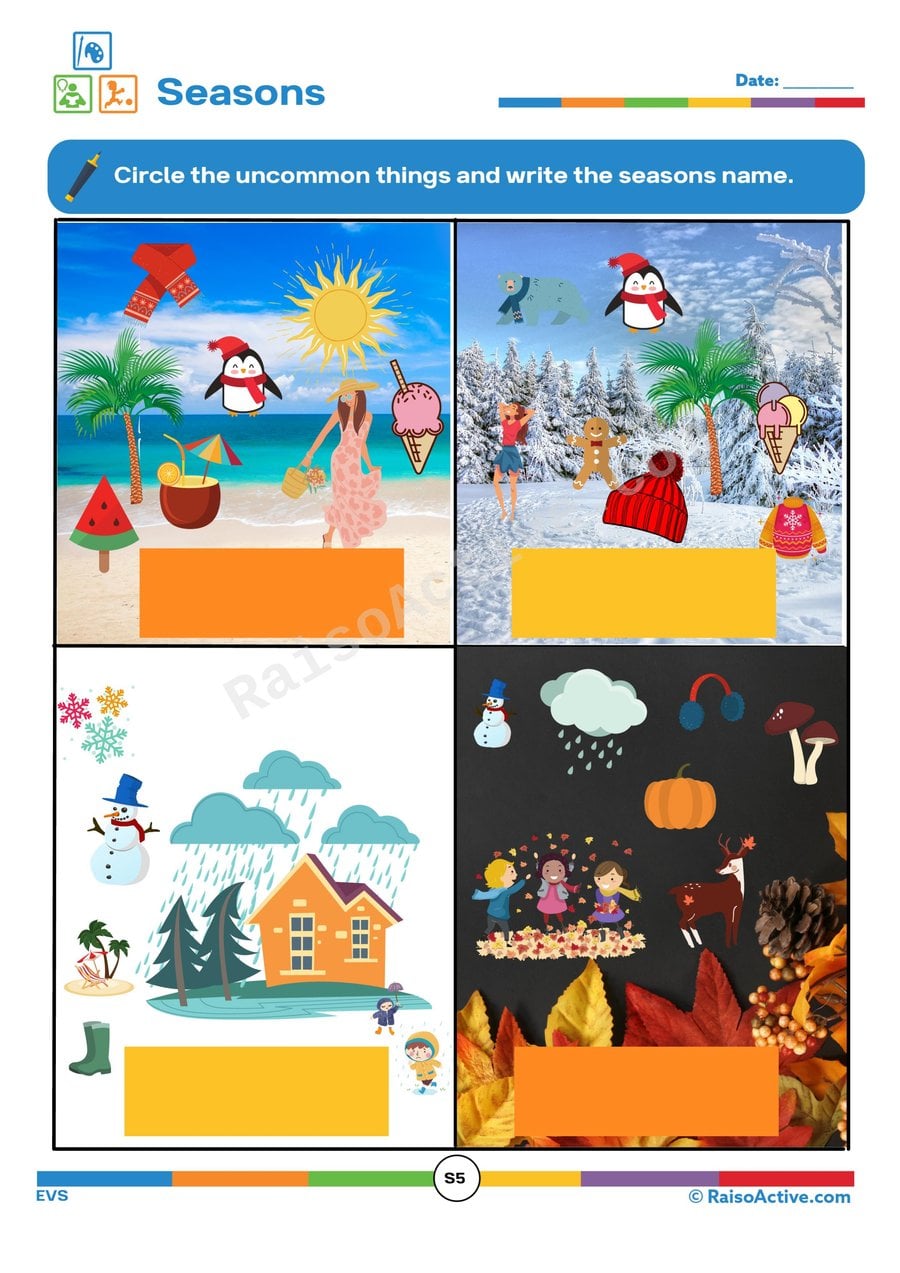
Seasons Worksheet: Circle the Uncommon Things!
Ages 3-5 · Preschool–Pre-KAges 3-5 · Nursery–ReceptionAges 3-5 · Nursery–LKGAges 3-5
This observation activity challenges children ages 3-5 to examine a seasonal scene and identify objects that don't belong, such as a snowman in a summer beach picture, sharpening their critical thinking and attention to seasonal detail. Naming the season afterward requires children to synthesize several visual clues into one overall conclusion rather than just spotting isolated errors. This kind of 'what doesn't fit' reasoning is an early form of the logical thinking used in later science observation and categorization skills.

Punctuation Fun: Practice Using Punctuation Marks!
Ages 4-6 · Pre-K–KindergartenAges 4-6 · Reception–Year 1Ages 4-6 · LKG–UKGAges 4-6
Choosing the correct punctuation mark to complete a sentence teaches children ages 4-6 that periods, question marks, and other marks change how a sentence should be read and understood, not just how it looks on paper. Matching sentences to their correct punctuation marks reinforces this by requiring children to recognize the tone or purpose of a sentence, whether it's a statement, a question, or an exclamation. This early grammar practice builds the foundation for reading with expression and writing complete, correctly punctuated sentences later on.

Weather Worksheet: Match the Weather to the Number!
Ages 3-5 · Preschool–Pre-KAges 3-5 · Nursery–ReceptionAges 3-5 · Nursery–LKGAges 3-5
This matching activity asks children ages 3-5 to connect weather pictures — sun, rain, clouds, snow — to numbered labels, combining early reading of weather vocabulary with number-symbol association. Recognizing that a picture, a word, and a number can all represent the same idea builds the kind of flexible symbolic thinking children will later use in reading and math alike. Weather is also a topic children experience daily, which makes the vocabulary immediately meaningful rather than abstract.

Tell the Time Worksheet: Clock Reading Practice for Kids
Ages 4-6 · Pre-K–KindergartenAges 4-6 · Reception–Year 1Ages 4-6 · LKG–UKGAges 4-6
This worksheet helps children ages 4-6 practice reading an analog clock by looking at the position of the hour and minute hands and writing down the time shown. Analog clock reading is a genuinely challenging skill that combines number recognition with an understanding of two hands moving at different speeds, making repeated, varied practice like this essential before a child can read time confidently on their own.

Safety Stairs Worksheet: Matching Traffic Signs and Following Directions
Ages 3-5 · Preschool–Pre-KAges 3-5 · Nursery–ReceptionAges 3-5 · Nursery–LKGAges 3-5
This worksheet builds road safety awareness in children ages 3-5 while also practicing sign recognition, visual matching, and following a multi-step path from start to finish. Matching sign names to sign shapes teaches children to recognize traffic signs by both their look and their meaning, a real-world reading skill that supports their safety once they're out walking or biking.

Shape Pattern Cut and Paste Worksheet for Preschoolers
Ages 3-5 · Preschool–Pre-KAges 3-5 · Nursery–ReceptionAges 3-5 · Nursery–LKGAges 3-5
This worksheet asks children ages 3-5 to identify the rule in a repeating shape pattern and select the correct cut-out shape to complete it, combining shape recognition with early sequencing logic. Recognizing and continuing patterns strengthens the kind of predictive thinking that later supports skip counting and multiplication concepts. Precisely cutting and placing each small shape piece also builds fine motor control.
Related worksheets

Leaf Painting Worksheet for Kids: Stamp and Create!
Ages 3-5 · Preschool–Pre-KAges 3-5 · Nursery–ReceptionAges 3-5 · Nursery–LKGAges 3-5
This activity builds fine motor skills and early science observation as children examine real leaf shapes and sizes while painting and stamping them onto paper to create original artwork. For three- to five-year-olds, handling actual leaves before turning them into art connects a hands-on nature experience to a creative outcome, reinforcing that natural objects have distinct shapes worth noticing.
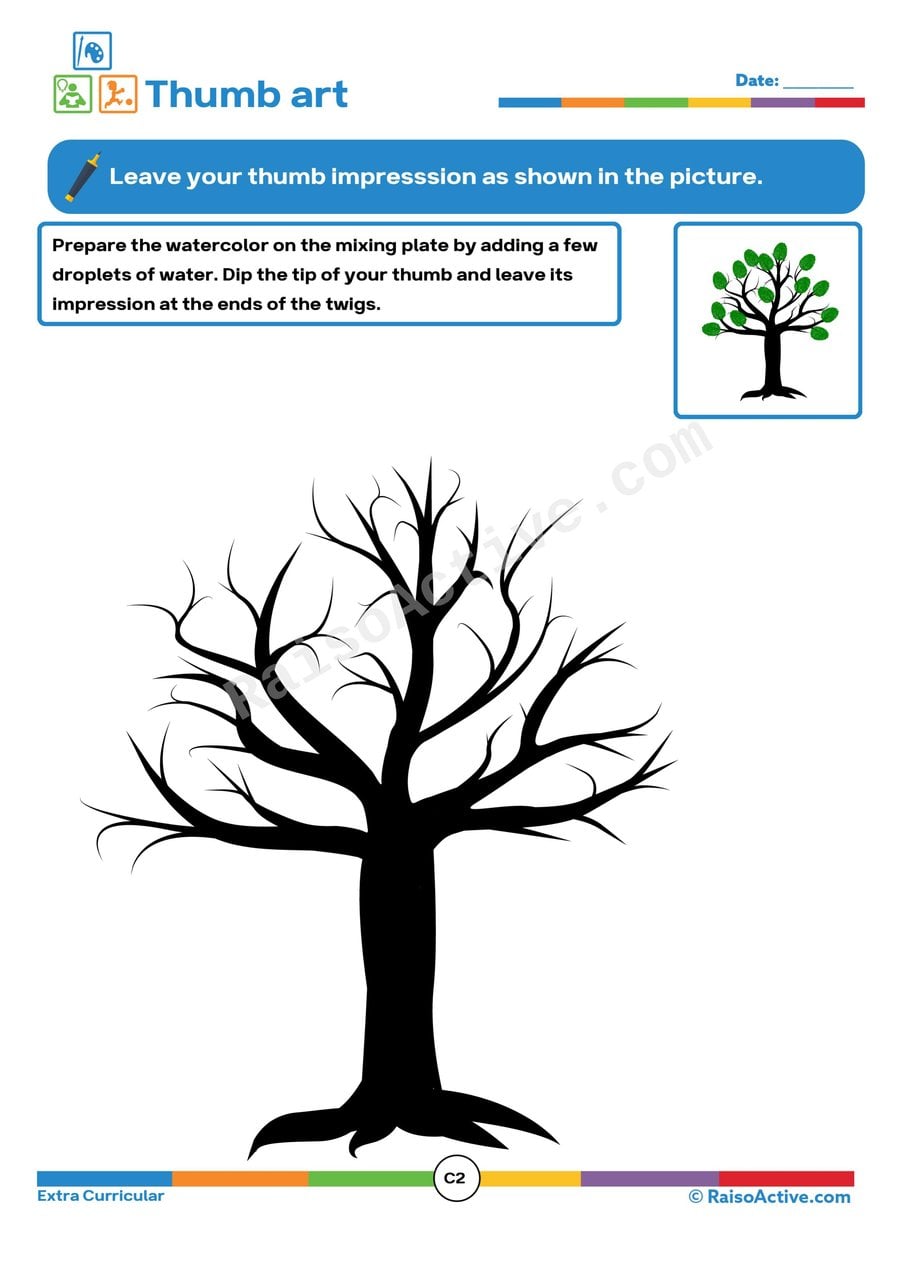
Thumb Art Tree Worksheet for Preschoolers
Ages 3-5 · Preschool–Pre-KAges 3-5 · Nursery–ReceptionAges 3-5 · Nursery–LKGAges 3-5
This thumbprint craft helps children ages 3-5 develop fine motor control and hand strength as they press their thumb repeatedly onto paper to create the leaves of a tree, a controlled, repetitive motion that's different from typical crayon coloring. It also introduces early art concepts like composition and texture, since the finished tree's fullness depends on how many thumbprints your child adds and where they place them.
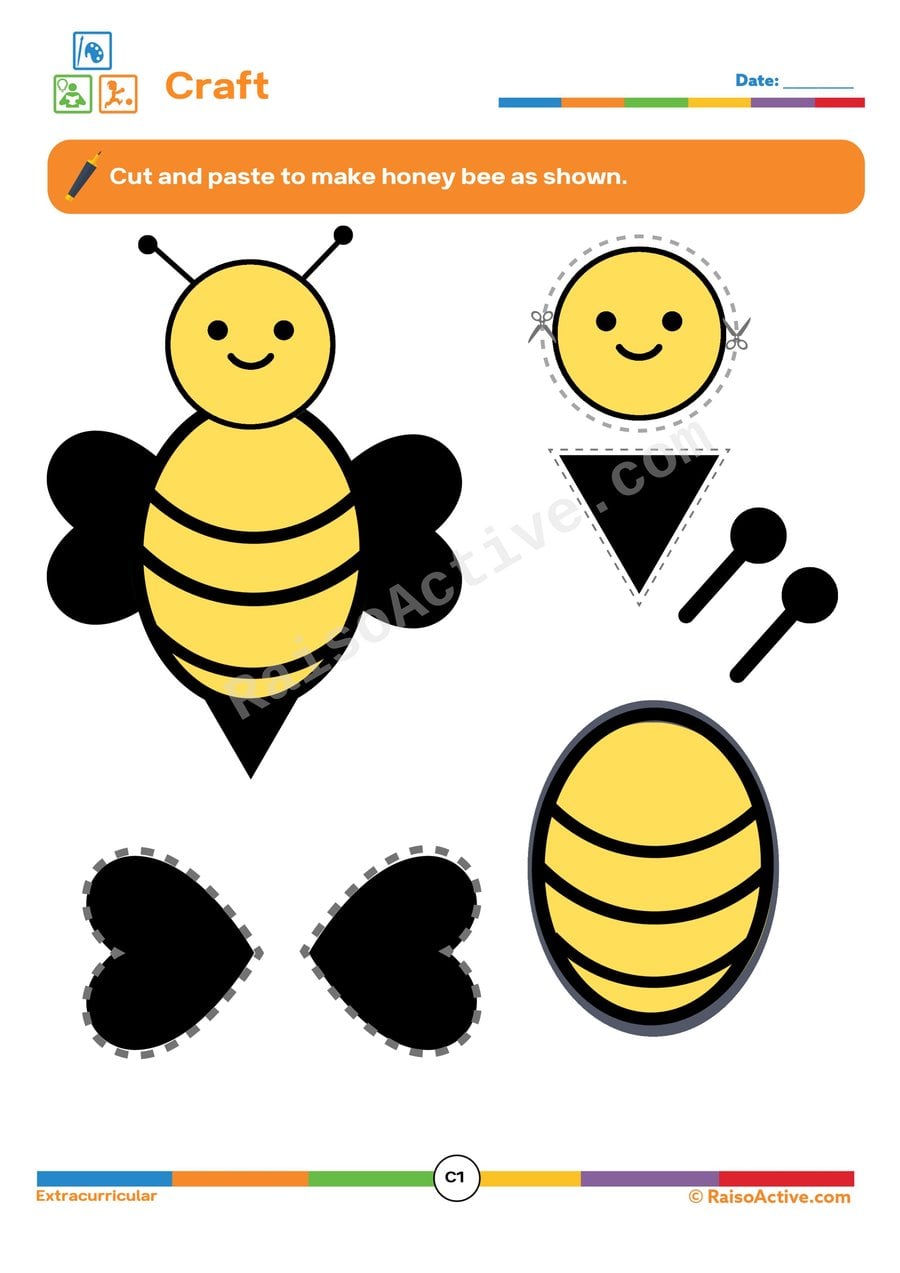
Honey Bee Craft Worksheet: Cut and Paste Fun!
Ages 3-5 · Preschool–Pre-KAges 3-5 · Nursery–ReceptionAges 3-5 · Nursery–LKGAges 3-5
This honey bee craft gives children ages 3-5 targeted practice with scissor control as they cut along dotted lines to separate bee body parts, then reassemble them by pasting into a complete bee shape. Because the pieces must be cut accurately to fit together correctly afterward, this activity demands more precision than simple free-cutting practice. Assembling a multi-piece figure also reinforces spatial reasoning, since children have to recognize how each cut piece relates to the whole.
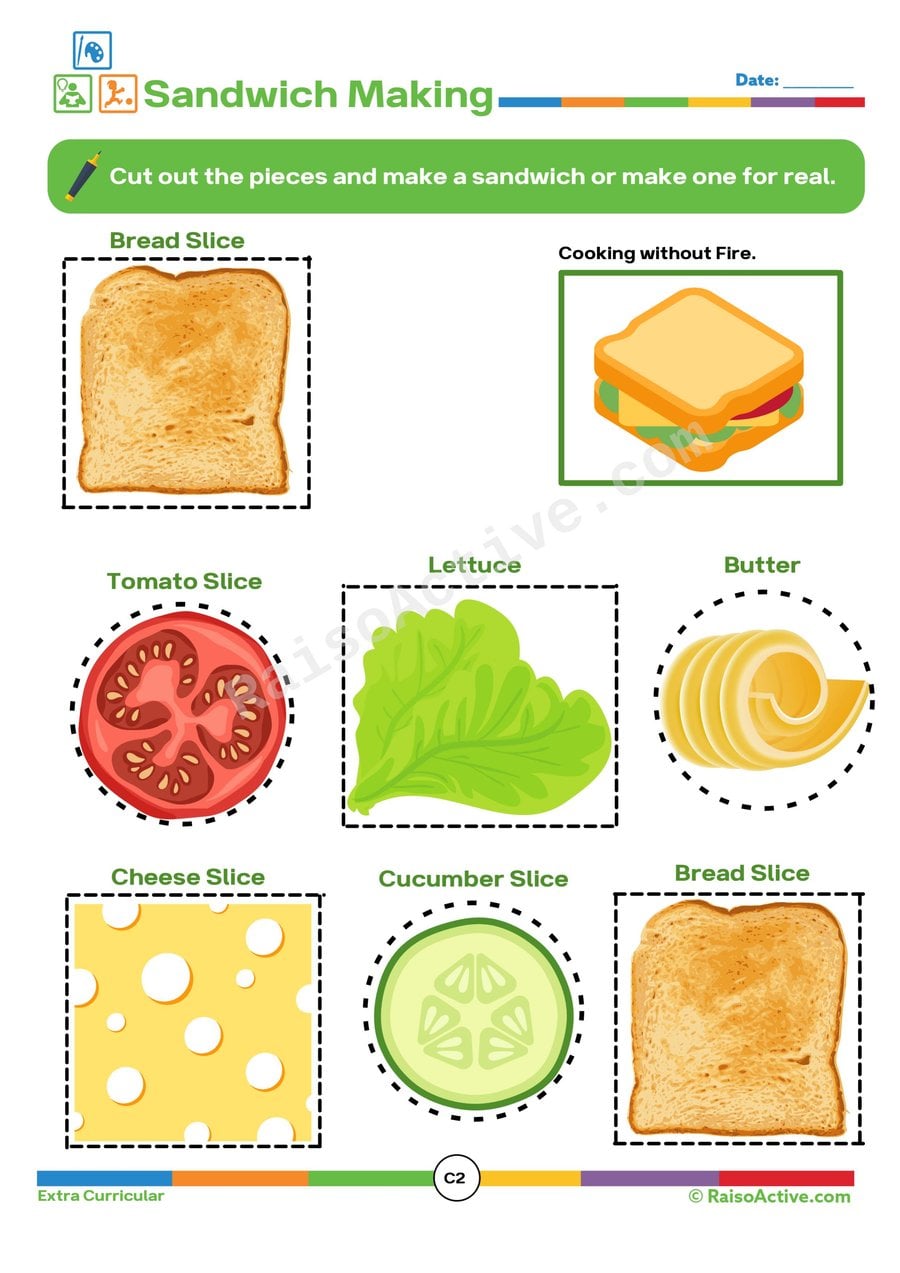
Sandwich Making Fun: Cut, Paste, and Create!
Ages 3-5 · Preschool–Pre-KAges 3-5 · Nursery–ReceptionAges 3-5 · Nursery–LKGAges 3-5
This worksheet helps children ages 3-5 develop fine motor skills by cutting out different food item shapes, while encouraging creativity as they decide which ingredients to layer to design their own imaginary sandwich. Making design choices about food order also introduces basic sequencing, since a sandwich is built in a specific stacked layer order.

Napkin Folding Fun: Following Instructions Worksheet for Kids
Ages 3-5 · Preschool–Pre-KAges 3-5 · Nursery–ReceptionAges 3-5 · Nursery–LKGAges 3-5
This activity builds sequential following-directions skills and fine motor control as children fold a napkin step by step into a new shape. Because each fold depends on the one before it, children practice holding a multi-step instruction in mind and executing it in order — a skill that transfers directly to following recipes, craft instructions, and classroom directions later on.

Cotton Bud Flower Craft Worksheet for Preschoolers
Ages 3-5 · Preschool–Pre-KAges 3-5 · Nursery–ReceptionAges 3-5 · Nursery–LKGAges 3-5
This cotton bud craft has children ages 3-5 paste cotton buds around a yellow center to build flower petals, an activity that strengthens the pincer grip and hand control needed for later pencil writing. Because each cotton bud represents one petal, the craft doubles as a counting exercise, giving children practice with one-to-one correspondence while they work. Combining a sensory material like cotton buds with a familiar shape — the flower — makes fine motor practice feel like play rather than drilling.
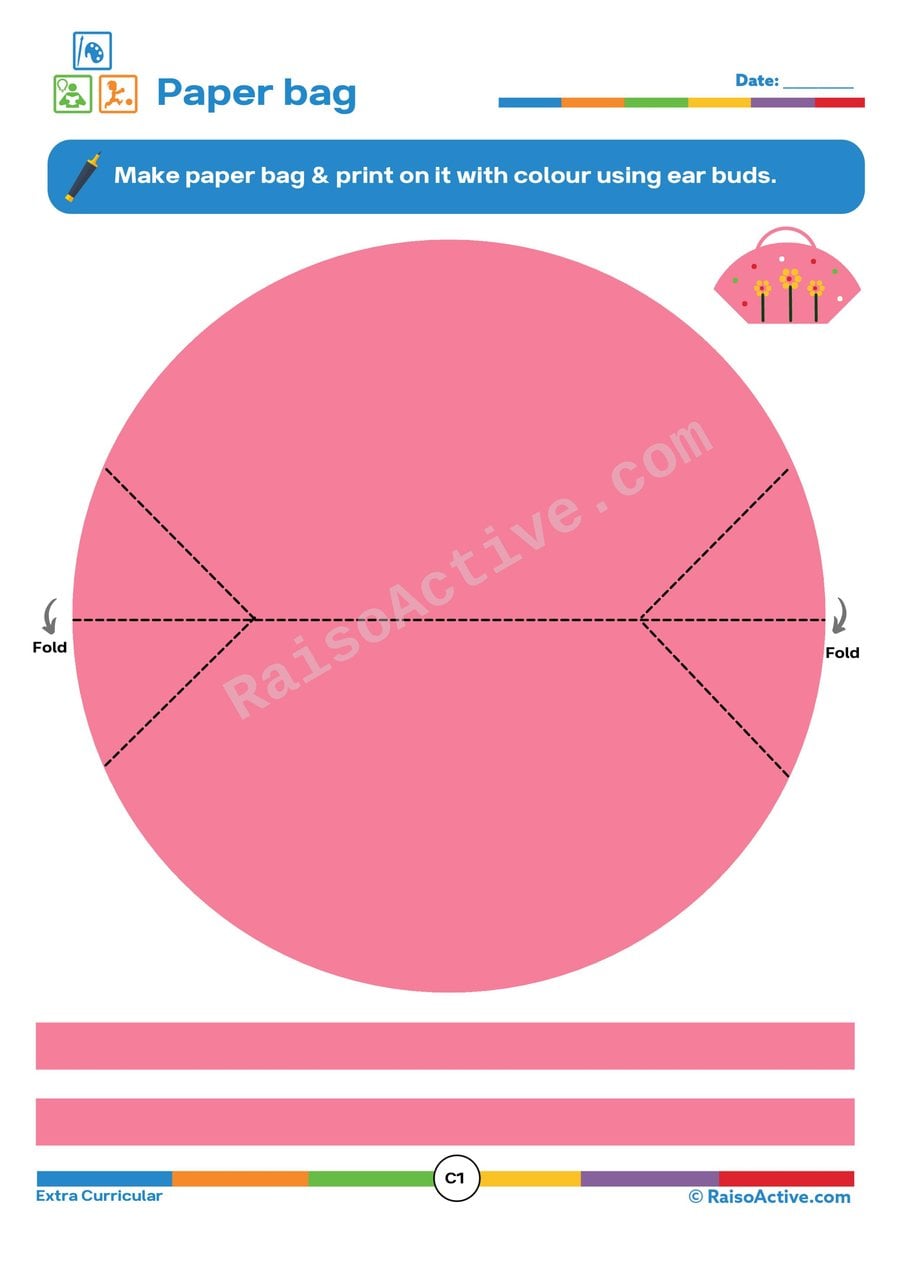
Paper Bag Craft Worksheet for Kids
Ages 3-5 · Preschool–Pre-KAges 3-5 · Nursery–ReceptionAges 3-5 · Nursery–LKGAges 3-5
Children ages 3-5 practice fine motor control and following multi-step craft instructions by folding a paper bag and decorating it using a cotton swab dipped in color, an unusual painting tool that builds hand control and creative expression at the same time. Following each folding and coloring step in order also strengthens early sequencing and listening skills.

Eco-Ganesha Craft: Make Your Own Eco-Friendly Ganesh!
Ages 3-5 · Preschool–Pre-KAges 3-5 · Nursery–ReceptionAges 3-5 · Nursery–LKGAges 3-5
Making an Eco-Ganesha from peepal leaves teaches children ages 3-5 to see natural materials as creative art supplies, building both fine motor skill through careful arrangement and early environmental awareness through using biodegradable materials instead of plastic. This hands-on craft also introduces cultural and seasonal tradition in a tactile, memorable way that connects art-making to real-world values.
Guides for this topic

Best Worksheets for 3-Year-Olds: What Works and What to Avoid
What works on worksheets for 3-year-olds: short sessions, crayons, tracing lines, matching, cutting, a free weekly plan, and signs one is too advanced.

Age-Appropriate Problem-Solving Activities: Building Critical Thinkers from the Ground Up
Discover fun, age-appropriate problem-solving activities for children ages 1-8. Build critical thinking, logic, and reasoning skills through play-based learning.
Fostering Creativity in Structured Learning: The Perfect Balance for Young Minds
Learn how to blend creativity with structured learning for children ages 1-8. Practical strategies, activities, and printable worksheets for parents and teachers.
Reviews
Every worksheet for ages 3–5, no watermark
Members download the full library of 1,000+ worksheets and every activity pack without watermarks or daily limits. One year costs ₹999 in India or $20 elsewhere.
See membership plansOr download any worksheet free with a watermark (5 a day).