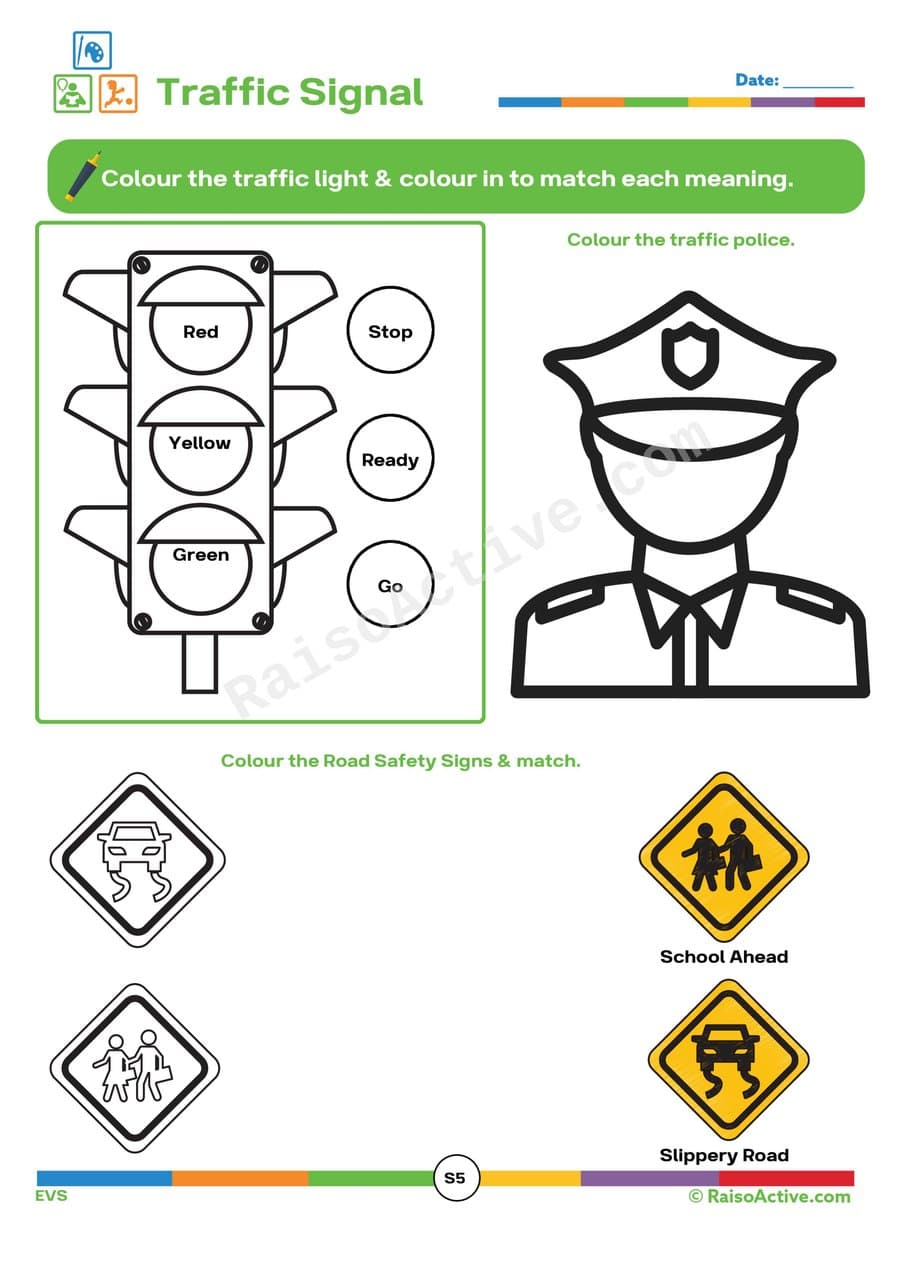
Traffic Signal Fun: Color and Match the Meanings!
Coloring traffic lights and matching words to their meanings teaches children ages 3-5 that colors carry specific, important messages in the real world, an early and practical form of symbol recognition and road safety awareness. Matching written words to the correct traffic light or road sign also reinforces early reading skills by connecting simple vocabulary to something visually familiar from everyday outings. Understanding what red, yellow, and green mean at a traffic light gives children knowledge they can apply immediately as pedestrians and future road users.
Part of the pack
Month 5: Preschool Subjects and Play | Ages Up to 4Curriculum
How to use this worksheet
Look at the traffic light picture together and talk through what each color means — red for stop, yellow for slow down or wait, and green for go. Have your child color the traffic light using the correct colors in the correct positions, then color the traffic police figure on the page. Move to the matching section, where your child draws a line connecting each word to the traffic light color or road sign it describes. Review the completed matches together, restating what each color and sign means in simple terms.
Materials needed
- Pencil
- Crayons
Extension activities
- •Draw your own traffic light on paper and quiz your child on what each color means.
- •Talk about other road safety rules, like looking both ways before crossing or holding an adult's hand near traffic.
- •Play a red-light, green-light game outdoors, moving and stopping based on the color called out.
- •Point out real traffic lights and signs during a walk or car ride and ask your child what they mean.
- •Create a simple road safety poster together with pictures of the traffic light and its meanings.
Tips for parents and teachers
Reinforce that traffic lights and signs are for real safety, not just a worksheet topic, by pointing them out and discussing them during actual outings. If your child mixes up which color means what, use a memorable phrase like 'red means stop, like a red stop sign' to anchor the meaning. This is a good opportunity to establish or review your family's own road safety habits, like always holding hands near a street.

Written by
Hemsweta Jain · Teacher Cheena
MBA and Early Childhood Educator, teaching since 2014 · Founder of RaisoActive, Mumbai
Every RaisoActive worksheet is designed and checked by the founder before publishing.
Published · Last reviewed
Related worksheets

Safety Stairs Worksheet: Matching Traffic Signs and Following Directions
This worksheet builds road safety awareness in children ages 3-5 while also practicing sign recognition, visual matching, and following a multi-step path from start to finish. Matching sign names to sign shapes teaches children to recognize traffic signs by both their look and their meaning, a real-world reading skill that supports their safety once they're out walking or biking.
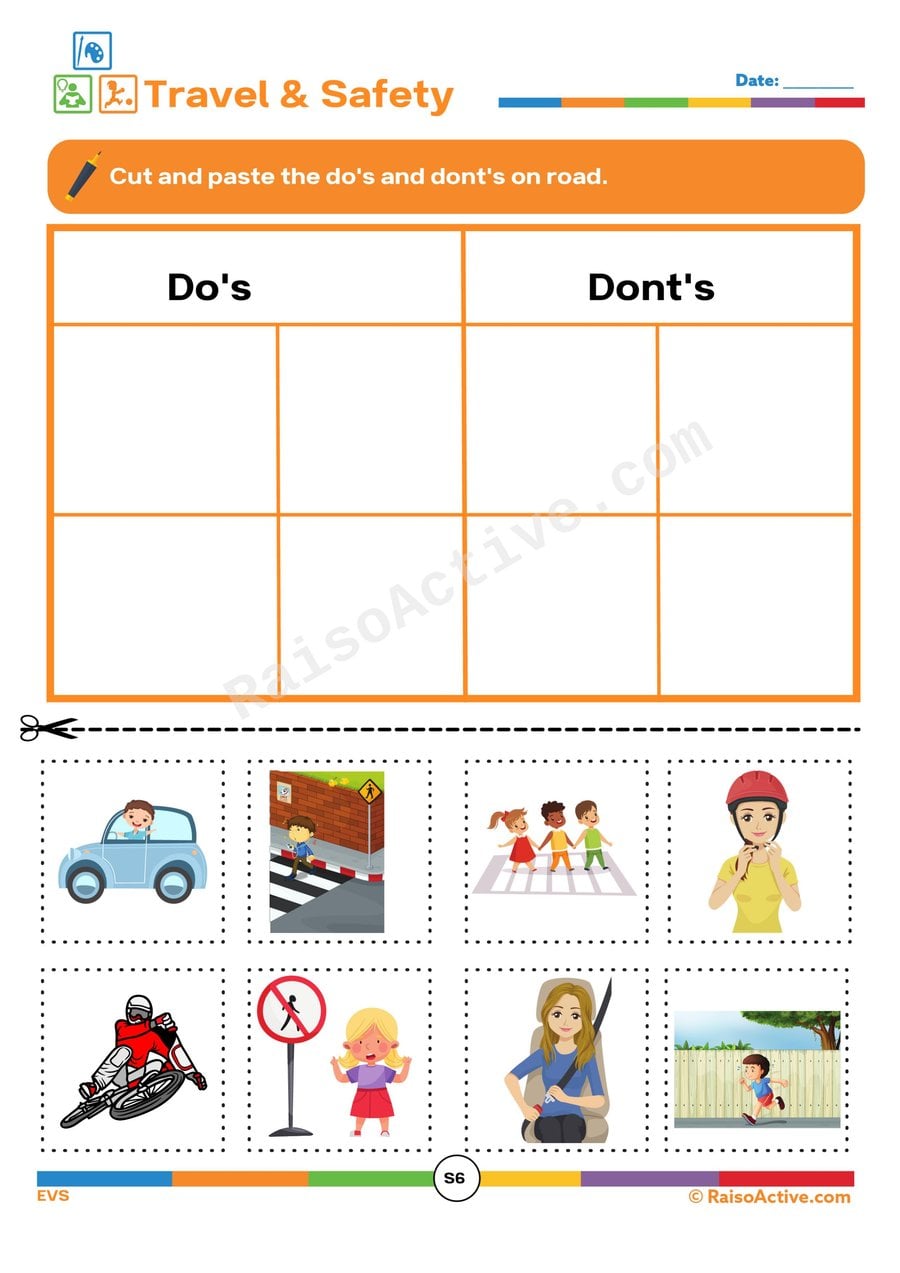
Road Safety Cut and Paste Worksheet for Kids
Children ages 3-5 practice identifying safe versus unsafe behaviors near roads and traffic by sorting pictures into 'Do's' and 'Don'ts' columns, building early safety awareness alongside basic classification skills. Talking through why each picture belongs in its column helps children move beyond simply memorizing rules toward actually understanding the reasoning behind road safety.

Traffic Rules Worksheet: Cut and Glue the Traffic Signs!
Cutting out traffic sign pictures and matching them to their correct labels builds early sign recognition and vocabulary for children ages 3-5, connecting a familiar shape and color to its real-world safety meaning.

Traffic Signals Cut and Paste Worksheet for Preschoolers
Children ages 3-5 learn to recognize red, yellow, and green traffic signals and connect each color to its meaning, an early road-safety skill that also reinforces color recognition and matching. Understanding what each signal means builds real-world safety awareness they'll use as pedestrians and passengers.

Road Safety Worksheet for Preschoolers: Safe Travel Fun!
Identifying safe versus unsafe travel behaviors by ticking pictures and circling thumbs up or thumbs down builds early critical thinking about real-world safety for children ages 3-5, connecting classroom learning to a practical life skill.

Road Safety Worksheet for Kids: Fill-in-the-Blanks
This worksheet teaches children ages 3-5 essential road safety vocabulary and rules — like looking both ways, using crosswalks, and obeying traffic signals — by having them choose the correct word to complete each safety-related sentence. Learning these rules in a reading and writing context, rather than just hearing them, helps reinforce safety habits that protect children in real traffic situations.
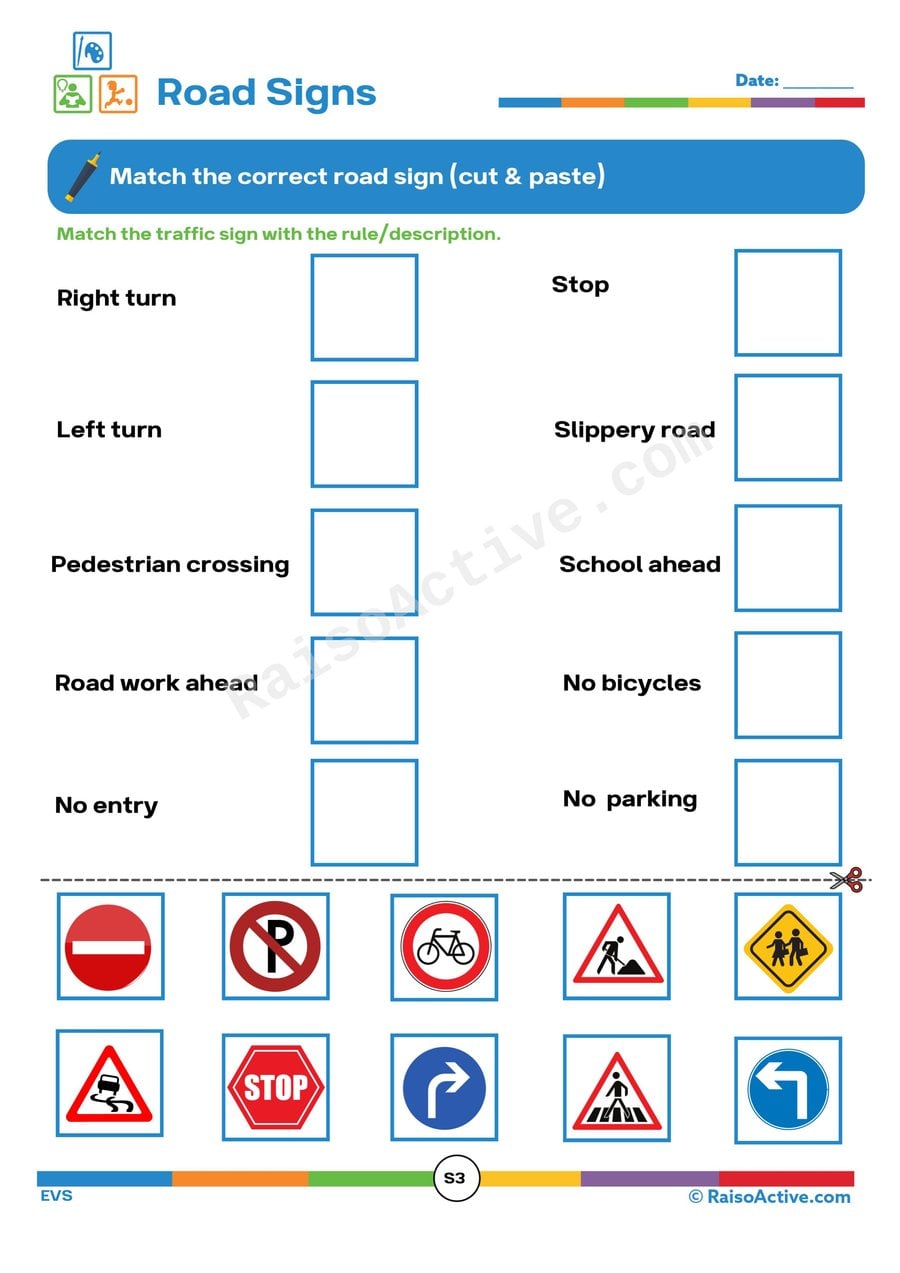
Road Signs Matching Worksheet for Preschoolers
This cut-and-paste worksheet helps children ages 3-5 build early road safety literacy by matching common signs — such as stop, crosswalk, and traffic light — to their correct meanings, while also practicing scissor control and precise gluing. Recognizing road signs by shape and color is a practical real-world skill that keeps children safer as pedestrians and future road users.

Safe Walker Worksheet: Following Pedestrian Rules for Kids
This worksheet teaches children ages 3-5 the core rules of safe pedestrian behavior — looking both ways, using crosswalks, and holding an adult's hand — by having them read simple instructions and fill in the correct safety word. Learning these specific rules early builds habits that matter for real-world safety long before a child is old enough to cross streets independently.
Guides for this topic
Best Worksheets for 3-Year-Olds: What Works and What to Avoid
What works on worksheets for 3-year-olds: short sessions, crayons, tracing lines, matching, cutting, a free weekly plan, and signs one is too advanced.
Documenting Learning Without Drowning in Data: A Practical Guide for Parents and Teachers
Learn practical ways to document your child's learning without overwhelm. Simple portfolios, observation tips, and printable trackers for ages 1-8.
Fostering Creativity in Structured Learning: The Perfect Balance for Young Minds
Learn how to blend creativity with structured learning for children ages 1-8. Practical strategies, activities, and printable worksheets for parents and teachers.
Reviews
Every worksheet for ages 3–5, no watermark
Members download the full library of 1,000+ worksheets and every activity pack without watermarks or daily limits. One year costs ₹1,000 in India or $20 elsewhere.
See membership plansOr download any worksheet free with a watermark (5 a day).