J, U, O Sorting Worksheet: Cut and Paste Pictures!
Sorting pictures by their beginning letter sound into J, U, or O columns asks children ages 3-5 to actively compare three different sounds rather than just recognizing one letter at a time, a more demanding phonics task than single-letter worksheets. This kind of three-way sorting builds sharper listening discrimination, since J, U, and O can sound similar in casual speech but are quite distinct once isolated. The cut-and-paste format also reinforces the sorting decision physically, since children must place each picture correctly rather than simply circling an answer.
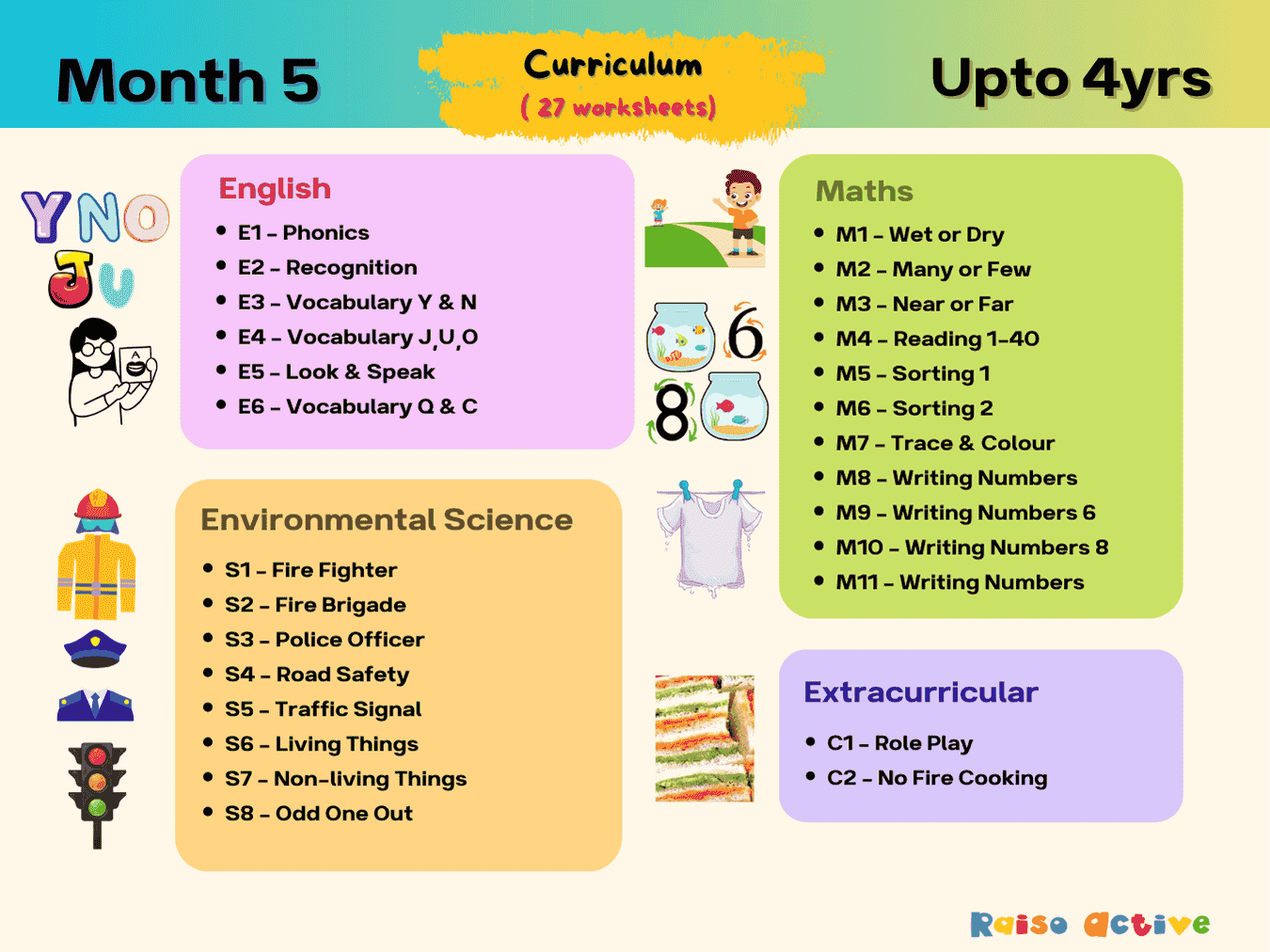
Part of the pack
Month 5: Preschool Subjects and Play | Ages Up to 4
This is page 7 of the pack. Ages 2-4 · PreschoolAges 2-4 · NurseryAges 2-4
Made for your child
A whole activity pack made with their name
60 pages to spot, build, trace and write their own name, plus pages about their favourites, feelings and family. See a free preview with their name.
Make an All About Me packFree preview · free for members
Or start free: a name tracing sheet with their nameCurriculum
- Phonics - Letter Sounds > Beginning Sounds
How to use this worksheet
Look at the three column headings together — J, U, and O — and say a sample word for each one aloud. Have your child cut out the pictures at the bottom of the page along the dotted lines. One at a time, ask them to say each picture's name slowly, listen for its beginning sound, and decide which column it belongs in. Glue each picture into its correct column, then review the finished sorting together, reading each column's words aloud as a group.
Materials needed
- Scissors
- Glue
- Pencil
Extension activities
- 1Write the beginning letter of each picture in its column as an extra writing challenge.
- 2Search the house for objects that start with J, U, or O and add them to the sorted lists verbally.
- 3Play a sound-sorting game with a fresh set of picture or word cards for J, U, and O.
- 4Create simple flashcards pairing each letter with the pictures your child sorted correctly.
- 5Practice saying and writing the letters J, U, and O on their own, focusing on their distinct sounds.

Written by
Hemsweta Jain · Teacher Cheena
MBA and Early Childhood Educator, teaching since 2014 · Founder of RaisoActive, Mumbai
Every RaisoActive worksheet is designed and checked by the founder before publishing.
Published · Last reviewed
More from Month 5: Preschool Subjects and Play | Ages Up to 4

Make a Colorful No-Fire Sandwich! A Fun Cooking Worksheet
Ages 3-5 · Preschool–Pre-KAges 3-5 · Nursery–ReceptionAges 3-5 · Nursery–LKGAges 3-5
This cooking activity gets 3-5 year olds following a multi-step recipe without any heat involved, which builds sequencing skills (first the spread, then the veggies, then the arrangement) alongside genuine fine motor practice from spreading, placing, and arranging ingredients. Because no cooking is involved, it's also a safe, hands-on way to introduce basic kitchen participation and sensory exploration of new foods and textures at an age when picky eating is common.

Role Play: Color, Cut, and Create Your Neighborhood!
Ages 3-5 · Preschool–Pre-KAges 3-5 · Nursery–ReceptionAges 3-5 · Nursery–LKGAges 3-5
This hands-on activity turns community-helper knowledge into a 3D building project: children color buildings and helper figures, cut them out along the dotted lines, and assemble a small neighborhood on cardboard. That construction step is what makes this different from a typical coloring page — folding tabs and sticking pieces upright requires spatial reasoning about how a flat cutout becomes a standing structure, on top of the fine motor demands of careful cutting. It also reinforces community-helper roles by having your child literally place each helper into the neighborhood they belong in.

Trace and Color the Fruits: Number Matching Worksheet
Ages 4-6 · Pre-K–KindergartenAges 4-6 · Reception–Year 1Ages 4-6 · LKG–UKGAges 4-6
This worksheet links three number skills together for 4-6 year olds: tracing dotted numerals for handwriting practice, counting a row of fruit for quantity, and then checking that the fruit count actually matches the traced number — a self-checking loop that reinforces number-to-quantity correspondence rather than treating tracing and counting as separate tasks. That verification step (does the fruit count really match?) pushes your child to count carefully rather than just glance and guess.
Fire Engine Fun: Color and Solve the Riddle!
Ages 3-5 · Preschool–Pre-KAges 3-5 · Nursery–ReceptionAges 3-5 · Nursery–LKGAges 3-5
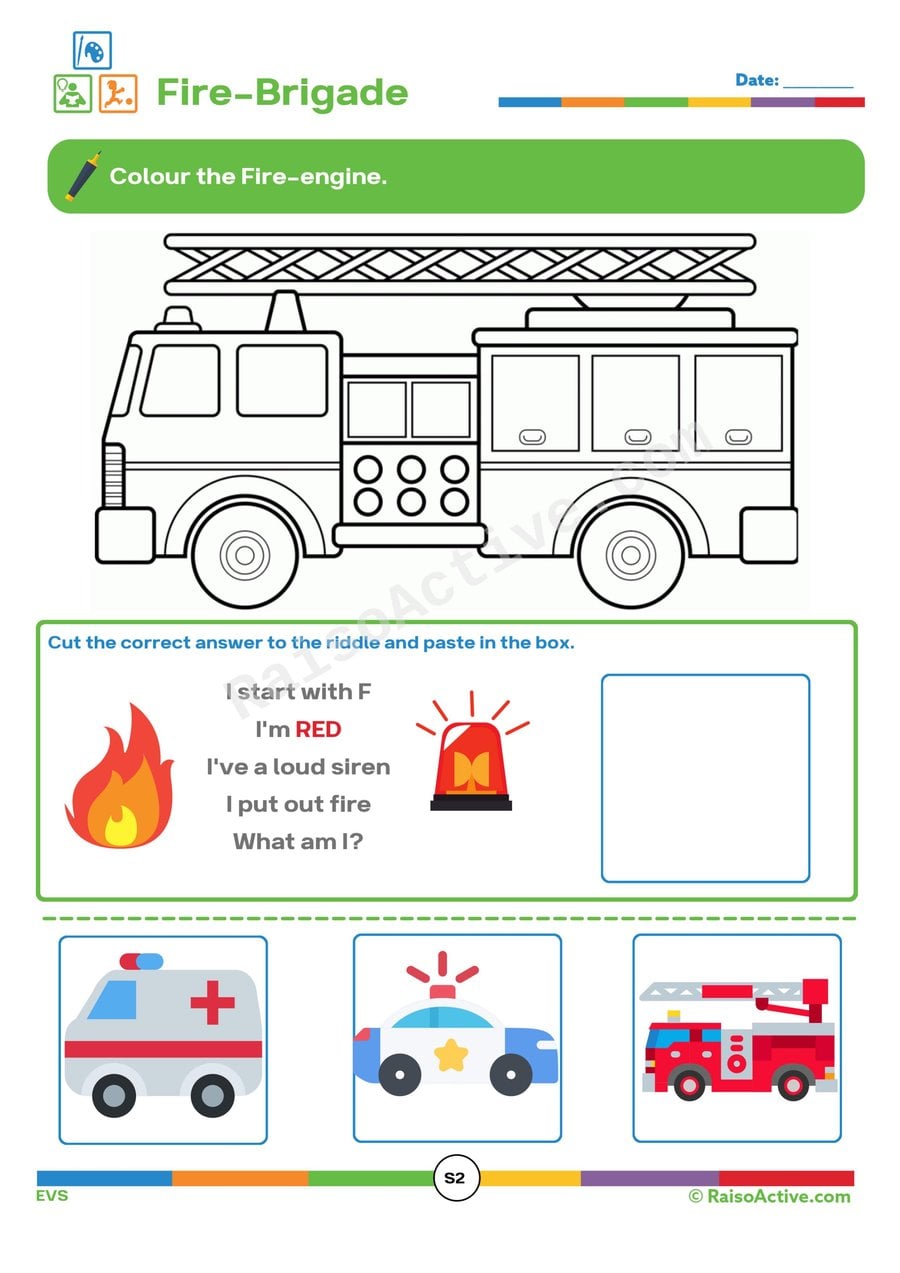
This worksheet pairs creative coloring with a light dose of deductive reasoning — after coloring the fire engine, children have to solve a simple riddle and pick out the correct picture answer to paste in place. That riddle-solving step goes beyond coloring practice into comprehension and logical thinking, since your child has to listen to clues, consider a few possible answers, and choose the one that actually fits, all while learning about firefighters as community helpers.
Connect the Dots: Sunny Day Picture Worksheet
Ages 3-5 · Preschool–Pre-KAges 3-5 · Nursery–ReceptionAges 3-5 · Nursery–LKGAges 3-5
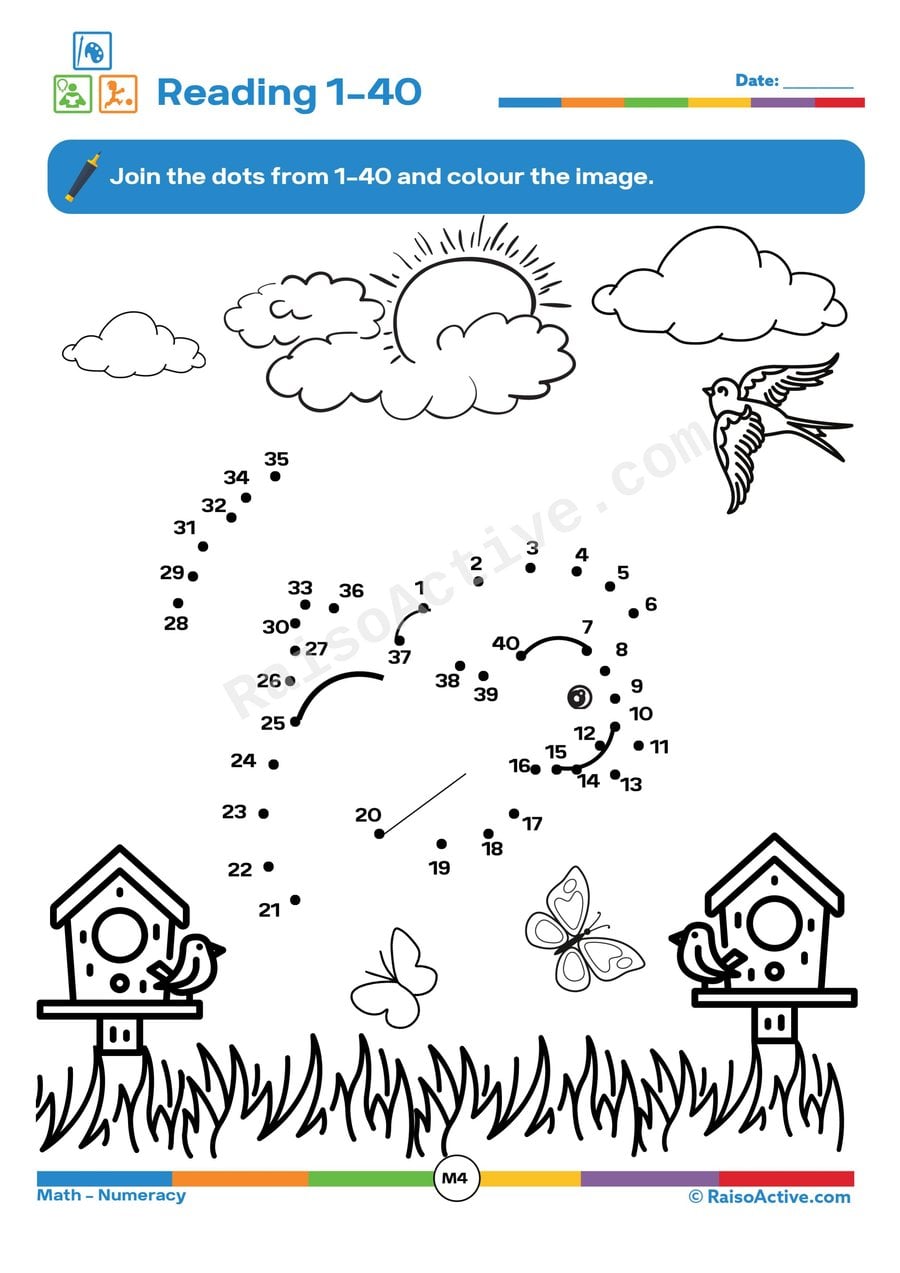
Connecting the dots from 1 to 40 gives 3-5 year olds real practice with number sequencing well beyond the basic 1-10 range most preschool materials cover, while the physical act of drawing a line from dot to dot builds the same pencil control needed for handwriting. Because the picture only appears once every number has been found and connected in order, it also rewards sustained attention — your child has to keep track of where they are in the sequence across a fairly long worksheet, which is a real stretch at this age.
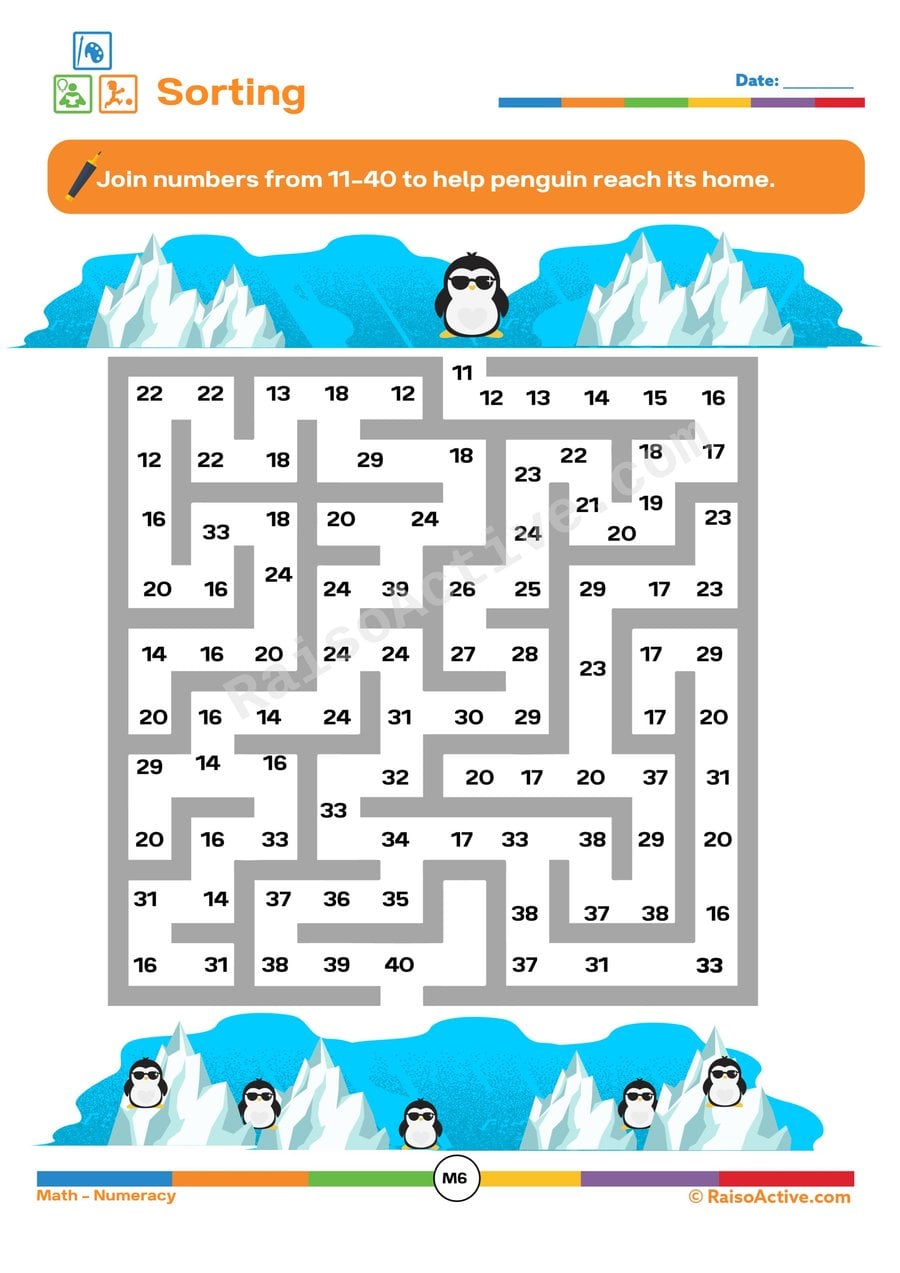
Penguin's Path: A Fun Sorting Worksheet for Kids!
Ages 4-6 · Pre-K–KindergartenAges 4-6 · Reception–Year 1Ages 4-6 · LKG–UKGAges 4-6
This maze worksheet has 4-6 year olds trace a path through numbers 11 to 40, building both number sequencing across a wider range and the fine motor control needed to draw a connected line dot to dot. Because the range spans several decades, your child gets real practice with the trickiest part of early counting — the transitions between decades (19 to 20, 29 to 30) — while the penguin's journey gives the task a clear, motivating goal.

Police Officer Worksheet: Learn About Community Helpers!
Ages 3-5 · Preschool–Pre-KAges 3-5 · Nursery–ReceptionAges 3-5 · Nursery–LKGAges 3-5
Beyond coloring practice, this worksheet builds early community-helper knowledge by asking children to identify which specific items — a badge, a hat, handcuffs, a whistle — actually belong to a police officer's job. Circling the correct items requires visual discrimination and recall of a real-world role, which is the beginning of understanding that different jobs come with different tools and responsibilities. Drawing the officer's face afterward adds a layer of personal expression to a lesson that's otherwise about categorization.
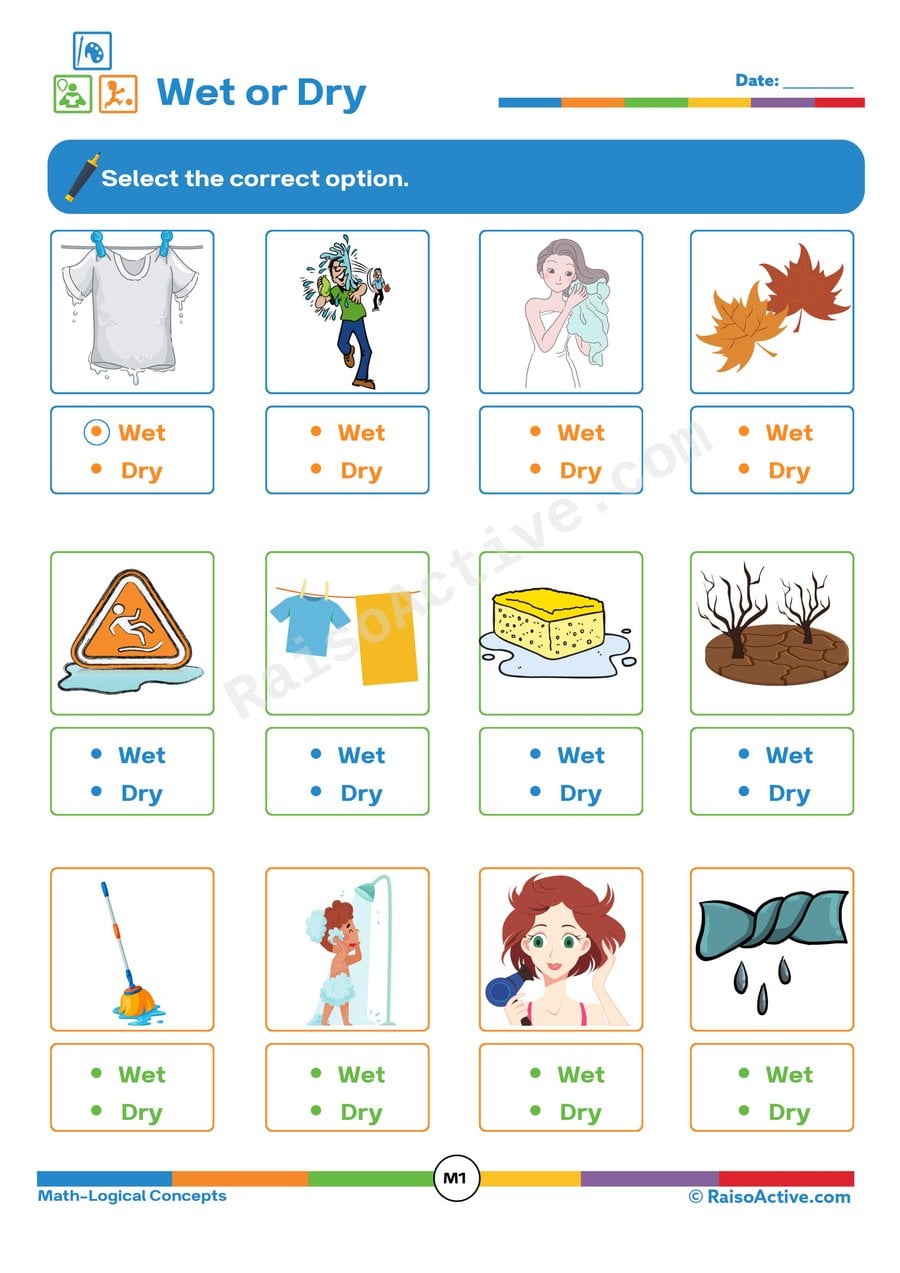
Wet or Dry Sorting Worksheet for Preschoolers
Ages 3-5 · Preschool–Pre-KAges 3-5 · Nursery–ReceptionAges 3-5 · Nursery–LKGAges 3-5
Sorting objects into 'wet' or 'dry' asks preschoolers to reach past the object's identity and notice a physical property instead — a step up from simply naming pictures. This is early scientific classification: your child has to observe a visual clue (a dripping umbrella, a puddle, a dry leaf) and reason about a quality that isn't always obvious from shape or color alone. Because some objects are genuinely tricky (a sponge can be either), the worksheet also opens the door to your child explaining their reasoning, which strengthens vocabulary around cause and state.
Related worksheets

Letter Sounds Worksheet: Color the Letter That Begins the Word!
Ages 4-5 · Pre-KAges 4-5 · ReceptionAges 4-5 · LKGAges 4-5
This worksheet strengthens phonemic awareness in children ages 4-5 by asking them to isolate the very first sound of a picture's name and match it to its printed letter. Identifying beginning sounds is one of the strongest early predictors of reading success, since it teaches children that spoken words are made of individual sounds that map onto letters. The coloring component adds a motivating, low-pressure way to record each answer.

Phonics Worksheet: Color the Correct Letter Sounds!
Ages 4-6 · Pre-K–KindergartenAges 4-6 · Reception–Year 1Ages 4-6 · LKG–UKGAges 4-6
This worksheet gives children ages 4-6 practice matching a picture to its correct beginning letter sound by coloring the box containing the right letter, reinforcing the phonics skill of connecting spoken sounds to written symbols. Because children choose from a set of letter options rather than writing freehand, the activity isolates sound recognition from the separate challenge of handwriting.

Color the Pictures! Kk, Ll, and Mm Letter Sounds Worksheet
Ages 4-5 · Pre-KAges 4-5 · ReceptionAges 4-5 · LKGAges 4-5
Coloring a circle beneath a picture only when its name starts with a target letter sound builds beginning-sound discrimination for children ages 4-5 across three letters — K, L, and M — sharpening their ability to isolate initial phonemes.

Phonics Worksheet: Color the Correct Letter - Letter Sounds
Ages 3-5 · Preschool–Pre-KAges 3-5 · Nursery–ReceptionAges 3-5 · Nursery–LKGAges 3-5
This phonics worksheet asks children ages 3-5 to say the name of each pictured object and identify which letter matches its beginning sound, then color that letter box. Isolating and identifying the very first sound in a spoken word is one of the core early literacy skills that predicts later reading success, and practicing it with real pictures rather than abstract letters makes it concrete.

Say My Sound: Beginning Letter Sounds Worksheet for Preschoolers
Ages 3-5 · Preschool–Pre-KAges 3-5 · Nursery–ReceptionAges 3-5 · Nursery–LKGAges 3-5
Saying a picture's name aloud and then circling the letter that matches its beginning sound builds phonemic awareness in children ages 3-5, teaching them to isolate the very first sound in a spoken word before connecting it to a printed letter. Because several letter options are given for each picture, this worksheet requires children to actively compare sounds rather than simply recognize a single correct letter by memory. This kind of applied letter-sound practice is one of the strongest early predictors of later reading success.

Letter Sounds: Cut and Paste 'Ii' and 'Jj' Pictures Worksheet
Ages 3-5 · Preschool–Pre-KAges 3-5 · Nursery–ReceptionAges 3-5 · Nursery–LKGAges 3-5
Sorting pictures by their beginning sound into 'Ii' and 'Jj' groups builds phonemic awareness for children ages 3-5, training their ear to isolate the first sound of a word before connecting it to its written letter.
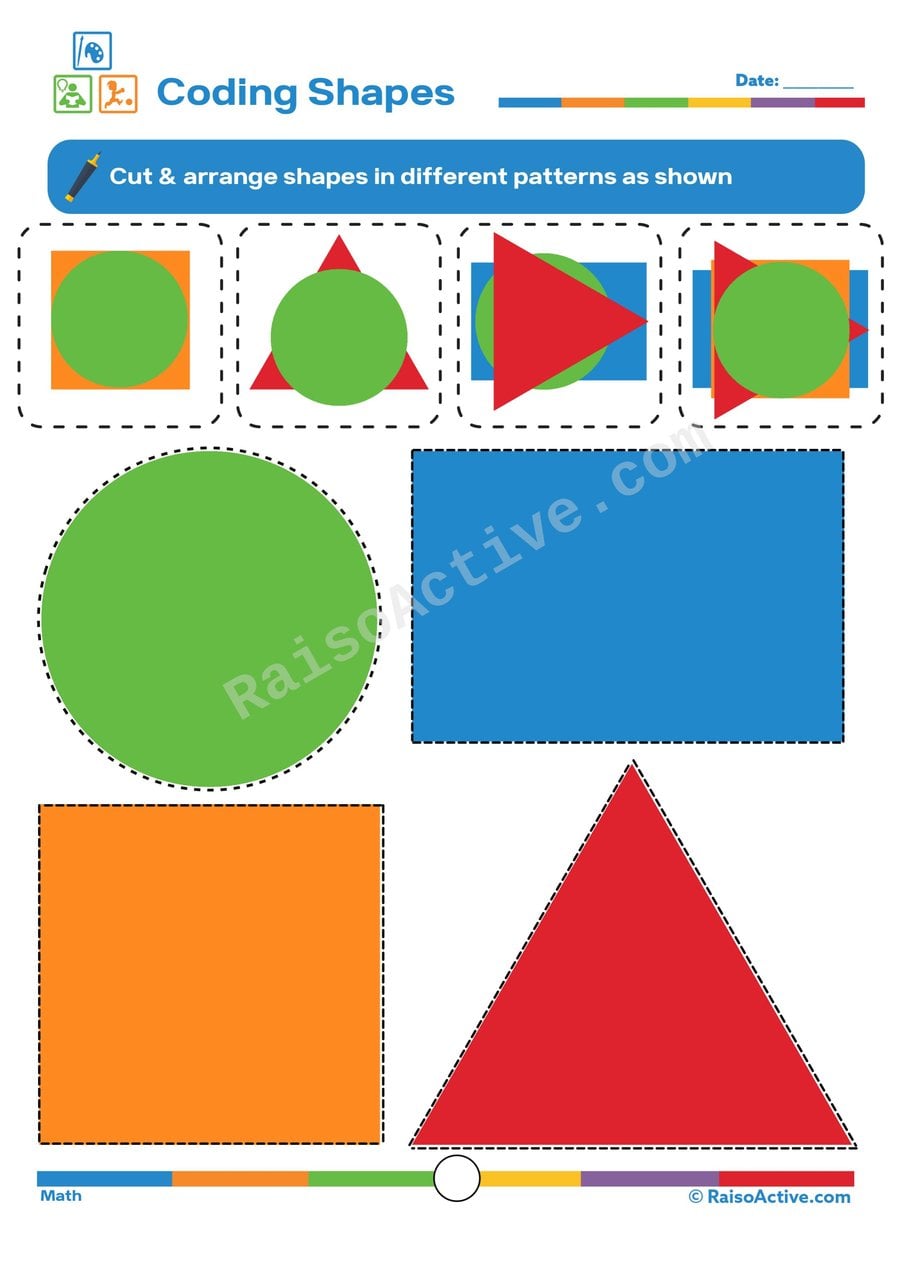
Coding Shapes Worksheet: Cut and Arrange Shapes!
Ages 3-5 · Preschool–Pre-KAges 3-5 · Nursery–ReceptionAges 3-5 · Nursery–LKGAges 3-5
This cut-and-paste worksheet has children ages 3-5 recreate example shape sequences by cutting out individual pieces and arranging them to match, combining shape recognition with the ordered, step-by-step thinking used in early coding and pattern logic. The physical act of cutting and precisely placing each piece also strengthens fine motor control and spatial planning.

Coding Shapes Worksheet for Preschoolers: Cut and Paste Patterns
Ages 3-5 · Preschool–Pre-KAges 3-5 · Nursery–ReceptionAges 3-5 · Nursery–LKGAges 3-5
This cut-and-paste activity has children ages 3-5 recreate shape sequences shown in sample boxes, combining shape recognition with the same ordered, step-by-step thinking used in beginner coding concepts. Cutting out individual shapes and arranging them in the correct sequence also builds fine motor precision and spatial planning.
Guides for this topic

How to Teach CVC Blending: A Step-by-Step Method That Works in Two Weeks
A step-by-step method for teaching CVC blending, covering continuous sounds, word families, common errors, and a 14-day plan that most children finish reading CVC words.
Phase 2 Phonics at Home: Sound Order, Blending Games, Worksheets
Phase 2 phonics at home: the five sound sets in order, oral blending, tricky words, a two-week routine, common mistakes, and free worksheets.

Reception Year Explained: EYFS Learning and How to Help at Home
A teacher's plain-English guide to the Reception Year: the seven areas of learning, Early Learning Goals, Phase 2/3 phonics, the RBA and home routines.
Reviews
Every worksheet for ages 3–5, no watermark
Members download the full library of 1,000+ worksheets and every activity pack without watermarks or daily limits. One year costs ₹999 in India or $20 elsewhere.
See membership plansOr download any worksheet free with a watermark (5 a day).