Say My Sound: Beginning Letter Sounds Worksheet for Preschoolers
Saying a picture's name aloud and then circling the letter that matches its beginning sound builds phonemic awareness in children ages 3-5, teaching them to isolate the very first sound in a spoken word before connecting it to a printed letter. Because several letter options are given for each picture, this worksheet requires children to actively compare sounds rather than simply recognize a single correct letter by memory. This kind of applied letter-sound practice is one of the strongest early predictors of later reading success.
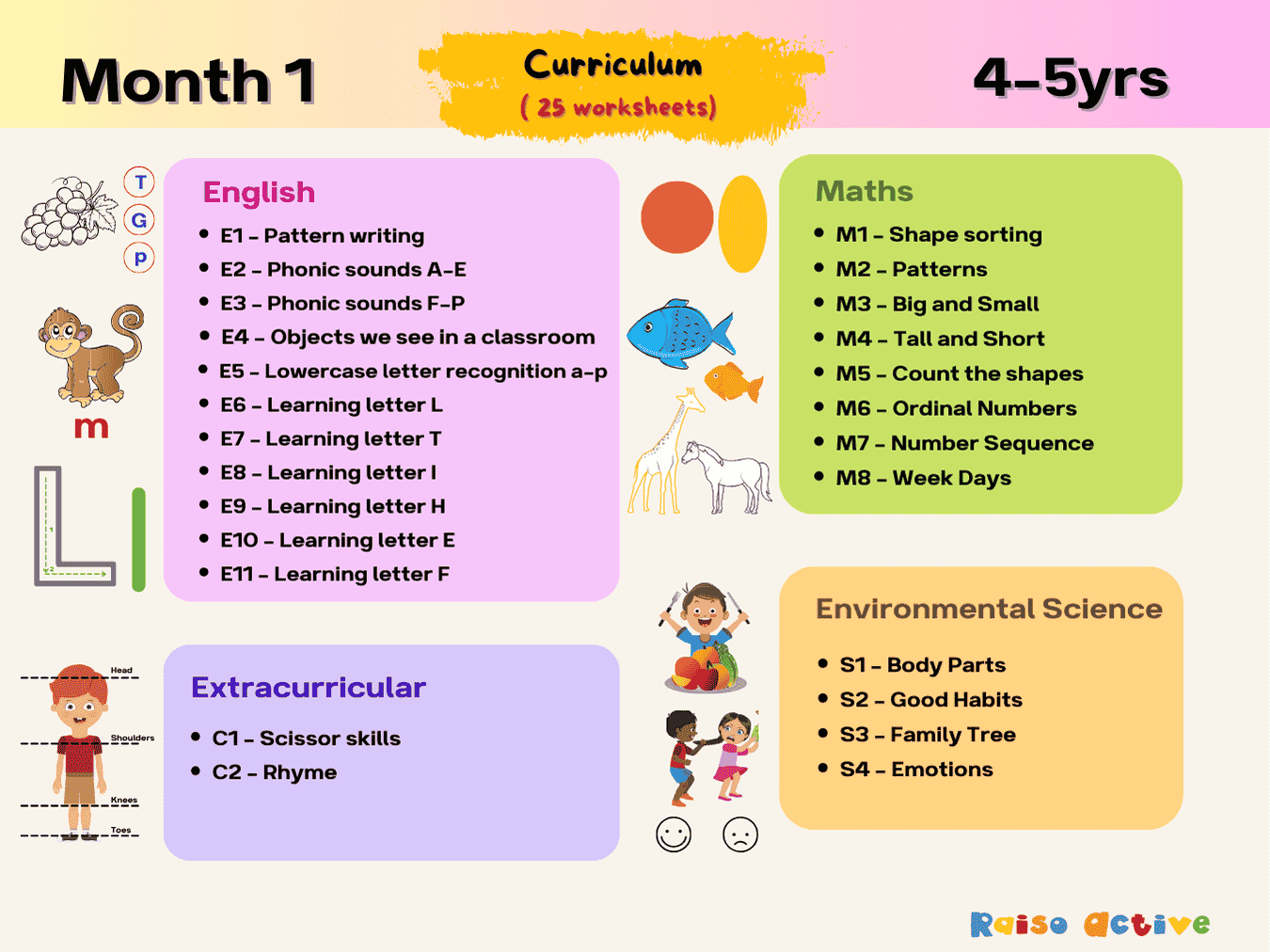
Part of the pack
Play-Based Learning Activity Book for 4-5 Year Olds | Literacy, Math & EVS
This is page 6 of the pack. Ages 4-5 · Pre-KAges 4-5 · ReceptionAges 4-5 · LKGAges 4-5
Made for your child
Counting to 10, made for your child
A maths pack with your child's name in it: pictures that explain, practice at three levels, puzzles and story sums about them. Print a new set whenever they finish.
Make a maths packFree preview · free for members
Curriculum
- Phonics - Letter Sounds > Beginning Sounds
How to use this worksheet
Look at the first picture together and say its name slowly and clearly, stretching out the beginning sound so your child can hear it distinctly. Read each letter option aloud, asking your child which one makes the same sound as the beginning of the picture's name. Have your child circle the correct letter, then say the whole word once more to double-check it sounds right. Continue through each picture on the page, encouraging your child to say each word slowly before choosing a letter.
Materials needed
- Pencil
- Crayons
Extension activities
- 1Have your child draw their own picture of something new and identify its beginning sound and matching letter.
- 2Go on a sound hunt around the house, finding objects that start with the same letters practiced on the worksheet.
- 3Play a sorting game putting small objects or toy pictures into piles based on their beginning sound.
- 4Practice saying tongue-twister style phrases using words that all start with the same sound.
- 5Read a picture book together and pause on a few pages to identify beginning sounds of objects shown.

Written by
Hemsweta Jain · Teacher Cheena
MBA and Early Childhood Educator, teaching since 2014 · Founder of RaisoActive, Mumbai
Every RaisoActive worksheet is designed and checked by the founder before publishing.
Published · Last reviewed
More from Play-Based Learning Activity Book for 4-5 Year Olds | Literacy, Math & EVS
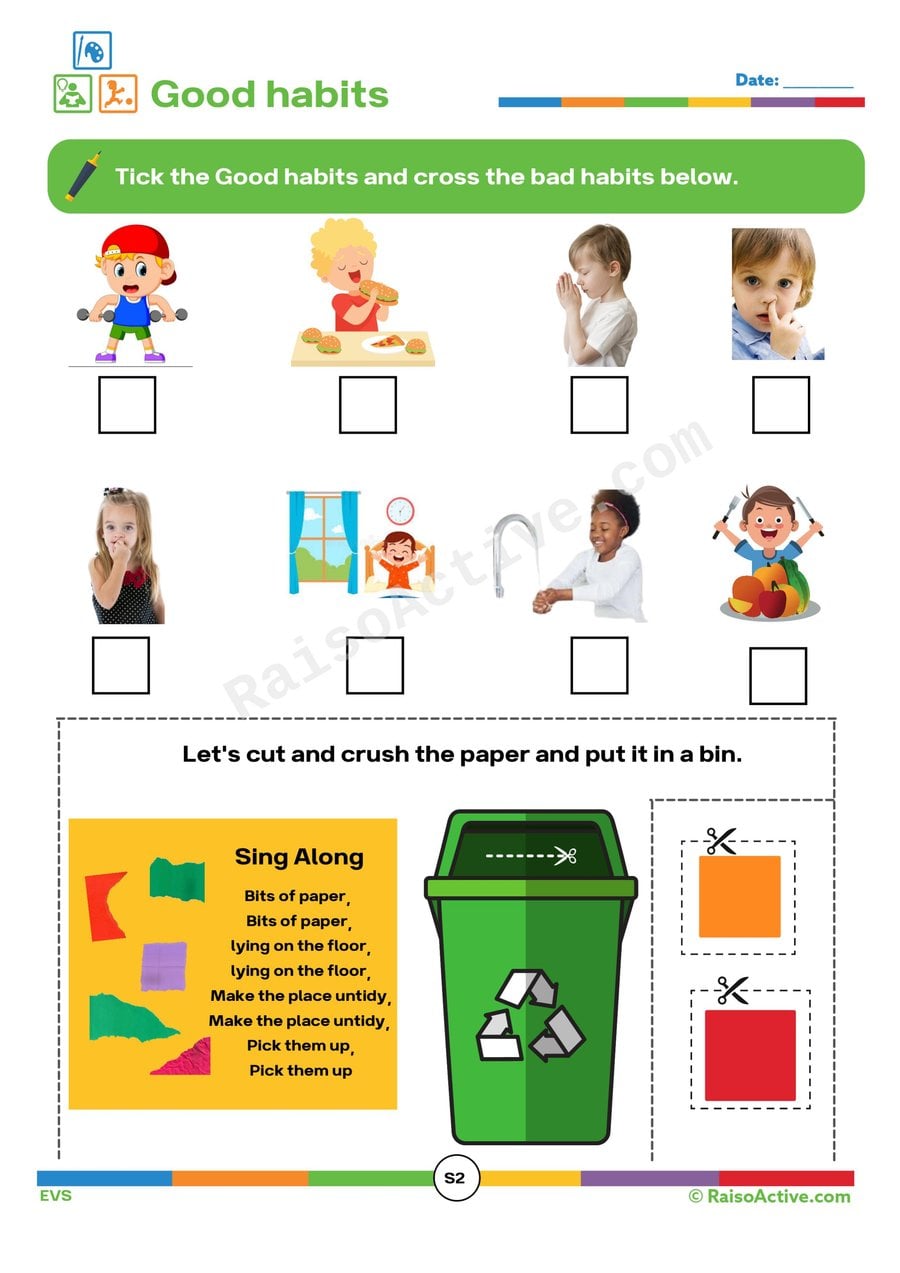
Good Habits Worksheet for Kids: Tick and Cross!
Ages 3-5 · Preschool–Pre-KAges 3-5 · Nursery–ReceptionAges 3-5 · Nursery–LKGAges 3-5
This worksheet helps children ages 3-5 practice evaluating everyday behaviors as good or bad habits using a simple tick-or-cross response system tied to cleanliness and healthy routines. Making a clear judgment call about each pictured scene builds early self-regulation awareness, helping children start to connect specific actions, like washing hands or brushing teeth, with positive outcomes. The tick-and-cross format is a quick, visual way for young children to record a decision without needing to write words.

Shape Count Worksheet: Count and Decorate the Crown!
Ages 3-5 · Preschool–Pre-KAges 3-5 · Nursery–ReceptionAges 3-5 · Nursery–LKGAges 3-5
Counting diamond shapes and matching each group to its correct number builds one-to-one correspondence and numeral recognition in children ages 3-5, while identifying the shape itself reinforces basic geometry vocabulary. Coloring, cutting, and gluing the diamonds onto a crown afterward adds a craft element that rewards accurate counting with a wearable, decorative result. Combining counting, shape recognition, and a craft project gives this worksheet several layers of skill practice within one engaging activity.

Butterfly Cutting Practice Worksheet for Preschoolers
Ages 3-5 · Preschool–Pre-KAges 3-5 · Nursery–ReceptionAges 3-5 · Nursery–LKGAges 3-5
This cutting-practice worksheet gives children ages 3-5 dedicated repetition in guiding scissors along a straight or gently curved dotted line, a core pre-writing and self-help skill that strengthens hand strength and bilateral coordination. Framing the goal as 'reaching the butterflies' gives children a visual reward for careful, controlled cutting rather than treating scissor practice as an isolated drill. Building this scissor control early supports later success with more complex cut-and-paste crafts.

Letter E Tracing and Coloring Worksheet for Preschoolers
Ages 3-5 · Preschool–Pre-KAges 3-5 · Nursery–ReceptionAges 3-5 · Nursery–LKGAges 3-5
This tracing and coloring worksheet teaches children ages 3-5 to recognize and write both the uppercase and lowercase letter E, while also identifying pictures of objects that begin with that letter's sound. Practicing a letter in both its capital and lowercase forms helps children see that they represent the same sound despite looking different, an important early literacy concept. Circling matching pictures alongside the tracing also connects the visual letter shape to its corresponding beginning sound in spoken words.

Learn to Write Letter L Worksheet for Preschoolers
Ages 3-5 · Preschool–Pre-KAges 3-5 · Nursery–ReceptionAges 3-5 · Nursery–LKGAges 3-5
This worksheet builds fine motor control and letter formation skills in children ages 3-5 as they trace and then independently write the capital letter L, while also identifying words that begin with the same letter. Practicing the simple two-stroke shape of L — a straight line down and a straight line across — is a good early letter for building confidence, since its strokes are more forgiving than curved letters. Coloring L-word pictures afterward reinforces the letter-sound connection alongside the shape practice.

Letter F Worksheet: Trace, Write, and Color the Letter F!
Ages 3-5 · Preschool–Pre-KAges 3-5 · Nursery–ReceptionAges 3-5 · Nursery–LKGAges 3-5
This worksheet gives children ages 3-5 structured practice tracing, then independently writing, the letter F in both its uppercase and lowercase forms, building the fine motor precision needed for legible handwriting. Moving from a traced guide to writing F on plain lines is an important step up in independence for early writers. Coloring pictures of F words afterward reinforces the connection between the letter's shape and its beginning sound.
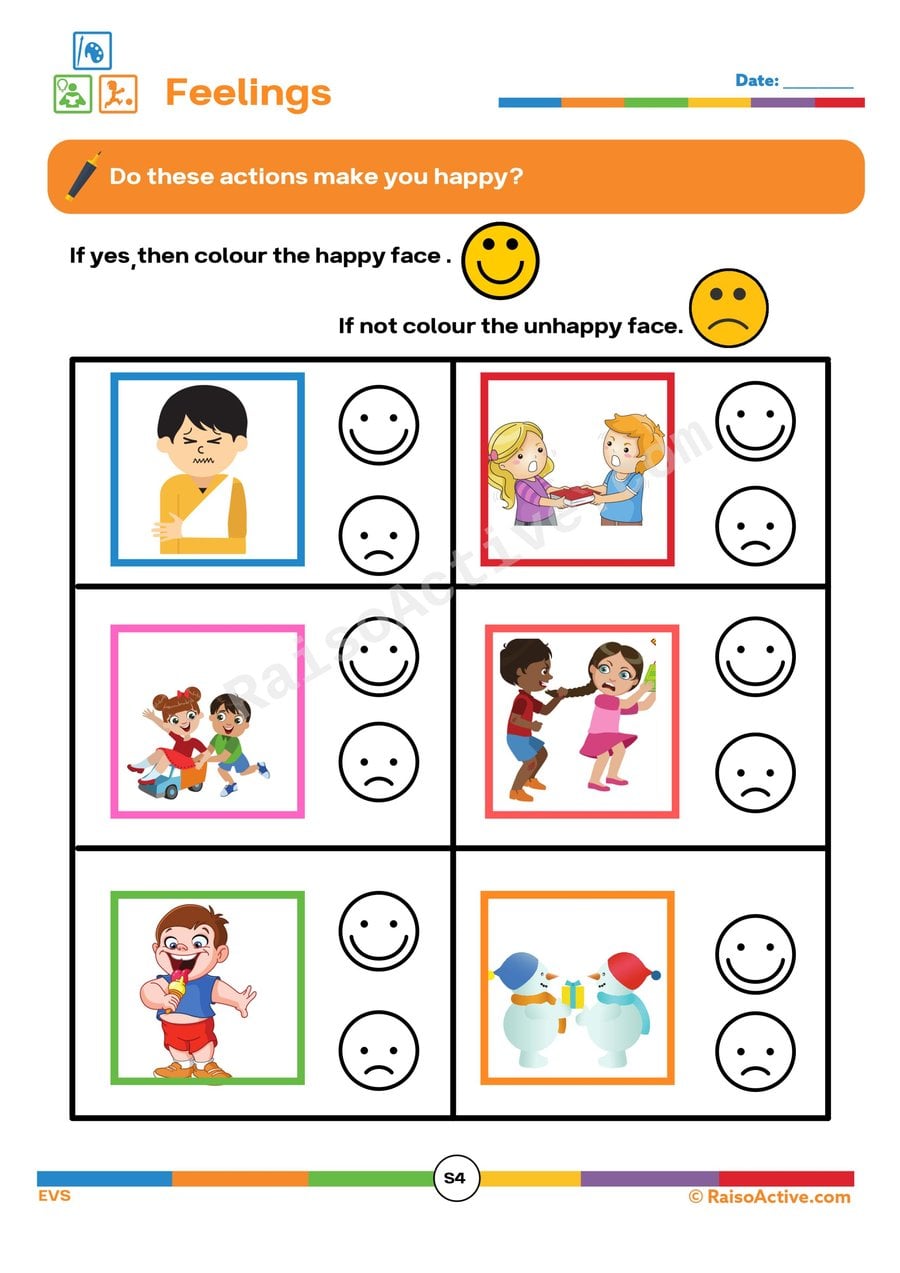
Feelings Worksheet: Happy or Sad?
Ages 3-5 · Preschool–Pre-KAges 3-5 · Nursery–ReceptionAges 3-5 · Nursery–LKGAges 3-5
Children ages 3-5 build emotional vocabulary and self-awareness as they decide whether different everyday situations would make them feel happy or sad. Naming and sorting emotions based on a scenario is an early social-emotional skill that helps children recognize and eventually talk about their own feelings more clearly.
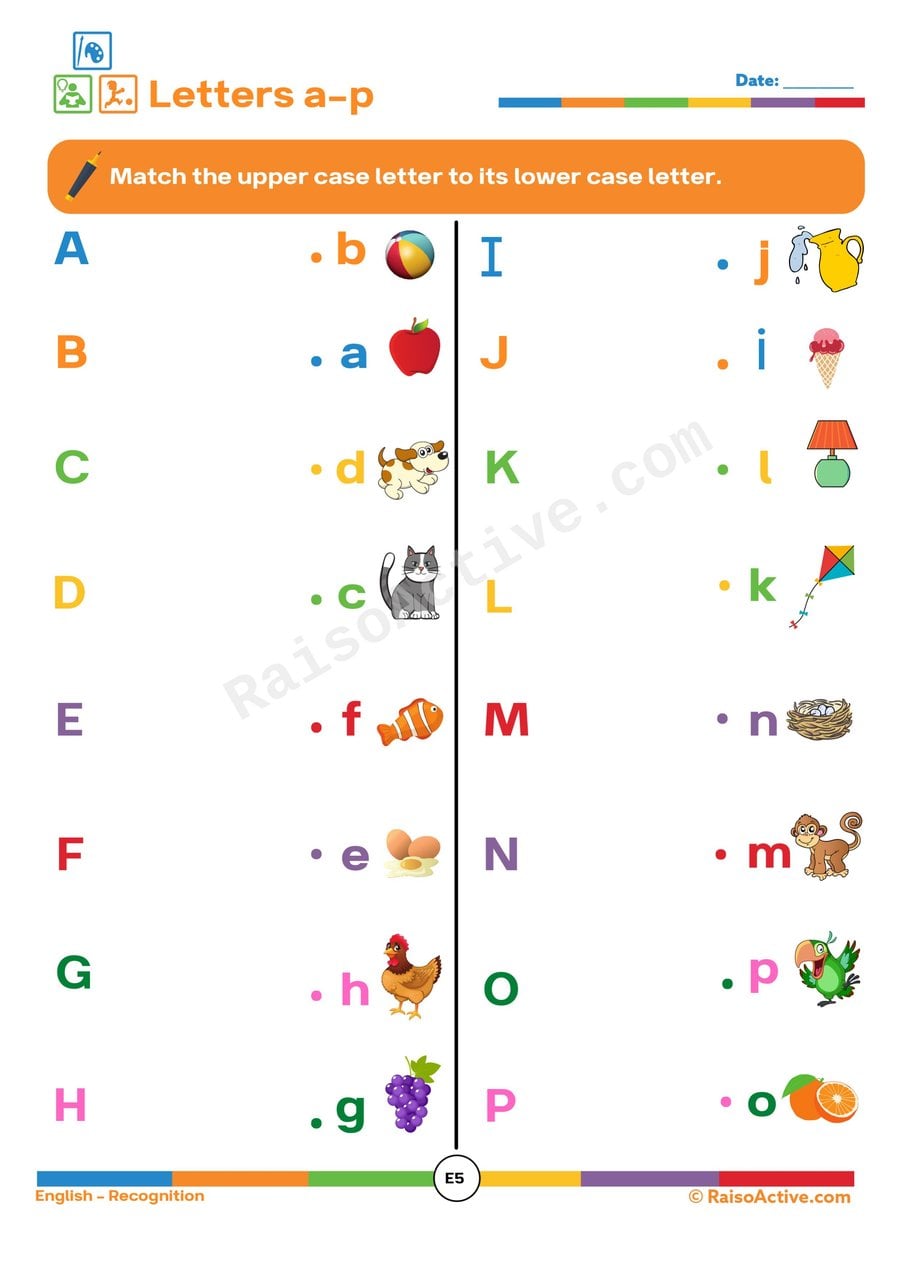
Match the Uppercase Letters: a-p Worksheet
Ages 4-6 · Pre-K–KindergartenAges 4-6 · Reception–Year 1Ages 4-6 · LKG–UKGAges 4-6
This worksheet helps children ages 4-6 practice matching uppercase letters to their corresponding lowercase forms across the first half of the alphabet, letters A through P. Recognizing that an uppercase and lowercase letter, even ones that look quite different like G and g, represent the same letter is an essential skill for reading printed text, which mixes both cases constantly. Covering a larger range of letters than a single-letter worksheet also builds broader alphabet fluency in one sitting.
Related worksheets

Phonics Worksheet: Color the Correct Letter - Letter Sounds
Ages 3-5 · Preschool–Pre-KAges 3-5 · Nursery–ReceptionAges 3-5 · Nursery–LKGAges 3-5
This phonics worksheet asks children ages 3-5 to say the name of each pictured object and identify which letter matches its beginning sound, then color that letter box. Isolating and identifying the very first sound in a spoken word is one of the core early literacy skills that predicts later reading success, and practicing it with real pictures rather than abstract letters makes it concrete.

Phonics Worksheet: Color the Correct Letter Sounds!
Ages 4-6 · Pre-K–KindergartenAges 4-6 · Reception–Year 1Ages 4-6 · LKG–UKGAges 4-6
This worksheet gives children ages 4-6 practice matching a picture to its correct beginning letter sound by coloring the box containing the right letter, reinforcing the phonics skill of connecting spoken sounds to written symbols. Because children choose from a set of letter options rather than writing freehand, the activity isolates sound recognition from the separate challenge of handwriting.

Letter Sounds: Cut and Paste 'Ii' and 'Jj' Pictures Worksheet
Ages 3-5 · Preschool–Pre-KAges 3-5 · Nursery–ReceptionAges 3-5 · Nursery–LKGAges 3-5
Sorting pictures by their beginning sound into 'Ii' and 'Jj' groups builds phonemic awareness for children ages 3-5, training their ear to isolate the first sound of a word before connecting it to its written letter.

Color the Pictures! Kk, Ll, and Mm Letter Sounds Worksheet
Ages 4-5 · Pre-KAges 4-5 · ReceptionAges 4-5 · LKGAges 4-5
Coloring a circle beneath a picture only when its name starts with a target letter sound builds beginning-sound discrimination for children ages 4-5 across three letters — K, L, and M — sharpening their ability to isolate initial phonemes.
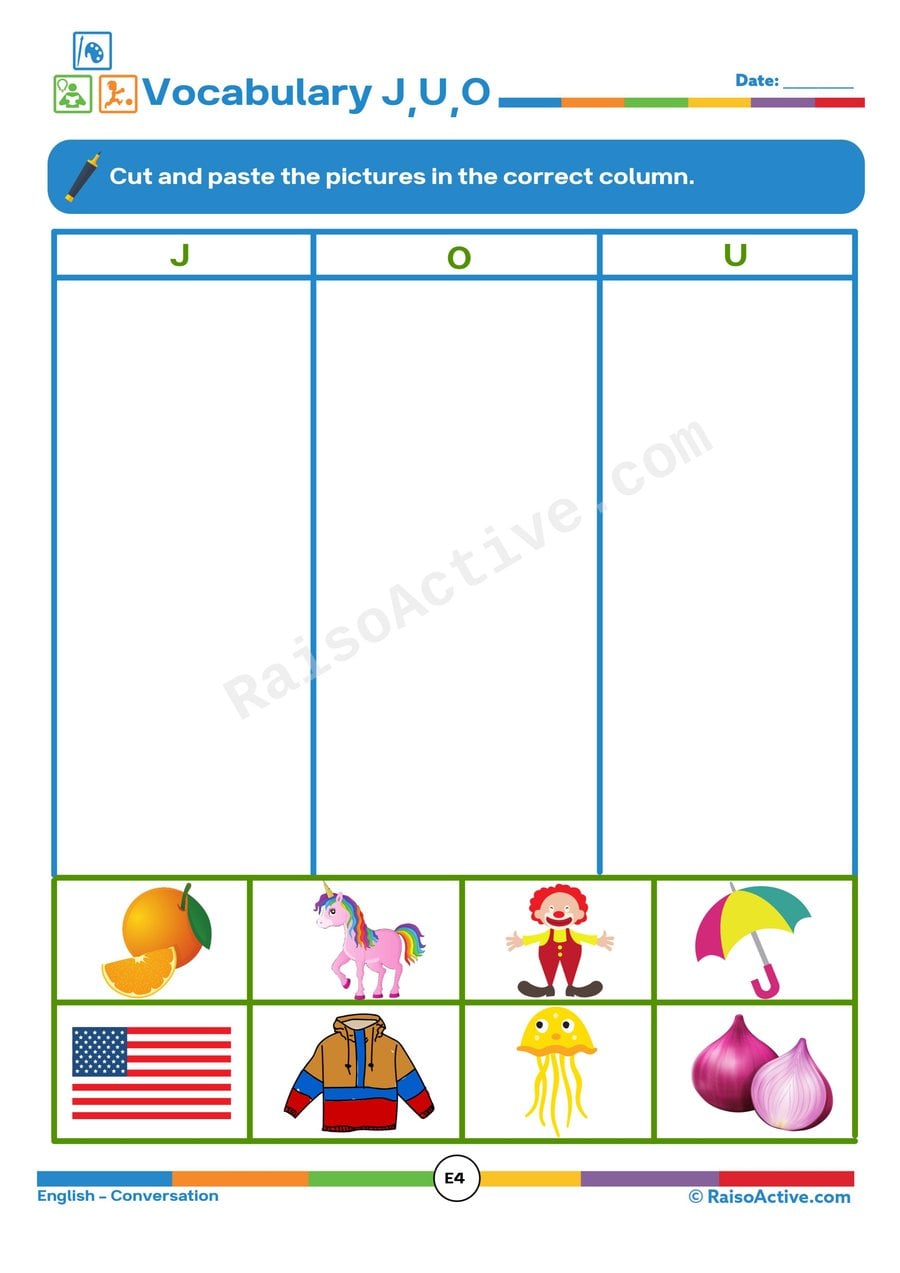
J, U, O Sorting Worksheet: Cut and Paste Pictures!
Ages 3-5 · Preschool–Pre-KAges 3-5 · Nursery–ReceptionAges 3-5 · Nursery–LKGAges 3-5
Sorting pictures by their beginning letter sound into J, U, or O columns asks children ages 3-5 to actively compare three different sounds rather than just recognizing one letter at a time, a more demanding phonics task than single-letter worksheets. This kind of three-way sorting builds sharper listening discrimination, since J, U, and O can sound similar in casual speech but are quite distinct once isolated. The cut-and-paste format also reinforces the sorting decision physically, since children must place each picture correctly rather than simply circling an answer.

Balloon Pattern Matching Worksheet for Preschoolers
Ages 3-5 · Preschool–Pre-KAges 3-5 · Nursery–ReceptionAges 3-5 · Nursery–LKGAges 3-5
This worksheet strengthens pattern recognition in children ages 3-5 by having them study a repeating sequence of colored balloons and locate the matching arrangement elsewhere on the page. Recognizing and reproducing a pattern is an early pre-algebra skill, laying groundwork for later number patterns and logical sequencing.

Halloween Match: Find and Color the Identical Objects!
Ages 3-5 · Preschool–Pre-KAges 3-5 · Nursery–ReceptionAges 3-5 · Nursery–LKGAges 3-5
This visual discrimination worksheet asks children ages 3-5 to scan a row of similar-looking Halloween objects and identify the two that are truly identical, sharpening their attention to small details like size, shading, and shape. Coloring the matched pair afterward gives a satisfying finishing step while reinforcing which items they correctly identified.
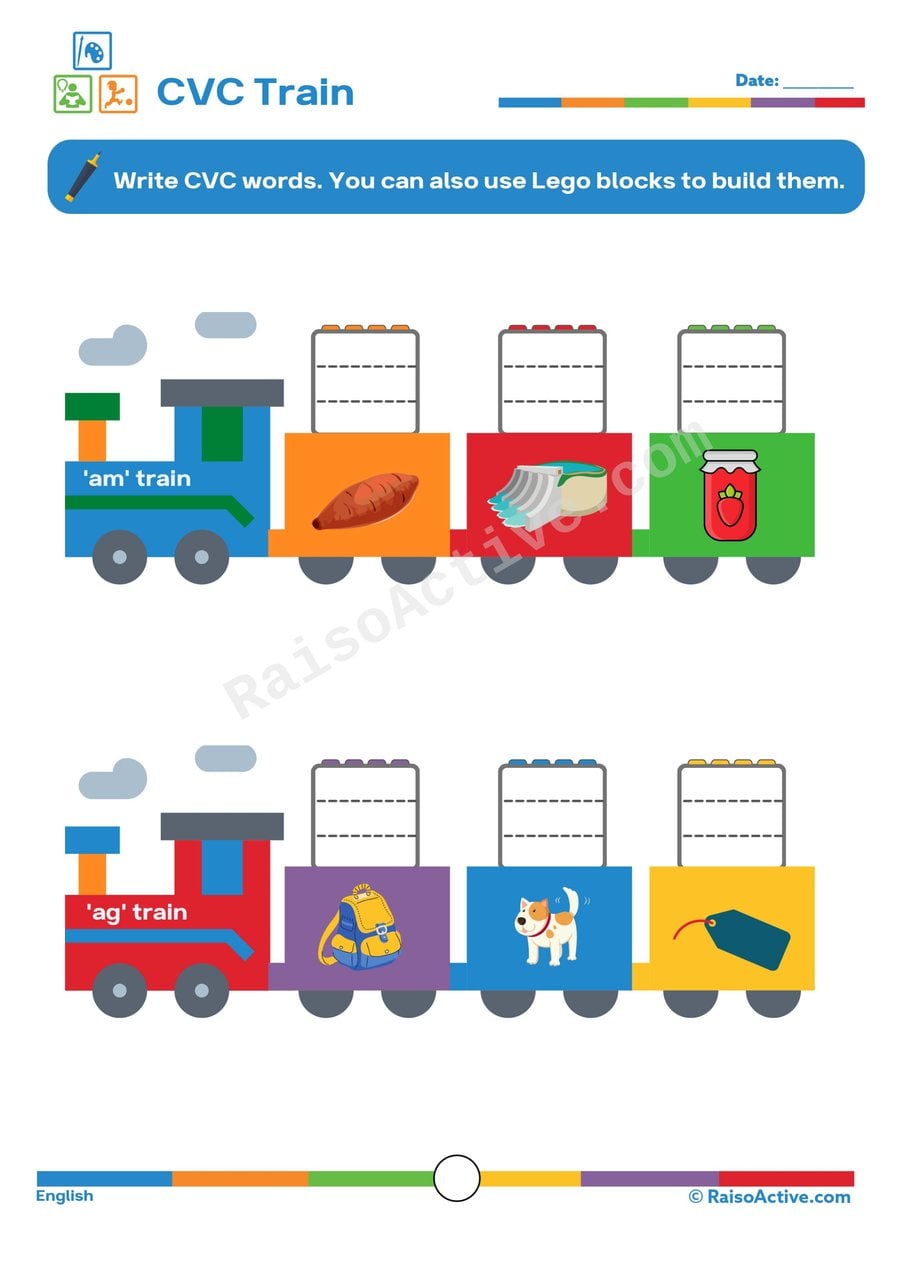
CVC Train Worksheet: Write and Build CVC Words!
Ages 4-6 · Pre-K–KindergartenAges 4-6 · Reception–Year 1Ages 4-6 · LKG–UKGAges 4-6
This worksheet gives children ages 4-6 focused practice blending letter sounds into consonant-vowel-consonant words, using train-car pictures as clues for words like 'dog,' 'hen,' or 'cup.' Because children both write the word and can optionally build it with Lego blocks, this worksheet reinforces the same phonics skill through two different physical actions — handwriting and hands-on construction — which helps the spelling patterns stick.
Guides for this topic

How to Teach CVC Blending: A Step-by-Step Method That Works in Two Weeks
A step-by-step method for teaching CVC blending, covering continuous sounds, word families, common errors, and a 14-day plan that most children finish reading CVC words.

Best Worksheets for 3-Year-Olds: What Works and What to Avoid
What works on worksheets for 3-year-olds: short sessions, crayons, tracing lines, matching, cutting, a free weekly plan, and signs one is too advanced.
Phase 2 Phonics at Home: Sound Order, Blending Games, Worksheets
Phase 2 phonics at home: the five sound sets in order, oral blending, tricky words, a two-week routine, common mistakes, and free worksheets.
Reviews
Every worksheet for ages 3–5, no watermark
Members download the full library of 1,000+ worksheets and every activity pack without watermarks or daily limits. One year costs ₹999 in India or $20 elsewhere.
See membership plansOr download any worksheet free with a watermark (5 a day).