Letter Sounds Worksheet: Color the Letter That Begins the Word!
This worksheet strengthens phonemic awareness in children ages 4-5 by asking them to isolate the very first sound of a picture's name and match it to its printed letter. Identifying beginning sounds is one of the strongest early predictors of reading success, since it teaches children that spoken words are made of individual sounds that map onto letters. The coloring component adds a motivating, low-pressure way to record each answer.
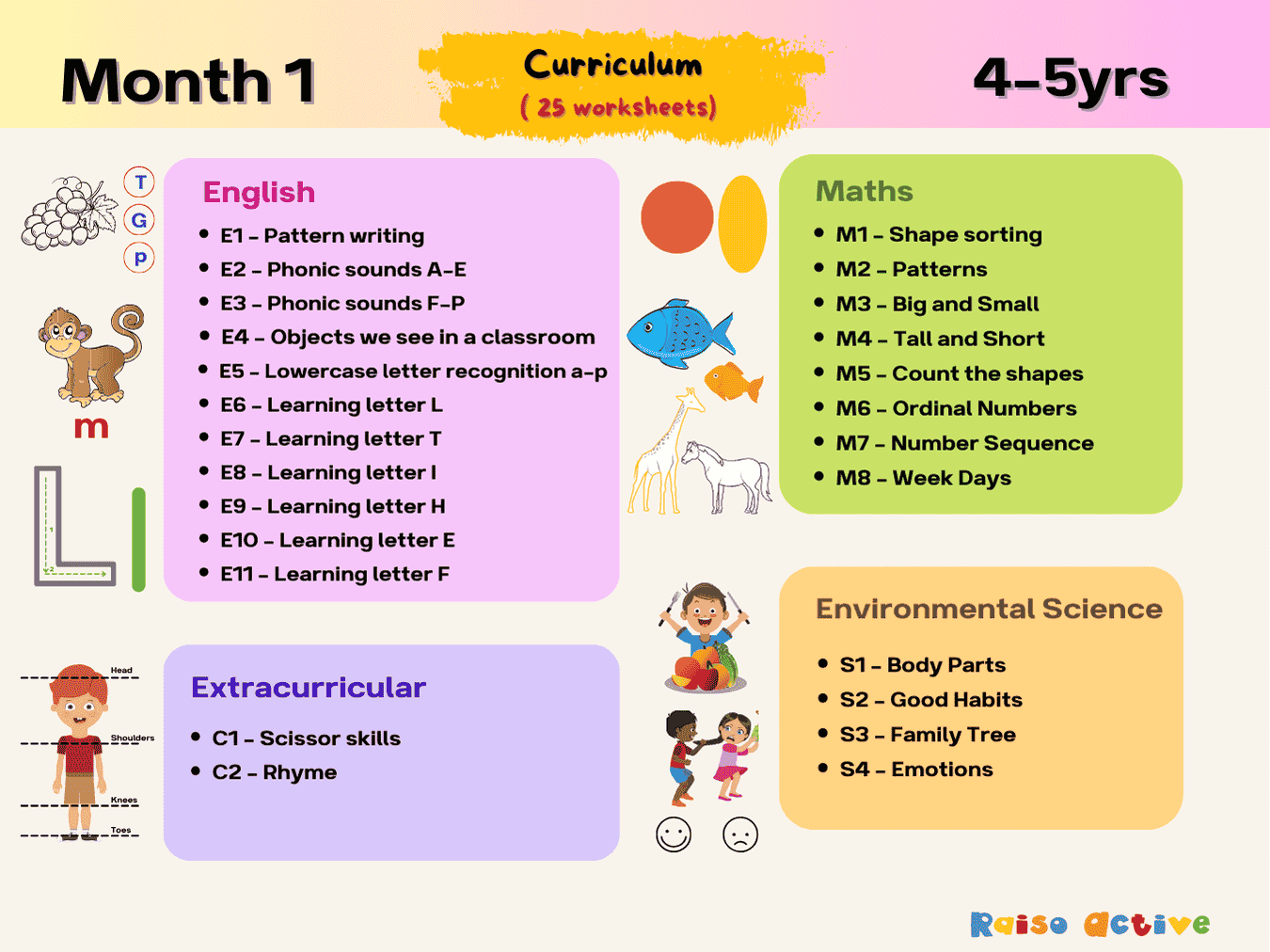
Part of the pack
Play-Based Learning Activity Book for 4-5 Year Olds | Literacy, Math & EVS
This is page 5 of the pack. Ages 4-5 · Pre-KAges 4-5 · ReceptionAges 4-5 · LKGAges 4-5

Made for your child
A whole activity pack made with their name
60 pages to spot, build, trace and write their own name, plus pages about their favourites, feelings and family. See a free preview with their name.
Make an All About Me packFree preview · free for members
Or start free: a name tracing sheet with their nameCurriculum
- Phonics - Letter Sounds > Beginning Sounds
How to use this worksheet
Point to the first picture and say its name slowly and clearly together, stretching out the very first sound, like 'ssss-un' for sun. Ask your child which letter makes that beginning sound and find it among the choices on the page. Have your child color in the correct letter using a crayon or colored pencil, working through each picture one at a time. Once finished, go back through the page and have your child say each word and its matching letter sound aloud again.
Materials needed
- Pencil
- Crayons or colored pencils
Extension activities
- 1Have the child draw their own pictures and write the beginning letter.
- 2Find other objects in the room that start with the same letter sounds.
- 3Play 'I Spy' using only the beginning sound of an object, like 'I spy something that starts with buh.'
- 4Sort small toys or household objects into piles by their beginning sound.
- 5Make up a silly sentence where every word starts with the same letter sound.

Written by
Hemsweta Jain · Teacher Cheena
MBA and Early Childhood Educator, teaching since 2014 · Founder of RaisoActive, Mumbai
Every RaisoActive worksheet is designed and checked by the founder before publishing.
Published · Last reviewed
More from Play-Based Learning Activity Book for 4-5 Year Olds | Literacy, Math & EVS
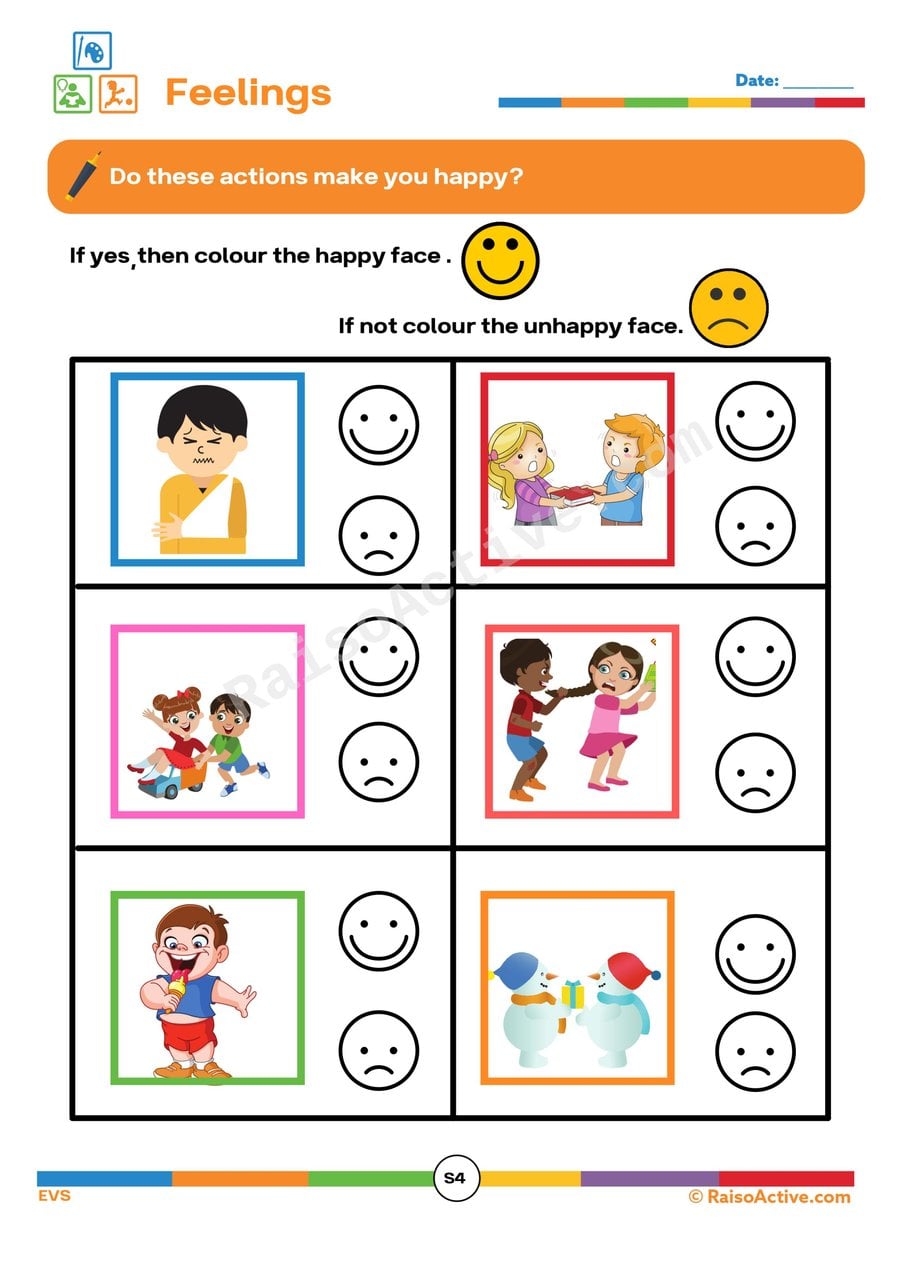
Feelings Worksheet: Happy or Sad?
Ages 3-5 · Preschool–Pre-KAges 3-5 · Nursery–ReceptionAges 3-5 · Nursery–LKGAges 3-5
Children ages 3-5 build emotional vocabulary and self-awareness as they decide whether different everyday situations would make them feel happy or sad. Naming and sorting emotions based on a scenario is an early social-emotional skill that helps children recognize and eventually talk about their own feelings more clearly.

Mickey Mouse Number Sequence Worksheet: Paste the Missing Numbers!
Ages 4-5 · Pre-KAges 4-5 · ReceptionAges 4-5 · LKGAges 4-5
This cut-and-paste worksheet uses a Mickey Mouse theme to give children ages 4-5 practice recognizing and completing number sequences by identifying missing numbers within numbered frames and pasting them into place. Because the missing numbers appear in the middle of a sequence rather than only at the end, children must think about both the number before and after a gap, a more demanding skill than simple 'what comes next' counting. The familiar character theme adds motivation to a task that is fundamentally about numerical reasoning.

Butterfly Cutting Practice Worksheet for Preschoolers
Ages 3-5 · Preschool–Pre-KAges 3-5 · Nursery–ReceptionAges 3-5 · Nursery–LKGAges 3-5
This cutting-practice worksheet gives children ages 3-5 dedicated repetition in guiding scissors along a straight or gently curved dotted line, a core pre-writing and self-help skill that strengthens hand strength and bilateral coordination. Framing the goal as 'reaching the butterflies' gives children a visual reward for careful, controlled cutting rather than treating scissor practice as an isolated drill. Building this scissor control early supports later success with more complex cut-and-paste crafts.
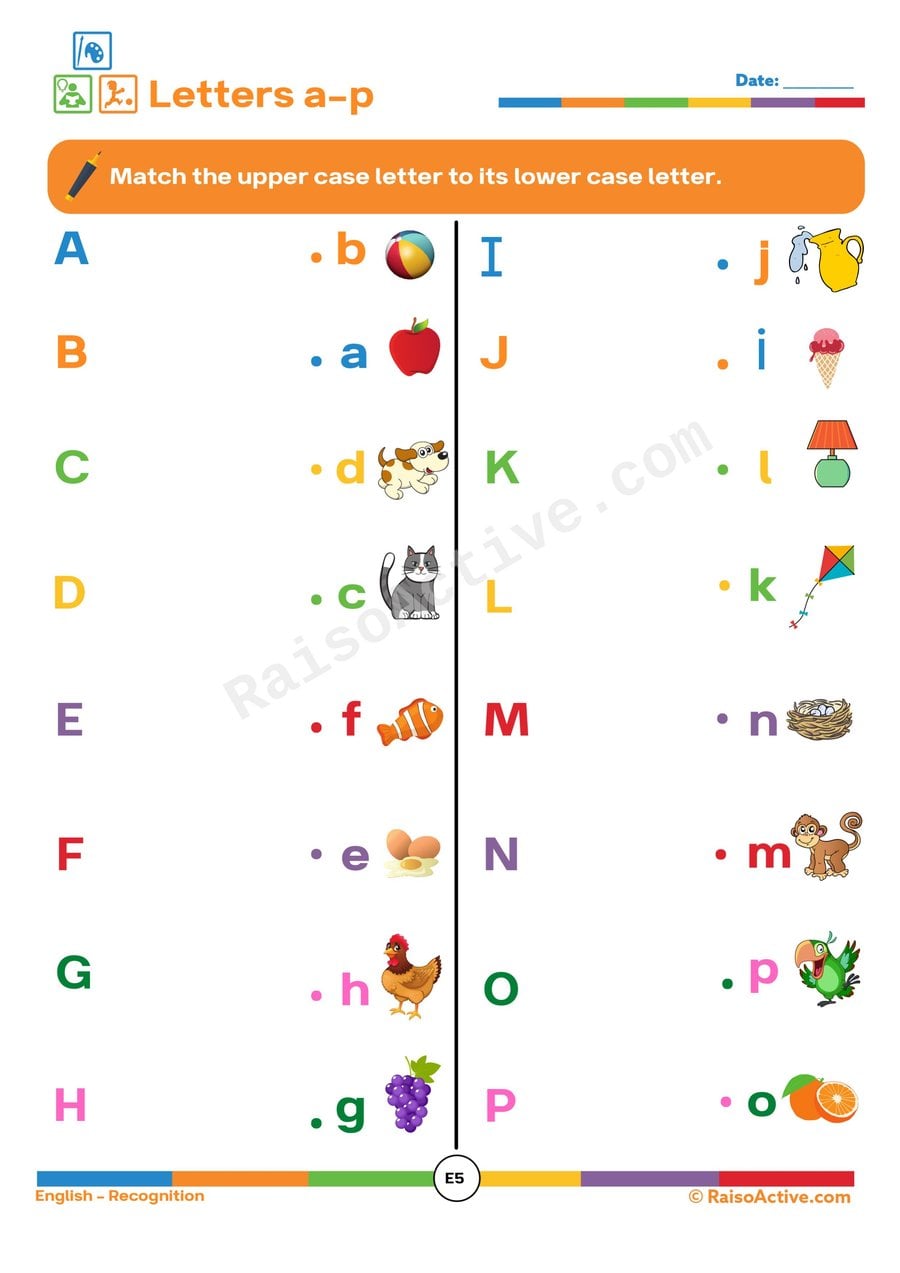
Match the Uppercase Letters: a-p Worksheet
Ages 4-6 · Pre-K–KindergartenAges 4-6 · Reception–Year 1Ages 4-6 · LKG–UKGAges 4-6
This worksheet helps children ages 4-6 practice matching uppercase letters to their corresponding lowercase forms across the first half of the alphabet, letters A through P. Recognizing that an uppercase and lowercase letter, even ones that look quite different like G and g, represent the same letter is an essential skill for reading printed text, which mixes both cases constantly. Covering a larger range of letters than a single-letter worksheet also builds broader alphabet fluency in one sitting.

Shape Sorting Fun: Cut and Paste Worksheet for Preschoolers
Ages 3-5 · Preschool–Pre-KAges 3-5 · Nursery–ReceptionAges 3-5 · Nursery–LKGAges 3-5
This cut-and-paste worksheet helps children ages 3-5 practice visually matching real-world objects to their underlying geometric shape, specifically distinguishing circles from ovals. Learning to see the circle or oval 'hiding' inside everyday objects, like a clock or an egg, builds the shape-recognition foundation that supports later geometry and spatial reasoning. Cutting and gluing each piece also strengthens fine motor precision.

Long, Tall, and Short: Comparing Objects Worksheet for Kids
Ages 3-5 · Preschool–Pre-KAges 3-5 · Nursery–ReceptionAges 3-5 · Nursery–LKGAges 3-5
Children ages 3-5 build comparative reasoning by identifying which of two or three objects is long, tall, or short. Understanding relative size — that an object is only 'tall' compared to something else — is an early measurement skill that lays the groundwork for later concepts like more/less and eventually numeric comparison.
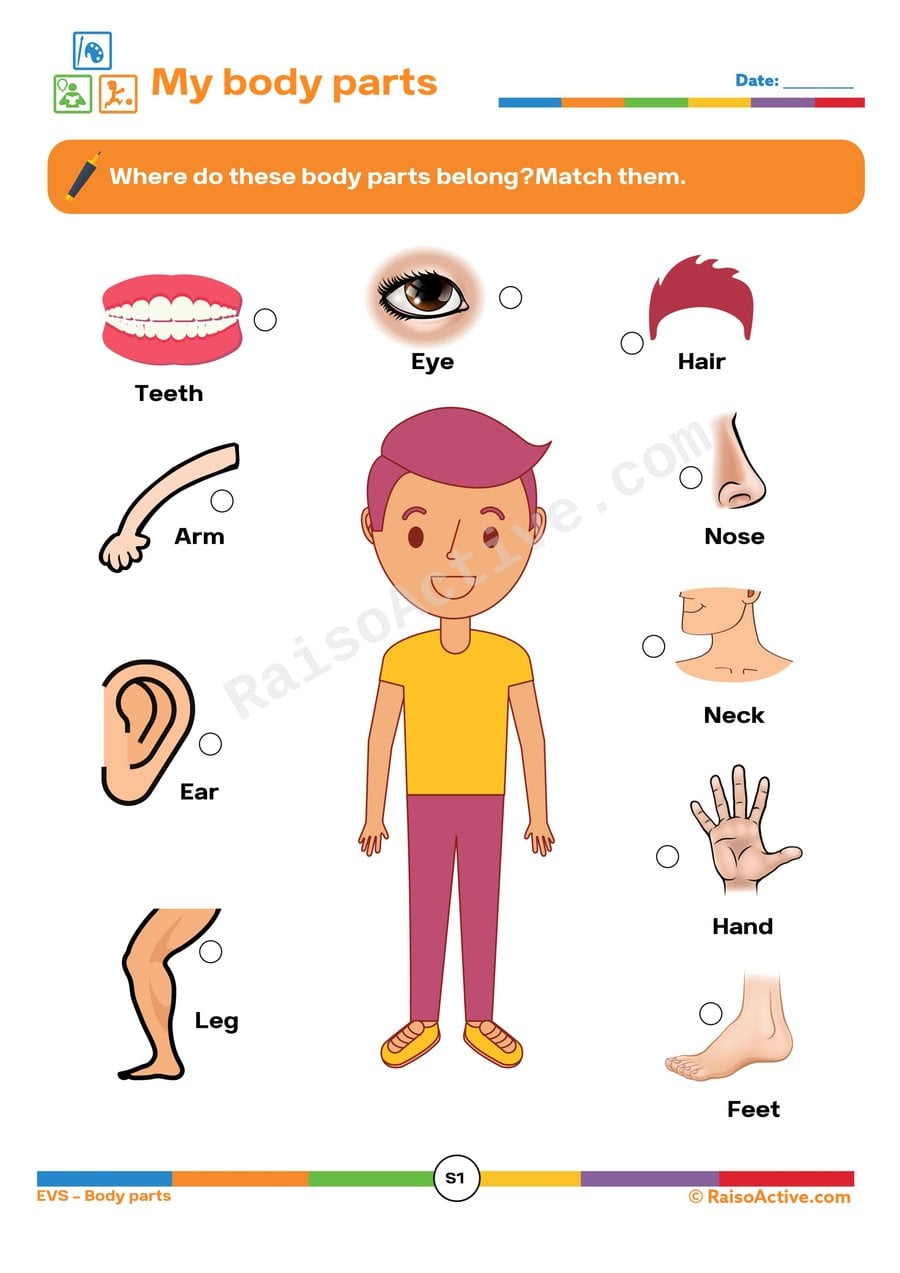
Match the Body Parts! A Fun Worksheet for Kids
Ages 3-5 · Preschool–Pre-KAges 3-5 · Nursery–ReceptionAges 3-5 · Nursery–LKGAges 3-5
Drawing lines from body part pictures to their correct location on a human figure helps children ages 3-5 build vocabulary for parts of the body, like arms, legs, and ears, while practicing visual-spatial matching between a small picture and its larger corresponding location. This worksheet strengthens the link between a spoken body part name and its physical location, a skill children also use constantly in daily routines like getting dressed or washing up. Matching pictures to a full-body diagram, rather than just naming parts in isolation, builds a more complete mental map of the body.

The Hungry Ant: Feed the Ant by Cutting and Pasting Fruits Worksheet
Ages 4-6 · Pre-K–KindergartenAges 4-6 · Reception–Year 1Ages 4-6 · LKG–UKGAges 4-6
Children ages 4-6 practice sequencing and vocabulary by associating specific fruits with each day of the week as they feed a hungry ant. Following a fixed weekly order while matching new vocabulary (fruit names) to each day builds both memory sequencing and category-association skills useful across early literacy and science tasks.
Related worksheets

Phonics Worksheet: Color the Correct Letter Sounds!
Ages 4-6 · Pre-K–KindergartenAges 4-6 · Reception–Year 1Ages 4-6 · LKG–UKGAges 4-6
This worksheet gives children ages 4-6 practice matching a picture to its correct beginning letter sound by coloring the box containing the right letter, reinforcing the phonics skill of connecting spoken sounds to written symbols. Because children choose from a set of letter options rather than writing freehand, the activity isolates sound recognition from the separate challenge of handwriting.

Letter Sounds: Cut and Paste 'Ii' and 'Jj' Pictures Worksheet
Ages 3-5 · Preschool–Pre-KAges 3-5 · Nursery–ReceptionAges 3-5 · Nursery–LKGAges 3-5
Sorting pictures by their beginning sound into 'Ii' and 'Jj' groups builds phonemic awareness for children ages 3-5, training their ear to isolate the first sound of a word before connecting it to its written letter.
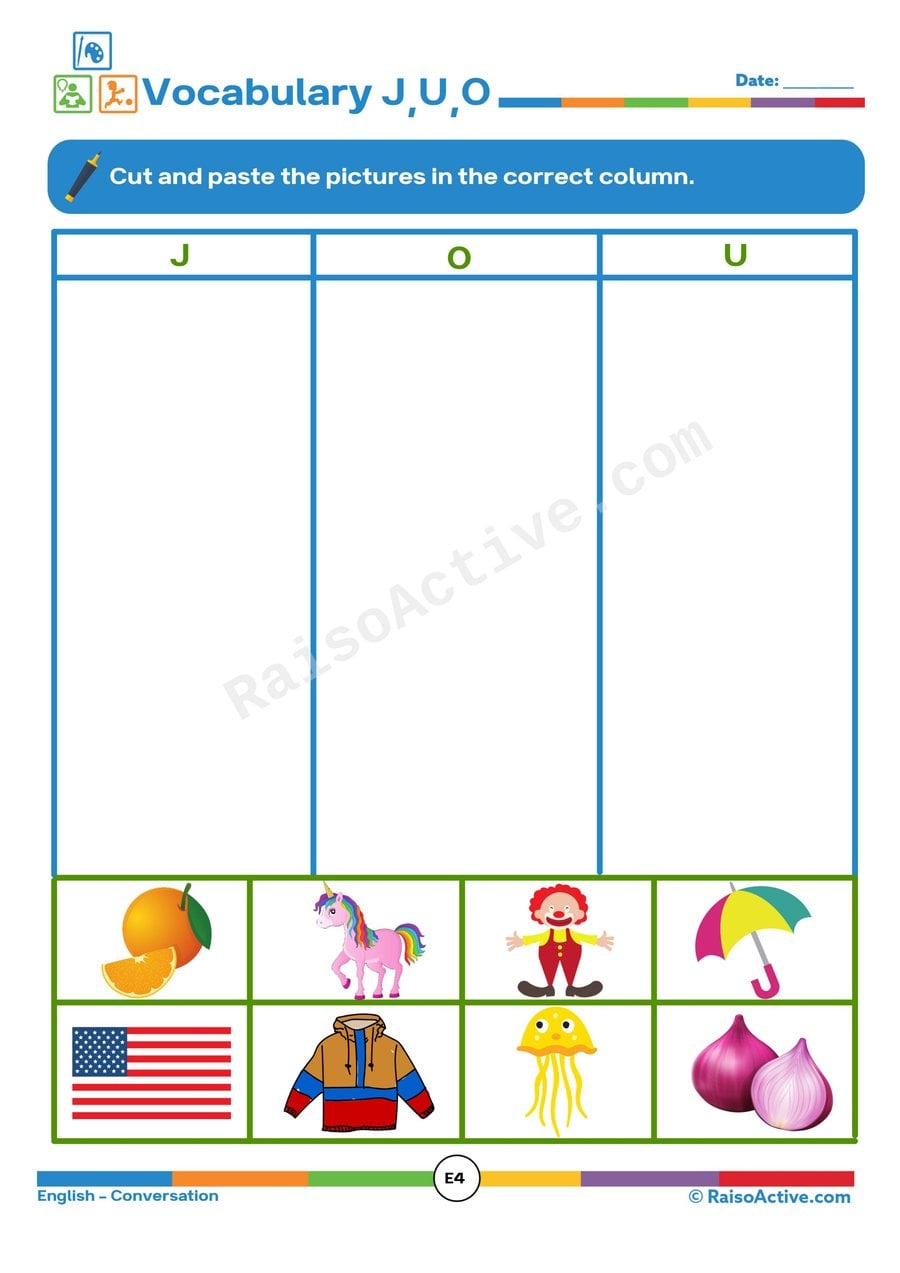
J, U, O Sorting Worksheet: Cut and Paste Pictures!
Ages 3-5 · Preschool–Pre-KAges 3-5 · Nursery–ReceptionAges 3-5 · Nursery–LKGAges 3-5
Sorting pictures by their beginning letter sound into J, U, or O columns asks children ages 3-5 to actively compare three different sounds rather than just recognizing one letter at a time, a more demanding phonics task than single-letter worksheets. This kind of three-way sorting builds sharper listening discrimination, since J, U, and O can sound similar in casual speech but are quite distinct once isolated. The cut-and-paste format also reinforces the sorting decision physically, since children must place each picture correctly rather than simply circling an answer.

Color the Pictures! Kk, Ll, and Mm Letter Sounds Worksheet
Ages 4-5 · Pre-KAges 4-5 · ReceptionAges 4-5 · LKGAges 4-5
Coloring a circle beneath a picture only when its name starts with a target letter sound builds beginning-sound discrimination for children ages 4-5 across three letters — K, L, and M — sharpening their ability to isolate initial phonemes.

Phonics Worksheet: Color the Correct Letter - Letter Sounds
Ages 3-5 · Preschool–Pre-KAges 3-5 · Nursery–ReceptionAges 3-5 · Nursery–LKGAges 3-5
This phonics worksheet asks children ages 3-5 to say the name of each pictured object and identify which letter matches its beginning sound, then color that letter box. Isolating and identifying the very first sound in a spoken word is one of the core early literacy skills that predicts later reading success, and practicing it with real pictures rather than abstract letters makes it concrete.
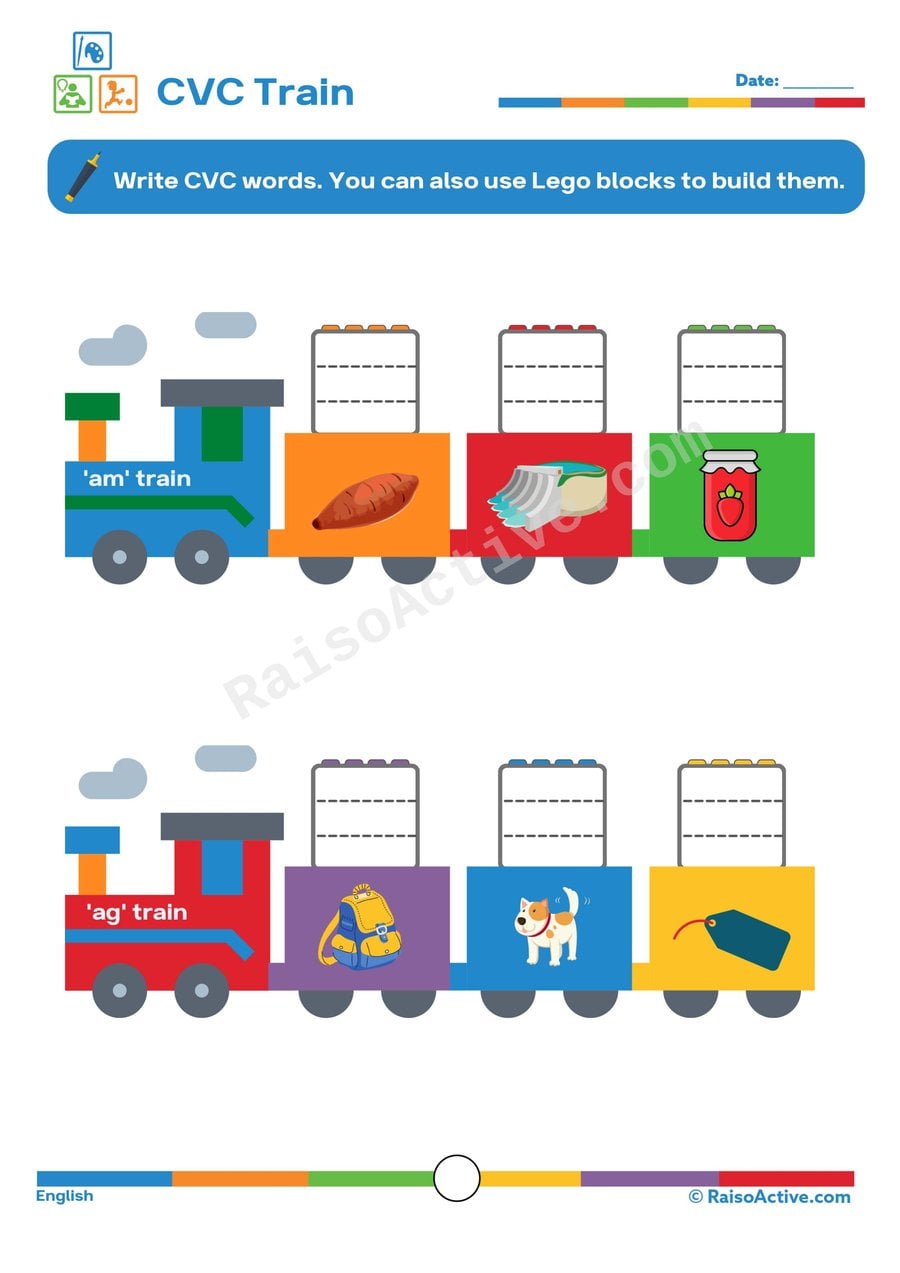
CVC Train Worksheet: Write CVC Words!
Ages 4-6 · Pre-K–KindergartenAges 4-6 · Reception–Year 1Ages 4-6 · LKG–UKGAges 4-6
Writing consonant-vowel-consonant words like 'cat,' 'sun,' or 'pig' under matching pictures gives children ages 4-6 direct practice with letter-sound blending, a core phonics skill that underpins independent reading. Because each train car pairs a picture clue with a blank space, children also practice translating a spoken word they can sound out into its correctly spelled written form.
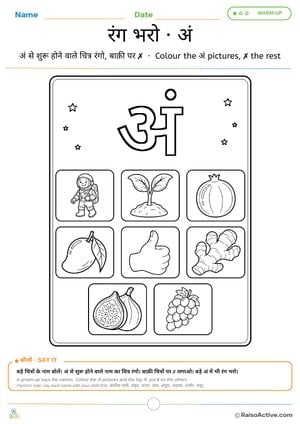
Colour the अं Words – Hindi Letter अं (am) Colouring Worksheet | अं वाली चीज़ों में रंग भरो
Ages 3-7 · Preschool–Grade 1Ages 3-7 · Nursery–Year 2Ages 3-7 · Nursery–Class 1Ages 3-7
Children say each picture name aloud, decide whether it starts with अं, colour the matching pictures (अंकुर, अंतरिक्ष यात्री, अंजीर, अंगूठा and अंगूर) and the big outline letter, and put a cross on the rest. Sorting by first sound trains the ear and colouring builds hand control.

Phonics Level 1 Answer Key
Ages 3-6 · Preschool–KindergartenAges 3-6 · Nursery–Year 1Ages 3-6 · Nursery–UKGAges 3-6
Grown-ups can check every Phonics Level 1 page that has one right answer, page by page.
Guides for this topic

How to Teach CVC Blending: A Step-by-Step Method That Works in Two Weeks
A step-by-step method for teaching CVC blending, covering continuous sounds, word families, common errors, and a 14-day plan that most children finish reading CVC words.

Best Worksheets for 3-Year-Olds: What Works and What to Avoid
What works on worksheets for 3-year-olds: short sessions, crayons, tracing lines, matching, cutting, a free weekly plan, and signs one is too advanced.
Phase 2 Phonics at Home: Sound Order, Blending Games, Worksheets
Phase 2 phonics at home: the five sound sets in order, oral blending, tricky words, a two-week routine, common mistakes, and free worksheets.
Reviews
Every worksheet for ages 4–5, no watermark
Members download the full library of 1,000+ worksheets and every activity pack without watermarks or daily limits. One year costs ₹999 in India or $20 elsewhere.
See membership plansOr download any worksheet free with a watermark (5 a day).