Shape Sorting Fun: Cut and Paste Worksheet for Preschoolers
This cut-and-paste worksheet helps children ages 3-5 practice visually matching real-world objects to their underlying geometric shape, specifically distinguishing circles from ovals. Learning to see the circle or oval 'hiding' inside everyday objects, like a clock or an egg, builds the shape-recognition foundation that supports later geometry and spatial reasoning. Cutting and gluing each piece also strengthens fine motor precision.
Part of the pack
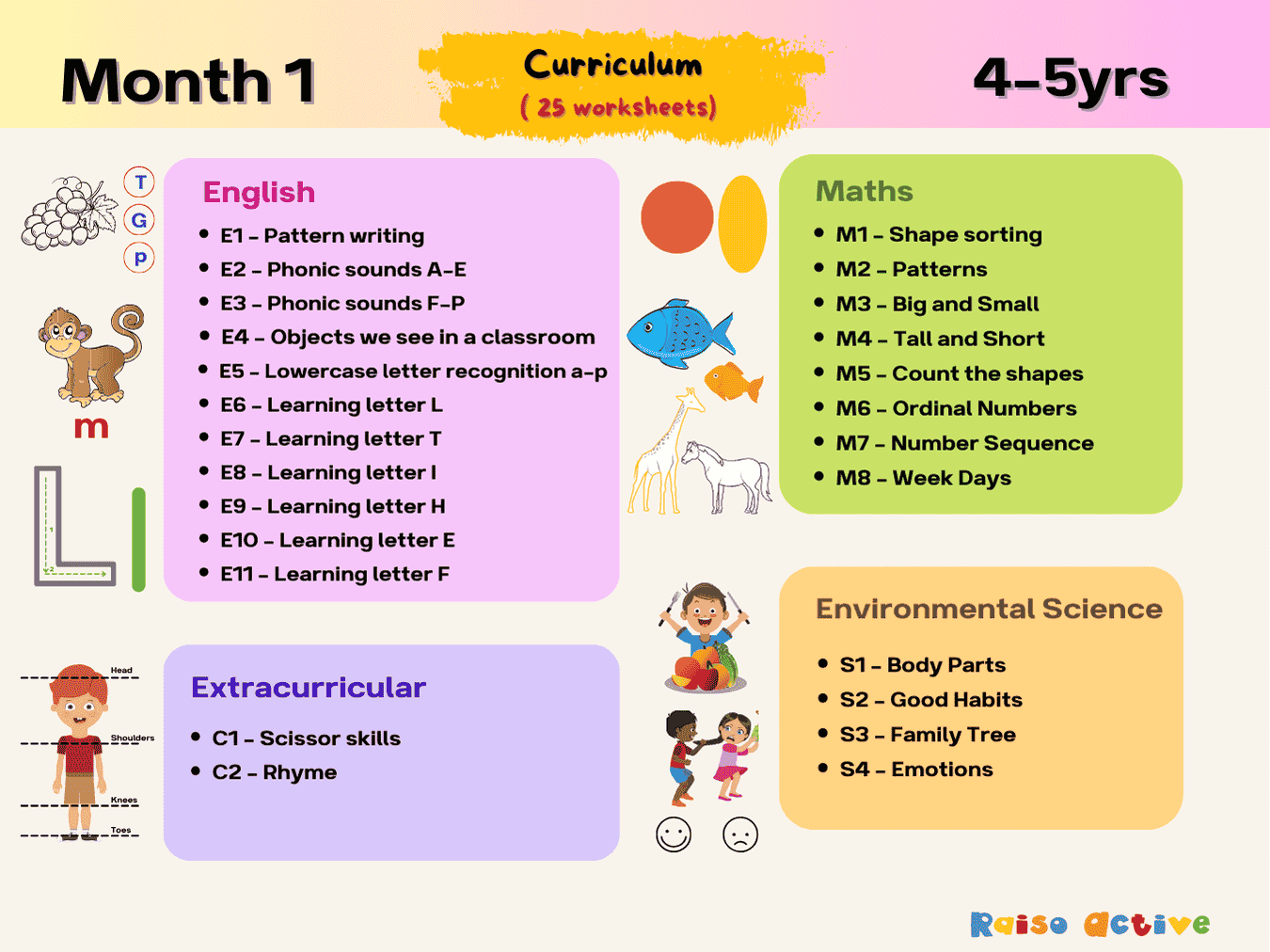
Play-Based Learning Activity Book for 4-5 Year Olds | Literacy, Math & EVS
This is page 15 of the pack. Ages 4-5 · Pre-KAges 4-5 · ReceptionAges 4-5 · LKGAges 4-5
Curriculum
- 2D Shapes > Shapes & Sorting
How to use this worksheet
Look at the two shape headings on the page together — circle and oval — and talk about how they are similar but different, since an oval is a stretched circle. Have your child cut out each object picture from the bottom of the page using child-safe scissors. For each object, ask 'is this shaped more like a circle or an oval?' before applying glue and pasting it under the matching heading. Once finished, review both columns and name each object and its shape together.
Materials needed
- Scissors
- Glue stick
- Pencil
Extension activities
- 1Go on a shape hunt around the house.
- 2Draw your own objects and have your child identify their shapes.
- 3Use playdough to create different shapes.
- 4Trace circular and oval household objects, like a cup and a spoon, onto paper.
- 5Sort a pile of buttons or coins by whether they are perfectly round or oval-shaped.

Written by
Hemsweta Jain · Teacher Cheena
MBA and Early Childhood Educator, teaching since 2014 · Founder of RaisoActive, Mumbai
Every RaisoActive worksheet is designed and checked by the founder before publishing.
Published · Last reviewed
More from Play-Based Learning Activity Book for 4-5 Year Olds | Literacy, Math & EVS
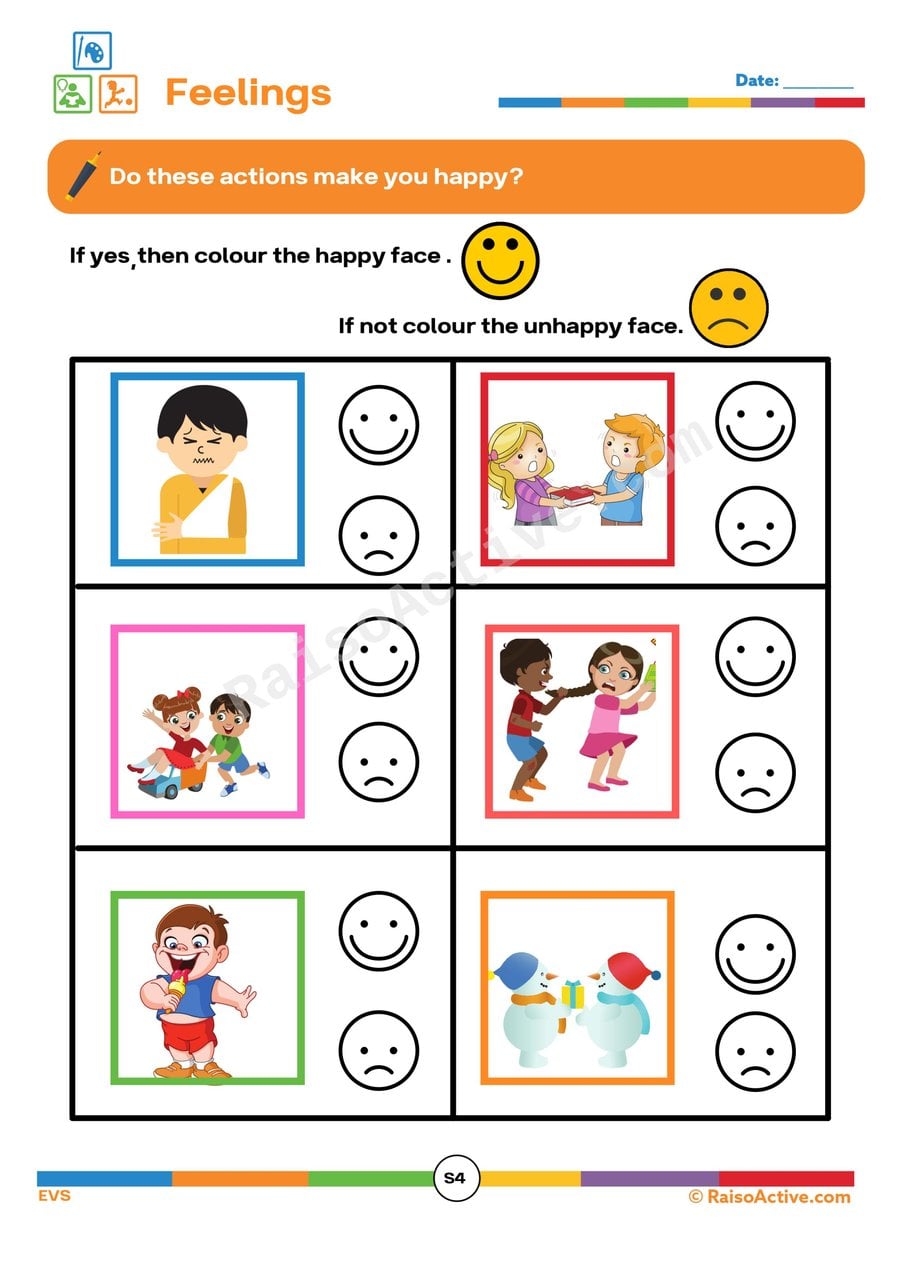
Feelings Worksheet: Happy or Sad?
Ages 3-5 · Preschool–Pre-KAges 3-5 · Nursery–ReceptionAges 3-5 · Nursery–LKGAges 3-5
Children ages 3-5 build emotional vocabulary and self-awareness as they decide whether different everyday situations would make them feel happy or sad. Naming and sorting emotions based on a scenario is an early social-emotional skill that helps children recognize and eventually talk about their own feelings more clearly.
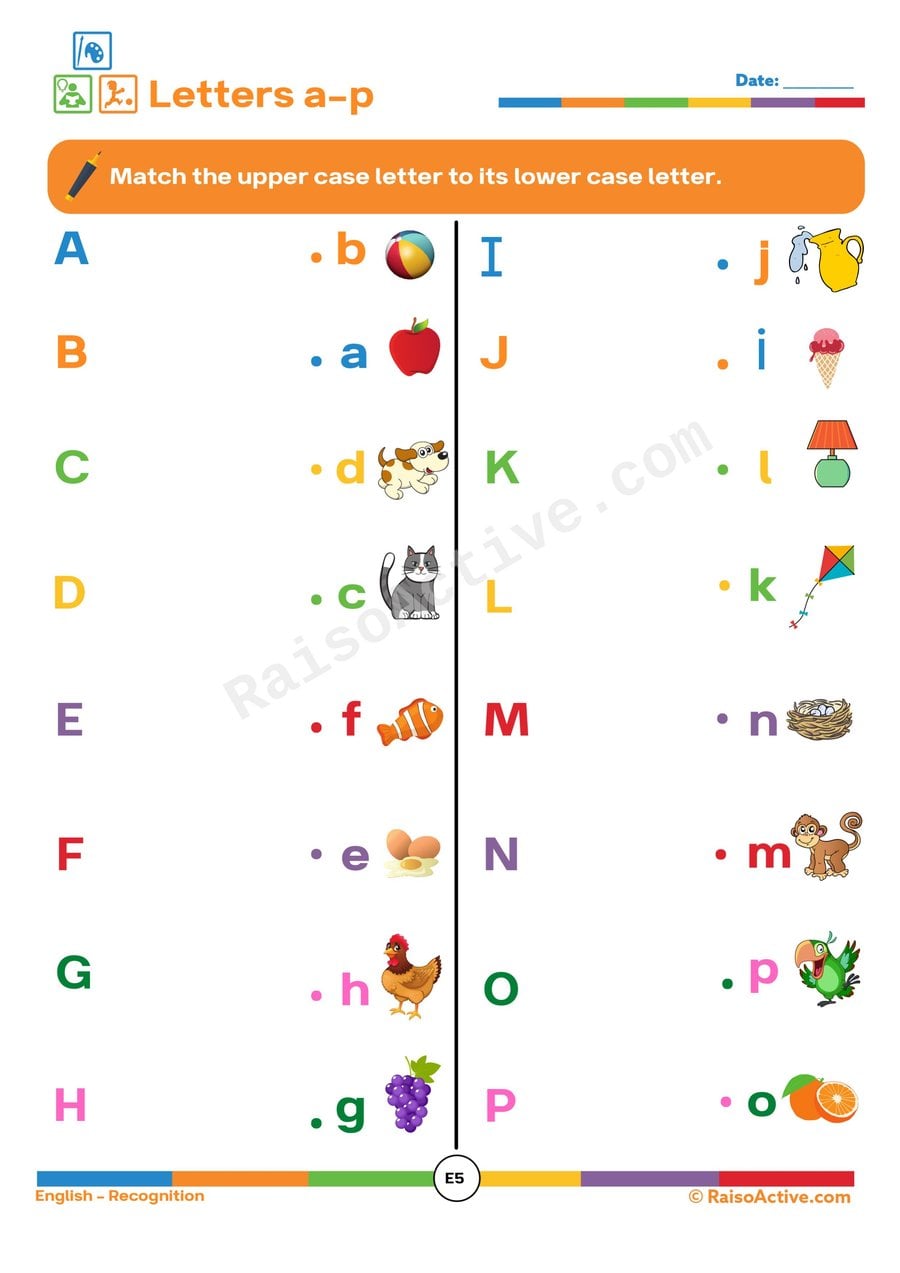
Match the Uppercase Letters: a-p Worksheet
Ages 4-6 · Pre-K–KindergartenAges 4-6 · Reception–Year 1Ages 4-6 · LKG–UKGAges 4-6
This worksheet helps children ages 4-6 practice matching uppercase letters to their corresponding lowercase forms across the first half of the alphabet, letters A through P. Recognizing that an uppercase and lowercase letter, even ones that look quite different like G and g, represent the same letter is an essential skill for reading printed text, which mixes both cases constantly. Covering a larger range of letters than a single-letter worksheet also builds broader alphabet fluency in one sitting.

Letter T Tracing and Coloring Worksheet for Preschoolers
Ages 3-5 · Preschool–Pre-KAges 3-5 · Nursery–ReceptionAges 3-5 · Nursery–LKGAges 3-5
This worksheet helps children ages 3-5 build the fine motor control and directional awareness needed to form the letter T correctly, tracing both its uppercase and lowercase forms along guided dotted lines. Repeated tracing builds the muscle memory in small hand muscles that eventually allows children to write letters independently without a guide. Coloring pictures that begin with T and hunting for the letter in a grid also reinforce letter-sound and letter-shape recognition side by side.
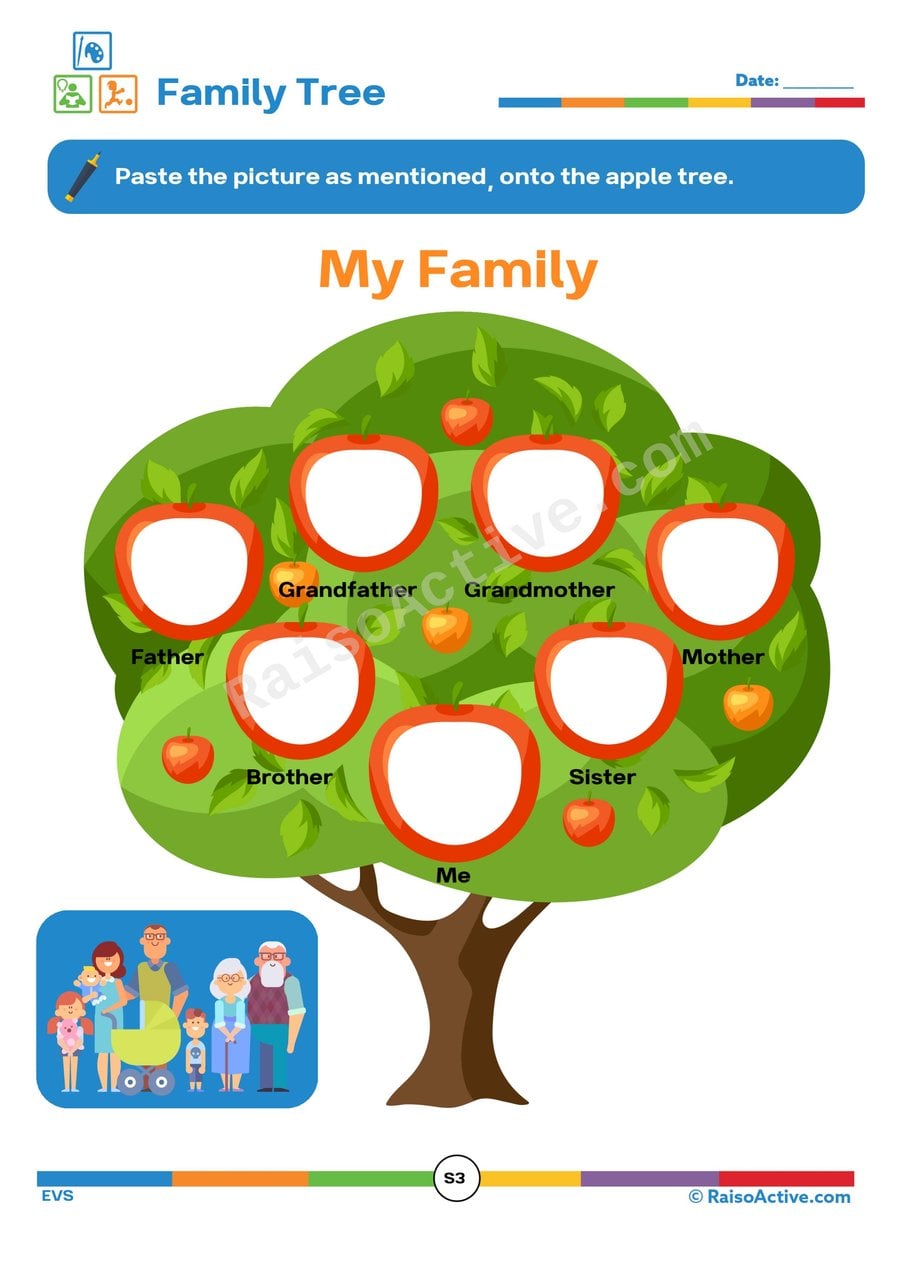
My Family Tree Worksheet: Paste & Learn!
Ages 3-5 · Preschool–Pre-KAges 3-5 · Nursery–ReceptionAges 3-5 · Nursery–LKGAges 3-5
This worksheet helps children ages 3-5 build vocabulary around family relationships while practicing pasting skills and personal storytelling. Creating a visual, personalized family tree helps children organize and talk about the people closest to them, an early step in understanding relationships and social structure.

The Hungry Ant: Feed the Ant by Cutting and Pasting Fruits Worksheet
Ages 4-6 · Pre-K–KindergartenAges 4-6 · Reception–Year 1Ages 4-6 · LKG–UKGAges 4-6
Children ages 4-6 practice sequencing and vocabulary by associating specific fruits with each day of the week as they feed a hungry ant. Following a fixed weekly order while matching new vocabulary (fruit names) to each day builds both memory sequencing and category-association skills useful across early literacy and science tasks.

Big and Small Fish Counting Worksheet for Preschoolers
Ages 3-5 · Preschool–Pre-KAges 3-5 · Nursery–ReceptionAges 3-5 · Nursery–LKGAges 3-5
This counting worksheet gives children ages 3-5 practice with one-to-one correspondence — touching and counting each fish exactly once — while also comparing two groups by size. Splitting the fish into 'big' and 'small' groups before counting adds a light classification step that sharpens observation skills alongside basic numeracy. Recording each total as a written numeral also connects counting aloud to number formation.

Animal Babies Tracing Worksheet: Help the Babies Find Their Mothers!
Ages 3-5 · Preschool–Pre-KAges 3-5 · Nursery–ReceptionAges 3-5 · Nursery–LKGAges 3-5
This tracing worksheet has children ages 3-5 trace dotted lines to connect each baby animal to its correct mother, combining pencil control practice with early science knowledge about animal families. Learning which baby belongs to which adult animal — like a calf to a cow, or a cub to a lion — builds vocabulary and categorization skills that go beyond the tracing itself. Because the correct line only makes sense if the child recognizes the right animal pairing first, this activity blends fine motor practice with genuine content knowledge.

Long, Tall, and Short: Comparing Objects Worksheet for Kids
Ages 3-5 · Preschool–Pre-KAges 3-5 · Nursery–ReceptionAges 3-5 · Nursery–LKGAges 3-5
Children ages 3-5 build comparative reasoning by identifying which of two or three objects is long, tall, or short. Understanding relative size — that an object is only 'tall' compared to something else — is an early measurement skill that lays the groundwork for later concepts like more/less and eventually numeric comparison.
Related worksheets

Connect the Dots: Hidden Shape Worksheet for Kids
Ages 3-5 · Preschool–Pre-KAges 3-5 · Nursery–ReceptionAges 3-5 · Nursery–LKGAges 3-5
Children ages 3-5 practice counting in sequence and fine motor line control as they connect numbered dots in order to reveal a hidden shape, combining numeracy with hand-eye coordination in one satisfying activity. The surprise of a shape emerging only once every dot is connected correctly also motivates children to stay careful and accurate rather than rushing through the numbers.

Scarecrow Cut and Paste Worksheet for Preschoolers
Ages 3-5 · Preschool–Pre-KAges 3-5 · Nursery–ReceptionAges 3-5 · Nursery–LKGAges 3-5
This scarecrow-building activity gives children ages 3-5 focused practice in cutting and gluing basic shapes — circles, triangles, rectangles — into place to assemble a recognizable figure. Matching each shape to its correct spot on the scarecrow outline also reinforces spatial reasoning, since children must judge size and orientation before pasting. Naming the shapes aloud as they work connects the craft to early geometry vocabulary rather than treating it as pure art time.

Shape Matching Worksheet: Circle, Square, Triangle, and Rectangle!
Ages 3-5 · Preschool–Pre-KAges 3-5 · Nursery–ReceptionAges 3-5 · Nursery–LKGAges 3-5
Children ages 3-5 practice recognizing and naming four basic shapes — circle, square, triangle, and rectangle — by matching everyday objects to their shape, then applying that recognition to a themed snowman picture. Counting the circles and triangles that make up the snowman afterward layers a numeracy task on top of the geometry, connecting shape recognition to early counting practice.

Pentagon Fun: Shape Recognition and Craft Activity Worksheet
Ages 3-5 · Preschool–Pre-KAges 3-5 · Nursery–ReceptionAges 3-5 · Nursery–LKGAges 3-5
This worksheet combines shape recognition with a hands-on craft, having children build a pentagon out of popsicle sticks and then find and glue pentagon-shaped pictures onto an outline. For ages 3-5, physically constructing a five-sided shape makes an otherwise abstract geometric concept concrete, while the cut-and-paste portion reinforces shape recognition through visual matching.
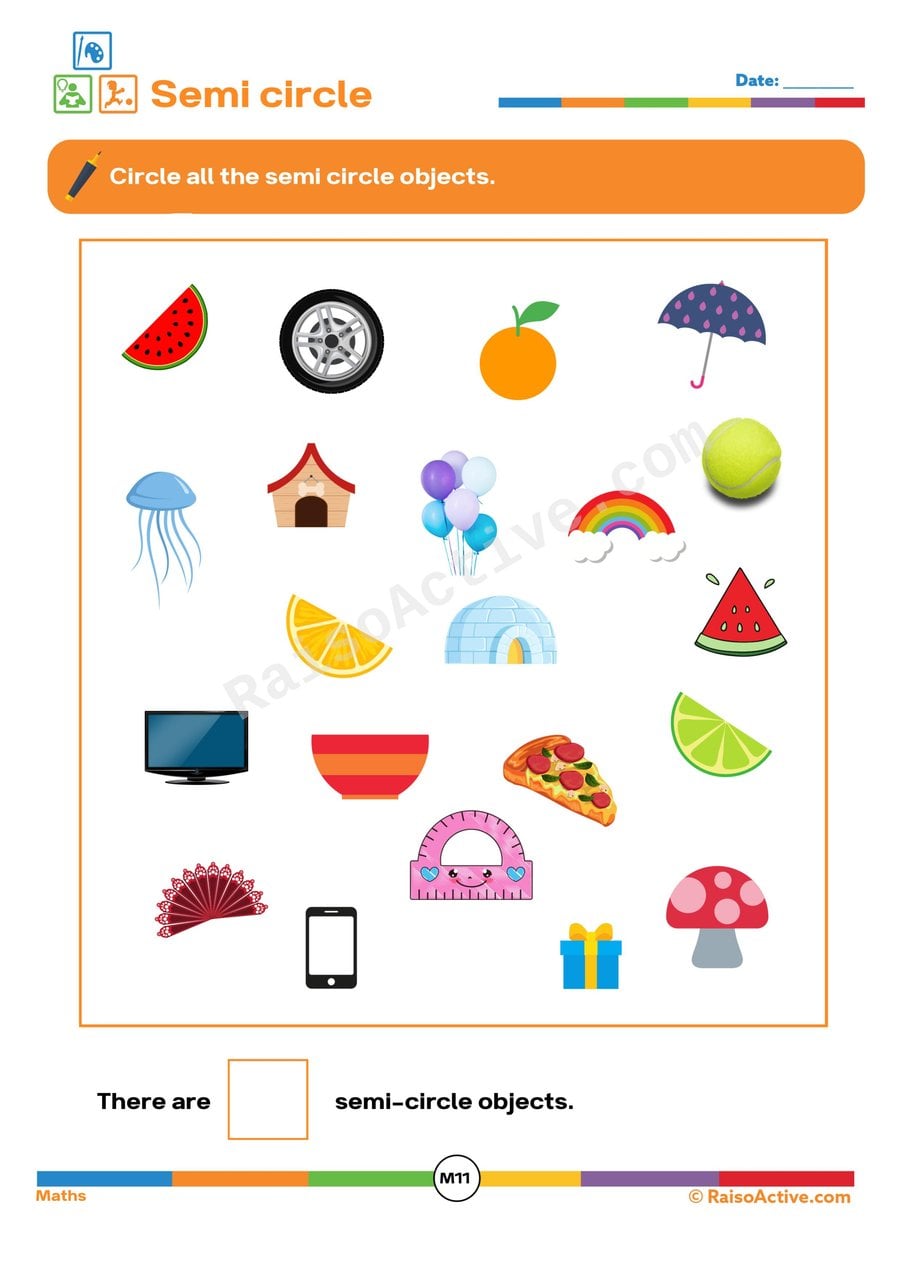
Semi-Circle Shapes Worksheet for Kids
Ages 3-5 · Preschool–Pre-KAges 3-5 · Nursery–ReceptionAges 3-5 · Nursery–LKGAges 3-5
This worksheet sharpens shape recognition by asking children to distinguish semi-circles, a curved half-shape, from other shapes and objects on the page. For ages 3-5, learning to identify a semi-circle specifically, rather than a full circle, builds the visual discrimination skills that support later geometry and letter recognition.
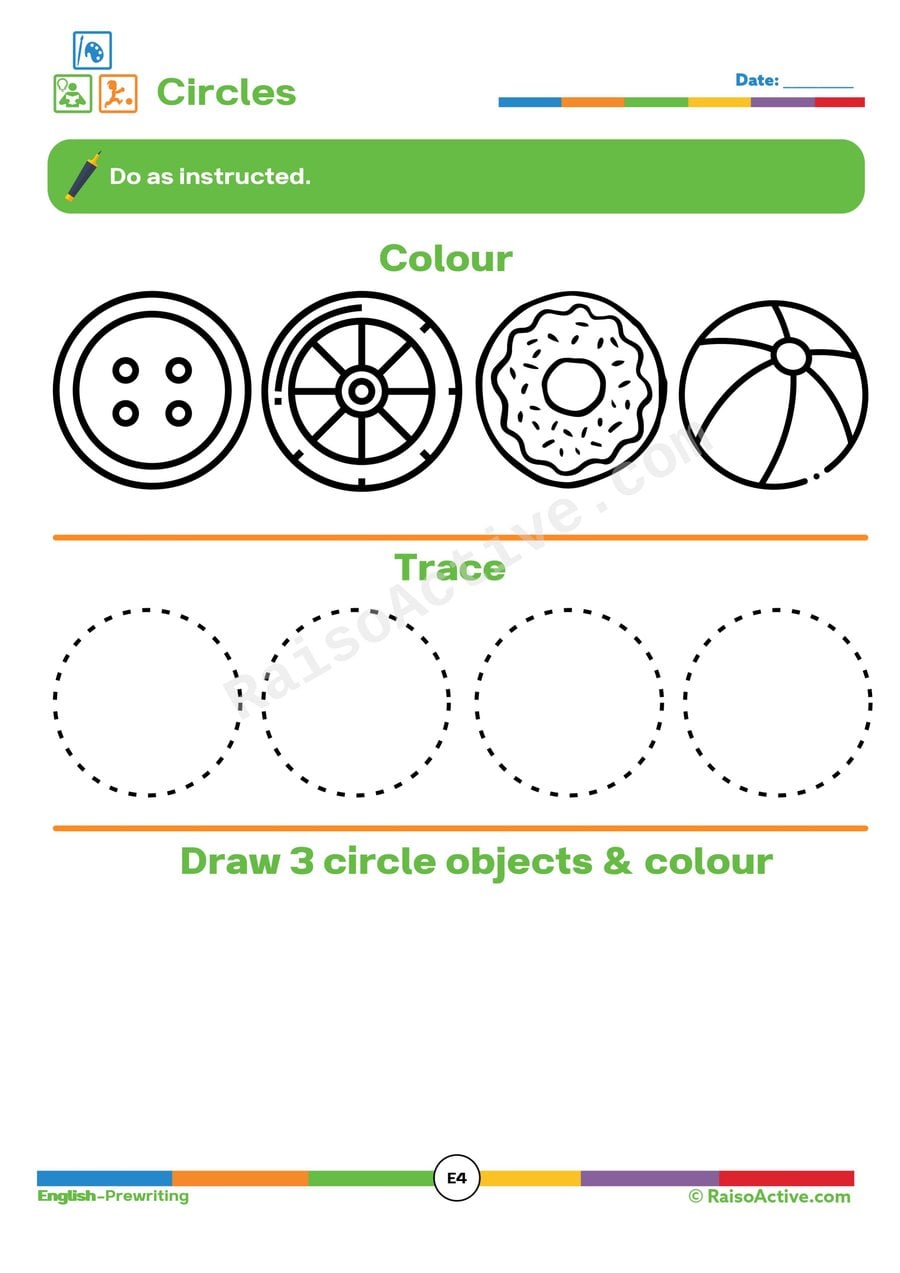
Circle Shapes Worksheet: Trace, Color, and Draw!
Ages 3-5 · Preschool–Pre-KAges 3-5 · Nursery–ReceptionAges 3-5 · Nursery–LKGAges 3-5
This worksheet builds shape recognition and drawing skills as children ages 3-5 trace dotted circles, color pictures of circular objects, and then draw three circle-shaped objects entirely on their own. Moving from tracing to independent drawing tracks a real developmental progression — first following a guide, then applying the shape from memory — which builds true shape mastery rather than just copying.

Shape Sorting Fun: Cut and Paste Worksheet for Preschoolers
Ages 3-5 · Preschool–Pre-KAges 3-5 · Nursery–ReceptionAges 3-5 · Nursery–LKGAges 3-5
Matching pictures of everyday objects to the 2D shape they resemble builds shape recognition and categorization for children ages 3-5, helping them see geometric shapes as patterns that exist in the real world around them.
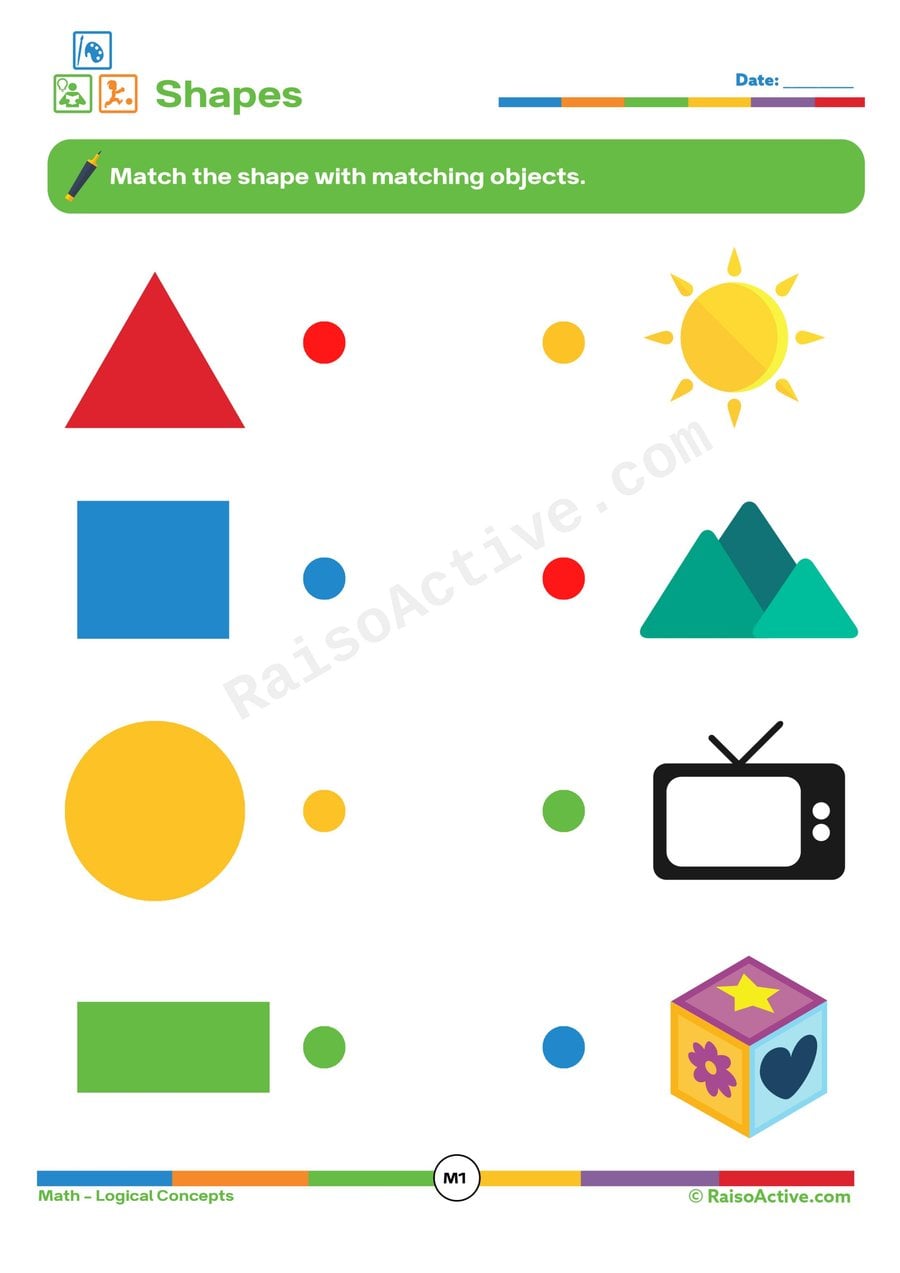
Shape Matching Worksheet for Preschoolers
Ages 3-5 · Preschool–Pre-KAges 3-5 · Nursery–ReceptionAges 3-5 · Nursery–LKGAges 3-5
This worksheet helps children ages 3-5 practice recognizing basic geometric shapes by connecting each shape outline to the everyday object it resembles. Pairing an abstract shape with a concrete object supports the transition from recognizing shapes in isolation to spotting them out in the real world. Drawing a connecting line between the matched pairs also builds hand-eye coordination and pencil control.
Guides for this topic

Age-Appropriate Problem-Solving Activities: Building Critical Thinkers from the Ground Up
Discover fun, age-appropriate problem-solving activities for children ages 1-8. Build critical thinking, logic, and reasoning skills through play-based learning.

Christmas and Winter Activities That Combine Fun and Learning: Creating Magical Educational Experiences
Discover Christmas and winter activities that combine festive fun with real learning. Crafts, counting, literacy, and printable worksheets for ages 2 to 8 — perfect for home and school.
Age-Appropriate Halloween Learning Activities: Balancing Spooks and Skills for Young Learners
Discover fun, age-appropriate Halloween learning activities for young children. Spooky crafts, counting games, literacy ideas, and printable worksheets for ages 2 to 8.
Reviews
Every worksheet for ages 3–5, no watermark
Members download the full library of 1,000+ worksheets and every activity pack without watermarks or daily limits. One year costs ₹999 in India or $20 elsewhere.
See membership plansOr download any worksheet free with a watermark (5 a day).