Shape Matching Worksheet: Circle, Square, Triangle, and Rectangle!
Children ages 3-5 practice recognizing and naming four basic shapes — circle, square, triangle, and rectangle — by matching everyday objects to their shape, then applying that recognition to a themed snowman picture. Counting the circles and triangles that make up the snowman afterward layers a numeracy task on top of the geometry, connecting shape recognition to early counting practice.

Part of the pack
Month 10: Learning & Development | Ages Up to 4
This is page 7 of the pack. Ages 2-4 · PreschoolAges 2-4 · NurseryAges 2-4

Made for your child
Counting to 10, made for your child
A maths pack with your child's name in it: pictures that explain, practice at three levels, puzzles and story sums about them. Print a new set whenever they finish.
Make a maths packFree preview · free for members
Curriculum
- 2D Shapes > Shapes & Sorting
How to use this worksheet
Look at each object on the left side of the page and ask your child to name its shape before they circle the matching shape option. Once the matching section is done, move to the snowman picture — have your child trace its outline and color it in, then count together how many circles make up its body and how many triangles form details like the hat or nose, writing the totals in the spaces provided.
Materials needed
- Pencil
- Crayons
Extension activities
- 1Go on a shape hunt around the house, looking for real circles, squares, triangles, and rectangles.
- 2Use playdough to roll, press, and shape each of the four shapes by hand.
- 3Draw a simple picture, like a house or a robot, made entirely of the four shapes practiced on the worksheet.
- 4Build a snowman out of paper circles of different sizes, stacking them the way the worksheet snowman is built.

Written by
Hemsweta Jain · Teacher Cheena
MBA and Early Childhood Educator, teaching since 2014 · Founder of RaisoActive, Mumbai
Every RaisoActive worksheet is designed and checked by the founder before publishing.
Published · Last reviewed
More from Month 10: Learning & Development | Ages Up to 4

Dinosaur's Missing Numbers Worksheet: Cut and Paste Fun!
Ages 4-6 · Pre-K–KindergartenAges 4-6 · Reception–Year 1Ages 4-6 · LKG–UKGAges 4-6
Children ages 4-6 practice number recognition and sequencing in a playful dinosaur theme, identifying which numbers are missing from a sequence and pasting them into the correct spots on a row of eggs. The dinosaur and egg imagery adds motivation and narrative context to what's otherwise a straightforward but important numeracy task — recognizing numerals and understanding their fixed order.

Speak Sentences: A Fun Sentence Building Worksheet!
Ages 4-6 · Pre-K–KindergartenAges 4-6 · Reception–Year 1Ages 4-6 · LKG–UKGAges 4-6
Reading a single word on each stair step and turning it into a full spoken sentence helps children ages 4-6 practice expanding a vocabulary word into a grammatically complete thought, an important bridge between word recognition and sentence-level language. The staircase, climb-to-the-top format adds a sense of progress and motivation, encouraging children to keep going even when a particular word is tricky to build a sentence around. This oral sentence-building practice also lays groundwork for later independent sentence writing.

Hidden Numbers Worksheet: Find and Complete the Table!
Ages 3-5 · Preschool–Pre-KAges 3-5 · Nursery–ReceptionAges 3-5 · Nursery–LKGAges 3-5
Searching a busy picture for hidden numbers trains visual scanning and sustained attention in children ages 3-5, since numbers may be tucked into small or unexpected spots within the artwork. Completing the table with the missing numbers afterward reinforces the counting sequence and numeral recognition, requiring children to recall which numbers they've already found and figure out which ones are still missing. Together, the search-and-complete format turns basic number practice into an engaging seek-and-find challenge.
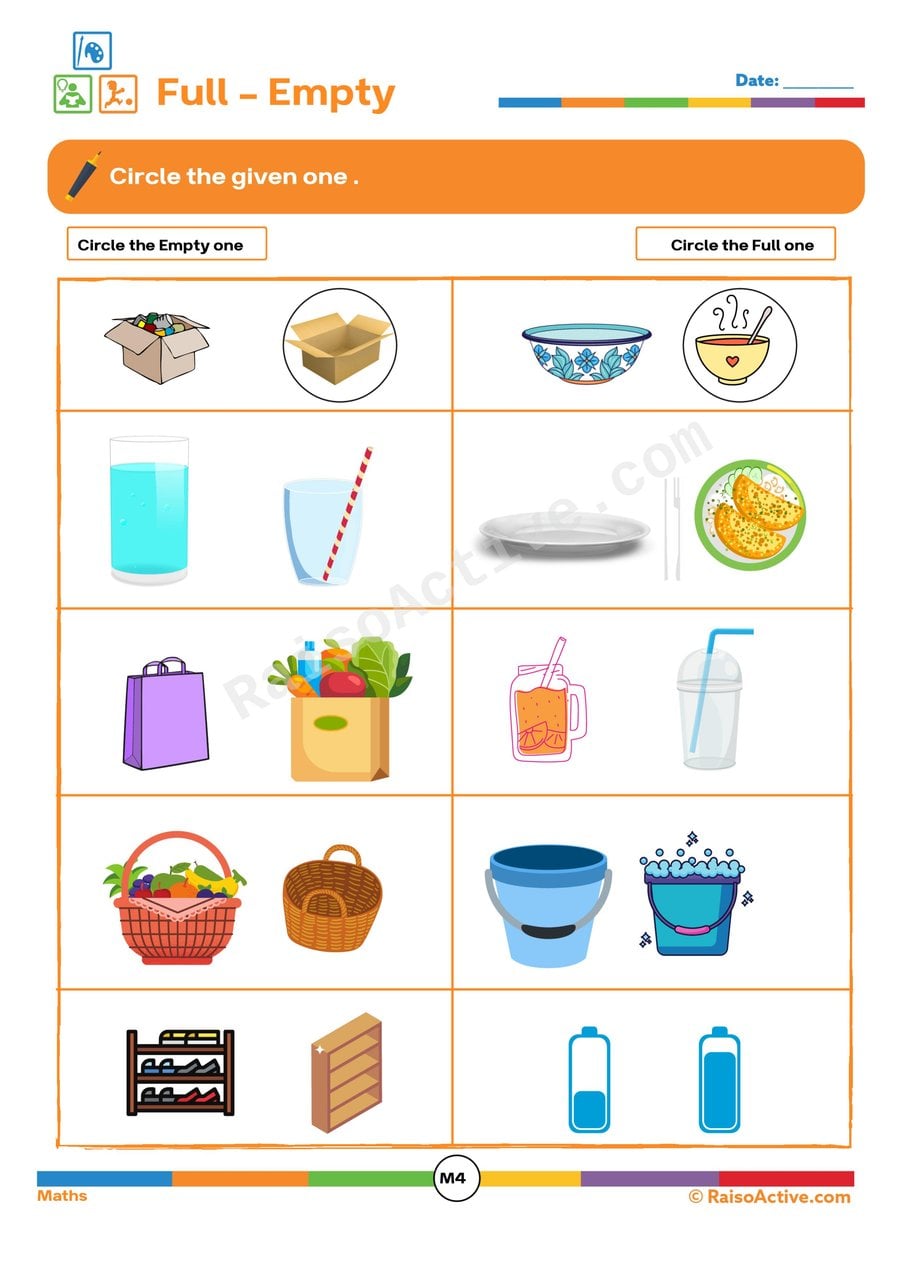
Full and Empty Worksheet for Preschoolers
Ages 3-5 · Preschool–Pre-KAges 3-5 · Nursery–ReceptionAges 3-5 · Nursery–LKGAges 3-5
This sorting worksheet introduces children ages 3-5 to the comparative concepts of 'full' and 'empty,' an early measurement idea that lays groundwork for later understanding of quantity and volume. By examining containers and objects at different fill levels, children practice careful visual observation rather than relying on counting alone. Learning to describe amounts in everyday language like full and empty also supports vocabulary development children will use constantly in daily life.
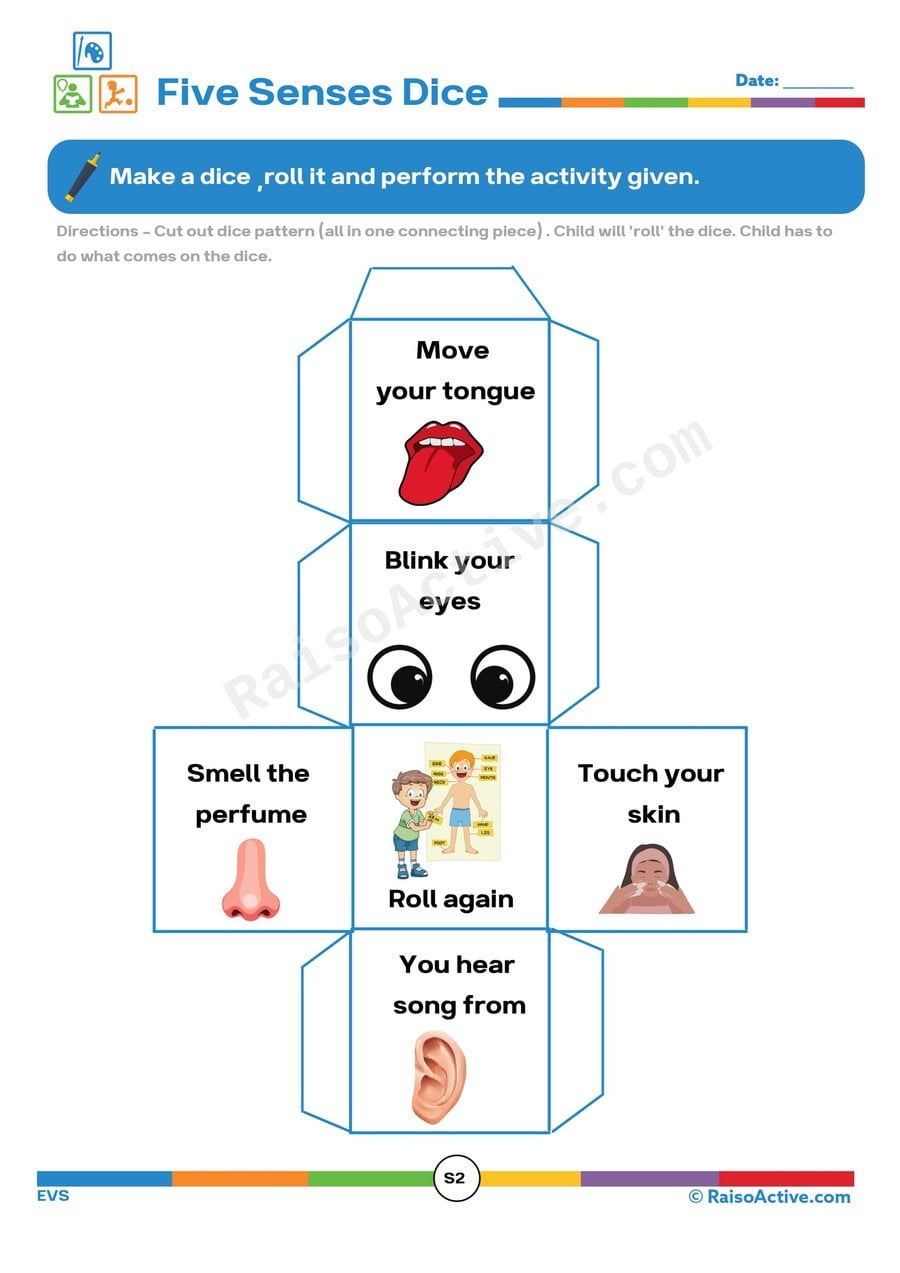
Five Senses Dice Activity: Roll and Explore!
Ages 3-5 · Preschool–Pre-KAges 3-5 · Nursery–ReceptionAges 3-5 · Nursery–LKGAges 3-5
Rolling a homemade dice to trigger sensory activities teaches children ages 3-5 to identify and use each of the five senses — sight, hearing, touch, taste, and smell — through direct hands-on exploration rather than only reading or discussing them. Building and assembling the dice itself also adds a light fine motor and spatial task before the sensory learning even begins.

Sorting Numbers Worksheet: Match the Number to the Picture!
Ages 3-5 · Preschool–Pre-KAges 3-5 · Nursery–ReceptionAges 3-5 · Nursery–LKGAges 3-5
Counting objects in a picture and then pasting that picture next to its matching numeral helps children ages 3-5 connect a written number symbol to an actual quantity, which is the heart of true number sense rather than just numeral naming. Cutting out the picture pieces beforehand also builds scissor control, giving this worksheet a fine motor component alongside the counting practice. The puzzle-piece format adds a satisfying, hands-on element that keeps repetitive counting practice engaging.

Spin the Wheel Activity: Follow Instructions and Perform Actions!
Ages 3-5 · Preschool–Pre-KAges 3-5 · Nursery–ReceptionAges 3-5 · Nursery–LKGAges 3-5
Spinning a homemade wheel and performing whatever action it lands on teaches children ages 3-5 to listen carefully and follow a one-step instruction, a foundational social and self-regulation skill for classroom and group settings. Because the action changes with every spin, children also practice quick physical responses, like jumping, hopping, or spinning, which supports gross motor development. The randomness of the spinner keeps the activity unpredictable and exciting, which helps sustain engagement through repeated rounds.
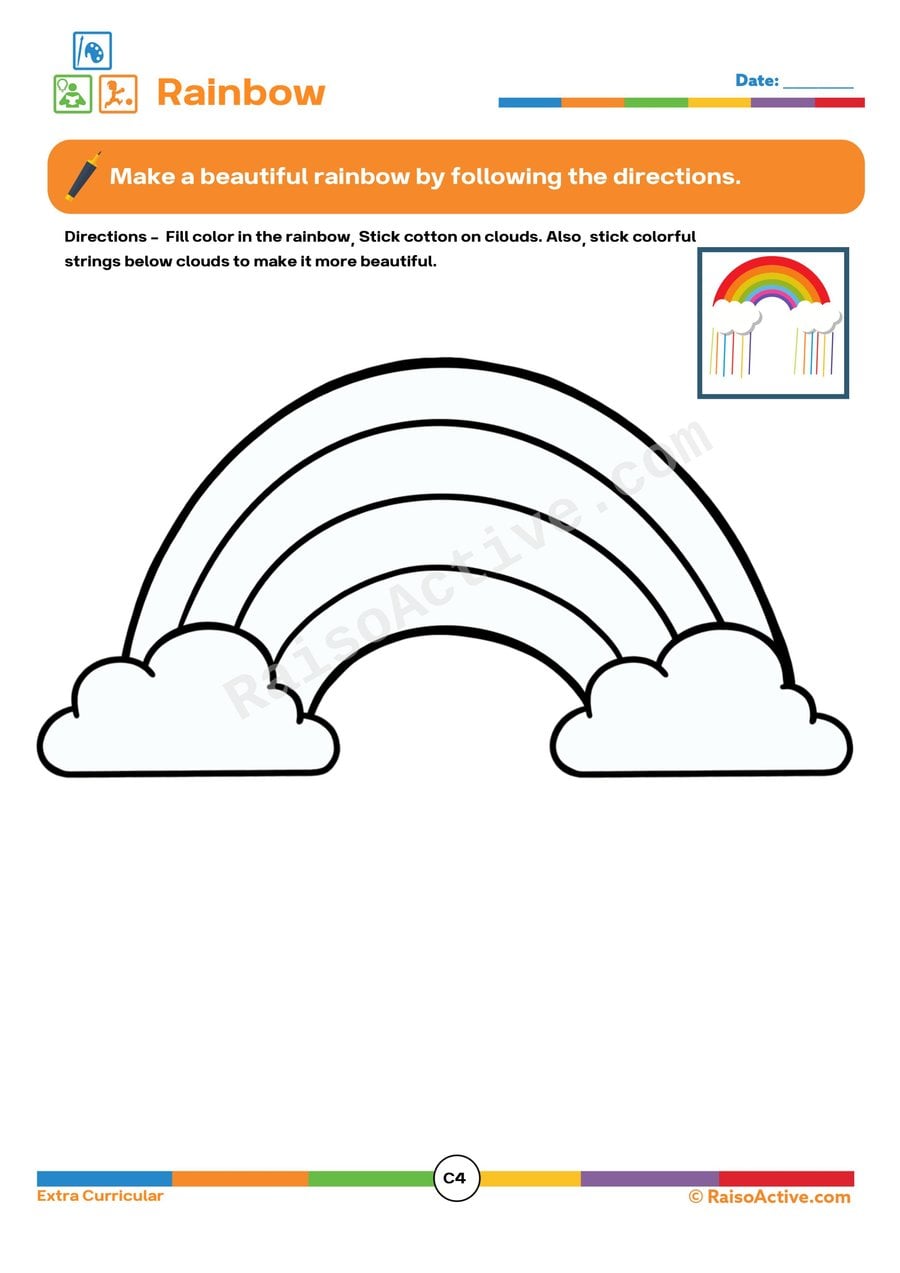
Rainbow Coloring Worksheet for Preschoolers
Ages 3-5 · Preschool–Pre-KAges 3-5 · Nursery–ReceptionAges 3-5 · Nursery–LKGAges 3-5
This multi-sensory worksheet helps children ages 3-5 practice color recognition and sequencing by coloring a rainbow in its correct color order, while also introducing texture through a cotton-ball cloud and string activity. Matching colors to a printed example teaches children to compare and follow a visual model precisely, an important pre-reading skill of left-to-right, top-to-bottom scanning. Adding cotton and string engages a different set of fine motor movements than coloring alone, like pinching and placing.
Related worksheets
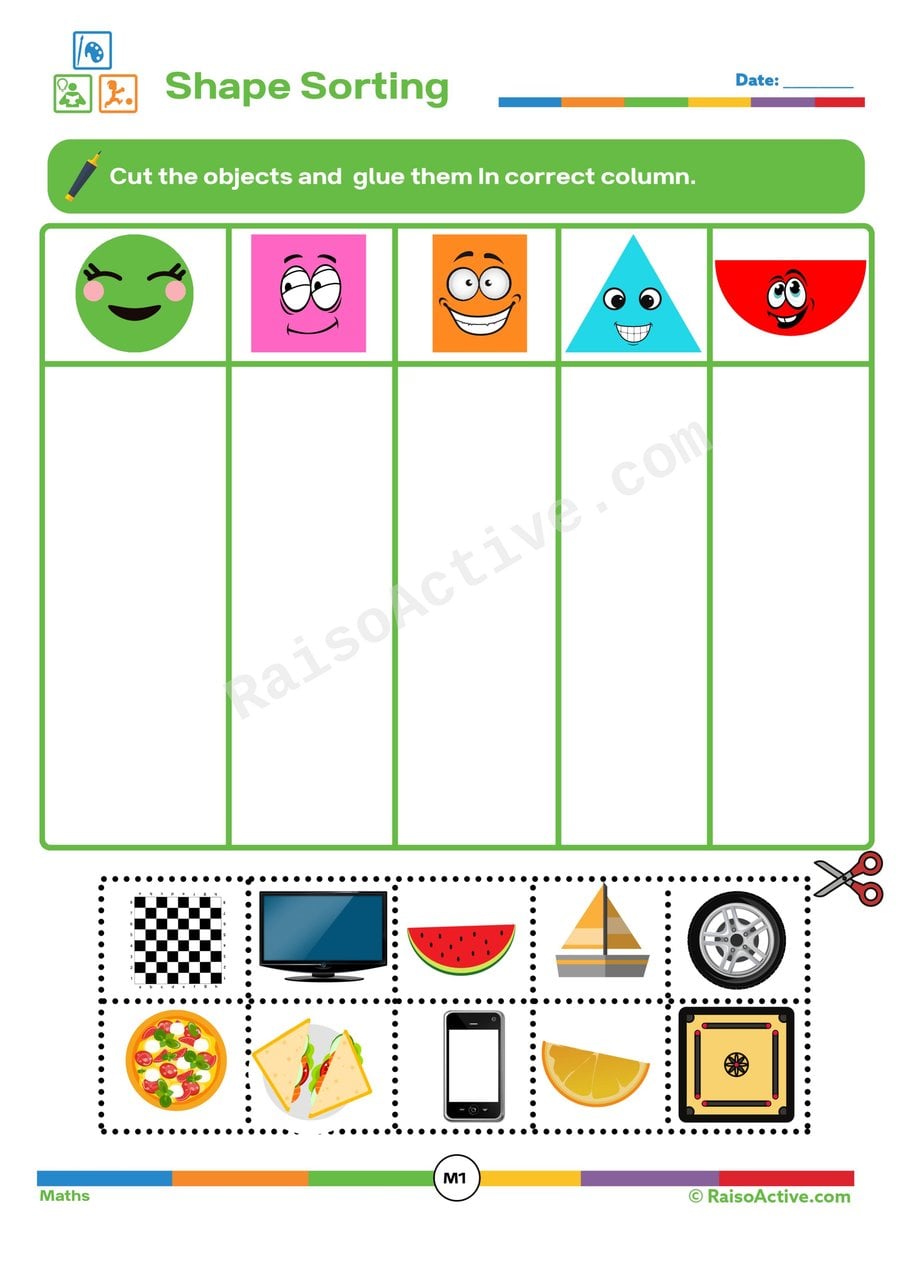
Shape Sorting Worksheet: Cut and Paste Fun!
Ages 3-5 · Preschool–Pre-KAges 3-5 · Nursery–ReceptionAges 3-5 · Nursery–LKGAges 3-5
This cut-and-paste activity asks 3-5 year olds to do more than just name a shape — they have to look at a jumble of circles, squares, and triangles, decide which column each one belongs to, and physically place it there. That sorting step is what builds real shape classification, not just shape labeling, since your child must compare each new piece against the ones already in the column. Cutting the shapes out along their curves and corners is also genuine scissor practice, since curved cuts (circles) are notably harder for small hands than straight ones (triangles, squares).

Semi-Circle Fun: Tracing, Counting, and Patterns Worksheet for Preschoolers
Ages 3-5 · Preschool–Pre-KAges 3-5 · Nursery–ReceptionAges 3-5 · Nursery–LKGAges 3-5
This worksheet helps children ages 3-5 learn about semi-circles through tracing their curved edge, counting how many appear in a group, and identifying which shape comes next in a repeating pattern. Covering one shape across three different skills, tracing, counting, and patterning, gives children a well-rounded, layered understanding of what makes a semi-circle unique.

Shape Sorting Fun: Matching Shapes by Properties Worksheet
Ages 4-5 · Pre-KAges 4-5 · ReceptionAges 4-5 · LKGAges 4-5
This worksheet has 4-5 year olds match written shape descriptions — number of sides, number of corners — to the correct shapes, then count how many of each shape appear in an accompanying picture. Reasoning from a property description back to the shape itself is a step up from simple naming, since it requires your child to hold the definition in mind and scan for a match, and the counting task afterward adds a quantity check to the geometry practice.

Shape Sorting Fun: Cut and Paste Worksheet for Preschoolers
Ages 3-5 · Preschool–Pre-KAges 3-5 · Nursery–ReceptionAges 3-5 · Nursery–LKGAges 3-5
Matching pictures of everyday objects to the 2D shape they resemble builds shape recognition and categorization for children ages 3-5, helping them see geometric shapes as patterns that exist in the real world around them.

Shapes Worksheet: Cut and Paste, Complete the Sequence!
Ages 4-5 · Pre-KAges 4-5 · ReceptionAges 4-5 · LKGAges 4-5
This worksheet combines shape identification with pattern completion, asking children ages 4-5 to cut out and paste shapes into matching boxes and then draw the missing shape needed to finish a simple sequence. Together these tasks build geometric vocabulary, precise cutting and gluing control, and the logical reasoning needed to predict what comes next in a repeating pattern.

Roll and Cover Shapes Worksheet for Preschoolers
Ages 3-5 · Preschool–Pre-KAges 3-5 · Nursery–ReceptionAges 3-5 · Nursery–LKGAges 3-5
This dice game helps children ages 3-5 practice shape recognition under a bit of playful chance, since they must roll a die, interpret which shape it points to, and then find and cover the matching shape on the worksheet. Reacting to a randomly rolled shape rather than working through a fixed sequence keeps children actively scanning the whole page, which builds visual search skills alongside basic geometry recognition.
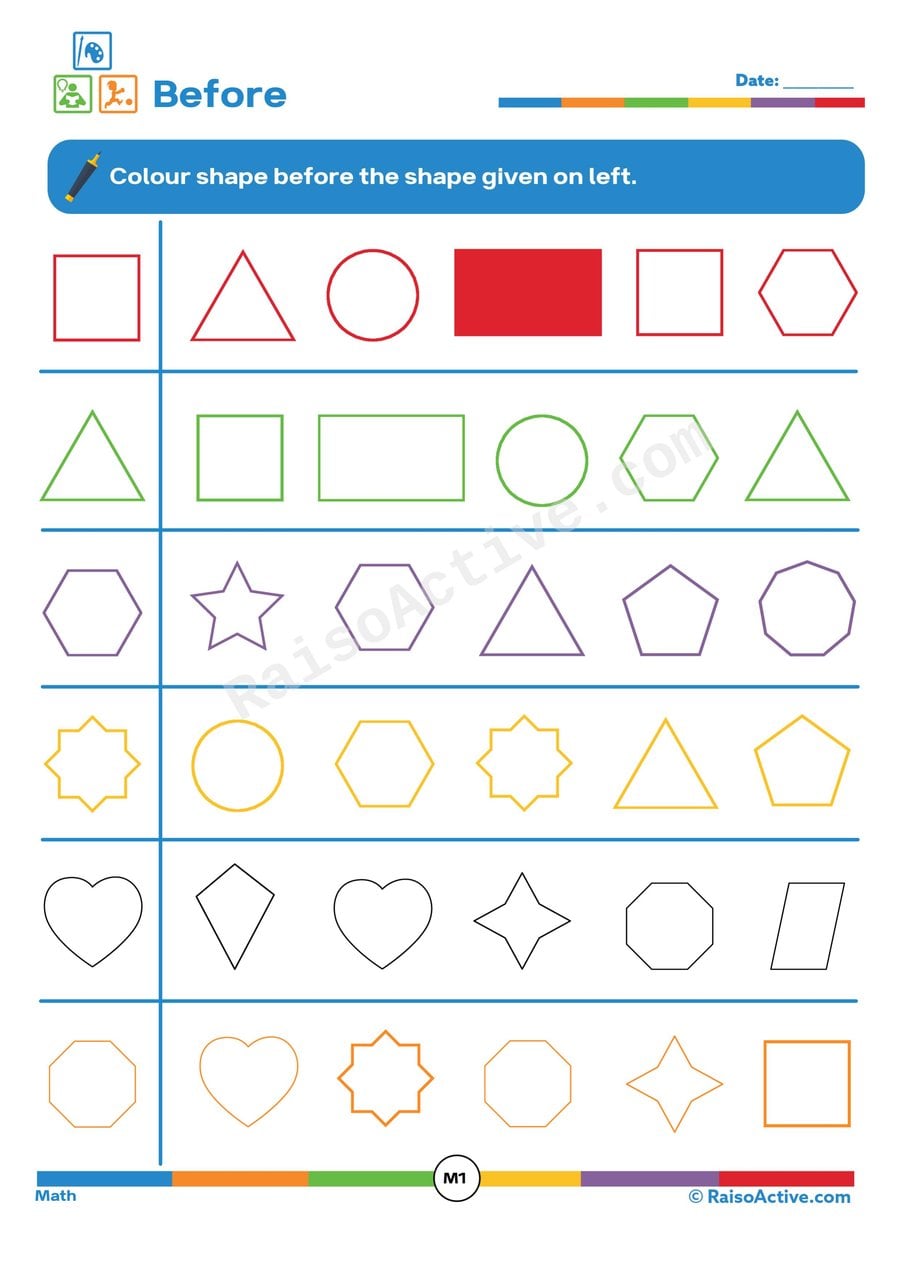
Shape Coloring Worksheet: Before the Shape!
Ages 3-5 · Preschool–Pre-KAges 3-5 · Nursery–ReceptionAges 3-5 · Nursery–LKGAges 3-5
This worksheet combines shape recognition with sequencing by asking children to identify which shape comes before a given shape in a row, requiring them to understand order as well as shape names. For ages three to five, thinking about what comes 'before' something visually is a gentle introduction to ordinal reasoning that will later apply to numbers and letters as well as shapes.
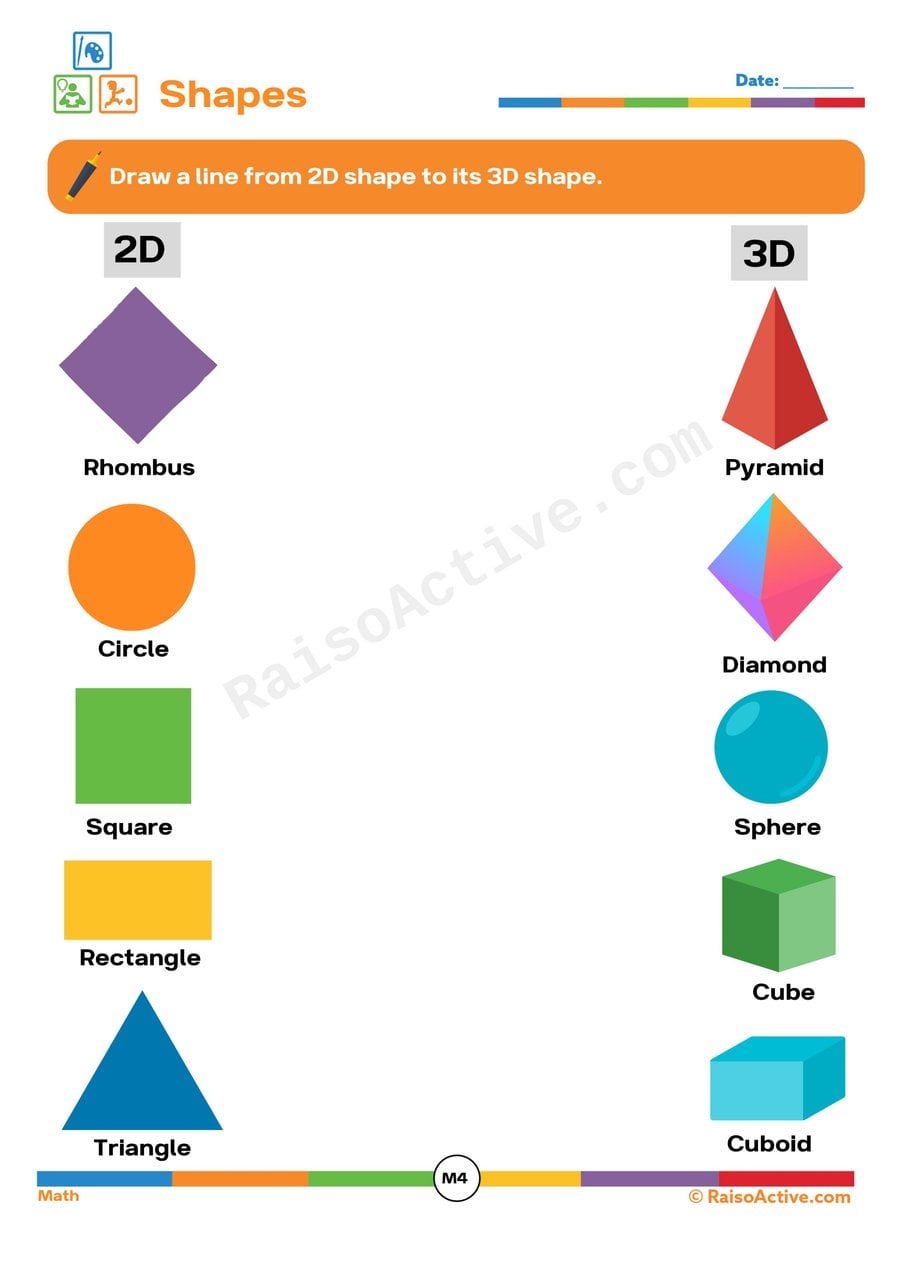
Shape Match: 2D to 3D Shapes Worksheet
Ages 4-6 · Pre-K–KindergartenAges 4-6 · Reception–Year 1Ages 4-6 · LKG–UKGAges 4-6
This worksheet introduces 4-6 year olds to the relationship between flat 2D shapes and solid 3D shapes — connecting a circle to a sphere, a square to a cube — which is an important spatial reasoning leap, since a 3D shape's flat 'face' is what actually corresponds to its related 2D shape. Making this connection explicit helps children understand that the shapes they've been learning aren't just flat pictures but also describe the surfaces of real, solid objects around them.
Guides for this topic

Best Worksheets for 3-Year-Olds: What Works and What to Avoid
What works on worksheets for 3-year-olds: short sessions, crayons, tracing lines, matching, cutting, a free weekly plan, and signs one is too advanced.
Christmas and Winter Activities That Combine Fun and Learning: Creating Magical Educational Experiences
Discover Christmas and winter activities that combine festive fun with real learning. Crafts, counting, literacy, and printable worksheets for ages 2 to 8 — perfect for home and school.
Age-Appropriate Halloween Learning Activities: Balancing Spooks and Skills for Young Learners
Discover fun, age-appropriate Halloween learning activities for young children. Spooky crafts, counting games, literacy ideas, and printable worksheets for ages 2 to 8.
Reviews
Every worksheet for ages 3–5, no watermark
Members download the full library of 1,000+ worksheets and every activity pack without watermarks or daily limits. One year costs ₹999 in India or $20 elsewhere.
See membership plansOr download any worksheet free with a watermark (5 a day).