Shape Sorting Fun: Cut and Paste Worksheet for Preschoolers
Matching pictures of everyday objects to the 2D shape they resemble builds shape recognition and categorization for children ages 3-5, helping them see geometric shapes as patterns that exist in the real world around them.
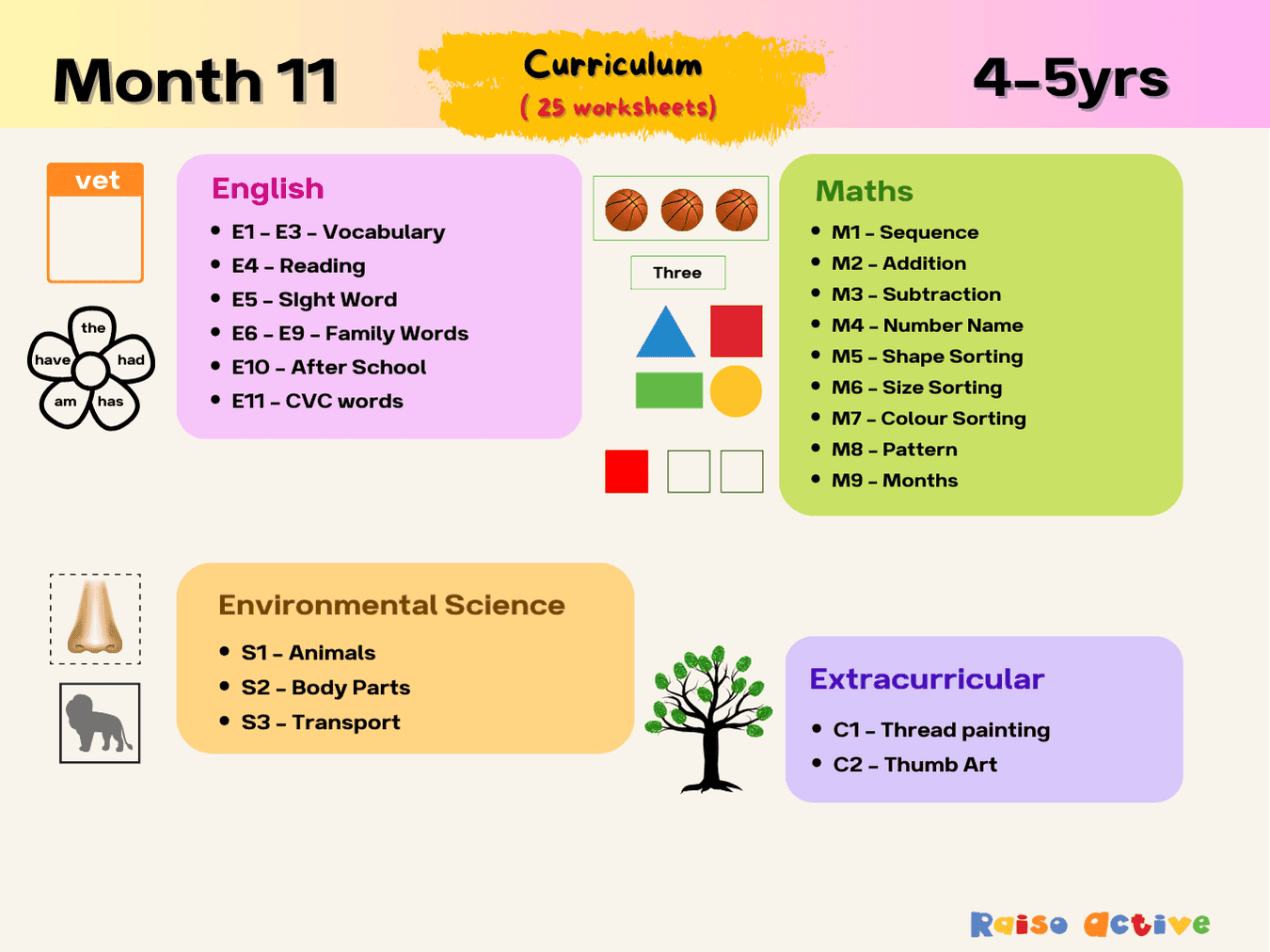
Part of the pack
Month 11: Learning & Development | Ages 4-5
This is page 19 of the pack. Ages 4-5 · Pre-KAges 4-5 · ReceptionAges 4-5 · LKGAges 4-5
Curriculum
- 2D Shapes > Shapes & Sorting
How to use this worksheet
Cut out the pictures at the bottom of the page. Look at each picture and decide which shape — circle, square, triangle, or rectangle — it most resembles. Glue each picture onto its matching shape, continuing through the remaining pictures while naming each shape aloud.
Materials needed
- Scissors
- Glue
- Pencil
Extension activities
- 1Go on a shape hunt around the house, looking for circles, squares, and triangles.
- 2Draw different shapes and label them.
- 3Use playdough to create different shapes and compare them to the pictures.
- 4Sort household objects into piles by their shape.

Written by
Hemsweta Jain · Teacher Cheena
MBA and Early Childhood Educator, teaching since 2014 · Founder of RaisoActive, Mumbai
Every RaisoActive worksheet is designed and checked by the founder before publishing.
Published · Last reviewed
More from Month 11: Learning & Development | Ages 4-5

Family Words Worksheet: Picture Matching and Word Recognition
Ages 4-6 · Pre-K–KindergartenAges 4-6 · Reception–Year 1Ages 4-6 · LKG–UKGAges 4-6
Children ages 4-6 practice recognizing and reading words from the 'family' word group, like 'candle' becoming 'candle-family' patterns or similar word-family endings, by matching written words to their corresponding pictures. Word family practice builds phonics pattern recognition, helping children read new words faster by spotting familiar chunks within them.

Count and Match: Number Names Worksheet for Preschoolers
Ages 3-5 · Preschool–Pre-KAges 3-5 · Nursery–ReceptionAges 3-5 · Nursery–LKGAges 3-5
This worksheet helps children ages 3-5 connect a counted group of objects to its written number name, reinforcing that a quantity, a numeral, and a number word all represent the same idea. Counting a group and then finding its matching name — rather than just its matching numeral — adds an extra layer of number literacy, since your child must recognize or read the word form as well as understand the quantity.

Bee's Number Sequence Adventure: Coloring Numbers 0-50!
Ages 4-6 · Pre-K–KindergartenAges 4-6 · Reception–Year 1Ages 4-6 · LKG–UKGAges 4-6
Children ages 4-6 practice counting and recognizing numbers from 0 to 50 in sequence by coloring each number in order to help a bee find its way to the hive, extending number recognition well beyond the smaller ranges typically practiced at this age. Following a long numerical sequence builds persistence and reinforces counting patterns like the teens, twenties, and thirties.

Pattern Recognition Worksheet: Cut and Paste the Next Picture!
Ages 3-5 · Preschool–Pre-KAges 3-5 · Nursery–ReceptionAges 3-5 · Nursery–LKGAges 3-5
This worksheet builds pattern recognition for children ages 3-5 by having them identify a repeating sequence in each row and then cut out and glue the picture that correctly continues it. Because the correct piece must be found among several distractor options, this task sharpens visual discrimination alongside the logical thinking needed to predict what comes next in a sequence.

Color the Pictures! Kk, Ll, and Mm Letter Sounds Worksheet
Ages 4-5 · Pre-KAges 4-5 · ReceptionAges 4-5 · LKGAges 4-5
Coloring a circle beneath a picture only when its name starts with a target letter sound builds beginning-sound discrimination for children ages 4-5 across three letters — K, L, and M — sharpening their ability to isolate initial phonemes.
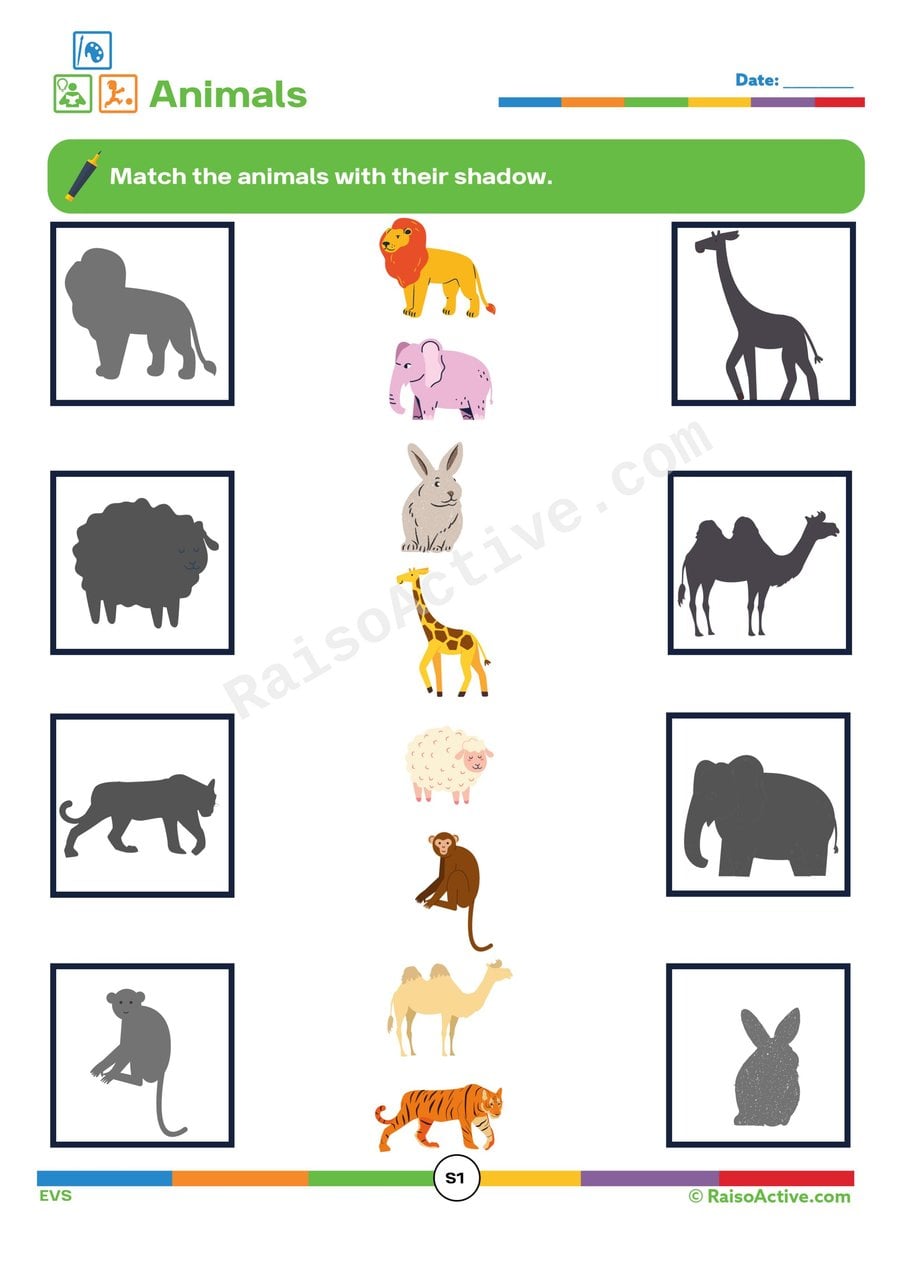
Animal Shadow Match Worksheet for Preschoolers
Ages 3-5 · Preschool–Pre-KAges 3-5 · Nursery–ReceptionAges 3-5 · Nursery–LKGAges 3-5
This worksheet builds visual discrimination skills for children ages 3-5 by having them match each animal to its correct silhouette or shadow shape. Because a shadow strips away color and detail, leaving only outline and proportion, this task requires more careful visual analysis than typical picture matching, sharpening the kind of attention to shape and form that supports later letter and word recognition.

After School Routine Worksheet: Sequencing Activities
Ages 3-5 · Preschool–Pre-KAges 3-5 · Nursery–ReceptionAges 3-5 · Nursery–LKGAges 3-5
Children ages 3-5 practice ordering a set of pictures to match the real sequence of their own after-school routine, building early sequencing skills that also support memory, planning, and the language of time, like 'first,' 'next,' and 'last.' Reflecting on their own daily routine makes this sequencing practice personally meaningful rather than abstract.
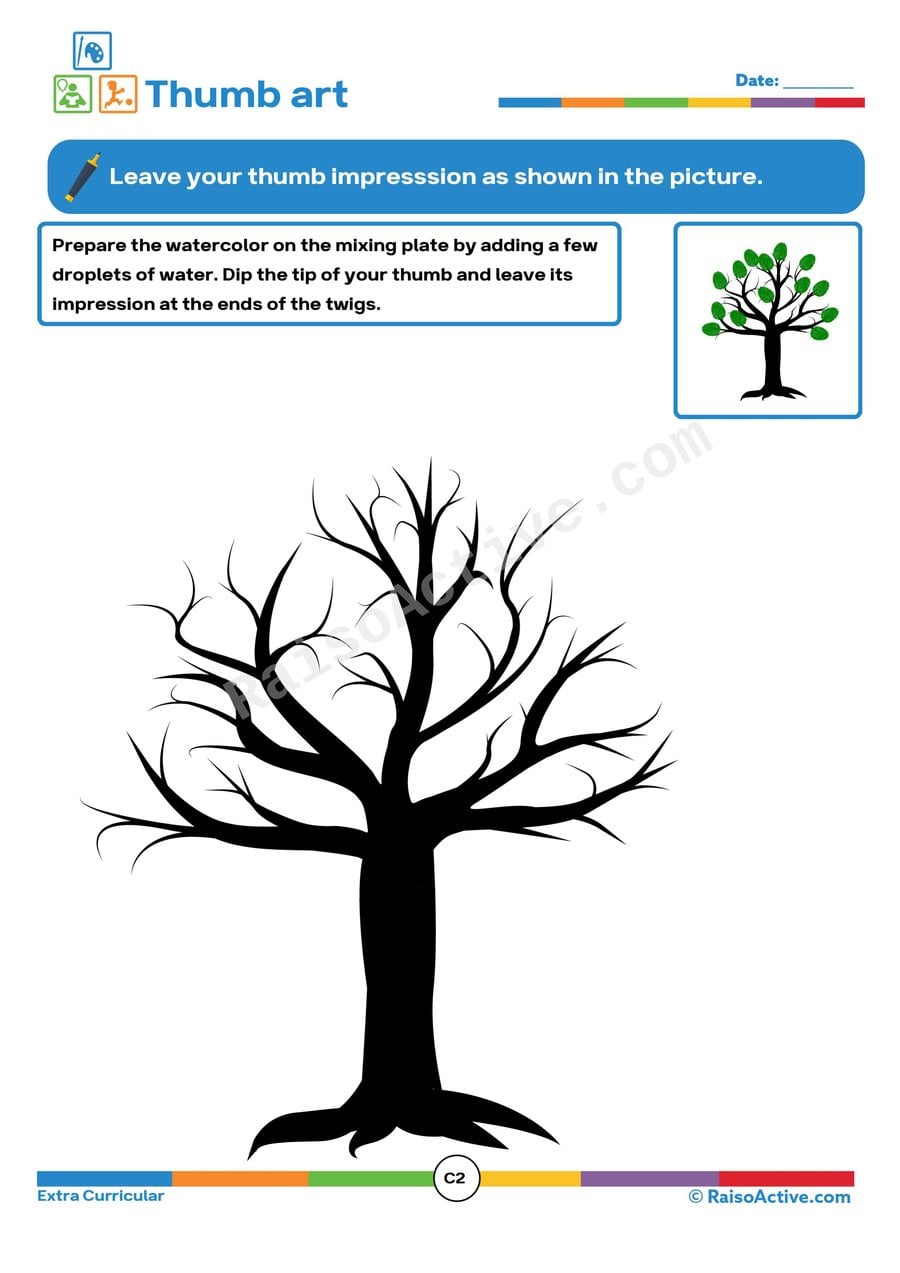
Thumb Art Tree Worksheet for Preschoolers
Ages 3-5 · Preschool–Pre-KAges 3-5 · Nursery–ReceptionAges 3-5 · Nursery–LKGAges 3-5
This thumbprint craft helps children ages 3-5 develop fine motor control and hand strength as they press their thumb repeatedly onto paper to create the leaves of a tree, a controlled, repetitive motion that's different from typical crayon coloring. It also introduces early art concepts like composition and texture, since the finished tree's fullness depends on how many thumbprints your child adds and where they place them.
Related worksheets

2D Shapes Worksheet for Preschoolers: Identifying Shapes and Properties
Ages 4-6 · Pre-K–KindergartenAges 4-6 · Reception–Year 1Ages 4-6 · LKG–UKGAges 4-6
This worksheet pushes 4-6 year olds past simply naming shapes into analyzing their properties — counting sides and corners for circles, triangles, squares, rectangles, pentagons, and hexagons, and using those properties to answer more complex questions about which shapes combine to form others. That combination-and-composition piece (asking what shapes make up a bigger shape, or identifying a shaded portion) is genuine early geometric reasoning, well beyond simple shape recognition.
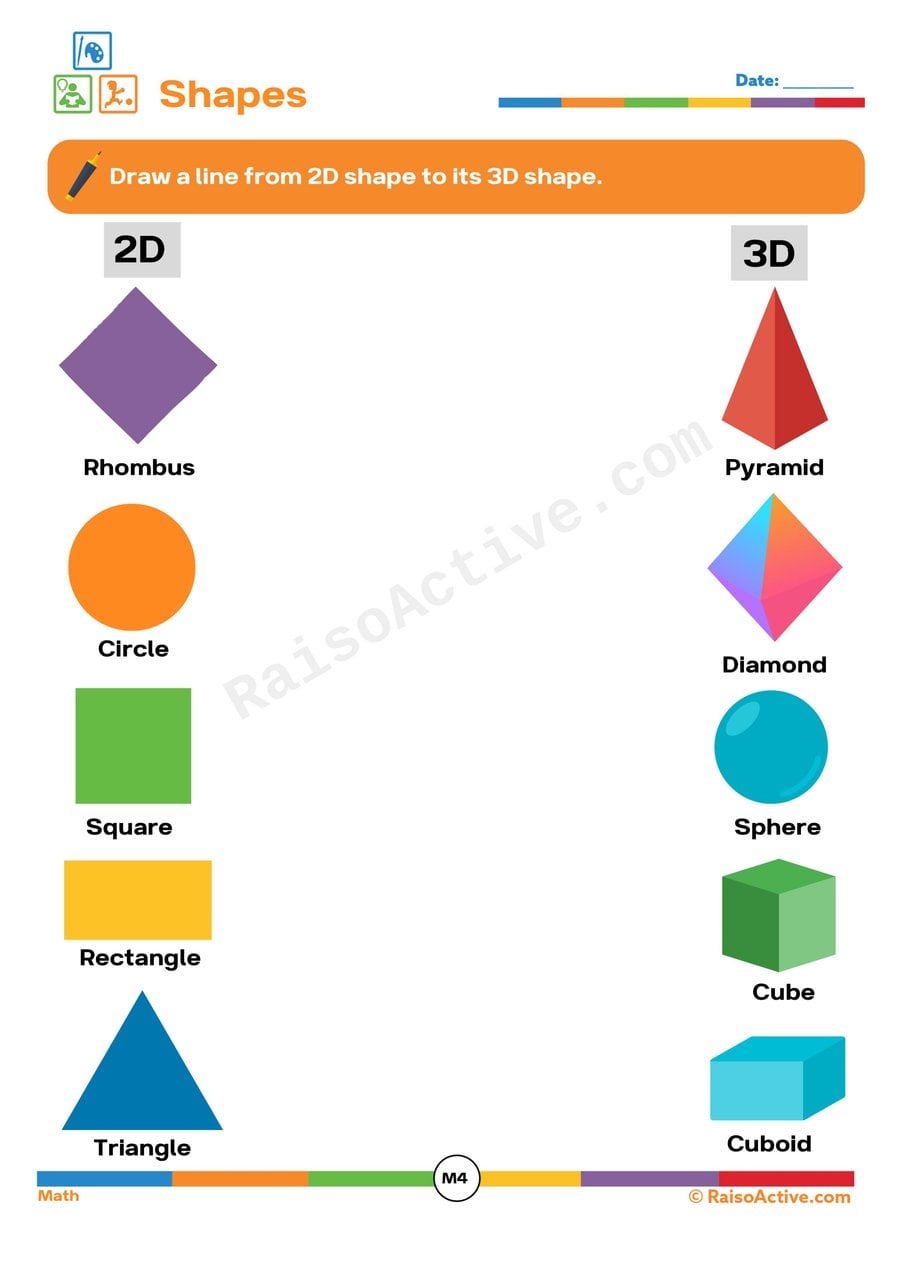
Shape Match: 2D to 3D Shapes Worksheet
Ages 4-6 · Pre-K–KindergartenAges 4-6 · Reception–Year 1Ages 4-6 · LKG–UKGAges 4-6
This worksheet introduces 4-6 year olds to the relationship between flat 2D shapes and solid 3D shapes — connecting a circle to a sphere, a square to a cube — which is an important spatial reasoning leap, since a 3D shape's flat 'face' is what actually corresponds to its related 2D shape. Making this connection explicit helps children understand that the shapes they've been learning aren't just flat pictures but also describe the surfaces of real, solid objects around them.
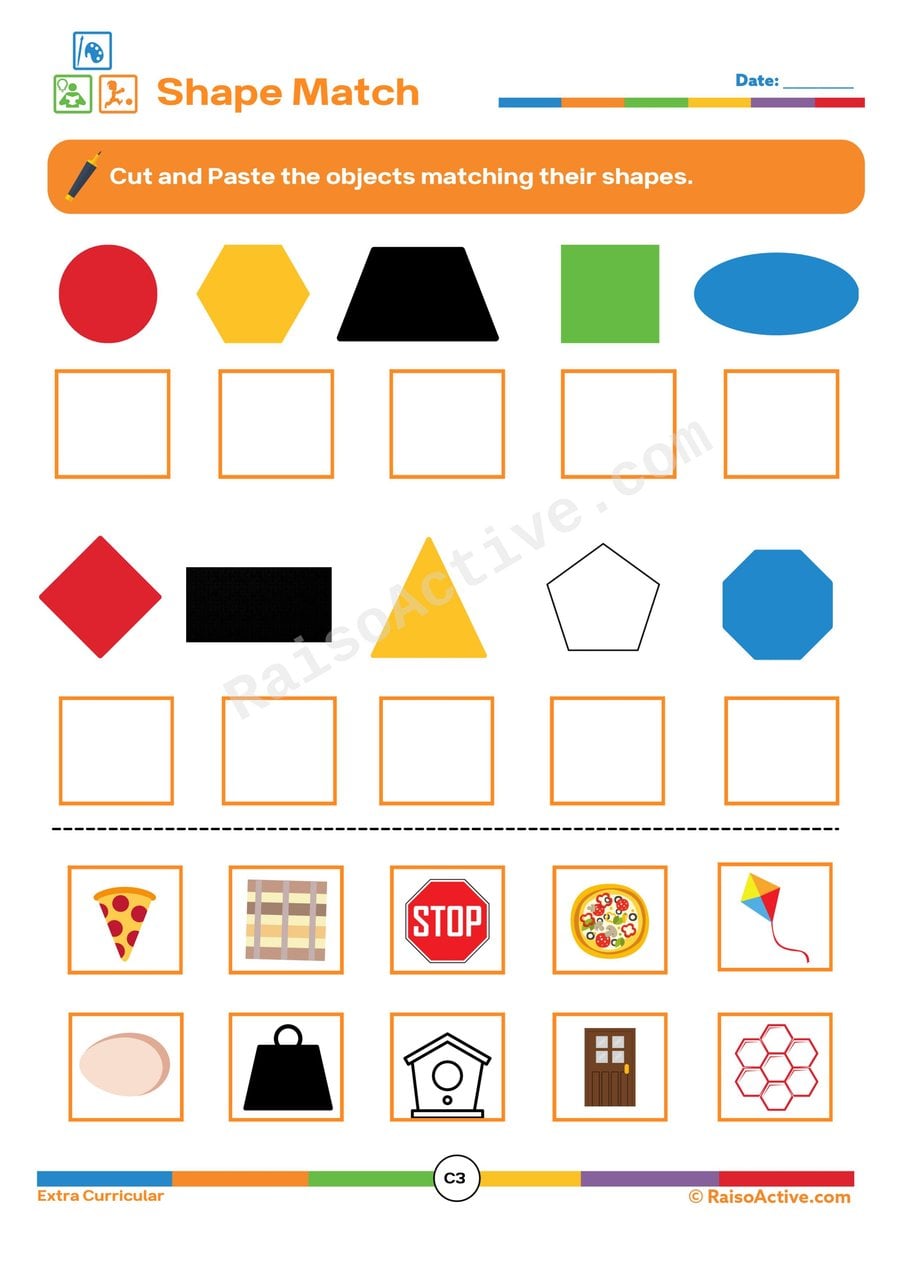
Shape Match Worksheet: Cut and Paste Shapes!
Ages 3-5 · Preschool–Pre-KAges 3-5 · Nursery–ReceptionAges 3-5 · Nursery–LKGAges 3-5
Children ages 3-5 practice shape recognition and visual discrimination as they cut out everyday objects and match each one to the 2D shape it most closely resembles, reinforcing that shapes exist all around them, not just on a worksheet page. This kind of real-world shape matching builds a stronger foundation than memorizing shape names in isolation.

Connect the Dots: Hidden Shape Worksheet for Kids
Ages 3-5 · Preschool–Pre-KAges 3-5 · Nursery–ReceptionAges 3-5 · Nursery–LKGAges 3-5
Children ages 3-5 practice counting in sequence and fine motor line control as they connect numbered dots in order to reveal a hidden shape, combining numeracy with hand-eye coordination in one satisfying activity. The surprise of a shape emerging only once every dot is connected correctly also motivates children to stay careful and accurate rather than rushing through the numbers.
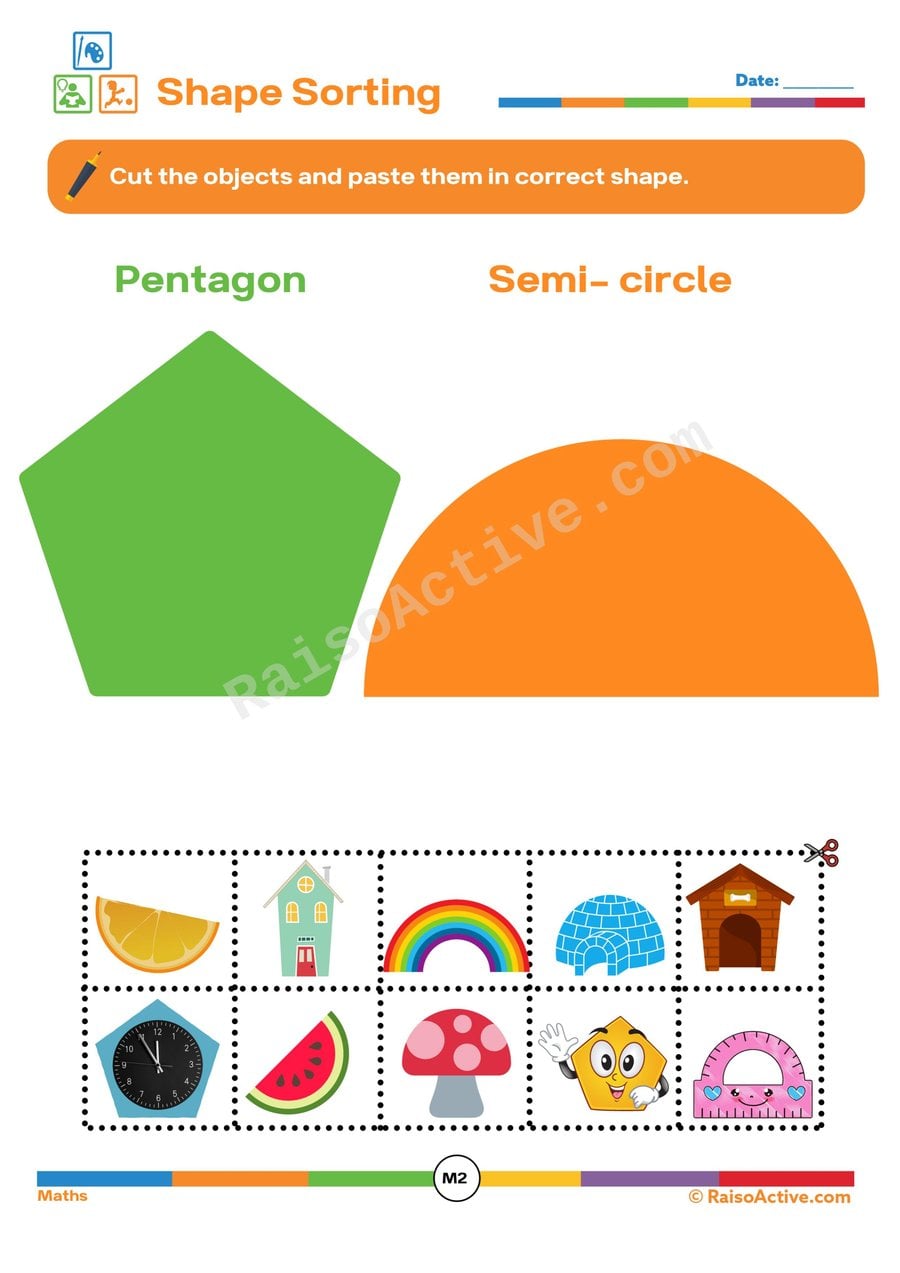
Shape Sorting Fun: Cut and Paste Shapes!
Ages 3-5 · Preschool–Pre-KAges 3-5 · Nursery–ReceptionAges 3-5 · Nursery–LKGAges 3-5
Cutting out shapes and pasting them into matching outlines teaches children ages 3-5 to recognize basic 2D shapes like circles, squares, and triangles by their defining features rather than just their color or size. The cutting and pasting also strengthens the fine motor coordination needed for handwriting later on.

Cut and Paste a Turtle Worksheet for Preschoolers
Ages 3-5 · Preschool–Pre-KAges 3-5 · Nursery–ReceptionAges 3-5 · Nursery–LKGAges 3-5
Children ages 3-5 build fine motor precision and shape recognition by cutting out individual geometric pieces and assembling them into a complete turtle picture. Because each shape must be correctly identified and positioned — the oval for the shell, circles for the head and legs — this activity trains spatial reasoning alongside scissor and gluing skills. Completing a recognizable image from separate parts also strengthens whole-to-part visual thinking.

Shape Counting Fun: Trace, Color, and Count the Shapes!
Ages 3-5 · Preschool–Pre-KAges 3-5 · Nursery–ReceptionAges 3-5 · Nursery–LKGAges 3-5
Tracing a dotted boat outline builds pencil control in children ages 3-5, while coloring the completed picture adds a creative, low-pressure finishing step. Counting the different shapes that make up the boat afterward connects shape recognition to number writing, since children must identify each shape type, tally how many appear, and record that total in a box. Combining tracing, coloring, and counting into one worksheet gives a well-rounded mix of fine motor and early math practice in a single sitting.

Shape Sorting Fun: Matching Shapes by Properties Worksheet
Ages 4-5 · Pre-KAges 4-5 · ReceptionAges 4-5 · LKGAges 4-5
This worksheet has 4-5 year olds match written shape descriptions — number of sides, number of corners — to the correct shapes, then count how many of each shape appear in an accompanying picture. Reasoning from a property description back to the shape itself is a step up from simple naming, since it requires your child to hold the definition in mind and scan for a match, and the counting task afterward adds a quantity check to the geometry practice.
Guides for this topic

Age-Appropriate Problem-Solving Activities: Building Critical Thinkers from the Ground Up
Discover fun, age-appropriate problem-solving activities for children ages 1-8. Build critical thinking, logic, and reasoning skills through play-based learning.

Christmas and Winter Activities That Combine Fun and Learning: Creating Magical Educational Experiences
Discover Christmas and winter activities that combine festive fun with real learning. Crafts, counting, literacy, and printable worksheets for ages 2 to 8 — perfect for home and school.
Age-Appropriate Halloween Learning Activities: Balancing Spooks and Skills for Young Learners
Discover fun, age-appropriate Halloween learning activities for young children. Spooky crafts, counting games, literacy ideas, and printable worksheets for ages 2 to 8.
Reviews
Every worksheet for ages 3–5, no watermark
Members download the full library of 1,000+ worksheets and every activity pack without watermarks or daily limits. One year costs ₹999 in India or $20 elsewhere.
See membership plansOr download any worksheet free with a watermark (5 a day).