Count and Match: Number Names Worksheet for Preschoolers
This worksheet helps children ages 3-5 connect a counted group of objects to its written number name, reinforcing that a quantity, a numeral, and a number word all represent the same idea. Counting a group and then finding its matching name — rather than just its matching numeral — adds an extra layer of number literacy, since your child must recognize or read the word form as well as understand the quantity.
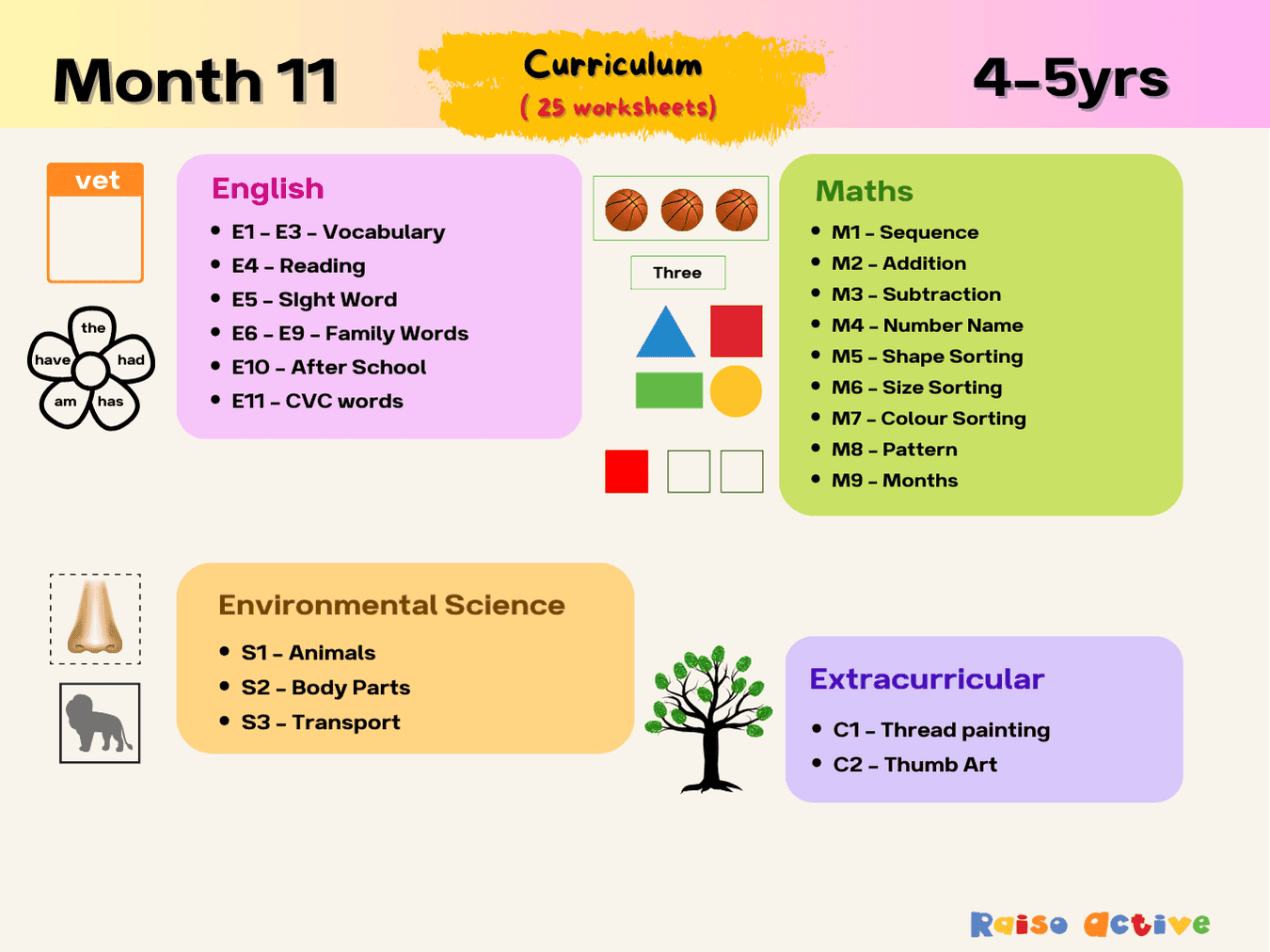
Part of the pack
Month 11: Learning & Development | Ages 4-5
This is page 18 of the pack. Ages 4-5 · Pre-KAges 4-5 · ReceptionAges 4-5 · LKGAges 4-5

Made for your child
Counting to 10, made for your child
A maths pack with your child's name in it: pictures that explain, practice at three levels, puzzles and story sums about them. Print a new set whenever they finish.
Make a maths packFree preview · free for members
Curriculum
- Counting > Counting Basics
How to use this worksheet
Look at the first group of objects together and count them out loud, touching each one as you count. Once you have the total, look at the number names listed on the page and read them together, sounding out any unfamiliar words. Have your child draw a line from the counted group to its matching number name. Repeat this process for each group on the page, encouraging your child to recount if they're unsure of the total.
Materials needed
- Pencil
- Crayons
Extension activities
- 1Have your child draw the matching number of objects for a chosen number name on a blank sheet.
- 2Use real-life objects, like buttons or blocks, to practice counting and matching to written number words.
- 3Make simple flashcards pairing counted dot groups with their number-word names.
- 4Practice writing a few of the number names independently for extra handwriting practice.

Written by
Hemsweta Jain · Teacher Cheena
MBA and Early Childhood Educator, teaching since 2014 · Founder of RaisoActive, Mumbai
Every RaisoActive worksheet is designed and checked by the founder before publishing.
Published · Last reviewed
More from Month 11: Learning & Development | Ages 4-5

Parent's Guide: Fun Activities for Early Learning!
Ages 3-5 · Preschool–Pre-KAges 3-5 · Nursery–ReceptionAges 3-5 · Nursery–LKGAges 3-5
This parent's guide gathers a set of adaptable, no-worksheet activities that build early reading, science exploration, and creative thinking for children ages 3-5. Because the activities span different domains — from a family memory book to sink-or-float experiments — this guide supports well-rounded early learning that goes beyond pencil-and-paper practice into hands-on discovery.
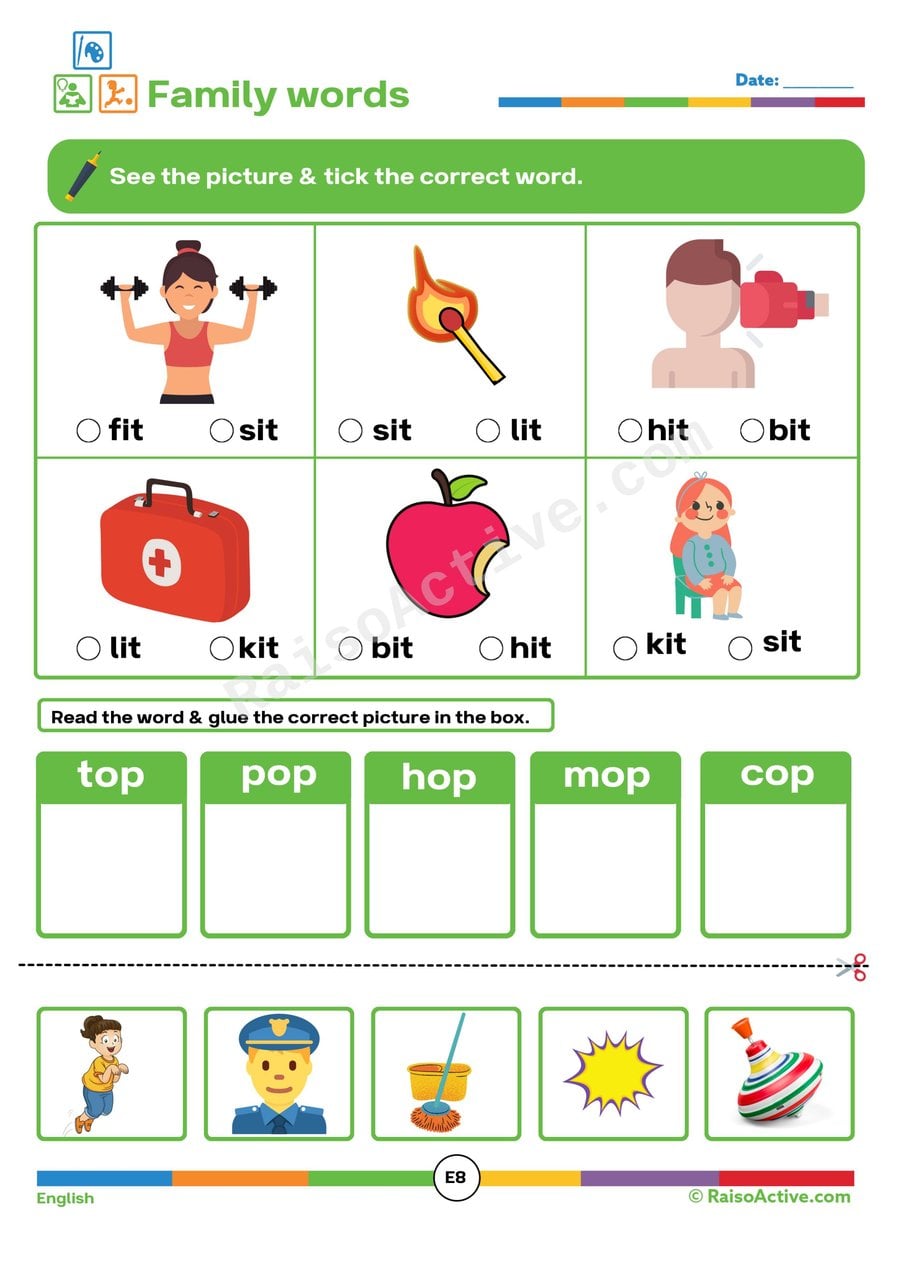
Family Words Worksheet: See, Tick, and Glue!
Ages 3-5 · Preschool–Pre-KAges 3-5 · Nursery–ReceptionAges 3-5 · Nursery–LKGAges 3-5
Children ages 3-5 practice recognizing family-member words and connecting them to pictures through a tick-and-glue format that combines quick visual checking with a hands-on cutting task. Doing the same type of match twice in different formats — once by ticking, once by pasting — gives extra repetition of the same small set of words, which is exactly what builds recognition at this age.
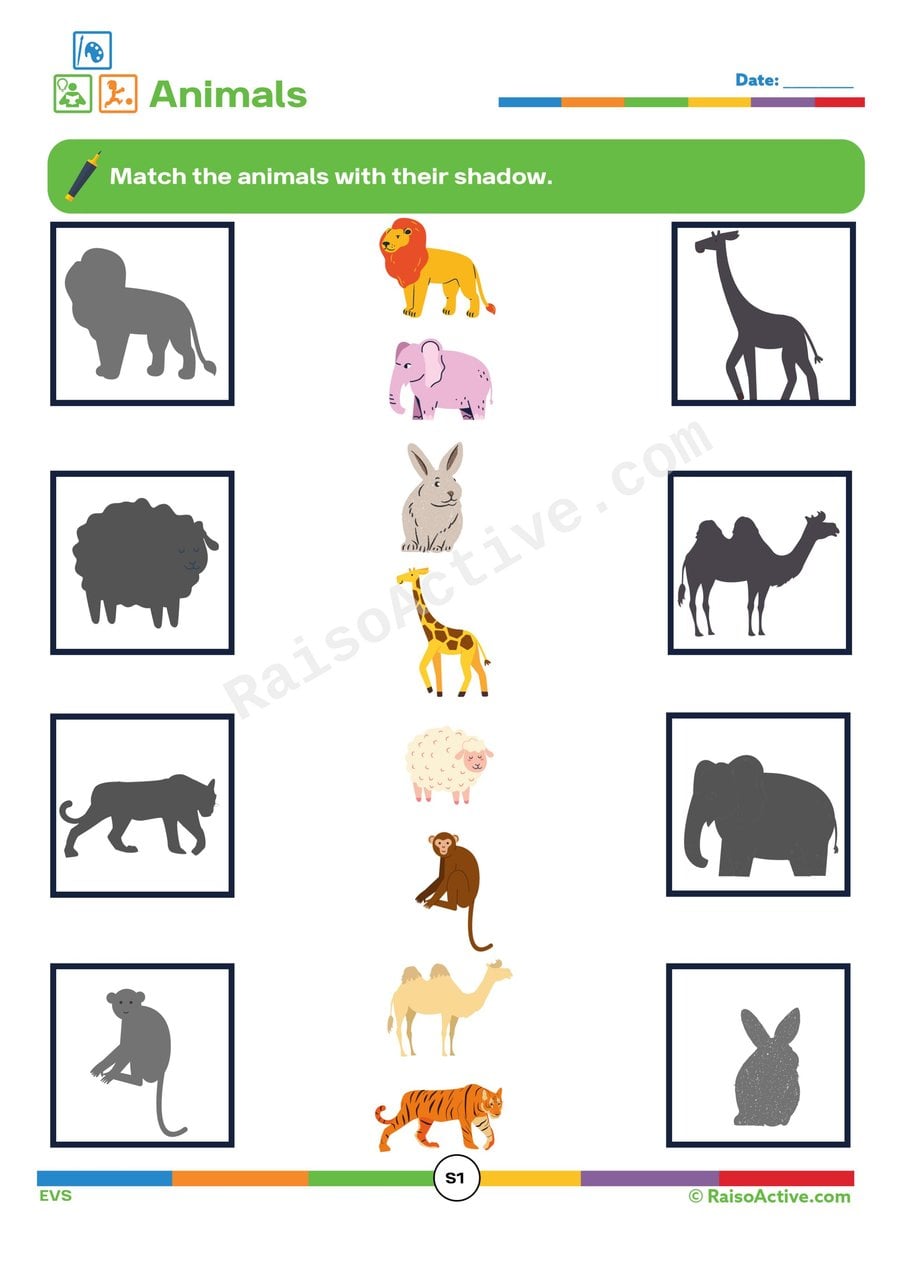
Animal Shadow Match Worksheet for Preschoolers
Ages 3-5 · Preschool–Pre-KAges 3-5 · Nursery–ReceptionAges 3-5 · Nursery–LKGAges 3-5
This worksheet builds visual discrimination skills for children ages 3-5 by having them match each animal to its correct silhouette or shadow shape. Because a shadow strips away color and detail, leaving only outline and proportion, this task requires more careful visual analysis than typical picture matching, sharpening the kind of attention to shape and form that supports later letter and word recognition.
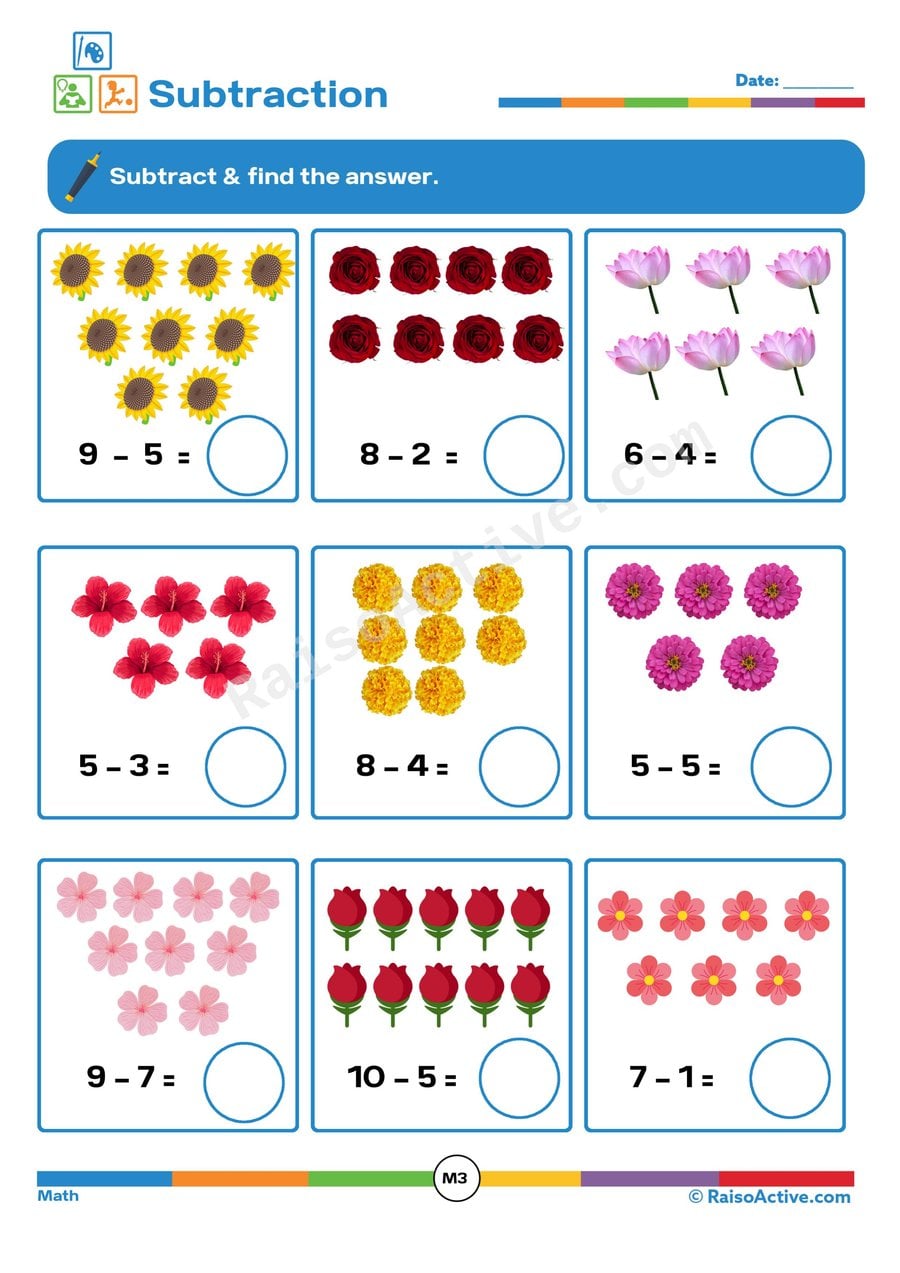
Flower Power Subtraction Worksheet for Kids
Ages 4-6 · Pre-K–KindergartenAges 4-6 · Reception–Year 1Ages 4-6 · LKG–UKGAges 4-6
This worksheet gives children ages 4-6 hands-on subtraction practice using a flower-themed counting context, asking them to count pictured objects, subtract a given amount, and write the difference in a circle. The visual, countable format helps make subtraction concrete rather than abstract, reinforcing that 'taking away' reduces a group's total in a way children can see and verify by recounting.

Color the Pictures! Kk, Ll, and Mm Letter Sounds Worksheet
Ages 4-5 · Pre-KAges 4-5 · ReceptionAges 4-5 · LKGAges 4-5
Coloring a circle beneath a picture only when its name starts with a target letter sound builds beginning-sound discrimination for children ages 4-5 across three letters — K, L, and M — sharpening their ability to isolate initial phonemes.

Transportation Fun: Identify Land, Water, and Air Vehicles!
Ages 3-5 · Preschool–Pre-KAges 3-5 · Nursery–ReceptionAges 3-5 · Nursery–LKGAges 3-5
This worksheet helps children ages 3-5 classify different vehicles by where they travel — land, water, or air — building early categorization skills alongside transportation vocabulary. Writing the correct letter (L, W, or A) for each picture requires children to think about a vehicle's purpose and environment, not just recognize what it is, adding a layer of reasoning beyond simple naming.

Family Words Worksheet: Picture Matching and Word Recognition
Ages 4-6 · Pre-K–KindergartenAges 4-6 · Reception–Year 1Ages 4-6 · LKG–UKGAges 4-6
This worksheet gives children ages 4-6 another round of practice recognizing family-member vocabulary words, reinforcing the connection between a printed word and the picture it names through both a tick-the-answer step and a cut-and-paste matching step. Repeating this pairing across two different formats on one page helps move these words from recognition with support toward more independent reading.

Thread Painting Fun: A Creative Craft Worksheet for Kids!
Ages 3-5 · Preschool–Pre-KAges 3-5 · Nursery–ReceptionAges 3-5 · Nursery–LKGAges 3-5
Dipping thread in watercolor, folding paper, and pulling the thread introduces children ages 3-5 to an unusual printmaking technique that builds fine motor control and cause-and-effect thinking, since the pulled thread creates a surprising symmetrical design they couldn't fully plan in advance.
Related worksheets
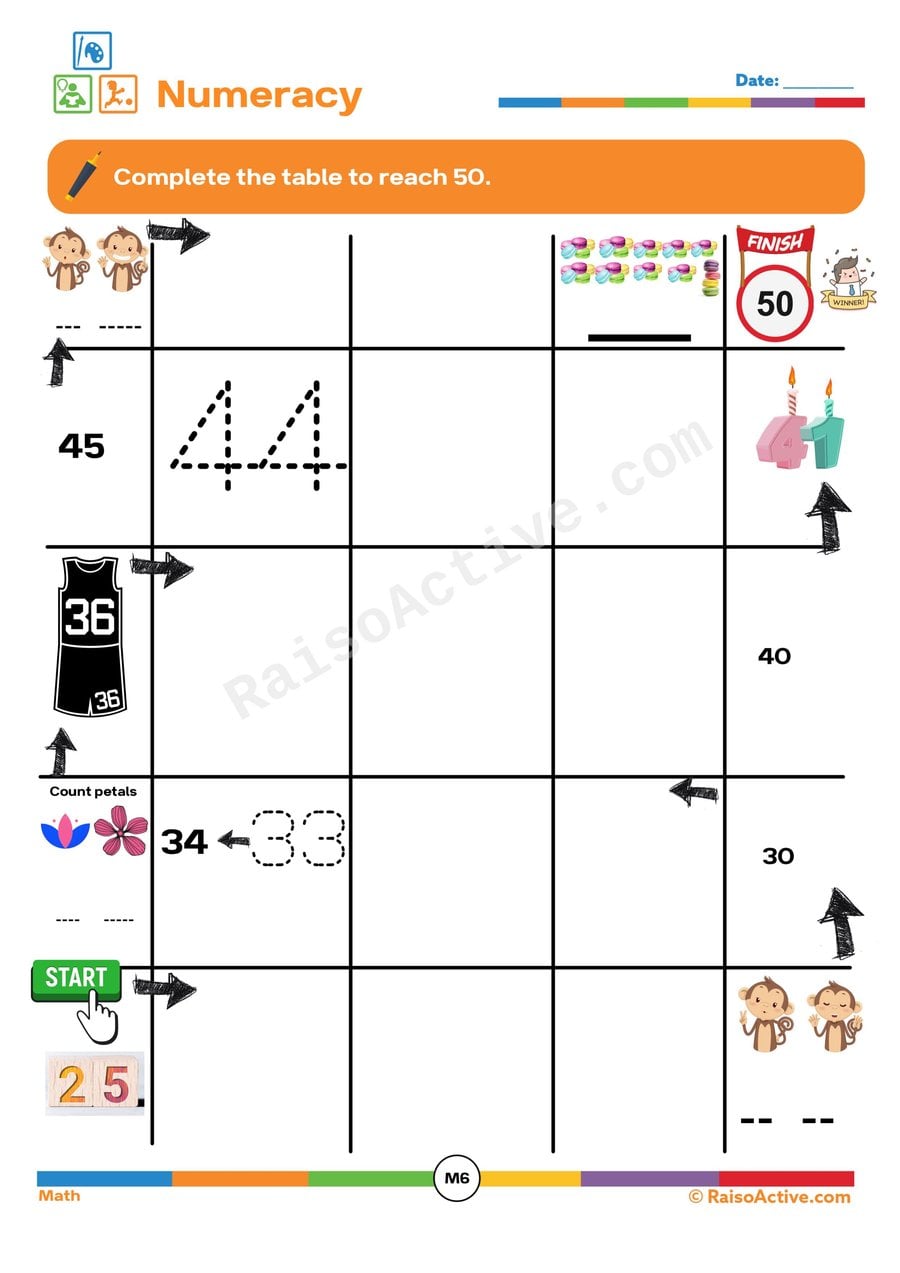
Reach 50! A Fun Numeracy Worksheet for Kids
Ages 4-5 · Pre-KAges 4-5 · ReceptionAges 4-5 · LKGAges 4-5
Filling in a number sequence toward a target like 50 gives children ages 4-5 practice with number order and pattern continuation over a longer stretch than they might attempt in casual counting, building stamina alongside numeracy. Starting partway through the sequence, at 25, also asks children to pick up counting from a non-zero starting point, which is a slightly more advanced skill than counting from one every time. Successfully completing the full path to 50 gives children a strong, visible sense of accomplishment tied to a meaningful numerical milestone.

Duckling Number Fun: Coloring Numbers 0-20 Worksheet
Ages 4-6 · Pre-K–KindergartenAges 4-6 · Reception–Year 1Ages 4-6 · LKG–UKGAges 4-6
This worksheet helps children ages 4-6 practice recognizing numerals from 0 to 20 in sequence as they color a path of boxes to help a duck reach its ducklings, turning number recognition into a purposeful, story-driven task. Coloring the boxes in strict numerical order also reinforces the idea that numbers build one after another, supporting later skip-counting and number-line skills.

Up and Down Worksheet: Counting and Writing Practice for Preschoolers
Ages 3-5 · Preschool–Pre-KAges 3-5 · Nursery–ReceptionAges 3-5 · Nursery–LKGAges 3-5
Children ages 3-5 combine spatial reasoning with counting practice by counting steps or elements going up and down, then writing the totals. Understanding 'up' and 'down' as directional concepts supports later skills like reading graphs, climbing stairs safely, and following spatial instructions. Writing the counted numbers afterward reinforces number formation alongside the counting itself.

Spider Count Worksheet: Finger Painting Fun for Halloween!
Ages 3-5 · Preschool–Pre-KAges 3-5 · Nursery–ReceptionAges 3-5 · Nursery–LKGAges 3-5
Dabbing fingertips or Q-tips in paint to create the exact number of spiders shown on each web gives children ages 3-5 hands-on practice with one-to-one counting while also strengthening the small hand muscles needed for pencil control later on. Because each web has a target number, children must count as they paint rather than just decorating freely, which reinforces number recognition in a playful, low-pressure way. The messy, sensory nature of finger painting also supports focus and engagement at an age when seated paper-and-pencil tasks can be hard to sustain.
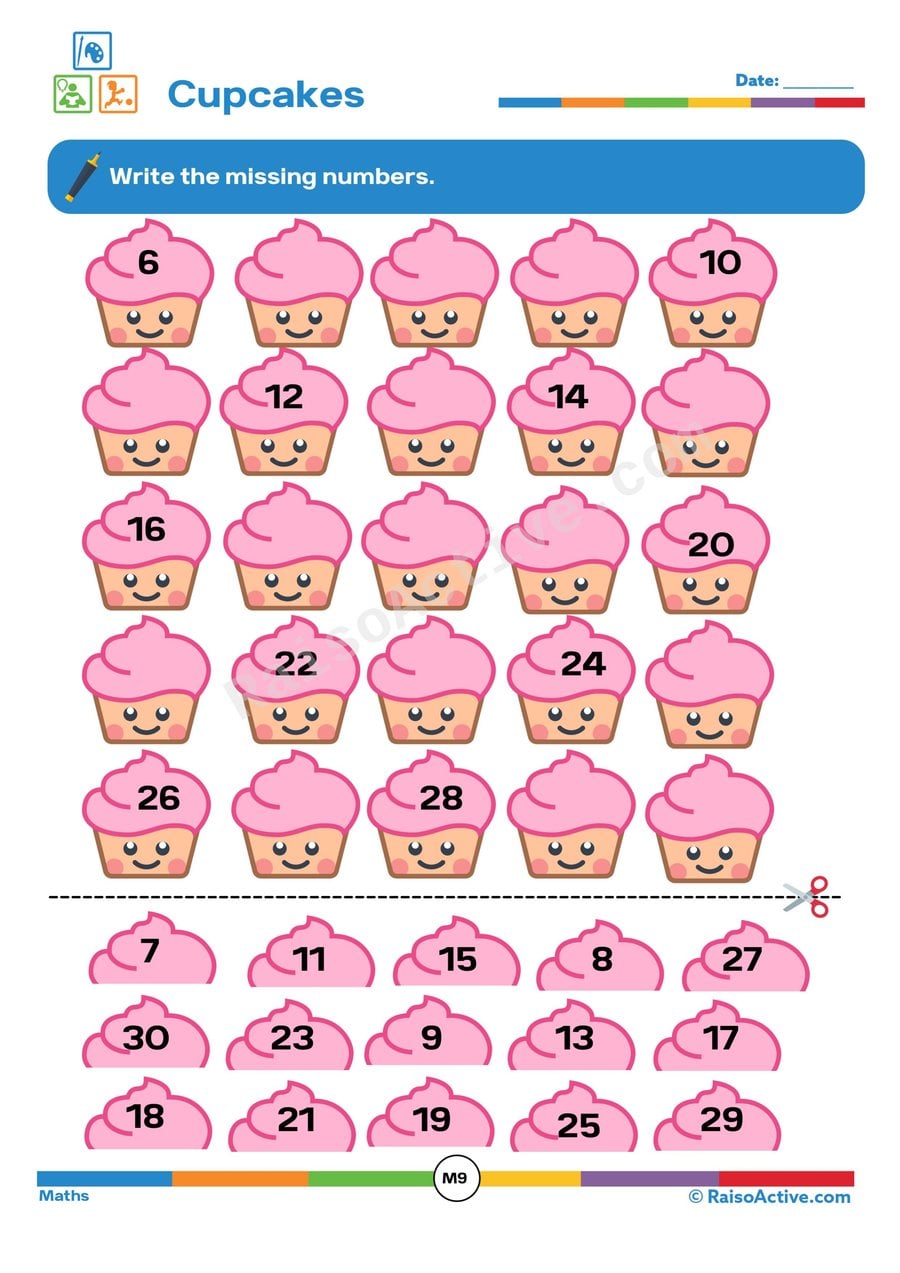
Cupcake Counting Worksheet: Missing Numbers!
Ages 4-6 · Pre-K–KindergartenAges 4-6 · Reception–Year 1Ages 4-6 · LKG–UKGAges 4-6
This worksheet strengthens number sequencing for children ages 4-6 as they study a row of numbered cupcakes and figure out which numbers are missing from the sequence, then write them in. Identifying a gap in a number sequence requires understanding the pattern of counting well enough to predict what's missing, a step beyond simply counting forward.
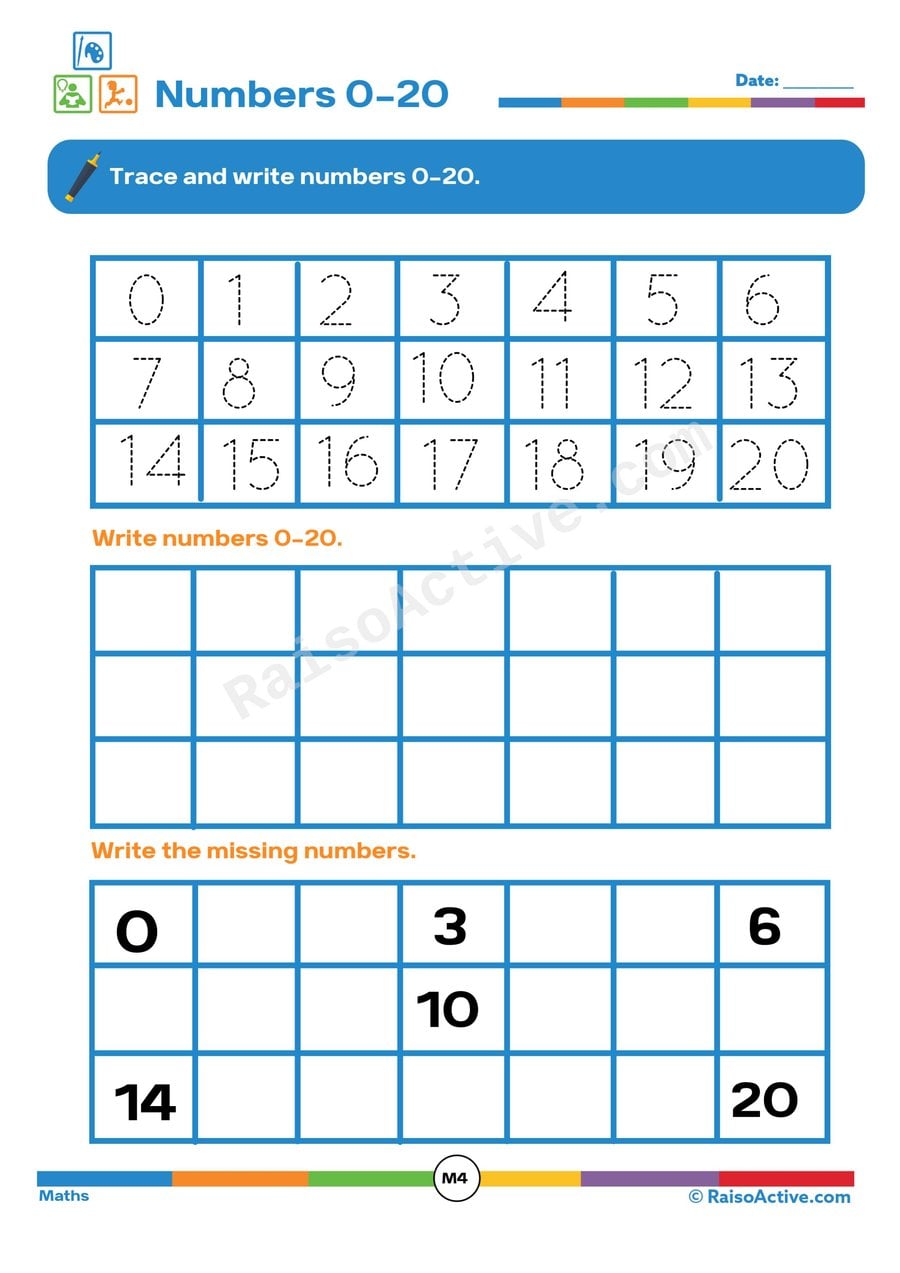
Trace and Write Numbers 0-20 Worksheet
Ages 4-6 · Pre-K–KindergartenAges 4-6 · Reception–Year 1Ages 4-6 · LKG–UKGAges 4-6
This worksheet extends number formation practice across the full range from 0 to 20, giving children repeated tracing and writing practice on both single-digit and two-digit numerals. For four- to six-year-olds, moving past 10 into the teens and twenties is an important milestone, since it introduces the idea that numbers can be built from combinations of digits rather than each needing its own unique symbol.
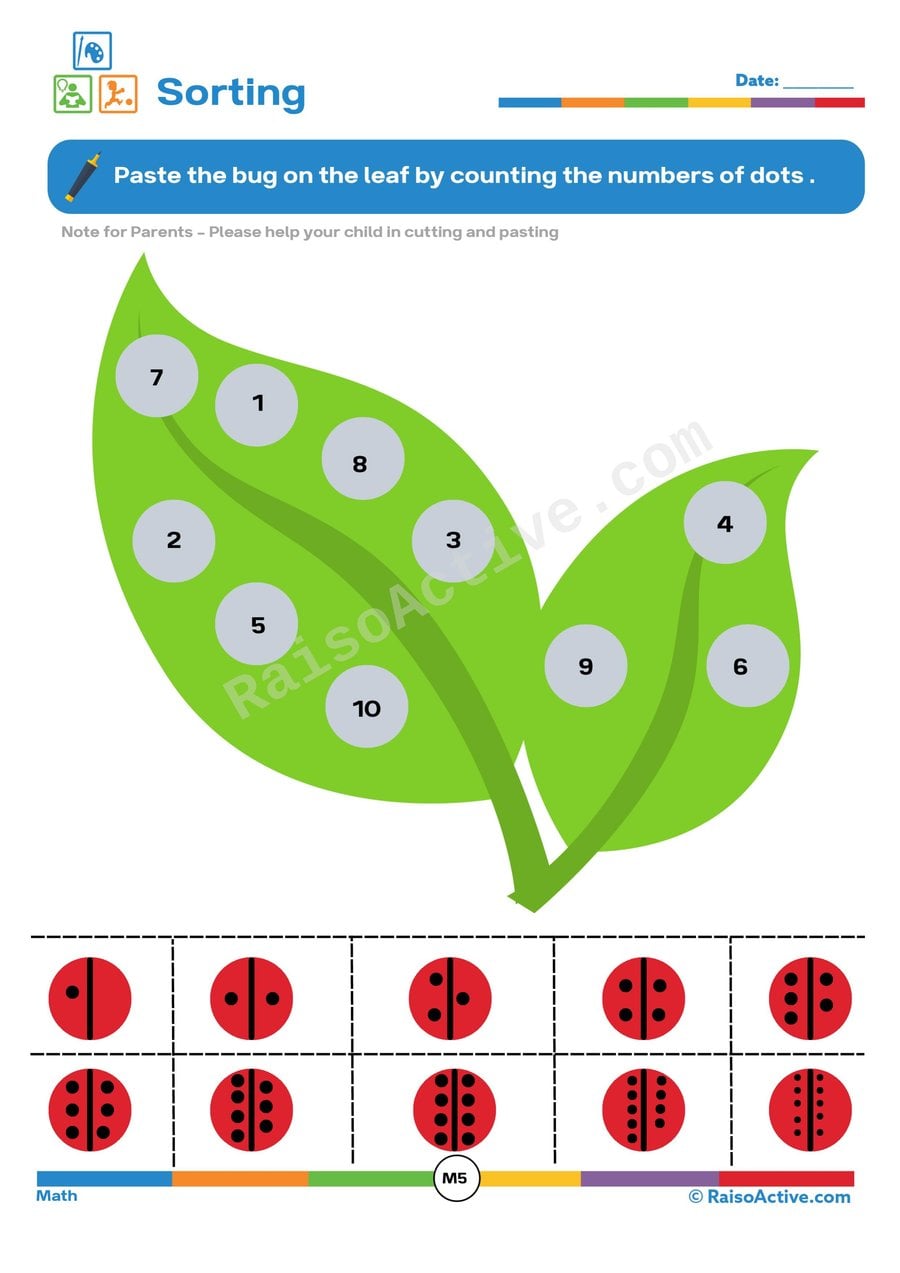
Ladybug Dot Counting Worksheet for Preschoolers
Ages 3-5 · Preschool–Pre-KAges 3-5 · Nursery–ReceptionAges 3-5 · Nursery–LKGAges 3-5
Children ages 3-5 practice one-to-one correspondence by counting the dots on each ladybug and matching that total to the correct numbered leaf, a core early numeracy skill that connects a printed number to an actual quantity. The cutting and pasting also strengthens fine motor control needed for later writing tasks.
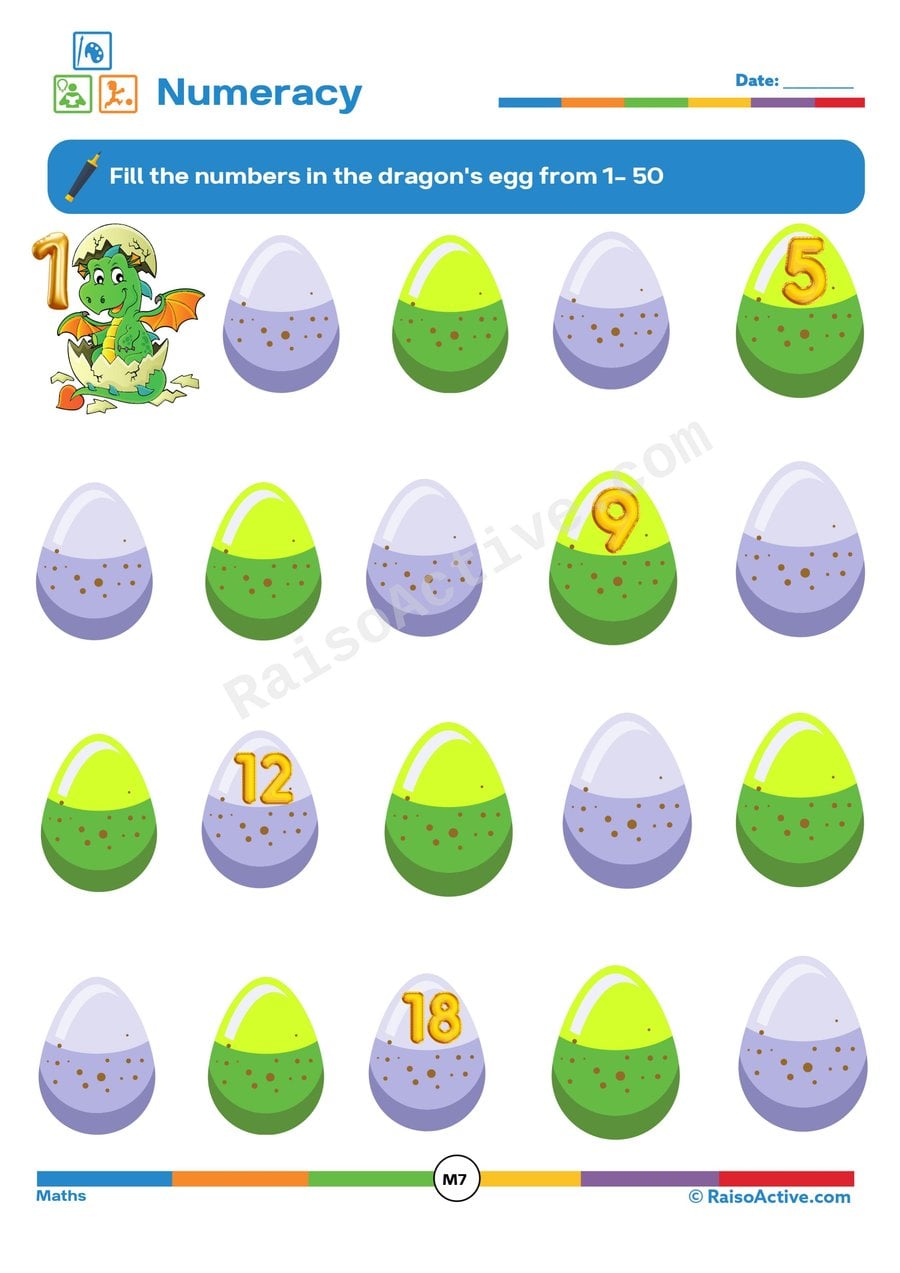
Dragon Egg Numbers: Counting to 50 Worksheet
Ages 4-6 · Pre-K–KindergartenAges 4-6 · Reception–Year 1Ages 4-6 · LKG–UKGAges 4-6
Filling in the missing numbers across a run of dragon eggs stretches a 4-6 year old's counting range well past the more common 1-20 practice, into territory where number patterns — like how every decade starts a new '_1, _2, _3' pattern — start to become visible. It's a strong bridge activity between rote counting and genuinely understanding how the number system is built.
Guides for this topic

Number Formation Rhymes 0–9 and How to Fix Reversals
Original number formation rhymes for 0–9, the correct stroke order for each digit, why 3, 5 and 7 get reversed most often, and multisensory fixes that work.

Best Worksheets for 3-Year-Olds: What Works and What to Avoid
What works on worksheets for 3-year-olds: short sessions, crayons, tracing lines, matching, cutting, a free weekly plan, and signs one is too advanced.
Christmas and Winter Activities That Combine Fun and Learning: Creating Magical Educational Experiences
Discover Christmas and winter activities that combine festive fun with real learning. Crafts, counting, literacy, and printable worksheets for ages 2 to 8 — perfect for home and school.
Reviews
Every worksheet for ages 3–5, no watermark
Members download the full library of 1,000+ worksheets and every activity pack without watermarks or daily limits. One year costs ₹999 in India or $20 elsewhere.
See membership plansOr download any worksheet free with a watermark (5 a day).