Roll and Cover Shapes Worksheet for Preschoolers
This dice game helps children ages 3-5 practice shape recognition under a bit of playful chance, since they must roll a die, interpret which shape it points to, and then find and cover the matching shape on the worksheet. Reacting to a randomly rolled shape rather than working through a fixed sequence keeps children actively scanning the whole page, which builds visual search skills alongside basic geometry recognition.
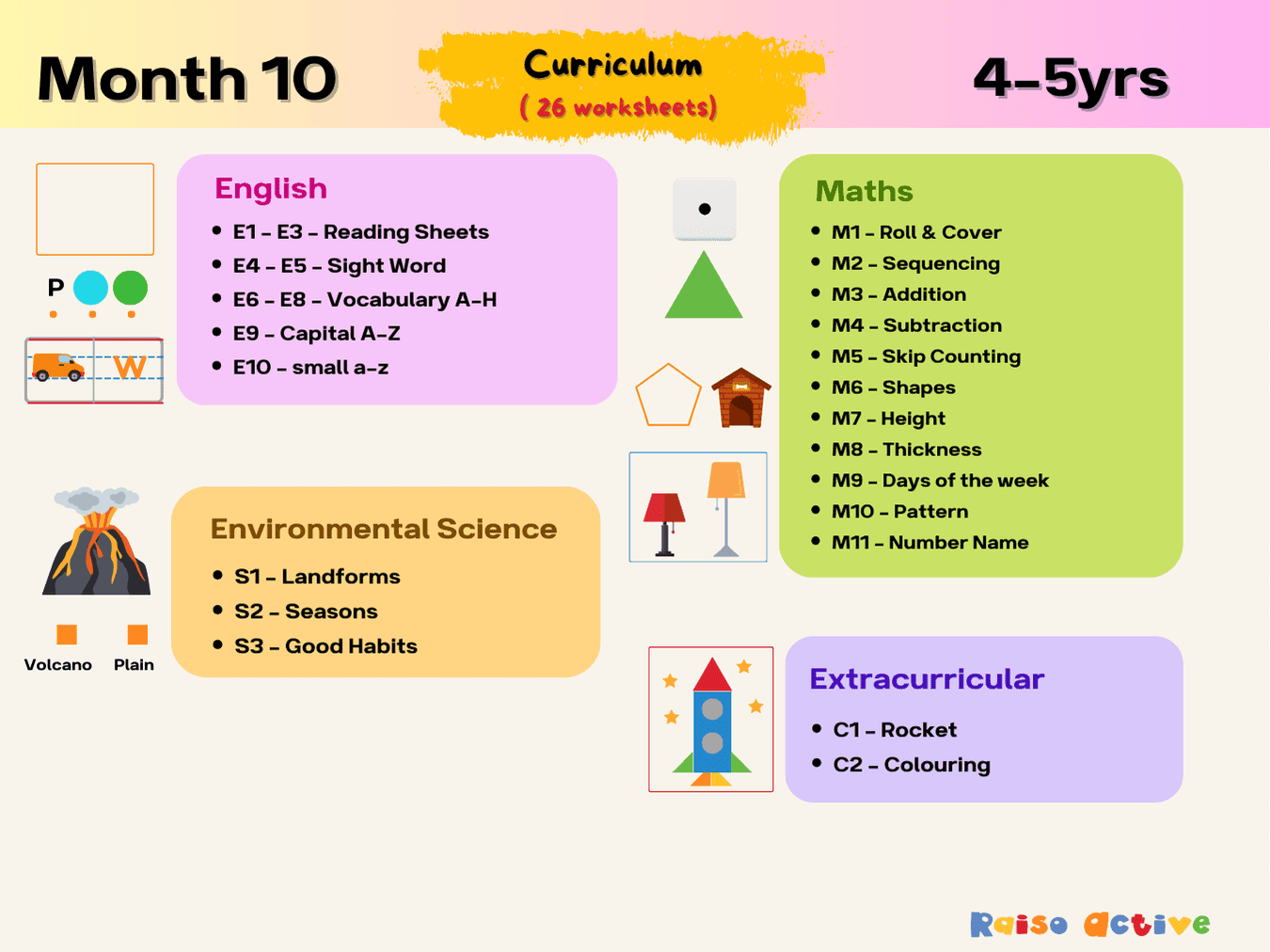
Part of the pack
Month 10: Learning & Development | Ages 4-5
This is page 14 of the pack. Ages 4-5 · Pre-KAges 4-5 · ReceptionAges 4-5 · LKGAges 4-5
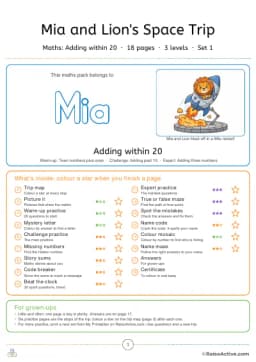
Made for your child
Counting to 10, made for your child
A maths pack with your child's name in it: pictures that explain, practice at three levels, puzzles and story sums about them. Print a new set whenever they finish.
Make a maths packFree preview · free for members
Curriculum
- 2D Shapes > Shapes & Sorting
How to use this worksheet
Roll the die together and look at which shape or symbol landed face up, naming it aloud before searching the worksheet. Have your child scan the page to find a matching shape, then cover it with a marker, crayon, or small counter. Take turns rolling and covering shapes until most or all of the shapes on the page are covered, keeping track together of which shapes have already been claimed.
Materials needed
- Die
- Markers or crayons
Extension activities
- 1Have children draw the shapes they cover on a separate sheet, labeling each with its name.
- 2Use the covered shapes to create a simple pattern or picture once the game is finished.
- 3Make a homemade shape die using a small box and stickers of different shapes for repeat play.
- 4Play a shape scavenger hunt around the house, finding real objects that match each shape from the die.

Written by
Hemsweta Jain · Teacher Cheena
MBA and Early Childhood Educator, teaching since 2014 · Founder of RaisoActive, Mumbai
Every RaisoActive worksheet is designed and checked by the founder before publishing.
Published · Last reviewed
More from Month 10: Learning & Development | Ages 4-5

Rocket Shapes Cut and Glue Worksheet for Preschoolers
Ages 3-5 · Preschool–Pre-KAges 3-5 · Nursery–ReceptionAges 3-5 · Nursery–LKGAges 3-5
Cutting out triangles, circles, and rectangles and gluing them into place to build a rocket teaches children ages 3-5 to recognize basic 2D shapes and understand how they combine to form a larger, recognizable object. This activity strengthens scissor control along straight and curved edges while also introducing early engineering thinking, since children must consider how each shape's position contributes to the finished rocket's structure. Framing shape practice as a space-themed craft project keeps a repetitive geometry lesson feeling exciting and imaginative.
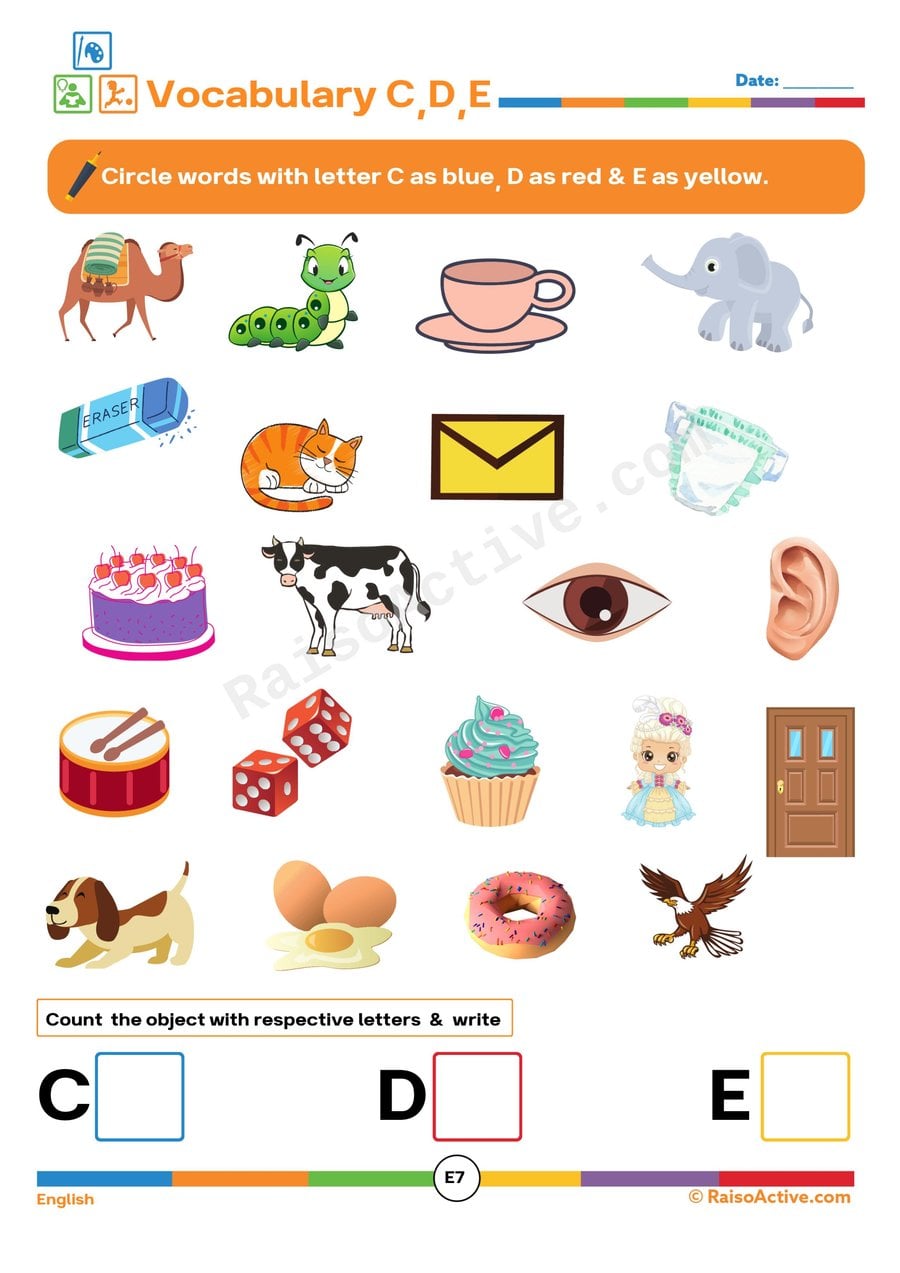
C, D, E Letter Sounds Worksheet: Circle and Count!
Ages 3-5 · Preschool–Pre-KAges 3-5 · Nursery–ReceptionAges 3-5 · Nursery–LKGAges 3-5
This activity gives children ages 3-5 focused practice recognizing the beginning sounds of the letters C, D, and E, asking them to circle matching pictures in different colors for each letter before counting the results. Combining phonics with counting means children practice two skills in one sitting: identifying initial letter sounds and recording a numeric total, both foundational for kindergarten readiness. Color-coding each letter also helps children visually organize the three sounds instead of mixing them together.
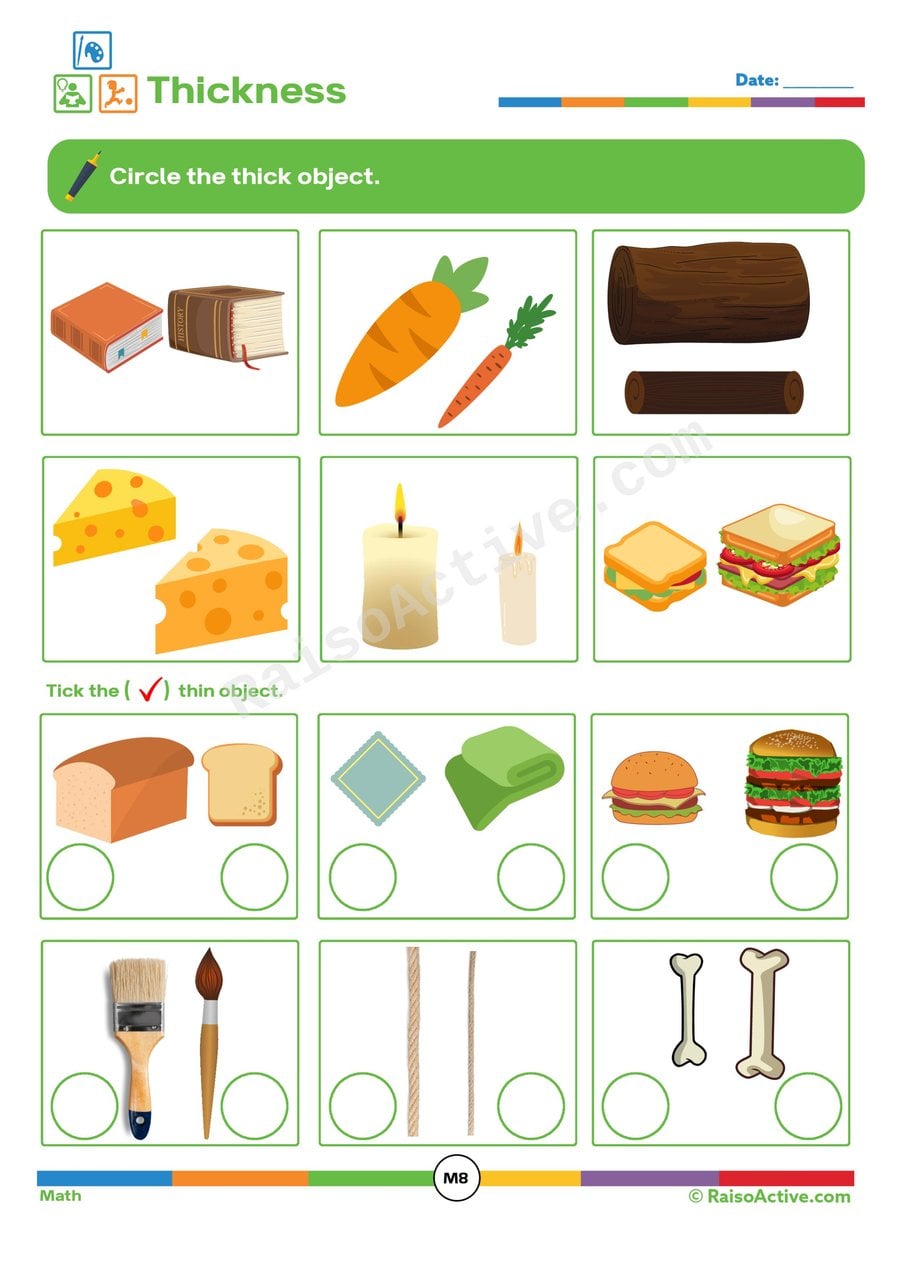
Thickness Worksheet: Circle the Thick Objects!
Ages 3-5 · Preschool–Pre-KAges 3-5 · Nursery–ReceptionAges 3-5 · Nursery–LKGAges 3-5
This sorting worksheet introduces children ages 3-5 to the comparative concept of thickness, asking them to distinguish thick objects from thin ones within paired pictures. Comparing physical properties like thickness, rather than just size or color, sharpens observational vocabulary and prepares children for later measurement concepts involving width and volume. Requiring two different responses — circling the thick object and ticking the thin one — also reinforces that opposite concepts can appear side by side in the very same picture.
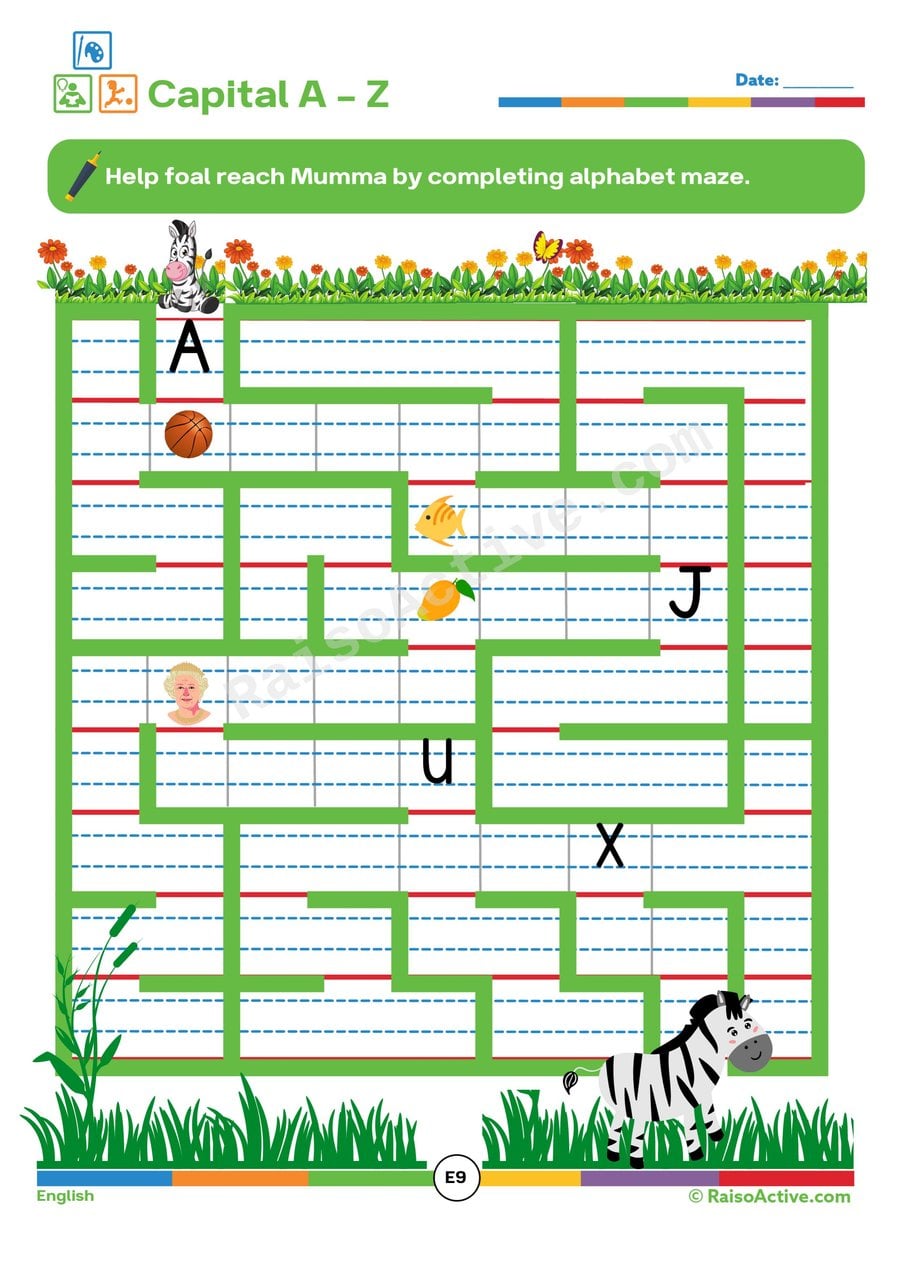
Capital Letter Maze: Help the Foal Find Mumma!
Ages 3-5 · Preschool–Pre-KAges 3-5 · Nursery–ReceptionAges 3-5 · Nursery–LKGAges 3-5
This maze worksheet combines fine motor tracing practice with capital letter recognition for children ages 3-5, as they navigate a path from letter to letter to reunite the foal with its mother. Following a maze path while simultaneously identifying letters along the way builds sustained visual attention and reinforces that letters appear in a meaningful, recognizable sequence. The storyline element also adds emotional motivation that keeps children engaged through a longer tracing task.

Subtraction Fun: Count and Subtract with Cute Animals!
Ages 4-6 · Pre-K–KindergartenAges 4-6 · Reception–Year 1Ages 4-6 · LKG–UKGAges 4-6
Counting a group of animal pictures and then crossing out or removing a specified number teaches children ages 4-6 the concept of subtraction as taking away from a starting quantity, which is easier to grasp visually than through numbers alone. Writing the remaining total after the take-away step reinforces that subtraction results in a smaller, specific number, connecting the physical act of removing objects to a written numeral. Using cute animal pictures as the countable objects keeps a potentially tricky math concept approachable and fun.

Read and Circle: Matching Sentences to Pictures Worksheet
Ages 4-5 · Pre-KAges 4-5 · ReceptionAges 4-5 · LKGAges 4-5
Children ages 4-5 build reading comprehension by reading a short, simple sentence and then identifying which of several pictures actually matches its meaning, rather than just decoding words in isolation. This step — connecting written language back to a real scene — is what separates true reading comprehension from mechanical word-calling, making it an important milestone activity for early readers.

Cut and Paste the Word: Fun Reading Worksheet for Kids!
Ages 4-5 · Pre-KAges 4-5 · ReceptionAges 4-5 · LKGAges 4-5
This cut-and-paste decoding activity has children ages 4-5 sound out simple CVC (consonant-vowel-consonant) words like 'cat' or 'sun' and match the missing picture to complete each word, directly practicing the phonics blending skills that underpin early reading fluency. Because the word is partly built from letters already on the page, children must connect individual letter sounds to a whole word rather than just recognizing a picture in isolation. This bridges the gap between knowing individual letter sounds and reading complete three-letter words independently.

Tall and Short Objects Worksheet for Preschoolers
Ages 3-5 · Preschool–Pre-KAges 3-5 · Nursery–ReceptionAges 3-5 · Nursery–LKGAges 3-5
Children ages 3-5 build early measurement vocabulary by comparing pairs of objects and identifying which one is taller and which is shorter, practicing both circling and ticking as response formats. Comparing height between two objects at a time, rather than sorting a whole group, keeps the comparison task simple and direct, which is developmentally appropriate before children move on to comparing three or more items at once.
Related worksheets

Shape Frog Cut and Paste Worksheet for Preschoolers
Ages 3-5 · Preschool–Pre-KAges 3-5 · Nursery–ReceptionAges 3-5 · Nursery–LKGAges 3-5
This worksheet gives children ages 3-5 hands-on practice manipulating basic shapes — like triangles, circles, and squares — to assemble a complete picture of a frog. Building a recognizable animal out of separate geometric shapes helps children see how simple shapes combine to form more complex forms, an early step toward representational drawing and spatial construction. Cutting and precisely placing each shape piece also strengthens fine motor coordination.

2D Shape Sort Worksheet for Preschoolers: Matching Shapes!
Ages 3-5 · Preschool–Pre-KAges 3-5 · Nursery–ReceptionAges 3-5 · Nursery–LKGAges 3-5
This worksheet connects a shape's visual form to its written name, asking 3-5 year olds to match circles, squares, triangles, and rectangles on one side of the page to their names on the other. That word-to-shape link builds early reading vocabulary alongside geometry, since shape names are often a child's first exposure to reading multi-letter words that describe something they can see and touch. The follow-up questions at the bottom add a light counting or identification check to confirm the matching was done with real understanding.

Connect the Dots: Hidden Shape Worksheet for Kids
Ages 3-5 · Preschool–Pre-KAges 3-5 · Nursery–ReceptionAges 3-5 · Nursery–LKGAges 3-5
Children ages 3-5 practice counting in sequence and fine motor line control as they connect numbered dots in order to reveal a hidden shape, combining numeracy with hand-eye coordination in one satisfying activity. The surprise of a shape emerging only once every dot is connected correctly also motivates children to stay careful and accurate rather than rushing through the numbers.

Semi-Circle Fun: Tracing, Counting, and Patterns Worksheet for Preschoolers
Ages 3-5 · Preschool–Pre-KAges 3-5 · Nursery–ReceptionAges 3-5 · Nursery–LKGAges 3-5
This worksheet helps children ages 3-5 learn about semi-circles through tracing their curved edge, counting how many appear in a group, and identifying which shape comes next in a repeating pattern. Covering one shape across three different skills, tracing, counting, and patterning, gives children a well-rounded, layered understanding of what makes a semi-circle unique.
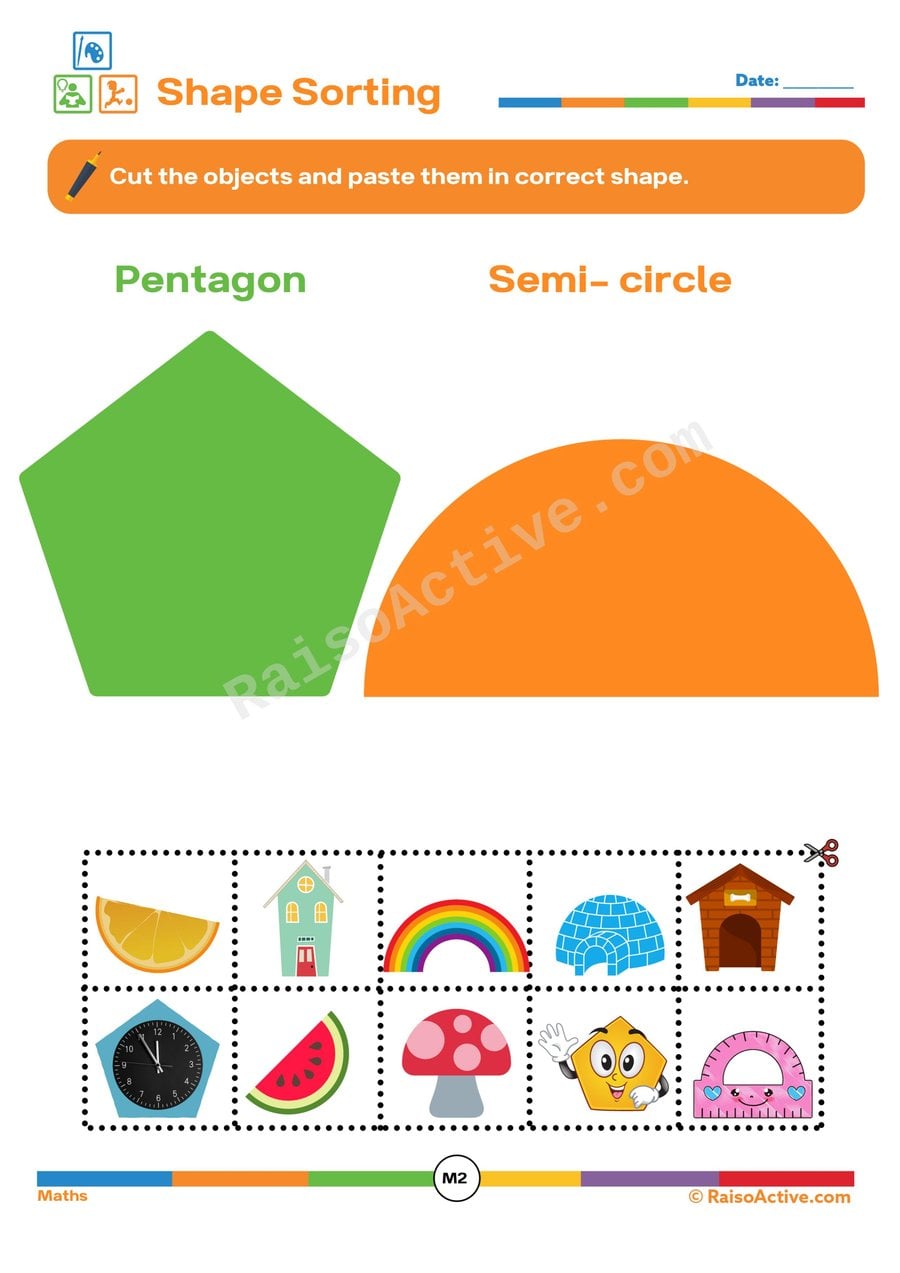
Shape Sorting Fun: Cut and Paste Shapes!
Ages 3-5 · Preschool–Pre-KAges 3-5 · Nursery–ReceptionAges 3-5 · Nursery–LKGAges 3-5
Cutting out shapes and pasting them into matching outlines teaches children ages 3-5 to recognize basic 2D shapes like circles, squares, and triangles by their defining features rather than just their color or size. The cutting and pasting also strengthens the fine motor coordination needed for handwriting later on.

Shape Sorting Fun: Cut and Paste Worksheet for Preschoolers
Ages 3-5 · Preschool–Pre-KAges 3-5 · Nursery–ReceptionAges 3-5 · Nursery–LKGAges 3-5
Matching pictures of everyday objects to the 2D shape they resemble builds shape recognition and categorization for children ages 3-5, helping them see geometric shapes as patterns that exist in the real world around them.

Shape Sorting Fun: Cut and Glue Worksheet for Preschoolers
Ages 3-5 · Preschool–Pre-KAges 3-5 · Nursery–ReceptionAges 3-5 · Nursery–LKGAges 3-5
Sorting cut-out shapes into matching rows builds shape recognition for children ages 3-5, requiring them to visually compare each piece's sides and corners before placing it correctly. This early geometry practice, paired with the fine motor demands of cutting and gluing, strengthens both cognitive classification skills and hand control at the same time.

Pentagon Fun: Shape Recognition and Craft Activity Worksheet
Ages 3-5 · Preschool–Pre-KAges 3-5 · Nursery–ReceptionAges 3-5 · Nursery–LKGAges 3-5
This worksheet combines shape recognition with a hands-on craft, having children build a pentagon out of popsicle sticks and then find and glue pentagon-shaped pictures onto an outline. For ages 3-5, physically constructing a five-sided shape makes an otherwise abstract geometric concept concrete, while the cut-and-paste portion reinforces shape recognition through visual matching.
Guides for this topic

Best Worksheets for 3-Year-Olds: What Works and What to Avoid
What works on worksheets for 3-year-olds: short sessions, crayons, tracing lines, matching, cutting, a free weekly plan, and signs one is too advanced.

Age-Appropriate Problem-Solving Activities: Building Critical Thinkers from the Ground Up
Discover fun, age-appropriate problem-solving activities for children ages 1-8. Build critical thinking, logic, and reasoning skills through play-based learning.
Critical Thinking Activities That Actually Work for Young Children: Building Tomorrow's Thinkers Today
Discover proven critical thinking activities for young children. Age-wise logic games, questioning techniques, and hands-on ideas to build thinking skills at home.
Reviews
Every worksheet for ages 3–5, no watermark
Members download the full library of 1,000+ worksheets and every activity pack without watermarks or daily limits. One year costs ₹999 in India or $20 elsewhere.
See membership plansOr download any worksheet free with a watermark (5 a day).