Subtraction Fun: Count and Subtract with Cute Animals!
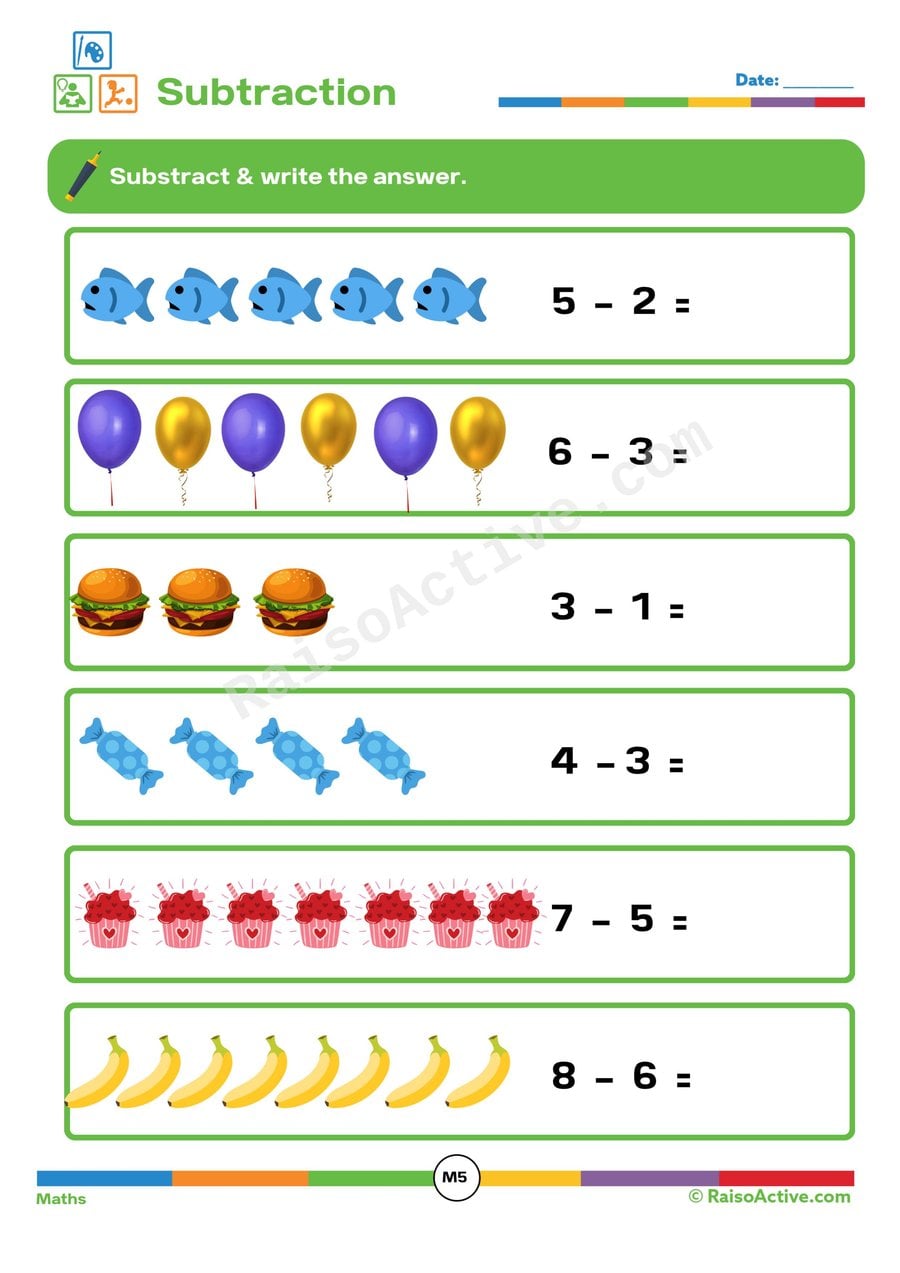
Counting a group of animal pictures and then crossing out or removing a specified number teaches children ages 4-6 the concept of subtraction as taking away from a starting quantity, which is easier to grasp visually than through numbers alone. Writing the remaining total after the take-away step reinforces that subtraction results in a smaller, specific number, connecting the physical act of removing objects to a written numeral. Using cute animal pictures as the countable objects keeps a potentially tricky math concept approachable and fun.
Part of the pack
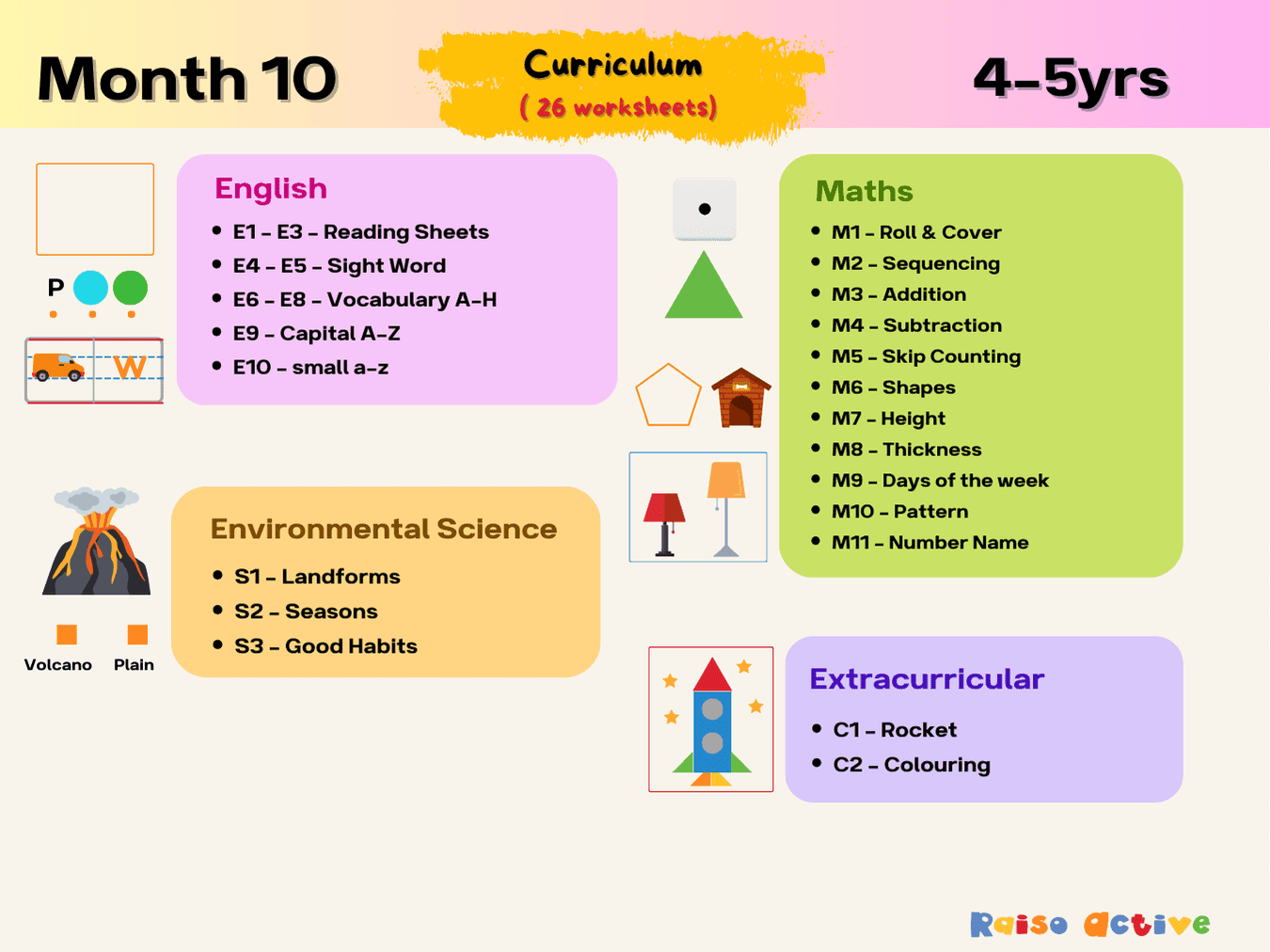
Month 10: Learning & Development | Ages 4-5
This is page 17 of the pack. Ages 4-5 · Pre-KAges 4-5 · ReceptionAges 4-5 · LKGAges 4-5
Made for your child
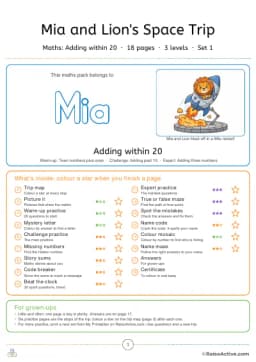
Taking away within 10, made for your child
A maths pack with your child's name in it: pictures that explain, practice at three levels, puzzles and story sums about them. Print a new set whenever they finish.
Make a maths packFree preview · free for members
Curriculum
- Subtraction > Subtraction Basics
How to use this worksheet
Have your child count the full group of animals in the first problem out loud and say the starting total. Read the instruction to see how many animals should be taken away, and have your child cross out or circle that many animals with an X. Ask your child to count only the animals that remain uncrossed and write that number as the answer. Repeat the process for each subtraction problem on the page, encouraging your child to recount the remaining animals to double-check their answer.
Materials needed
- Pencil
- Eraser
Extension activities
- 1Use small toys or snacks to physically act out taking objects away and counting what's left.
- 2Play a simple game where you start with a pile of objects and take turns removing a few, counting what remains each time.
- 3Create your own subtraction problems by drawing a group of animals and crossing some out.
- 4Practice saying subtraction sentences aloud, like 'five minus two equals three,' using real objects.
- 5Turn it into a story problem, like 'three birds were on a branch and one flew away, how many are left?'

Written by
Hemsweta Jain · Teacher Cheena
MBA and Early Childhood Educator, teaching since 2014 · Founder of RaisoActive, Mumbai
Every RaisoActive worksheet is designed and checked by the founder before publishing.
Published · Last reviewed
More from Month 10: Learning & Development | Ages 4-5

Days of the Week Cut and Paste Worksheet for Preschoolers
Ages 4-6 · Pre-K–KindergartenAges 4-6 · Reception–Year 1Ages 4-6 · LKG–UKGAges 4-6
Cutting out the seven day names and gluing them into the correct sequence teaches children ages 4-6 the fixed order of the days of the week, a foundational piece of time-concept knowledge they'll rely on for calendars, schedules, and daily routines. Because this activity requires both reading the day names and remembering their correct order, it strengthens sight-word recognition alongside sequencing skills. The hands-on cutting and pasting also gives fine motor practice within a literacy and time-concept task.

Number Names Matching Worksheet for Preschoolers
Ages 3-5 · Preschool–Pre-KAges 3-5 · Nursery–ReceptionAges 3-5 · Nursery–LKGAges 3-5
This worksheet helps children ages 3-5 connect written number names, like 'three' or 'seven,' to the numeral they represent, an important step beyond simply recognizing digits since it introduces reading actual number words. Decoding a color clue to figure out and write each number name first adds an extra layer of visual attention before the matching step even begins.
Summer Coloring Worksheet: Color the Beach Scene!
Ages 3-5 · Preschool–Pre-KAges 3-5 · Nursery–ReceptionAges 3-5 · Nursery–LKGAges 3-5
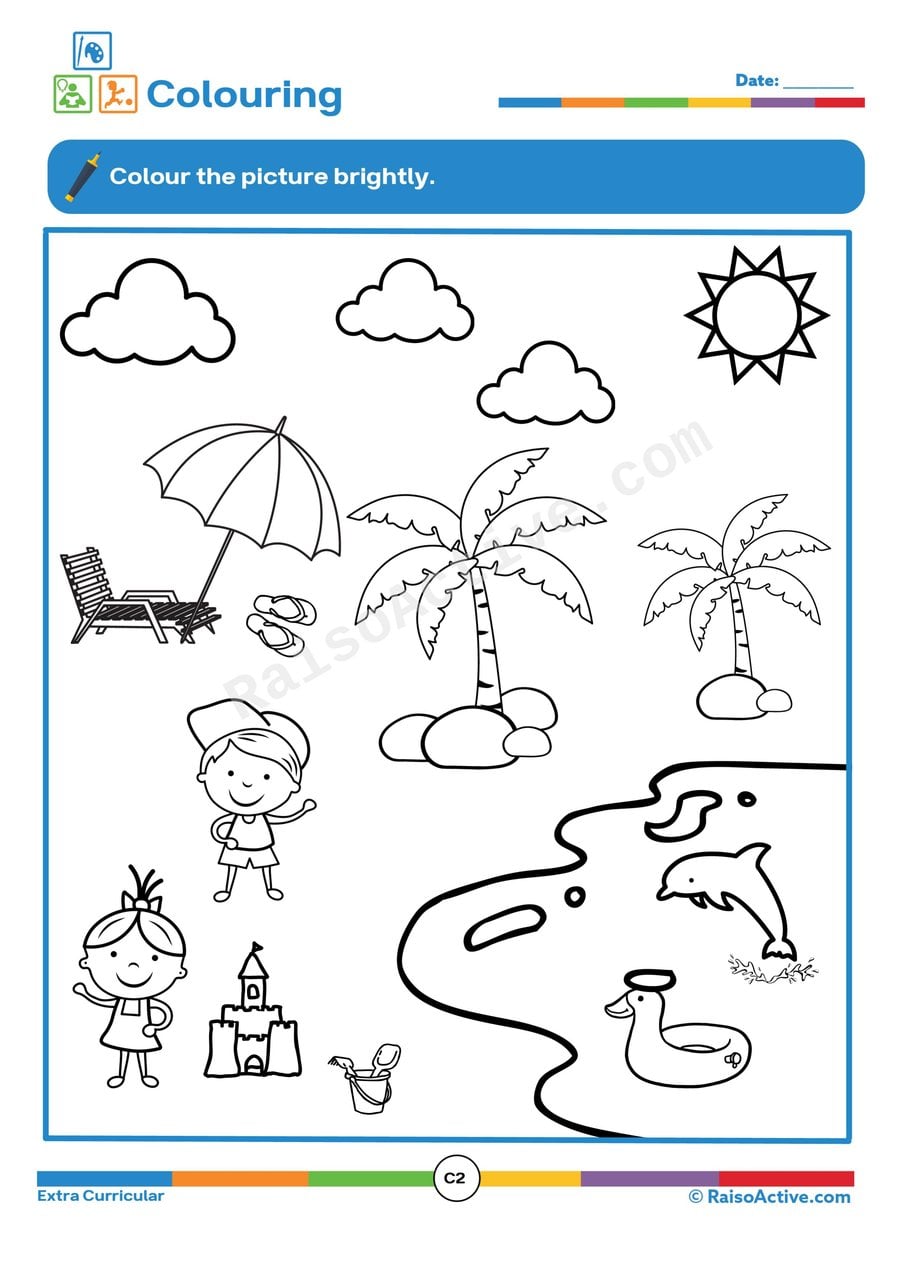
This coloring worksheet lets children ages 3-5 practice staying within lines and choosing appropriate colors while reinforcing recognition of summer-themed objects like sand, sun, and beach toys. Coloring a themed scene rather than a random picture also builds vocabulary, since children naturally name and discuss each object as they decide what color to use. This combination of fine motor practice and vocabulary reinforcement makes even a simple coloring page more purposeful than free coloring alone.
F, G, H Letter Sounds Cut and Paste Worksheet
Ages 4-5 · Pre-KAges 4-5 · ReceptionAges 4-5 · LKGAges 4-5
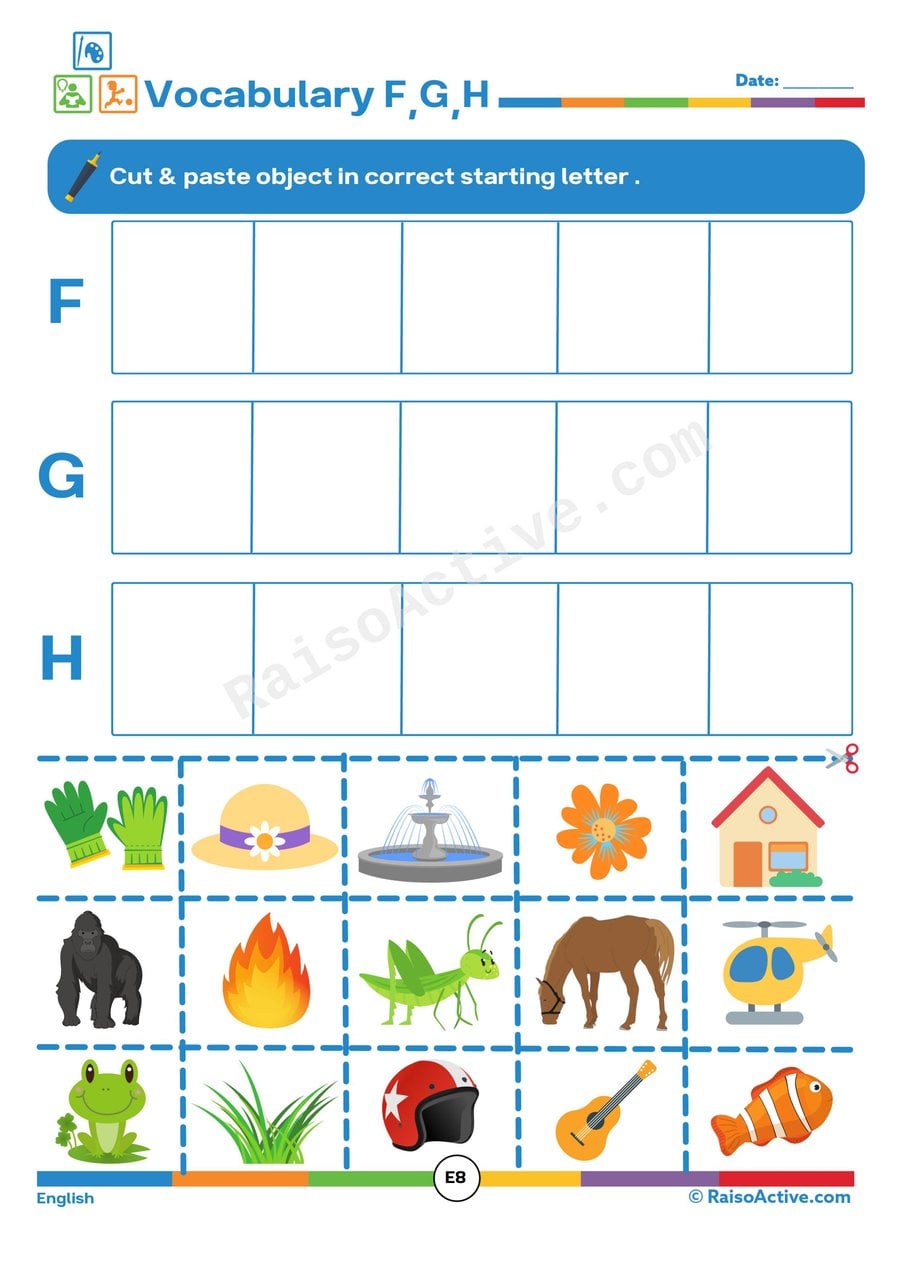
This worksheet builds phonemic awareness in children ages 4-5 by asking them to isolate the beginning sound of each picture and sort it under the correct letter — F, G, or H. Sorting across three letters at once, rather than just one, requires children to hold multiple sound-letter associations in mind and choose between them, which is a step up in difficulty from single-letter worksheets. This kind of comparative sound-sorting strengthens the phonics foundation needed for early reading.

Rocket Shapes Cut and Glue Worksheet for Preschoolers
Ages 3-5 · Preschool–Pre-KAges 3-5 · Nursery–ReceptionAges 3-5 · Nursery–LKGAges 3-5
Cutting out triangles, circles, and rectangles and gluing them into place to build a rocket teaches children ages 3-5 to recognize basic 2D shapes and understand how they combine to form a larger, recognizable object. This activity strengthens scissor control along straight and curved edges while also introducing early engineering thinking, since children must consider how each shape's position contributes to the finished rocket's structure. Framing shape practice as a space-themed craft project keeps a repetitive geometry lesson feeling exciting and imaginative.

Landforms Worksheet: Identify and Tick the Correct Answer!
Ages 3-5 · Preschool–Pre-KAges 3-5 · Nursery–ReceptionAges 3-5 · Nursery–LKGAges 3-5
Looking at pictures of landforms like volcanoes, glaciers, and islands and choosing the correct name from two options teaches children ages 3-5 early earth science vocabulary while building visual discrimination between different natural features. Because each landform has a distinct silhouette, shape, and texture, children practice careful observation of details, like noticing that a volcano has a cone shape while an island is surrounded by water. This worksheet introduces basic geography concepts in a way that's grounded in pictures rather than abstract explanation.

Color the Sight Words: 'She' and 'He' Worksheet for Preschoolers
Ages 3-5 · Preschool–Pre-KAges 3-5 · Nursery–ReceptionAges 3-5 · Nursery–LKGAges 3-5
This worksheet helps children ages 3-5 build instant sight-word recognition for the common pronouns 'she' and 'he' by having them scan a page and color each word according to a color code. Because sight words like these can't be sounded out easily, repeated visual exposure through an engaging coloring task helps children recognize them instantly by shape, which is essential for early reading fluency. Differentiating between two similar short words also sharpens visual discrimination.

Parent's Guide: Fun Activities for Early Learning
Ages 3-5 · Preschool–Pre-KAges 3-5 · Nursery–ReceptionAges 3-5 · Nursery–LKGAges 3-5
This parent guide equips caregivers of children ages 3-5 with structured activity ideas around three early-learning concepts: recognizing the days of the week, identifying patterns, and practicing skip counting. Each activity translates an abstract concept into a hands-on or playful format, since young children learn these ideas best through repetition embedded in daily routines rather than worksheets alone. Covering multiple concepts in one guide also gives caregivers flexibility to pick the activity that fits their child's current interest.
Related worksheets

Subtraction Worksheet: Count and Subtract for Preschoolers
Ages 4-5 · Pre-KAges 4-5 · ReceptionAges 4-5 · LKGAges 4-5
This worksheet introduces basic subtraction by having children count a starting group of objects, remove or cross out a specified number, and count what remains to find the answer. For ages 4-5, grounding subtraction in physical counting rather than abstract numbers alone helps children understand that subtraction means 'taking away' a quantity, not just manipulating symbols.
Subtraction Worksheet: Count and Subtract!
Ages 4-5 · Pre-KAges 4-5 · ReceptionAges 4-5 · LKGAges 4-5
This worksheet gives children ages 4-5 hands-on practice with subtraction as 'taking away' from a visible group, helping them understand that a number decreases when items are removed rather than treating subtraction as an abstract symbol on paper. Counting the starting group and then physically crossing out or covering objects before writing the difference builds the concrete number sense that later supports mental subtraction.

Subtraction Worksheet: Counting and Subtracting for Preschoolers
Ages 4-5 · Pre-KAges 4-5 · ReceptionAges 4-5 · LKGAges 4-5
This worksheet introduces children ages 4-5 to the concept of subtraction as 'taking away' by having them count a group of objects, cross out the number indicated, and write how many remain. Building this concrete, visual understanding of subtraction before introducing abstract number sentences helps children grasp what the minus sign actually means rather than just memorizing a procedure.

Subtraction Worksheet: Count and Subtract with Fun Objects!
Ages 4-6 · Pre-K–KindergartenAges 4-6 · Reception–Year 1Ages 4-6 · LKG–UKGAges 4-6
This worksheet grounds subtraction in something 4-6 year olds can actually see and count — a group of objects being taken away — rather than starting with abstract numerals and symbols. Because your child has to count the starting group, physically account for the number being subtracted, and then count what's left, this builds real number sense about what subtraction means, not just a memorized fact.

Subtraction Worksheet: Find the Row with Matching Answers!
Ages 4-6 · Pre-K–KindergartenAges 4-6 · Reception–Year 1Ages 4-6 · LKG–UKGAges 4-6
This worksheet pushes subtraction practice a step further for children ages 4-6 by having them solve several subtraction problems and then compare the answers across different rows to find matches, adding a layer of number-sense reasoning on top of basic calculation. Recognizing that two different subtraction problems can produce the same answer helps children understand that numbers can be reached in more than one way, which is an important early step toward flexible mathematical thinking. This kind of comparison task also builds attention to detail, since a child has to solve every problem accurately before the matching rows can be found.

Subtraction Worksheet: Count and Subtract for Preschoolers
Ages 4-5 · Pre-KAges 4-5 · ReceptionAges 4-5 · LKGAges 4-5
Counting a group of pictured objects and then subtracting a stated number introduces children ages 4-5 to the concept that a quantity can decrease, building on their counting skills to form an early foundation for subtraction. Working from a visual group of objects, rather than abstract numbers alone, lets children physically cross out or count away items, which matches how young children naturally understand 'taking away.' This concrete, visual approach to subtraction sets up a much smoother transition to number-only subtraction problems later.

Subtraction Fun: Counting Fingers Worksheet for Kids
Ages 4-5 · Pre-KAges 4-5 · ReceptionAges 4-5 · LKGAges 4-5
Children ages 4-5 use their own fingers as a built-in counting tool to practice subtraction, connecting an abstract number sentence to something they can physically see and touch. This bridges the gap between counting objects and solving take-away problems with numbers alone.

Subtraction Fun: Cross Out and Count the Cupcakes!
Ages 4-5 · Pre-KAges 4-5 · ReceptionAges 4-5 · LKGAges 4-5
This worksheet introduces subtraction to 4-5 year olds through a very concrete take-away model: your child crosses out one cupcake from a group and counts what remains, which makes the abstract idea of 'subtracting' visible and immediate rather than something happening only inside a number sentence. Because the crossing-out step comes before the counting step, this worksheet keeps the connection between the physical action and the resulting number crystal clear.
Guides for this topic

Number Formation Rhymes 0–9 and How to Fix Reversals
Original number formation rhymes for 0–9, the correct stroke order for each digit, why 3, 5 and 7 get reversed most often, and multisensory fixes that work.

Documenting Learning Without Drowning in Data: A Practical Guide for Parents and Teachers
Learn practical ways to document your child's learning without overwhelm. Simple portfolios, observation tips, and printable trackers for ages 1-8.

Coding Activities for Preschoolers: Building Tomorrow's Thinkers Today
Discover 15+ unplugged and screen-based coding activities for preschoolers that build sequencing, logic, and problem-solving skills through play. NEP 2020 aligned.
Reviews
Every worksheet for ages 4–6, no watermark
Members download the full library of 1,000+ worksheets and every activity pack without watermarks or daily limits. One year costs ₹999 in India or $20 elsewhere.
See membership plansOr download any worksheet free with a watermark (5 a day).