Pentagon Fun: Shape Recognition and Craft Activity Worksheet
This worksheet combines shape recognition with a hands-on craft, having children build a pentagon out of popsicle sticks and then find and glue pentagon-shaped pictures onto an outline. For ages 3-5, physically constructing a five-sided shape makes an otherwise abstract geometric concept concrete, while the cut-and-paste portion reinforces shape recognition through visual matching.
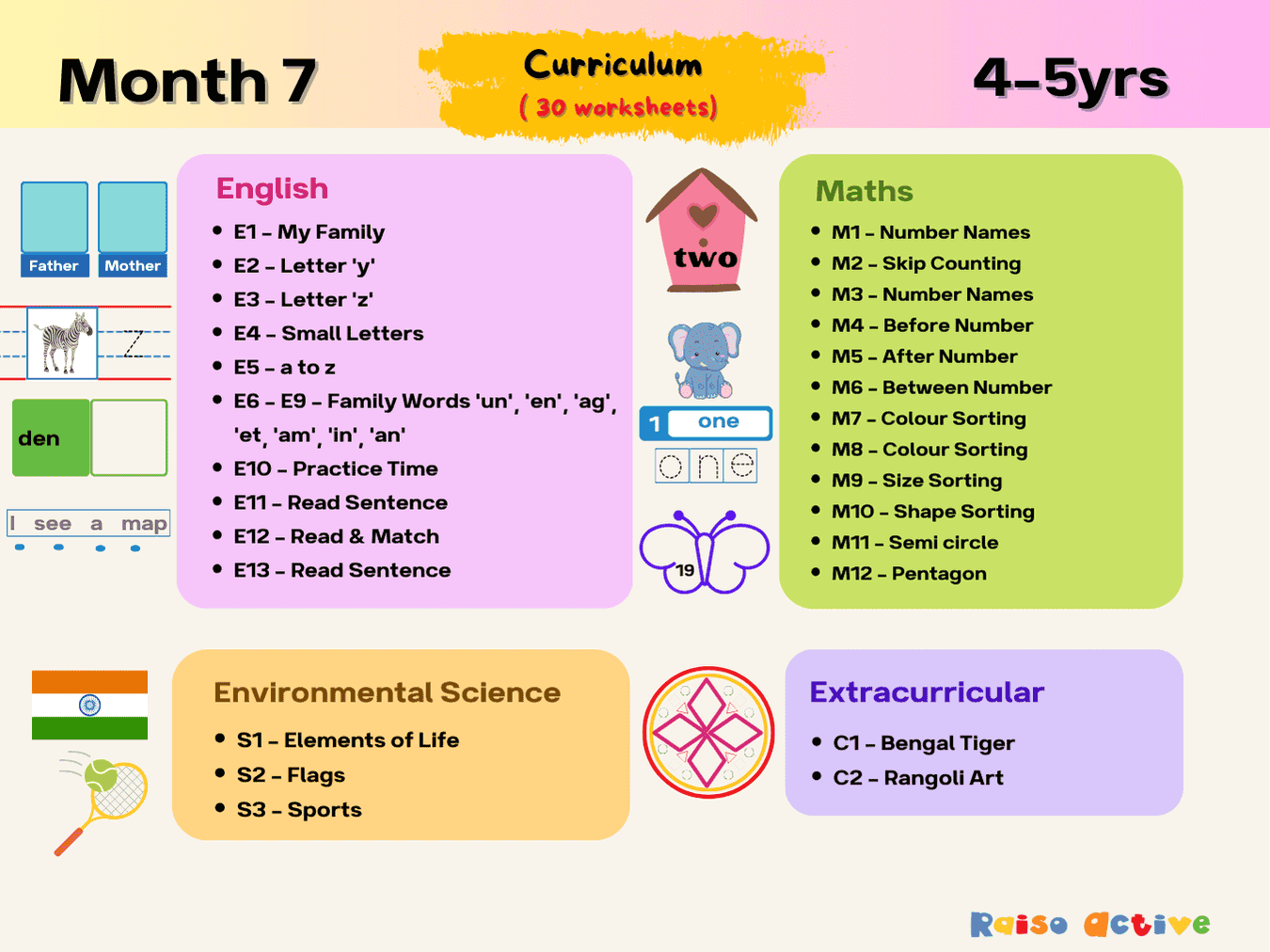
Part of the pack
Month 7: Preschool Skills Through Play | Ages 4-5
This is page 28 of the pack. Ages 4-5 · Pre-KAges 4-5 · ReceptionAges 4-5 · LKGAges 4-5
Curriculum
- 2D Shapes > Shapes & Sorting
How to use this worksheet
Start by counting five popsicle sticks together and talking about how a pentagon has five straight sides. Guide your child to arrange and glue the popsicle sticks into a five-sided pentagon shape, helping steady the sticks while the glue sets if needed. Once the pentagon craft is complete, move to the worksheet page, where your child cuts out the pentagon-shaped objects from the provided sheet. Have your child glue each pentagon-shaped cutout onto the dashed pentagon outline, then decorate the popsicle stick pentagon with crayons if desired.
Materials needed
- Pencil
- Scissors
- Glue
- Popsicle sticks
- Crayons
Extension activities
- 1Search the house or yard for real objects shaped like a pentagon, such as certain signs or packaging.
- 2Count the sides and corners of the finished pentagon craft together, reinforcing the 'five sides, five corners' definition.
- 3Create pentagons out of different materials, like straws or paper strips, to compare textures and sizes.
- 4Make a pentagon collage using magazine cutouts or scrap paper shaped or cut into five-sided pieces.
- 5Compare a pentagon to a square or triangle, counting and discussing how the number of sides differs.

Written by
Hemsweta Jain · Teacher Cheena
MBA and Early Childhood Educator, teaching since 2014 · Founder of RaisoActive, Mumbai
Every RaisoActive worksheet is designed and checked by the founder before publishing.
Published · Last reviewed
More from Month 7: Preschool Skills Through Play | Ages 4-5

Rhyming Words Matching Worksheet for Preschoolers
Ages 3-5 · Preschool–Pre-KAges 3-5 · Nursery–ReceptionAges 3-5 · Nursery–LKGAges 3-5
Spotting rhyming word pairs trains children ages 3-5 to tune into the sounds inside words rather than their spelling or meaning, an auditory skill called phonological awareness that strongly predicts later reading success. Coloring matching rhymes the same color turns an abstract listening task into a visual, hands-on one that keeps young children engaged while they practice.

Bengal Tiger Cut and Paste Worksheet for Preschoolers
Ages 3-5 · Preschool–Pre-KAges 3-5 · Nursery–ReceptionAges 3-5 · Nursery–LKGAges 3-5
Cutting apart and reordering picture strips to rebuild a Bengal tiger image teaches children ages 3-5 to follow multi-step directions while practicing scissor control and sequencing at the same time. Because the final picture only makes sense when the strips are arranged correctly, this activity also builds visual-spatial reasoning as children compare each piece to figure out where it belongs.

Small Letters Worksheet: Practice Writing Lowercase Letters!
Ages 4-5 · Pre-KAges 4-5 · ReceptionAges 4-5 · LKGAges 4-5
Tracing and then independently writing lowercase letters helps children ages 4-5 move from guided hand motion to self-directed letter formation, a critical step toward legible, automatic handwriting. Pairing each letter with a picture also reinforces the letter-sound connection, so children are practicing both motor control and early phonics at the same time.

Alphabet Maze: Help the Alligator Find the Zoo! (a to z Worksheet)
Ages 3-5 · Preschool–Pre-KAges 3-5 · Nursery–ReceptionAges 3-5 · Nursery–LKGAges 3-5
Guiding a character through a maze from A to Z asks children to recall the full alphabet in order while also navigating a physical path, combining letter sequencing with the visual planning and fine motor control needed for any maze activity. For ages three to five, tracing the entire alphabet in one continuous task is a bigger sequencing challenge than shorter letter drills, building real stamina in letter-order recall.
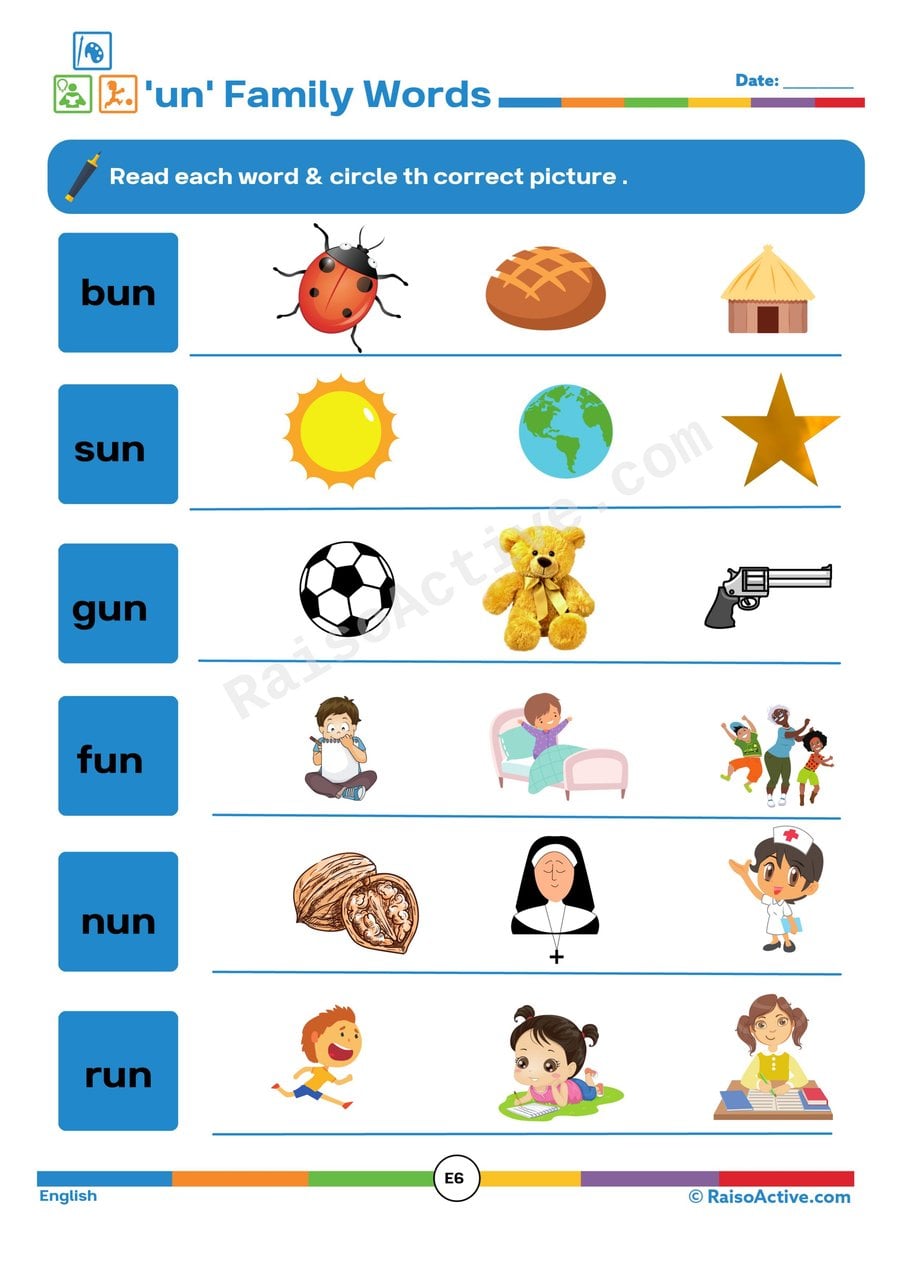
Fun 'un' Family Words Worksheet for Kids
Ages 4-6 · Pre-K–KindergartenAges 4-6 · Reception–Year 1Ages 4-6 · LKG–UKGAges 4-6
Reading and matching words from the 'un' family, like fun, run, and sun, teaches children ages 4-6 to recognize a shared spelling pattern and use it to decode new words more quickly. Because this word family relies on consistent rhyming sounds, practicing it strengthens the connection between letter patterns and pronunciation that underlies early reading fluency.
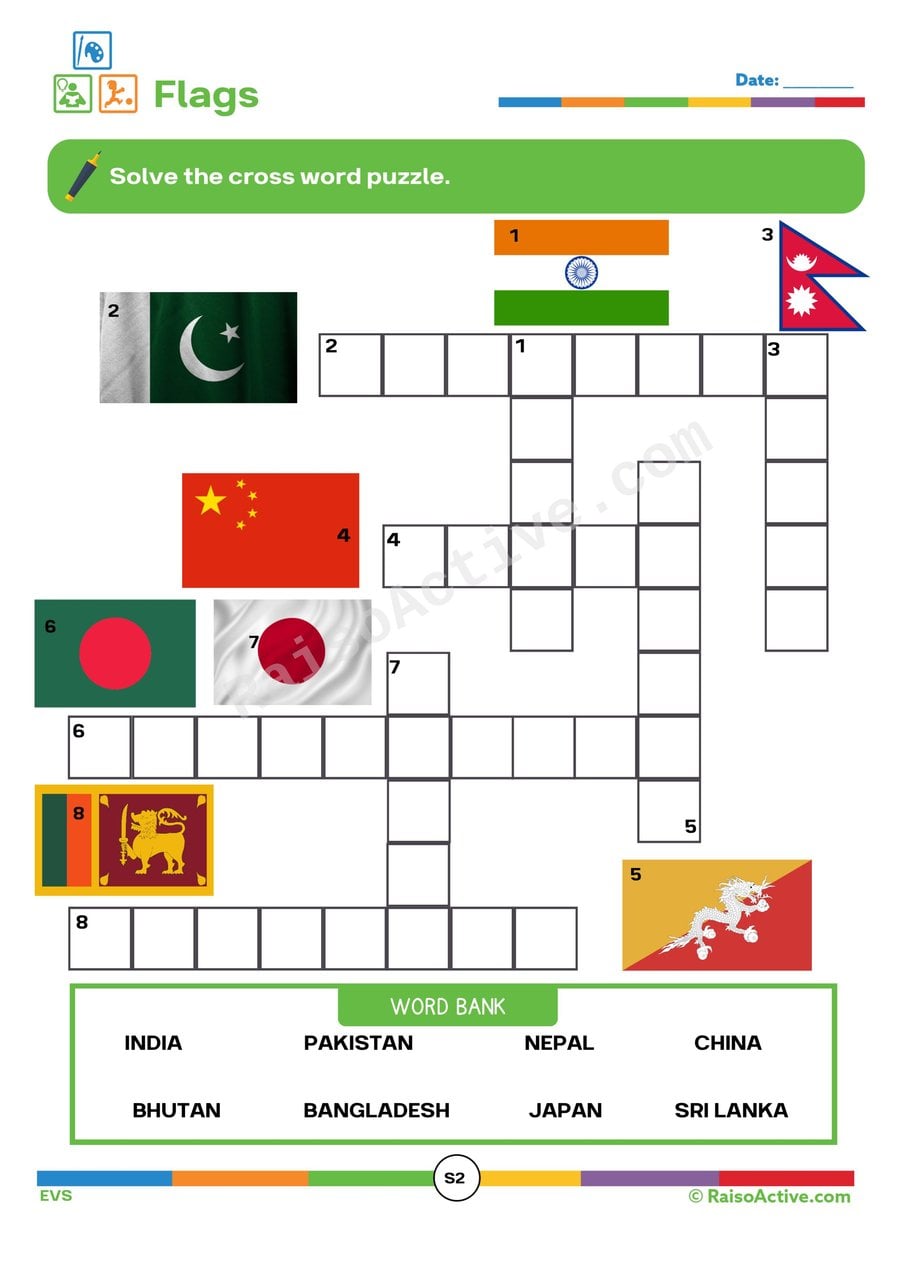
Flags Crossword Puzzle Worksheet for Kids
Ages 4-6 · Pre-K–KindergartenAges 4-6 · Reception–Year 1Ages 4-6 · LKG–UKGAges 4-6
This worksheet blends early geography knowledge with word-puzzle problem-solving, asking children to identify countries by their flags and use a word bank to complete a crossword. For ages 4-6, matching a visual flag to a written country name builds both visual discrimination and beginning spelling recognition, while the crossword format introduces a fun, structured way to practice new vocabulary.
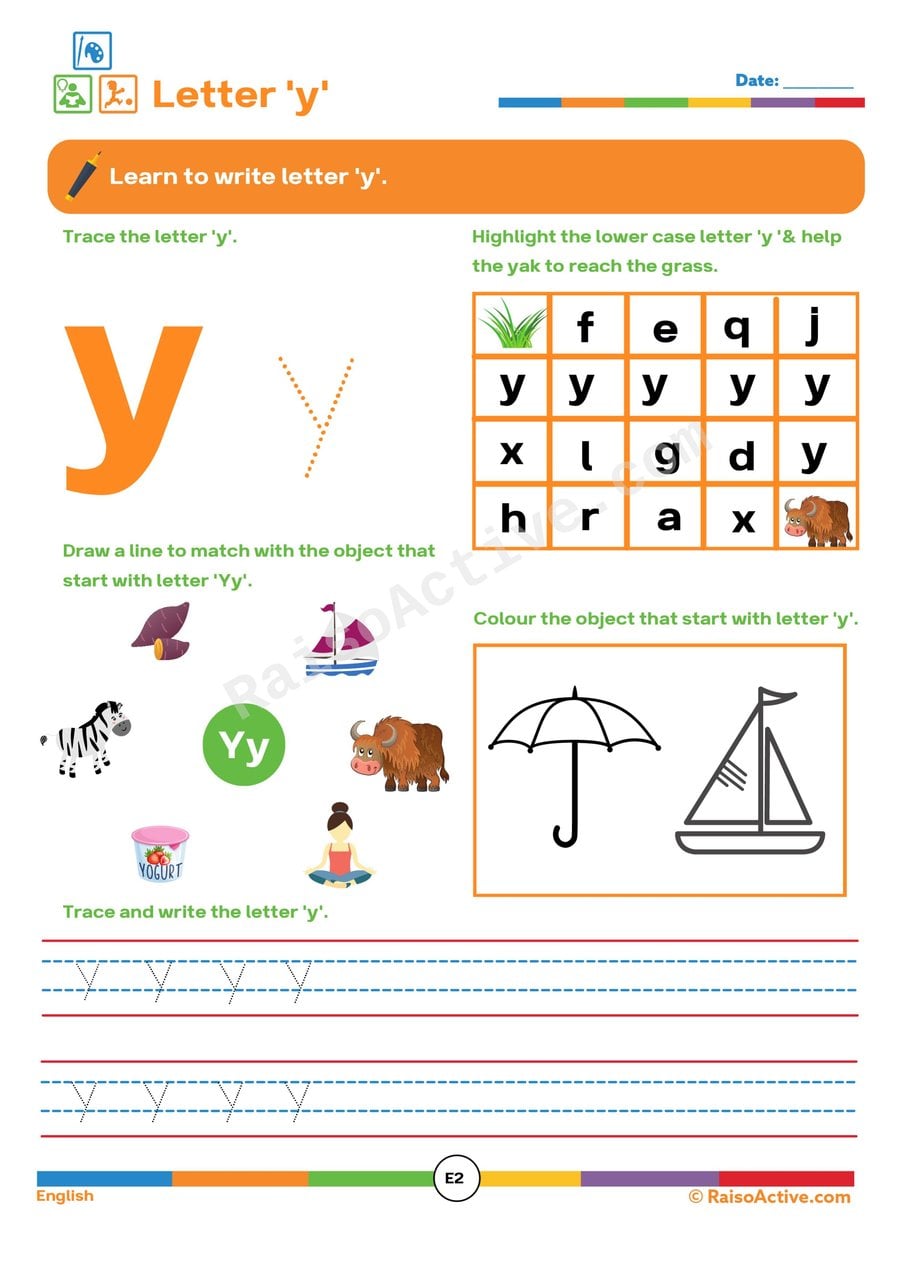
Letter 'y' Worksheet: Trace, Match, and Color!
Ages 3-5 · Preschool–Pre-KAges 3-5 · Nursery–ReceptionAges 3-5 · Nursery–LKGAges 3-5
This letter 'y' worksheet gives children ages 3-5 focused handwriting practice on a letter with a distinctive descending tail, which requires different pencil control than letters that stay above the baseline. Matching and coloring pictures that start with 'y' also builds beginning-sound awareness, linking the letter's shape to its sound through repeated, varied practice.

Number Names Worksheet: Trace, Count, and Match Numbers 1-5!
Ages 3-5 · Preschool–Pre-KAges 3-5 · Nursery–ReceptionAges 3-5 · Nursery–LKGAges 3-5
Tracing, counting, and matching number names for 1 through 5 helps children ages 3-5 connect three different representations of the same quantity — the written word, the numeral, and a countable group of objects. Building this three-way connection early strengthens overall number sense and makes it easier to recognize numbers in whatever form they appear later, whether written as words or digits.
Related worksheets

Shape Dog Craft: Cut and Assemble a Fun Shapes Worksheet!
Ages 3-5 · Preschool–Pre-KAges 3-5 · Nursery–ReceptionAges 3-5 · Nursery–LKGAges 3-5
This worksheet helps children ages 3-5 recognize and assemble basic shapes, like circles, triangles, and squares, into a recognizable dog, reinforcing shape recognition while also building the fine motor precision needed to cut and place pieces accurately. Following a visual example to combine multiple shapes into one picture also strengthens early spatial reasoning.
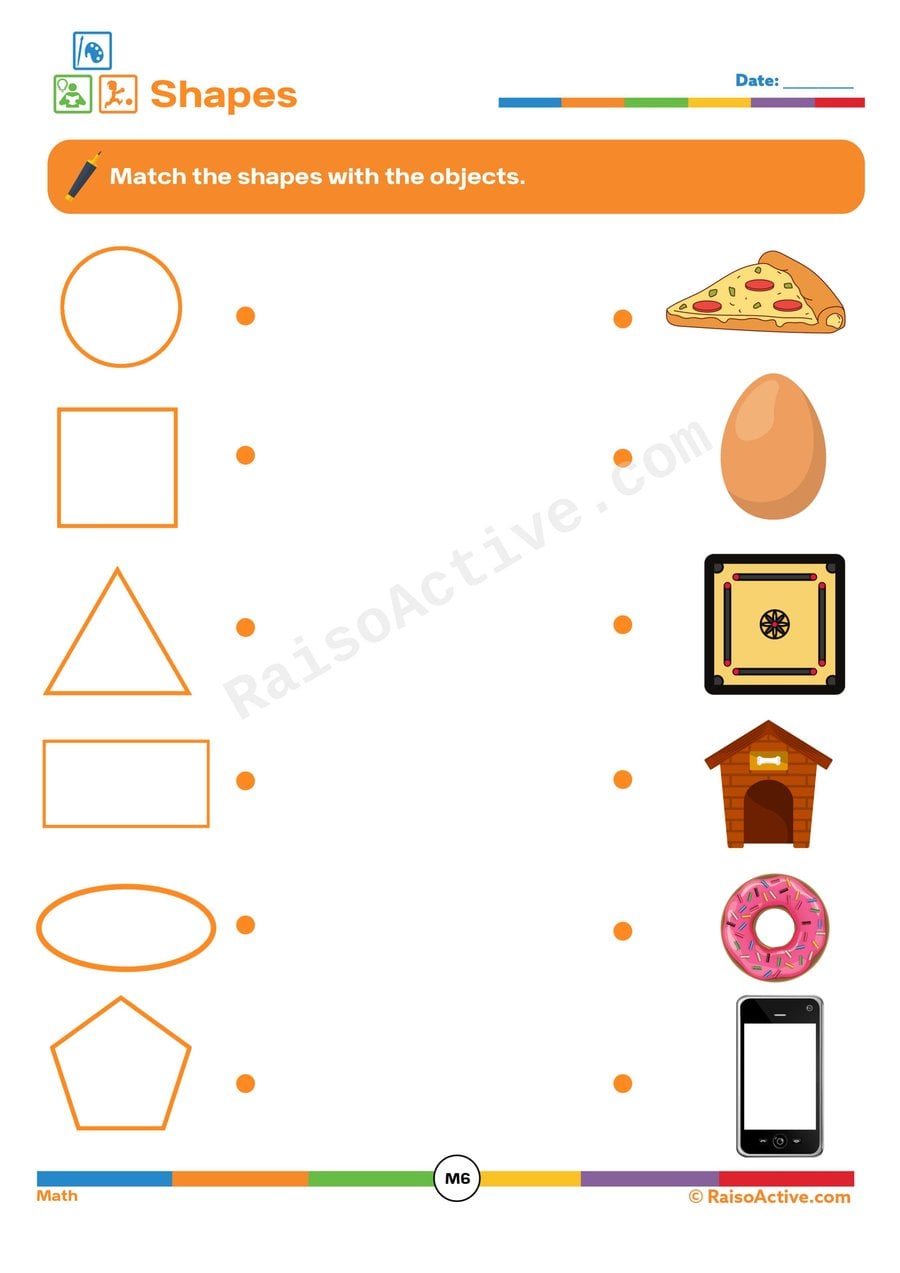
Shape Matching Worksheet for Preschoolers
Ages 3-5 · Preschool–Pre-KAges 3-5 · Nursery–ReceptionAges 3-5 · Nursery–LKGAges 3-5
This worksheet strengthens shape recognition for children ages 3-5 by asking them to connect abstract shape outlines to the real-world objects that share that same shape. Recognizing that a shape like a circle or rectangle can apply to very different objects, such as a clock and a door, helps children generalize shape concepts beyond a single example. Drawing the connecting line between matched pairs also reinforces visual tracking and pencil control.

Shapes Worksheet: Cut and Paste, Complete the Sequence!
Ages 4-5 · Pre-KAges 4-5 · ReceptionAges 4-5 · LKGAges 4-5
This worksheet combines shape identification with pattern completion, asking children ages 4-5 to cut out and paste shapes into matching boxes and then draw the missing shape needed to finish a simple sequence. Together these tasks build geometric vocabulary, precise cutting and gluing control, and the logical reasoning needed to predict what comes next in a repeating pattern.
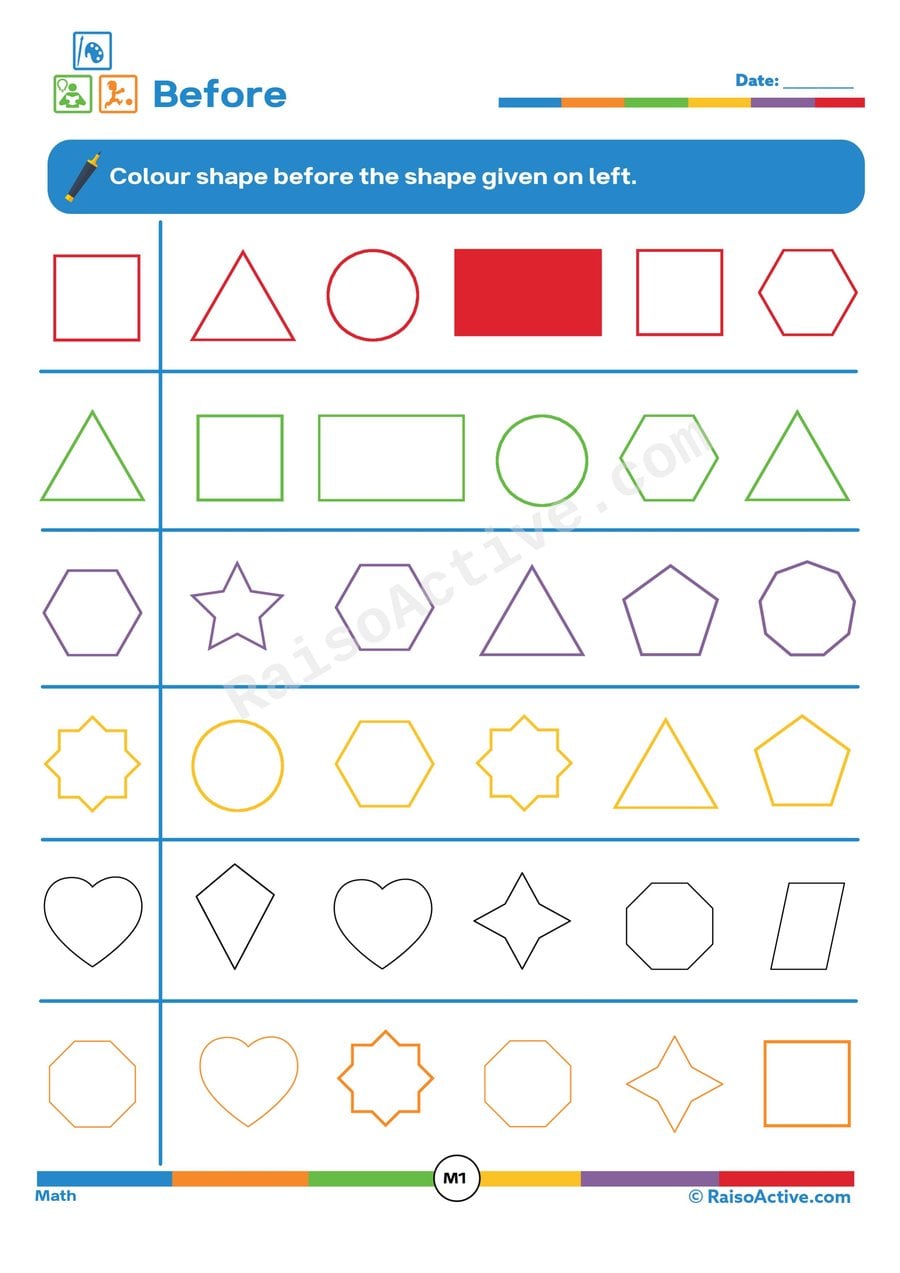
Shape Coloring Worksheet: Before the Shape!
Ages 3-5 · Preschool–Pre-KAges 3-5 · Nursery–ReceptionAges 3-5 · Nursery–LKGAges 3-5
This worksheet combines shape recognition with sequencing by asking children to identify which shape comes before a given shape in a row, requiring them to understand order as well as shape names. For ages three to five, thinking about what comes 'before' something visually is a gentle introduction to ordinal reasoning that will later apply to numbers and letters as well as shapes.
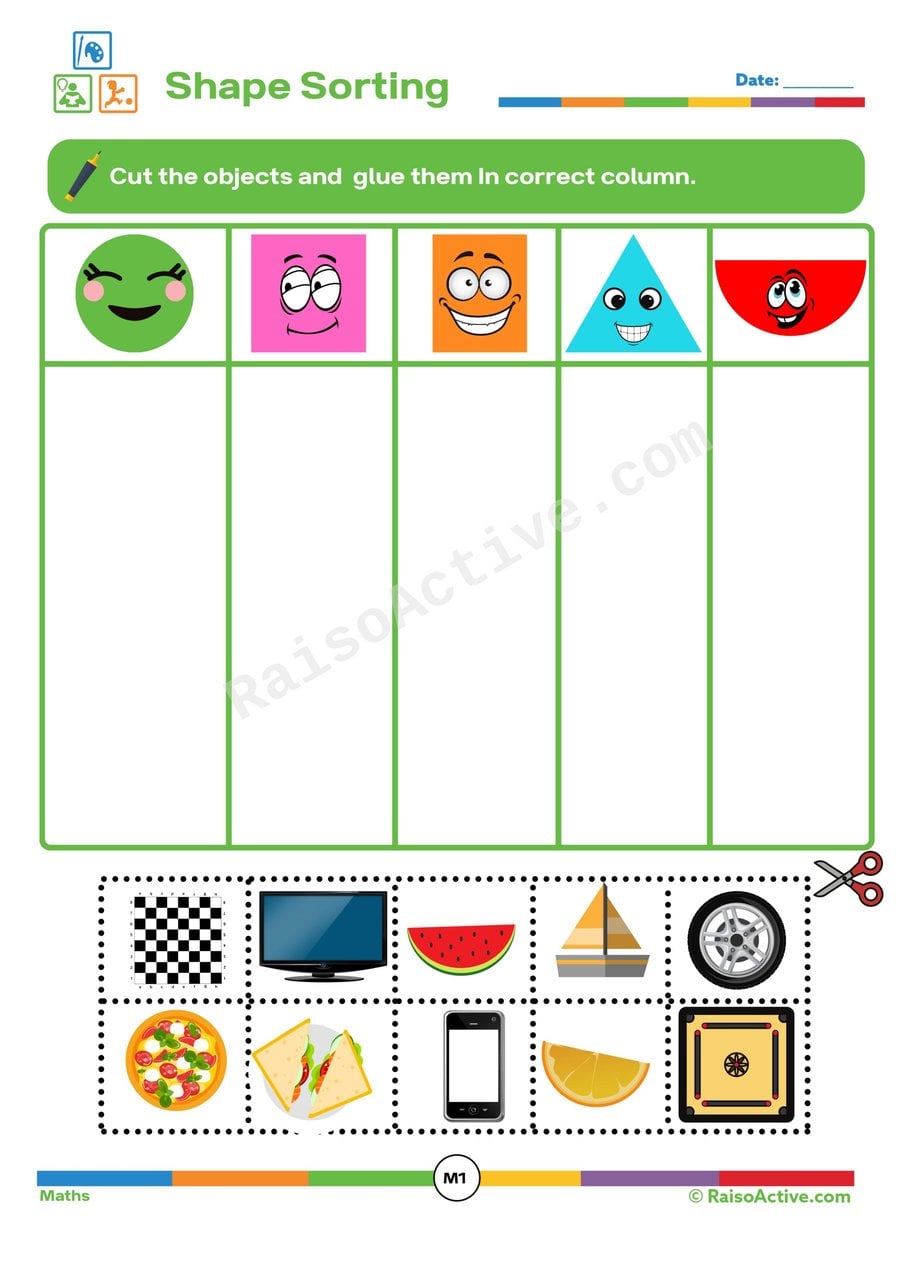
Shape Sorting Worksheet: Cut and Paste Fun!
Ages 3-5 · Preschool–Pre-KAges 3-5 · Nursery–ReceptionAges 3-5 · Nursery–LKGAges 3-5
This cut-and-paste activity asks 3-5 year olds to do more than just name a shape — they have to look at a jumble of circles, squares, and triangles, decide which column each one belongs to, and physically place it there. That sorting step is what builds real shape classification, not just shape labeling, since your child must compare each new piece against the ones already in the column. Cutting the shapes out along their curves and corners is also genuine scissor practice, since curved cuts (circles) are notably harder for small hands than straight ones (triangles, squares).

Shape Matching Worksheet: Circle, Square, Triangle, and Rectangle!
Ages 3-5 · Preschool–Pre-KAges 3-5 · Nursery–ReceptionAges 3-5 · Nursery–LKGAges 3-5
Children ages 3-5 practice recognizing and naming four basic shapes — circle, square, triangle, and rectangle — by matching everyday objects to their shape, then applying that recognition to a themed snowman picture. Counting the circles and triangles that make up the snowman afterward layers a numeracy task on top of the geometry, connecting shape recognition to early counting practice.
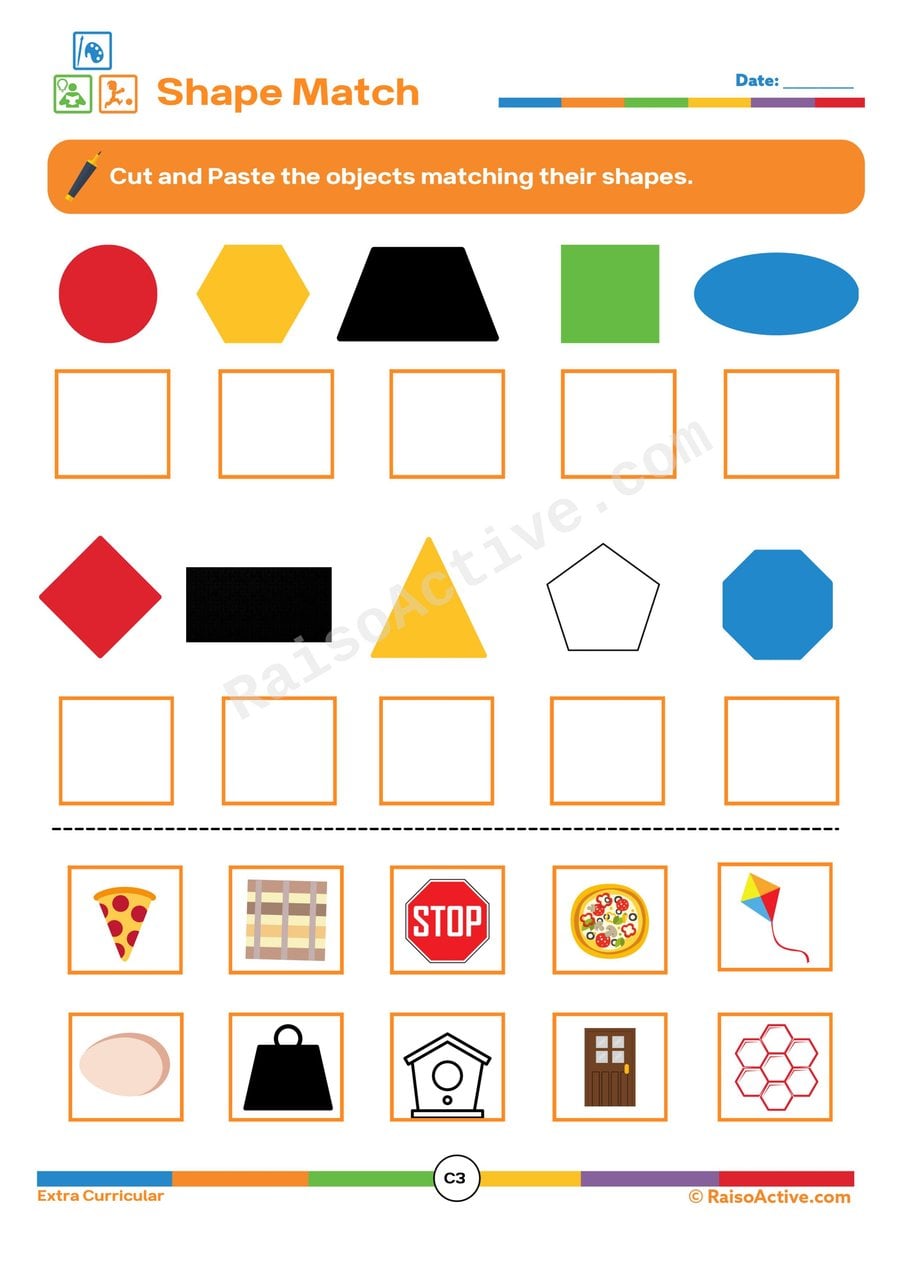
Shape Match Worksheet: Cut and Paste Shapes!
Ages 3-5 · Preschool–Pre-KAges 3-5 · Nursery–ReceptionAges 3-5 · Nursery–LKGAges 3-5
Children ages 3-5 practice shape recognition and visual discrimination as they cut out everyday objects and match each one to the 2D shape it most closely resembles, reinforcing that shapes exist all around them, not just on a worksheet page. This kind of real-world shape matching builds a stronger foundation than memorizing shape names in isolation.

Color the Shapes! A Fun Coloring Worksheet for Kids
Ages 3-5 · Preschool–Pre-KAges 3-5 · Nursery–ReceptionAges 3-5 · Nursery–LKGAges 3-5
This worksheet strengthens children ages 3-5 in both shape recognition and color matching by having them reproduce a colored key onto a black-and-white picture made of shapes. Matching a printed example rather than choosing colors freely also builds a new skill: following a visual reference precisely, which is different from — and complements — open-ended coloring.
Guides for this topic

Fostering Creativity in Structured Learning: The Perfect Balance for Young Minds
Learn how to blend creativity with structured learning for children ages 1-8. Practical strategies, activities, and printable worksheets for parents and teachers.
Celebrating Diversity: How to Incorporate Cultural Awareness in Learning Activities for Young Children
Practical cultural awareness activities for young children aged 2-8. Explore Indian festivals, world cultures, food, music, and crafts to teach diversity and inclusion.
How to Teach Cutting Skills to Your Preschooler: A Complete Guide for Parents and Teachers
Help your child master scissor skills safely. Expert guide covering readiness signs, scissor types, progression steps, pre-cutting exercises, and fun practice ideas for ages 2-6.
Reviews
Every worksheet for ages 3–5, no watermark
Members download the full library of 1,000+ worksheets and every activity pack without watermarks or daily limits. One year costs ₹999 in India or $20 elsewhere.
See membership plansOr download any worksheet free with a watermark (5 a day).