Number Names Worksheet: Trace, Count, and Match Numbers 1-5!
Tracing, counting, and matching number names for 1 through 5 helps children ages 3-5 connect three different representations of the same quantity — the written word, the numeral, and a countable group of objects. Building this three-way connection early strengthens overall number sense and makes it easier to recognize numbers in whatever form they appear later, whether written as words or digits.
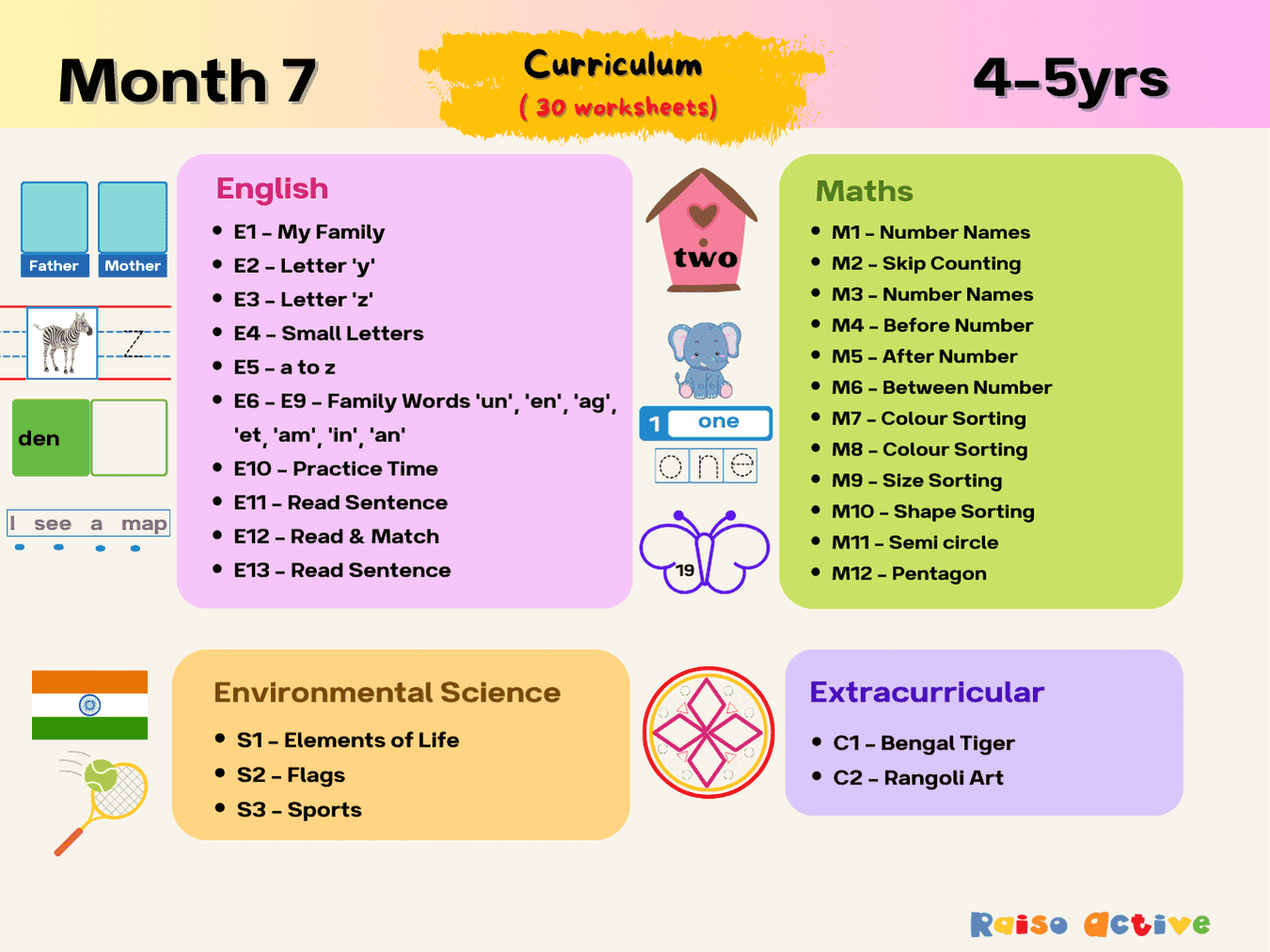
Part of the pack
Month 7: Preschool Skills Through Play | Ages 4-5
This is page 19 of the pack. Ages 4-5 · Pre-KAges 4-5 · ReceptionAges 4-5 · LKGAges 4-5

Made for your child
Counting to 10, made for your child
A maths pack with your child's name in it: pictures that explain, practice at three levels, puzzles and story sums about them. Print a new set whenever they finish.
Make a maths packFree preview · free for members
Curriculum
- Number Recognition > Number Names
How to use this worksheet
Start by tracing the first number name, like 'one,' saying each letter aloud as your child moves the pencil. Have your child count the objects shown in the matching group, pointing to each one and saying the count aloud. Guide them to match that number name to its correct numeral by drawing a line or writing the numeral in a box. Repeat this trace-count-match sequence for numbers one through five, then finish by tracing both the numerals and their number-name words at the bottom of the page.
Materials needed
- Pencil
- Crayons
Extension activities
- 1Make flashcards pairing each number name with its numeral and a group of dots, and practice matching them.
- 2Count everyday objects around the house, like spoons or toy cars, up to five and say the number name aloud.
- 3Sing simple counting songs together that emphasize both the numeral and the number word.
- 4Play a quick game where you hold up fingers and your child says the matching number name.
- 5Write each number name on separate cards and put them in order from one to five together.

Written by
Hemsweta Jain · Teacher Cheena
MBA and Early Childhood Educator, teaching since 2014 · Founder of RaisoActive, Mumbai
Every RaisoActive worksheet is designed and checked by the founder before publishing.
Published · Last reviewed
More from Month 7: Preschool Skills Through Play | Ages 4-5

Z is for Zebra! Letter Z Tracing and Coloring Worksheet
Ages 3-5 · Preschool–Pre-KAges 3-5 · Nursery–ReceptionAges 3-5 · Nursery–LKGAges 3-5
This letter Z worksheet gives children ages 3-5 focused practice recognizing and forming both the uppercase and lowercase versions of one of the trickiest letters to write, since its diagonal strokes differ from the curves and straight lines used in most other letters. Matching and coloring objects that start with 'z' also builds beginning-sound awareness, helping the letter's shape and sound become linked in memory.

Pentagon Fun: Shape Recognition and Craft Activity Worksheet
Ages 3-5 · Preschool–Pre-KAges 3-5 · Nursery–ReceptionAges 3-5 · Nursery–LKGAges 3-5
This worksheet combines shape recognition with a hands-on craft, having children build a pentagon out of popsicle sticks and then find and glue pentagon-shaped pictures onto an outline. For ages 3-5, physically constructing a five-sided shape makes an otherwise abstract geometric concept concrete, while the cut-and-paste portion reinforces shape recognition through visual matching.

Small Letters Worksheet: Practice Writing Lowercase Letters!
Ages 4-5 · Pre-KAges 4-5 · ReceptionAges 4-5 · LKGAges 4-5
Tracing and then independently writing lowercase letters helps children ages 4-5 move from guided hand motion to self-directed letter formation, a critical step toward legible, automatic handwriting. Pairing each letter with a picture also reinforces the letter-sound connection, so children are practicing both motor control and early phonics at the same time.

Bengal Tiger Cut and Paste Worksheet for Preschoolers
Ages 3-5 · Preschool–Pre-KAges 3-5 · Nursery–ReceptionAges 3-5 · Nursery–LKGAges 3-5
Cutting apart and reordering picture strips to rebuild a Bengal tiger image teaches children ages 3-5 to follow multi-step directions while practicing scissor control and sequencing at the same time. Because the final picture only makes sense when the strips are arranged correctly, this activity also builds visual-spatial reasoning as children compare each piece to figure out where it belongs.
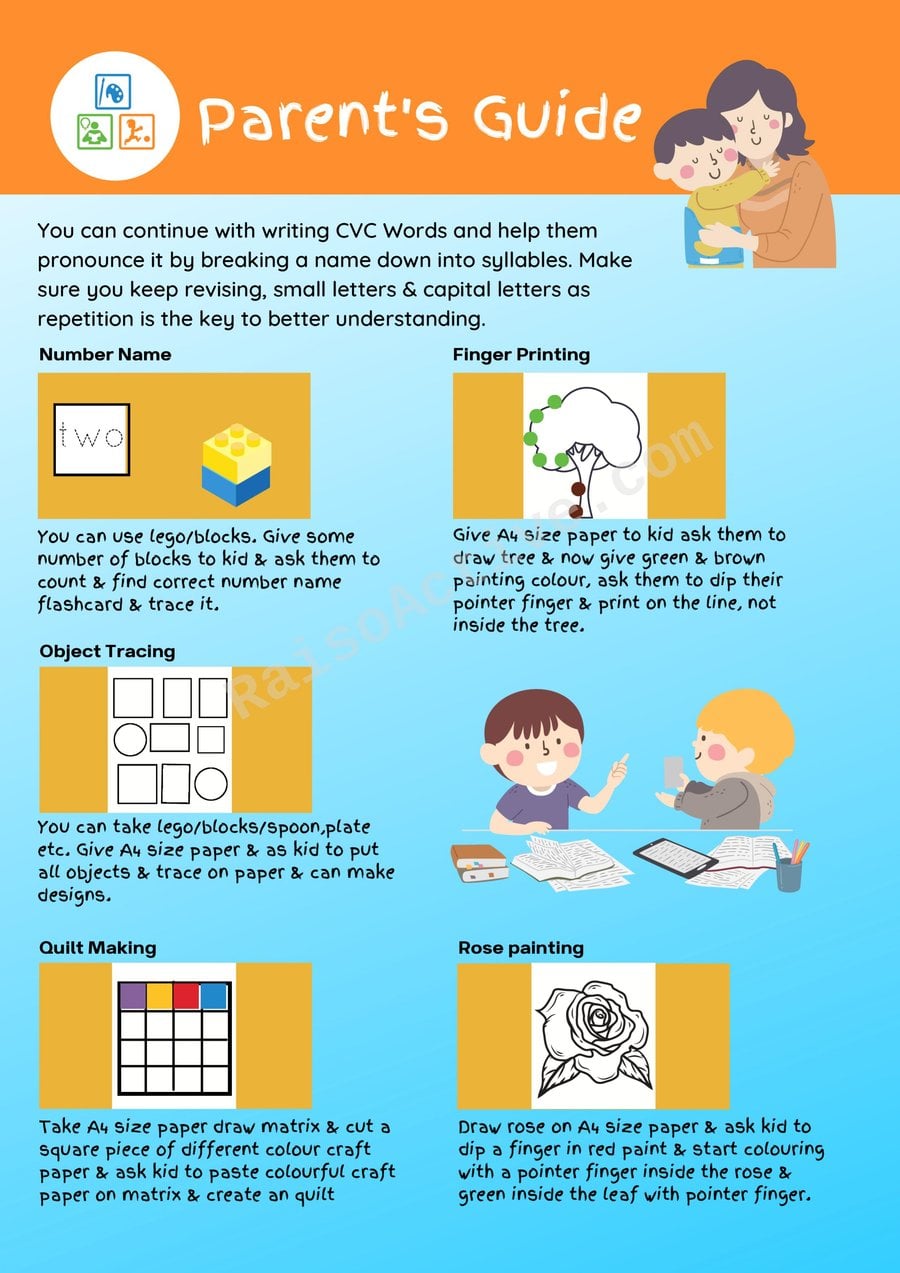
Parent's Guide: Fun Activities for Early Learners
Ages 3-5 · Preschool–Pre-KAges 3-5 · Nursery–ReceptionAges 3-5 · Nursery–LKGAges 3-5
This parent's guide bundles several distinct early-learning activities — number recognition, finger painting, object tracing, simple quilt making, and rose painting — giving children ages 3-5 a varied menu of fine motor, creative, and cognitive practice in one place. Rotating through different activity types like this keeps engagement high while touching multiple developmental areas across a single session or week.
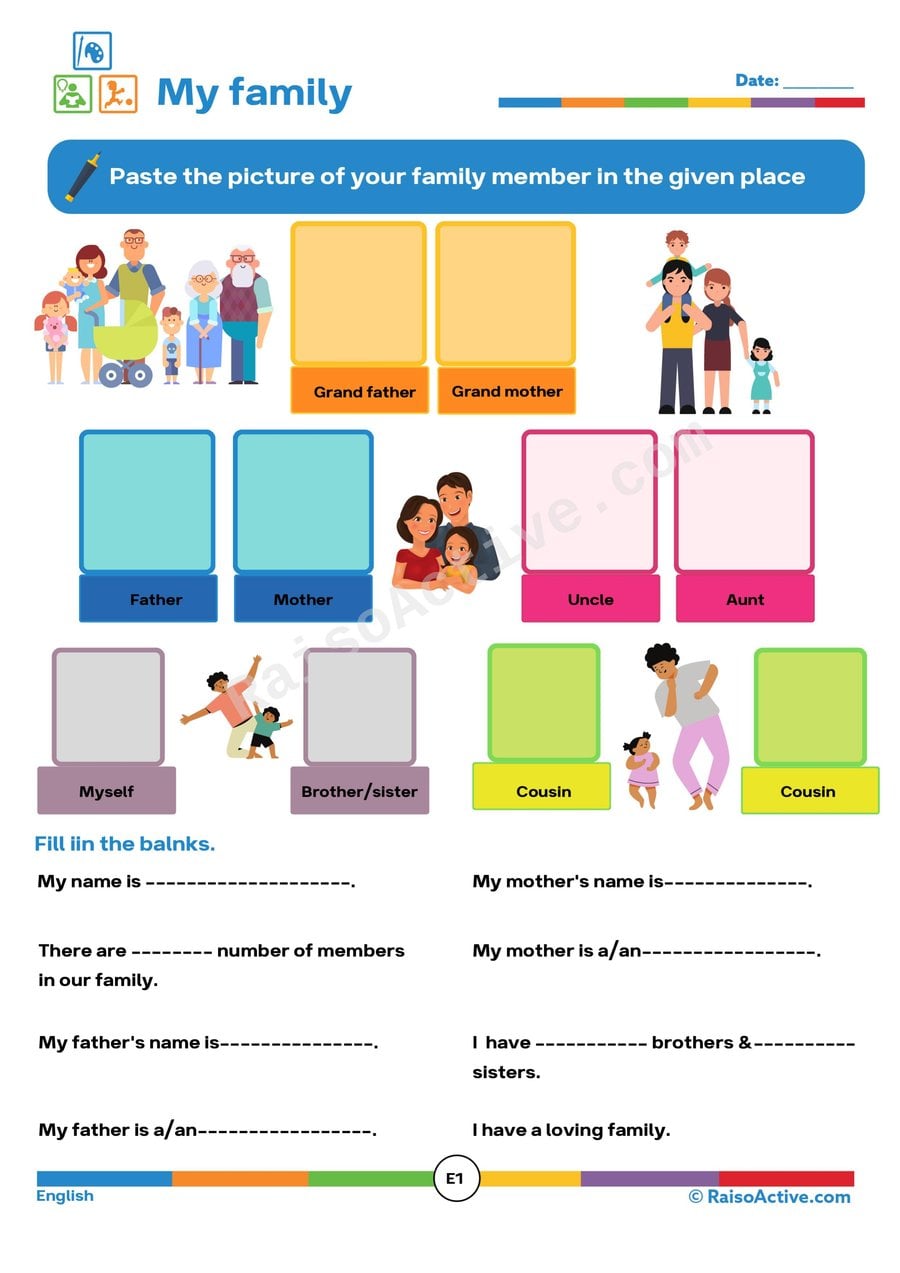
My Family Worksheet: Learn About Family Members!
Ages 3-5 · Preschool–Pre-KAges 3-5 · Nursery–ReceptionAges 3-5 · Nursery–LKGAges 3-5
Describing and pasting pictures of family members helps children practice using descriptive language about people they know well, building both vocabulary and an early sense of identity and belonging. For ages three to five, talking about family structure also introduces social-emotional vocabulary, since children learn to name relationships and describe why family matters to them.

Color Sorting Fun: Cut and Paste Worksheet for Preschoolers
Ages 3-5 · Preschool–Pre-KAges 3-5 · Nursery–ReceptionAges 3-5 · Nursery–LKGAges 3-5
This cut-and-paste activity builds color recognition alongside fine motor control, as children use scissors to cut out pictures and glue them into matching color categories. For ages 3-5, sorting by a single attribute like color is an early classification skill that lays the groundwork for later math concepts like grouping and comparing.
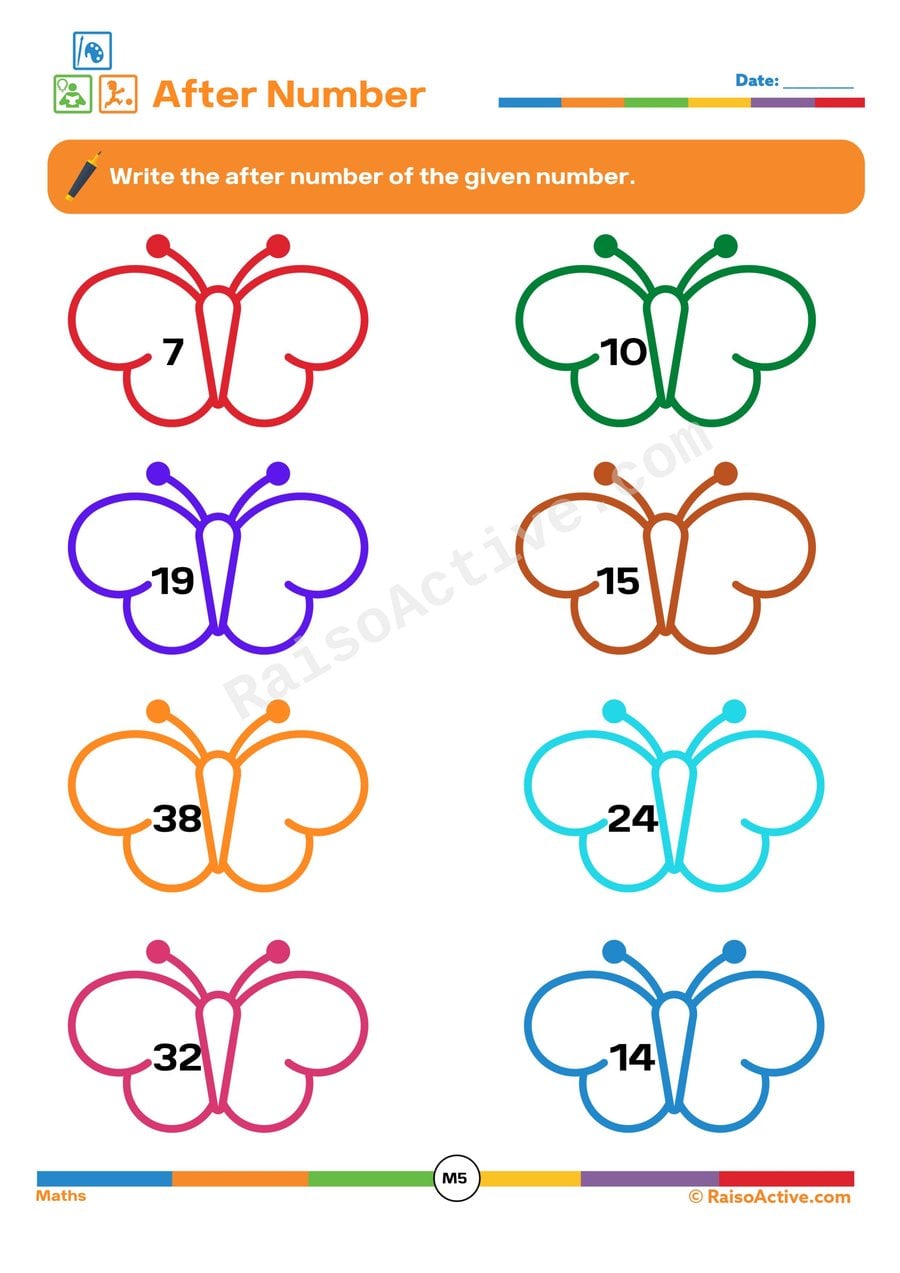
After Number Worksheet: Butterfly Fun!
Ages 4-6 · Pre-K–KindergartenAges 4-6 · Reception–Year 1Ages 4-6 · LKG–UKGAges 4-6
This worksheet targets a specific early-numeracy milestone: understanding that every number has a number that comes immediately after it in sequence. For ages 4-6, practicing 'what comes next' strengthens the mental number line children rely on for later addition, since knowing that 7 comes after 6 is the foundation of counting on.
Related worksheets

Number Names Worksheet: Addition Practice for Kids
Ages 4-6 · Pre-K–KindergartenAges 4-6 · Reception–Year 1Ages 4-6 · LKG–UKGAges 4-6
This worksheet combines addition practice with number-word writing for children ages 4-6, asking them to solve simple addition problems and then spell out the answer using its written name rather than a numeral. Requiring the answer in word form pushes children beyond calculation into applying number vocabulary correctly, reinforcing that 'seven' and '7' represent the same value. This dual task builds both math fluency and early spelling skills together.

Place Value Beads: Count and Fill the Numbers Worksheet
Ages 3-5 · Preschool–Pre-KAges 3-5 · Nursery–ReceptionAges 3-5 · Nursery–LKGAges 3-5
Counting beads on an abacus-style picture and writing the tens and ones totals teaches children ages 3-5 place value through a visual, hands-on representation rather than abstract numerals alone. Solving the final abacus total afterward reinforces that a two-digit number is really the sum of its tens and ones parts.
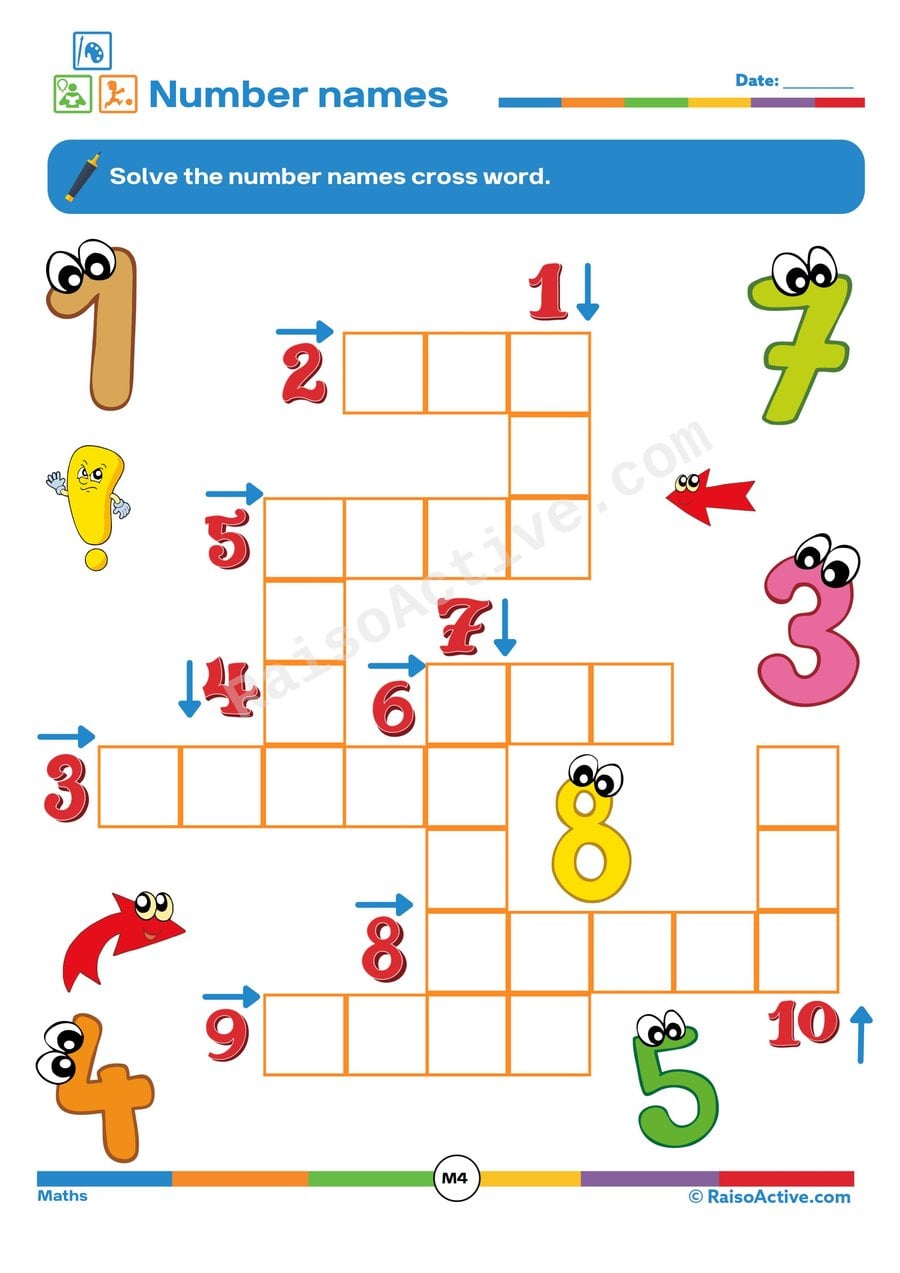
Number Names Crossword Worksheet for Kids
Ages 4-6 · Pre-K–KindergartenAges 4-6 · Reception–Year 1Ages 4-6 · LKG–UKGAges 4-6
Children ages 4-6 practice spelling number names — like 'five', 'twelve', or 'twenty' — by using numeral clues to fill in a crossword grid. This task bridges numeral recognition with word spelling, requiring children to think about both quantity and written vocabulary simultaneously. Fitting letters into the fixed crossword boxes also builds spatial planning and careful letter counting.

Number Names Worksheet: Writing and Matching Numbers 41-50
Ages 4-6 · Pre-K–KindergartenAges 4-6 · Reception–Year 1Ages 4-6 · LKG–UKGAges 4-6
Writing number names like 'forty-one' through 'fifty' next to their numerals helps children ages 4-6 connect the spoken word for a two-digit number to both its written word form and its digit form, deepening overall number sense in this specific range. This worksheet also revisits missing-number sequencing and color-coded boxes, reinforcing the same number range through several different, related tasks rather than one repetitive drill. Building fluency with number names in the 40s prepares children to confidently read numbers they encounter in daily life, from clocks to price tags.

Solar System Number Matching Worksheet for Preschoolers
Ages 4-6 · Pre-K–KindergartenAges 4-6 · Reception–Year 1Ages 4-6 · LKG–UKGAges 4-6
This worksheet combines number-word recognition with a color-by-key coloring task for children ages 4-6, asking them to match number names written on planets to their corresponding numerals before coloring each planet according to a color code. Matching written number words in a space-themed context adds novelty that keeps repeated number-word practice fresh, while the color-key step reinforces careful, sequential following of visual instructions. Together, these two tasks combine literacy and numeracy practice in one engaging page.
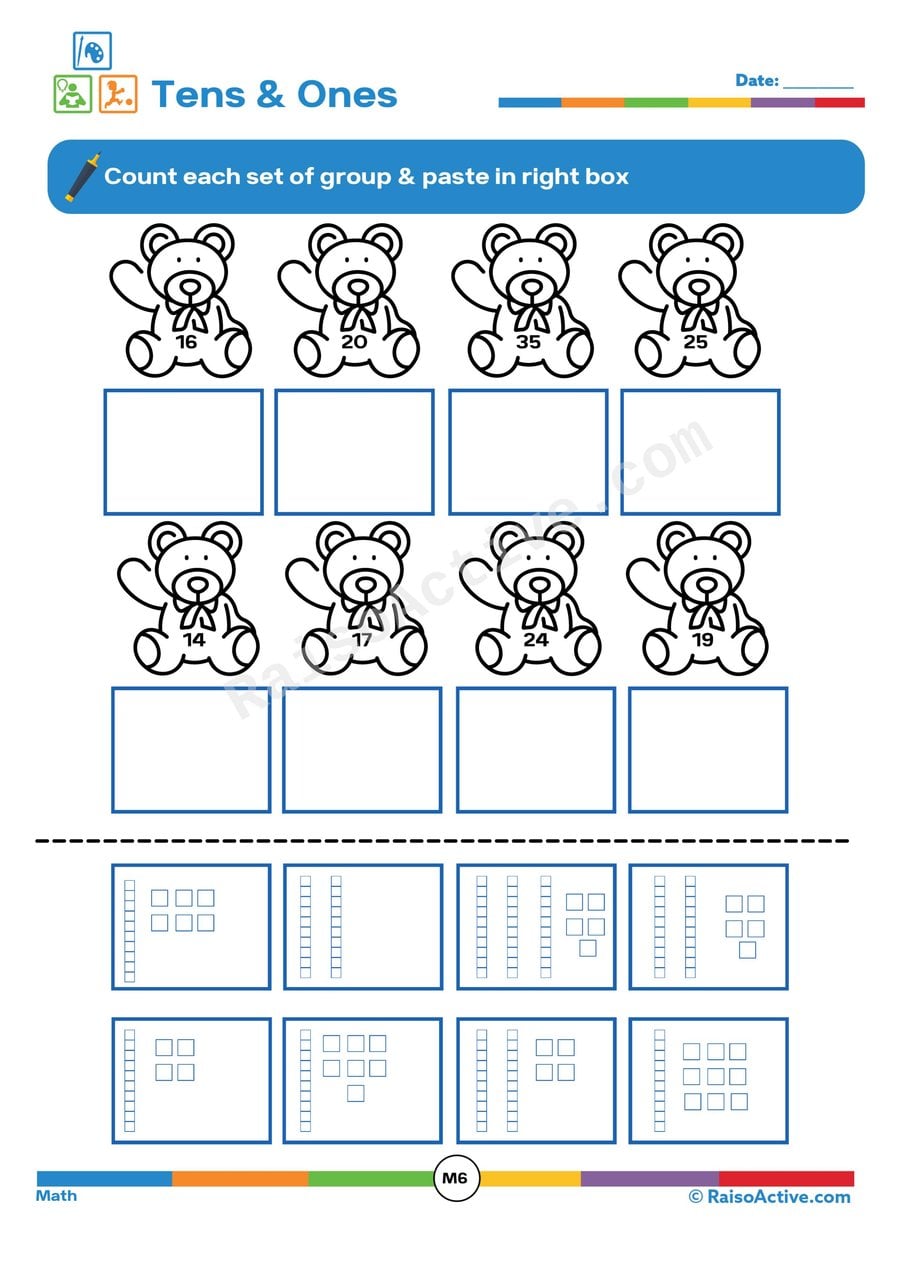
Count and Paste! Tens and Ones Worksheet
Ages 4-6 · Pre-K–KindergartenAges 4-6 · Reception–Year 1Ages 4-6 · LKG–UKGAges 4-6
Counting groups of teddy bears and then matching each total to its tens-and-ones representation teaches children ages 4-6 to connect a counted quantity with its place value breakdown, reinforcing that numbers can be represented in more than one way. Cutting and pasting the matching representation adds fine motor practice to the counting and place value work.
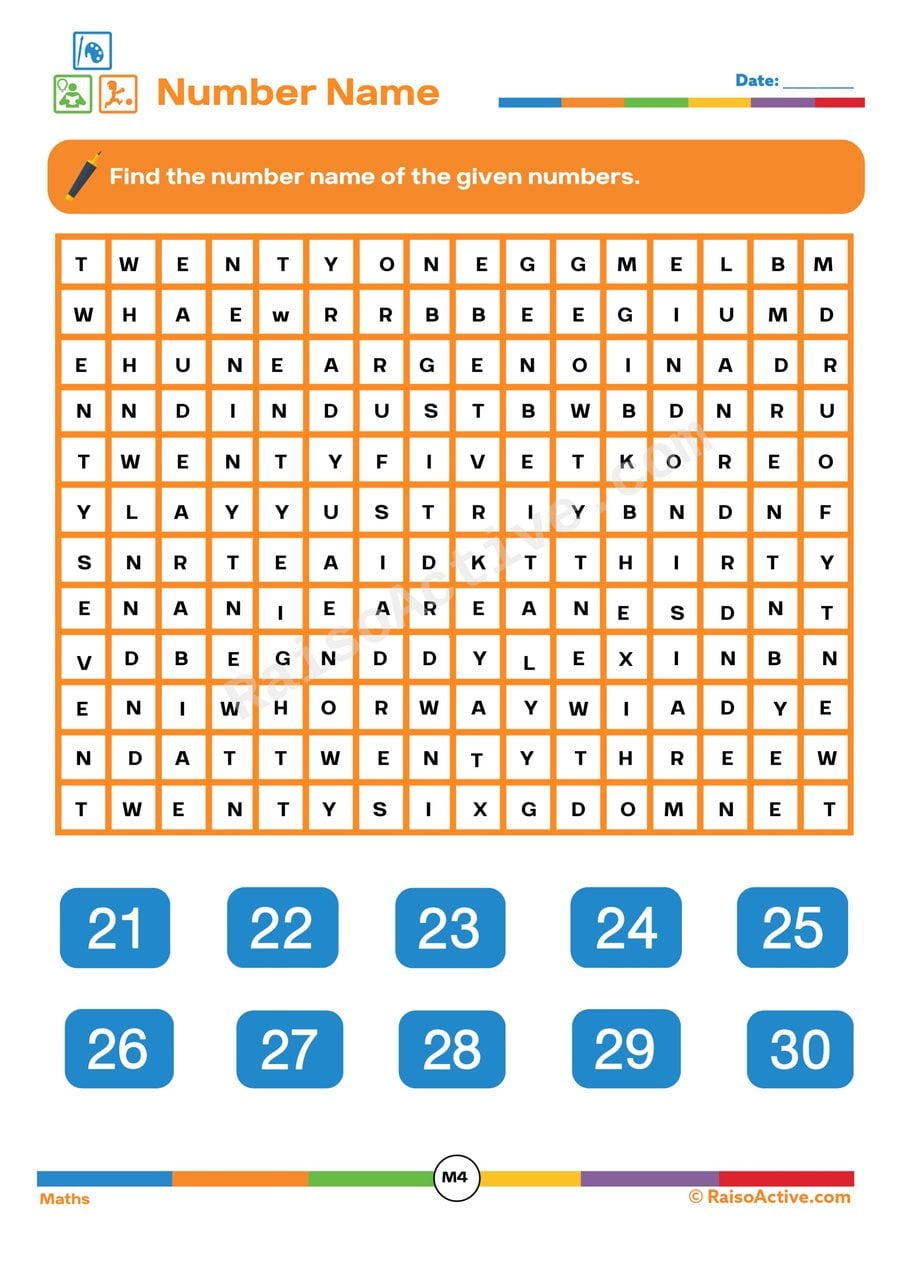
Number Name Word Search Worksheet for Kids
Ages 4-6 · Pre-K–KindergartenAges 4-6 · Reception–Year 1Ages 4-6 · LKG–UKGAges 4-6
This word search worksheet asks children ages 4-6 to visually scan a letter grid to find hidden number names, then match each found word to its numeral — combining spelling recognition, visual scanning, and number sense in one activity. Searching for whole words rather than single letters is a step up in difficulty that pushes early readers to recognize letter patterns quickly.

Number Path: Help the Boy Reach His House! (Numbers 41-50)
Ages 4-6 · Pre-K–KindergartenAges 4-6 · Reception–Year 1Ages 4-6 · LKG–UKGAges 4-6
This maze worksheet takes 4-6 year olds into two-digit number territory, asking them to recognize and sequence numbers 41 through 50 in order to trace a path — a step up in difficulty from single-digit counting since two-digit numbers are easy to reverse or confuse (41 versus 14). Tracing the connecting line also keeps pencil control and hand-eye coordination in play alongside the number work, and the payoff of guiding the boy home gives the counting task a clear, motivating goal.
Guides for this topic

Number Formation Rhymes 0–9 and How to Fix Reversals
Original number formation rhymes for 0–9, the correct stroke order for each digit, why 3, 5 and 7 get reversed most often, and multisensory fixes that work.

Christmas and Winter Activities That Combine Fun and Learning: Creating Magical Educational Experiences
Discover Christmas and winter activities that combine festive fun with real learning. Crafts, counting, literacy, and printable worksheets for ages 2 to 8 — perfect for home and school.
Age-Appropriate Halloween Learning Activities: Balancing Spooks and Skills for Young Learners
Discover fun, age-appropriate Halloween learning activities for young children. Spooky crafts, counting games, literacy ideas, and printable worksheets for ages 2 to 8.
Reviews
Every worksheet for ages 3–5, no watermark
Members download the full library of 1,000+ worksheets and every activity pack without watermarks or daily limits. One year costs ₹999 in India or $20 elsewhere.
See membership plansOr download any worksheet free with a watermark (5 a day).