Shape Frog Cut and Paste Worksheet for Preschoolers
This worksheet gives children ages 3-5 hands-on practice manipulating basic shapes — like triangles, circles, and squares — to assemble a complete picture of a frog. Building a recognizable animal out of separate geometric shapes helps children see how simple shapes combine to form more complex forms, an early step toward representational drawing and spatial construction. Cutting and precisely placing each shape piece also strengthens fine motor coordination.
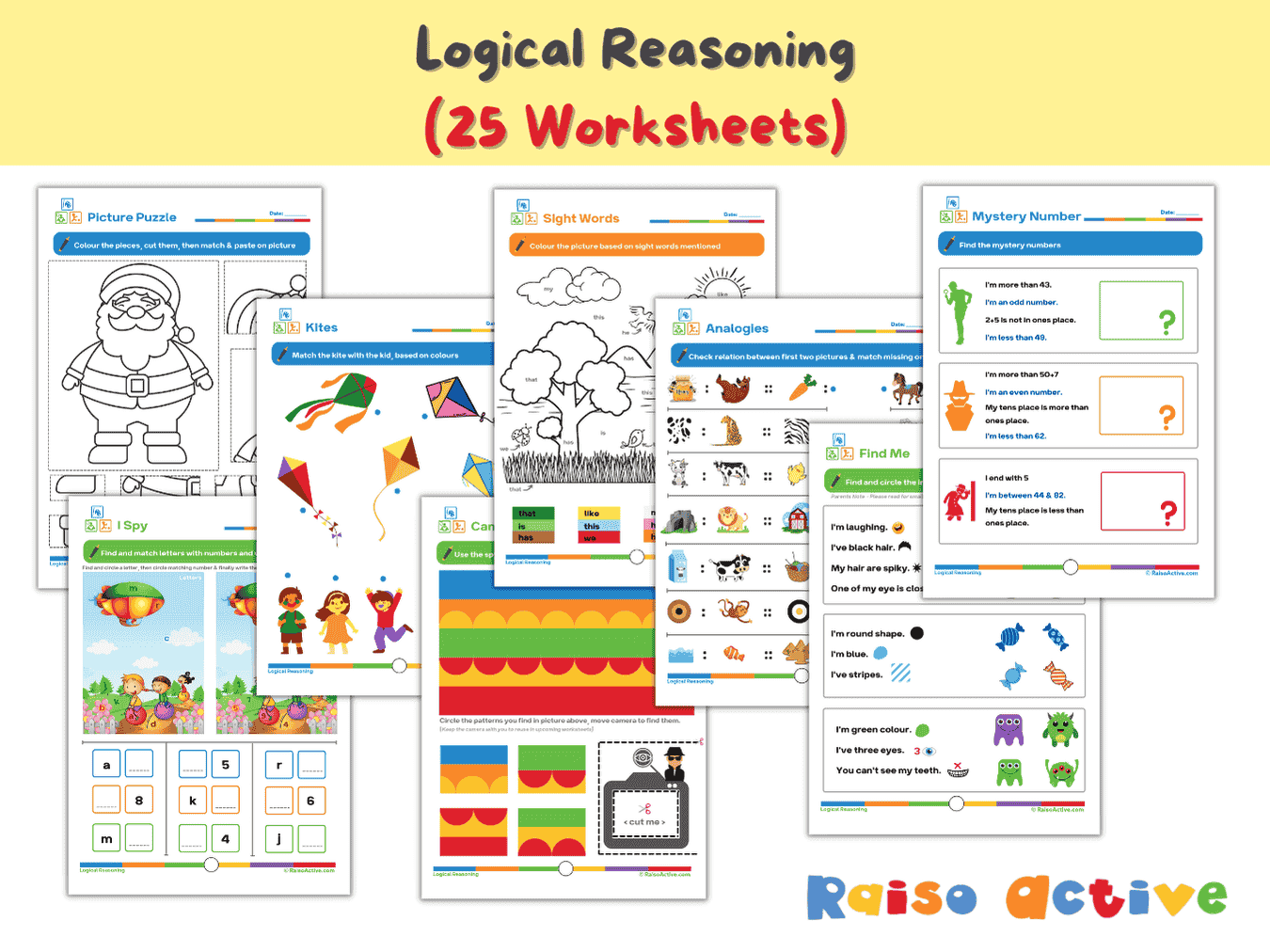
Part of the pack
Logical Reasoning Activity Book for Preschool & Kindergarten | Patterns, Puzzles & Analogies
This is page 4 of the pack. Ages 4-7 · Pre-K–Grade 1Ages 4-7 · Reception–Year 2Ages 4-7 · LKG–Class 1Ages 4-7
Curriculum
- 2D Shapes > Shapes & Sorting
How to use this worksheet
Look at the frog outline and the shape pieces together first, so your child understands which shape goes where before cutting begins. Have your child cut out each shape piece carefully using child-safe scissors. Guide them to place the shapes onto the frog outline in the correct positions — such as a circle for the body and triangles for the eyes — before applying glue. Once the placement looks right, help them glue each shape down to complete the frog.
Materials needed
- Scissors
- Glue
- Pencil
Extension activities
- 1Have the child color the frog after they have pasted the shapes.
- 2Ask the child to identify the shapes they used (triangle, circle, square).
- 3Create other animals using shapes.
- 4Make a simple frog hop game using the finished paper frog and a die.
- 5Look at pictures of real frogs and talk about their shape and color.

Written by
Hemsweta Jain · Teacher Cheena
MBA and Early Childhood Educator, teaching since 2014 · Founder of RaisoActive, Mumbai
Every RaisoActive worksheet is designed and checked by the founder before publishing.
Published · Last reviewed
More from Logical Reasoning Activity Book for Preschool & Kindergarten | Patterns, Puzzles & Analogies

Camera Spy: Find the Patterns Worksheet for Preschoolers
Ages 3-5 · Preschool–Pre-KAges 3-5 · Nursery–ReceptionAges 3-5 · Nursery–LKGAges 3-5
This pattern-recognition worksheet has children ages 3-5 study a set pattern shown at the top of the page and then locate that same repeating sequence within smaller boxes below, training visual comparison and pattern-matching across separate parts of a page. Unlike simply continuing a pattern, this format asks children to recognize an identical pattern elsewhere, a subtly different and useful skill for later tasks like matching sets or comparing groups. Repeating this scan-and-match process across several boxes builds sustained visual attention.

Color by Number Snowman Worksheet for Preschoolers
Ages 3-5 · Preschool–Pre-KAges 3-5 · Nursery–ReceptionAges 3-5 · Nursery–LKGAges 3-5
This color-by-number worksheet helps children ages 3-5 practice number recognition and color matching simultaneously, using a snowman picture divided into numbered sections. Reading a number key and applying it consistently across an entire picture builds sustained attention and careful visual tracking, since a single mistake can be spotted easily against the intended design. This combination of numeracy and following directions makes color-by-number activities a favorite bridge between math and art.
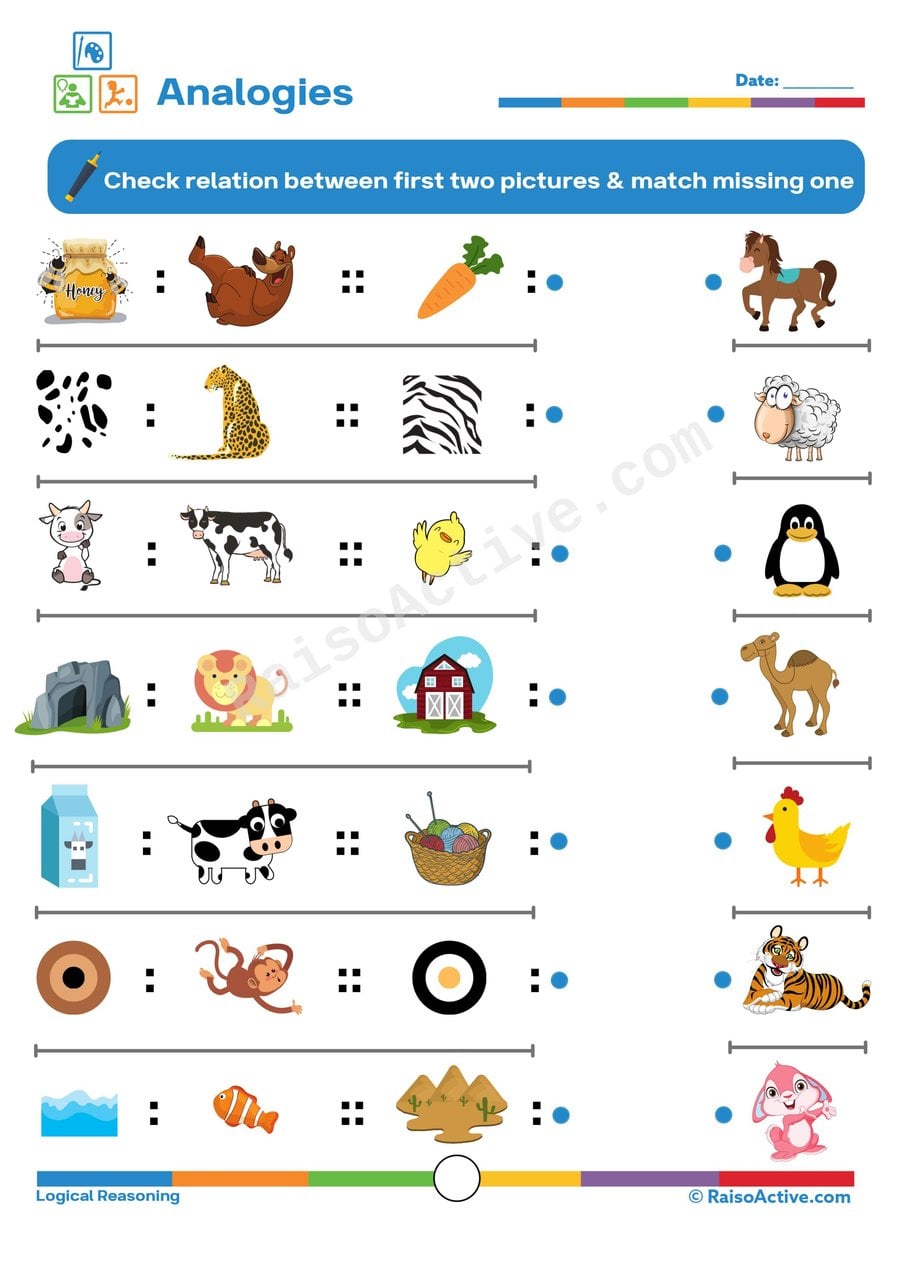
Analogies Worksheet: Match the Pictures!
Ages 4-6 · Pre-K–KindergartenAges 4-6 · Reception–Year 1Ages 4-6 · LKG–UKGAges 4-6
Identifying the relationship between two pictures and then finding a third picture that completes the same relationship teaches children ages 4-6 an early form of analogical reasoning, a skill that underlies much of later logical and mathematical thinking. Because children must first figure out an abstract relationship, like cause and effect or part to whole, before applying it to a new pair, this worksheet is more advanced than simple picture matching. Drawing a line to connect the completed analogy gives a clear, hands-on way to show their reasoning.

Holiday Sudoku: Cut and Paste Picture Puzzle Worksheet
Ages 4-6 · Pre-K–KindergartenAges 4-6 · Reception–Year 1Ages 4-6 · LKG–UKGAges 4-6
This holiday-themed sudoku worksheet builds logical reasoning and problem-solving skills in children ages 4-6 by having them determine which holiday picture is missing from each row and column of a puzzle grid. Solving a picture sudoku by elimination, rather than by simple matching, requires children to hold multiple constraints in mind at once — what's already in the row and what's already in the column — which is genuinely challenging early logic practice. The festive imagery adds motivation and seasonal fun to an otherwise abstract reasoning task.

Secret Words Worksheet: Matching Shapes and Letters!
Ages 3-5 · Preschool–Pre-KAges 3-5 · Nursery–ReceptionAges 3-5 · Nursery–LKGAges 3-5
Matching shapes to letters and then using that code to figure out a sequence of pictures teaches children ages 3-5 early symbolic reasoning, understanding that one thing, a shape, can stand in for another, a letter. This kind of code-breaking task builds logical thinking and pattern recognition beyond simple matching, since children must apply a rule consistently across multiple steps to reach a final answer. Framing the activity as uncovering a 'secret word' adds a sense of mystery and motivation that keeps children engaged through a multi-step reasoning task.
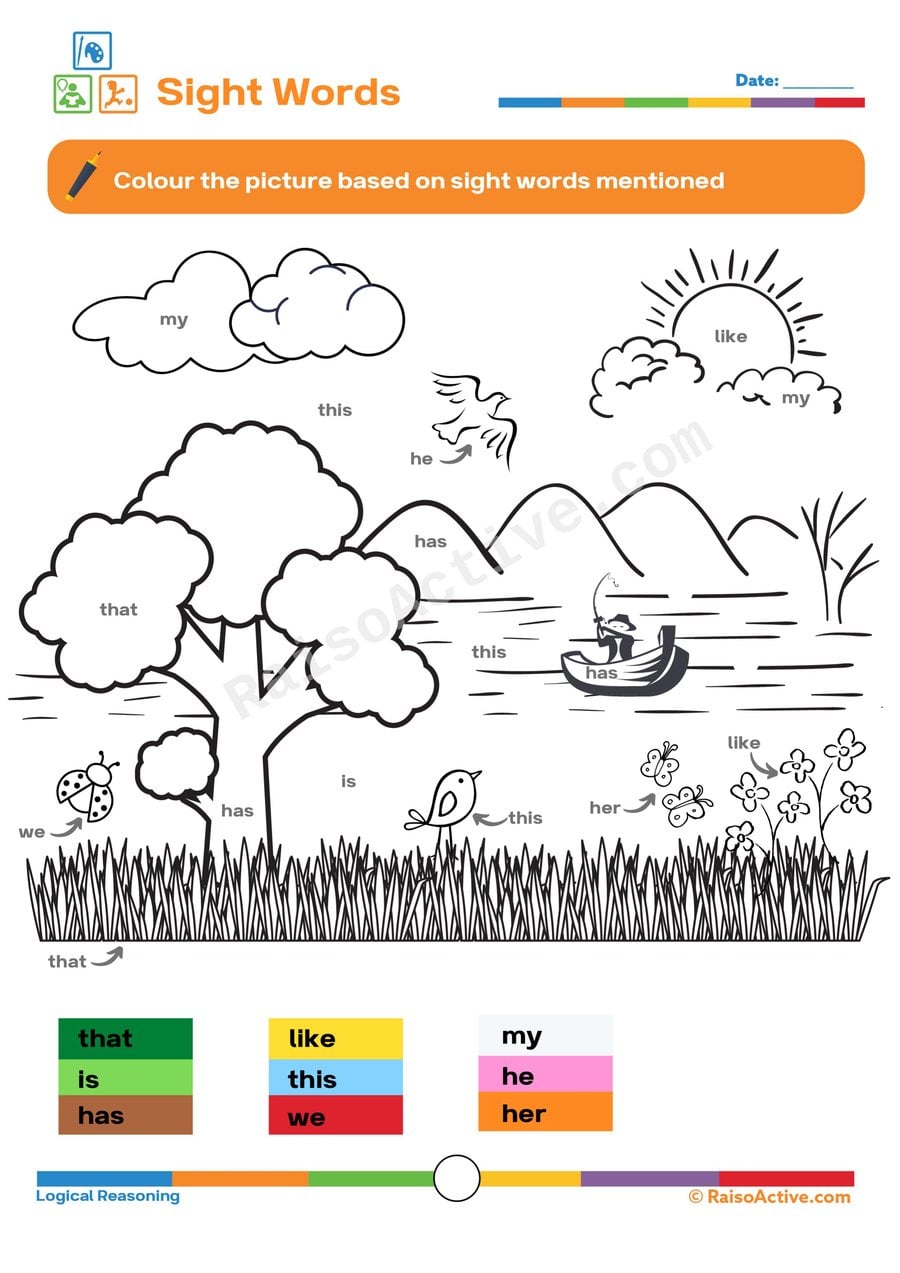
Sight Word Coloring Worksheet for Preschoolers
Ages 3-5 · Preschool–Pre-KAges 3-5 · Nursery–ReceptionAges 3-5 · Nursery–LKGAges 3-5
This worksheet helps children ages 3-5 build sight-word recognition by having them read common high-frequency words and use a color key to decide how to color the corresponding pictures. Connecting a printed word to a coloring decision requires children to actually read and recall the word's meaning, rather than just copying or tracing it, which is a genuine step toward independent reading. The coloring format also keeps the repeated word-reading practice feeling like an art activity rather than a drill.
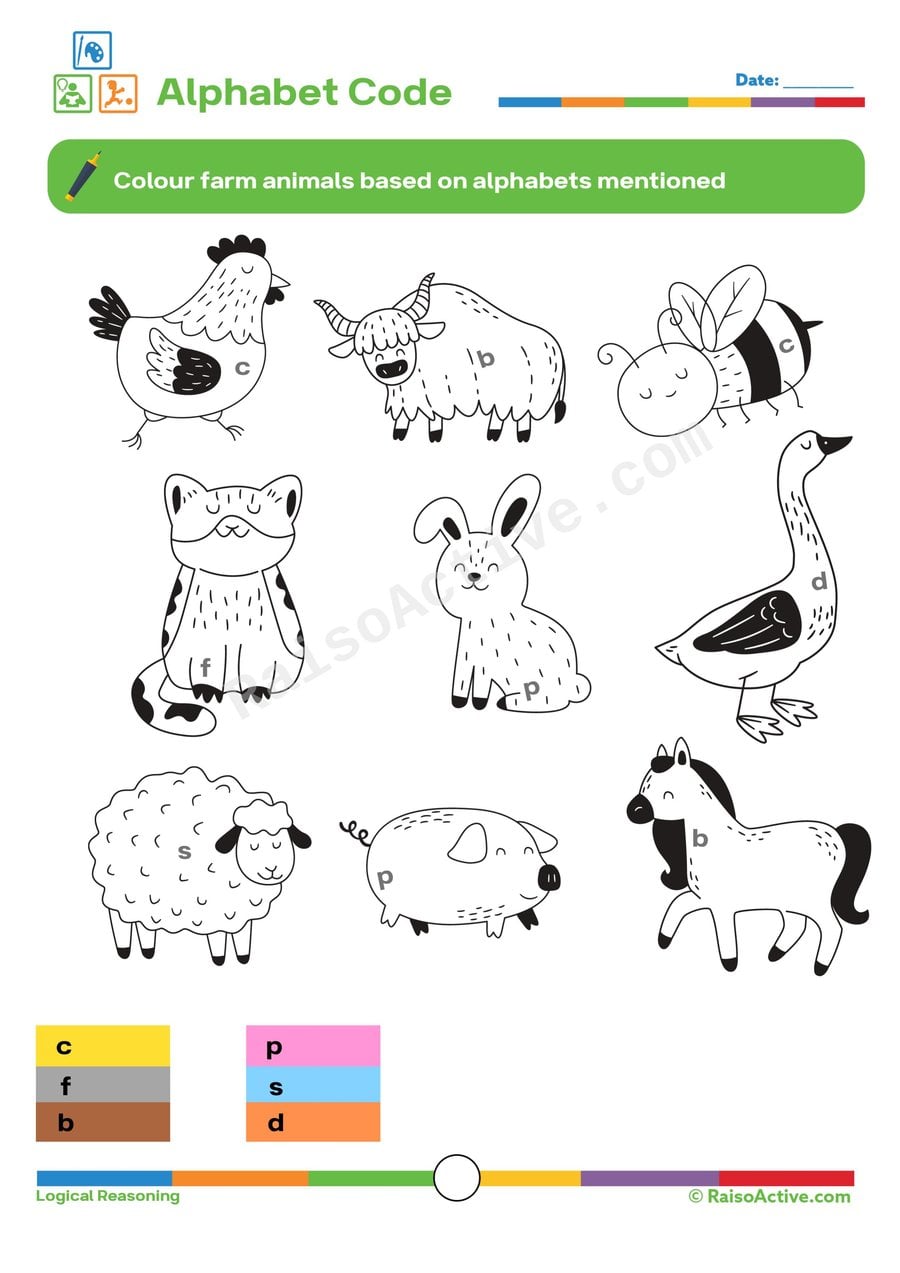
Color the Farm Animals! Alphabet Code Worksheet
Ages 3-5 · Preschool–Pre-KAges 3-5 · Nursery–ReceptionAges 3-5 · Nursery–LKGAges 3-5
Children ages 3-5 practice letter recognition and instruction-following by coloring farm animals according to a color code tied to specific letters. Matching a letter to its assigned color adds an extra layer of symbolic thinking beyond simple coloring, since children must hold both a letter and a color in mind at once.

Pizza Pattern Matching Worksheet for Preschoolers
Ages 3-5 · Preschool–Pre-KAges 3-5 · Nursery–ReceptionAges 3-5 · Nursery–LKGAges 3-5
This worksheet uses a pizza-slice theme to build visual discrimination and pattern-completion skills in children ages 3-5, asking them to match a missing pizza slice to the whole pizza it belongs to. Matching a piece to its correct whole requires children to compare small visual details, like topping arrangement or slice shape, which sharpens attention to detail beyond simple color or shape matching. The food theme adds a fun, relatable context that keeps young children engaged with the visual comparison task.
Related worksheets
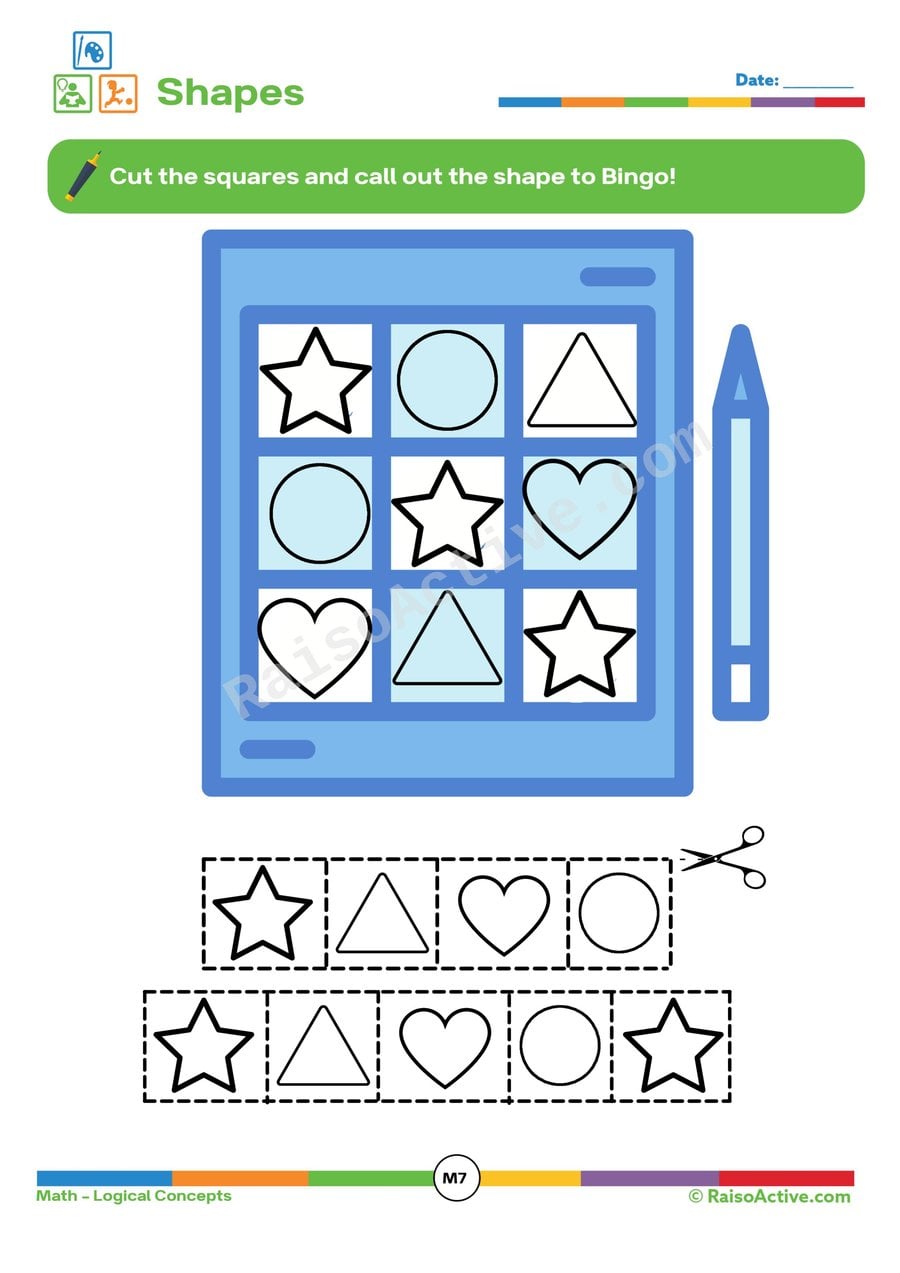
Shape Bingo Worksheet: Cut and Identify Shapes!
Ages 3-5 · Preschool–Pre-KAges 3-5 · Nursery–ReceptionAges 3-5 · Nursery–LKGAges 3-5
This worksheet turns shape recognition into a bingo-style game for children ages 3-5, asking them to cut out shapes and match them to identical shapes on a bingo board. The bingo format adds a playful, goal-oriented structure to shape practice, motivating children to scan carefully for stars, circles, triangles, and hearts. Calling out each shape name as it's matched also builds verbal shape vocabulary alongside visual recognition.
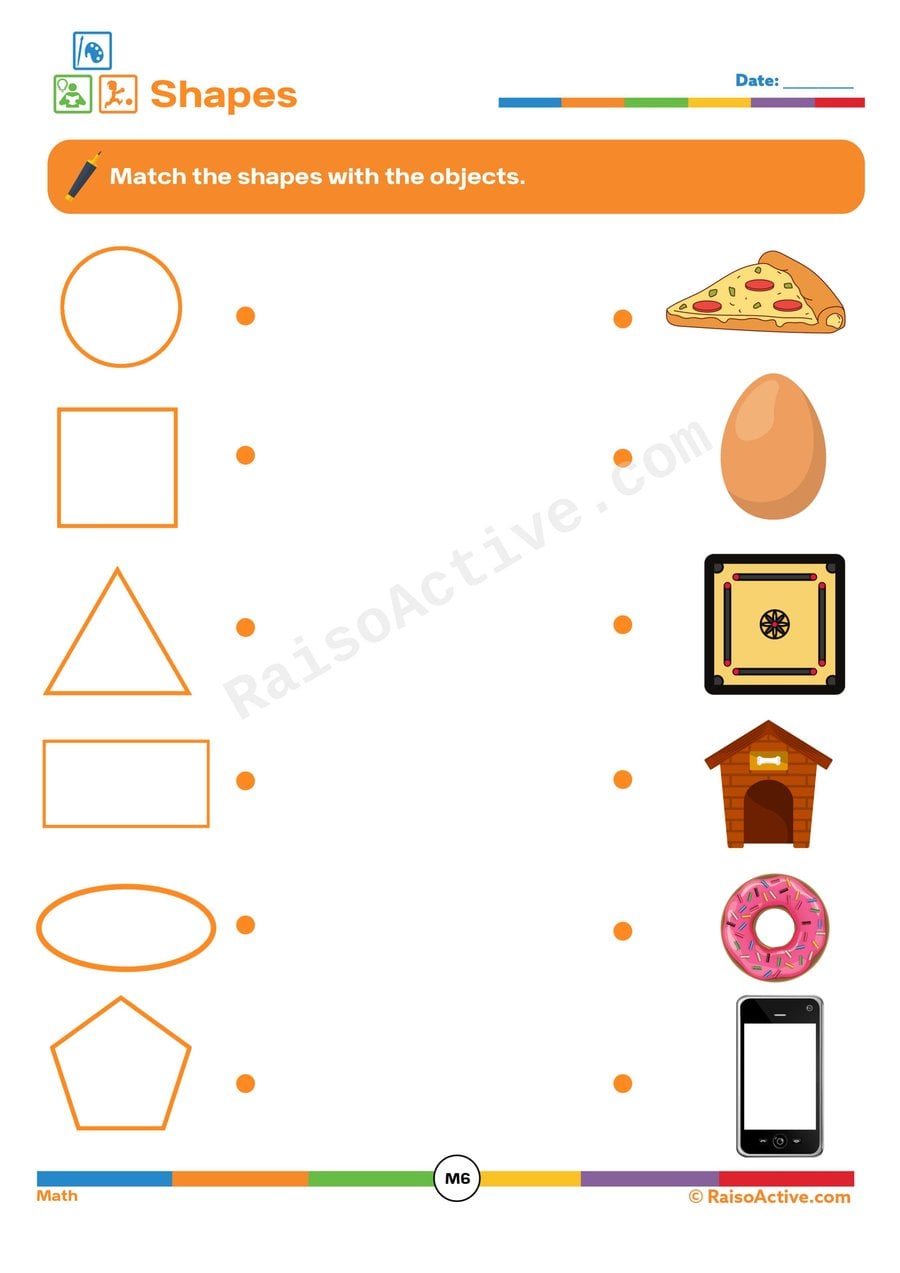
Shape Matching Worksheet for Preschoolers
Ages 3-5 · Preschool–Pre-KAges 3-5 · Nursery–ReceptionAges 3-5 · Nursery–LKGAges 3-5
This worksheet strengthens shape recognition for children ages 3-5 by asking them to connect abstract shape outlines to the real-world objects that share that same shape. Recognizing that a shape like a circle or rectangle can apply to very different objects, such as a clock and a door, helps children generalize shape concepts beyond a single example. Drawing the connecting line between matched pairs also reinforces visual tracking and pencil control.
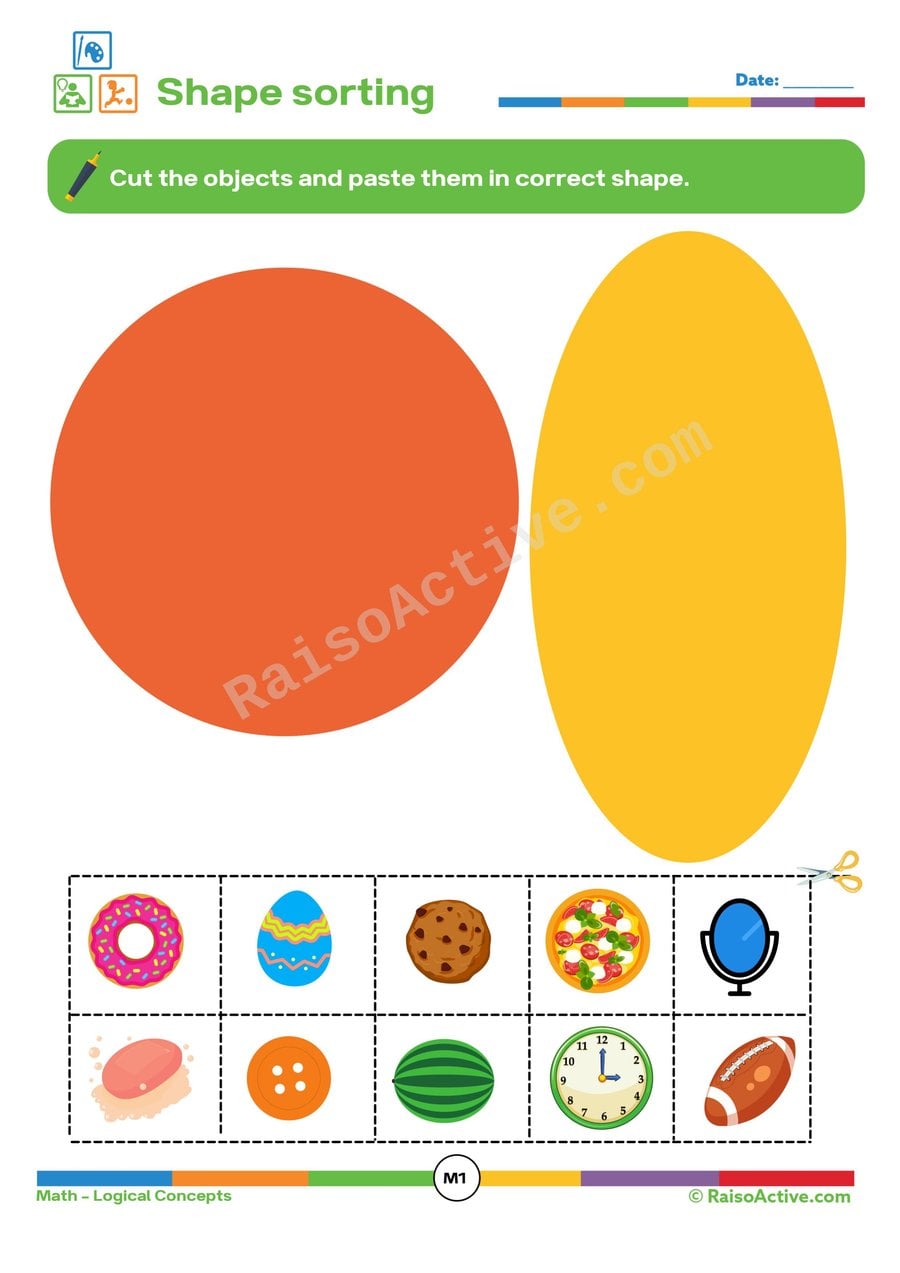
Shape Sorting Worksheet: Cut and Paste Fun!
Ages 3-5 · Preschool–Pre-KAges 3-5 · Nursery–ReceptionAges 3-5 · Nursery–LKGAges 3-5
Sorting everyday objects — a plate, an egg, a clock — into 'circle' or 'oval' bins asks a 3-5 year old to look past what an object is and notice its geometric shape instead, an early step toward abstract categorization. Cutting along the outline of each picture and gluing it into the right column also builds the scissor control and hand-eye coordination that later supports handwriting.
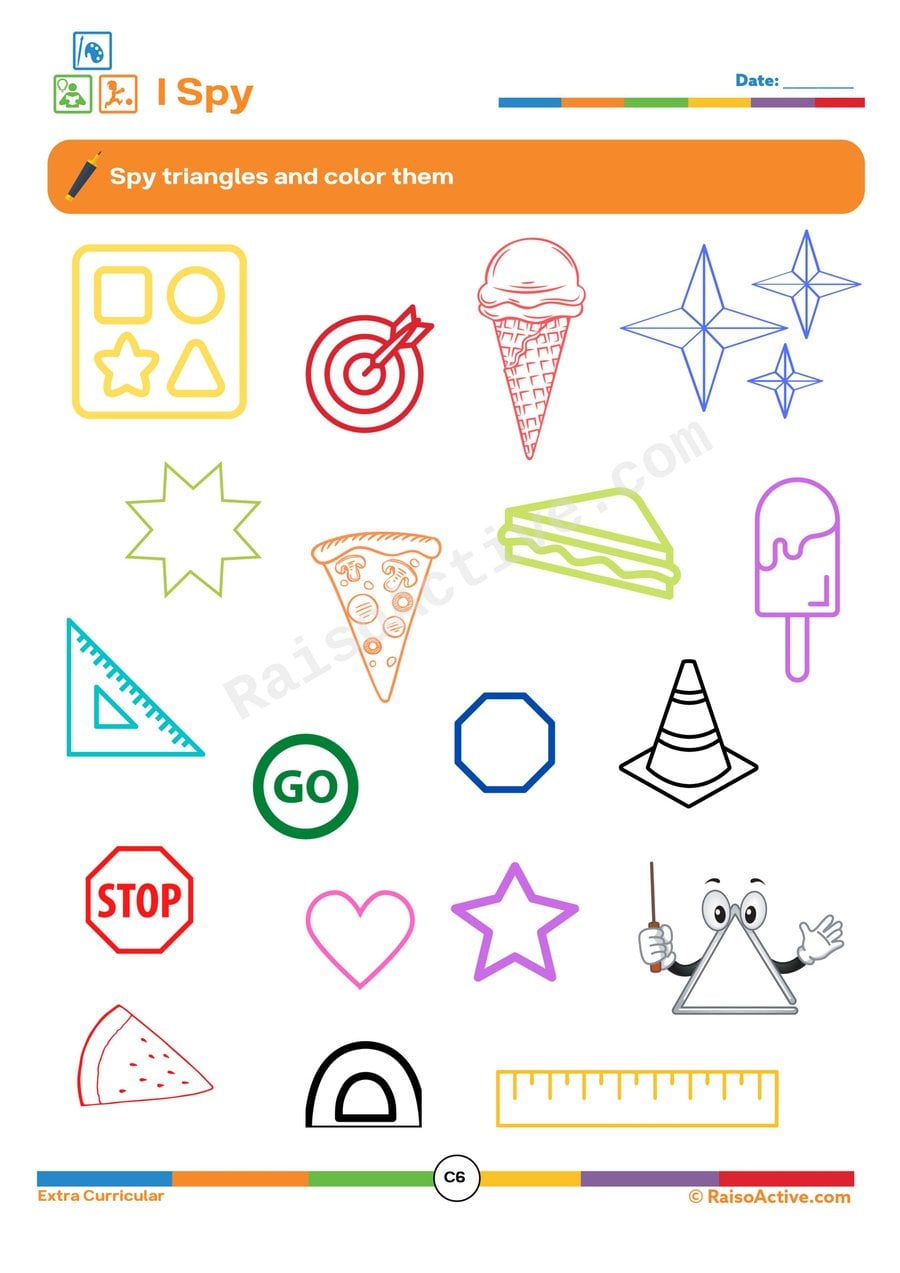
I Spy Triangles Worksheet: Find and Color!
Ages 3-5 · Preschool–Pre-KAges 3-5 · Nursery–ReceptionAges 3-5 · Nursery–LKGAges 3-5
This 'I Spy' style worksheet trains children ages 3-5 to visually pick out triangles hidden within a busier picture, building the visual discrimination skill of recognizing a specific shape by its defining feature — three straight sides and three corners — even when it's surrounded by other shapes or details. This kind of active shape-hunting goes beyond simple shape naming to real visual search practice.

Shape Song Fun: Color & Learn Shapes Worksheet for Preschoolers
Ages 3-5 · Preschool–Pre-KAges 3-5 · Nursery–ReceptionAges 3-5 · Nursery–LKGAges 3-5
Coloring each shape according to its outline helps children ages 3-5 practice recognizing 2D shapes while staying within lines, and singing the accompanying shape song adds a rhythmic memory aid that makes shape names easier to recall. Combining a physical coloring task with an auditory song appeals to multiple ways young children learn best.

Shape Counting Fun: Trace, Color, and Count the Shapes!
Ages 3-5 · Preschool–Pre-KAges 3-5 · Nursery–ReceptionAges 3-5 · Nursery–LKGAges 3-5
Tracing a dotted boat outline builds pencil control in children ages 3-5, while coloring the completed picture adds a creative, low-pressure finishing step. Counting the different shapes that make up the boat afterward connects shape recognition to number writing, since children must identify each shape type, tally how many appear, and record that total in a box. Combining tracing, coloring, and counting into one worksheet gives a well-rounded mix of fine motor and early math practice in a single sitting.
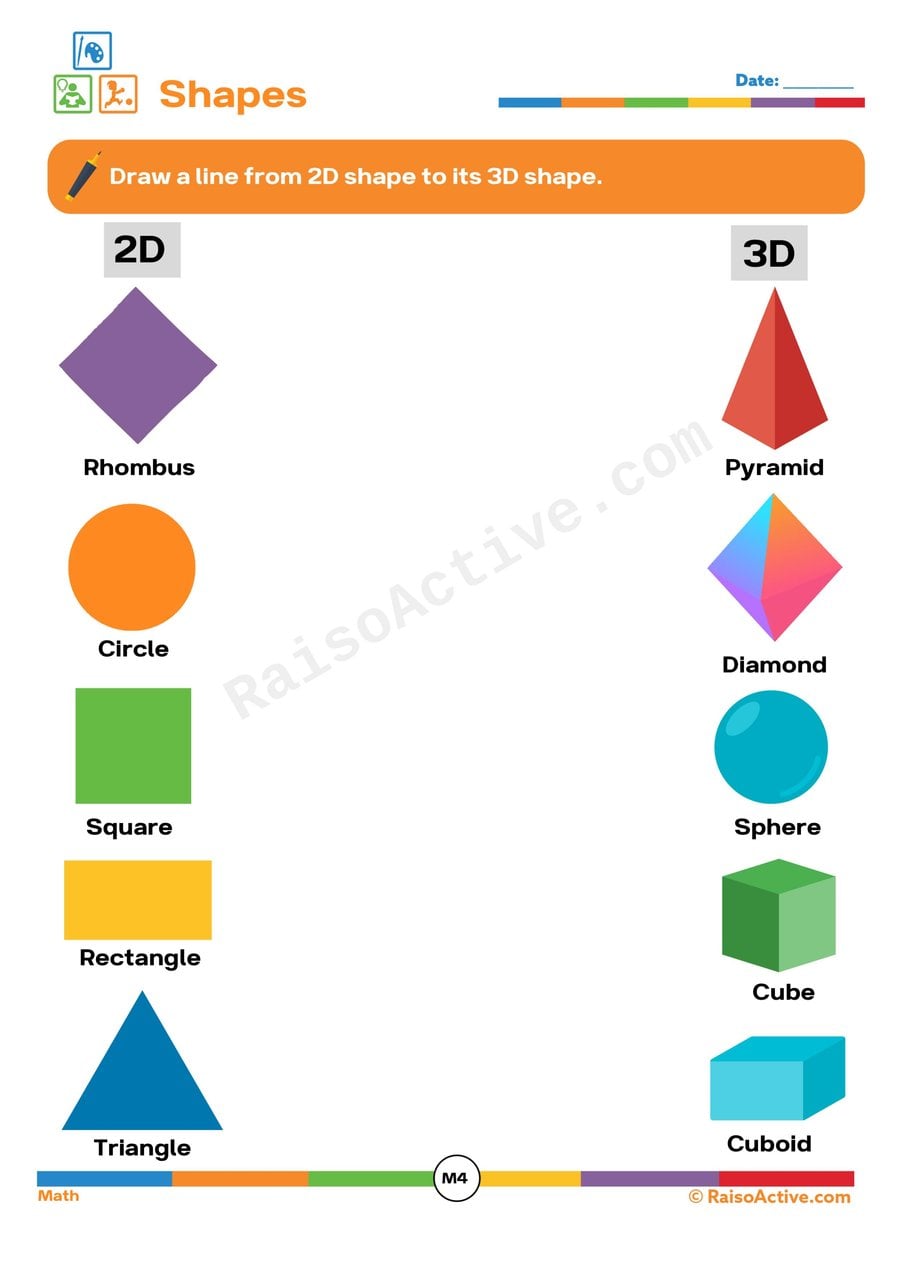
Shape Match: 2D to 3D Shapes Worksheet
Ages 4-6 · Pre-K–KindergartenAges 4-6 · Reception–Year 1Ages 4-6 · LKG–UKGAges 4-6
This worksheet introduces 4-6 year olds to the relationship between flat 2D shapes and solid 3D shapes — connecting a circle to a sphere, a square to a cube — which is an important spatial reasoning leap, since a 3D shape's flat 'face' is what actually corresponds to its related 2D shape. Making this connection explicit helps children understand that the shapes they've been learning aren't just flat pictures but also describe the surfaces of real, solid objects around them.

Pentagon Fun: Shape Recognition and Craft Activity Worksheet
Ages 3-5 · Preschool–Pre-KAges 3-5 · Nursery–ReceptionAges 3-5 · Nursery–LKGAges 3-5
This worksheet combines shape recognition with a hands-on craft, having children build a pentagon out of popsicle sticks and then find and glue pentagon-shaped pictures onto an outline. For ages 3-5, physically constructing a five-sided shape makes an otherwise abstract geometric concept concrete, while the cut-and-paste portion reinforces shape recognition through visual matching.
Guides for this topic

Age-Appropriate Problem-Solving Activities: Building Critical Thinkers from the Ground Up
Discover fun, age-appropriate problem-solving activities for children ages 1-8. Build critical thinking, logic, and reasoning skills through play-based learning.
Critical Thinking Activities That Actually Work for Young Children: Building Tomorrow's Thinkers Today
Discover proven critical thinking activities for young children. Age-wise logic games, questioning techniques, and hands-on ideas to build thinking skills at home.

Teaching Basic Computer Skills to Young Children: A Parent's Complete Guide
Help your child ages 3-8 build digital literacy with age-appropriate computer skills: mouse, keyboard, safe internet, and top apps for Indian families.
Reviews
Every worksheet for ages 3–5, no watermark
Members download the full library of 1,000+ worksheets and every activity pack without watermarks or daily limits. One year costs ₹999 in India or $20 elsewhere.
See membership plansOr download any worksheet free with a watermark (5 a day).