Secret Words Worksheet: Crack the Shape Code
This worksheet helps children practice letter recognition and matching skills by associating letters with shapes and identifying the corresponding pictures.
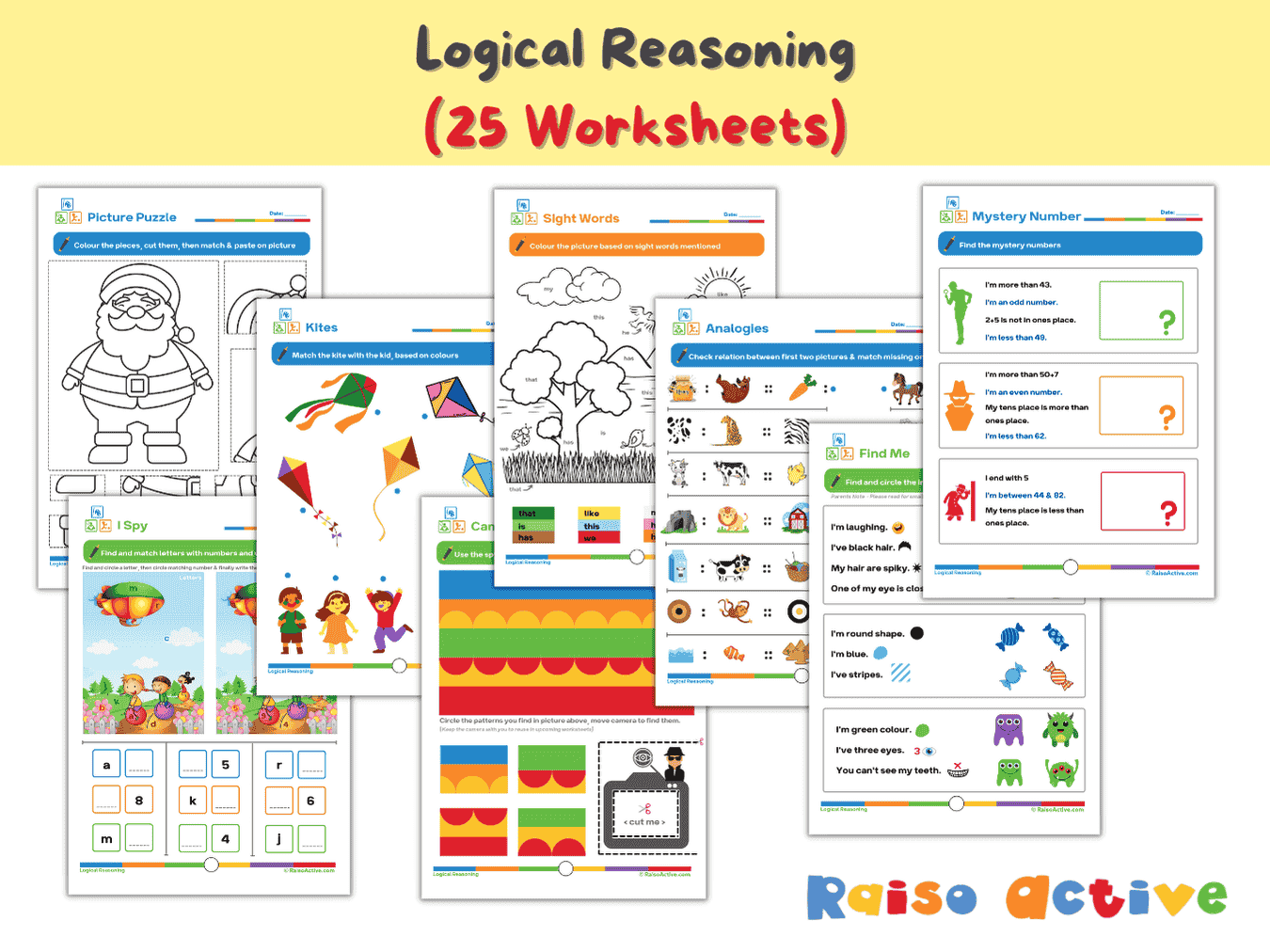
Part of the pack
Logical Reasoning Activity Book for Preschool & Kindergarten | Patterns, Sudoku, Mazes & Coding
This is page 3 of the pack. Ages 4-7 · Pre-K–Grade 1Ages 4-7 · Reception–Year 2Ages 4-7 · LKG–Class 1Ages 4-7
Made for your child
Adding within 10, made for your child
A maths pack with your child's name in it: pictures that explain, practice at three levels, puzzles and story sums about them. Print a new set whenever they finish.
Make a maths packFree preview · free for members
Curriculum
- Cognitive - Attention > Observation Skills
How to use this worksheet
Look at the shapes and letters at the top. Find the shape that matches the letters and write the letter in the box. Then, match the sequence of shapes to the correct picture.
Materials needed
- Pencil
- Crayons
Extension activities
- 1Create your own secret words using different shapes and letters.
- 2Draw the shapes and letters on flashcards and play a matching game.

Written by
Hemsweta Jain · Teacher Cheena
MBA and Early Childhood Educator, teaching since 2014 · Founder of RaisoActive, Mumbai
Every RaisoActive worksheet is designed and checked by the founder before publishing.
Published · Last reviewed
More from Logical Reasoning Activity Book for Preschool & Kindergarten | Patterns, Sudoku, Mazes & Coding

Growing Patterns Worksheet: Draw What Comes Next
Ages 4-7 · Pre-K–Grade 1Ages 4-7 · Reception–Year 2Ages 4-7 · LKG–Class 1Ages 4-7
This worksheet helps children practice observing and identifying patterns, a foundational skill for early math and logical reasoning.

Pizza Pattern Matching Worksheet for Preschoolers
Ages 4-7 · Pre-K–Grade 1Ages 4-7 · Reception–Year 2Ages 4-7 · LKG–Class 1Ages 4-7
This worksheet helps children practice visual discrimination and pattern recognition by matching pizza slices to complete the whole pizza.

Logical Reasoning Certificate of Achievement
Ages 4-7 · Pre-K–Grade 1Ages 4-7 · Reception–Year 2Ages 4-7 · LKG–Class 1Ages 4-7
A certificate to celebrate a child who has spotted patterns, cracked codes, solved mazes and thought things through. It has tick boxes for the Warm-up, Challenge and Expert levels completed.

Logic Clue Puzzles Worksheet: Find Me
Ages 4-7 · Pre-K–Grade 1Ages 4-7 · Reception–Year 2Ages 4-7 · LKG–Class 1Ages 4-7
This worksheet helps children practice logical reasoning by matching descriptions to images.

Kite Color Matching Worksheet for Preschoolers
Ages 4-7 · Pre-K–Grade 1Ages 4-7 · Reception–Year 2Ages 4-7 · LKG–Class 1Ages 4-7
This worksheet helps children practice color recognition and visual discrimination by matching kites to children based on the colors.
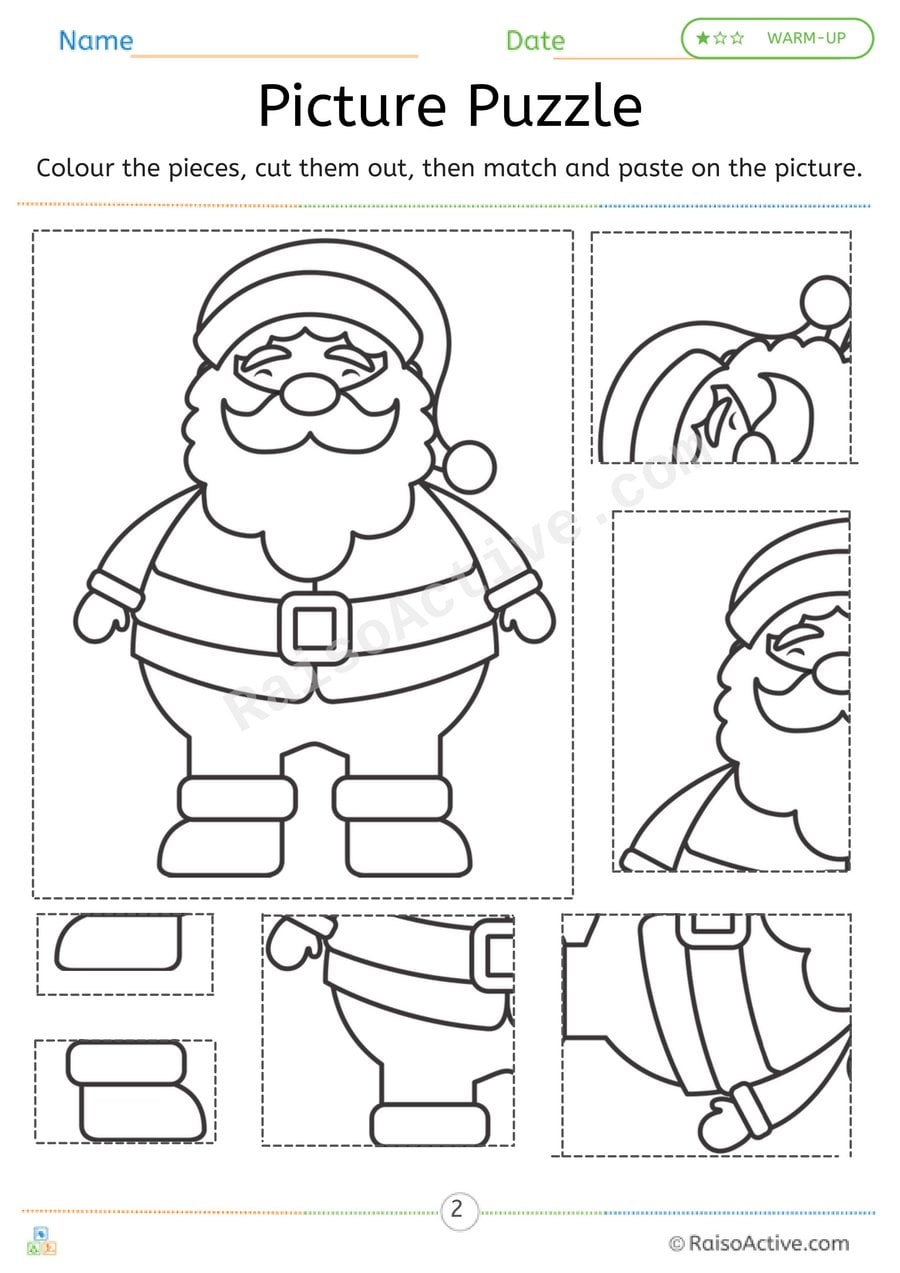
Santa Picture Puzzle Worksheet for Kids
Ages 4-7 · Pre-K–Grade 1Ages 4-7 · Reception–Year 2Ages 4-7 · LKG–Class 1Ages 4-7
This worksheet helps children develop visual discrimination and problem-solving skills by cutting out puzzle pieces and matching them to create a picture of Santa.

Honeycomb Pattern Matching Worksheet for Preschoolers
Ages 4-7 · Pre-K–Grade 1Ages 4-7 · Reception–Year 2Ages 4-7 · LKG–Class 1Ages 4-7
This worksheet helps children practice pattern recognition and matching skills by cutting out hexagon shapes and matching them to complete a honeycomb.

Logical Reasoning Activity Pack Answer Key, Pages 2 to 16
Ages 4-7 · Pre-K–Grade 1Ages 4-7 · Reception–Year 2Ages 4-7 · LKG–Class 1Ages 4-7
Grown-ups can check the answers for pages 2 to 16 of the pack, from the picture puzzle and secret words to patterns, honeycomb and analogies.
Related worksheets

Circle the Correct Letter: Fun Phonics Worksheet for Kids
Ages 4-5 · Pre-KAges 4-5 · ReceptionAges 4-5 · LKGAges 4-5
This phonics worksheet helps children ages 4-5 connect a picture's beginning sound to its matching letter, a key decoding skill on the path to independent reading. Circling the correct letter from a small set of choices also builds visual discrimination, since children must tell similar-looking letters apart under a bit of time pressure.

Q and C Vocabulary Worksheet: Circle and Square the Pictures!
Ages 3-5 · Preschool–Pre-KAges 3-5 · Nursery–ReceptionAges 3-5 · Nursery–LKGAges 3-5
Distinguishing between the letters Q and C by sight and sound is a genuine phonics challenge for children ages 3-5, since both letters can look and even sound similar in casual speech. This worksheet asks children to apply a different marking — a circle for Q, a square for C — for each letter's pictures, which forces active decision-making rather than passive letter recognition. Strengthening this kind of visual and auditory discrimination helps prevent letter mix-ups that commonly appear in early reading and writing.

Match the Pictures: Letter Matching Worksheet for Preschoolers
Ages 3-5 · Preschool–Pre-KAges 3-5 · Nursery–ReceptionAges 3-5 · Nursery–LKGAges 3-5
Connecting pictures to their matching letters helps children ages 3-5 build the foundation of phonics, learning that a printed letter represents the beginning sound of a spoken word. Circling the animals that specifically start with the letter B adds a second layer of practice, requiring children to apply that letter-sound knowledge rather than just matching shapes. This two-step approach moves children from simple visual matching toward true letter-sound recognition, a critical pre-reading skill.

Fun Phonics Worksheet: Matching Uppercase and Lowercase Letters!
Ages 3-5 · Preschool–Pre-KAges 3-5 · Nursery–ReceptionAges 3-5 · Nursery–LKGAges 3-5
This matching worksheet teaches children ages 3-5 to recognize that uppercase and lowercase versions of the same letter — like S and s — represent one letter despite looking different, a concept that trips up many early readers. Drawing a line between the four matching pairs builds visual discrimination and letter-form memory, while the follow-up task of circling pictures that start with 'C' adds practice connecting a letter to its sound.

Coloring and Matching Fun: Heart, Fish, and Alphabet Worksheet
Ages 3-5 · Preschool–Pre-KAges 3-5 · Nursery–ReceptionAges 3-5 · Nursery–LKGAges 3-5
This multi-part worksheet asks children ages 3-5 to follow a specific coloring instruction and then match letters to objects, building both instruction-following skills and early letter-object association in a single activity. Coloring only the heart red, rather than coloring freely, practices listening comprehension and attention to detail, a skill children need for following classroom directions later on. The letter-matching portion reinforces that letters represent real objects and sounds, an important building block before formal phonics instruction takes over.

Alphabet Games Worksheet: Match the Letters to the Games!
Ages 4-6 · Pre-K–KindergartenAges 4-6 · Reception–Year 1Ages 4-6 · LKG–UKGAges 4-6
This worksheet helps children ages 4-6 practice beginning-sound letter recognition by matching alphabet cards to pictures of games whose names start with that letter. Placing a letter card on its matching game picture, rather than simply circling an answer, adds a hands-on sorting element that keeps the activity active and physical rather than purely paper-based.
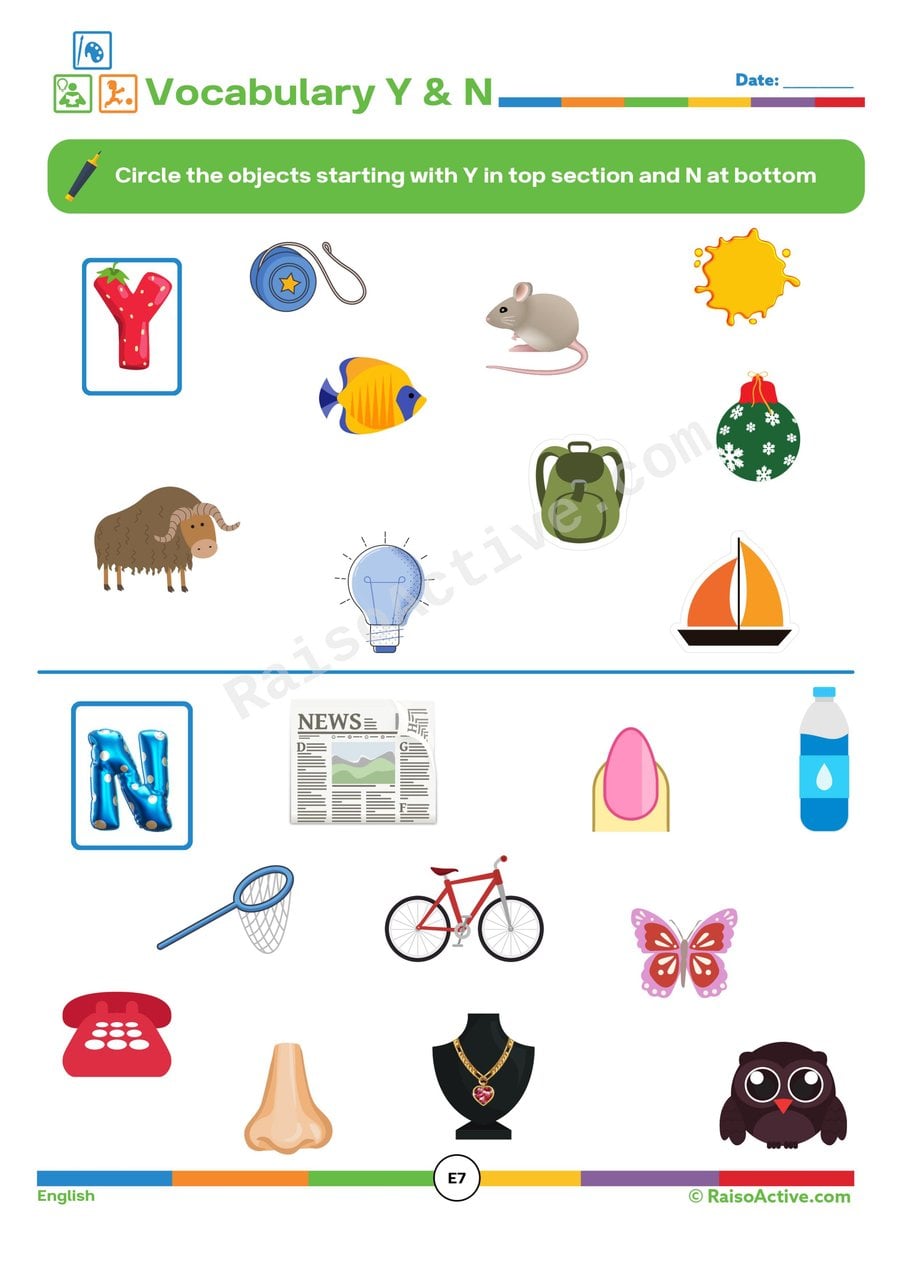
Y and N Vocabulary Worksheet: Circle the Objects!
Ages 3-5 · Preschool–Pre-KAges 3-5 · Nursery–ReceptionAges 3-5 · Nursery–LKGAges 3-5
Deciding whether a pictured object starts with Y or N helps children ages 3-5 practice initial sound discrimination between two distinct consonant sounds, building both vocabulary and listening skills. Circling in the correct top or bottom section adds a simple visual organization step that reinforces the category each object belongs to.

Matching Uppercase and Lowercase Letters: q-z Worksheet
Ages 4-5 · Pre-KAges 4-5 · ReceptionAges 4-5 · LKGAges 4-5
This worksheet builds letter recognition by having children match uppercase letters from Q to Z with their corresponding lowercase forms, a pairing that can be tricky since several lowercase letters in this range, like 'q' and 'g,' don't closely resemble their capital counterparts. For four- and five-year-olds, mastering the second half of the alphabet's upper-lowercase pairs completes the foundational letter knowledge needed before reading fluently.
Guides for this topic

Kindergarten Readiness Checklist: 25 Skills to Practice Before the First Day
A kindergarten readiness checklist of 25 literacy, math, motor, self-regulation and self-help skills, with an 8-week summer plan and notes on when not to worry.
Best Worksheets for 3-Year-Olds: What Works and What to Avoid
What works on worksheets for 3-year-olds: short sessions, crayons, tracing lines, matching, cutting, a free weekly plan, and signs one is too advanced.

Phase 2 Phonics at Home: Sound Order, Blending Games, Worksheets
Phase 2 phonics at home: the five sound sets in order, oral blending, tricky words, a two-week routine, common mistakes, and free worksheets.
Reviews
Every worksheet for ages 4–7, no watermark
Members download the full library of 1,000+ worksheets and every activity pack without watermarks or daily limits. One year costs ₹999 in India or $20 elsewhere.
See membership plansOr download any worksheet free with a watermark (5 a day).