Pizza Pattern Matching Worksheet for Preschoolers
This worksheet helps children practice visual discrimination and pattern recognition by matching pizza slices to complete the whole pizza.
Part of the pack
Logical Reasoning Activity Book for Preschool & Kindergarten | Patterns, Sudoku, Mazes & Coding
This is page 13 of the pack. Ages 4-7 · Pre-K–Grade 1Ages 4-7 · Reception–Year 2Ages 4-7 · LKG–Class 1Ages 4-7
Made for your child
Adding within 10, made for your child
A maths pack with your child's name in it: pictures that explain, practice at three levels, puzzles and story sums about them. Print a new set whenever they finish.
Make a maths packFree preview · free for members
Curriculum
- Patterns > Patterns
How to use this worksheet
Color, cut, and paste or match the pizza slice to the remaining pizza to complete the pattern.
Materials needed
- Pencil
- Crayons
- Scissors
- Glue (optional)
Extension activities
- 1Create your own pizza patterns using different toppings.
- 2Sort the pizza slices by the number of toppings.

Written by
Hemsweta Jain · Teacher Cheena
MBA and Early Childhood Educator, teaching since 2014 · Founder of RaisoActive, Mumbai
Every RaisoActive worksheet is designed and checked by the founder before publishing.
Published · Last reviewed
More from Logical Reasoning Activity Book for Preschool & Kindergarten | Patterns, Sudoku, Mazes & Coding

Maze Worksheet for Kids: Bee Maze and Tangled Lines
Ages 4-7 · Pre-K–Grade 1Ages 4-7 · Reception–Year 2Ages 4-7 · LKG–Class 1Ages 4-7
Children plan a route through a maze to take the bee home, then trace three tangled lines with their eyes and finger to match each child to a toy. Both tasks build focus, planning and visual tracking.

Symmetry Worksheet for Kids: Mirror Halves and Shadow Match
Ages 4-7 · Pre-K–Grade 1Ages 4-7 · Reception–Year 2Ages 4-7 · LKG–Class 1Ages 4-7
Children complete the other half of a butterfly and a house on a dot grid so both sides match like a mirror, then draw lines to match eight pictures to their shadows. This builds spatial reasoning and visual discrimination.
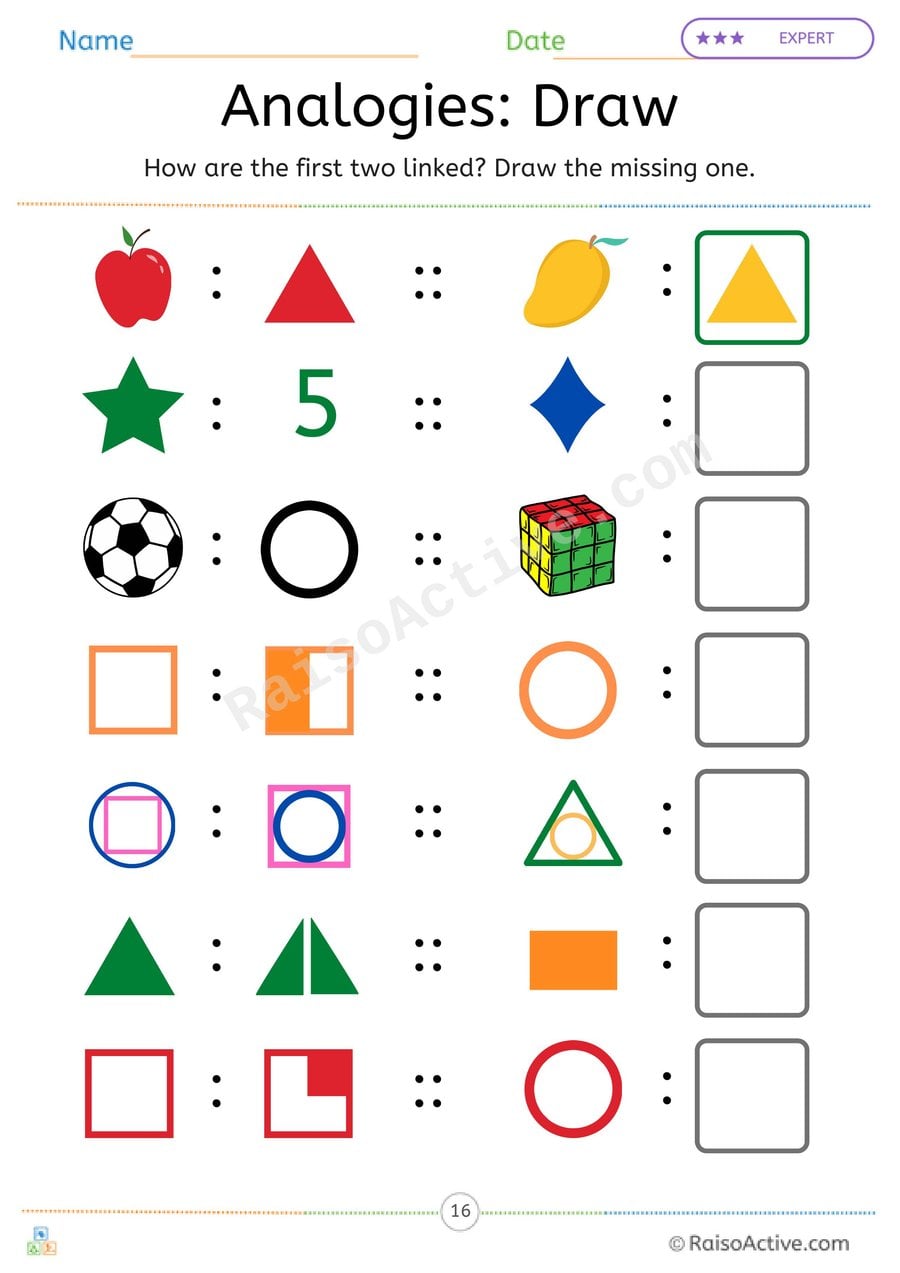
Shape Analogies Worksheet: Draw the Missing Picture
Ages 4-7 · Pre-K–Grade 1Ages 4-7 · Reception–Year 2Ages 4-7 · LKG–Class 1Ages 4-7
This worksheet helps children understand and identify relationships between shapes, developing their logical reasoning skills.
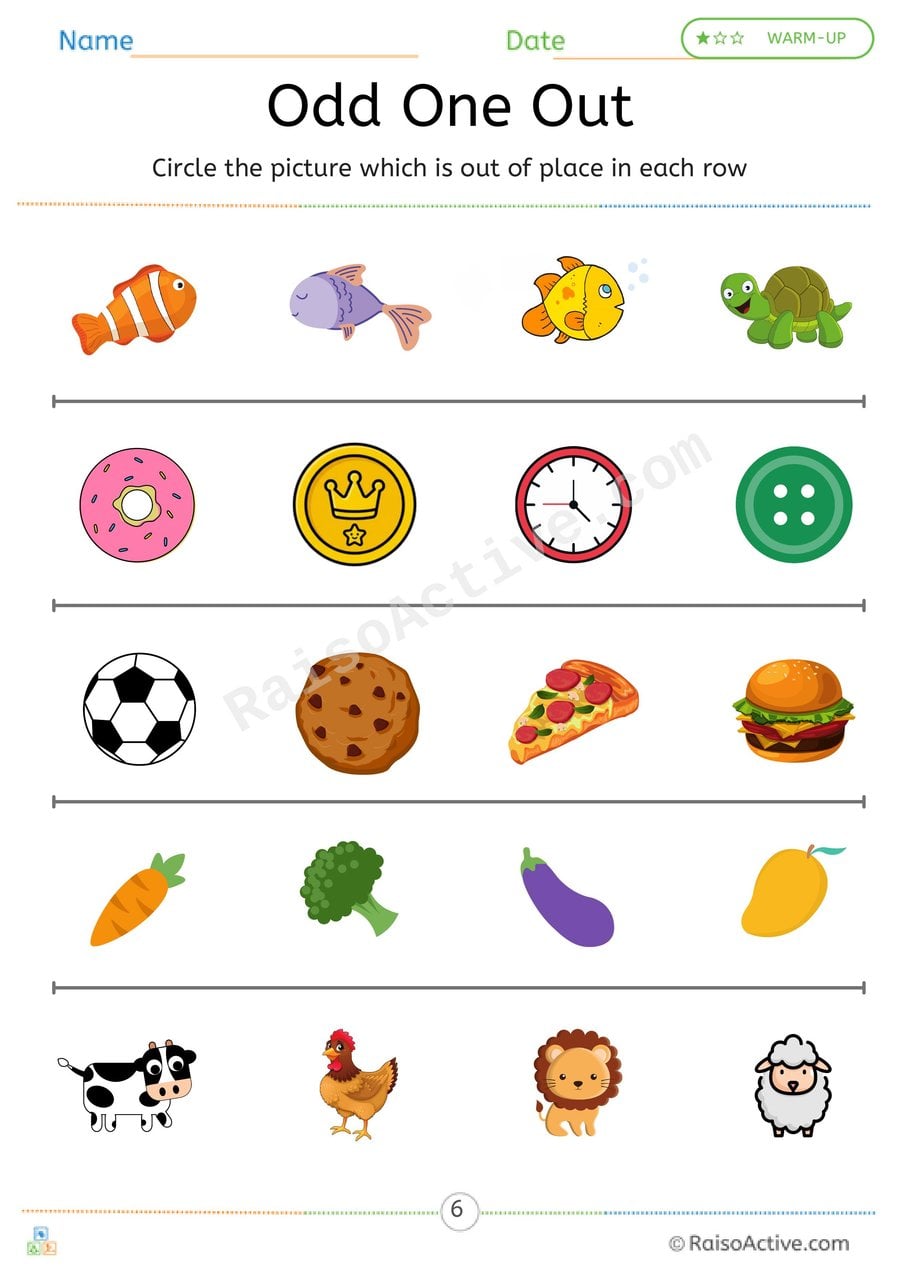
Odd One Out Worksheet: Circle What Does Not Belong
Ages 4-7 · Pre-K–Grade 1Ages 4-7 · Reception–Year 2Ages 4-7 · LKG–Class 1Ages 4-7
This worksheet helps children develop visual discrimination and logical reasoning skills by identifying the object that is different in each row.

I Spy Letter and Number Matching Worksheet for Preschoolers
Ages 4-7 · Pre-K–Grade 1Ages 4-7 · Reception–Year 2Ages 4-7 · LKG–Class 1Ages 4-7
This worksheet helps children practice matching letters to numbers and improve their early literacy and numeracy skills.

Coding Worksheet for Kids: Arrow Codes and Robot Grid
Ages 4-7 · Pre-K–Grade 1Ages 4-7 · Reception–Year 2Ages 4-7 · LKG–Class 1Ages 4-7
Children read arrow codes to move a robot across a grid, write their own arrow code to take the bee to the flower, and spot the one wrong arrow in a code. These are first steps in coding, sequencing and debugging.

Kite Color Matching Worksheet for Preschoolers
Ages 4-7 · Pre-K–Grade 1Ages 4-7 · Reception–Year 2Ages 4-7 · LKG–Class 1Ages 4-7
This worksheet helps children practice color recognition and visual discrimination by matching kites to children based on the colors.

Camera Spy 3: Pattern Recognition Worksheet for Preschoolers
Ages 4-7 · Pre-K–Grade 1Ages 4-7 · Reception–Year 2Ages 4-7 · LKG–Class 1Ages 4-7
This worksheet helps children identify and match patterns by using a 'spy camera'.
Related worksheets

Balloon Pattern Matching Worksheet for Preschoolers
Ages 3-5 · Preschool–Pre-KAges 3-5 · Nursery–ReceptionAges 3-5 · Nursery–LKGAges 3-5
Children ages 3-5 build early pattern-recognition skills on this worksheet by studying a sequence of colored balloons and finding the matching set to complete it. Recognizing and continuing a repeating sequence is a foundational pre-math skill that later supports understanding of number patterns, skip counting, and simple algebraic thinking.
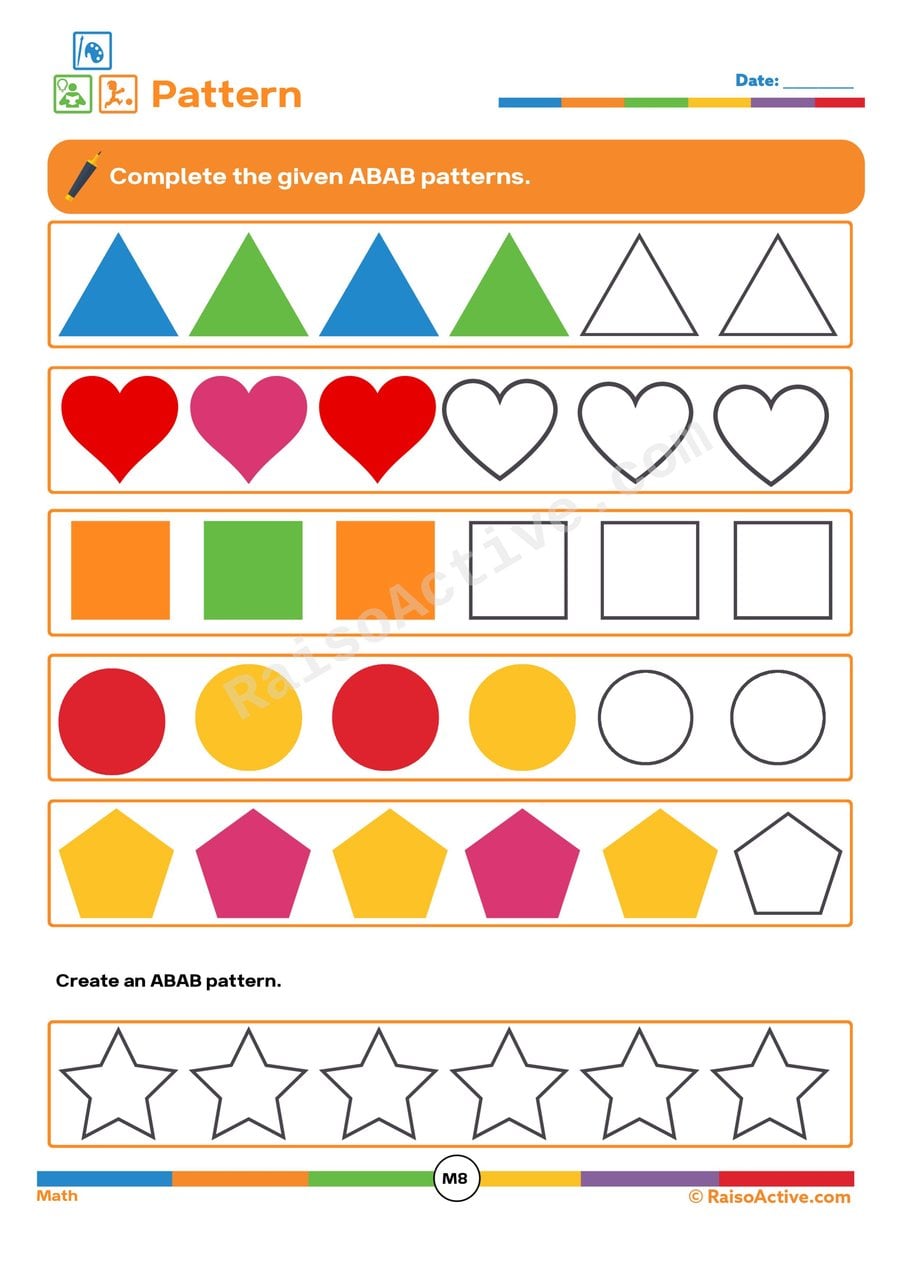
ABAB Pattern Fun: Complete the Shapes Worksheet!
Ages 3-5 · Preschool–Pre-KAges 3-5 · Nursery–ReceptionAges 3-5 · Nursery–LKGAges 3-5
This worksheet builds early algebraic thinking as children ages 3-5 identify and continue ABAB patterns using shapes and colors, then create a pattern of their own using stars. Recognizing that a pattern repeats in a predictable unit is a foundational math skill that later supports understanding sequences, multiplication, and logical prediction, making this simple shape activity more mathematically important than it might first appear.
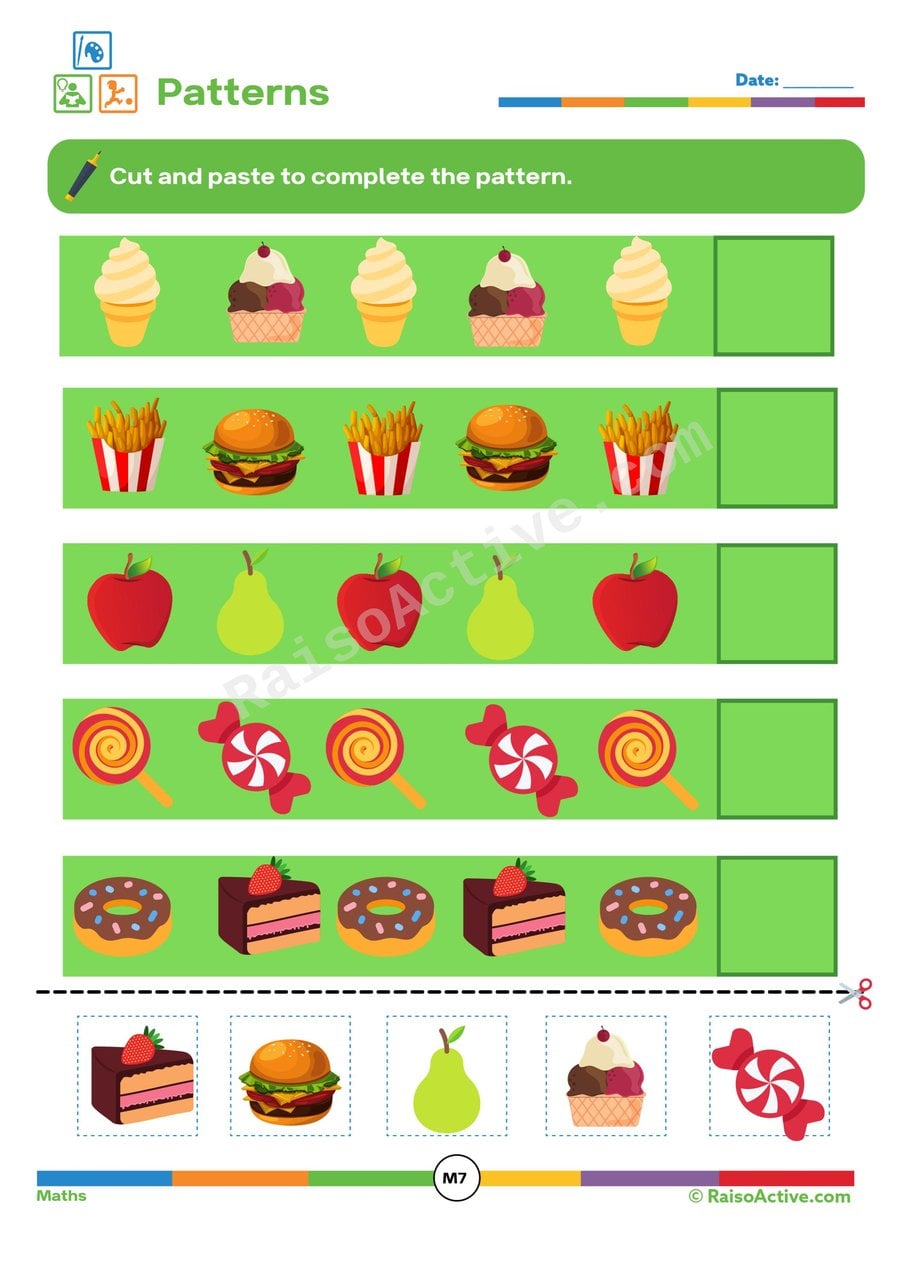
Yummy Food Patterns Worksheet for Preschoolers
Ages 3-5 · Preschool–Pre-KAges 3-5 · Nursery–ReceptionAges 3-5 · Nursery–LKGAges 3-5
This worksheet introduces pattern recognition — a core pre-math skill — by having children identify what food item comes next in a repeating sequence like apple-banana-apple-banana. Spotting and continuing patterns teaches children to predict what comes next based on a rule, an early form of the logical reasoning used later in math and science.

Christmas Pattern Worksheet: Circle the Next Picture!
Ages 4-6 · Pre-K–KindergartenAges 4-6 · Reception–Year 1Ages 4-6 · LKG–UKGAges 4-6
This seasonal worksheet gives children ages 4-6 practice identifying a repeating pattern using Christmas-themed pictures and predicting which picture logically comes next. Pattern prediction requires children to notice a repeating rule and apply it forward, a skill that underlies later math concepts like skip counting and multiplication tables. The festive imagery adds seasonal excitement that can make repeated pattern practice feel like a holiday game.

Shape Pattern Worksheet: Identify and Color the Next Shape!
Ages 3-5 · Preschool–Pre-KAges 3-5 · Nursery–ReceptionAges 3-5 · Nursery–LKGAges 3-5
This worksheet helps children ages 3-5 recognize and continue simple repeating shape patterns, an early form of the logical reasoning that later supports algebraic thinking. Coloring the shape that comes next also requires children to first identify each shape by name, reinforcing basic geometry vocabulary.
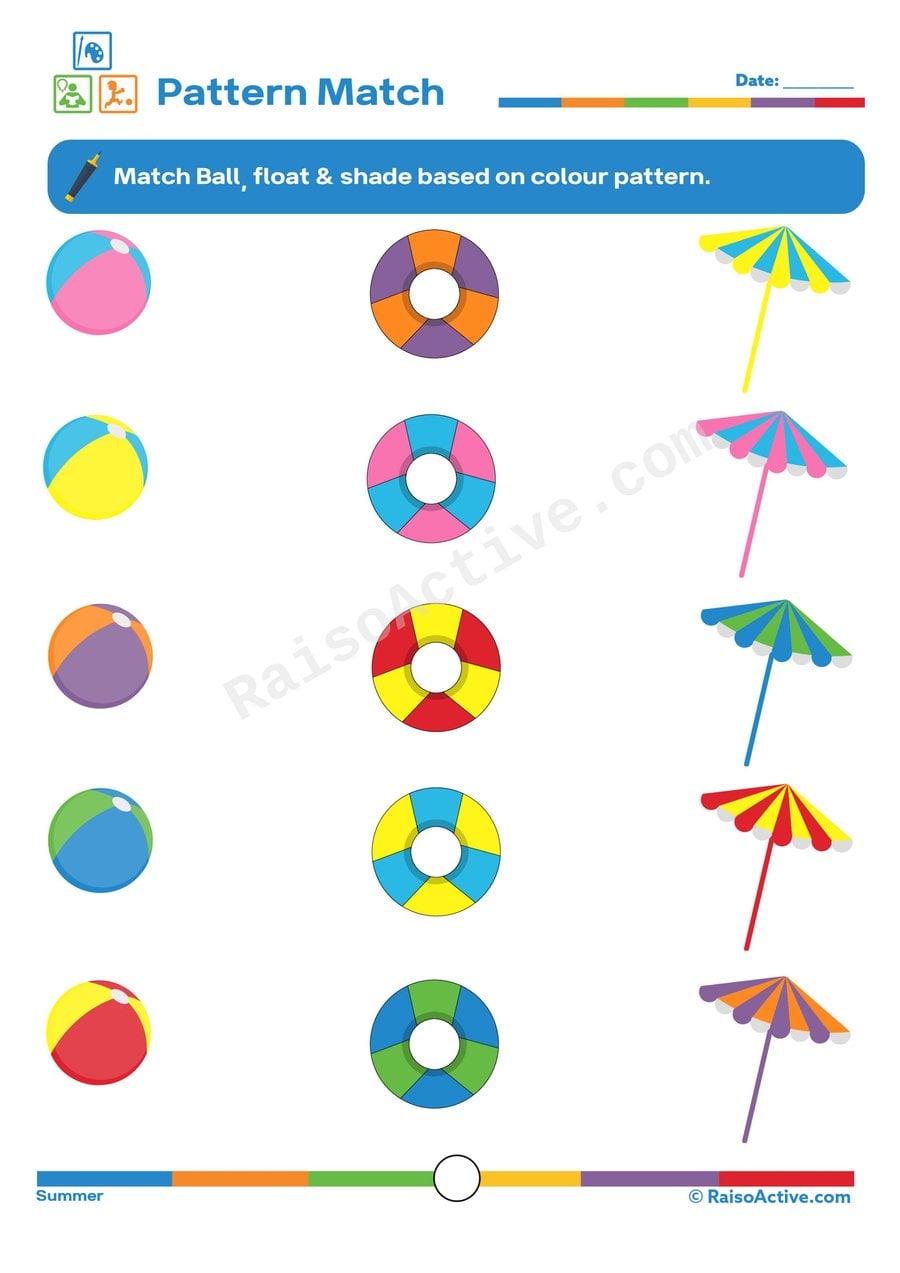
Summer Pattern Match Worksheet for Preschoolers
Ages 3-5 · Preschool–Pre-KAges 3-5 · Nursery–ReceptionAges 3-5 · Nursery–LKGAges 3-5
This worksheet asks children ages 3-5 to study the color pattern on a beach ball, pool float, and sun umbrella and match each item to its correctly patterned counterpart, building early pattern recognition, a foundational skill for later math concepts like sequencing and algebraic thinking. Because the match depends on noticing the order and repetition of colors rather than just matching a single color, children must compare details carefully rather than glance quickly. This strengthens visual attention alongside the pattern skill itself.
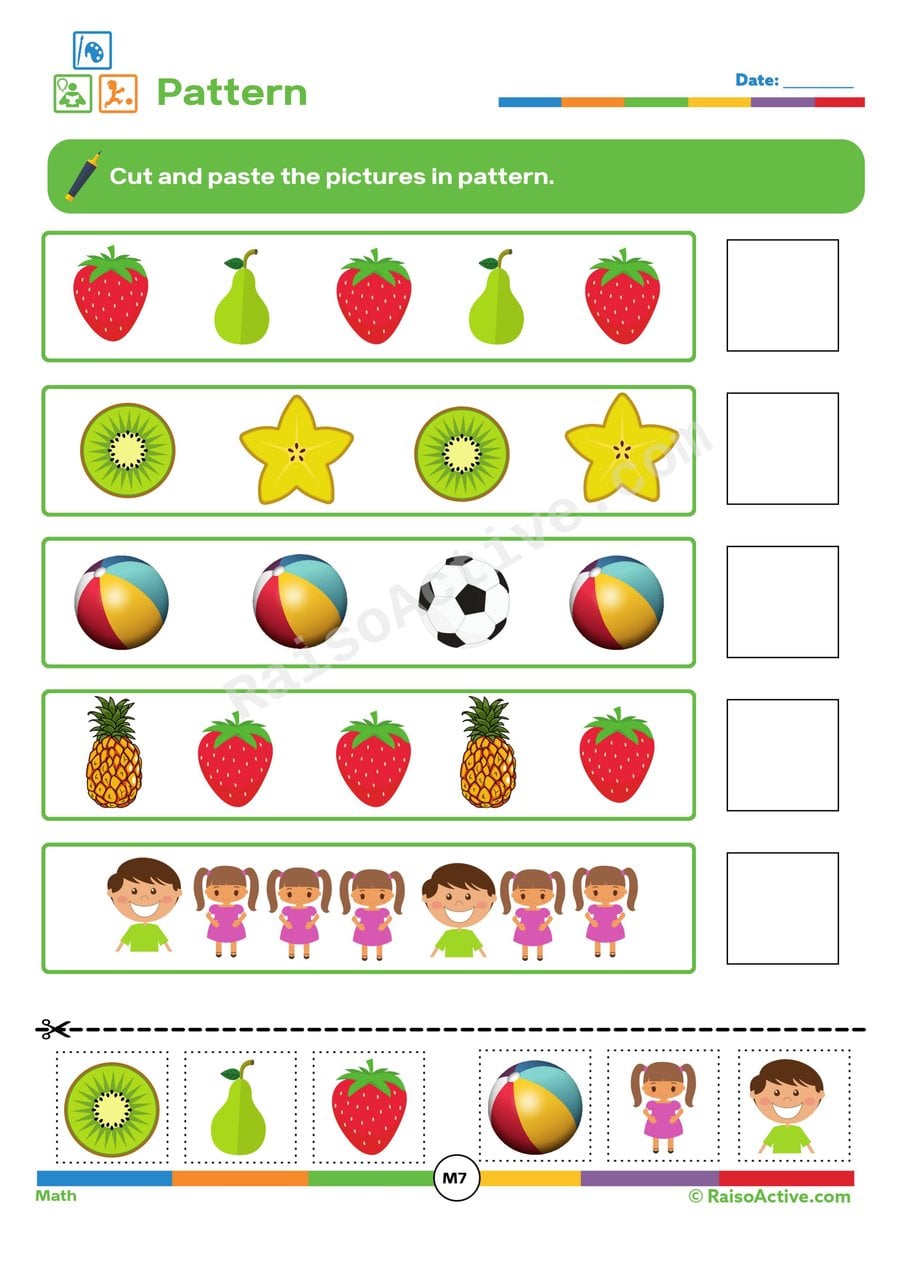
Fruit and Friends Pattern Worksheet
Ages 3-5 · Preschool–Pre-KAges 3-5 · Nursery–ReceptionAges 3-5 · Nursery–LKGAges 3-5
Identifying a repeating sequence of fruits or characters and choosing the correct picture to continue it builds pattern-recognition skills for children ages 3-5, an early form of logical reasoning that connects directly to later math concepts like skip counting.

What Comes Next? Pattern Worksheet for Preschoolers
Ages 3-5 · Preschool–Pre-KAges 3-5 · Nursery–ReceptionAges 3-5 · Nursery–LKGAges 3-5
Identifying a repeating sequence of pictures and circling the one that comes next builds pattern-recognition and visual discrimination skills for children ages 3-5, an early form of logical reasoning that connects to later math concepts like skip counting and multiplication.
Guides for this topic

Pre-Writing Strokes in Order: From Standing Lines to Loops (With Printable Patterns)
The developmental order of pre-writing strokes, from vertical lines to loops, and why practicing them in sequence makes letter formation much easier to learn.

Best Worksheets for 3-Year-Olds: What Works and What to Avoid
What works on worksheets for 3-year-olds: short sessions, crayons, tracing lines, matching, cutting, a free weekly plan, and signs one is too advanced.

Age-Appropriate Problem-Solving Activities: Building Critical Thinkers from the Ground Up
Discover fun, age-appropriate problem-solving activities for children ages 1-8. Build critical thinking, logic, and reasoning skills through play-based learning.
Reviews
Every worksheet for ages 4–7, no watermark
Members download the full library of 1,000+ worksheets and every activity pack without watermarks or daily limits. One year costs ₹999 in India or $20 elsewhere.
See membership plansOr download any worksheet free with a watermark (5 a day).