Summer Pattern Match Worksheet for Preschoolers
This worksheet asks children ages 3-5 to study the color pattern on a beach ball, pool float, and sun umbrella and match each item to its correctly patterned counterpart, building early pattern recognition, a foundational skill for later math concepts like sequencing and algebraic thinking. Because the match depends on noticing the order and repetition of colors rather than just matching a single color, children must compare details carefully rather than glance quickly. This strengthens visual attention alongside the pattern skill itself.
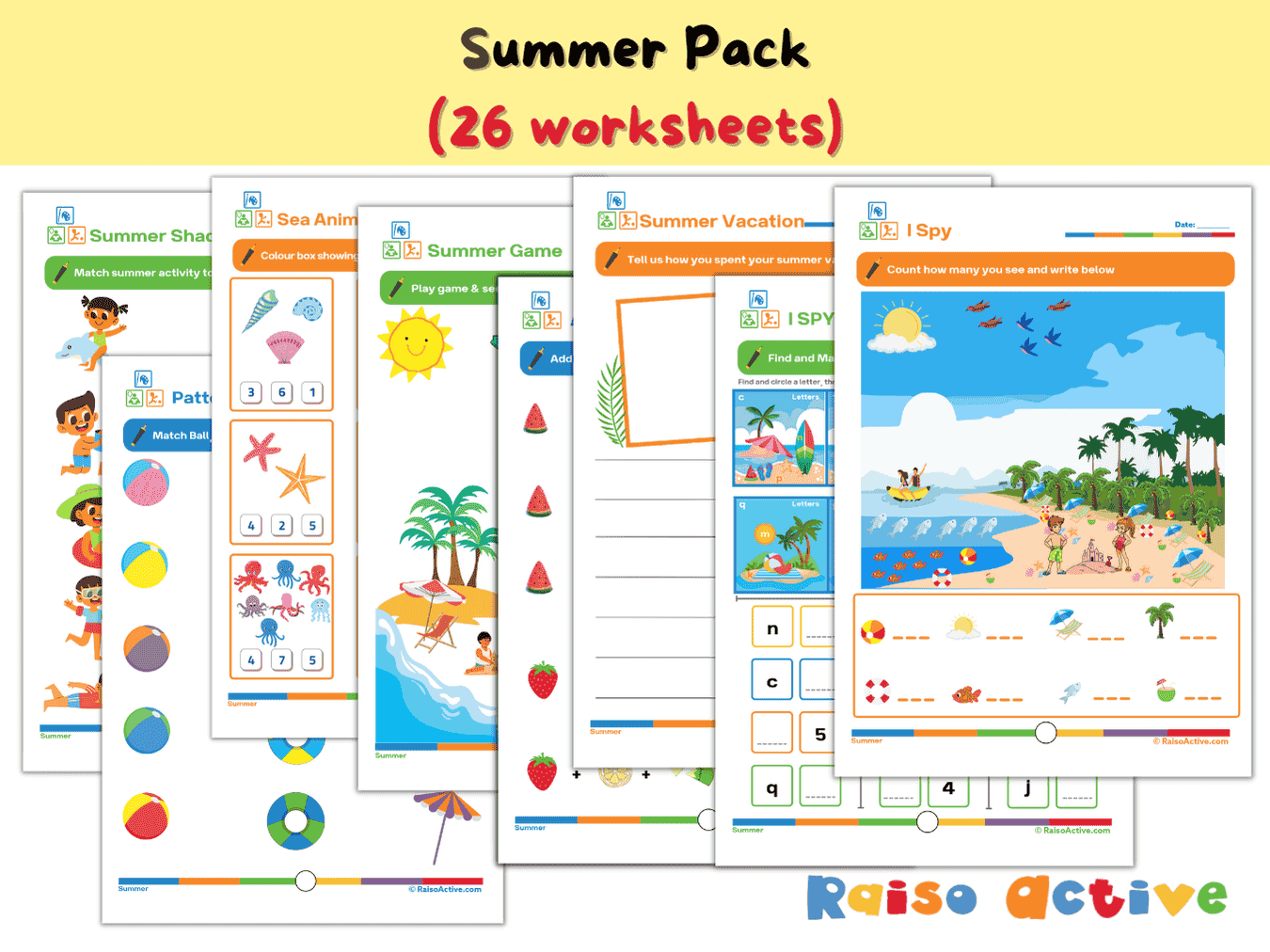
Part of the pack
Summer Activity Pack: Math, Literacy, Puzzles & More for Preschool & Kindergarten
This is page 6 of the pack. Ages 3-7 · Preschool–Grade 1Ages 3-7 · Nursery–Year 2Ages 3-7 · Nursery–Class 1Ages 3-7
Made for your child
Counting to 10, made for your child
A maths pack with your child's name in it: pictures that explain, practice at three levels, puzzles and story sums about them. Print a new set whenever they finish.
Make a maths packFree preview · free for members
Curriculum
- Patterns > Patterns
How to use this worksheet
Look at the beach ball, float, and umbrella shade on one side of the page with your child and describe the color pattern out loud together, such as 'red, yellow, red, yellow.' Then look at the umbrellas on the other side of the page and help your child compare each pattern carefully before deciding which umbrella matches which item. Once they've identified a match, have them draw a line connecting the item to its correct umbrella, repeating the process for all three pairs.
Materials needed
- Pencil
- Crayons
Extension activities
- 1Use crayons to create your own color pattern on a strip of paper, then have your child continue the pattern.
- 2String colorful beads in a repeating pattern, like red-blue-red-blue, and ask your child to predict the next bead.
- 3Look for striped or patterned towels, clothes, or umbrellas around the house and describe their color order.
- 4Play a clapping pattern game, like clap-clap-stomp, and have your child repeat and then extend the pattern.

Written by
Hemsweta Jain · Teacher Cheena
MBA and Early Childhood Educator, teaching since 2014 · Founder of RaisoActive, Mumbai
Every RaisoActive worksheet is designed and checked by the founder before publishing.
Published · Last reviewed
More from Summer Activity Pack: Math, Literacy, Puzzles & More for Preschool & Kindergarten
Beach Day Coloring Worksheet for Preschoolers
Ages 3-5 · Preschool–Pre-KAges 3-5 · Nursery–ReceptionAges 3-5 · Nursery–LKGAges 3-5
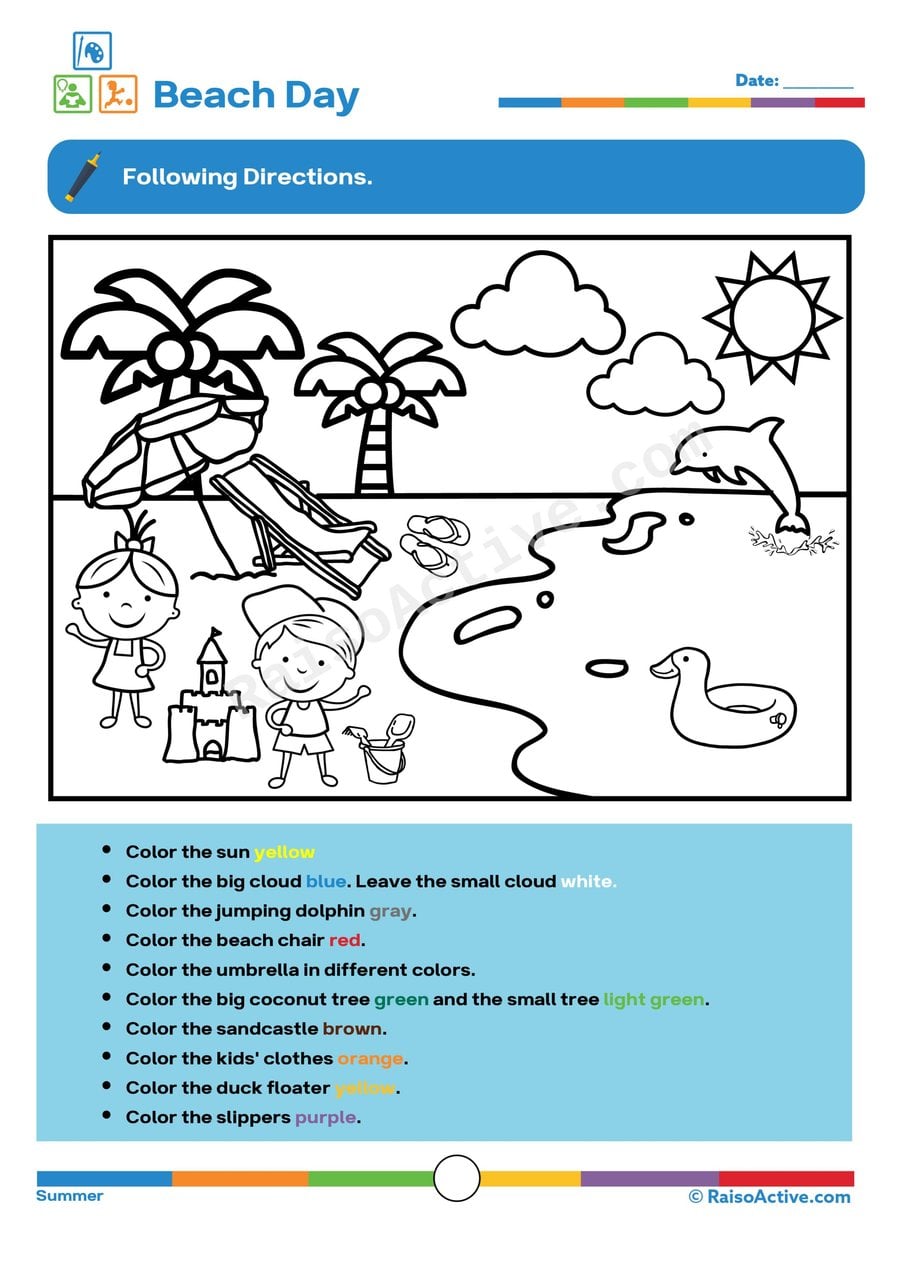
This worksheet has children ages 3-5 read or listen to specific color instructions, like coloring the sun yellow and a cloud blue, and then apply the correct color to each part of a beach scene. Following multi-part color instructions builds listening comprehension and the ability to hold several separate directions in mind at once, both important readiness skills for classroom instructions. It also reinforces color-word vocabulary and fine motor control as children color within the lines of each shape.

Summer Counting Worksheet: Count and Color Summer Objects!
Ages 3-5 · Preschool–Pre-KAges 3-5 · Nursery–ReceptionAges 3-5 · Nursery–LKGAges 3-5
This summer-themed counting page has children ages 3-5 count groups of sun, beach, and vacation-related objects and write the matching numeral in a box, directly practicing one-to-one correspondence, the skill of counting each item exactly once. Because the objects are grouped by theme rather than lined up in neat rows, children also practice visually organizing a scattered set before counting it, a slightly harder skill than counting objects in a straight line. Writing the total afterward connects the physical act of counting to the abstract symbol that represents it.
Summer Sudoku: Cut and Paste Worksheet for Kids
Ages 4-6 · Pre-K–KindergartenAges 4-6 · Reception–Year 1Ages 4-6 · LKG–UKGAges 4-6
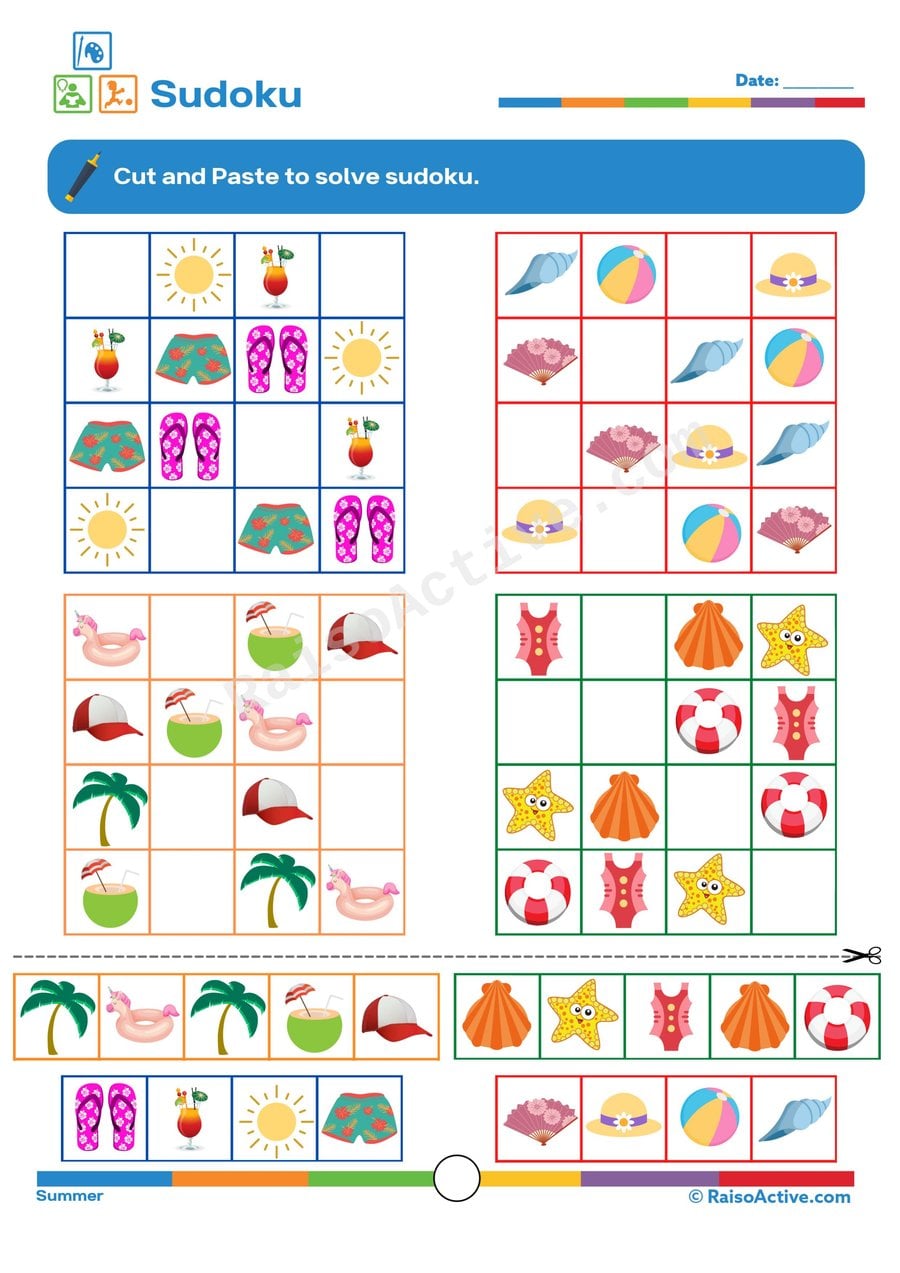
This worksheet combines cutting and pasting with logical puzzle-solving for children ages 4-6, who must cut out small summer images and paste each one into the correct empty square of a Sudoku grid so no image repeats in any row, column, or smaller square. Beyond the reasoning skills of a typical Sudoku, this version adds scissor practice and precise placement with glue, building fine motor coordination alongside logical thinking. Handling small cut-out pieces and placing them accurately also demands more spatial planning than simply coloring or drawing a picture.

Summer Addition Worksheet for Preschoolers: Counting and Adding Fun!
Ages 4-5 · Pre-KAges 4-5 · ReceptionAges 4-5 · LKGAges 4-5
Adding two small groups of summer-themed pictures — ice creams, beach balls, sunglasses — gives a 4-5 year old a concrete, countable version of addition before they ever see the plus sign written abstractly. Counting each group separately and then counting the combined total builds the core idea that addition means 'put together and count again', which underlies every later addition strategy.

Summer Word Unscramble Worksheet for Preschoolers
Ages 3-5 · Preschool–Pre-KAges 3-5 · Nursery–ReceptionAges 3-5 · Nursery–LKGAges 3-5
This worksheet has children ages 3-5 unscramble jumbled letters to spell summer-themed words, practicing early phonics and spelling by sounding out letters and considering how they might combine into a familiar word. Because the letters are already given but out of order, children focus specifically on sequencing and sound-blending rather than recalling spelling from scratch, making this an accessible entry point into word-building. Writing the corrected word afterward reinforces handwriting alongside the phonics practice.

Summer T-Shirt Match: A Fun Matching Worksheet for Kids!
Ages 3-5 · Preschool–Pre-KAges 3-5 · Nursery–ReceptionAges 3-5 · Nursery–LKGAges 3-5
This worksheet has children ages 3-5 match fruit designs to summer t-shirts featuring the same pattern, building visual discrimination as they compare details like shape and arrangement across two separate pictures. Because the match depends on recognizing a specific fruit design repeated in a different context, children practice the transferable skill of identifying that two pictures represent the same thing even when shown in a different format. Naming the fruits along the way also builds vocabulary.
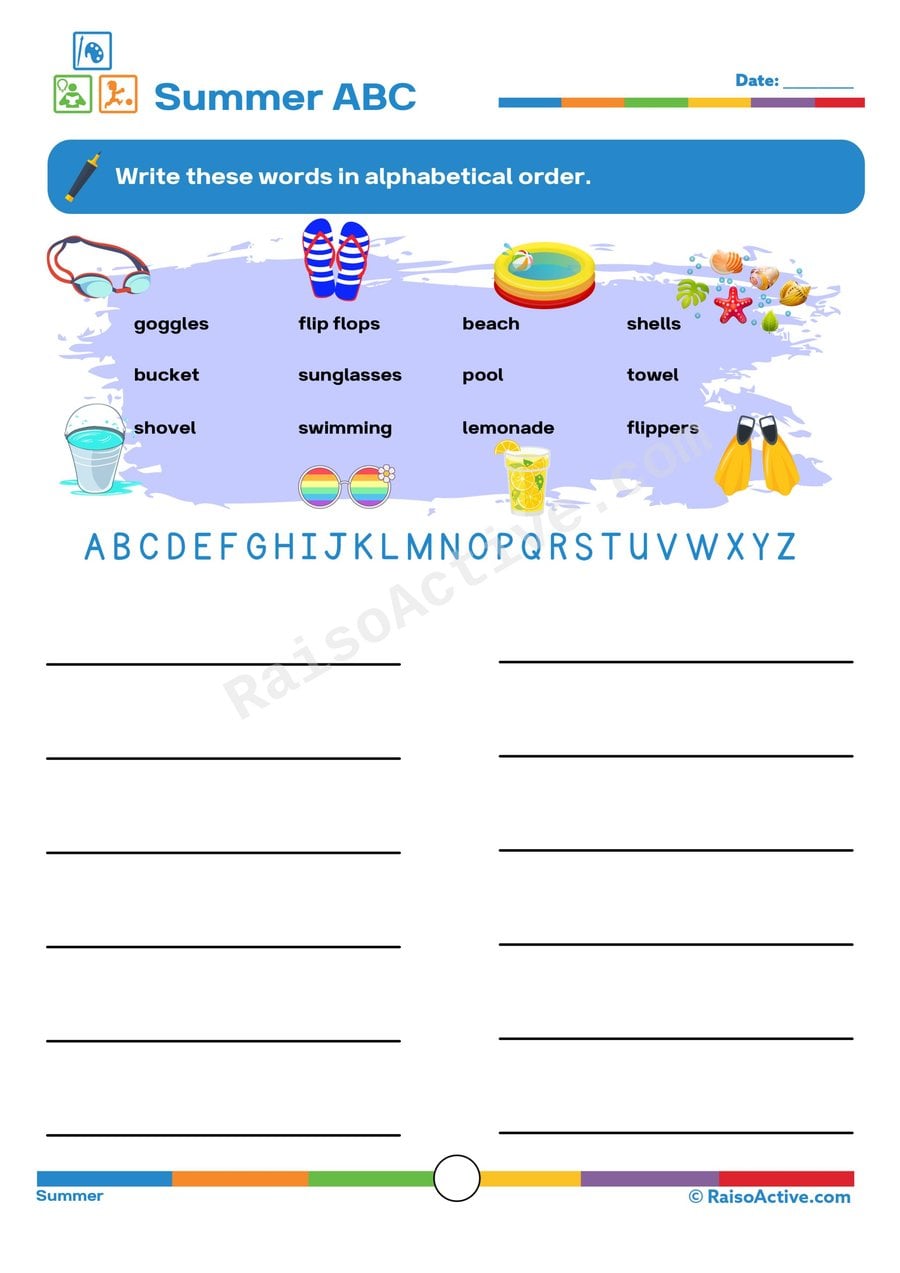
Summer ABC Worksheet: Alphabetical Order Fun!
Ages 4-6 · Pre-K–KindergartenAges 4-6 · Reception–Year 1Ages 4-6 · LKG–UKGAges 4-6
This worksheet has children ages 4-6 put a new set of summer words into alphabetical order, building on the comparison and sequencing skills involved in matching each word's first letter to its place in the alphabet. Because this task requires holding several words in mind at once and deciding their relative order, it strengthens working memory alongside letter-sequence knowledge. Repeated practice with alphabetizing across different word sets like this one helps the skill become more automatic over time.

Summer Words ABC Order Worksheet for Preschoolers
Ages 4-5 · Pre-KAges 4-5 · ReceptionAges 4-5 · LKGAges 4-5
This worksheet has children ages 4-5 practice putting summer-themed words in alphabetical order, a key pre-reading skill that requires comparing the first letters of multiple words and understanding that the alphabet has a fixed sequence. Because children must hold several words in mind and decide their relative order rather than just recognizing a single letter, this task builds early sequencing and comparison skills alongside letter knowledge. Writing the words out afterward also reinforces spelling and handwriting practice.
Related worksheets

Clothing Pattern Match Worksheet for Preschoolers
Ages 3-5 · Preschool–Pre-KAges 3-5 · Nursery–ReceptionAges 3-5 · Nursery–LKGAges 3-5
This worksheet has children ages 3-5 study repeating patterns on clothing items — stripes, polka dots, or checks — and match each item to its identical twin, building visual discrimination and early pattern-sequencing skills. Distinguishing between similar-looking patterns also sharpens attention to detail, a skill that later supports letter and word recognition.

Match the Patterns: Fun Worksheet for Preschoolers
Ages 3-5 · Preschool–Pre-KAges 3-5 · Nursery–ReceptionAges 3-5 · Nursery–LKGAges 3-5
By connecting each picture to its matching pattern, children ages 3-5 practice visual pattern recognition - the ability to notice a repeating sequence of colors, shapes, or objects - which is an early building block for both math reasoning and reading, since reading also relies on recognizing repeated letter patterns. The worksheet also builds fine motor control as children draw connecting lines with a pencil or crayon.

What Comes Next? Pattern Worksheet for Preschoolers
Ages 3-5 · Preschool–Pre-KAges 3-5 · Nursery–ReceptionAges 3-5 · Nursery–LKGAges 3-5
Identifying a repeating sequence of pictures and circling the one that comes next builds pattern-recognition and visual discrimination skills for children ages 3-5, an early form of logical reasoning that connects to later math concepts like skip counting and multiplication.

Pattern Recognition Worksheet: Cut and Paste the Next Picture!
Ages 3-5 · Preschool–Pre-KAges 3-5 · Nursery–ReceptionAges 3-5 · Nursery–LKGAges 3-5
This worksheet builds pattern recognition for children ages 3-5 by having them identify a repeating sequence in each row and then cut out and glue the picture that correctly continues it. Because the correct piece must be found among several distractor options, this task sharpens visual discrimination alongside the logical thinking needed to predict what comes next in a sequence.

Growing Patterns Worksheet: Draw What Comes Next
Ages 4-7 · Pre-K–Grade 1Ages 4-7 · Reception–Year 2Ages 4-7 · LKG–Class 1Ages 4-7
This worksheet helps children practice observing and identifying patterns, a foundational skill for early math and logical reasoning.

Decreasing Patterns Worksheet: Observe and Draw What Comes Next
Ages 4-7 · Pre-K–Grade 1Ages 4-7 · Reception–Year 2Ages 4-7 · LKG–Class 1Ages 4-7
This worksheet helps children learn to identify and continue decreasing patterns, developing their observation and logical reasoning skills.

Clothing Pattern Matching Worksheet for Preschoolers
Ages 3-5 · Preschool–Pre-KAges 3-5 · Nursery–ReceptionAges 3-5 · Nursery–LKGAges 3-5
By comparing clothing items and connecting each one to its pattern match, children ages 3-5 build visual discrimination skills, learning to notice fine differences in stripes, dots, or repeated shapes. This close-looking practice supports the same attention-to-detail children will later need to tell similar-looking letters and numbers apart.

Pizza Pattern Matching Worksheet for Preschoolers
Ages 4-7 · Pre-K–Grade 1Ages 4-7 · Reception–Year 2Ages 4-7 · LKG–Class 1Ages 4-7
This worksheet helps children practice visual discrimination and pattern recognition by matching pizza slices to complete the whole pizza.
Guides for this topic

Pre-Writing Strokes in Order: From Standing Lines to Loops (With Printable Patterns)
The developmental order of pre-writing strokes, from vertical lines to loops, and why practicing them in sequence makes letter formation much easier to learn.

Best Worksheets for 3-Year-Olds: What Works and What to Avoid
What works on worksheets for 3-year-olds: short sessions, crayons, tracing lines, matching, cutting, a free weekly plan, and signs one is too advanced.

Age-Appropriate Problem-Solving Activities: Building Critical Thinkers from the Ground Up
Discover fun, age-appropriate problem-solving activities for children ages 1-8. Build critical thinking, logic, and reasoning skills through play-based learning.
Reviews
Every worksheet for ages 3–5, no watermark
Members download the full library of 1,000+ worksheets and every activity pack without watermarks or daily limits. One year costs ₹999 in India or $20 elsewhere.
See membership plansOr download any worksheet free with a watermark (5 a day).