Summer Addition Worksheet for Preschoolers: Counting and Adding Fun!
Adding two small groups of summer-themed pictures — ice creams, beach balls, sunglasses — gives a 4-5 year old a concrete, countable version of addition before they ever see the plus sign written abstractly. Counting each group separately and then counting the combined total builds the core idea that addition means 'put together and count again', which underlies every later addition strategy.
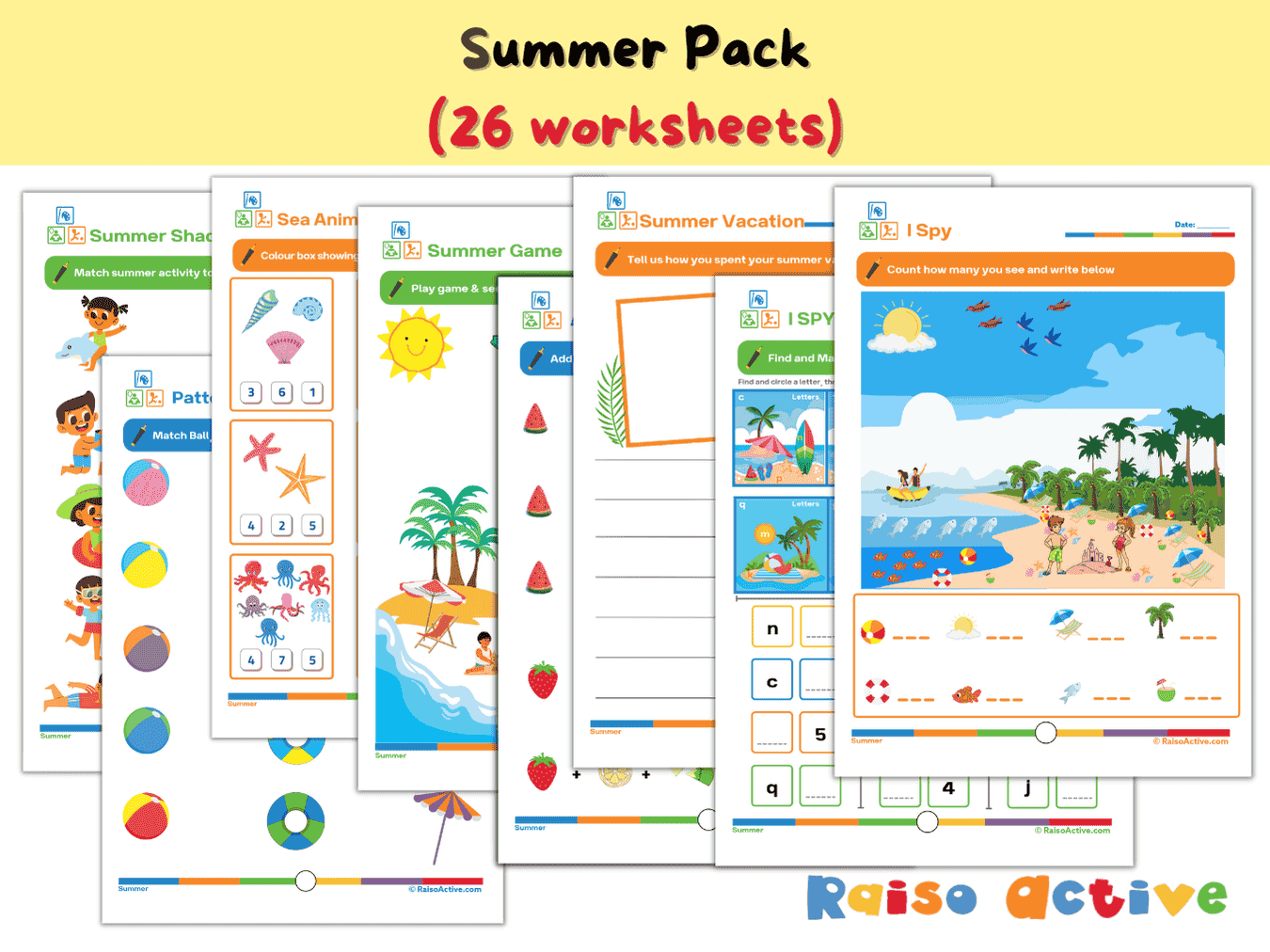
Part of the pack
Summer Activity Pack: Math, Literacy, Puzzles & More for Preschool & Kindergarten
This is page 17 of the pack. Ages 3-7 · Preschool–Grade 1Ages 3-7 · Nursery–Year 2Ages 3-7 · Nursery–Class 1Ages 3-7
Made for your child
Adding within 10, made for your child
A maths pack with your child's name in it: pictures that explain, practice at three levels, puzzles and story sums about them. Print a new set whenever they finish.
Make a maths packFree preview · free for members
Curriculum
- Addition > Addition Basics
How to use this worksheet
Point to the first group of pictures and count them aloud together, then do the same for the second group before looking at the total. Encourage your child to count all the pictures in both groups from the very beginning — 1, 2, 3 across both — rather than trying to add the two numbers in their head. Write the total number after the equals sign only once they've counted out loud and are confident in the number.
Materials needed
- Pencil
- Crayons
Extension activities
- 1Use real snacks — two crackers plus three crackers — and let your child eat the 'answer' after counting.
- 2Draw two small groups of suns or beach balls on paper and count the combined total together.
- 3Play an addition game with dice: roll two dice and count all the dots together.
- 4Build two towers of blocks, push them together, and count the combined tower.
- 5Practice 'one more' by adding a single object to a small group and recounting the new total.

Written by
Hemsweta Jain · Teacher Cheena
MBA and Early Childhood Educator, teaching since 2014 · Founder of RaisoActive, Mumbai
Every RaisoActive worksheet is designed and checked by the founder before publishing.
Published · Last reviewed
More from Summer Activity Pack: Math, Literacy, Puzzles & More for Preschool & Kindergarten

Summer Shadows Matching Worksheet for Preschoolers
Ages 3-5 · Preschool–Pre-KAges 3-5 · Nursery–ReceptionAges 3-5 · Nursery–LKGAges 3-5
This worksheet has children ages 3-5 match pictures of summer activities, like swimming or building a sandcastle, to their correct shadow silhouettes, building visual discrimination through shape recognition rather than color or detail. Because these shadows represent action scenes rather than single objects, children must recognize more complex outlines, including body positions and poses, which is a step up from matching simpler object shadows. This adds a layer of visual reasoning about how shapes and motion relate.
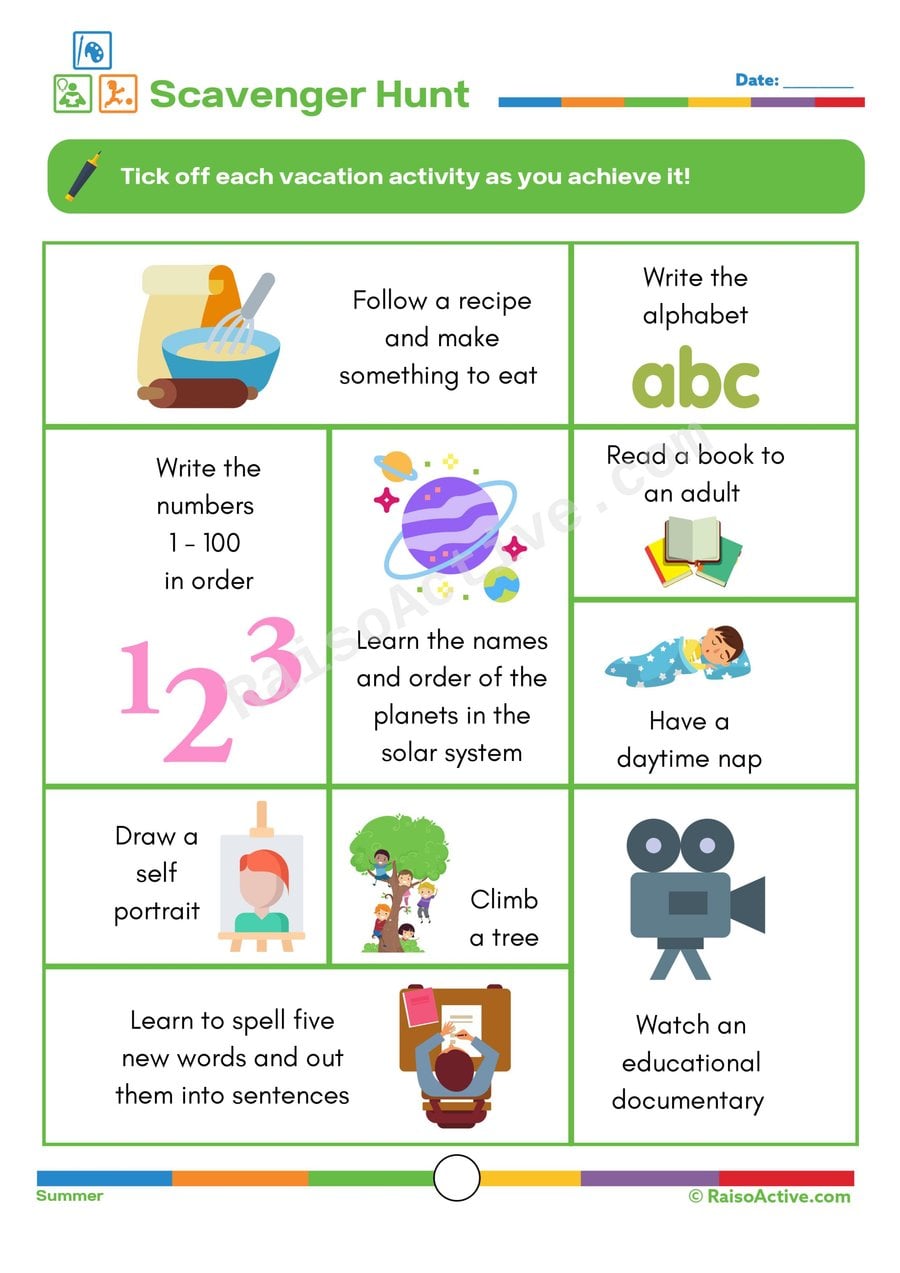
Summer Scavenger Hunt Worksheet for Kids
Ages 3-5 · Preschool–Pre-KAges 3-5 · Nursery–ReceptionAges 3-5 · Nursery–LKGAges 3-5
This scavenger hunt worksheet encourages children ages 3-5 to actively search their environment for specific summer sights, sounds, and objects, building observation skills and sustained attention as they look for each item on the list. Unlike a worksheet completed sitting at a table, this activity connects paper-based learning to real, physical exploration, which helps children practice following a checklist over an extended period of time. Checking off each item as it's found also introduces an early sense of tracking progress toward completing a task.

I Spy Summer Fun Worksheet: Counting and Identifying Objects!
Ages 3-5 · Preschool–Pre-KAges 3-5 · Nursery–ReceptionAges 3-5 · Nursery–LKGAges 3-5
This 'I Spy Summer Fun' worksheet helps young learners (ages 3-5) master one-to-one correspondence, a crucial foundational math skill, by counting specific summer-themed objects within a busy scene. Children will practice associating a number name with each item they touch or point to, building early number sense and visual discrimination. This activity strengthens their ability to accurately count quantities up to 20, preparing them for more complex mathematical concepts.

Summer T-Shirt Match: A Fun Matching Worksheet for Kids!
Ages 3-5 · Preschool–Pre-KAges 3-5 · Nursery–ReceptionAges 3-5 · Nursery–LKGAges 3-5
This worksheet has children ages 3-5 match fruit designs to summer t-shirts featuring the same pattern, building visual discrimination as they compare details like shape and arrangement across two separate pictures. Because the match depends on recognizing a specific fruit design repeated in a different context, children practice the transferable skill of identifying that two pictures represent the same thing even when shown in a different format. Naming the fruits along the way also builds vocabulary.

Summer Sudoku: Complete the Summer-Themed Sudoku Puzzle!
Ages 4-6 · Pre-K–KindergartenAges 4-6 · Reception–Year 1Ages 4-6 · LKG–UKGAges 4-6
This picture Sudoku puzzle introduces children ages 4-6 to logical reasoning by having them fill empty squares with summer images so that no picture repeats in any row, column, or smaller square. Solving it requires children to hold multiple pieces of information in mind at once, tracking what's already placed in a row and column before deciding what belongs in an empty square, which builds working memory alongside visual discrimination. This kind of structured logic puzzle is an early stepping stone toward the reasoning skills used in later math and problem-solving.

Color Code Shorts: A Fun Summer Coloring Worksheet!
Ages 3-5 · Preschool–Pre-KAges 3-5 · Nursery–ReceptionAges 3-5 · Nursery–LKGAges 3-5
This worksheet has children ages 3-5 use a color-by-number code to color a pair of summer shorts, matching each numbered section to the correct color listed in a key at the bottom of the page. This activity strengthens number recognition, since children must match numerals to their position in a code, while also reinforcing color names and fine motor control as they color within smaller, numbered sections. Following a color code is also an early introduction to reading and applying a visual key, a skill used again in maps and charts later on.
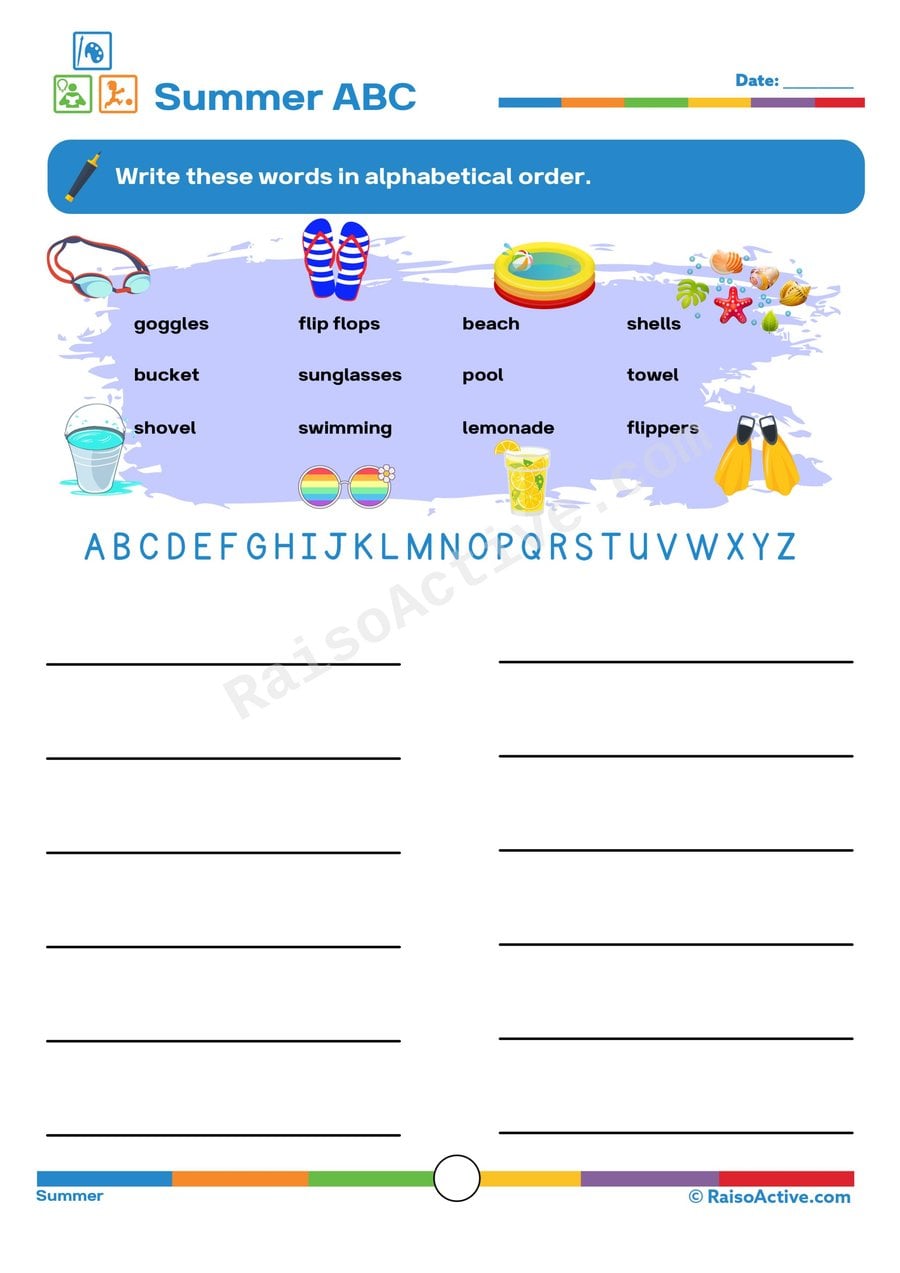
Summer ABC Worksheet: Alphabetical Order Fun!
Ages 4-6 · Pre-K–KindergartenAges 4-6 · Reception–Year 1Ages 4-6 · LKG–UKGAges 4-6
This worksheet has children ages 4-6 put a new set of summer words into alphabetical order, building on the comparison and sequencing skills involved in matching each word's first letter to its place in the alphabet. Because this task requires holding several words in mind at once and deciding their relative order, it strengthens working memory alongside letter-sequence knowledge. Repeated practice with alphabetizing across different word sets like this one helps the skill become more automatic over time.
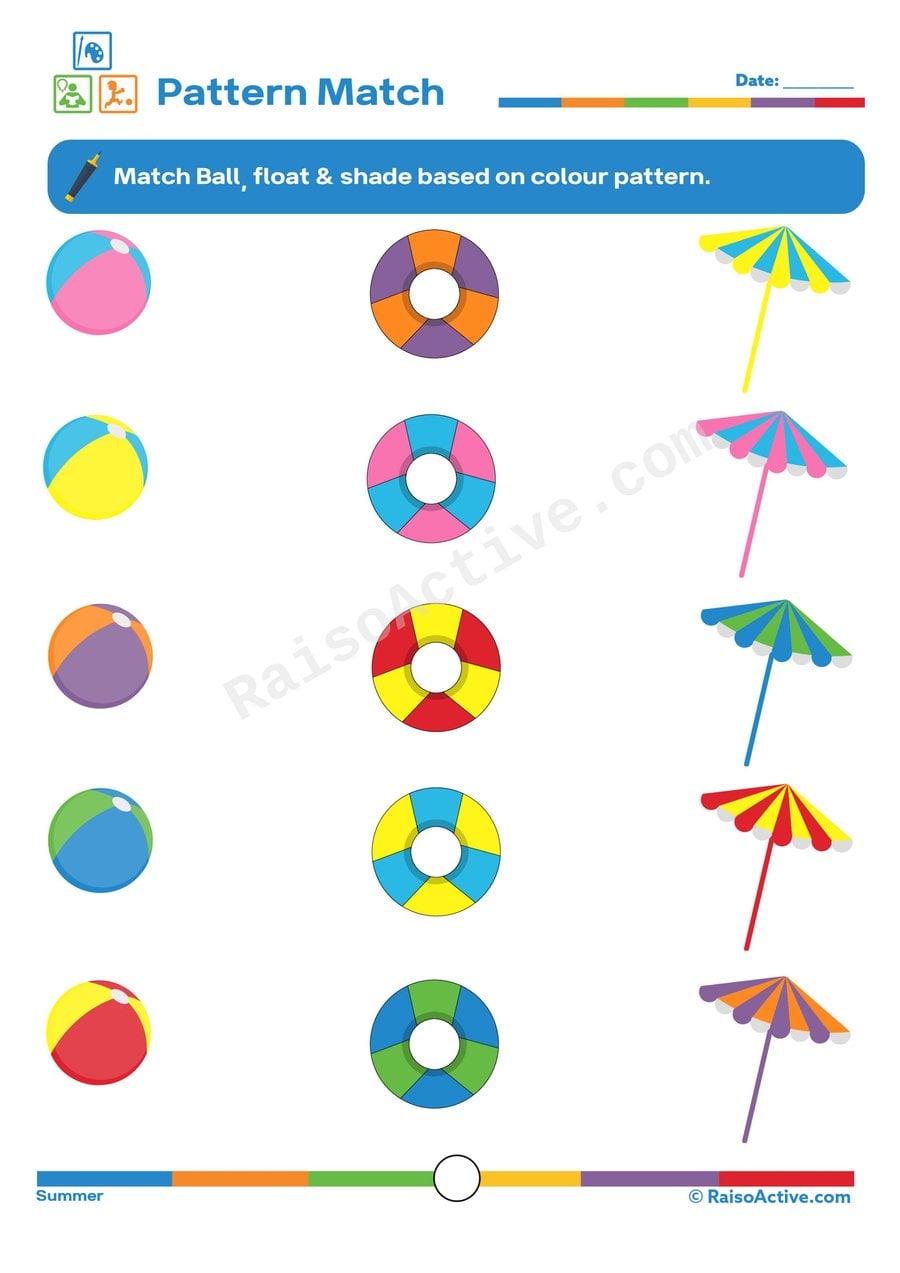
Summer Pattern Match Worksheet for Preschoolers
Ages 3-5 · Preschool–Pre-KAges 3-5 · Nursery–ReceptionAges 3-5 · Nursery–LKGAges 3-5
This worksheet asks children ages 3-5 to study the color pattern on a beach ball, pool float, and sun umbrella and match each item to its correctly patterned counterpart, building early pattern recognition, a foundational skill for later math concepts like sequencing and algebraic thinking. Because the match depends on noticing the order and repetition of colors rather than just matching a single color, children must compare details carefully rather than glance quickly. This strengthens visual attention alongside the pattern skill itself.
Related worksheets
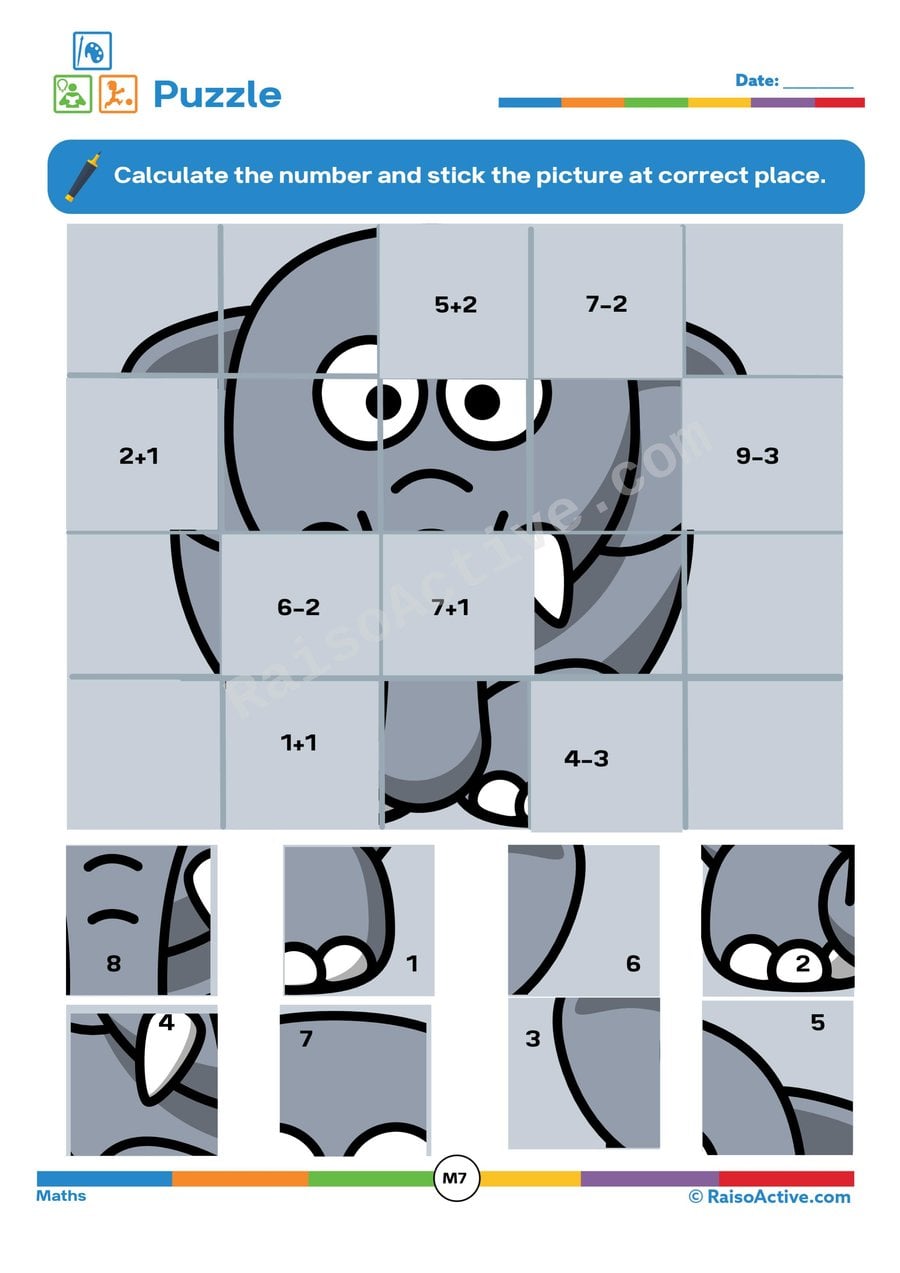
Elephant Puzzle: Math Worksheet for Preschoolers
Ages 4-5 · Pre-KAges 4-5 · ReceptionAges 4-5 · LKGAges 4-5
Children ages 4-5 practice solving simple addition problems and then use those answers to solve a picture puzzle, matching each answer to the correct puzzle piece to complete an elephant. This turns basic addition fact practice into a satisfying hands-on challenge with a visual reward at the end.
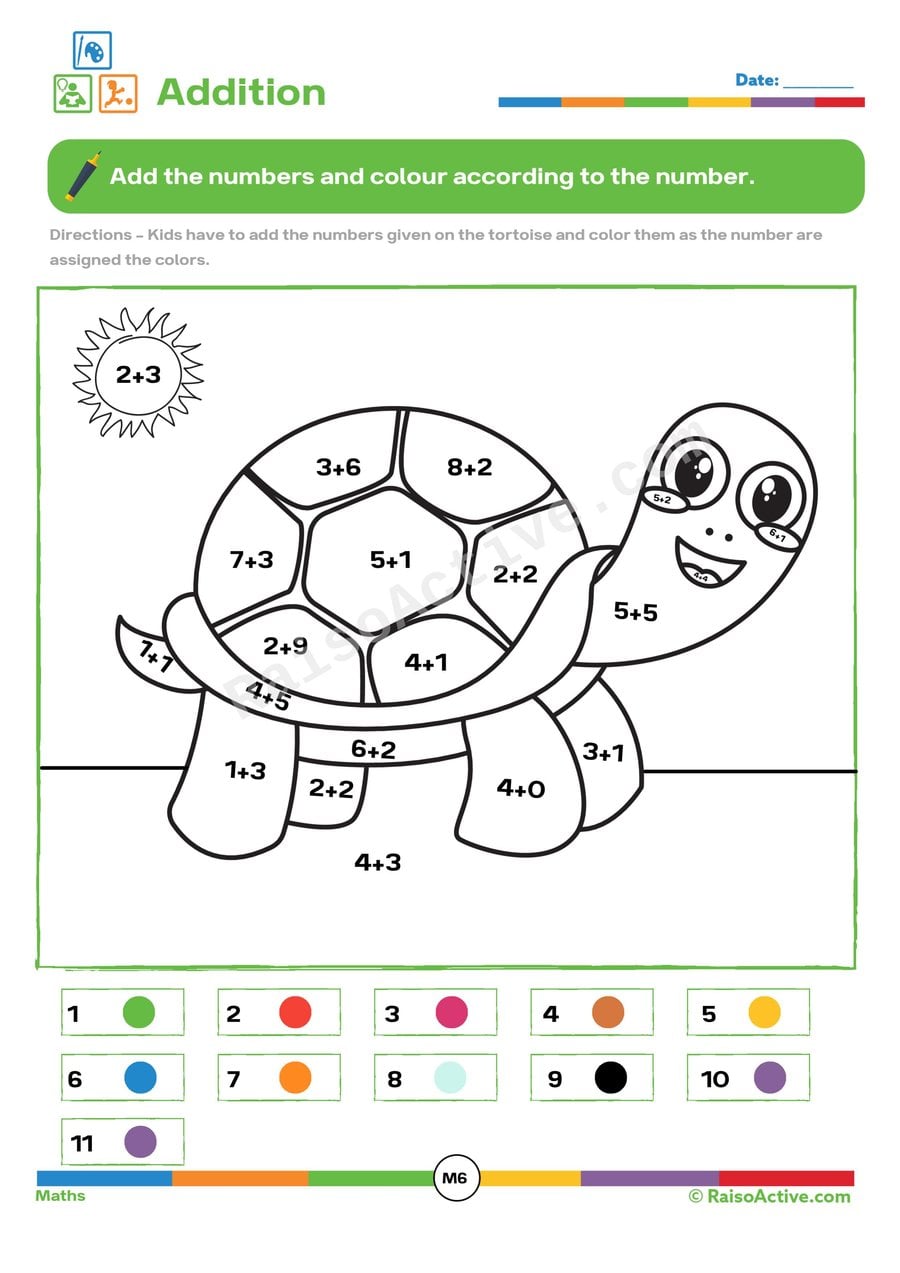
Color by Number Addition Worksheet: The Turtle!
Ages 4-6 · Pre-K–KindergartenAges 4-6 · Reception–Year 1Ages 4-6 · LKG–UKGAges 4-6
Children ages 4-6 practice single-digit addition facts and then apply a color key to their answers, combining math fluency with careful visual matching as the turtle picture is revealed. The immediate visual payoff of a colored picture gives children a clear, motivating way to check whether their addition was correct.
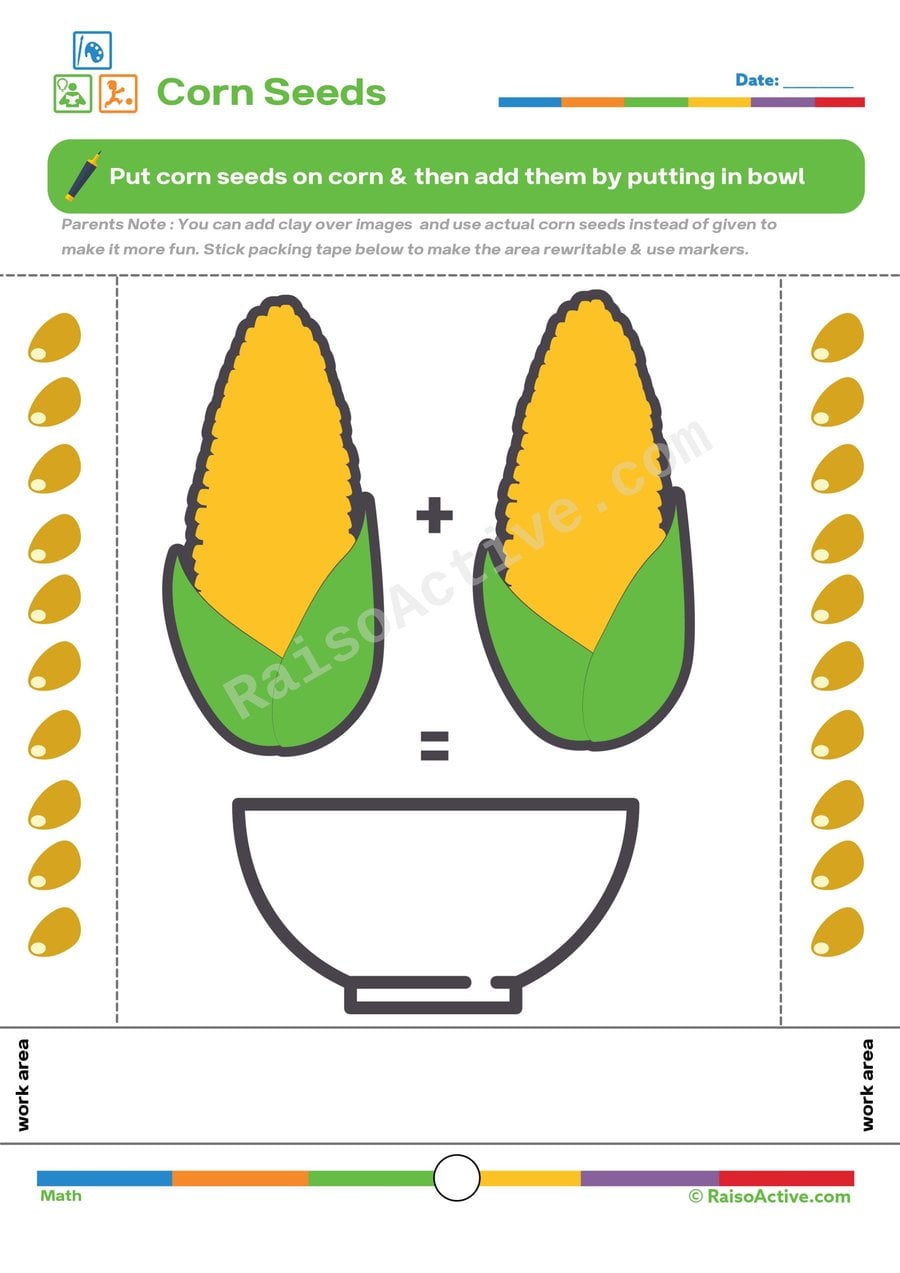
Corn Seed Addition Worksheet for Preschoolers
Ages 3-5 · Preschool–Pre-KAges 3-5 · Nursery–ReceptionAges 3-5 · Nursery–LKGAges 3-5
Counting corn seeds on two ears of corn and combining them into one total teaches children ages 3-5 the core concept of addition as joining groups together, using a concrete, countable image rather than abstract numerals alone. This worksheet also builds one-to-one correspondence, since accurate addition depends on touching or pointing to each seed exactly once while counting.

Addition House Worksheet for Preschoolers
Ages 4-5 · Pre-KAges 4-5 · ReceptionAges 4-5 · LKGAges 4-5
This hands-on craft turns simple addition into a reusable game, as children ages 4-5 build a paper house with numbered windows and a door that can be changed with tape or number stripes. Physically swapping numbers to create new addition problems (like 2 windows + 1 door) helps children grasp that addition means combining separate groups into one total, rather than just memorizing facts.
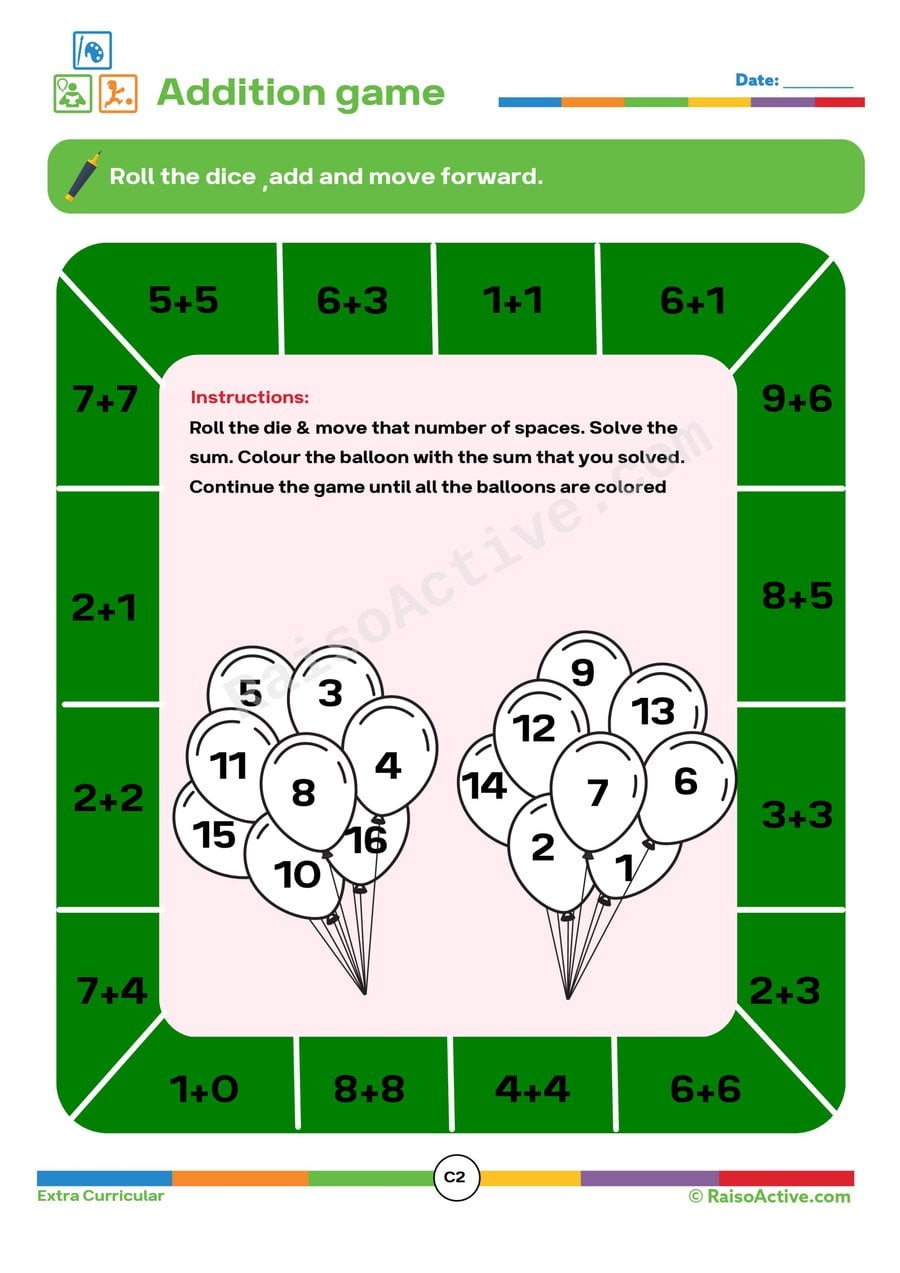
Addition Game: Roll, Add, and Color the Balloons!
Ages 4-6 · Pre-K–KindergartenAges 4-6 · Reception–Year 1Ages 4-6 · LKG–UKGAges 4-6
Turning addition practice into a dice game gives children ages 4-6 a built-in reason to solve repeated equations without it feeling like a repetitive drill, since each roll introduces a small element of chance and excitement. Solving the addition problem in each space and then coloring the matching balloon connects abstract number work to a satisfying visual result, reinforcing that math has a concrete, visible payoff. Playing a game format like this also builds early skills in following multi-step game rules, which supports both math confidence and general executive function.

Addition Worksheet for Kids: Add Horizontally and Vertically!
Ages 4-6 · Pre-K–KindergartenAges 4-6 · Reception–Year 1Ages 4-6 · LKG–UKGAges 4-6
Children ages 4-6 practice basic addition by solving problems arranged both horizontally, like '3 + 2 =,' and vertically, in a stacked column format, building flexibility with the two most common ways addition problems appear in early math worksheets and textbooks. Learning both formats now means neither will feel unfamiliar once formal school math introduces them side by side.

Diwali Addition Worksheet for Kids: Counting and Adding Objects!
Ages 4-5 · Pre-KAges 4-5 · ReceptionAges 4-5 · LKGAges 4-5
Children ages 4-5 practice addition by counting two separate sets of Diwali-themed objects, then combining the totals and writing the sum. Seeing objects grouped together concretely helps children understand what 'adding' actually means before relying on memorized number facts. This festive theme also connects the math skill to a real cultural celebration, giving the abstract addition work a meaningful, relatable context.

Mickey Mouse Number Sequence Worksheet: Paste the Missing Numbers!
Ages 4-5 · Pre-KAges 4-5 · ReceptionAges 4-5 · LKGAges 4-5
This cut-and-paste worksheet uses a Mickey Mouse theme to give children ages 4-5 practice recognizing and completing number sequences by identifying missing numbers within numbered frames and pasting them into place. Because the missing numbers appear in the middle of a sequence rather than only at the end, children must think about both the number before and after a gap, a more demanding skill than simple 'what comes next' counting. The familiar character theme adds motivation to a task that is fundamentally about numerical reasoning.
Guides for this topic

Number Formation Rhymes 0–9 and How to Fix Reversals
Original number formation rhymes for 0–9, the correct stroke order for each digit, why 3, 5 and 7 get reversed most often, and multisensory fixes that work.

UKG Syllabus Explained: English, Maths and EVS Month by Month
What UKG classes typically cover in English, maths and EVS, month by month, aligned to NEP 2020, with ways to support at home and signs your child is behind.

Spring and Summer Learning Activities: Harnessing Nature's Classroom for Year-Round Growth
Discover heat-safe outdoor activities, monsoon science experiments, and summer holiday learning plans for young children in India. Prevent summer slide with fun ideas for ages 1-8.
Reviews
Every worksheet for ages 4–5, no watermark
Members download the full library of 1,000+ worksheets and every activity pack without watermarks or daily limits. One year costs ₹999 in India or $20 elsewhere.
See membership plansOr download any worksheet free with a watermark (5 a day).