Diwali Addition Worksheet for Kids: Counting and Adding Objects!
Children ages 4-5 practice addition by counting two separate sets of Diwali-themed objects, then combining the totals and writing the sum. Seeing objects grouped together concretely helps children understand what 'adding' actually means before relying on memorized number facts. This festive theme also connects the math skill to a real cultural celebration, giving the abstract addition work a meaningful, relatable context.
Part of the pack
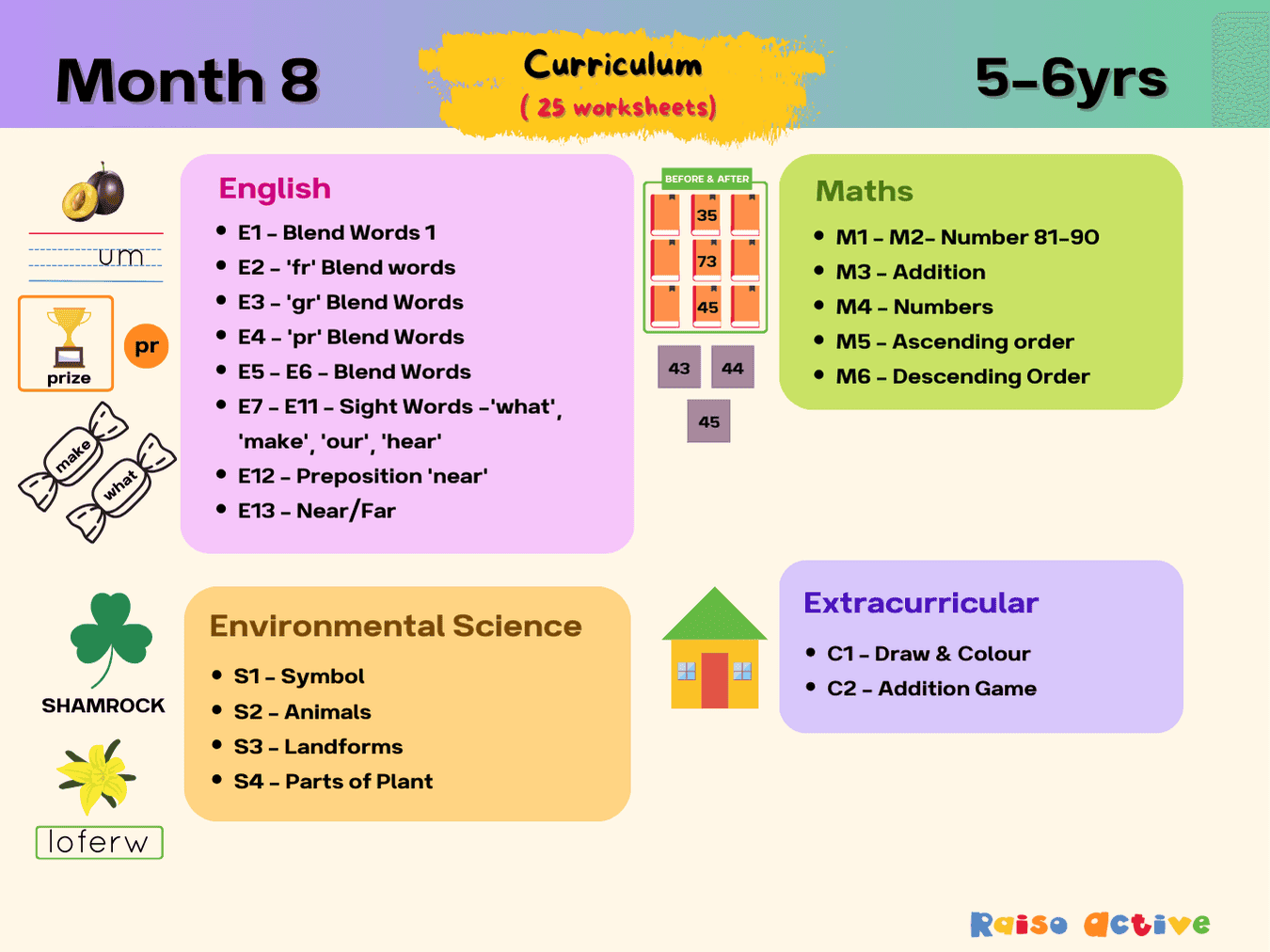
Month 8: Literacy, Math, Science Foundations | Ages 5-6
This is page 19 of the pack. Ages 5-6 · KindergartenAges 5-6 · Year 1Ages 5-6 · UKGAges 5-6
Made for your child
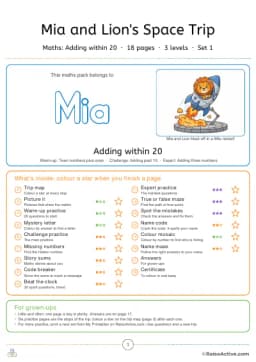
Adding within 10, made for your child
A maths pack with your child's name in it: pictures that explain, practice at three levels, puzzles and story sums about them. Print a new set whenever they finish.
Make a maths packFree preview · free for members
Curriculum
- Addition > Addition Basics
How to use this worksheet
Look at the first set of objects together and count them aloud, then count the second set separately. Ask your child to combine both counts by counting all the objects together, or by counting on from the first total. Have them write the combined total in the box provided to complete the addition problem. Repeat this process for each remaining problem on the page, checking each sum by recounting together.
Materials needed
- Pencil
- Eraser
Extension activities
- 1Use real diyas, candles, or small objects to physically combine two groups and count the total.
- 2Have your child draw their own two sets of objects and create an addition problem to solve.
- 3Talk about Diwali traditions while counting objects related to the festival, like lights or sweets.
- 4Practice simple addition facts using fingers, counting up from the larger number.
- 5Play a quick game combining two small piles of snacks and asking for the total count.

Written by
Hemsweta Jain · Teacher Cheena
MBA and Early Childhood Educator, teaching since 2014 · Founder of RaisoActive, Mumbai
Every RaisoActive worksheet is designed and checked by the founder before publishing.
Published · Last reviewed
More from Month 8: Literacy, Math, Science Foundations | Ages 5-6
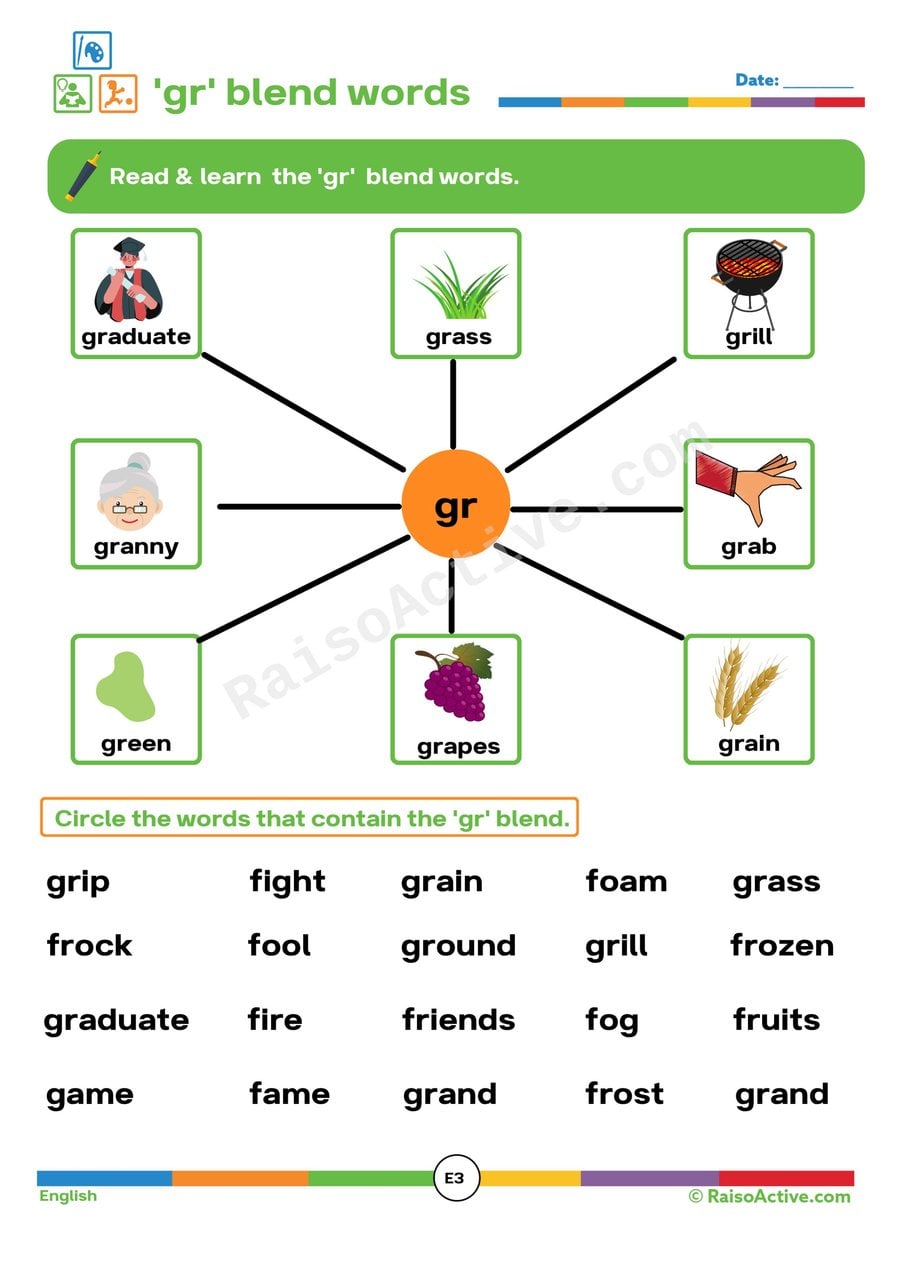
Gr Blend Words Worksheet: Circle the 'gr' Words!
Ages 4-6 · Pre-K–KindergartenAges 4-6 · Reception–Year 1Ages 4-6 · LKG–UKGAges 4-6
Learning to recognize the 'gr' consonant blend, as in 'grass,' 'green,' or 'grape,' trains children's ears to hear two consonant sounds pressed together at the start of a word, a more advanced phonics skill than single-letter sounds. For ages four to six, mastering common blends like 'gr' significantly expands the number of words they can decode independently when reading.
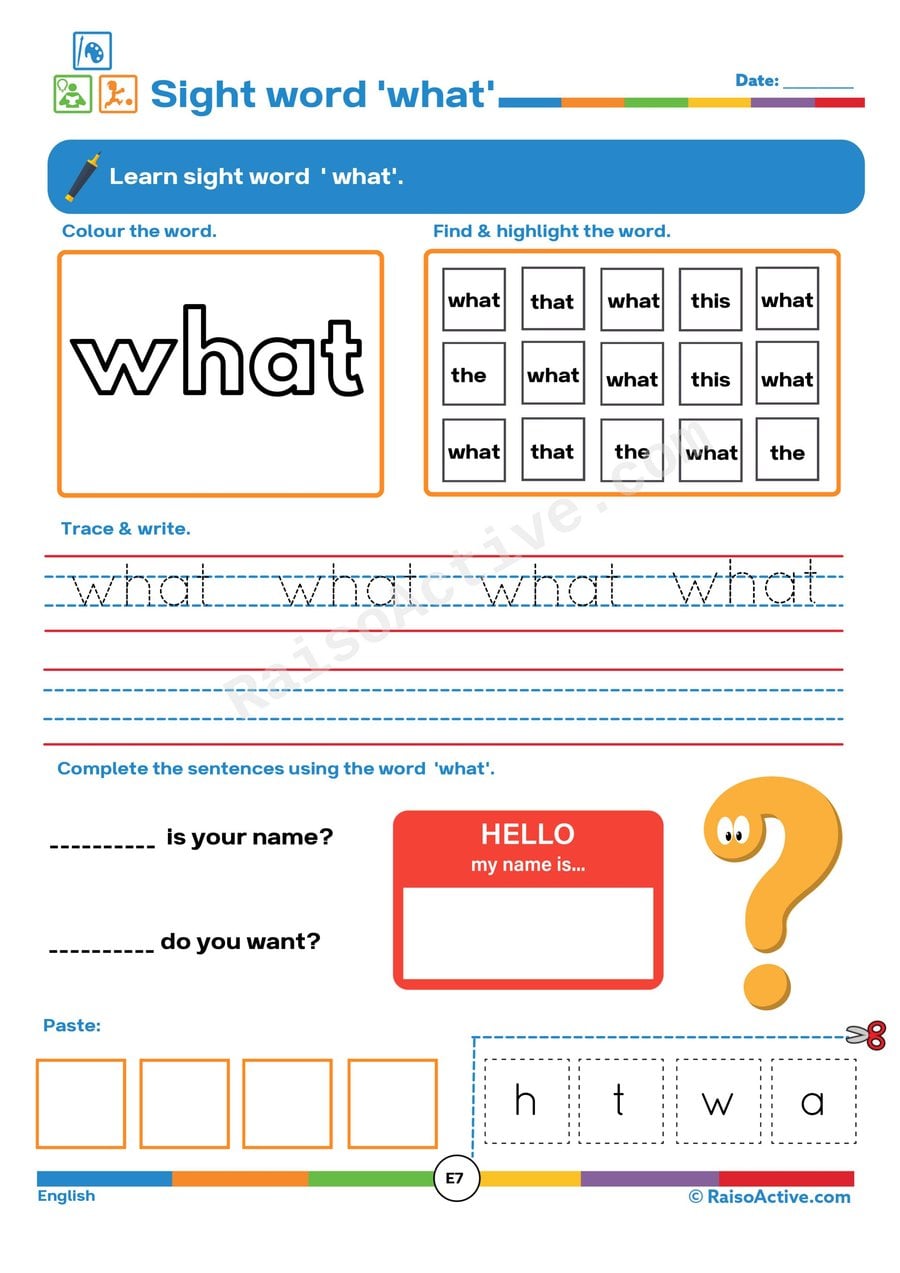
Sight Word 'What' Worksheet: Learn, Trace, and Find!
Ages 4-5 · Pre-KAges 4-5 · ReceptionAges 4-5 · LKGAges 4-5
The word 'what' is a common question word that children ages 4-5 encounter constantly in both spoken conversation and early reading, making it an important addition to their sight word vocabulary. This worksheet builds recognition through several formats — coloring, tracing, word searching, sentence completion, and cut-and-paste spelling — giving the word repeated, varied exposure in a single sitting. Because 'what' is a question word, practicing it in sentences also gives children an early sense of how question structures differ from statement structures.
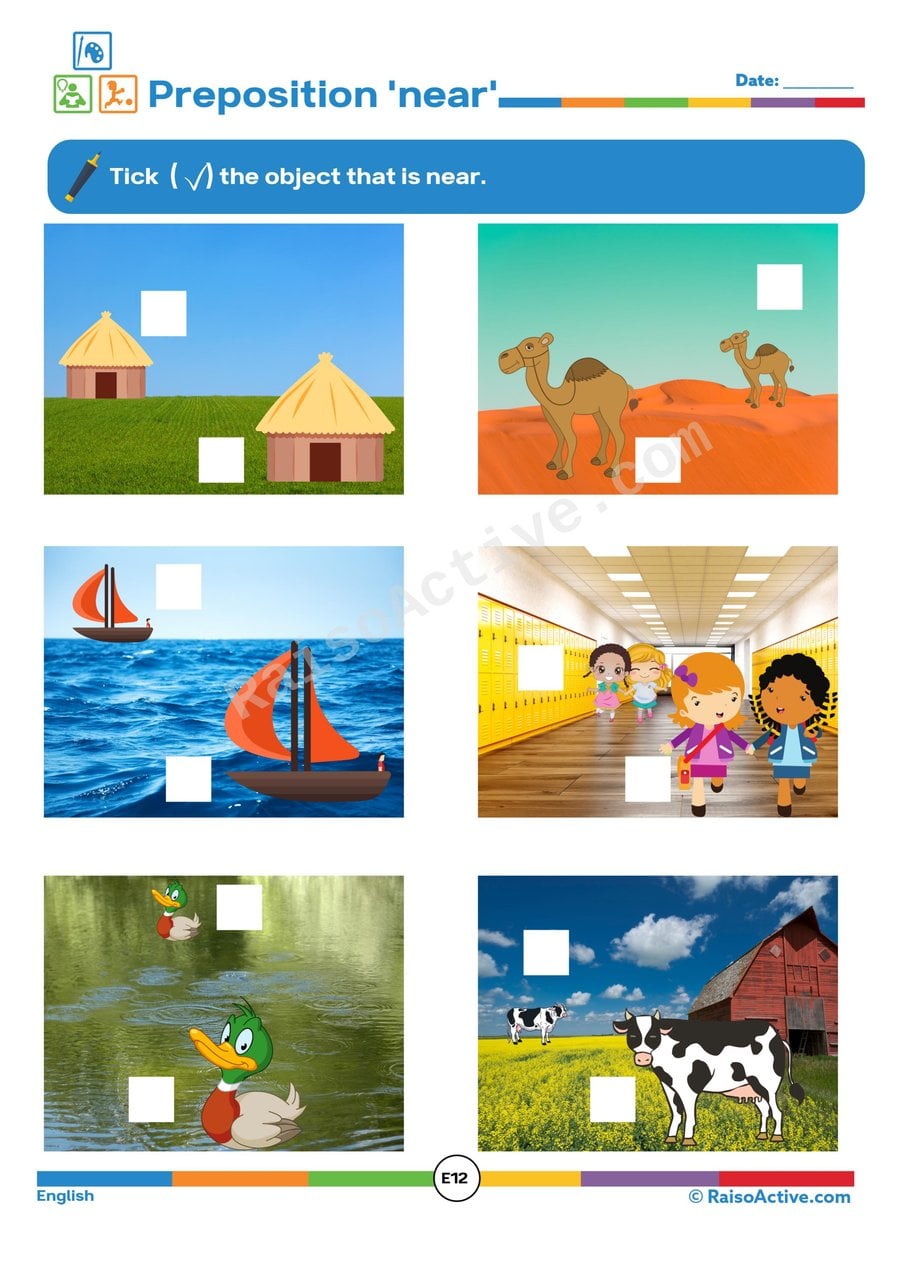
Near or Far? Preposition Worksheet for Kids
Ages 3-5 · Preschool–Pre-KAges 3-5 · Nursery–ReceptionAges 3-5 · Nursery–LKGAges 3-5
Preschoolers ages 3-5 build early spatial vocabulary by identifying which pictured object is positioned 'near' another, a comparative concept that requires judging relative distance between two things. Understanding 'near' versus 'far' lays groundwork for later spatial reasoning skills, like following directions and reading simple maps. Ticking the correct object also sharpens visual comparison and careful observation.
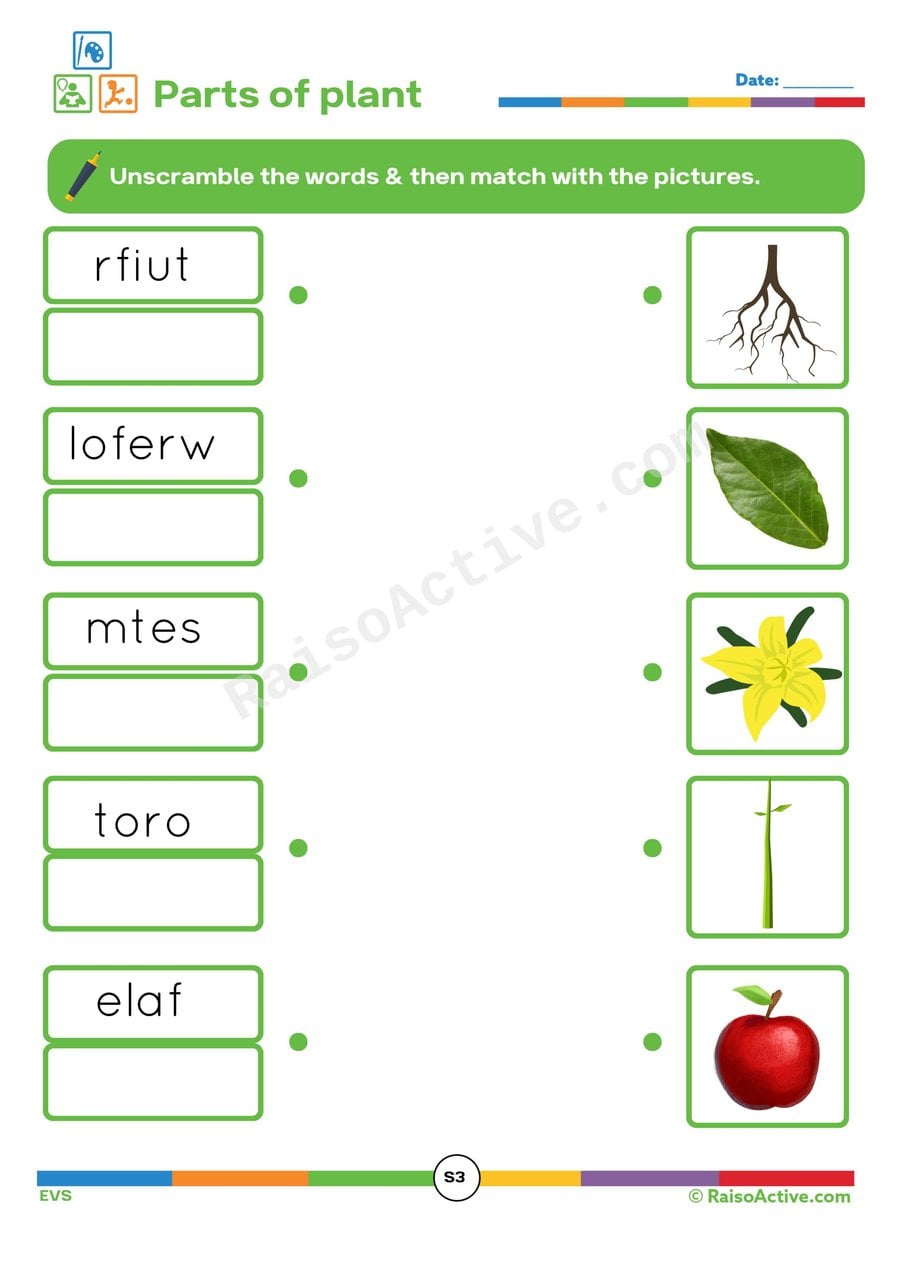
Parts of a Plant Worksheet: Unscramble and Match!
Ages 4-6 · Pre-K–KindergartenAges 4-6 · Reception–Year 1Ages 4-6 · LKG–UKGAges 4-6
Children ages 4-6 learn the names of plant parts — like roots, stem, leaves, and flower — by unscrambling jumbled letters to spell each word and then matching it to the correct picture. Unscrambling requires recognizing familiar letter patterns and sounding out possibilities, a strong spelling and phonics challenge. Matching the unscrambled word to its picture reinforces plant science vocabulary in a hands-on, puzzle-like way.
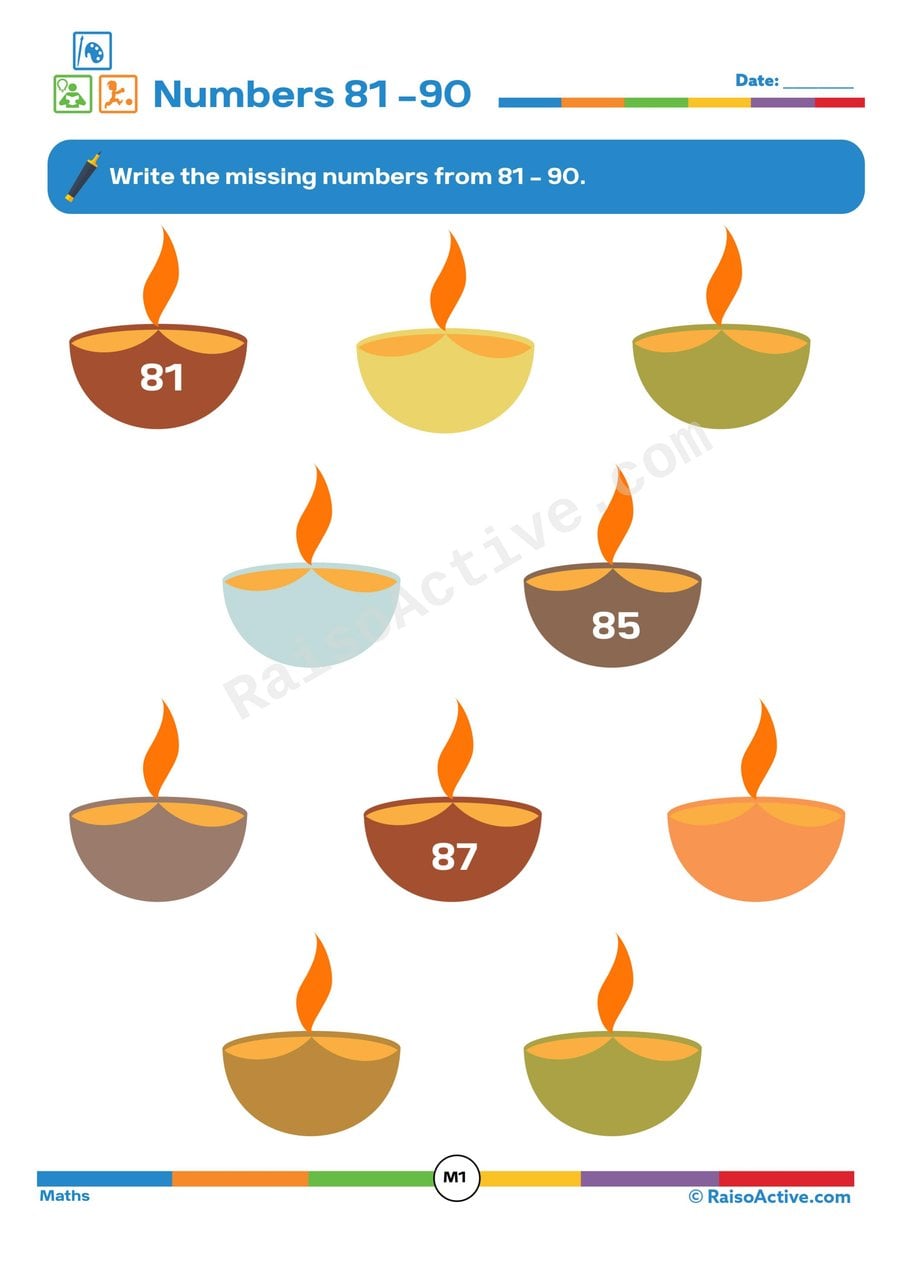
Missing Numbers: Diwali Diyas Worksheet for Kids
Ages 4-6 · Pre-K–KindergartenAges 4-6 · Reception–Year 1Ages 4-6 · LKG–UKGAges 4-6
Children ages 4-6 practice number sequencing within the 81 to 90 range by identifying and writing missing numbers on a set of Diwali-themed diyas. Working with numbers in the 80s pushes children beyond the more familiar 1-20 range, reinforcing that the same counting pattern continues predictably into higher numbers. This festive theme also connects math practice to a meaningful cultural celebration, making the abstract number work feel relevant.
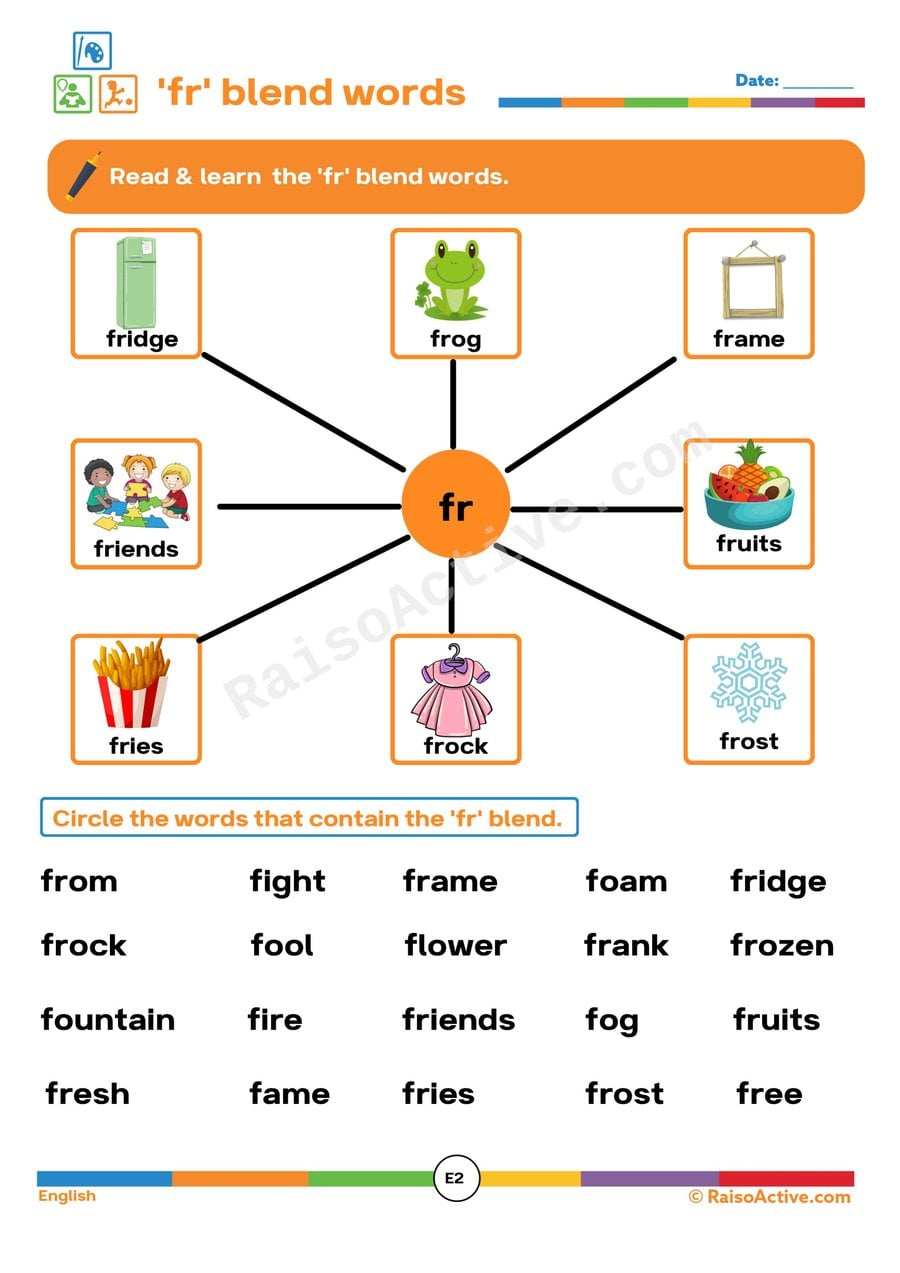
FR Blend Words Worksheet: Circle the Words!
Ages 4-6 · Pre-K–KindergartenAges 4-6 · Reception–Year 1Ages 4-6 · LKG–UKGAges 4-6
Children ages 4-6 practice recognizing the 'fr' consonant blend at the start of words, like 'frog' and 'friend', which requires blending two distinct sounds smoothly together rather than reading them as separate letters. Circling the correct words trains visual scanning alongside auditory sound recognition, both essential for fluent early reading. This kind of blend practice moves children beyond single-letter phonics into more complex word decoding.
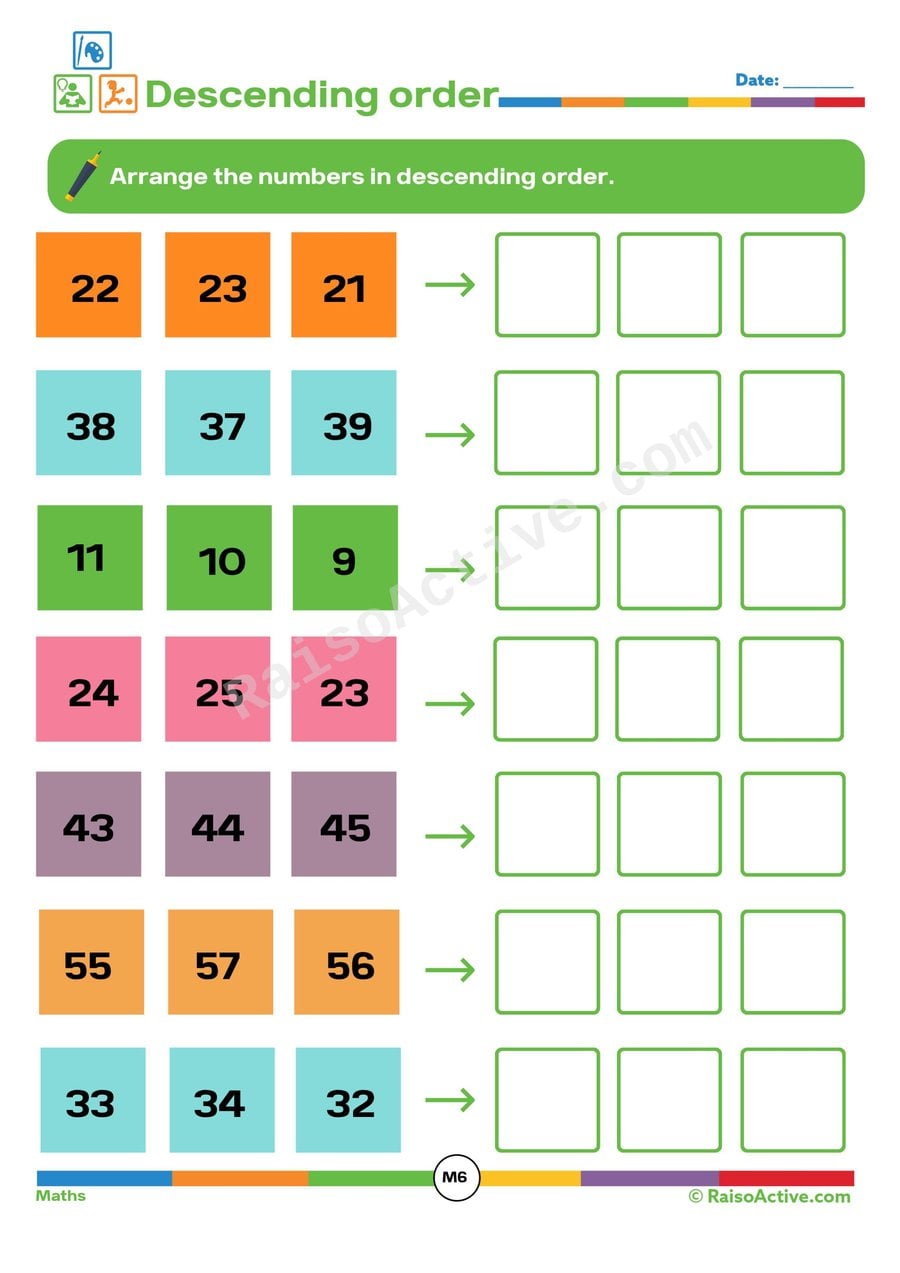
Descending Order Worksheet: Numbers 1-100
Ages 4-6 · Pre-K–KindergartenAges 4-6 · Reception–Year 1Ages 4-6 · LKG–UKGAges 4-6
Arranging numbers from largest to smallest requires children to compare multiple quantities at once and hold a mental number line firmly enough to reverse their usual forward-counting habit, making this noticeably more challenging than ascending order practice. For ages four to six working with numbers up to 100, this builds flexible number sense that supports later skills like rounding and estimating.
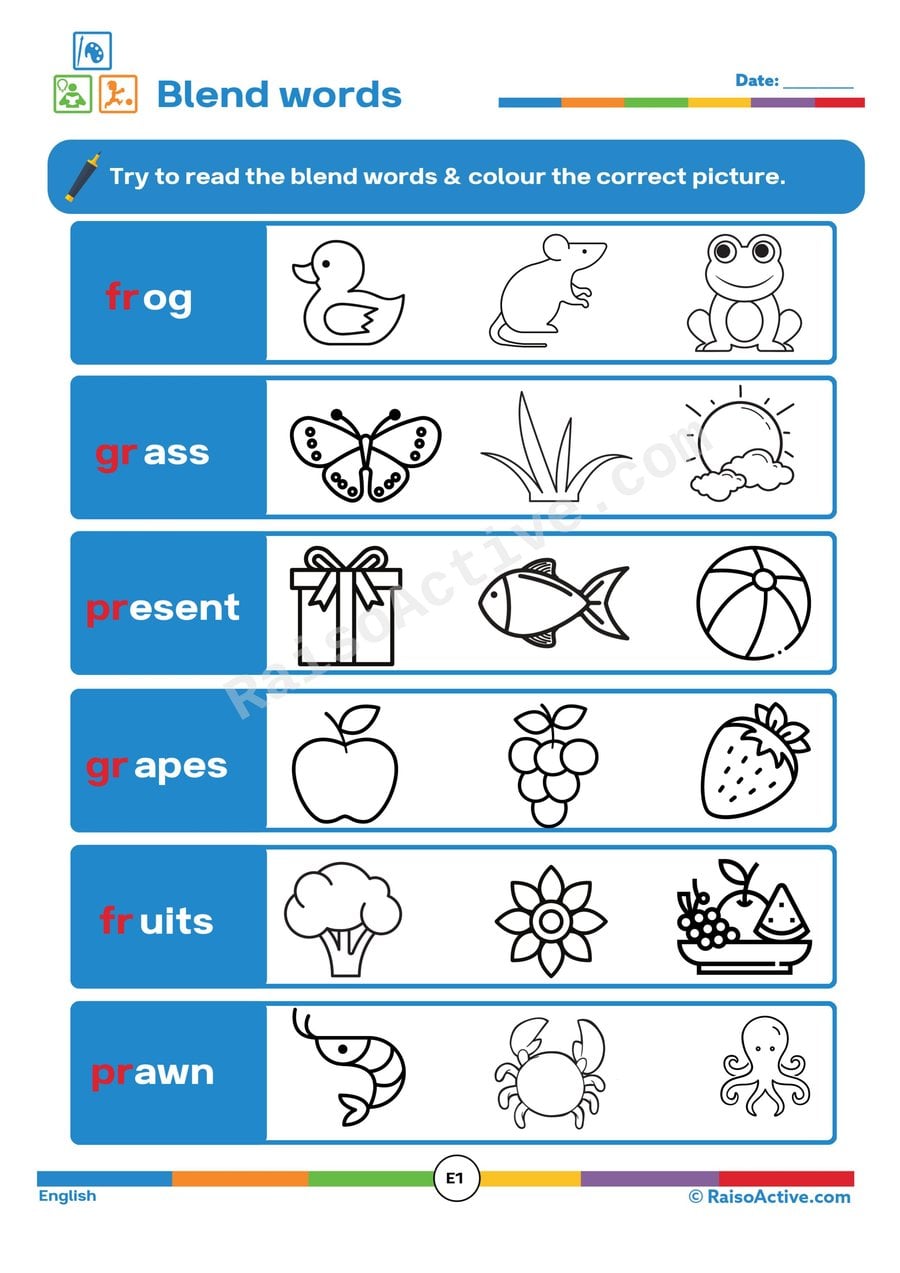
Blend Words Coloring Worksheet for Preschoolers
Ages 4-6 · Pre-K–KindergartenAges 4-6 · Reception–Year 1Ages 4-6 · LKG–UKGAges 4-6
Consonant blends, like 'bl,' 'st,' or 'fr,' require children ages 4-6 to read two consonant sounds together without a vowel between them, which is genuinely more demanding than single-consonant CVC words and represents an important next step in phonics progression. This worksheet asks children to read a blend word and then color the picture that matches it, giving an immediate visual check on whether they decoded the blend correctly. Because coloring is the reward for accurate reading, the activity keeps repeated blend practice feeling engaging rather than repetitive.
Related worksheets

Summer Addition Worksheet for Preschoolers: Counting and Adding Fun!
Ages 4-5 · Pre-KAges 4-5 · ReceptionAges 4-5 · LKGAges 4-5
Adding two small groups of summer-themed pictures — ice creams, beach balls, sunglasses — gives a 4-5 year old a concrete, countable version of addition before they ever see the plus sign written abstractly. Counting each group separately and then counting the combined total builds the core idea that addition means 'put together and count again', which underlies every later addition strategy.
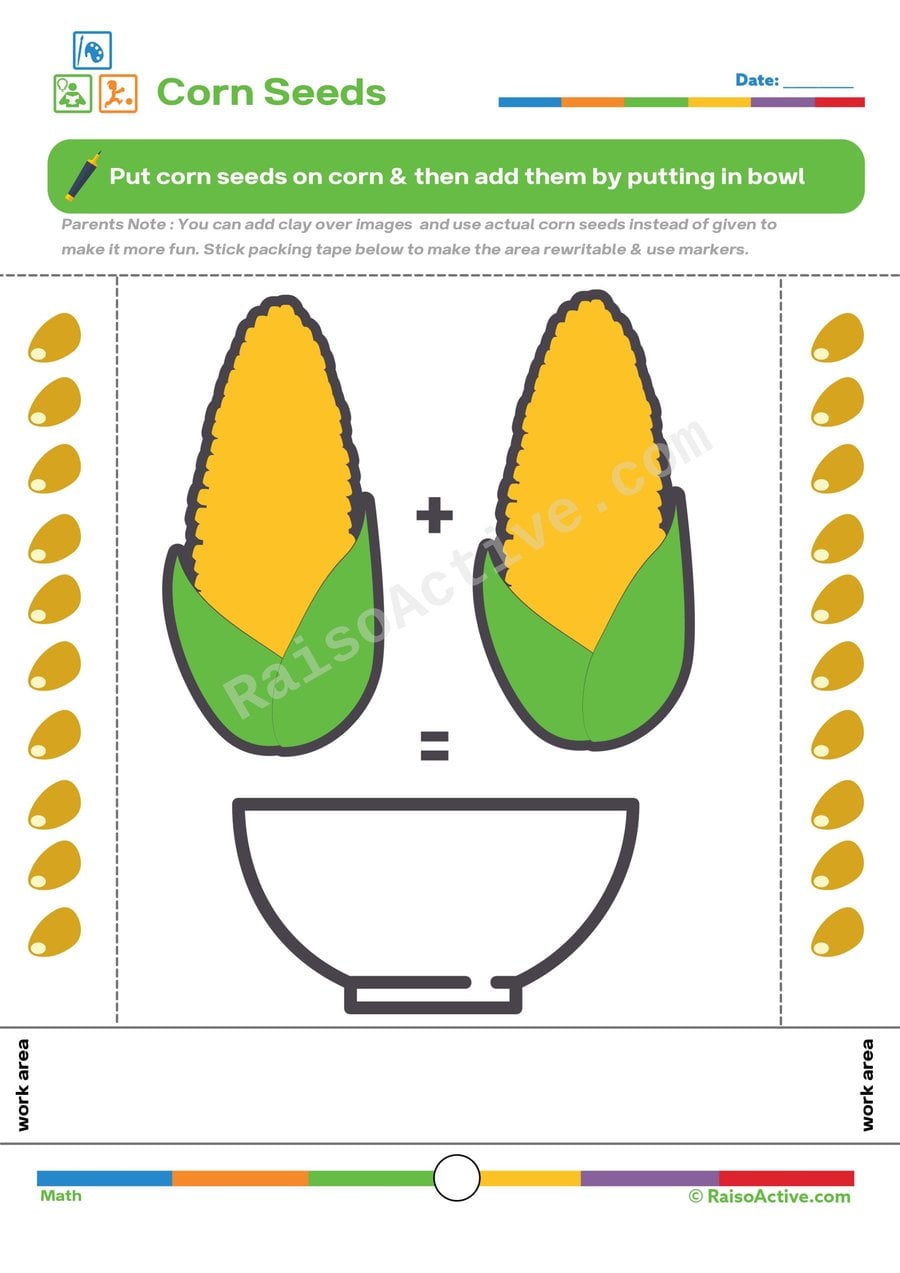
Corn Seed Addition Worksheet for Preschoolers
Ages 3-5 · Preschool–Pre-KAges 3-5 · Nursery–ReceptionAges 3-5 · Nursery–LKGAges 3-5
Counting corn seeds on two ears of corn and combining them into one total teaches children ages 3-5 the core concept of addition as joining groups together, using a concrete, countable image rather than abstract numerals alone. This worksheet also builds one-to-one correspondence, since accurate addition depends on touching or pointing to each seed exactly once while counting.

Addition Worksheet for Kids: Add Horizontally and Vertically!
Ages 4-6 · Pre-K–KindergartenAges 4-6 · Reception–Year 1Ages 4-6 · LKG–UKGAges 4-6
Children ages 4-6 practice basic addition by solving problems arranged both horizontally, like '3 + 2 =,' and vertically, in a stacked column format, building flexibility with the two most common ways addition problems appear in early math worksheets and textbooks. Learning both formats now means neither will feel unfamiliar once formal school math introduces them side by side.
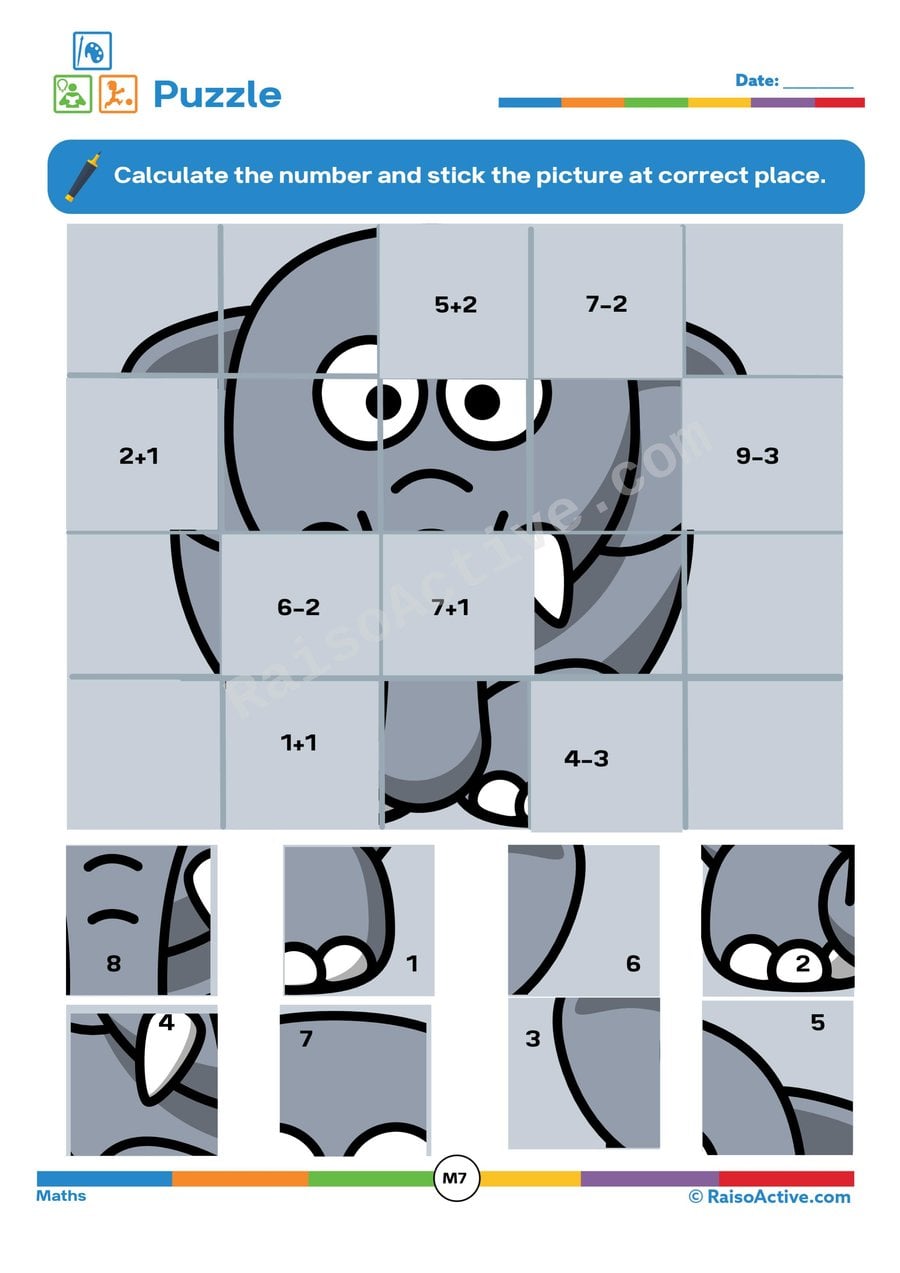
Elephant Puzzle: Math Worksheet for Preschoolers
Ages 4-5 · Pre-KAges 4-5 · ReceptionAges 4-5 · LKGAges 4-5
Children ages 4-5 practice solving simple addition problems and then use those answers to solve a picture puzzle, matching each answer to the correct puzzle piece to complete an elephant. This turns basic addition fact practice into a satisfying hands-on challenge with a visual reward at the end.
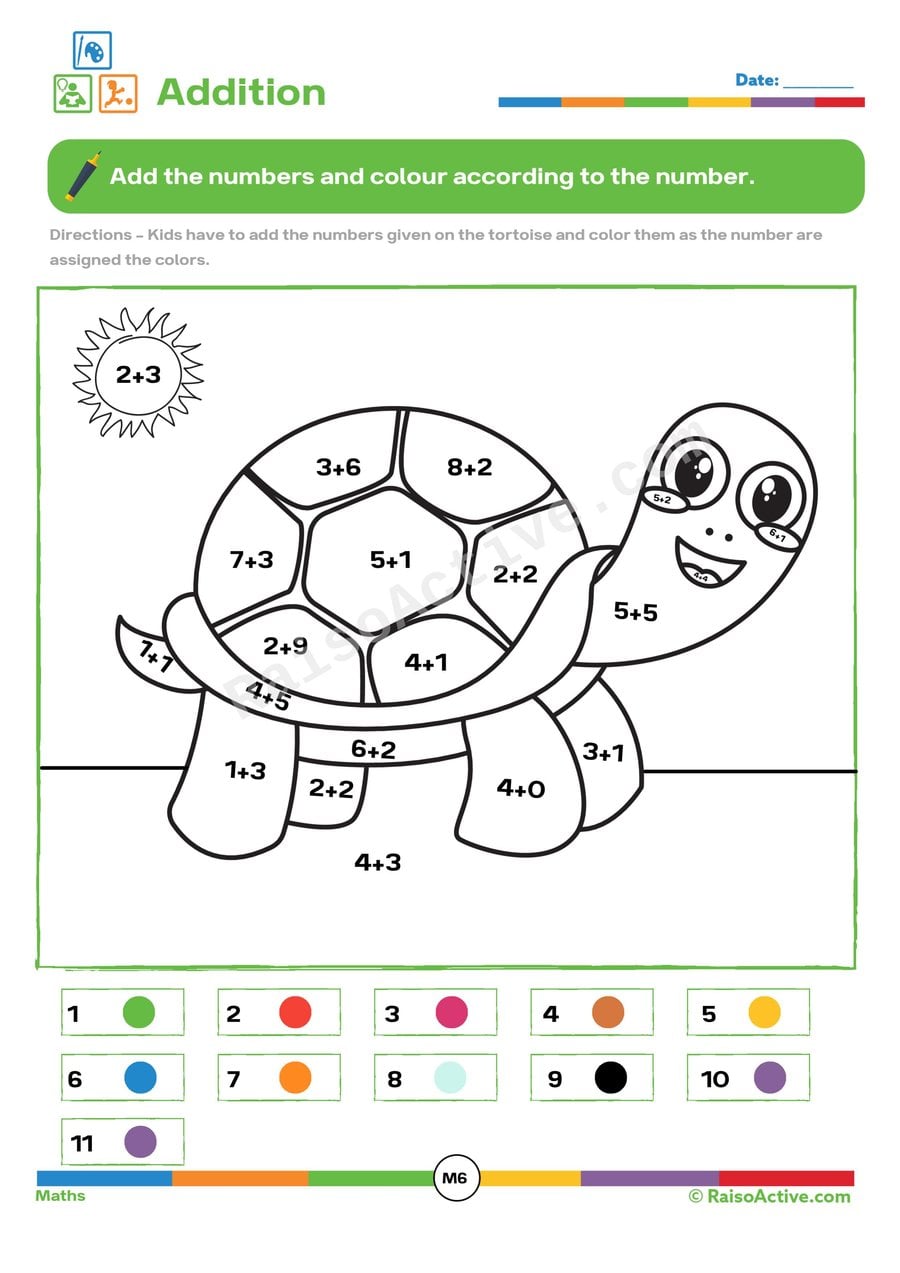
Color by Number Addition Worksheet: The Turtle!
Ages 4-6 · Pre-K–KindergartenAges 4-6 · Reception–Year 1Ages 4-6 · LKG–UKGAges 4-6
Children ages 4-6 practice single-digit addition facts and then apply a color key to their answers, combining math fluency with careful visual matching as the turtle picture is revealed. The immediate visual payoff of a colored picture gives children a clear, motivating way to check whether their addition was correct.

Addition House Worksheet for Preschoolers
Ages 4-5 · Pre-KAges 4-5 · ReceptionAges 4-5 · LKGAges 4-5
This hands-on craft turns simple addition into a reusable game, as children ages 4-5 build a paper house with numbered windows and a door that can be changed with tape or number stripes. Physically swapping numbers to create new addition problems (like 2 windows + 1 door) helps children grasp that addition means combining separate groups into one total, rather than just memorizing facts.
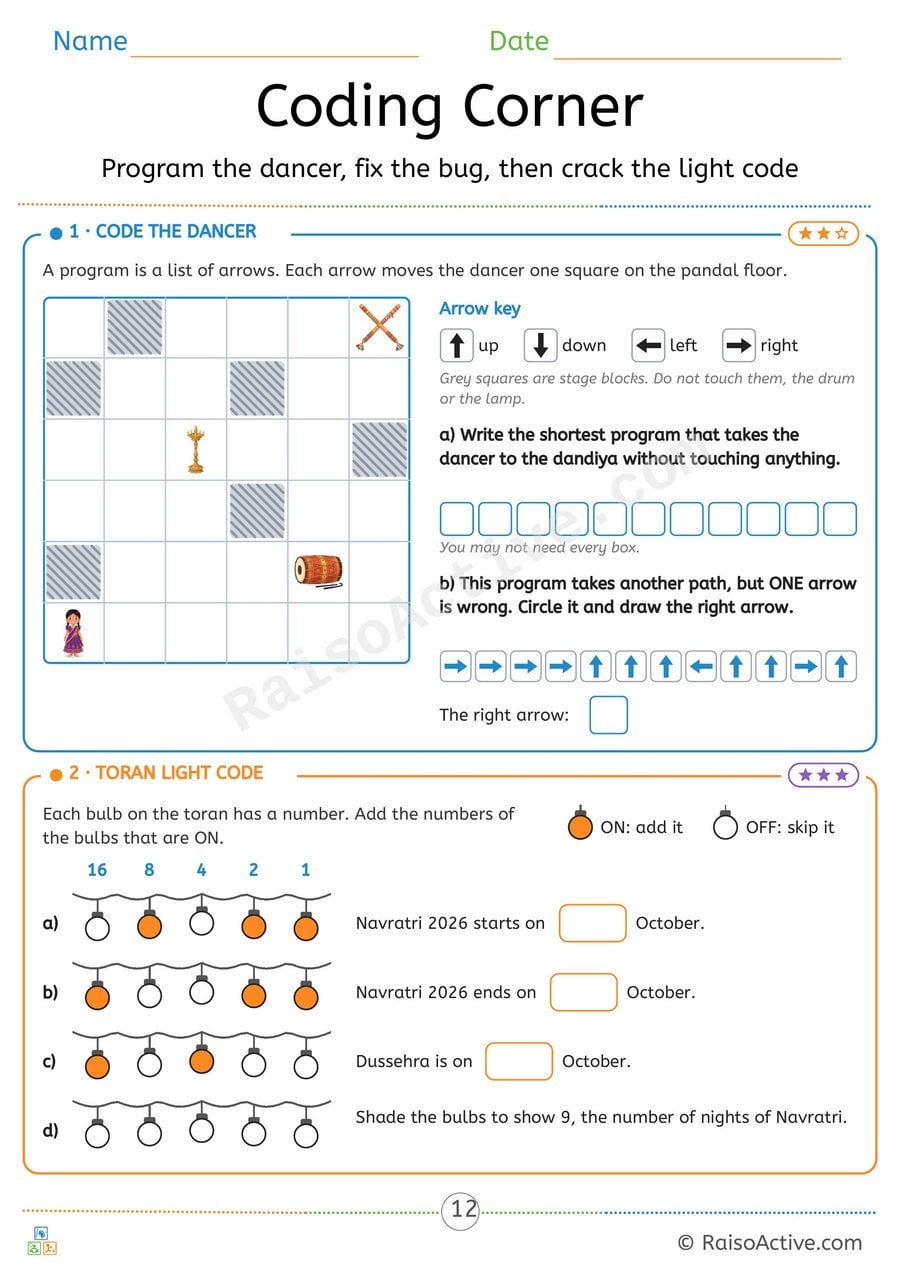
Navratri Coding Corner: Program the Dancer and Toran Light Code
Ages 7-11 · Grade 2–Grade 3Ages 7-11 · Year 3–Year 4Ages 7-11 · Class 2–Class 3Ages 7-11
Children write the shortest arrow program to move a dancer across a grid without touching obstacles, find and fix a bug in another program, and add the values of lit bulbs (16, 8, 4, 2, 1) to read binary numbers that give the dates of Navratri 2026 and Dussehra.

Navratri Colour Hunt: Colour Words, Matching and Bangles
Ages 4-6 · Pre-K–KindergartenAges 4-6 · Reception–Year 1Ages 4-6 · LKG–UKGAges 4-6
Children read colour words, colour bangles to match, count how many of each colour, match everyday things to their colours and find colours around the home.
Guides for this topic

Number Formation Rhymes 0–9 and How to Fix Reversals
Original number formation rhymes for 0–9, the correct stroke order for each digit, why 3, 5 and 7 get reversed most often, and multisensory fixes that work.

Coding Activities for Preschoolers: Building Tomorrow's Thinkers Today
Discover 15+ unplugged and screen-based coding activities for preschoolers that build sequencing, logic, and problem-solving skills through play. NEP 2020 aligned.

Celebrating Diversity: How to Incorporate Cultural Awareness in Learning Activities for Young Children
Practical cultural awareness activities for young children aged 2-8. Explore Indian festivals, world cultures, food, music, and crafts to teach diversity and inclusion.
Reviews
Every worksheet for ages 4–5, no watermark
Members download the full library of 1,000+ worksheets and every activity pack without watermarks or daily limits. One year costs ₹999 in India or $20 elsewhere.
See membership plansOr download any worksheet free with a watermark (5 a day).