UKG Syllabus Explained: English, Maths and EVS Month by Month
Author
RaisoActive - Kids Activities and Fun Learning
Published
Reading Time
7 min read
- UKG (Sr KG) is the final pre-primary year, ages 5–6, and the last pre-school year of the NEP 2020 Foundational Stage before Class 1
- English typically moves from letter sounds to three-letter words, word families, sight words and short sentences by the end of the year
- Maths typically covers numbers to 50 or 100, number names, before/after/between, simple addition and subtraction, shapes, patterns and measurement
- EVS is built around the child: my body, family, home, school, food, animals, plants, seasons, transport, helpers and good habits
- The month-by-month progression below is the usual order; most CBSE, ICSE and state-board schools follow something similar
What the UKG Syllabus Covers
A typical UKG syllabus covers three areas. English: letter sounds, vowels and consonants, three-letter words, word families, sight words and simple sentences. Maths: numbers to 50 or 100, number names, before/after/between, addition and subtraction within 10 or 20, shapes, patterns and measurement. EVS: myself, family, home, school, food, animals, plants, seasons, transport and community helpers.
There is no single national UKG syllabus. CBSE and ICSE schools set their own pre-primary programmes, state boards publish their own, and many schools follow a publisher's series. What they share is a broadly similar order, because it follows how 5-year-olds learn. Since NEP 2020 and the National Curriculum Framework for the Foundational Stage (NCF-FS 2022), that order has also been framed around development rather than content alone. The UKG worksheets on RaisoActive follow the same progression.
This guide describes what typically happens, month by month, so you can see where your child is and what comes next. Your school's planner will differ in detail; treat it as the final word and this guide as the map.
How NEP 2020 Frames the UKG Year
NCF-FS 2022 describes the Foundational Stage (ages 3–8) in terms of five domains of development: physical; socio-emotional and ethical; cognitive; language and literacy; and aesthetic and cultural. English, maths and EVS are how most schools organise the timetable, but a good UKG class is also building attention, self-regulation and habits of learning across the day. Keep that in mind as you read: a child who is slower at sums but plays, listens and persists is in a strong position.
of development frame the Foundational Stage in the National Curriculum Framework for the Foundational Stage 2022: physical; socio-emotional and ethical; cognitive; language and literacy; and aesthetic and cultural. UKG English, maths and EVS all sit inside these, which is why play, art and conversation count as part of the syllabus rather than a break from it
Source: NCF-FS 2022
UKG English: From Sounds to Sentences
UKG English assumes the child arrives from LKG recognising most capital and small letters. The year then moves in a fairly fixed order: letter sounds, vowels and consonants, two-letter and three-letter words, word families, sight words, and finally reading and writing short sentences. Many schools begin cursive or joined-writing patterns in the second half of the year; some leave that to Class 1.
What the English year usually includes
- Revision of A–Z in capitals and small letters, with correct formation on four-line pages
- Letter sounds (phonics), then the five vowels and the difference between vowels and consonants
- Two-letter words (at, in, on, up) and three-letter CVC words in families: -at, -an, -en, -ig, -ot, -ug
- Sight words such as the, is, a, and, this, that, and reading simple sentences built from them
- Rhyming words, opposites, naming words, one and many, this/that and these/those
- Picture reading, listening to stories and answering simple questions; a few lines of dictation by the end of the year
The step that decides the year is blending: hearing c-a-t and saying "cat". Children who blend by the middle of UKG read simple sentences by the end; children still naming letters instead of sounding them tend to stall. Free phonics worksheets that pair a picture with a three-letter word give short daily practice, and the UKG English worksheets collection follows the same word-family order most schools use.
UKG Maths: Numbers, Operations and Measurement
UKG maths builds on LKG counting to about 20 and extends it in three directions: further along the number line, into number names, and into operations. The upper limit varies more than anything else in the syllabus. Some schools stop at 50, many go to 100 and a few push to 200; the number itself matters less than whether the child understands what the numbers mean.
What the maths year usually includes
- Number recognition and writing to 50, then 100; counting forwards and backwards within 20
- Number names one to twenty (some schools to fifty)
- Before, after and between; smaller and bigger; ascending and descending order within 20
- Addition with pictures and objects, then single-digit sums; subtraction as "take away" in the later months
- Shapes (circle, square, triangle, rectangle, oval), patterns, and sorting by size, colour and shape
- Measurement words (long/short, heavy/light, tall/short), days of the week, day and night, and coin recognition
Addition is where home support helps most. Schools move from pictures to numerals quickly, and children who have not had enough time with real objects start counting on fingers under the desk and guessing. Free addition worksheets with picture sums let a child count the objects, write the total, and only later work from numerals alone. The UKG maths worksheets collection covers the rest of the list above in the usual order.
UKG EVS: Environmental Studies Built Around the Child
EVS in UKG is not science in the later sense. It is a set of themes that start with the child's own body and widen outward: family, home, school, food, clothes, animals, birds, plants, water, air, weather and seasons, transport, safety, community helpers, festivals and national symbols. It is taught mostly through conversation, pictures, songs and simple activities, with a page of colouring or matching to record what was learned.
- Myself and my body: parts of the body, the five senses, keeping clean, healthy food
- My family, my home and my school: who does what, rooms and their uses, classroom rules
- Animals and birds: domestic and wild, their homes, young ones and sounds; parts of a plant
- Seasons and weather, water and its uses, air, day and night, sun and moon
- Transport (land, water, air), road safety, community helpers, festivals, and the national flag, bird and animal
EVS is the easiest subject to support at home because it is everywhere: the vegetable market, the monsoon, a bus ride, a grandparent's story. Talking about these things in full sentences and asking "why" does more than any worksheet.
Month-by-Month Progression (Typical)
Most Indian schools run a ten-month year from June or April to March, with a break around October or November. The blocks below show the usual order in two-month steps. Your school may be a month ahead or behind, and the sequence within a subject matters more than the calendar.
A typical UKG year in five blocks
Months 1–2: Settling and revision
English: A–Z revision, letter sounds, vowels and consonants. Maths: numbers 1–20 recognition and writing, counting objects, more and less. EVS: myself, my body, my family. The first month is mostly routines and oral work, with writing kept short.
Months 3–4: Words and numbers to 50
English: two-letter words, then CVC words in the -at, -an and -en families; first sight words. Maths: numbers to 50, number names to ten, before and after. EVS: my home, my school, food and clothes. Blending should be emerging by the end of this block.
Months 5–6: Reading and adding
English: more word families (-ig, -ot, -ug), rhyming words, reading three-word sentences. Maths: addition with pictures, numbers to 100 begun, shapes and patterns. EVS: animals, birds and their homes; parts of a plant. A mid-year assessment usually falls here.
Months 7–8: Sentences and subtraction
English: sight-word sentences, naming words, opposites, one and many, first dictation. Maths: single-digit addition without pictures, subtraction as take away, number names to twenty, between. EVS: seasons and weather, water and air, day and night.
Months 9–10: Consolidation and Class 1 readiness
English: reading short passages of four or five sentences, writing a sentence independently, cursive patterns in some schools. Maths: mixed addition and subtraction within 10 or 20, ascending and descending order, measurement and time words. EVS: transport, safety, helpers, festivals and national symbols. Year-end assessment.
- +CVC words, word families and the first 20–30 sight words
- +Reading and writing simple sentences
- +Numbers to 100 and number names to 20
- +Addition and subtraction within 10–20 with objects and numerals
- +Basic 2D shapes, patterns and comparison words
- -Consonant blends (bl, st, tr) and long-vowel patterns such as ai, ee, oa
- -Paragraph reading and writing four or five connected sentences
- -Numbers beyond 100 and place value (tens and ones)
- -Two-digit addition and subtraction; word problems
- -3D shapes, measuring with units, reading a clock to the hour
How to Support UKG Learning at Home
The most useful home support in UKG is short and daily, not long and weekly: ten minutes of reading practice, five minutes of counting or sums with real objects, and a dinner-table conversation about whatever EVS theme is running that month. Hemsweta Jain (Teacher Cheena), RaisoActive's founder and an early-childhood educator since 2014, tells parents to match the school's sequence rather than race ahead of it; a child doing subtraction at home while the class is still on addition gets confused, not advanced.
- Read three CVC words aloud together, then let your child read three alone; stop while it is still easy
- Count something real to the current class limit (20, 50, 100) once a day, and backwards from 10
- Do two picture sums with objects, then write the same sums with numerals underneath
- Ask one EVS question at dinner from the current theme, such as "which animals live on a farm?", and wait for a full sentence
- Keep worksheets to one page a day and date it; a folder of dated pages shows progress better than marks
Signs a Child Is Falling Behind in UKG (and What to Do)
UKG has a wide normal range, and a child who is slower in one area in November is often fine by February. Still, a few signs are worth acting on early, because the gap widens in Class 1 if left alone.
- Still says letter names ("bee", "see") instead of sounds by mid-year, and cannot blend c-a-t into "cat" even with support
- Cannot recognise numerals to 20 out of sequence, or counts objects by reciting without touching them
- Writes letters and numbers reversed or with a fist grip well into the second half of the year
- Cannot say what a short story was about, or answer a "why" question about a picture
- Avoids all written work, or cries over a single page
If you see two or more of these, speak to the class teacher first; they will know whether it is a settling issue or a learning one. At home, drop back one step (oral blending before reading, objects before numerals, pattern writing before letters) and give it three or four weeks of short daily practice. Most gaps at this age close with time and repetition; a persistent difficulty with sounds or with holding a pencil is worth a check with a paediatrician or an occupational therapist.
Sequence matters more than speed in UKG.
Sounds before words, objects before numerals, patterns before letters, conversation before worksheets. A child who moves through that order steadily arrives in Class 1 reading simple sentences and adding within 20 with understanding. A child rushed to numbers to 200 and cursive by October often reads and calculates less securely by March. Follow the school's month, support the current step, and let the syllabus do its work.
Frequently Asked Questions
Is there an official UKG syllabus from CBSE or ICSE?
Should a UKG child be able to read by the end of the year?
Up to what number should my child count and write in UKG?
What is EVS in UKG and why is it taught so early?
When should I worry that my child is behind in UKG?
Are the UKG worksheets on RaisoActive free?
Following the Year, One Step at a Time
Find out which block your child's class is in, print one page from the matching subject, and do it for ten minutes at the same time each day. When the school moves on, move with it. If you would rather have the pages without the watermark, an annual subscription costs ₹1000; otherwise the free downloads are enough for a page a day.
Free worksheets for this topic
Browse all worksheets
Navratri Festival Quest Answer Key for Grown-ups
Ages 7-11 · Grade 2–Grade 3Ages 7-11 · Year 3–Year 4Ages 7-11 · Class 2–Class 3Ages 7-11
Grown-ups can check every answer in the pack, with workings for the maths, grid positions for the word search, the logic grid and sudoku solutions, and the reasons behind the science results.
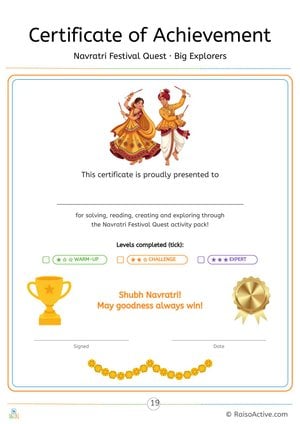
Navratri Festival Quest Certificate of Achievement
Ages 7-11 · Grade 2–Grade 3Ages 7-11 · Year 3–Year 4Ages 7-11 · Class 2–Class 3Ages 7-11
Children celebrate finishing the Navratri Festival Quest pack and record which levels they completed.
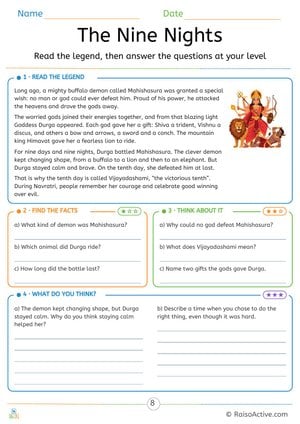
The Nine Nights: Durga and Mahishasura Reading Comprehension
Ages 7-11 · Grade 2–Grade 3Ages 7-11 · Year 3–Year 4Ages 7-11 · Class 2–Class 3Ages 7-11
Children read a retelling of the legend of Durga and Mahishasura, find facts in the text, answer inference questions about why things happened, and write their own opinion about staying calm and doing the right thing.
Navratri Fun Time Answer Key for Grown-ups
Ages 4-6 · Pre-K–KindergartenAges 4-6 · Reception–Year 1Ages 4-6 · LKG–UKGAges 4-6
Grown-ups can quickly check every answer in the Navratri Fun Time pack, page by page.

Written by
Hemsweta Jain · Teacher Cheena
MBA and Early Childhood Educator, teaching since 2014 · Founder of RaisoActive, Mumbai
Published · Last reviewed
Related Resources
Printable Resources(10)
View all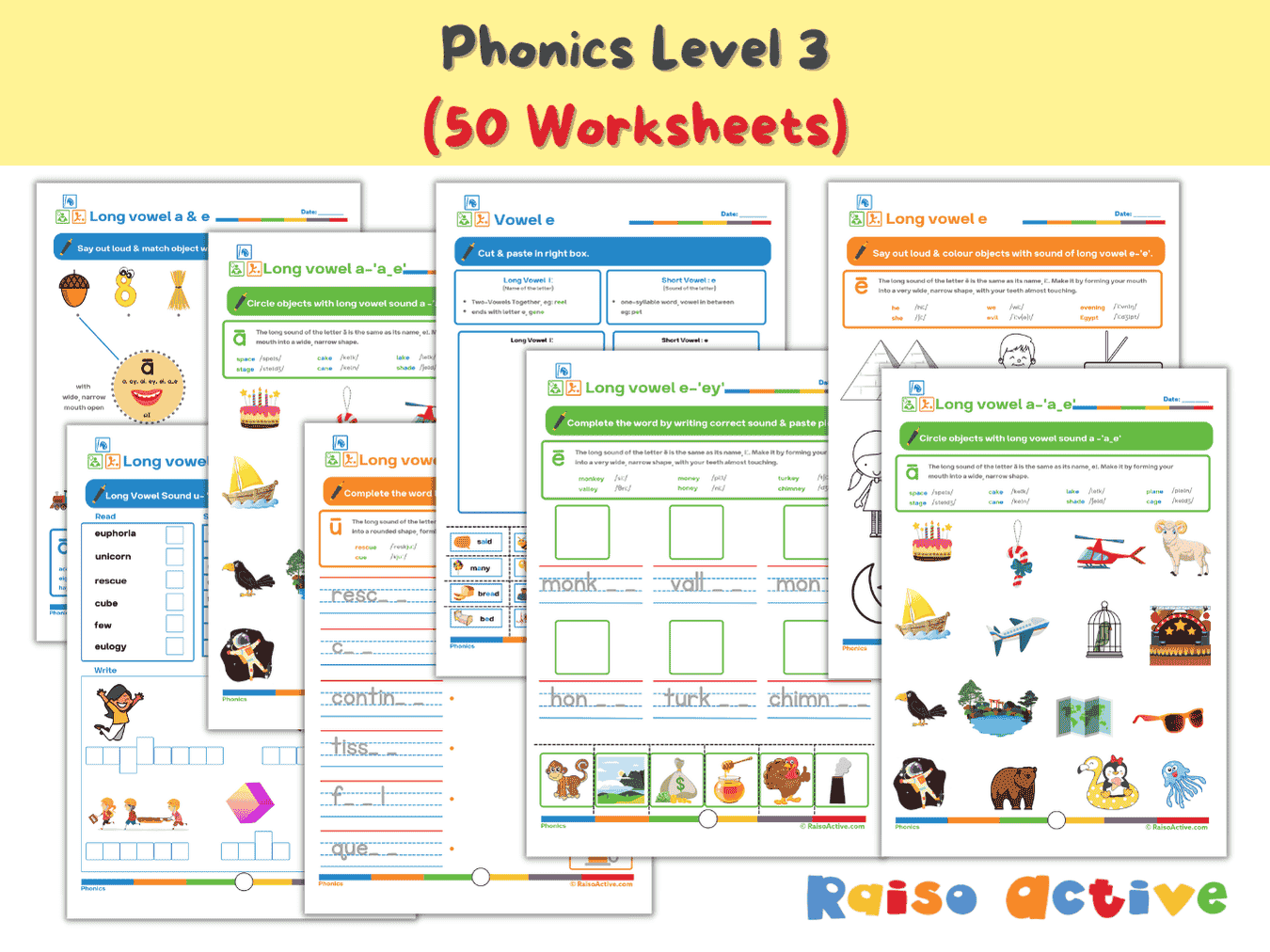

Phonics Level 3 Long Vowels Activity Book for Kindergarten & 1st Grade
Ages 5-7 · Kindergarten–Grade 1Ages 5-7 · Year 1–Year 2Ages 5-7 · UKG–Class 1Ages 5-7 · 51 pages
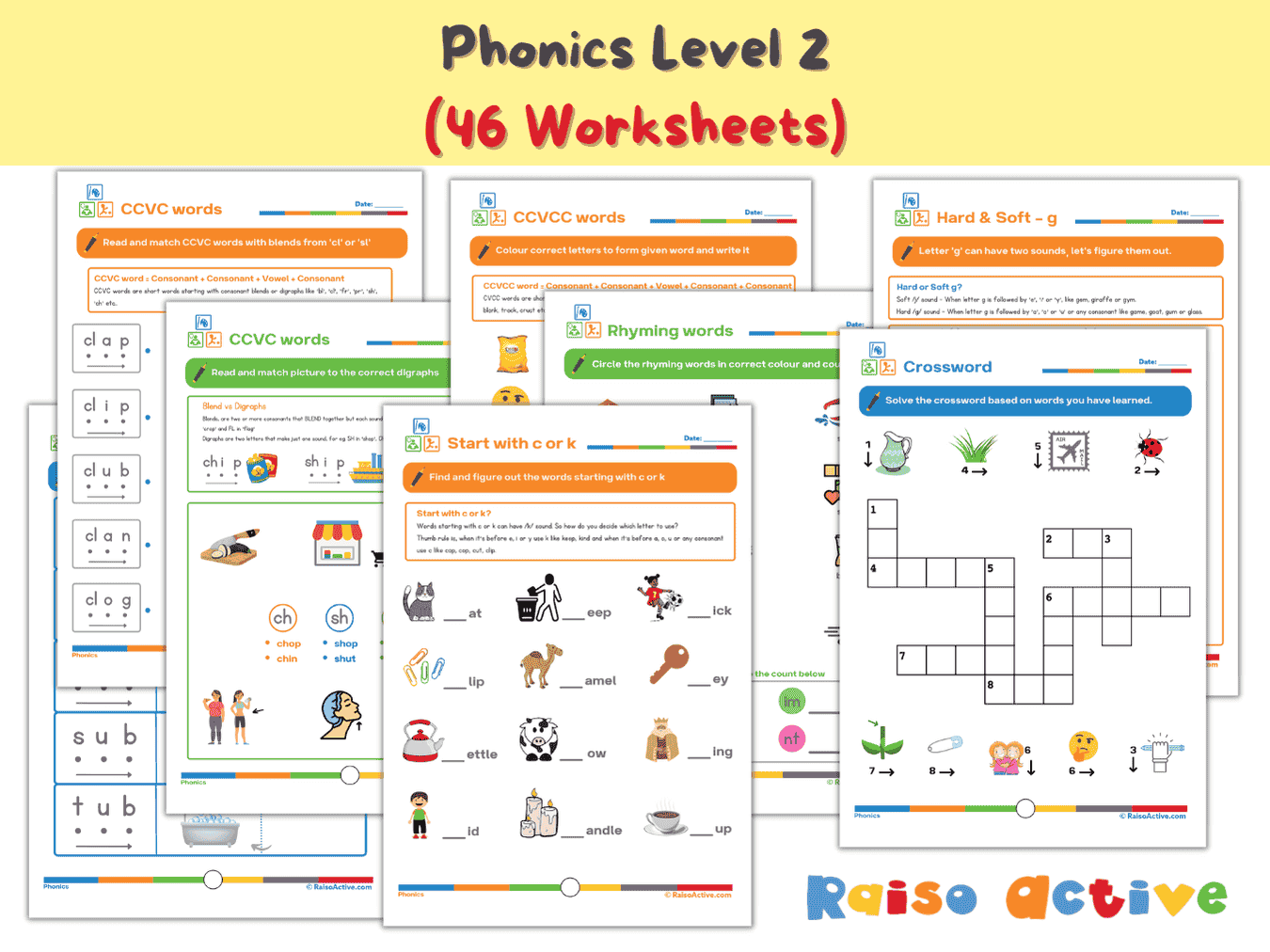
Phonics Level 2 Worksheets: CVC, CCVC, CVCC Word Families & Blends for Early Readers (Ages 4-7)
Ages 4-7 · Pre-K–Grade 1Ages 4-7 · Reception–Year 2Ages 4-7 · LKG–Class 1Ages 4-7 · 47 pages
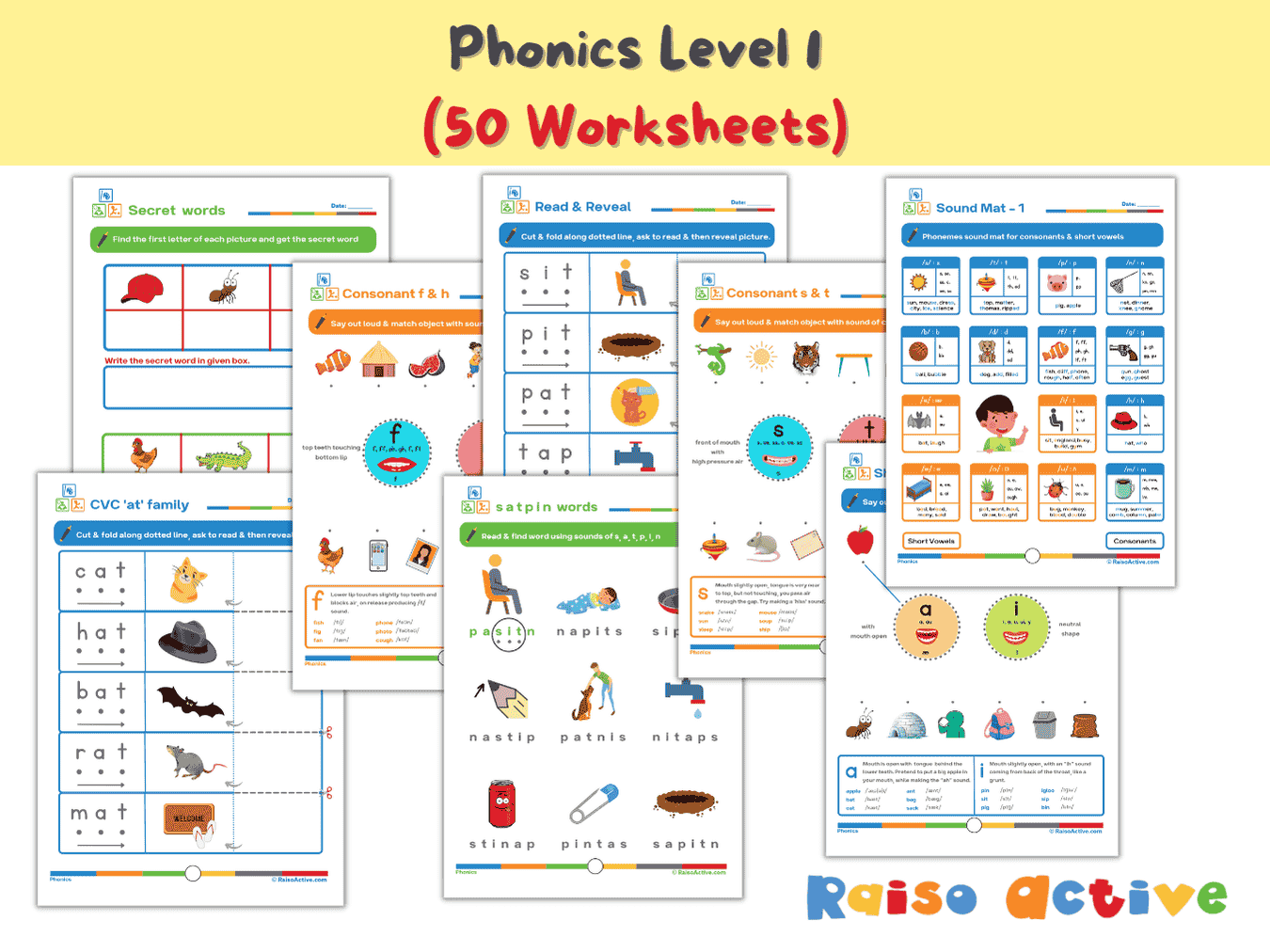
Phonics Level 1 Activity Book: Letter Sounds, Blending & CVC Words for Preschool & Kindergarten
Ages 3-6 · Preschool–KindergartenAges 3-6 · Nursery–Year 1Ages 3-6 · Nursery–UKGAges 3-6 · 60 pages

Festivals & Cultural Diversity Activity Book for Kids (Ages 4-8)
Ages 4-8 · Pre-K–Grade 2Ages 4-8 · Reception–Year 3Ages 4-8 · LKG–Class 2Ages 4-8 · 30 pages

Flags of the World Activity Book & Flashcards for Kids (Ages 5-9)
Ages 5-8 · Kindergarten–Grade 2Ages 5-8 · Year 1–Year 3Ages 5-8 · UKG–Class 2Ages 5-8 · 23 pages
Halloween & Fall Activity Book: Math, Literacy & Cognitive Skills for Ages 4-8
Ages 4-8 · Pre-K–Grade 2Ages 4-8 · Reception–Year 3Ages 4-8 · LKG–Class 2Ages 4-8 · 23 pages
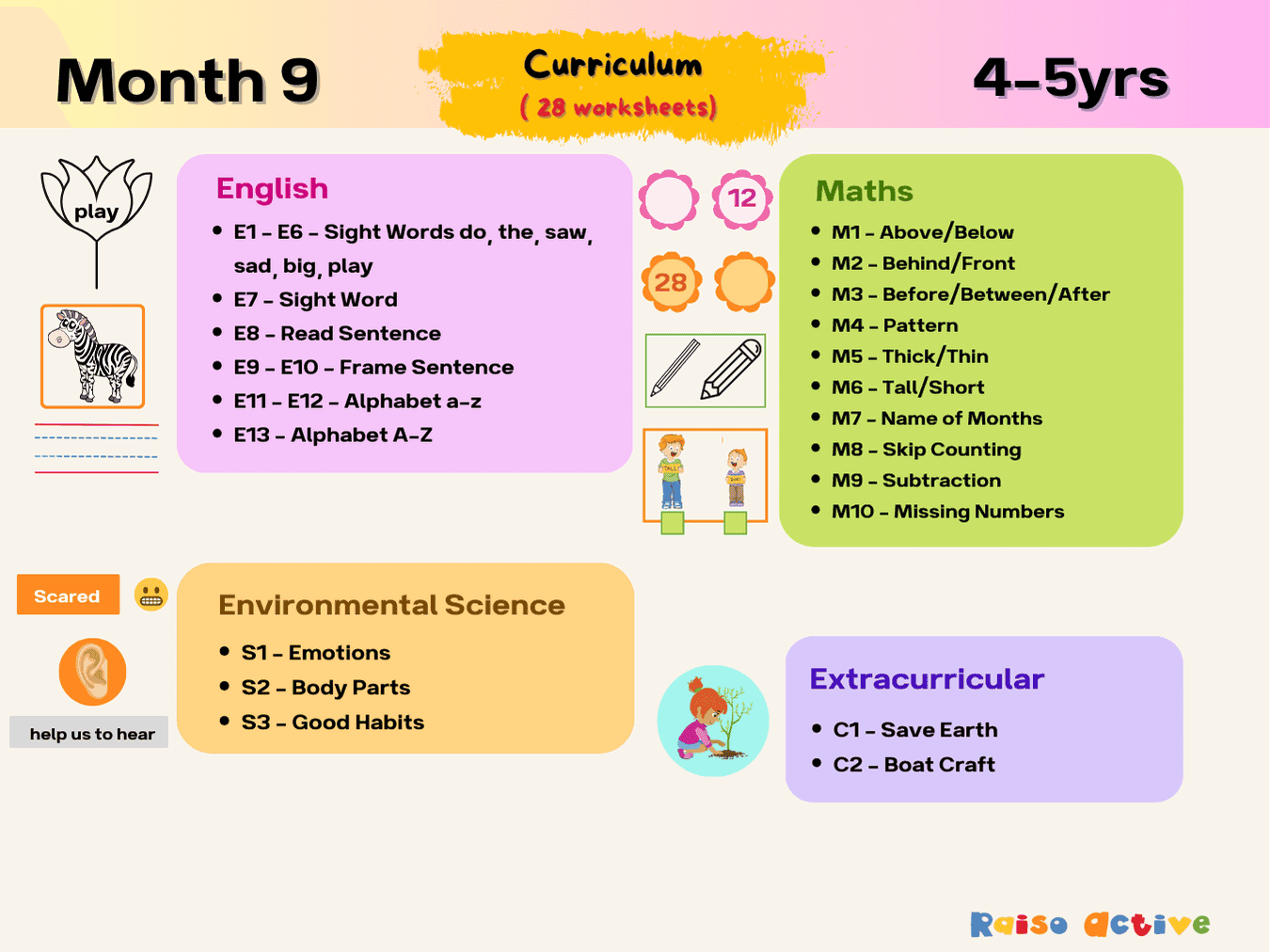
Month 9: Play-Based Preschool Foundational Skills | Ages 4-5
Ages 4-5 · Pre-KAges 4-5 · ReceptionAges 4-5 · LKGAges 4-5 · 31 pages
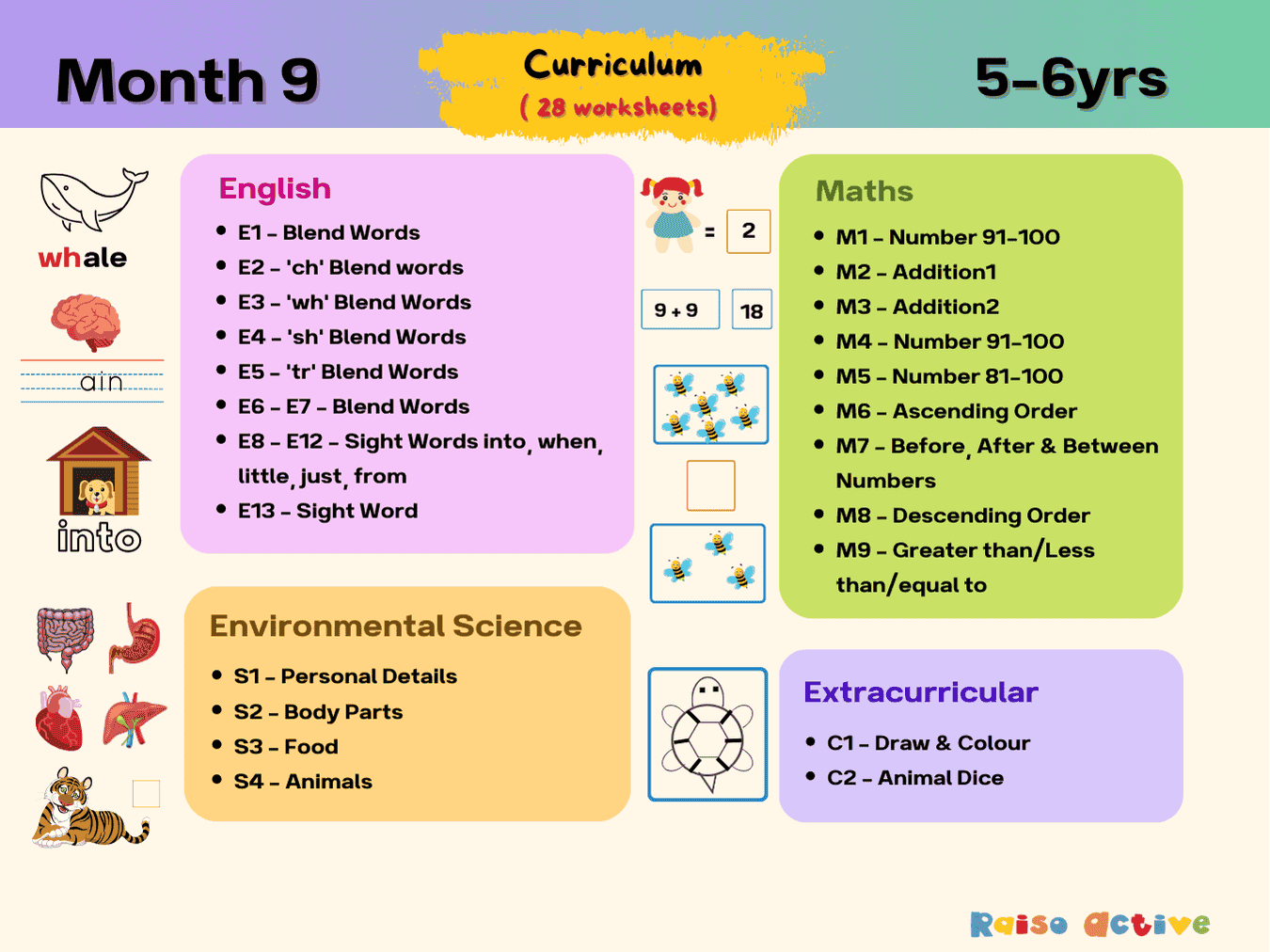
Month 9: Early Learning English Math Science | Ages 5-6
Ages 5-6 · KindergartenAges 5-6 · Year 1Ages 5-6 · UKGAges 5-6 · 31 pages
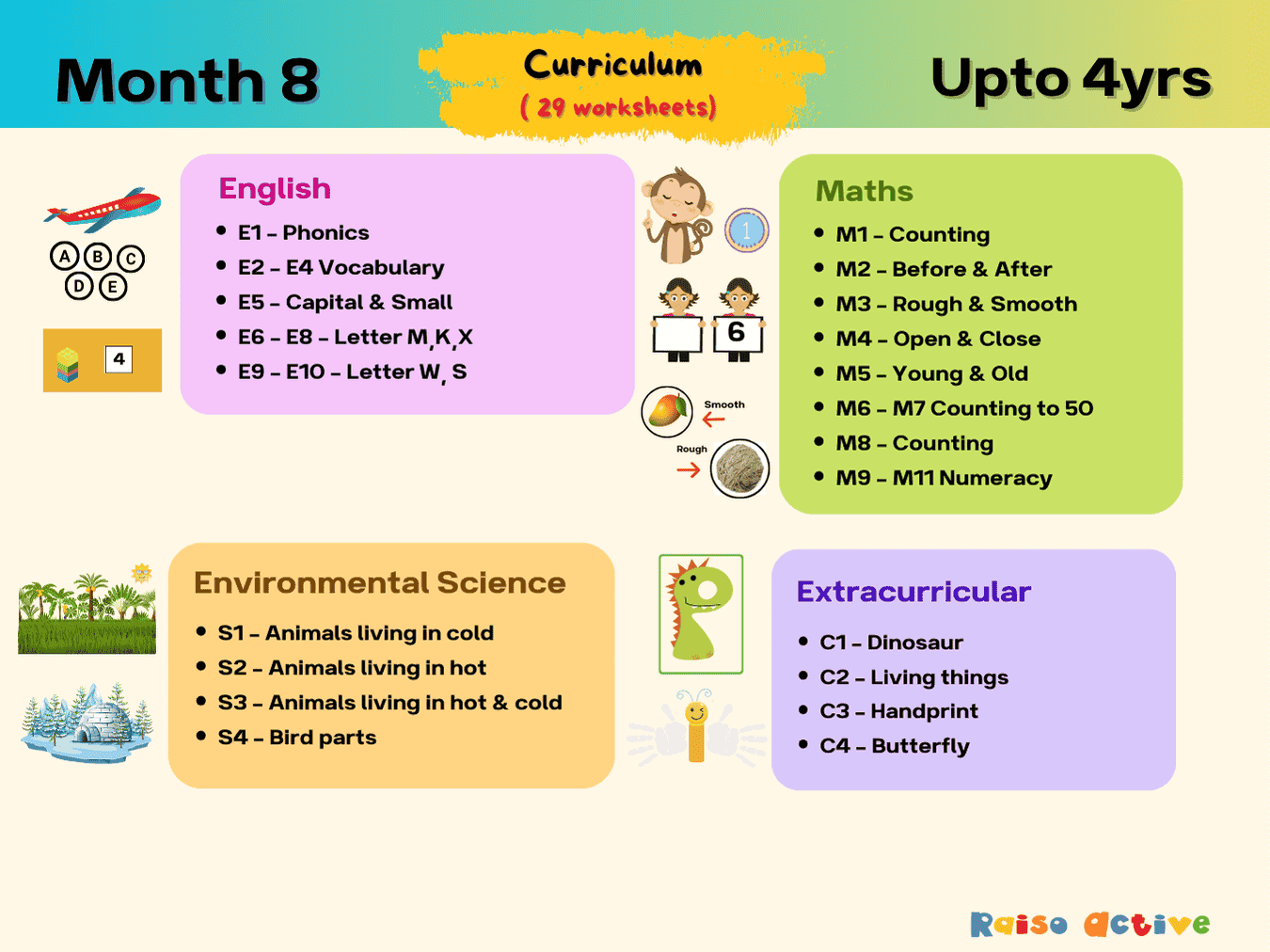
Month 8: Phonics, Math, Science, Creativity | Ages Up to 4
Ages 3-5 · Preschool–Pre-KAges 3-5 · Nursery–ReceptionAges 3-5 · Nursery–LKGAges 3-5 · 32 pages
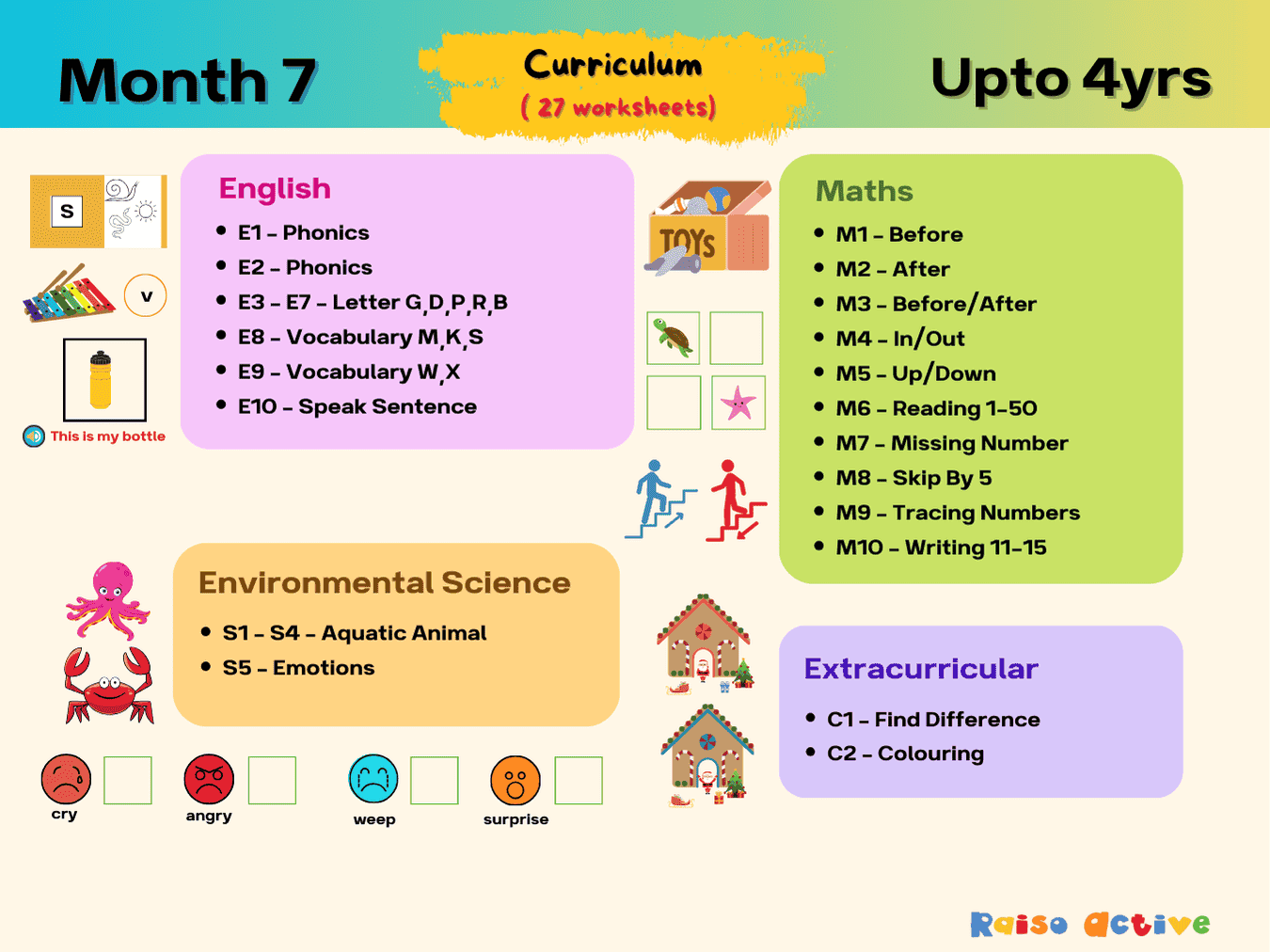
Month 7: Comprehensive preschool learning | Ages Up to 4
Ages 2-4 · PreschoolAges 2-4 · NurseryAges 2-4 · 30 pages