Free printable worksheets · India
UKG English Worksheets
UKG English worksheets are practice sheets for children aged 5 to 6 in Senior KG, the year Indian children begin reading and writing independently. They cover blending letter sounds into CVC words, reading and spelling sight words, writing simple sentences with capital letters and full stops, opposites, plurals, and reading short decodable passages before Class 1.
UKG English is the blending year. A child who left LKG knowing letters and sounds now has to push "c-a-t" together and hear a word, and that single skill unlocks everything on this page. The sheets progress the way most CBSE and ICSE UKG readers do: CVC words by vowel family (a-words, then e, i, o, u), then sight words that cannot be sounded out, then short sentences that combine the two, then decodable passages of three or four lines. Grammar arrives gently as opposites, plurals with -s, and "a" versus "an". Writing moves from copying to composing: by the end of UKG a child should write a sentence about a picture without a model. Fifteen minutes a day covers it.
1065+ worksheets · free PDF download · print on A4 or Letter
UKG English Worksheets to print
Browse all worksheets for ages 5–6
Sl Blend Words Worksheet: Read, Identify, and Circle!
Reading and circling words that begin with the 'sl' consonant blend helps children ages 4-6 hear that two consonants pressed together, like s and l, still form one connected sound at the start of a word. This is a more advanced phonics skill than single-letter sounds, since children must blend two consonants smoothly rather than separating them. Recognizing blends like 'sl' in words such as 'slide' or 'sled' builds the decoding fluency needed to read longer, less predictable words independently.

Match the Sentence: Picture Matching Worksheet for Early Readers
Reading a full sentence and connecting it to the picture it describes asks children ages 4-6 to move beyond single-word recognition into genuine sentence comprehension, checking that they understood the sentence's overall meaning rather than just decoding individual words. This worksheet builds that comprehension skill by having children read several simple sentences and match each one to the correct illustration, reinforcing that reading is about extracting meaning, not just producing sounds. Developing this kind of sentence-level comprehension early is an important bridge between phonics-based decoding and true reading fluency.

Internal Organs Worksheet: Find and Match the Body Parts!
Finding organ names hidden in a word search and then cutting and pasting the organs onto the correct spot on a body diagram teaches children ages 4-6 the names and general locations of internal organs, like the heart, lungs, and stomach, introducing basic human biology. Searching the word grid builds visual scanning and word recognition, while the cut-and-paste placement step reinforces spatial understanding of where each organ sits inside the body. Combining a word search with a hands-on placement task gives this worksheet both a literacy and a science learning goal.

Before, After, and Between Numbers Worksheet for Preschoolers
This number sequencing worksheet gives children ages 4-6 practice identifying what comes before, after, and between given numbers, a skill that builds the flexible mental number line children need before tackling formal addition and subtraction. Unlike a matching or counting task, this version asks children to write in the missing numbers directly, which requires stronger independent recall of number order rather than recognition from a set of choices. Practicing all three directions — before, after, and between — on one page also reinforces that number sequences can be approached from multiple angles, not just forward counting.

Vowel i Matching Worksheet: Long and Short Sounds
In this worksheet, children ages 4-6 train their ears to tell apart the short 'i' sound (as in 'pig') from the long 'i' sound (as in 'kite'), then sort pictures into the correct category. This side-by-side comparison is a key phonics milestone, because confusing short and long vowels is one of the most common early reading errors, and deliberate practice like this builds the auditory discrimination needed to read unfamiliar words accurately.
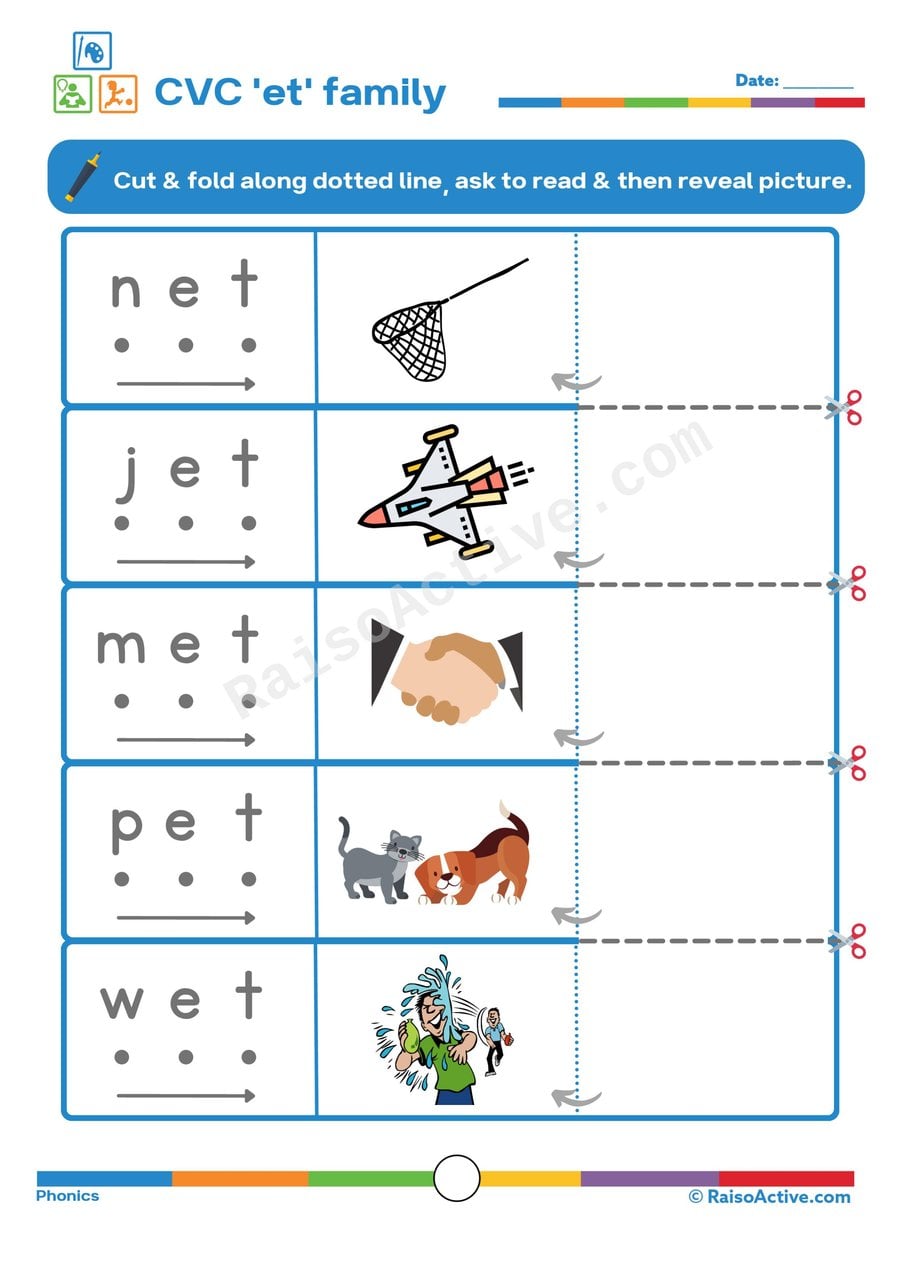
CVC 'et' Family Worksheet: Read, Cut, and Match!
This 'et' word family worksheet (like 'wet,' 'net,' 'jet') adds a fun reveal mechanic to word-family reading practice for children ages 4-6, where cutting and folding a flap hides the picture until after the word has been read and guessed. This delayed-reveal format encourages genuine decoding rather than guessing from a picture first, since your child has to sound out the word before seeing what it depicts, strengthening true reading skill instead of picture-cued guessing. The cutting and folding also builds fine motor control alongside the phonics practice.
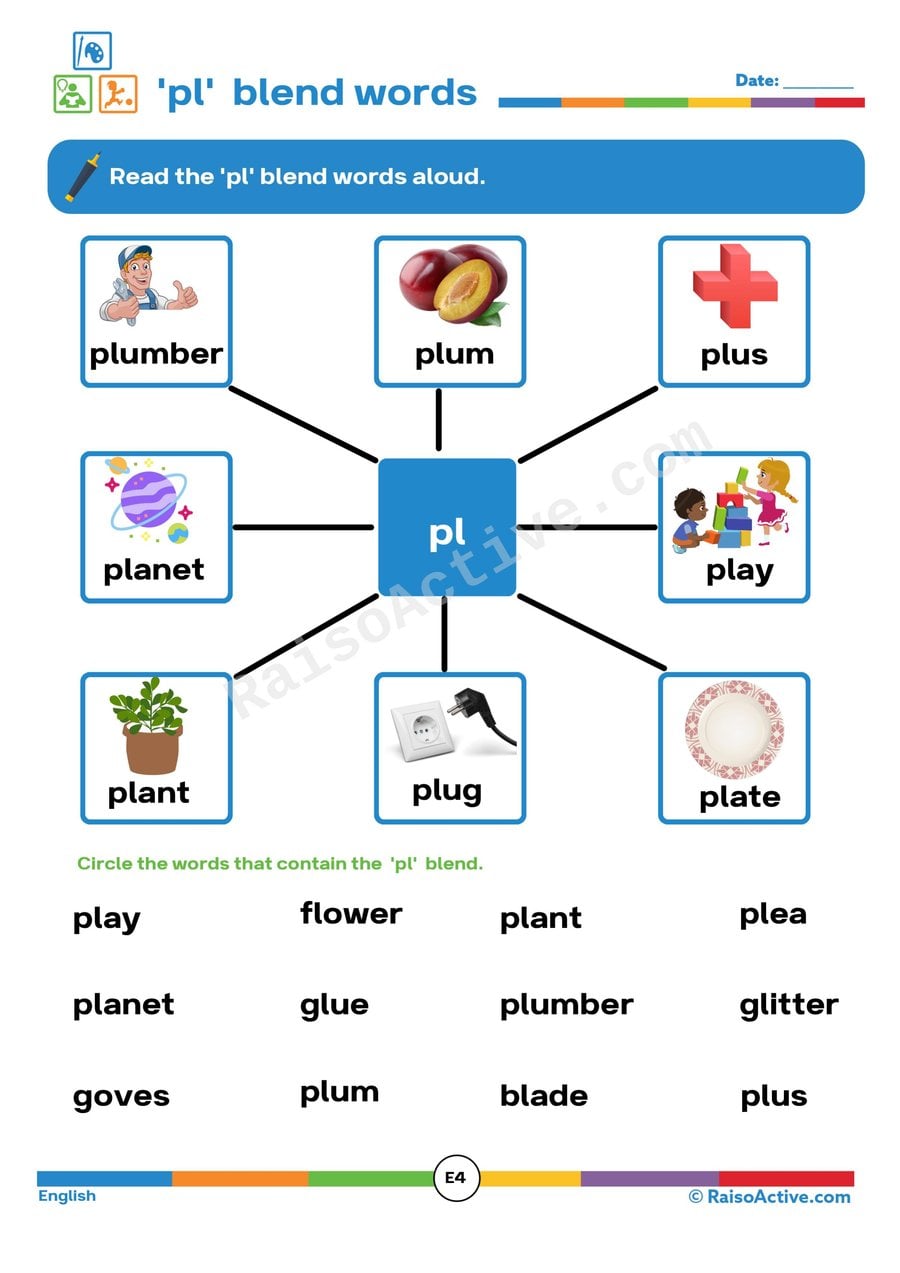
Pl Blend Words Worksheet for Preschoolers
This worksheet targets the 'pl' consonant blend, helping children recognize and read words like 'play,' 'plane,' and 'plant' where two consonant sounds combine at the start of a word. For ages 4-6, mastering blends is a key phonics milestone that comes after single letter sounds, since blending two consonants together requires more advanced sound segmentation skills.
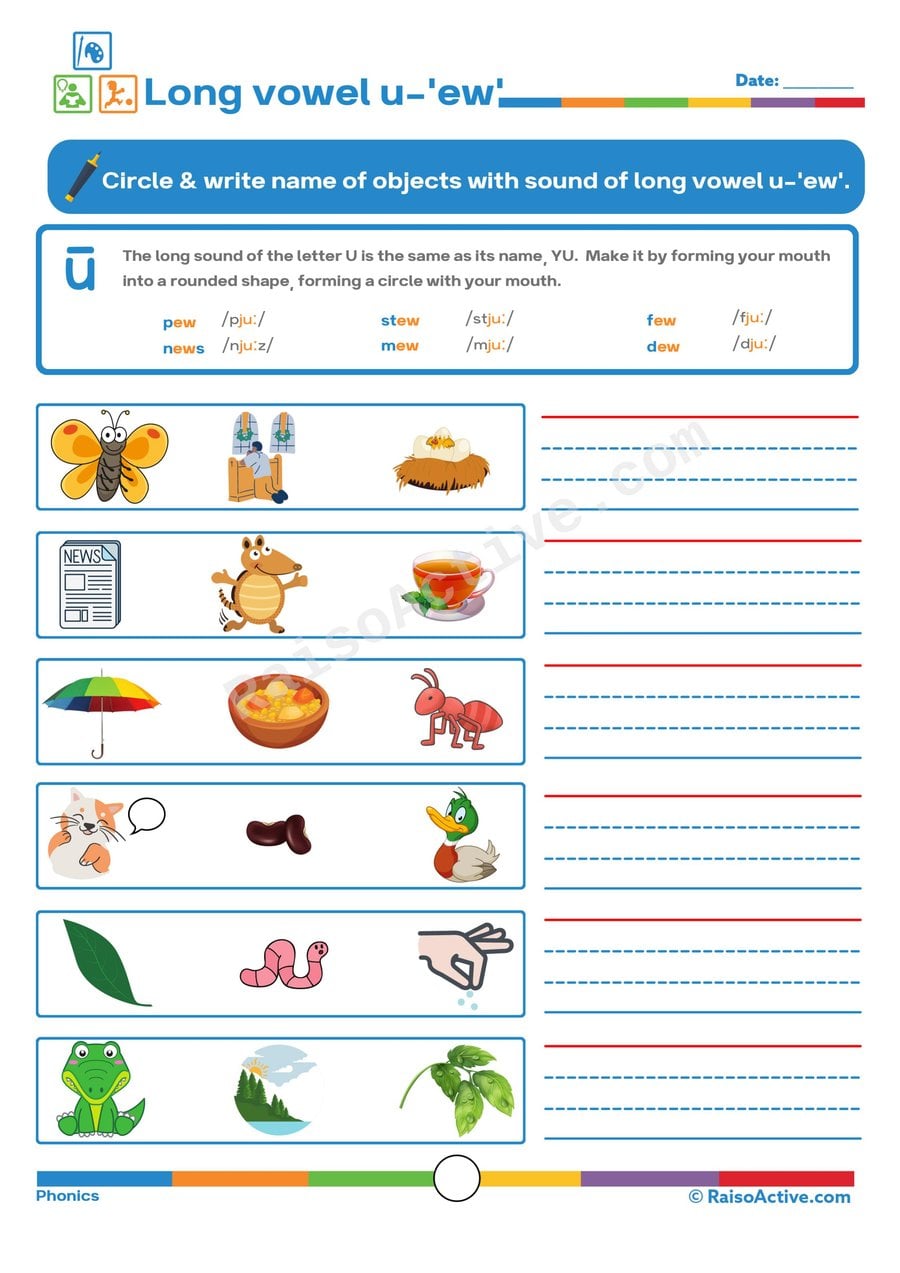
Long Vowel U 'ew' Worksheet: Circle and Write
This worksheet has children ages 4-6 identify pictures whose names contain the long 'u' sound spelled with the letters 'ew,' as in 'few' or 'new,' building awareness of this less common spelling pattern for a sound they may already recognize from simpler spellings. Circling the matching pictures practices listening skills, while writing the words afterward reinforces the specific 'ew' spelling through repeated handwriting. Focusing on a single spelling pattern like 'ew' helps children build pattern recognition they can apply to new, unfamiliar words later.

Sense Organs Worksheet: Circle the Objects We Use!
Children ages 4-6 practice connecting each of the five senses to real objects and experiences, like identifying what they might see, hear, smell, taste, or touch. This builds early science vocabulary and body awareness while reinforcing that different body parts are used to experience the world in different ways.

My Summer Vacation Worksheet: Write and Draw About Your Fun!
This worksheet has children ages 4-6 write about their own summer vacation and draw a picture to match, practicing personal narrative writing, one of the earliest and most motivating forms of writing since it draws on a child's real memories rather than an assigned topic. Because children are describing something they actually experienced, this task builds both sentence-forming skills and the confidence that comes from writing about a subject they already know well. Pairing the writing with a drawing also lets children who aren't yet strong writers still fully express their ideas.

Number Names Worksheet: Writing and Matching Numbers 51-60!
Writing out number names like 'fifty-one' or 'fifty-eight' next to their numerals helps children ages 4-6 connect the spoken word for a number to both its written word form and its digit form, a three-way link that strengthens overall number sense in the 51-60 range. This worksheet also revisits missing-number sequencing and color-coding, giving repeated exposure to the same number range through several different tasks. Building fluency with two-digit number names prepares children for reading numbers in books, on clocks, and in everyday life.

Ot Word Family Worksheet: Read, Trace, and Identify!
Reading, tracing, and identifying words from the 'ot' family — like pot, dot, and hot — helps children ages 4-6 see how changing the first letter of a word while keeping the same ending produces a whole new word, reinforcing the pattern-based phonics strategy known as word families. Tracing each word while reading it connects handwriting practice directly to reading practice, and identifying the matching picture afterward checks genuine comprehension rather than rote letter-sounding. Word family practice like this builds the foundation for decoding many more words independently later on.

Blend Words Worksheet: Circle the Correct Picture!
This worksheet strengthens blending skills for children ages 4-6, asking them to say a consonant blend like 'bl' or 'st' together with different word endings and identify which resulting word matches a picture. Blending two consonant sounds smoothly before adding a vowel is a more advanced phonics skill than single-letter sounds, and this practice directly supports decoding multisyllabic and blended words during independent reading.

Pollution Awareness Worksheet for Kids: Circle the Correct Answer!
This worksheet introduces children ages 4-6 to the idea that pollution comes in different forms — air, water, and land — and asks them to connect each type to a picture, building early environmental science vocabulary alongside visual reasoning. Sorting items into recycling categories afterward extends the lesson from simply naming a problem to practicing a real-world solution, which helps young children start to see themselves as capable of taking action. This blend of identification and hands-on sorting suits a preschooler's concrete way of understanding abstract ideas like 'the environment.'

Family Words Worksheet: Picture Matching and Word Recognition
This worksheet gives children ages 4-6 another round of practice recognizing family-member vocabulary words, reinforcing the connection between a printed word and the picture it names through both a tick-the-answer step and a cut-and-paste matching step. Repeating this pairing across two different formats on one page helps move these words from recognition with support toward more independent reading.

My Favorite Animal: Lifecycle Writing Worksheet for Kids
This writing worksheet asks children ages 4-6 to describe their favorite animal's life cycle using sequencing words like 'first,' 'then,' 'next,' and 'last,' essential building blocks for narrative and informational writing. Choosing their own animal makes the task personally engaging while still requiring them to organize factual information in a logical order. This combination of choice and structure helps children practice both content knowledge and the mechanics of sequential writing.

Match the Countries with Their Symbols Worksheet
Children ages 4-6 build early social studies awareness by matching country flags to their well-known national symbols, connecting visual recognition with basic geography and cultural knowledge. This kind of matching exercise strengthens careful observation, since children must compare colors, shapes, and details across both the flag and the symbol image. It also plants the seed for understanding that different countries have distinct identities and traditions.
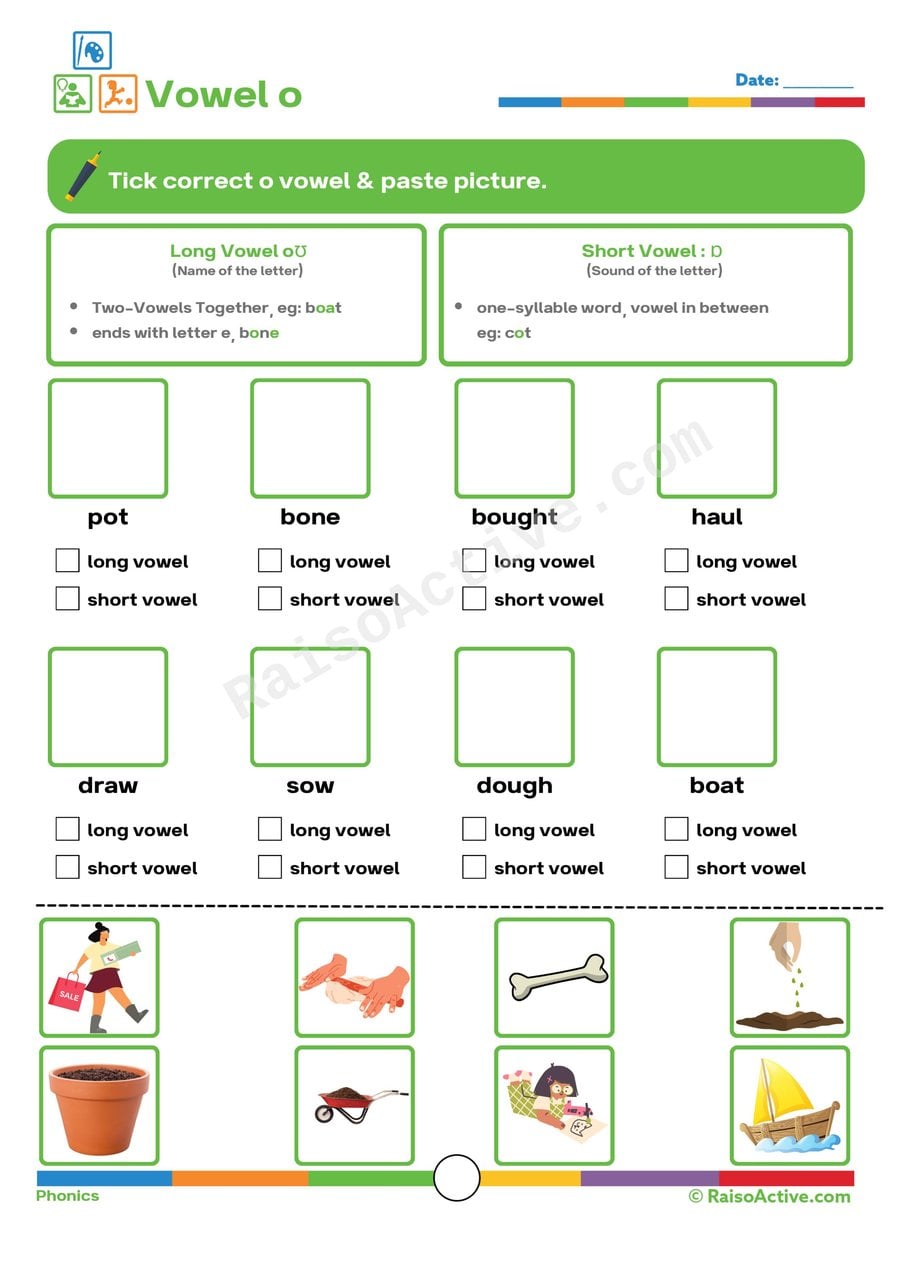
Vowel o Worksheet: Long and Short Vowel Sounds
This matching worksheet builds on early phonemic awareness by asking children ages 4-6 to listen for the long 'o' sound (as in 'boat') versus the short 'o' sound (as in 'dog') and sort accordingly. Cutting and pasting the matching picture adds a fine-motor and visual-matching layer on top of the listening task, so children are practicing several pre-reading skills at once. Recognizing vowel length is a stepping stone toward reading multisyllabic words later on.

Short Vowel Fun: Complete the Words Worksheet for Kids
This worksheet has children ages 4-6 fill in missing short vowels to complete words based on pictures, then locate and color those same words within a grid, layering active spelling recall with visual word-search practice. Completing a word by choosing the correct short vowel requires your child to distinguish between five different vowel sounds — a, e, i, o, and u — which is a more demanding discrimination task than working with just one or two vowels at a time. Following that with a word search reinforces the completed spelling by having your child recognize and locate the exact same word again.

Y and Z Consonant Sounds Worksheet: Match the Objects!
This worksheet builds beginning-sound recognition for children ages 4-6 with the letters 'y' and 'z', two consonants that appear less frequently at the start of common words, giving children practice with sounds they may hear less often than 's', 't', or 'm'. Matching each picture to its correct starting letter reinforces the sound-symbol connection while also expanding vocabulary, since words like 'yarn' or 'zebra' may be less familiar to young learners. This rounds out a child's coverage of consonant sounds toward full alphabet mastery.

Animal Homes Worksheet: Match the Animals to Their Habitats!
Children ages 4-6 build early life-science knowledge as they match each animal to the habitat where it actually lives, such as a fish to water or a bird to a nest. This worksheet moves beyond simple animal identification into understanding the relationship between a living thing and its environment, an important building block for later ecosystem and habitat topics in science class.
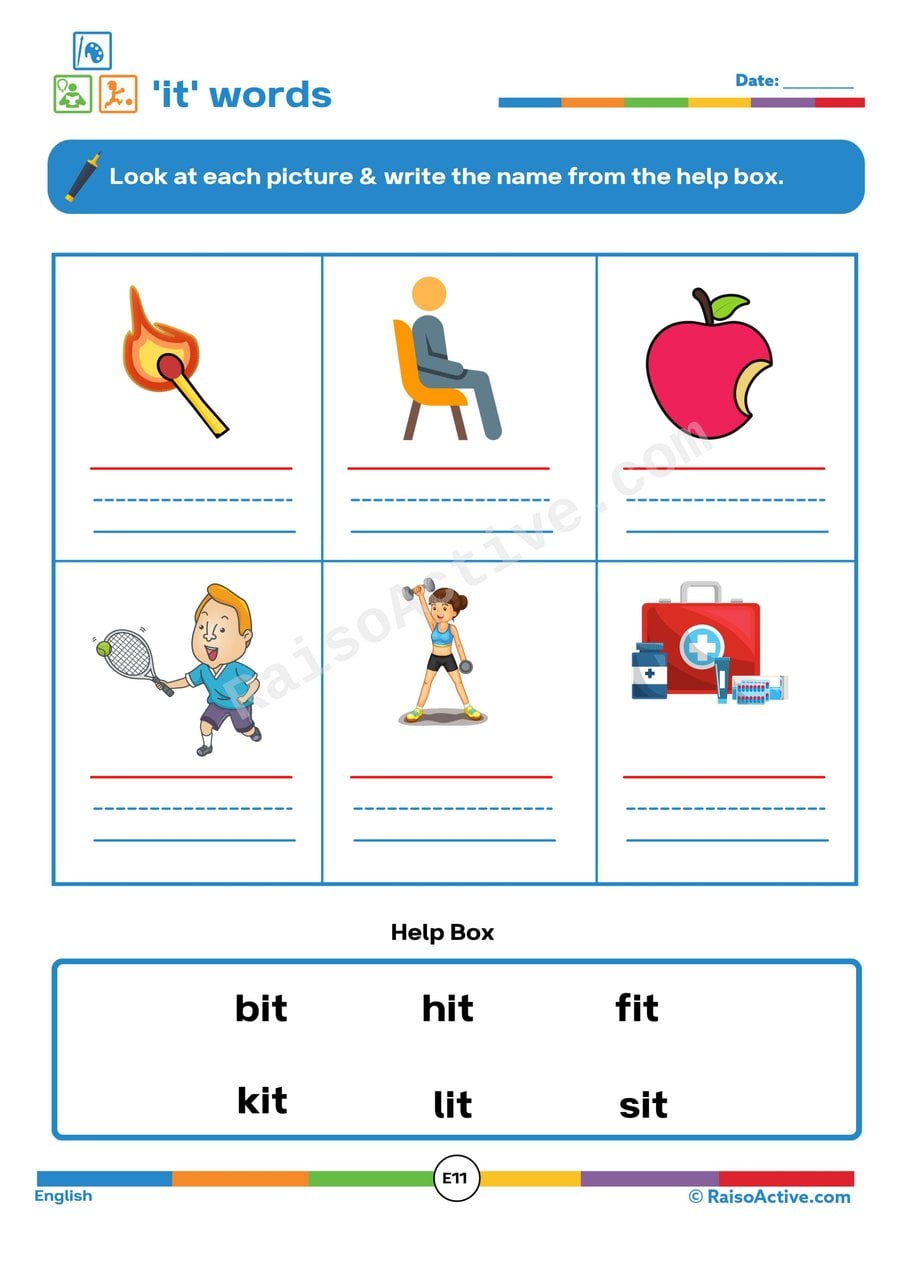
It Words Worksheet: Read and Write 'it' Words!
Children ages 4-6 build phonics fluency by reading and writing CVC words from the 'it' family, such as 'sit', 'bit', and 'fit'. Recognizing this word family pattern teaches children that groups of letters carry predictable, reusable sounds, which speeds up decoding of new words they encounter later. Writing each word after identifying it also reinforces correct spelling and letter sequencing.

Blend Words Worksheet: Fill in the Blanks with Beginning Blends!
Similar to blend recognition but with an added layer of choice, this worksheet gives children ages 4-6 a bank of possible beginning blends to choose from as they complete each picture word, building both phonics recall and careful selection skills. Choosing the correct blend from several options requires your child to test each possibility mentally against the word they're trying to spell, which strengthens their ability to self-check and problem-solve rather than just guessing. This kind of active decision-making with phonics elements builds toward more independent spelling down the road.

Color Mixing Worksheet for Preschoolers: Learn Primary and Secondary Colors!
Identifying primary colors and predicting which two combine to create each secondary color introduces children ages 4-6 to basic color theory, an early scientific concept about how colors interact. This worksheet builds the vocabulary and reasoning skills needed to understand color mixing before testing it out with real paint or crayons.
What your child learns in UKG English
By the end of UKG a child is expected to read and write three-letter words with all five short vowels, read common four-letter words with blends, recognise fifty or more sight words, write a short sentence with a capital letter, finger spaces and a full stop, give the opposite of common words, form plurals by adding -s, and read a short passage and answer a question about it.
- Phonics: blending and segmenting CVC words, short vowel families, beginning blends, digraphs sh, ch, th
- Sight words: reading, tracing and spelling high-frequency words such as the, and, is, was, you
- Sentence writing: copy, complete and compose sentences; capital letter, spacing, full stop
- Grammar and vocabulary: opposites, plurals with -s, a/an, this/that, naming and action words
- Reading: decodable passages with picture support and one or two comprehension questions
How to use UKG English worksheets
Start each session with a quick sound review, then one blending sheet. Have your child say each sound with a finger under it, then slide the finger across and say the word. Do not let them guess from the picture; cover it if needed. Once a vowel family is secure, move to the next rather than repeating a-words for weeks.
Alternate phonics days with writing days. On a writing day, the child reads a sight-word sheet and then writes two sentences of their own about the picture on the page. Check for the three basics (capital, spaces, full stop) before spelling. Keep sessions to fifteen minutes and read a real book together afterwards.
Signs your child is ready for Class 1 English
A child ready for Class 1 reads CVC and simple blend words without sounding out every one, knows most of the sight words their school uses, writes a sentence independently that a stranger could read, and can tell you what a short passage was about. If blending is still letter-by-letter and slow, spend the last term on decodable passages rather than new grammar; fluency matters more than plurals.
Frequently asked questions
What is taught in UKG English?
UKG English in most Indian schools covers small letters and their sounds, blending three-letter words by vowel family, reading and spelling sight words, forming plurals, opposites, "a" and "an", naming and doing words, writing simple sentences, listening to and retelling stories, and reading short passages. Cursive writing is introduced in many CBSE and ICSE schools during UKG as well.
What should a UKG child know in English before Class 1?
Before Class 1 a child should read three-letter phonetic words and common blends, recognise fifty or more sight words, write small and capital letters correctly, write a simple sentence with a capital letter and full stop, use plurals and opposites in speech, and answer questions about a short story. Schools admitting to Class 1 often check reading of simple words and sentence writing.
How do I teach my child to blend CVC words?
Start with words that share one vowel, such as cat, mat, sat, hat. Say each sound while pointing at the letter, then say the sounds faster and faster until the word appears. Use the blending sheets on this page daily for a few minutes, and let the child read the word before looking at the picture. Once a-words are easy, move to o-words, then i, e and u.
What are sight words for UKG?
Sight words are common words that cannot be fully sounded out or appear so often that children should recognise them instantly, such as the, was, you, said, are and have. UKG lists usually run to fifty or so words. Practise them in short daily bursts of five words at a time, reading and writing each one, and look for them in books and in the sentences on the worksheets.
How many English worksheets should a UKG child do a day?
One phonics or reading sheet and one writing sheet, roughly fifteen to twenty minutes, is right for a five-year-old. Daily short practice builds blending speed far better than a long weekend session. If school homework already covers writing, use these sheets for the reading side, which most children get less of at home.
Are the UKG English worksheets free to download?
Yes. Each worksheet downloads as a watermarked PDF free of charge after you create an account, with five downloads a day. An annual subscription removes the watermark and the daily cap across the full library, which is useful for teachers printing full-class sets of phonics and sentence sheets on A4.

Written by
Hemsweta Jain · Teacher Cheena
MBA and Early Childhood Educator, teaching since 2014 · Founder of RaisoActive, Mumbai
Written and reviewed by Hemsweta Jain (Teacher Cheena), who designs every RaisoActive worksheet.
Last reviewed
Printable packs for ages 5–6
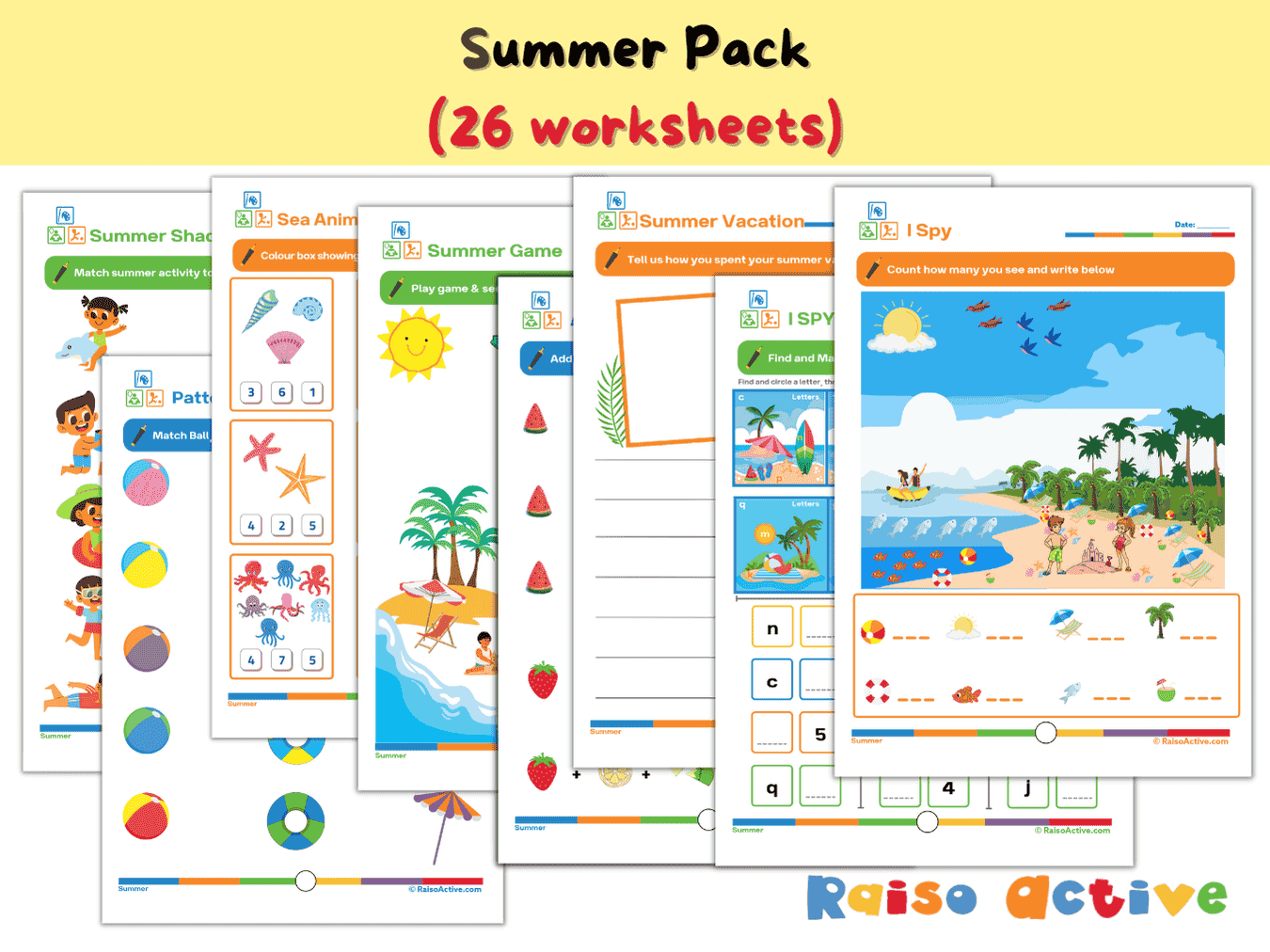
Summer Activity Pack: Math, Literacy, Puzzles & More for Preschool & Kindergarten
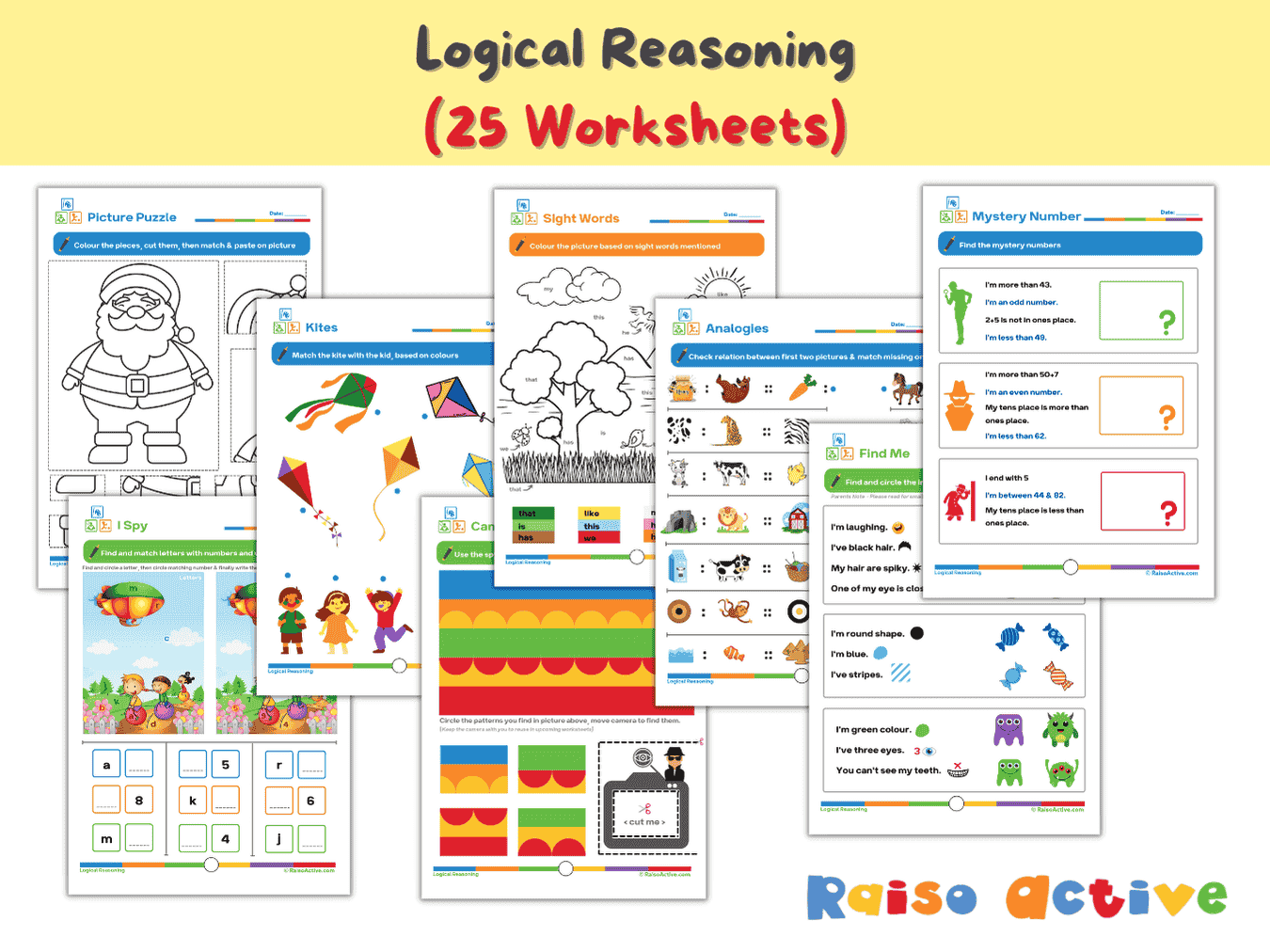
Logical Reasoning Activity Book for Preschool & Kindergarten | Patterns, Puzzles & Analogies
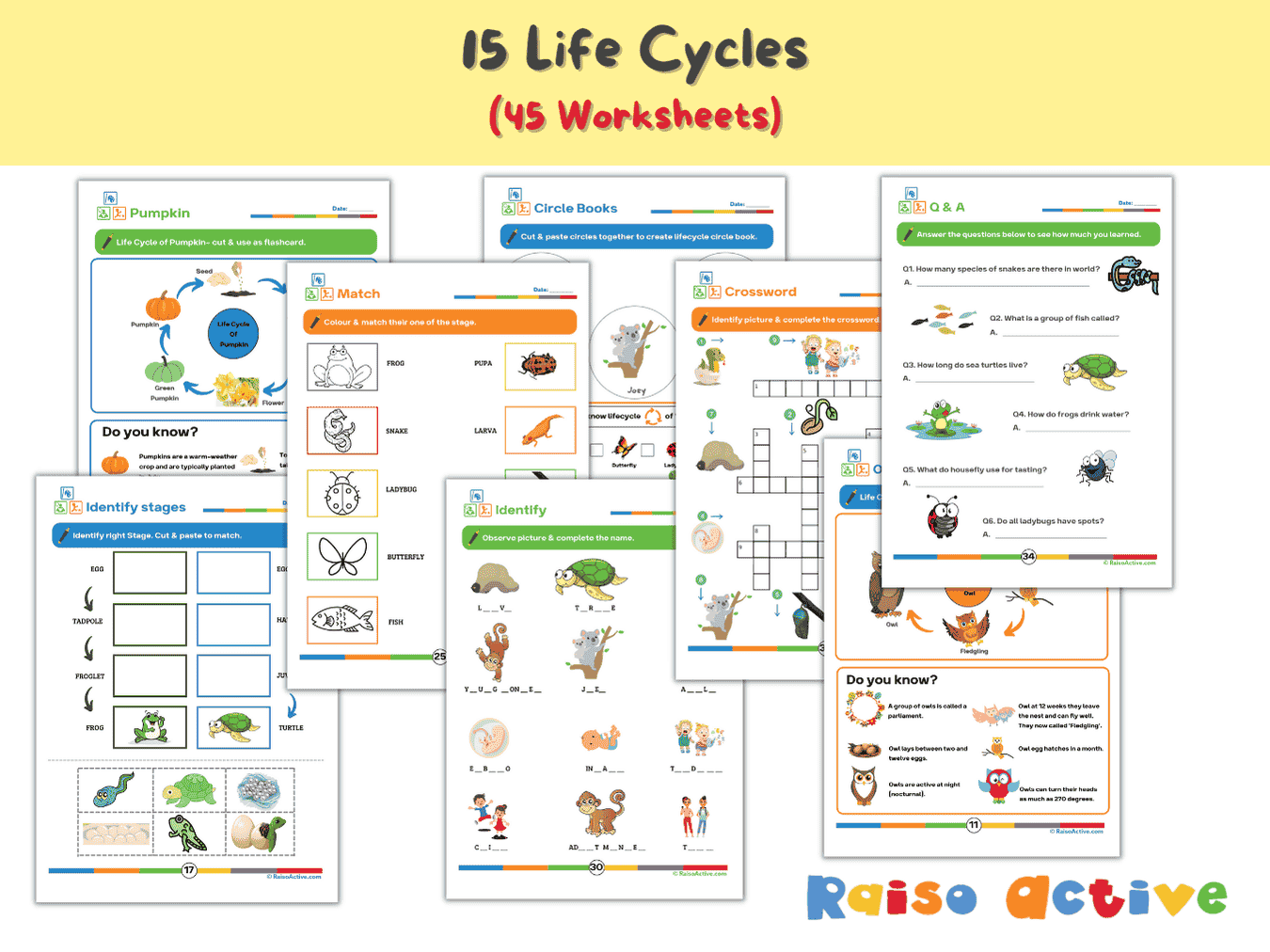
Lifecycles Activity Book & Flashcards for Preschool & Early Elementary
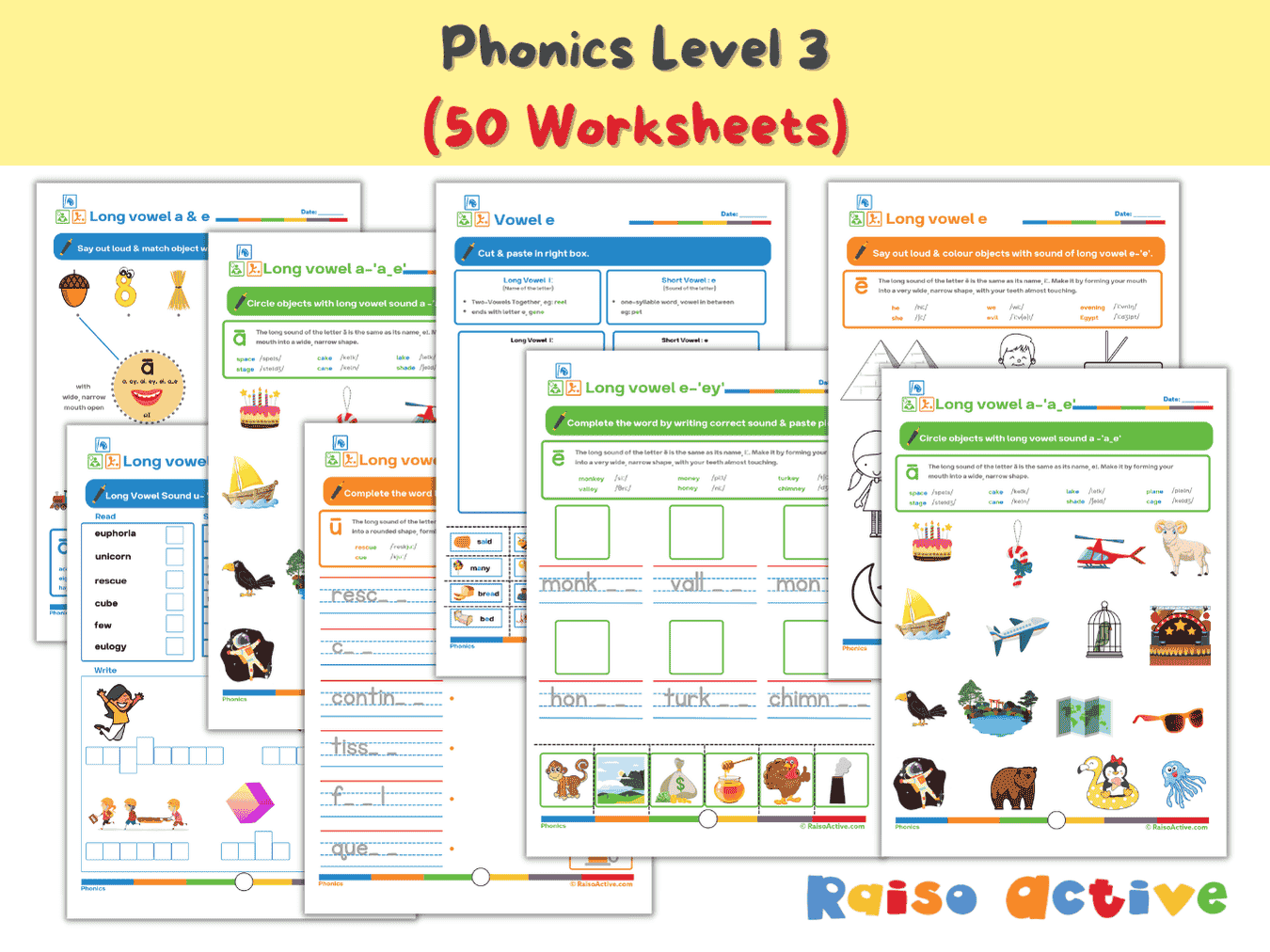
Phonics Level 3 Long Vowels Activity Book for Kindergarten & 1st Grade
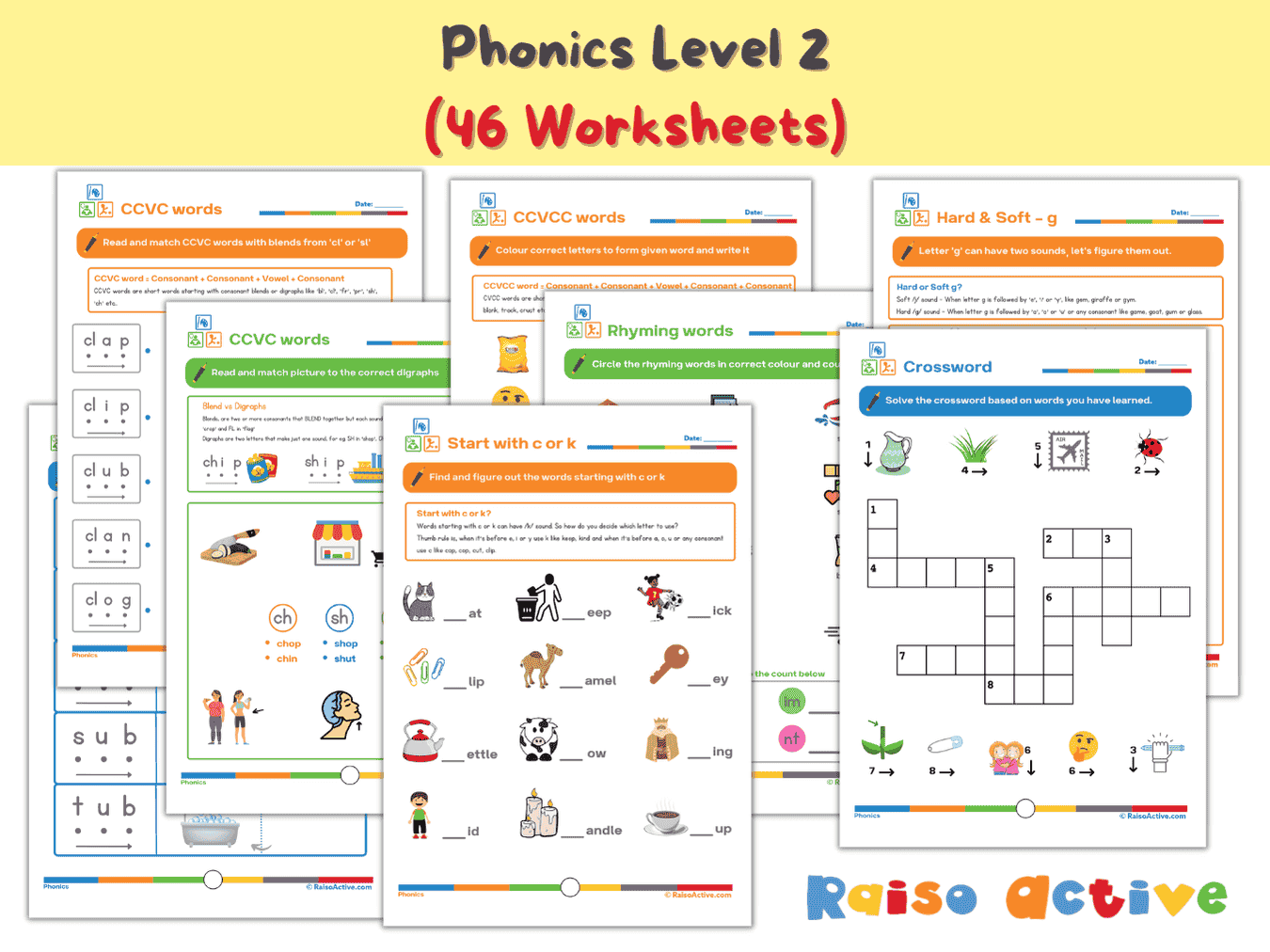
Phonics Level 2 Worksheets: CVC, CCVC, CVCC Word Families & Blends for Early Readers (Ages 4-7)
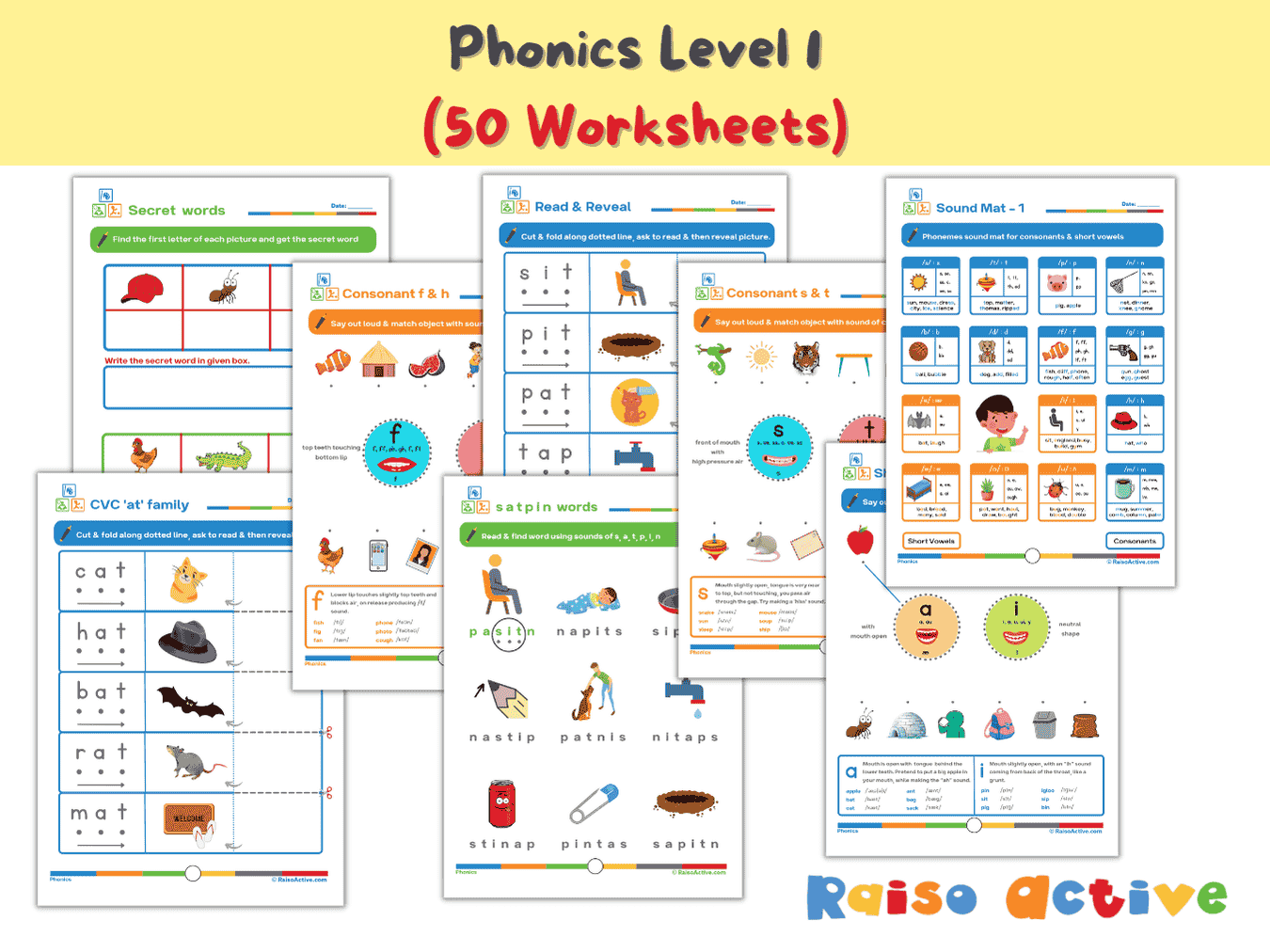
Phonics Level 1 Activity Book: Letter Sounds, Blending & CVC Words for Preschool & Kindergarten
Guides for parents and teachers
See all guides →Sight Words by Age: The First 50 Words and How to Teach Them Without Flashcard Fatigue
Which sight words to teach first and why, the heart-word method, a read-trace-write-find routine, games, and a by-age table of typical sight-word progress.
How to Teach CVC Blending: A Step-by-Step Method That Works in Two Weeks
A step-by-step method for teaching CVC blending, covering continuous sounds, word families, common errors, and a 14-day plan that most children finish reading CVC words.
Kindergarten Readiness Checklist: 25 Skills to Practice Before the First Day
A kindergarten readiness checklist of 25 literacy, math, motor, self-regulation and self-help skills, with an 8-week summer plan and notes on when not to worry.
Phase 2 Phonics at Home: Sound Order, Blending Games, Worksheets
Phase 2 phonics at home: the five sound sets in order, oral blending, tricky words, a two-week routine, common mistakes, and free worksheets.
Reception Year Explained: EYFS Learning and How to Help at Home
A teacher's plain-English guide to the Reception Year: the seven areas of learning, Early Learning Goals, Phase 2/3 phonics, the RBA and home routines.
UKG Syllabus Explained: English, Maths and EVS Month by Month
What UKG classes typically cover in English, maths and EVS, month by month, aligned to NEP 2020, with ways to support at home and signs your child is behind.