Pl Blend Words Worksheet for Preschoolers
This worksheet targets the 'pl' consonant blend, helping children recognize and read words like 'play,' 'plane,' and 'plant' where two consonant sounds combine at the start of a word. For ages 4-6, mastering blends is a key phonics milestone that comes after single letter sounds, since blending two consonants together requires more advanced sound segmentation skills.
Part of the pack
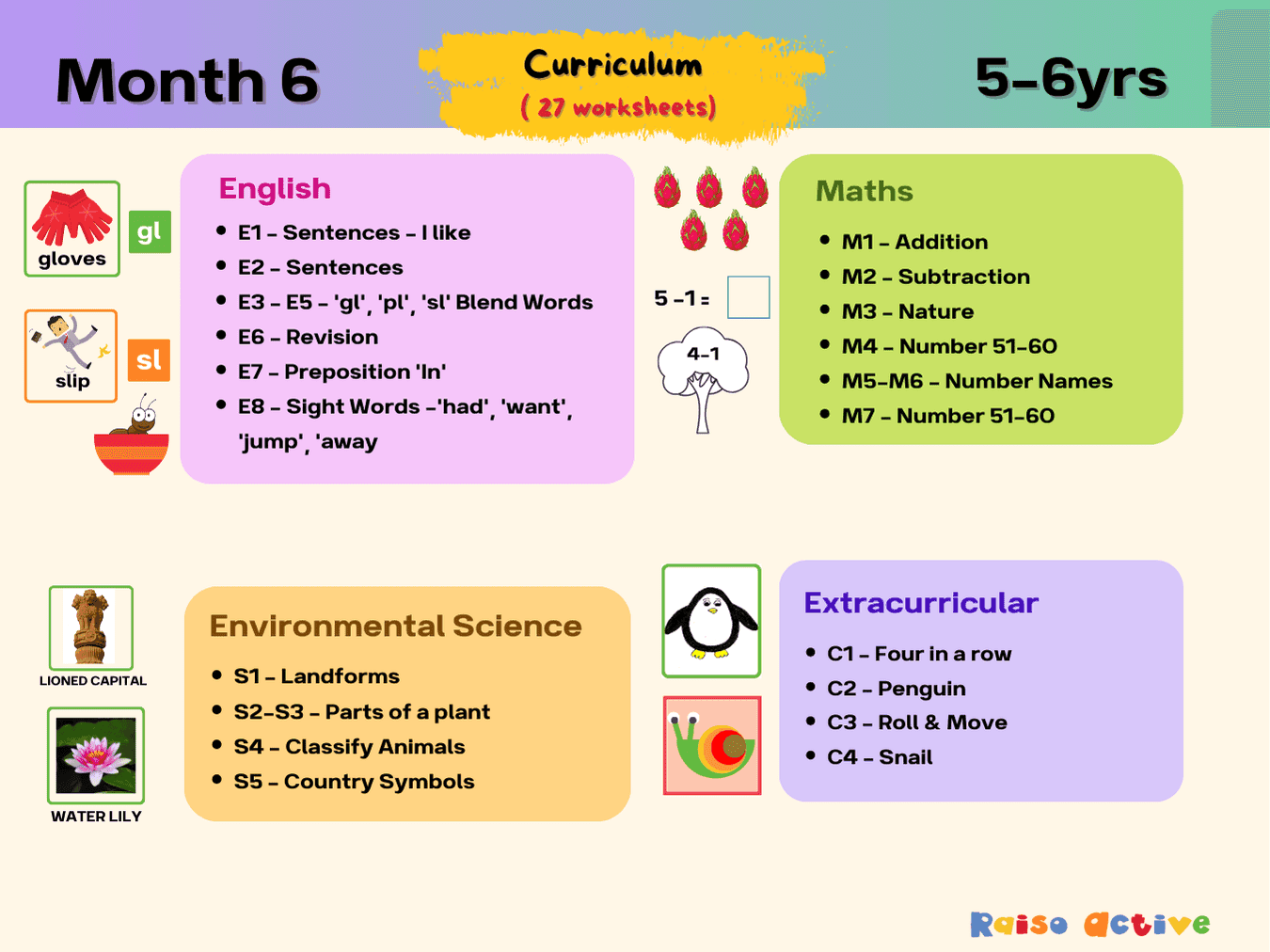
Month 6: Holistic early learning activities | Ages 5-6
This is page 7 of the pack. Ages 5-6 · KindergartenAges 5-6 · Year 1Ages 5-6 · UKGAges 5-6
Made for your child
Spelling practice, made for your child
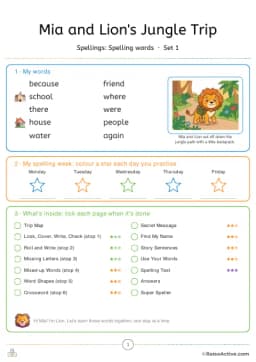
Their own spelling words turned into a pack: trace or look-cover-write-check, roll and write, a secret picture code, a word search, a crossword and a test, with their name in it.
Make a spelling packFree preview · free for members
Or start free: a word search with sight wordsCurriculum
- Phonics - Blends > Consonant Blends
How to use this worksheet
Read the first 'pl' word aloud together, emphasizing the blended 'pl' sound at the beginning rather than separating it into two distinct sounds. Have your child repeat the word back, practicing the blend, before looking at the full list of words on the page. Ask your child to circle each word that begins with the 'pl' blend, reading through the full list to check for any words that don't belong. Once finished, review each circled word together, having your child read it aloud one more time independently.
Materials needed
- Pencil
- Crayons
Extension activities
- 1Brainstorm additional 'pl' blend words together, like 'plate,' 'plus,' or 'please,' and add them to a list.
- 2Draw a simple picture for each 'pl' word circled on the worksheet to reinforce meaning alongside sound.
- 3Play an 'I spy' game around the house looking for objects that start with the 'pl' blend.
- 4Practice writing a few 'pl' words independently on a separate sheet of paper.
- 5Create flashcards with 'pl' words on one side and a matching picture on the other for quick review.

Written by
Hemsweta Jain · Teacher Cheena
MBA and Early Childhood Educator, teaching since 2014 · Founder of RaisoActive, Mumbai
Every RaisoActive worksheet is designed and checked by the founder before publishing.
Published · Last reviewed
More from Month 6: Holistic early learning activities | Ages 5-6
I Like Sentences Worksheet: Cut, Paste, and Write!
Ages 4-5 · Pre-KAges 4-5 · ReceptionAges 4-5 · LKGAges 4-5
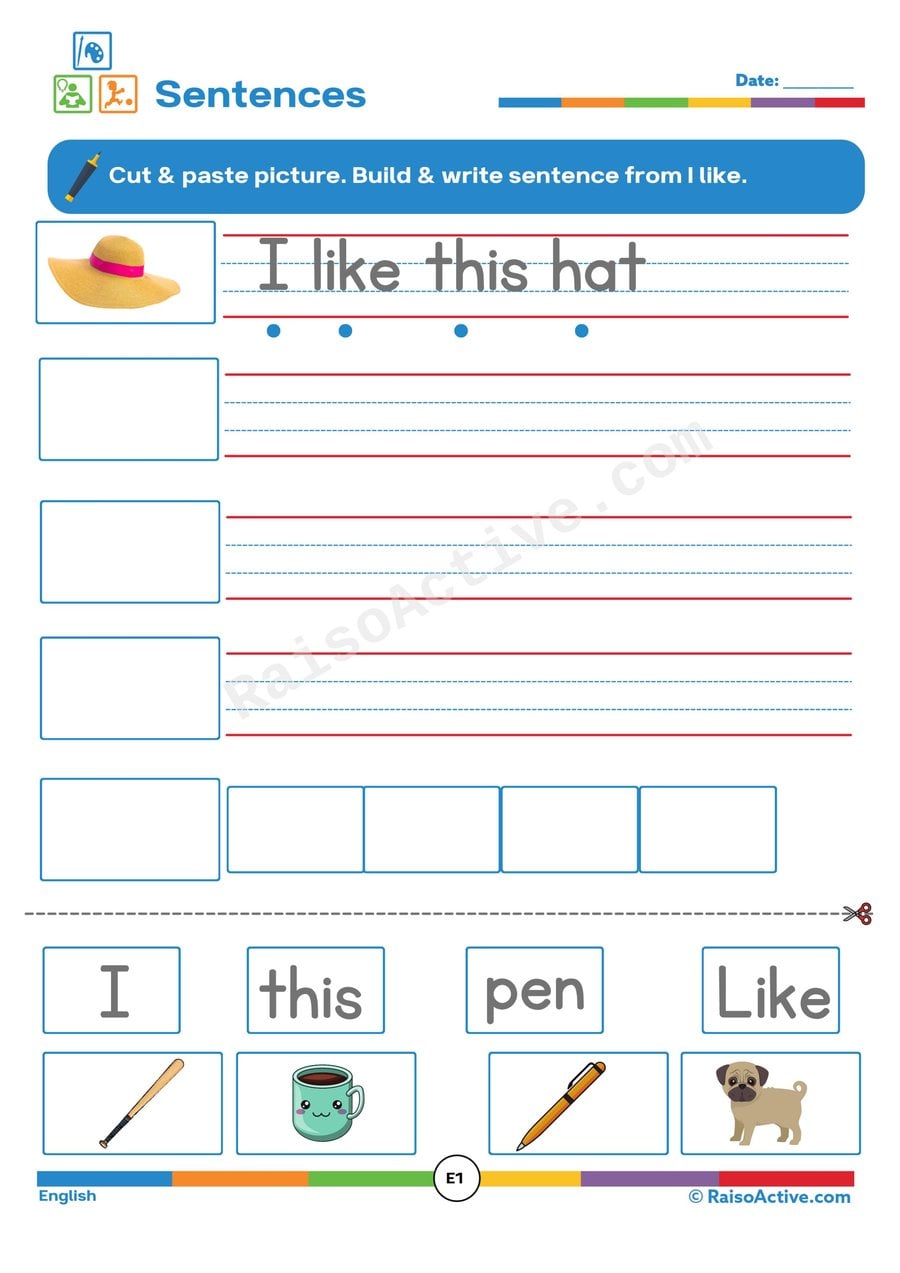
This worksheet builds early sentence construction and fine motor skills together, having children cut out a picture and word cards, paste them into a simple 'I like ___' sentence frame, and then copy the full sentence in their own writing. For ages 4-5, physically assembling a sentence from separate word pieces before writing it independently helps children understand that sentences are built from individual words in a specific order.
Match the Country Symbols Worksheet for Kids
Ages 4-6 · Pre-K–KindergartenAges 4-6 · Reception–Year 1Ages 4-6 · LKG–UKGAges 4-6
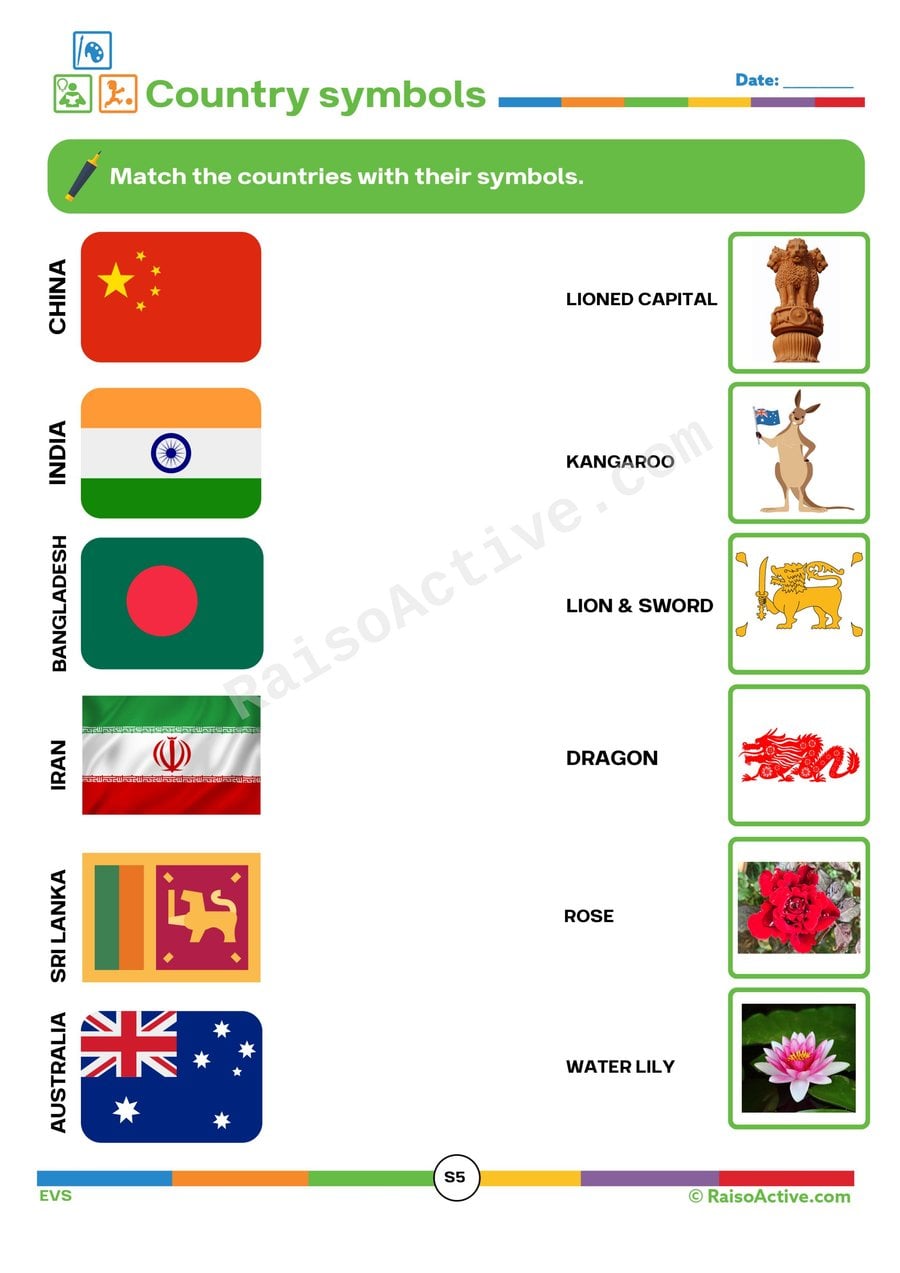
Matching country flags to their national symbols introduces children ages 4-6 to the idea that countries have their own distinct visual identities, an early and engaging entry point into geography and cultural awareness. This matching task builds visual discrimination, since flags and symbols can share similar colors or shapes that require careful comparison. Learning to associate a flag with a symbol also plants early vocabulary for talking about different countries and cultures around the world.
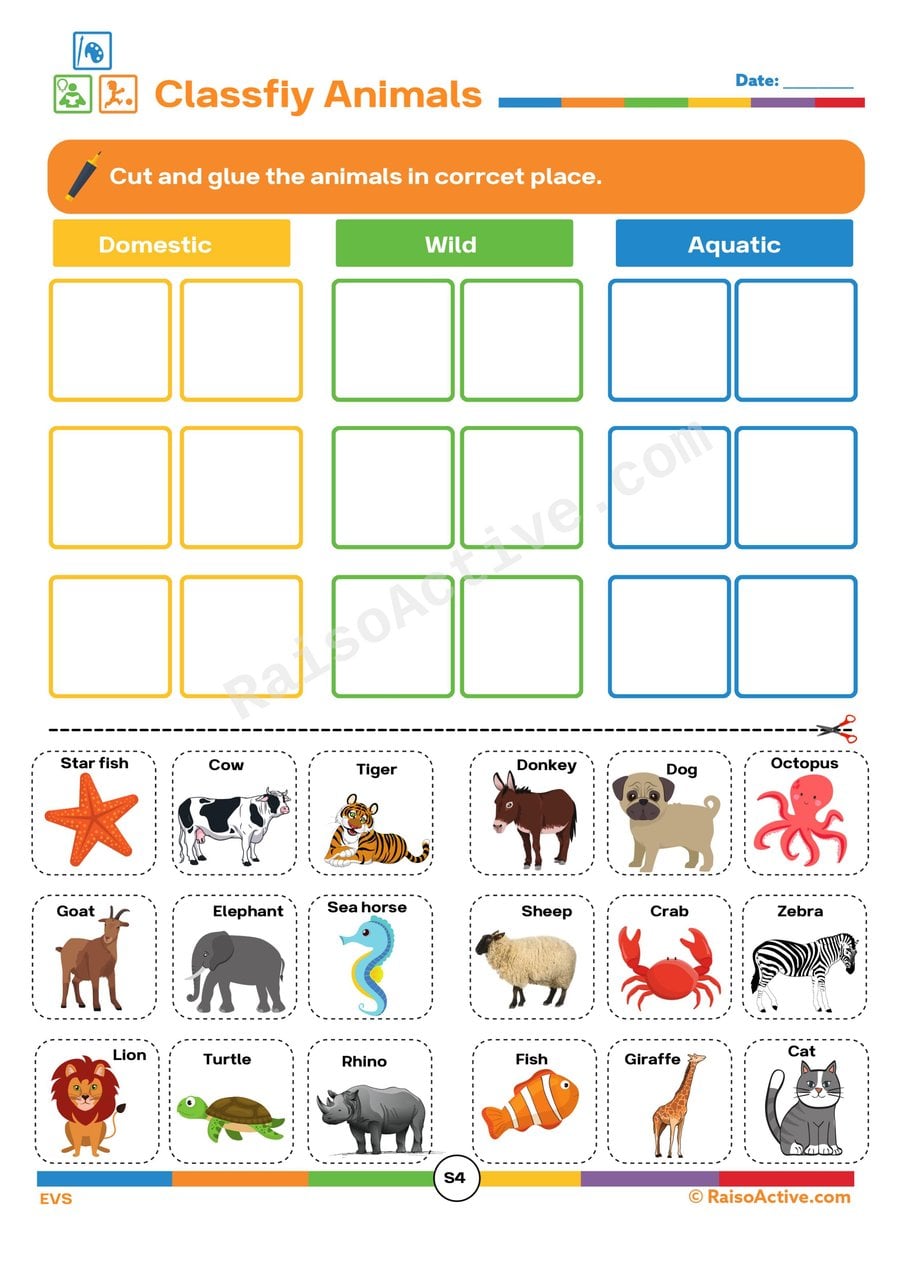
Classify Animals: Sorting Worksheet for Kids
Ages 4-6 · Pre-K–KindergartenAges 4-6 · Reception–Year 1Ages 4-6 · LKG–UKGAges 4-6
Sorting animals into domestic, wild, and aquatic categories asks children ages 4-6 to classify based on habitat and human relationship rather than just appearance, a more advanced kind of categorization than simple color or shape sorting. This builds early scientific thinking, since children must consider where an animal lives and how it behaves to decide where it belongs. The cut-and-paste format also reinforces the categories through repeated physical sorting rather than a single verbal answer.
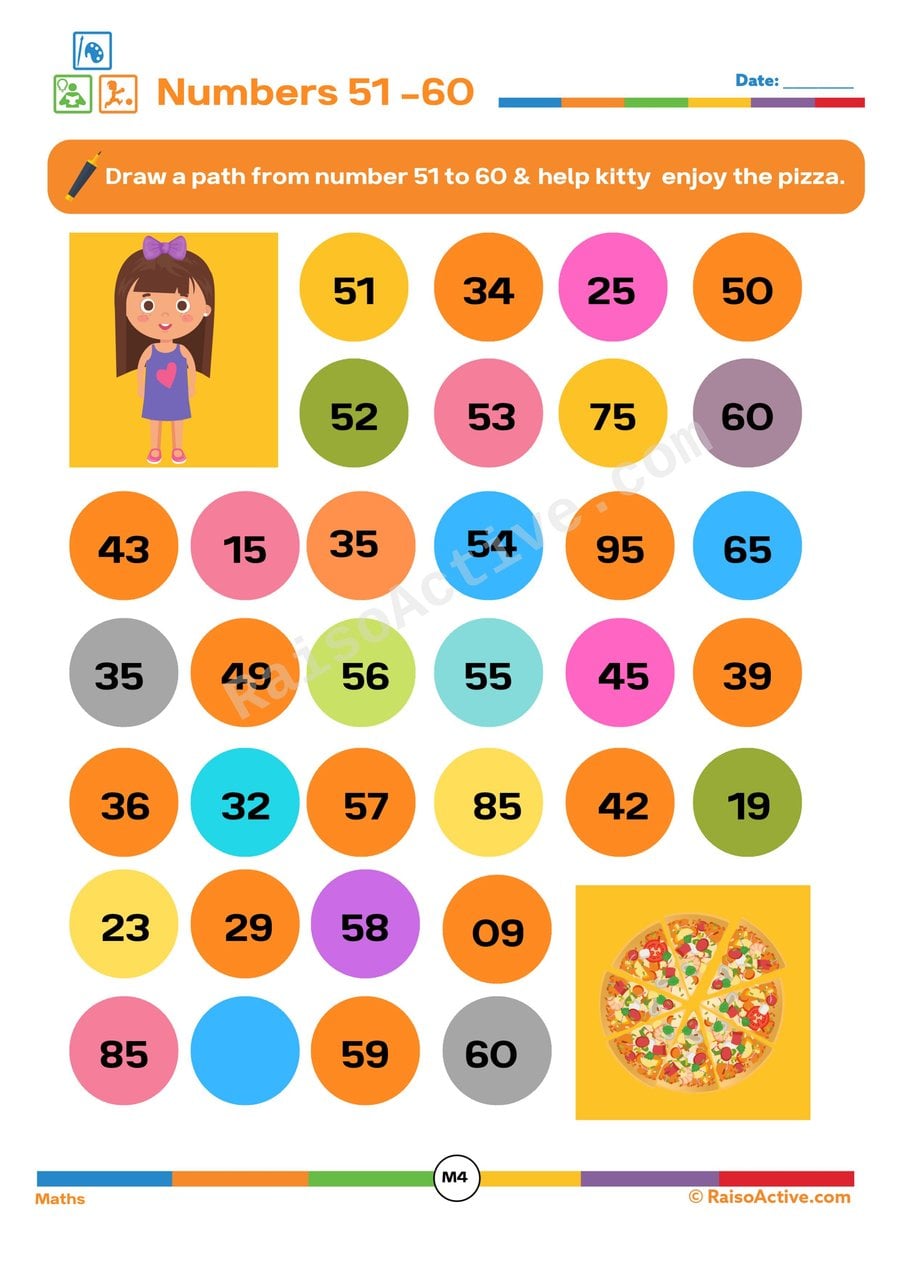
Pizza Path: Numbers 51-60 Worksheet for Kids
Ages 4-5 · Pre-KAges 4-5 · ReceptionAges 4-5 · LKGAges 4-5
Connecting the dots from 51 to 60 in order pushes children ages 4-5 beyond the more familiar 1-20 range, helping them recognize two-digit numbers and understand that counting sequences continue predictably into higher decades. This dot-to-dot format turns number recognition into a rewarding visual payoff, since a hidden pizza picture only appears once every number is found and connected correctly. It's a motivating way to practice number order without it feeling like repetitive drilling.

Addition Fun: Counting and Adding Worksheet for Kids
Ages 4-6 · Pre-K–KindergartenAges 4-6 · Reception–Year 1Ages 4-6 · LKG–UKGAges 4-6
This worksheet builds foundational addition skills by having children count two separate groups of objects and then combine those counts to find a total sum. For ages 4-6, grounding addition in physical counting of pictured objects, rather than abstract numbers alone, helps children understand that addition means putting two groups together to make a bigger group.

Subtraction Worksheet: Count and Subtract for Preschoolers
Ages 4-5 · Pre-KAges 4-5 · ReceptionAges 4-5 · LKGAges 4-5
This worksheet introduces basic subtraction by having children count a starting group of objects, remove or cross out a specified number, and count what remains to find the answer. For ages 4-5, grounding subtraction in physical counting rather than abstract numbers alone helps children understand that subtraction means 'taking away' a quantity, not just manipulating symbols.

Sight Word 'Away' Worksheet: Learn to Read and Write!
Ages 3-5 · Preschool–Pre-KAges 3-5 · Nursery–ReceptionAges 3-5 · Nursery–LKGAges 3-5
Like many high-frequency words, 'away' doesn't follow standard phonics rules cleanly, so children ages 3-5 need to build instant visual recognition of it as a whole sight word rather than sounding it out each time. This worksheet delivers that repetition through several varied tasks — coloring, tracing, word-hunting, sentence completion, and letter reassembly — which keeps a young learner engaged while reinforcing the same word from multiple angles. Strong sight-word recognition for common words like 'away' is one of the biggest accelerators of early reading fluency.

Blends Revision Worksheet: Circle the Correct Blend!
Ages 4-6 · Pre-K–KindergartenAges 4-6 · Reception–Year 1Ages 4-6 · LKG–UKGAges 4-6
Choosing the correct consonant blend to match a picture asks children ages 4-6 to compare two similar-sounding options, like 'bl' versus 'br,' and decide which one truly matches the word they hear, a sharper phonics skill than recognizing a single blend in isolation. This side-by-side comparison format catches confusion between commonly mixed-up blends that simple flashcards might miss. Building this discrimination skill helps children read multisyllabic and blended words more accurately and confidently.
Related worksheets

Blend Words Matching Worksheet: Read and Circle the Picture!
Ages 4-6 · Pre-K–KindergartenAges 4-6 · Reception–Year 1Ages 4-6 · LKG–UKGAges 4-6
This worksheet gives children ages 4-6 further practice reading consonant blend words and connecting them to their matching picture, this time by circling rather than cutting and pasting, which keeps the focus purely on reading and visual scanning. Repeated blend practice across different formats — matching, circling, and later independent writing — helps these two-consonant sounds become automatic rather than something a child has to sound out every time.

Blend Words Worksheet: See the Pictures and Write the Correct Blend!
Ages 4-6 · Pre-K–KindergartenAges 4-6 · Reception–Year 1Ages 4-6 · LKG–UKGAges 4-6
Children ages 4-6 practice identifying missing consonant blends by looking at a picture, saying the word aloud, and writing the correct blend to complete it. This task requires children to isolate the blended sound at the beginning of a word and match it to its written letter combination, a more advanced phonics skill than single-letter sounds. Successfully completing each word strengthens both spelling accuracy and reading fluency with blended sounds.
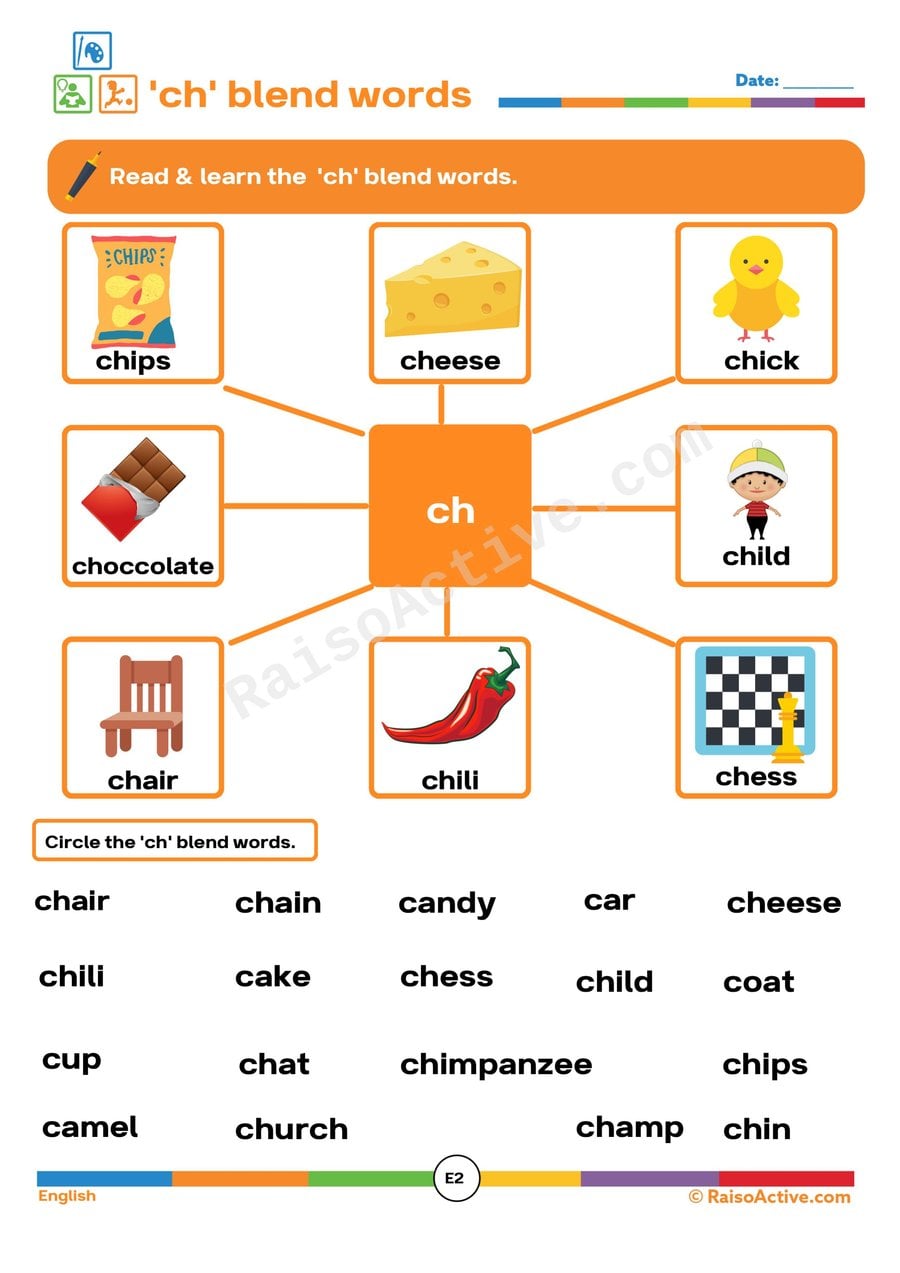
Ch Blend Words Worksheet: Read, Learn, and Circle!
Ages 4-6 · Pre-K–KindergartenAges 4-6 · Reception–Year 1Ages 4-6 · LKG–UKGAges 4-6
This worksheet focuses children ages 4-6 on recognizing words that begin with the 'ch' digraph, like 'chair' and 'cheese', asking them to read and then circle matching words. Because 'ch' represents a single new sound rather than two blended consonants, mastering it teaches children an important phonics rule: some letter pairs combine to make one brand-new sound entirely.
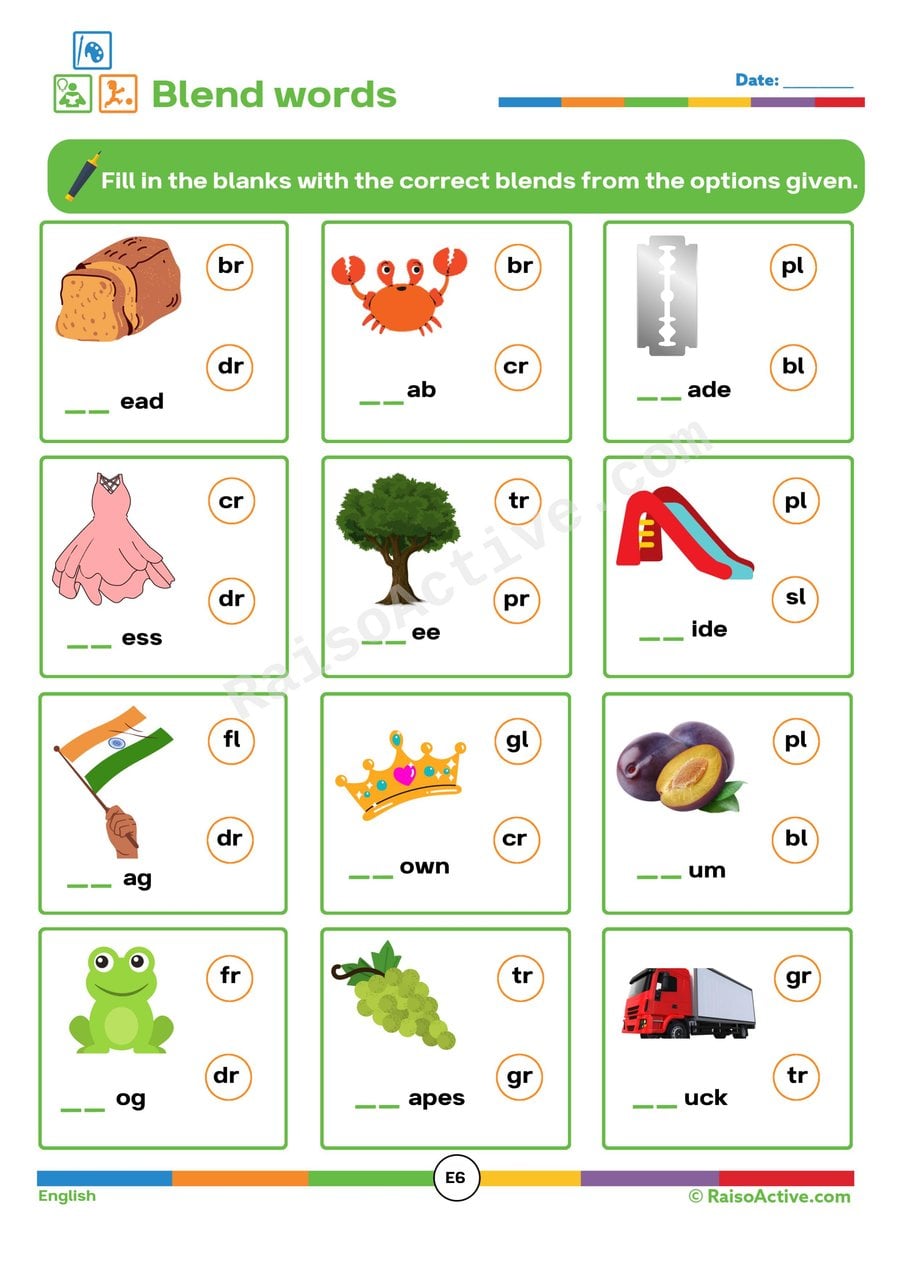
Blend Words Worksheet: Practice Blending Sounds!
Ages 4-6 · Pre-K–KindergartenAges 4-6 · Reception–Year 1Ages 4-6 · LKG–UKGAges 4-6
This worksheet gives children ages 4-6 focused practice blending initial consonant sounds, like 'cl' or 'fr,' with the rest of a word to complete a picture-labeled word. Unlike simple picture matching, writing the missing blend requires children to actively produce the correct letter combination from memory, which is a more demanding and valuable phonics skill than recognition alone.
Blend Words Coloring Worksheet for Preschoolers
Ages 4-6 · Pre-K–KindergartenAges 4-6 · Reception–Year 1Ages 4-6 · LKG–UKGAges 4-6
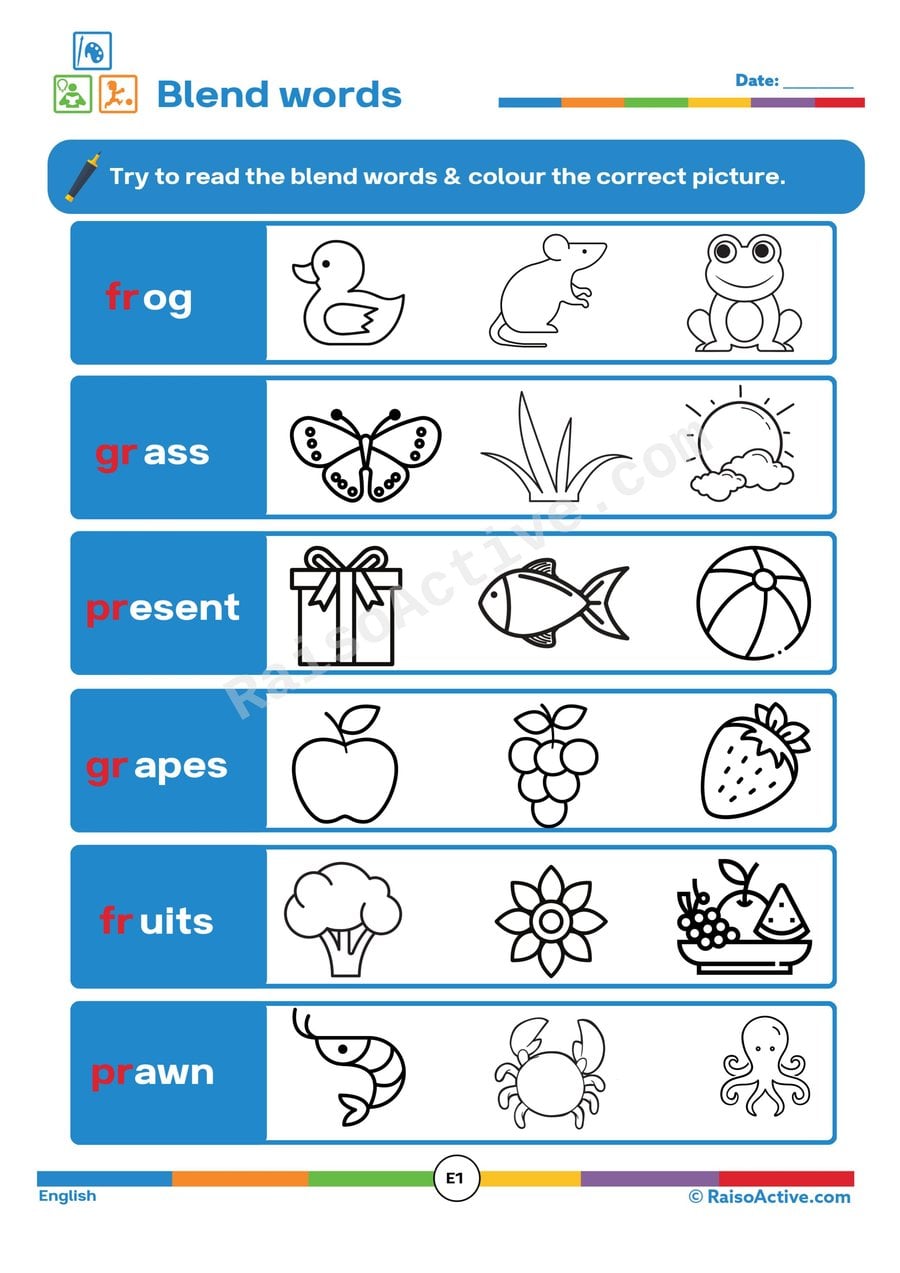
Consonant blends, like 'bl,' 'st,' or 'fr,' require children ages 4-6 to read two consonant sounds together without a vowel between them, which is genuinely more demanding than single-consonant CVC words and represents an important next step in phonics progression. This worksheet asks children to read a blend word and then color the picture that matches it, giving an immediate visual check on whether they decoded the blend correctly. Because coloring is the reward for accurate reading, the activity keeps repeated blend practice feeling engaging rather than repetitive.

Read and Circle: 'br' Blend Words Worksheet for Preschoolers
Ages 3-5 · Preschool–Pre-KAges 3-5 · Nursery–ReceptionAges 3-5 · Nursery–LKGAges 3-5
This worksheet trains children to hear and recognize the 'br' consonant blend at the start of words like 'bread' or 'brush,' building on single-letter phonics toward the more complex blended sounds that make up much of early reading vocabulary. For ages three to five, matching a read word to its picture also reinforces that written letters correspond to real, specific meanings rather than abstract symbols.

Blend Words Worksheet: Fill in the Blanks with Beginning Blends!
Ages 4-6 · Pre-K–KindergartenAges 4-6 · Reception–Year 1Ages 4-6 · LKG–UKGAges 4-6
Children ages 4-6 practice identifying and writing beginning consonant blends, like 'bl', 'cr', or 'st', by looking at pictures and completing the missing letters to form the full word. This task requires connecting a spoken sound to its written letter combination, deepening phonics skills beyond single-letter sounds into multi-letter blends. Successfully building these words strengthens both spelling and reading fluency.

Read and Learn 'tr' Blend Words Worksheet for Preschoolers
Ages 3-5 · Preschool–Pre-KAges 3-5 · Nursery–ReceptionAges 3-5 · Nursery–LKGAges 3-5
This worksheet gives children ages 3-5 practice reading and recognizing words that begin with the 'tr' consonant blend, like 'tree' and 'truck', by circling matching words from a list. Blending two consonant sounds together at the start of a word is a genuine reading challenge, and repeated practice with one specific blend builds the muscle memory needed to eventually recognize it instantly in new words.
Guides for this topic

How to Teach CVC Blending: A Step-by-Step Method That Works in Two Weeks
A step-by-step method for teaching CVC blending, covering continuous sounds, word families, common errors, and a 14-day plan that most children finish reading CVC words.
Phase 2 Phonics at Home: Sound Order, Blending Games, Worksheets
Phase 2 phonics at home: the five sound sets in order, oral blending, tricky words, a two-week routine, common mistakes, and free worksheets.

Reception Year Explained: EYFS Learning and How to Help at Home
A teacher's plain-English guide to the Reception Year: the seven areas of learning, Early Learning Goals, Phase 2/3 phonics, the RBA and home routines.
Reviews
Every worksheet for ages 4–6, no watermark
Members download the full library of 1,000+ worksheets and every activity pack without watermarks or daily limits. One year costs ₹999 in India or $20 elsewhere.
See membership plansOr download any worksheet free with a watermark (5 a day).