Read and Circle: 'br' Blend Words Worksheet for Preschoolers
This worksheet trains children to hear and recognize the 'br' consonant blend at the start of words like 'bread' or 'brush,' building on single-letter phonics toward the more complex blended sounds that make up much of early reading vocabulary. For ages three to five, matching a read word to its picture also reinforces that written letters correspond to real, specific meanings rather than abstract symbols.
Part of the pack
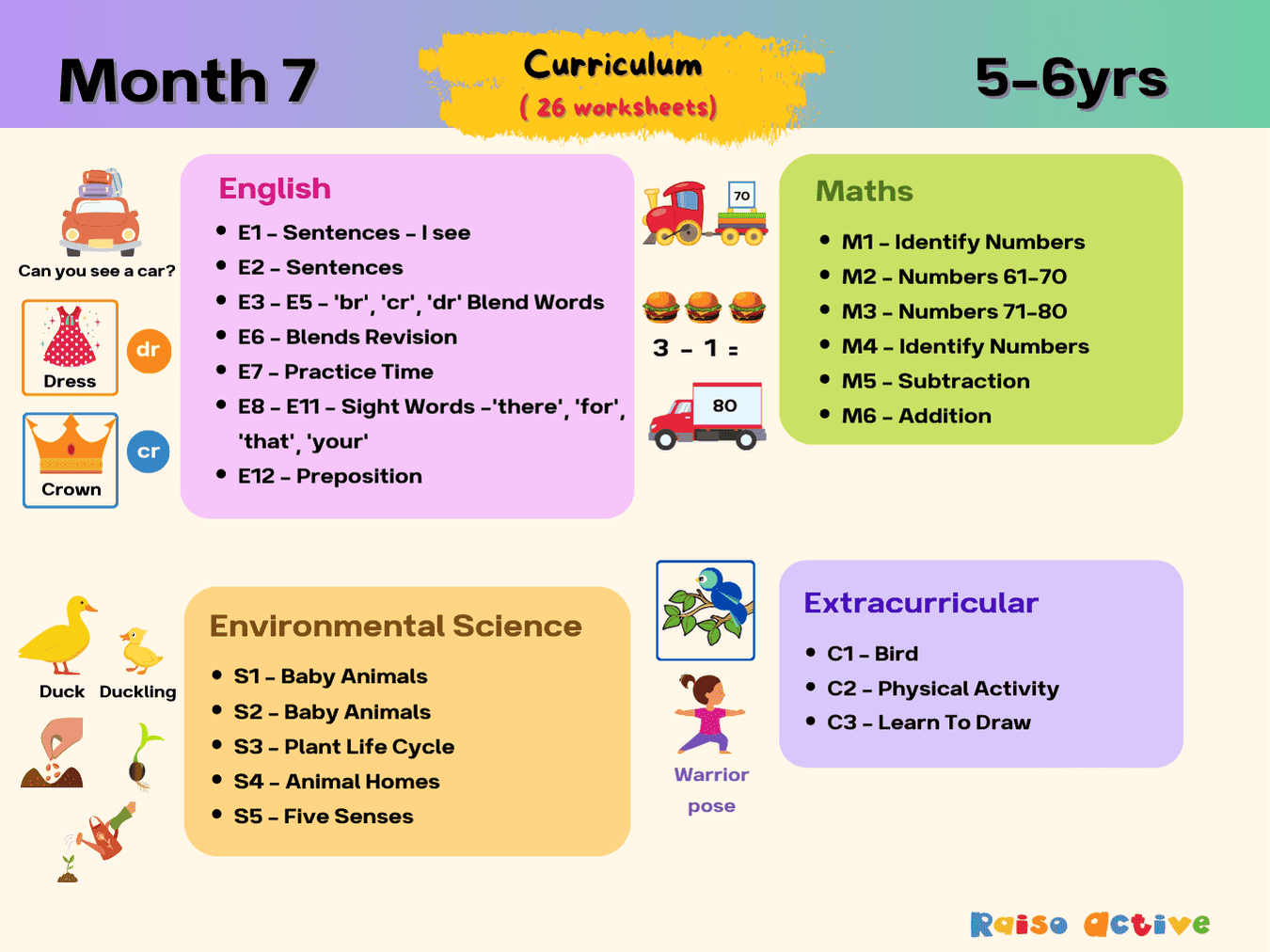
Month 7: Holistic Kindergarten Curriculum | Ages 5-6
This is page 6 of the pack. Ages 5-6 · KindergartenAges 5-6 · Year 1Ages 5-6 · UKGAges 5-6

Made for your child
Counting to 10, made for your child
A maths pack with your child's name in it: pictures that explain, practice at three levels, puzzles and story sums about them. Print a new set whenever they finish.
Make a maths packFree preview · free for members
Curriculum
- Phonics - Blends > Consonant Blends
How to use this worksheet
Read the word at the beginning of each section aloud together, sounding out the 'buh-ruh' blend clearly before moving to the pictures. Have your child look at the picture options in that section and decide which one matches the word they just read. Ask them to circle the matching picture, checking the word one more time before they commit to their answer. Continue through each section on the page, reading and circling as you go.
Materials needed
- Pencil
- Crayons
Extension activities
- 1Have your child write the 'br' words on a separate sheet of paper for extra practice.
- 2Ask your child to draw a picture for each 'br' word they read on the worksheet.
- 3Go on a 'br' word hunt, looking around the house or in a book for anything that starts with that blend.
- 4Play a rhyming game using br-words, like 'bread' and 'said,' to build phonemic awareness.

Written by
Hemsweta Jain · Teacher Cheena
MBA and Early Childhood Educator, teaching since 2014 · Founder of RaisoActive, Mumbai
Every RaisoActive worksheet is designed and checked by the founder before publishing.
Published · Last reviewed
More from Month 7: Holistic Kindergarten Curriculum | Ages 5-6
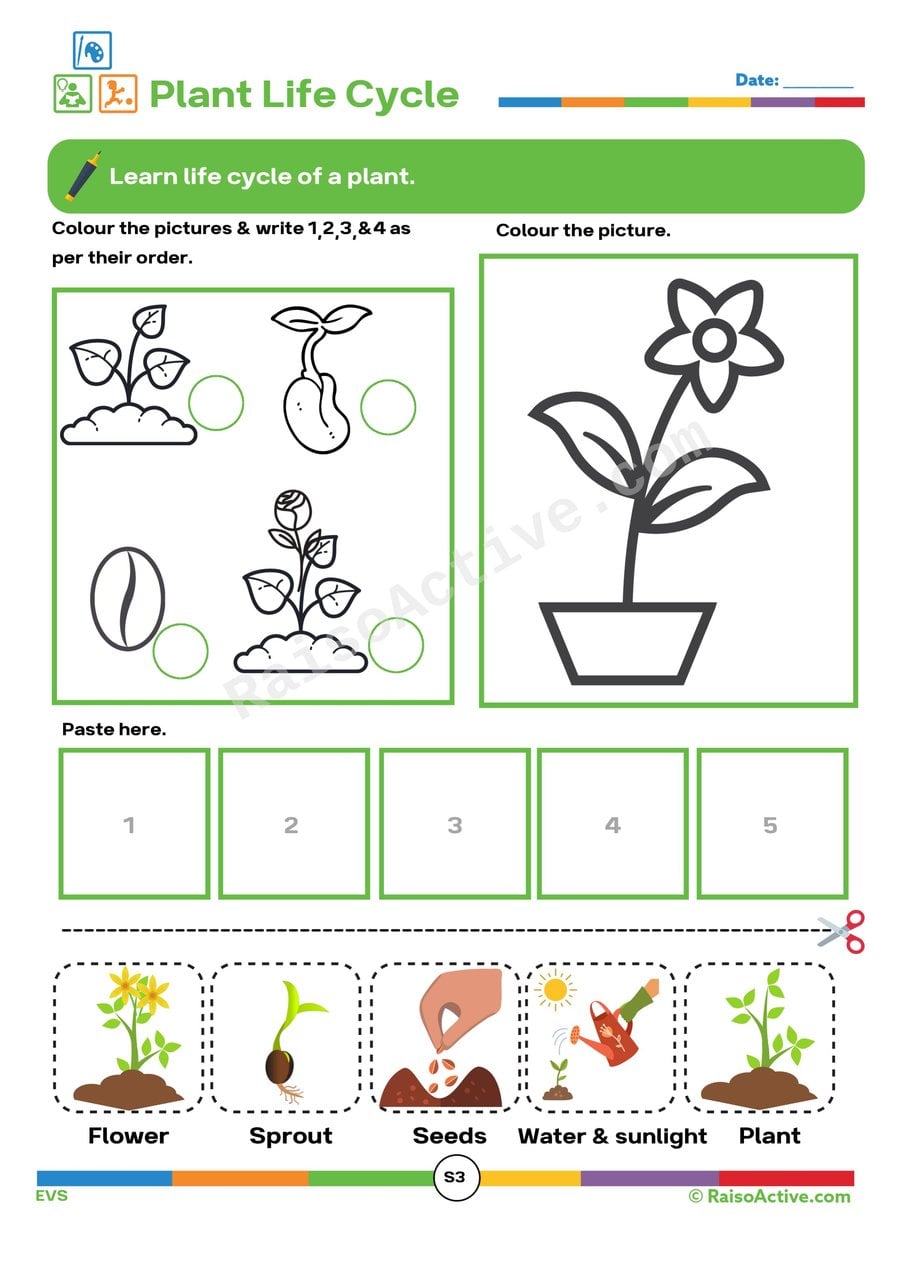
Plant Life Cycle Worksheet: Learn and Color!
Ages 3-5 · Preschool–Pre-KAges 3-5 · Nursery–ReceptionAges 3-5 · Nursery–LKGAges 3-5
Sequencing the stages of a plant's life cycle — from seed to sprout to full-grown flower — introduces children ages 3-5 to the science concept that living things grow and change in a predictable order over time. Numbering the stages before coloring also builds early sequencing and observation skills, since children must look closely at each picture to judge which comes before the next.

Make Your Own Paper Bird Worksheet for Preschoolers
Ages 3-5 · Preschool–Pre-KAges 3-5 · Nursery–ReceptionAges 3-5 · Nursery–LKGAges 3-5
Cutting out shapes and assembling them into a paper bird helps children ages 3-5 build fine motor control and hand-eye coordination, since aligning several small pieces accurately requires more precision than a single cut-and-paste task. Following a reference image to guide assembly also strengthens visual sequencing and the ability to translate a picture instruction into a physical, step-by-step action.

Sight Word 'There' Worksheet for Preschoolers: Tracing, Coloring, and Sentence Building
Ages 4-5 · Pre-KAges 4-5 · ReceptionAges 4-5 · LKGAges 4-5
Because 'there' can't be decoded using typical phonics rules and is easily confused with the similar-sounding 'their' and 'they're,' children ages 4-5 need repeated, varied exposure to memorize it as a sight word. Practicing it through coloring, tracing, searching, and sentence-building helps move the word from momentary recognition into automatic recall needed for fluent reading.
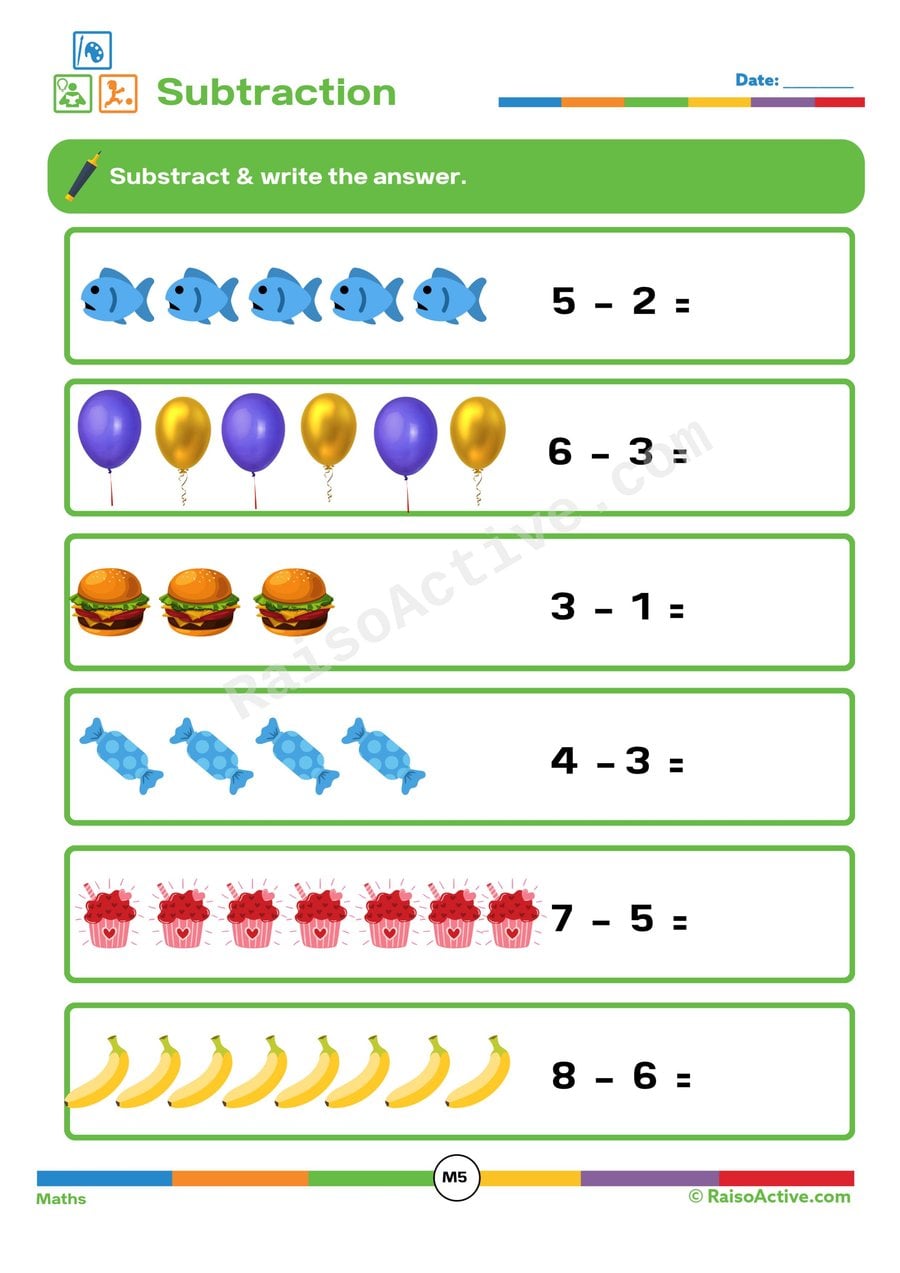
Subtraction Worksheet: Count and Subtract!
Ages 4-5 · Pre-KAges 4-5 · ReceptionAges 4-5 · LKGAges 4-5
This worksheet gives children ages 4-5 hands-on practice with subtraction as 'taking away' from a visible group, helping them understand that a number decreases when items are removed rather than treating subtraction as an abstract symbol on paper. Counting the starting group and then physically crossing out or covering objects before writing the difference builds the concrete number sense that later supports mental subtraction.

Match the Baby Animals Worksheet for Preschoolers
Ages 3-5 · Preschool–Pre-KAges 3-5 · Nursery–ReceptionAges 3-5 · Nursery–LKGAges 3-5
Connecting adult animals to their babies builds specific vocabulary for children ages 3-5, like puppy, kitten, and fawn, while training visual comparison skills as they look for matching features between each pair. This activity also introduces the early biology concept that offspring, though smaller and sometimes differently colored, belong to the same animal family as their parent.

Learn to Draw a Duck: Step-by-Step Drawing Worksheet for Kids
Ages 3-5 · Preschool–Pre-KAges 3-5 · Nursery–ReceptionAges 3-5 · Nursery–LKGAges 3-5
Following numbered steps to draw a duck teaches children ages 3-5 to break a complex picture into simple shapes — circles, ovals, and lines — building both sequencing skills and early drawing confidence. Learning that any drawing can be built one small step at a time helps reduce the frustration many young children feel when facing a blank page.

Animal Homes Matching Worksheet for Preschoolers
Ages 3-5 · Preschool–Pre-KAges 3-5 · Nursery–ReceptionAges 3-5 · Nursery–LKGAges 3-5
By matching each animal to its home, children ages 3-5 build early classification skills and expand their vocabulary around habitats like nests, dens, hives, and burrows. This kind of cause-and-effect pairing — this animal lives in this particular place — lays groundwork for later science concepts about how living things depend on their environment.

Match the Baby Animals Worksheet for Preschoolers
Ages 3-5 · Preschool–Pre-KAges 3-5 · Nursery–ReceptionAges 3-5 · Nursery–LKGAges 3-5
Matching adult animals to their babies teaches children ages 3-5 specific animal vocabulary — like calf, cub, and kit — while sharpening visual comparison skills as they look for physical similarities between the pictures. This kind of pairing task also builds early categorization thinking, since children must recognize that a baby animal, despite looking different from its parent, still belongs to the same animal family.
Related worksheets
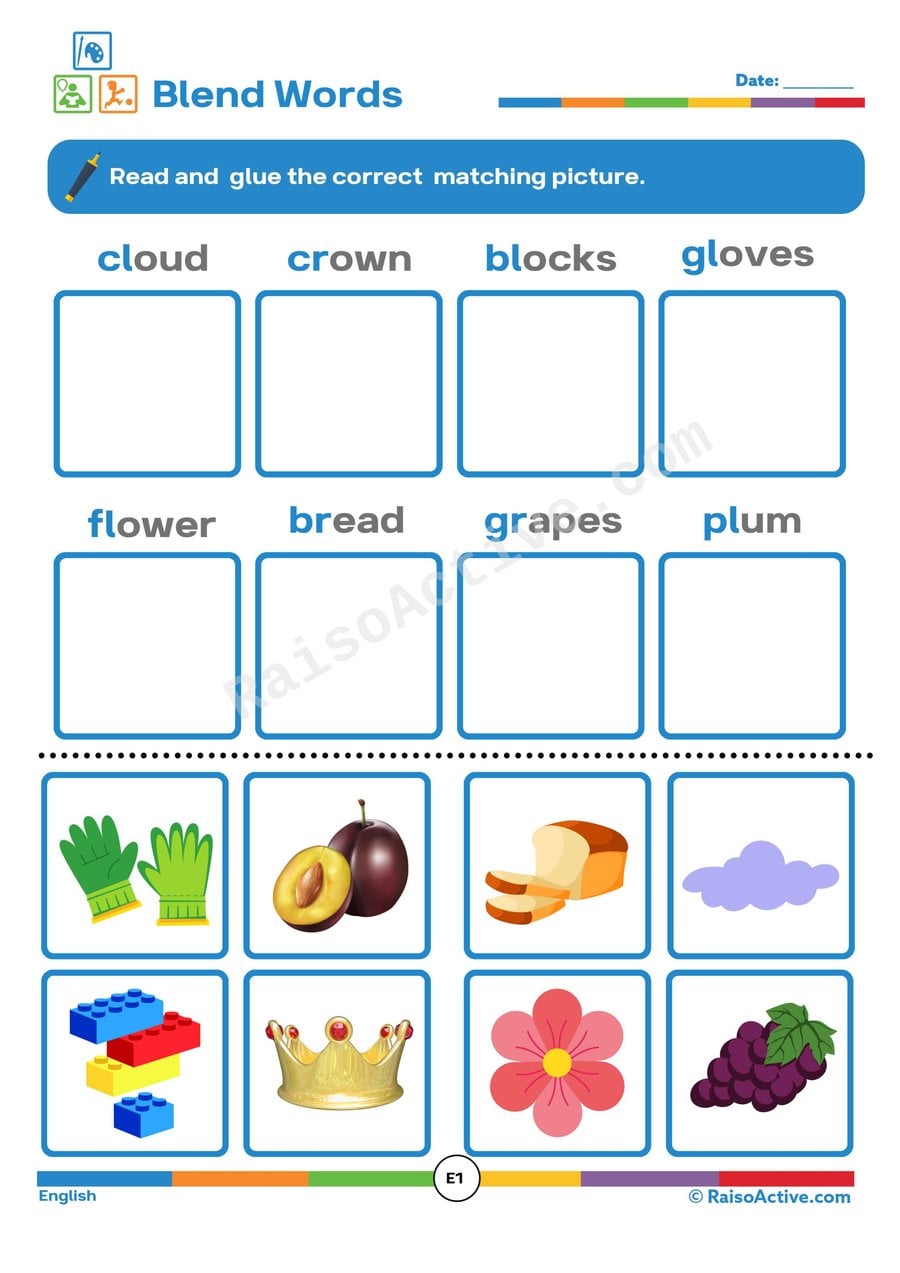
Blend Words Matching Worksheet for Preschoolers
Ages 4-5 · Pre-KAges 4-5 · ReceptionAges 4-5 · LKGAges 4-5
Children ages 4-5 practice reading consonant blend words — words that start with two consonant sounds blended together, like 'bl' or 'st' — and connecting them to the correct picture through a cut-and-paste matching activity. Blends are a step up in difficulty from single beginning sounds, since children must hear and produce two consonant sounds smoothly together, an important milestone on the way to more advanced phonics.

Blend Words Worksheet: Fill in the Blanks with Beginning Blends!
Ages 4-6 · Pre-K–KindergartenAges 4-6 · Reception–Year 1Ages 4-6 · LKG–UKGAges 4-6
Children ages 4-6 practice identifying and writing beginning consonant blends, like 'bl', 'cr', or 'st', by looking at pictures and completing the missing letters to form the full word. This task requires connecting a spoken sound to its written letter combination, deepening phonics skills beyond single-letter sounds into multi-letter blends. Successfully building these words strengthens both spelling and reading fluency.
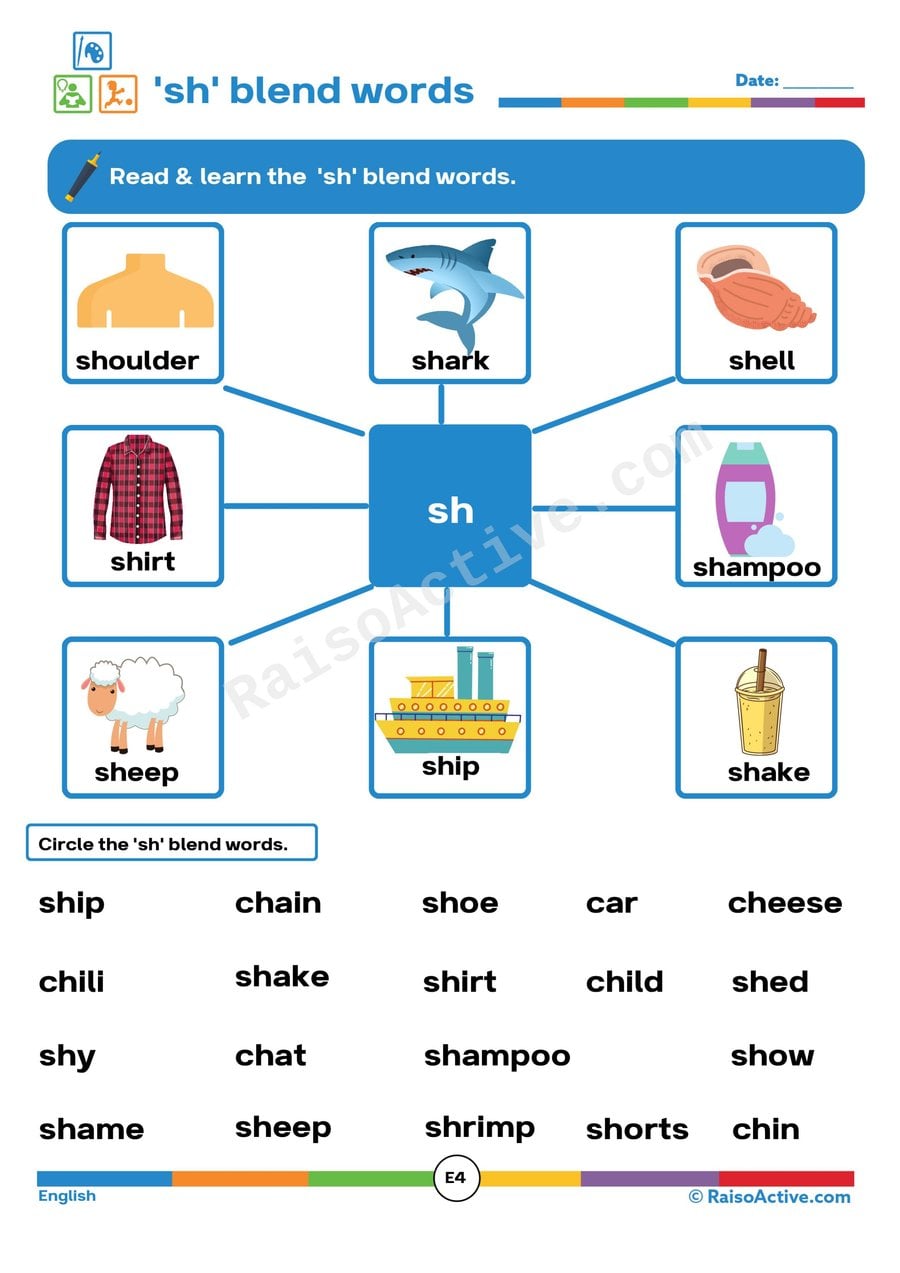
Sh Blend Words Worksheet: Read, Learn, and Circle!
Ages 4-6 · Pre-K–KindergartenAges 4-6 · Reception–Year 1Ages 4-6 · LKG–UKGAges 4-6
The 'sh' blend is one of the most common digraphs in early English words, appearing in everyday vocabulary like 'ship,' 'shell,' and 'shop,' which makes this worksheet especially useful for children ages 4-6 building toward independent reading. Recognizing that two letters, 's' and 'h,' combine to make one brand-new sound (rather than two separate sounds) is a key phonics milestone, since digraphs behave differently from regular consonant blends. Reading and then circling 'sh' words from a list reinforces both the sound and the specific letter pattern that represents it.

Blend Words Worksheet: Fill in the Blanks with Beginning Blends!
Ages 4-6 · Pre-K–KindergartenAges 4-6 · Reception–Year 1Ages 4-6 · LKG–UKGAges 4-6
Similar to blend recognition but with an added layer of choice, this worksheet gives children ages 4-6 a bank of possible beginning blends to choose from as they complete each picture word, building both phonics recall and careful selection skills. Choosing the correct blend from several options requires your child to test each possibility mentally against the word they're trying to spell, which strengthens their ability to self-check and problem-solve rather than just guessing. This kind of active decision-making with phonics elements builds toward more independent spelling down the road.

Read and Learn 'tr' Blend Words Worksheet for Preschoolers
Ages 3-5 · Preschool–Pre-KAges 3-5 · Nursery–ReceptionAges 3-5 · Nursery–LKGAges 3-5
This worksheet gives children ages 3-5 practice reading and recognizing words that begin with the 'tr' consonant blend, like 'tree' and 'truck', by circling matching words from a list. Blending two consonant sounds together at the start of a word is a genuine reading challenge, and repeated practice with one specific blend builds the muscle memory needed to eventually recognize it instantly in new words.
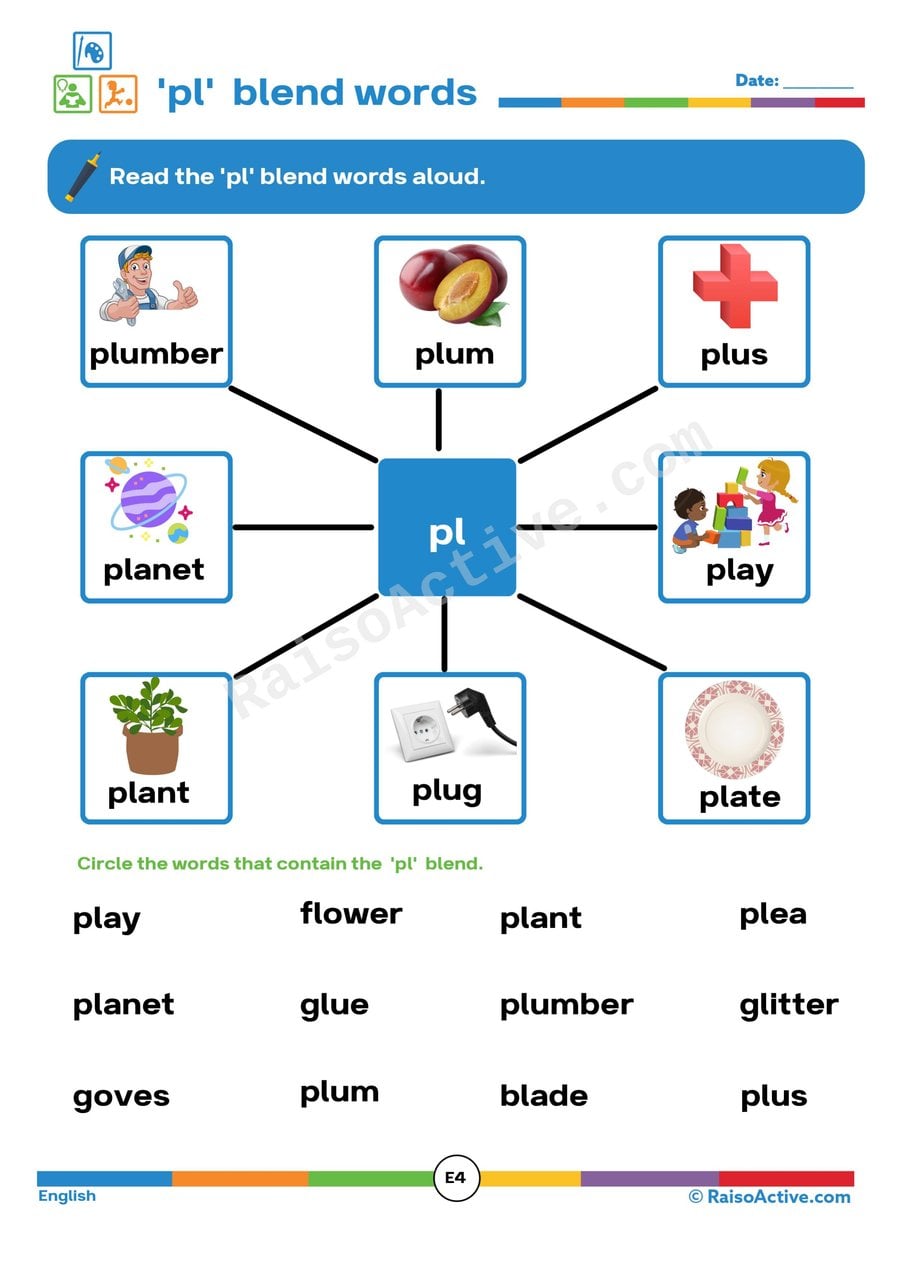
Pl Blend Words Worksheet for Preschoolers
Ages 4-6 · Pre-K–KindergartenAges 4-6 · Reception–Year 1Ages 4-6 · LKG–UKGAges 4-6
This worksheet targets the 'pl' consonant blend, helping children recognize and read words like 'play,' 'plane,' and 'plant' where two consonant sounds combine at the start of a word. For ages 4-6, mastering blends is a key phonics milestone that comes after single letter sounds, since blending two consonants together requires more advanced sound segmentation skills.

Blends Revision Worksheet: Circle the Correct Blend!
Ages 4-6 · Pre-K–KindergartenAges 4-6 · Reception–Year 1Ages 4-6 · LKG–UKGAges 4-6
Choosing the correct consonant blend to match a picture asks children ages 4-6 to compare two similar-sounding options, like 'bl' versus 'br,' and decide which one truly matches the word they hear, a sharper phonics skill than recognizing a single blend in isolation. This side-by-side comparison format catches confusion between commonly mixed-up blends that simple flashcards might miss. Building this discrimination skill helps children read multisyllabic and blended words more accurately and confidently.
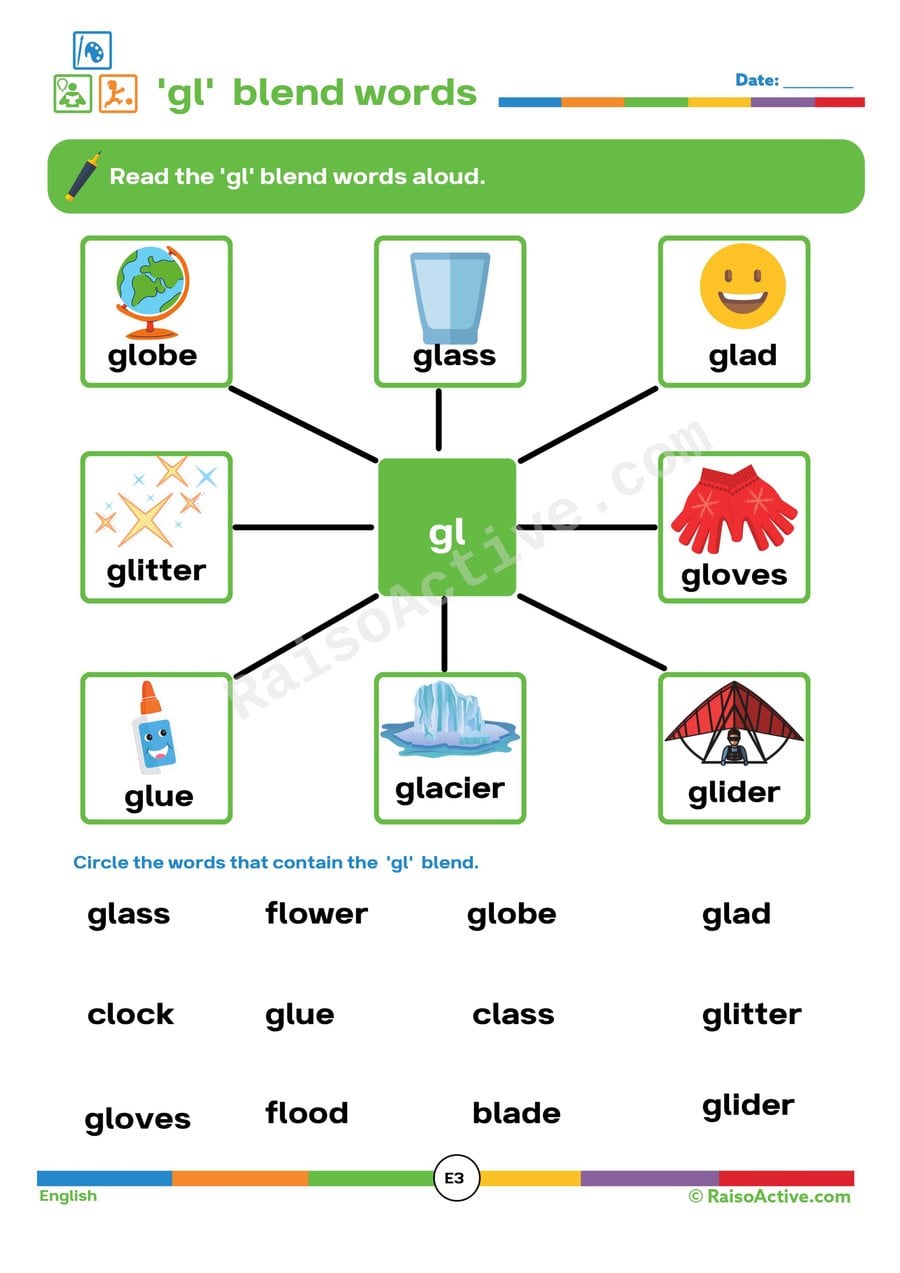
Gl Blend Words Worksheet: Read and Circle!
Ages 4-6 · Pre-K–KindergartenAges 4-6 · Reception–Year 1Ages 4-6 · LKG–UKGAges 4-6
This worksheet builds phonics skills around the 'gl' consonant blend, helping children recognize and read words like 'glass,' 'glue,' and 'glow' where the sounds of g and l combine at the start of a word. For ages 4-6, practicing blends like gl strengthens the sound-segmentation skills needed to decode increasingly complex words as reading develops.
Guides for this topic

How to Teach CVC Blending: A Step-by-Step Method That Works in Two Weeks
A step-by-step method for teaching CVC blending, covering continuous sounds, word families, common errors, and a 14-day plan that most children finish reading CVC words.
Phase 2 Phonics at Home: Sound Order, Blending Games, Worksheets
Phase 2 phonics at home: the five sound sets in order, oral blending, tricky words, a two-week routine, common mistakes, and free worksheets.

Reception Year Explained: EYFS Learning and How to Help at Home
A teacher's plain-English guide to the Reception Year: the seven areas of learning, Early Learning Goals, Phase 2/3 phonics, the RBA and home routines.
Reviews
Every worksheet for ages 3–5, no watermark
Members download the full library of 1,000+ worksheets and every activity pack without watermarks or daily limits. One year costs ₹999 in India or $20 elsewhere.
See membership plansOr download any worksheet free with a watermark (5 a day).