
Blend Words Worksheet: Fill in the Blanks with Beginning Blends!
Similar to blend recognition but with an added layer of choice, this worksheet gives children ages 4-6 a bank of possible beginning blends to choose from as they complete each picture word, building both phonics recall and careful selection skills. Choosing the correct blend from several options requires your child to test each possibility mentally against the word they're trying to spell, which strengthens their ability to self-check and problem-solve rather than just guessing. This kind of active decision-making with phonics elements builds toward more independent spelling down the road.
Part of the pack
Month 9: Early Learning English Math Science | Ages 5-6Curriculum
How to use this worksheet
Look at the first picture together and say its name slowly, listening for the blend sound at the beginning. Read through the blend choices provided at the bottom of the page together. Have your child pick the blend they think is correct and write it in the blank space to complete the word, then read the finished word aloud to check if it makes sense. Continue through each picture the same way, encouraging your child to try selecting the blend independently before offering help.
Materials needed
- Pencil
- Eraser
Extension activities
- •Have your child write the full completed words on a separate sheet of paper for extra practice.
- •Create flashcards with the blend words and practice reading them quickly together.
- •Play a sorting game, grouping objects or pictures by their shared beginning blend.
- •Make up simple sentences using a few of the completed blend words.
- •Turn the blend choices into a quick oral quiz, saying a word and having your child pick the correct blend from memory.
Tips for parents and teachers
Encourage your child to say each blend choice out loud and test it against the picture before writing, since this trial-and-check process builds real phonics reasoning rather than random guessing. Focus your support on the blend sounds specifically, since that's the skill being targeted here rather than overall spelling. Offer plenty of patience, since selecting the right blend from several options is more cognitively demanding than a simple fill-in task.

Written by
Hemsweta Jain · Teacher Cheena
MBA and Early Childhood Educator, teaching since 2014 · Founder of RaisoActive, Mumbai
Every RaisoActive worksheet is designed and checked by the founder before publishing.
Published · Last reviewed
Related worksheets

Blend Words Matching Worksheet: Read and Circle the Picture!
This worksheet gives children ages 4-6 further practice reading consonant blend words and connecting them to their matching picture, this time by circling rather than cutting and pasting, which keeps the focus purely on reading and visual scanning. Repeated blend practice across different formats — matching, circling, and later independent writing — helps these two-consonant sounds become automatic rather than something a child has to sound out every time.
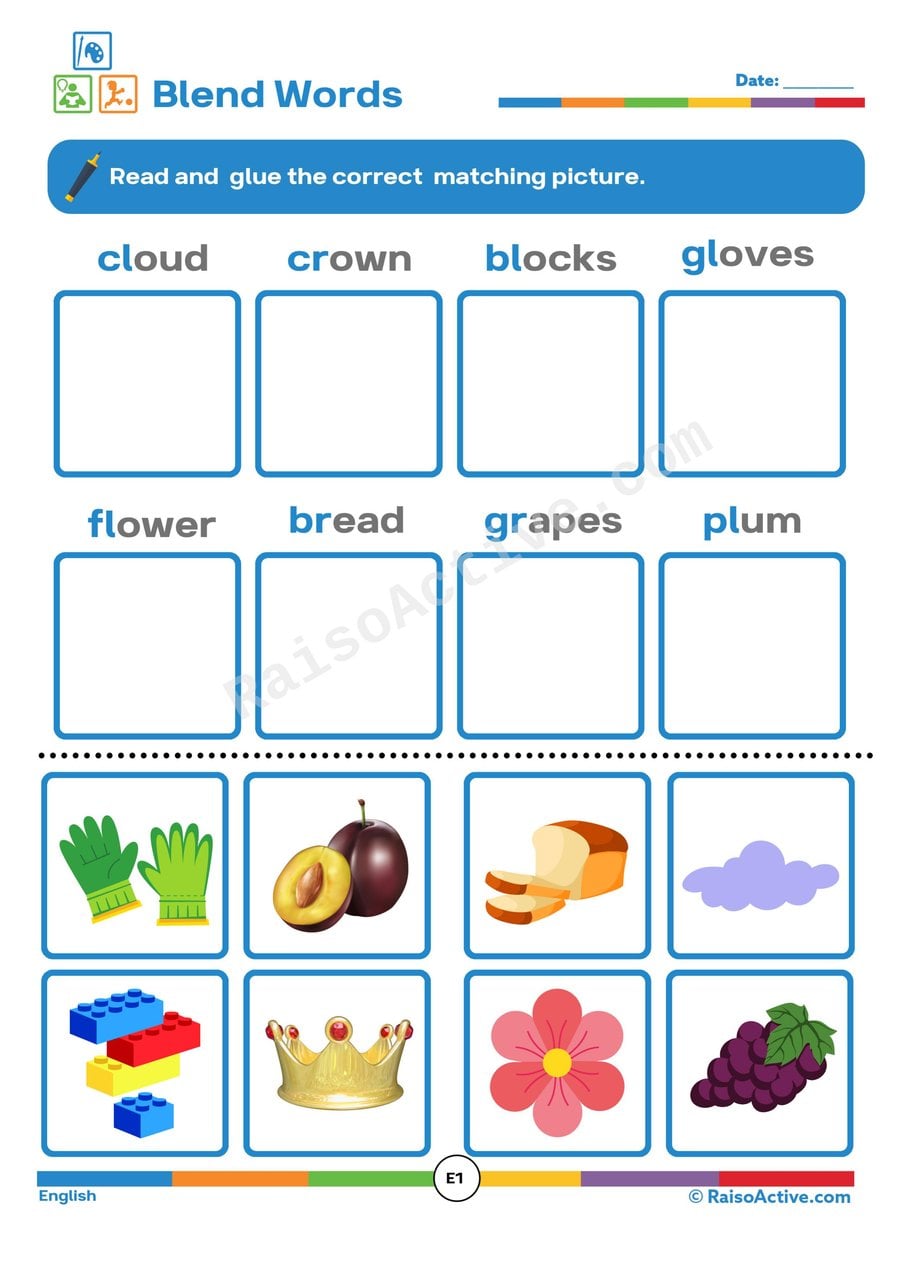
Blend Words Matching Worksheet for Preschoolers
Children ages 4-5 practice reading consonant blend words — words that start with two consonant sounds blended together, like 'bl' or 'st' — and connecting them to the correct picture through a cut-and-paste matching activity. Blends are a step up in difficulty from single beginning sounds, since children must hear and produce two consonant sounds smoothly together, an important milestone on the way to more advanced phonics.

Blend Words Worksheet: Circle the Correct Picture!
This worksheet strengthens blending skills for children ages 4-6, asking them to say a consonant blend like 'bl' or 'st' together with different word endings and identify which resulting word matches a picture. Blending two consonant sounds smoothly before adding a vowel is a more advanced phonics skill than single-letter sounds, and this practice directly supports decoding multisyllabic and blended words during independent reading.
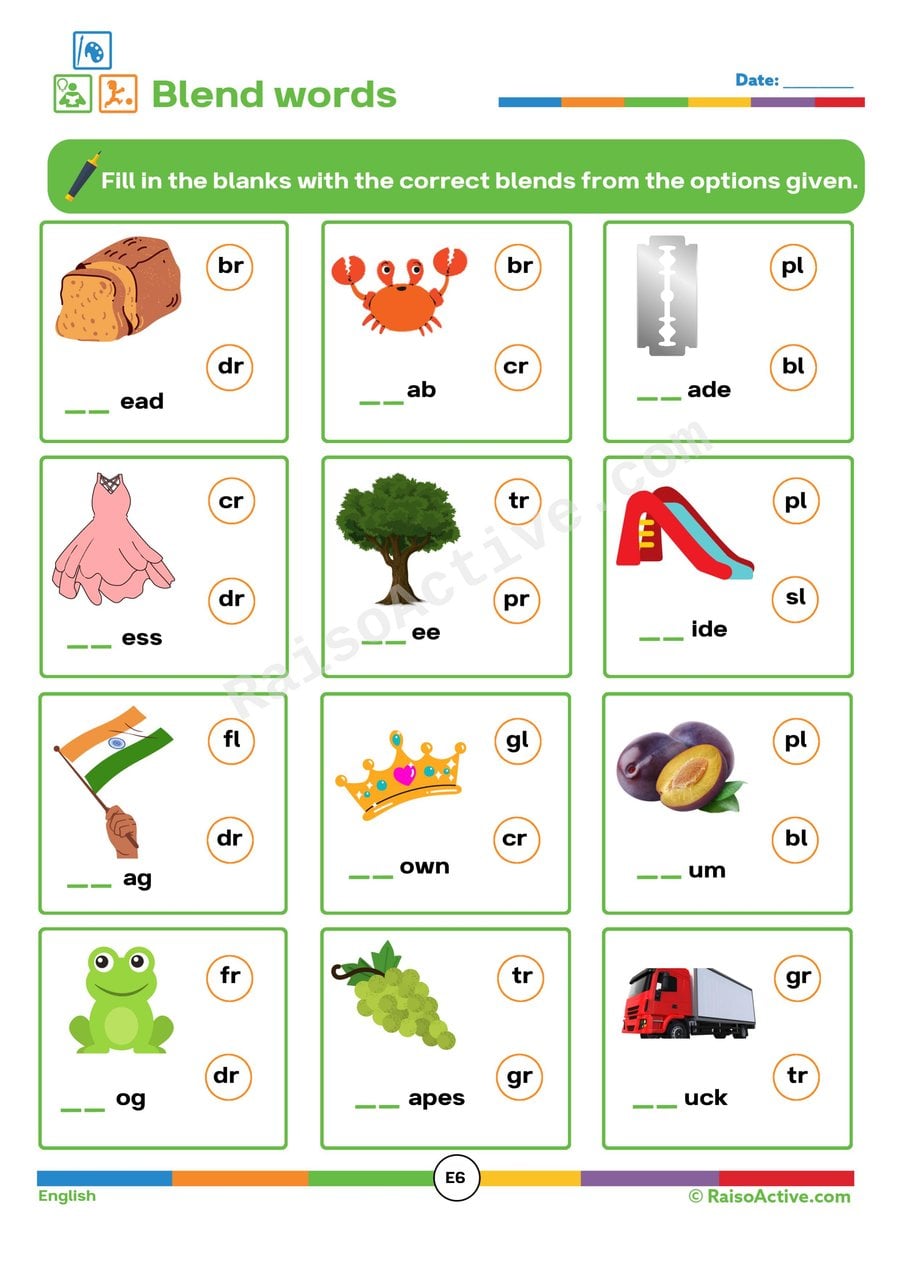
Blend Words Worksheet: Practice Blending Sounds!
This worksheet gives children ages 4-6 focused practice blending initial consonant sounds, like 'cl' or 'fr,' with the rest of a word to complete a picture-labeled word. Unlike simple picture matching, writing the missing blend requires children to actively produce the correct letter combination from memory, which is a more demanding and valuable phonics skill than recognition alone.

Blends Revision Worksheet: Circle the Correct Blend!
Choosing the correct consonant blend to match a picture asks children ages 4-6 to compare two similar-sounding options, like 'bl' versus 'br,' and decide which one truly matches the word they hear, a sharper phonics skill than recognizing a single blend in isolation. This side-by-side comparison format catches confusion between commonly mixed-up blends that simple flashcards might miss. Building this discrimination skill helps children read multisyllabic and blended words more accurately and confidently.

Sl Blend Words Worksheet: Read, Identify, and Circle!
Reading and circling words that begin with the 'sl' consonant blend helps children ages 4-6 hear that two consonants pressed together, like s and l, still form one connected sound at the start of a word. This is a more advanced phonics skill than single-letter sounds, since children must blend two consonants smoothly rather than separating them. Recognizing blends like 'sl' in words such as 'slide' or 'sled' builds the decoding fluency needed to read longer, less predictable words independently.
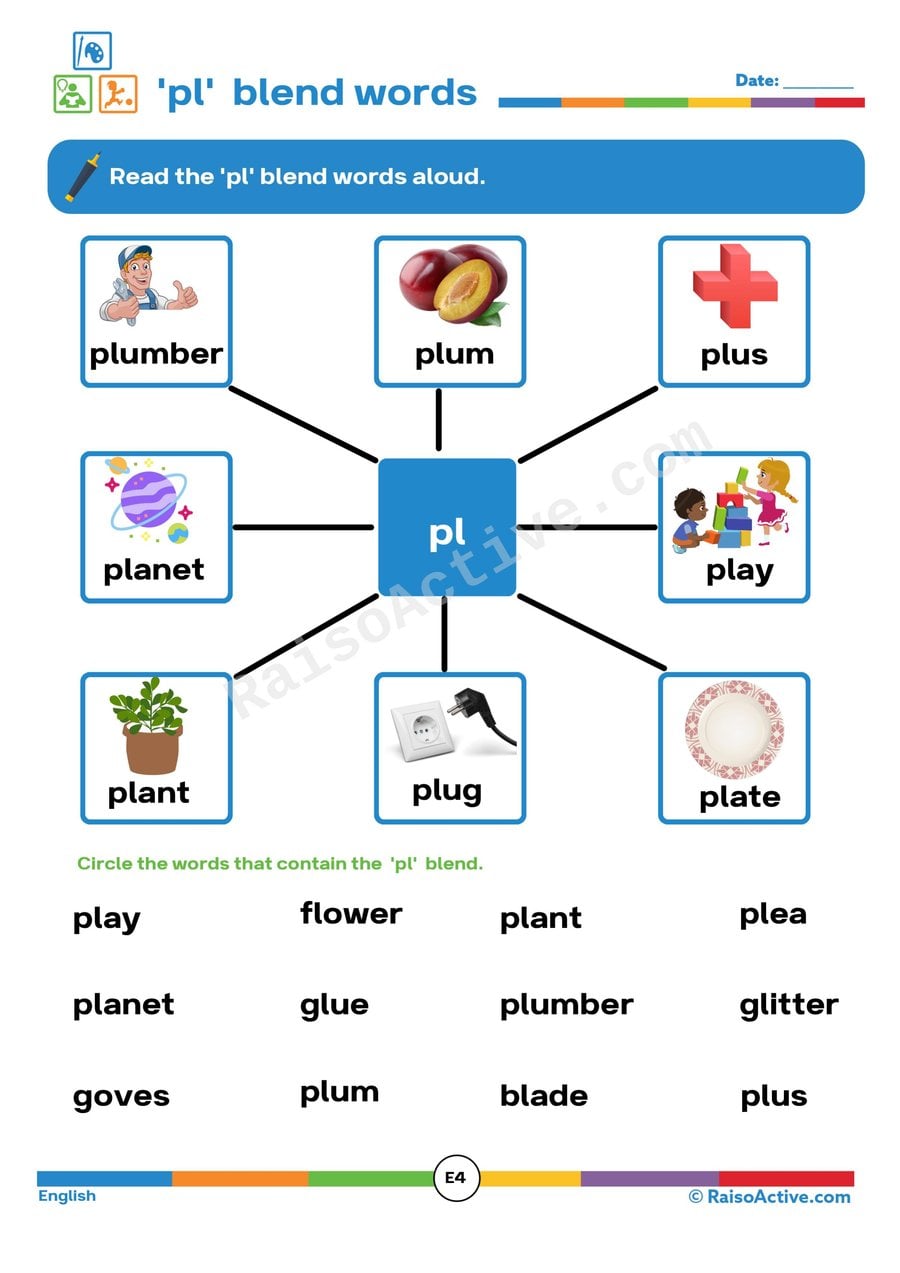
Pl Blend Words Worksheet for Preschoolers
This worksheet targets the 'pl' consonant blend, helping children recognize and read words like 'play,' 'plane,' and 'plant' where two consonant sounds combine at the start of a word. For ages 4-6, mastering blends is a key phonics milestone that comes after single letter sounds, since blending two consonants together requires more advanced sound segmentation skills.
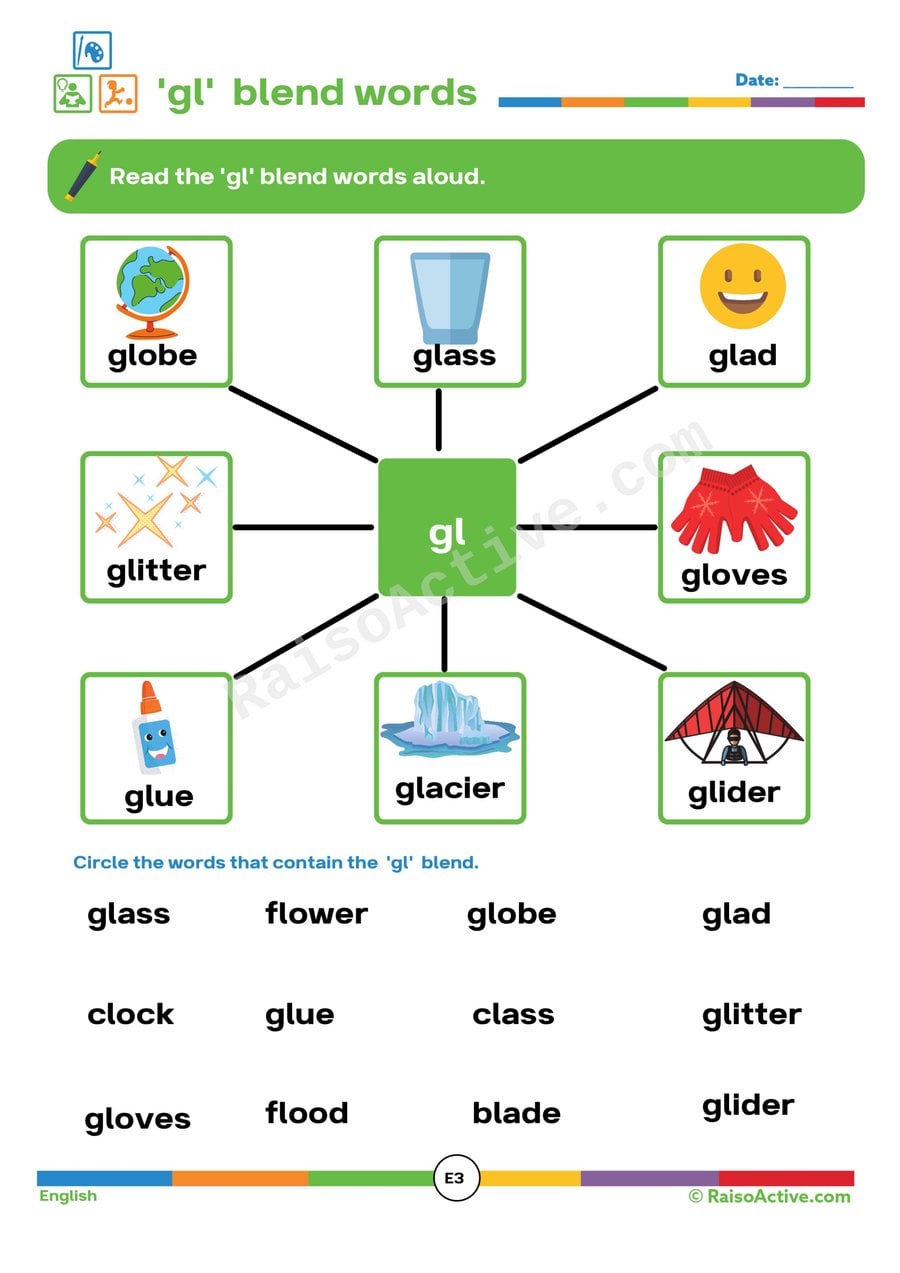
Gl Blend Words Worksheet: Read and Circle!
This worksheet builds phonics skills around the 'gl' consonant blend, helping children recognize and read words like 'glass,' 'glue,' and 'glow' where the sounds of g and l combine at the start of a word. For ages 4-6, practicing blends like gl strengthens the sound-segmentation skills needed to decode increasingly complex words as reading develops.
Guides for this topic
How to Teach CVC Blending: A Step-by-Step Method That Works in Two Weeks
A step-by-step method for teaching CVC blending, covering continuous sounds, word families, common errors, and a 14-day plan that most children finish reading CVC words.
Phase 2 Phonics at Home: Sound Order, Blending Games, Worksheets
Phase 2 phonics at home: the five sound sets in order, oral blending, tricky words, a two-week routine, common mistakes, and free worksheets.
Reception Year Explained: EYFS Learning and How to Help at Home
A teacher's plain-English guide to the Reception Year: the seven areas of learning, Early Learning Goals, Phase 2/3 phonics, the RBA and home routines.
Reviews
Every worksheet for ages 4–6, no watermark
Members download the full library of 1,000+ worksheets and every activity pack without watermarks or daily limits. One year costs ₹1,000 in India or $20 elsewhere.
See membership plansOr download any worksheet free with a watermark (5 a day).