Descending Order Worksheet for Kids: Numbers 63-100
Arranging numbers from largest to smallest asks children ages 4-6 to apply their counting knowledge in reverse, which is a genuinely different mental skill from counting forward and helps solidify a flexible, deep understanding of number order rather than rote recitation. Working within the 63 to 100 range also pushes children to compare two-digit numbers directly, deciding which of two numbers is bigger based on both digits rather than just the first one. This kind of descending practice complements ascending counting practice and rounds out a child's overall number sense.
Part of the pack
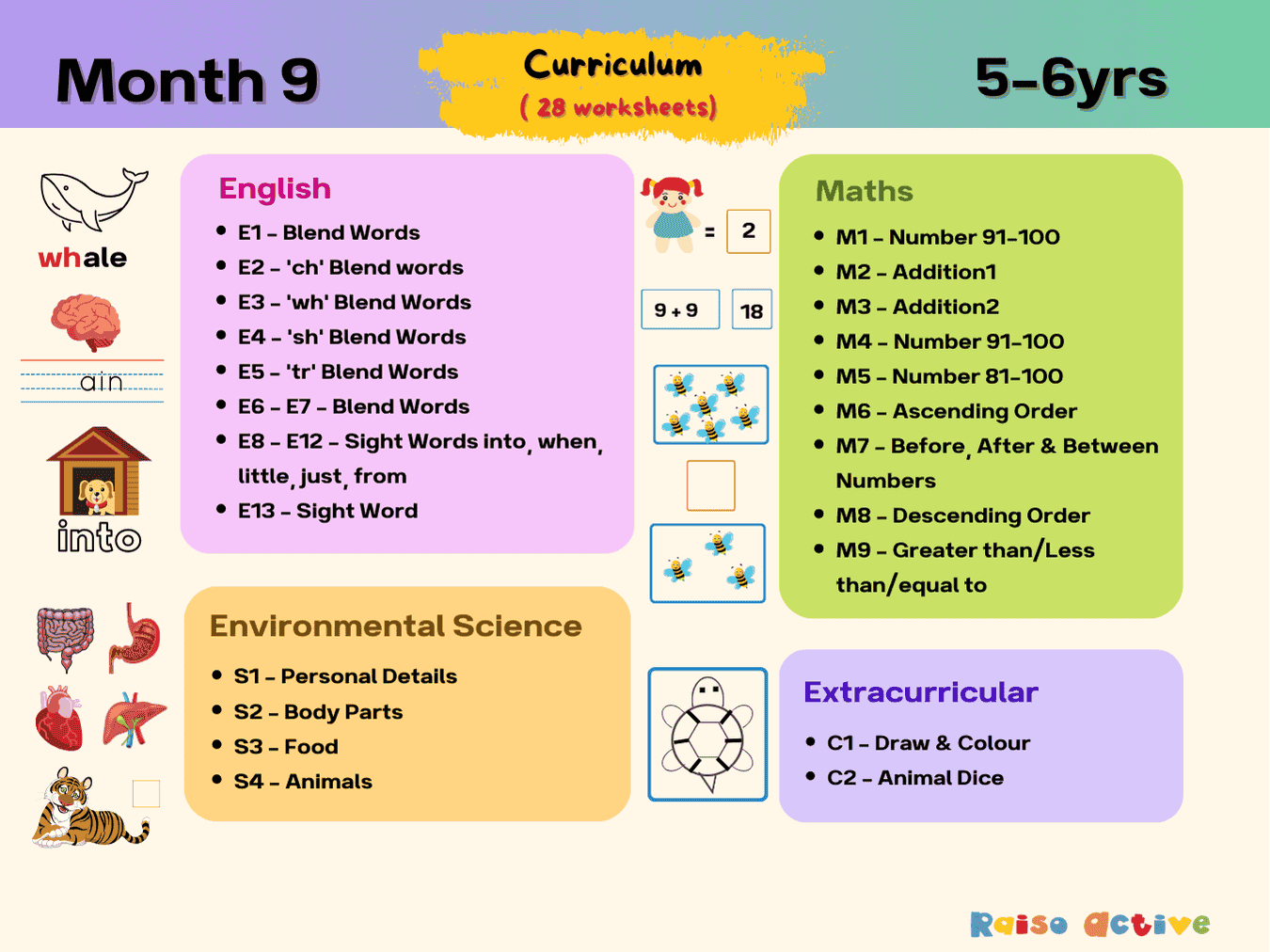
Month 9: Early Learning English Math Science | Ages 5-6
This is page 24 of the pack. Ages 5-6 · KindergartenAges 5-6 · Year 1Ages 5-6 · UKGAges 5-6
Made for your child
Counting to 10, made for your child
A maths pack with your child's name in it: pictures that explain, practice at three levels, puzzles and story sums about them. Print a new set whenever they finish.
Make a maths packFree preview · free for members
Curriculum
- Number Sense > Number Sequencing
How to use this worksheet
Look at the numbers in the first row together and read them aloud in the order they're given. Ask your child which number is the largest and have them write it first in the row of boxes provided. Continue working down from largest to smallest, comparing the remaining numbers each time to decide the correct order. Repeat this process for each row on the page, checking the final sequence together before moving to the next.
Materials needed
- Pencil
- Eraser
Extension activities
- 1Have your child create their own set of numbers in this range and arrange them in descending order.
- 2Use blocks, counters, or toys to represent different numbers and physically arrange them from largest to smallest.
- 3Practice counting backward together out loud, starting from 100 and counting down.
- 4Play a comparison game, showing two numbers and asking your child which one is bigger.
- 5Look for real numbers in this range around the house, like page numbers or dates, and compare their sizes.

Written by
Hemsweta Jain · Teacher Cheena
MBA and Early Childhood Educator, teaching since 2014 · Founder of RaisoActive, Mumbai
Every RaisoActive worksheet is designed and checked by the founder before publishing.
Published · Last reviewed
More from Month 9: Early Learning English Math Science | Ages 5-6

Read and Learn 'tr' Blend Words Worksheet for Preschoolers
Ages 3-5 · Preschool–Pre-KAges 3-5 · Nursery–ReceptionAges 3-5 · Nursery–LKGAges 3-5
This worksheet gives children ages 3-5 practice reading and recognizing words that begin with the 'tr' consonant blend, like 'tree' and 'truck', by circling matching words from a list. Blending two consonant sounds together at the start of a word is a genuine reading challenge, and repeated practice with one specific blend builds the muscle memory needed to eventually recognize it instantly in new words.

Parent's Guide: Sight Words, Number Order, and Creative Art Activities!
Ages 3-5 · Preschool–Pre-KAges 3-5 · Nursery–ReceptionAges 3-5 · Nursery–LKGAges 3-5
This parent's guide gives families of children ages 3-5 a set of structured activities covering sight word recognition, ascending and descending number order, and open-ended art projects using building blocks. Weaving literacy, math, and creative expression together in one guide reflects how young children actually learn best — through varied, hands-on engagement rather than long stretches of a single skill.

Color the Sight Words! A Fun Sight Word Coloring Worksheet
Ages 3-5 · Preschool–Pre-KAges 3-5 · Nursery–ReceptionAges 3-5 · Nursery–LKGAges 3-5
This worksheet turns sight word recognition into a color-matching game, asking children ages 3-5 to read a sight word and then color a shape with the color that corresponds to it, which keeps repeated word exposure feeling playful rather than like drilling. Because children must actually read each word correctly before knowing which color to use, the coloring choice becomes a built-in check on whether the word was recognized accurately. Repeating this recognize-and-respond pattern across many candies or shapes gives children dozens of low-pressure reps with common sight words in a single sitting.
Wh' Blend Words Worksheet: Read, Learn, and Circle!
Ages 4-6 · Pre-K–KindergartenAges 4-6 · Reception–Year 1Ages 4-6 · LKG–UKGAges 4-6
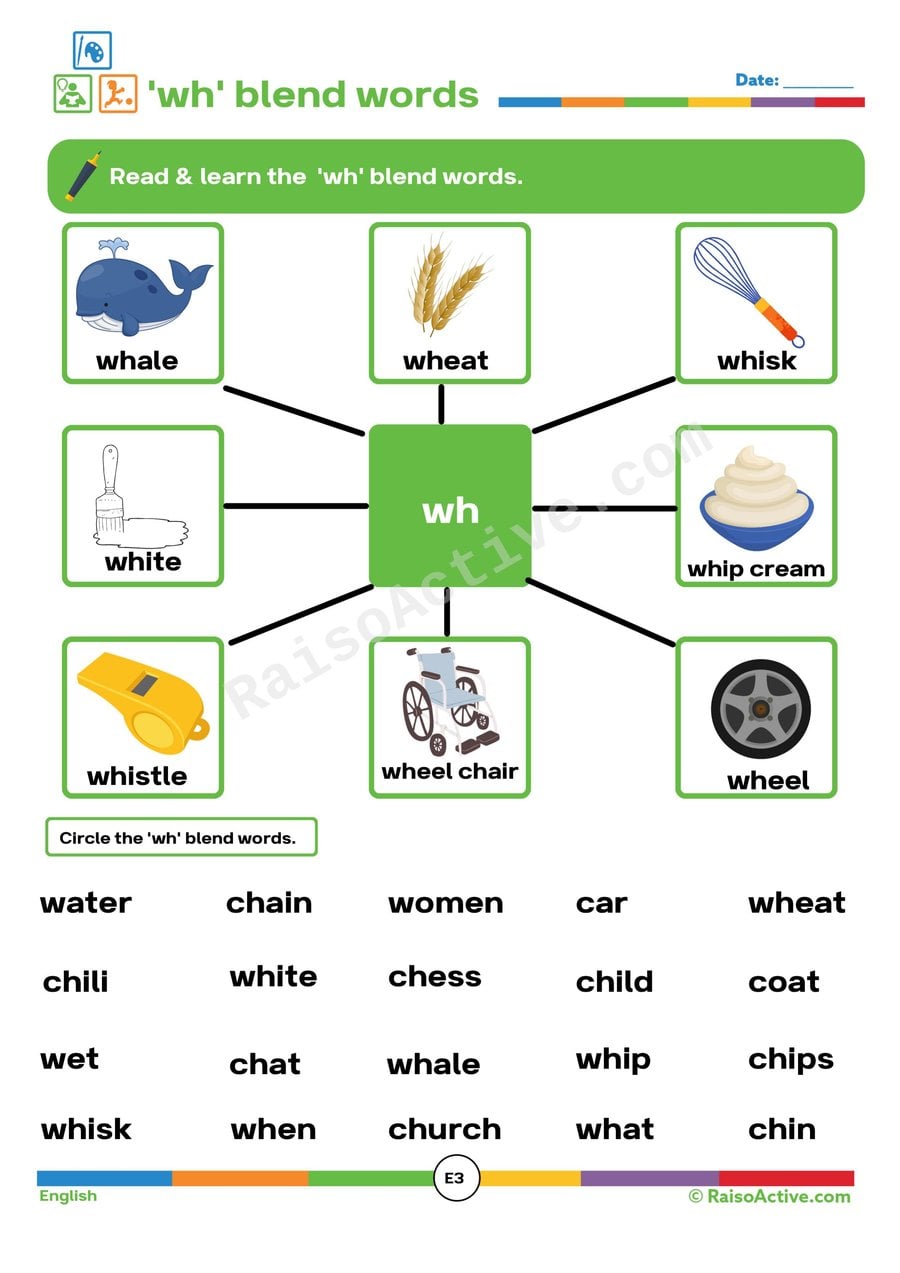
The 'wh' blend appears in common early words like 'what,' 'when,' and 'why,' making it an especially high-value sound for children ages 4-6 to master, since these words show up constantly in questions and everyday speech. This worksheet has children read and recognize 'wh' words paired with pictures before circling them in a final list, reinforcing both the visual spelling pattern and the blended sound. Because 'wh' words are often question words, mastering this blend also supports oral language development alongside pure phonics skill.
Ch Blend Words Worksheet: Read, Learn, and Circle!
Ages 4-6 · Pre-K–KindergartenAges 4-6 · Reception–Year 1Ages 4-6 · LKG–UKGAges 4-6
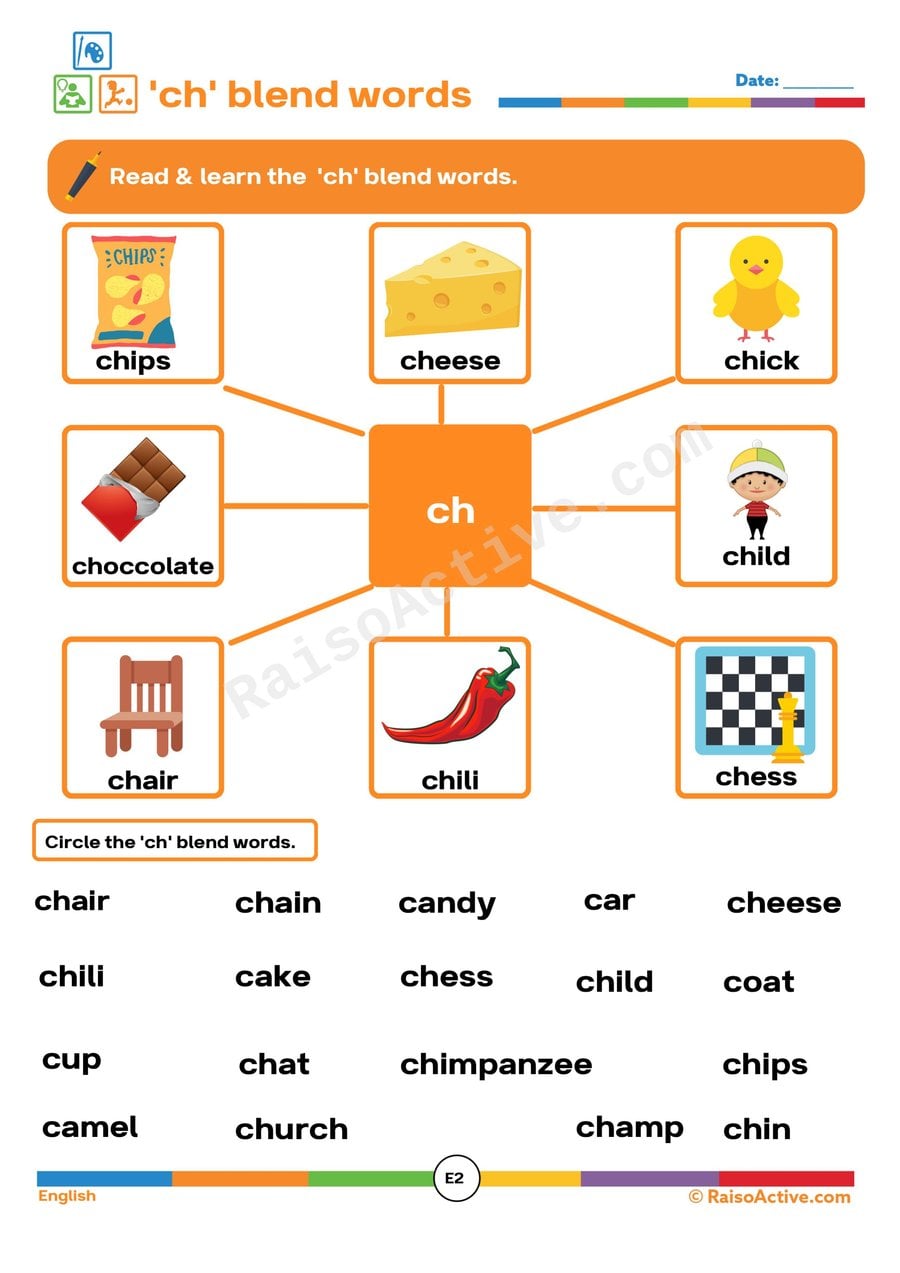
This worksheet focuses children ages 4-6 on recognizing words that begin with the 'ch' digraph, like 'chair' and 'cheese', asking them to read and then circle matching words. Because 'ch' represents a single new sound rather than two blended consonants, mastering it teaches children an important phonics rule: some letter pairs combine to make one brand-new sound entirely.

My Personal Details Worksheet: Fill in the Blanks!
Ages 3-5 · Preschool–Pre-KAges 3-5 · Nursery–ReceptionAges 3-5 · Nursery–LKGAges 3-5
This worksheet has children ages 3-5 write their own name, age, and other basic personal information into labeled blanks, building both early writing practice and a sense of personal identity. Learning to write and recognize one's own personal details is a genuinely meaningful, motivating writing task for young children, since it's about themselves rather than an abstract exercise.

Body Parts Cut and Paste Worksheet for Preschoolers
Ages 3-5 · Preschool–Pre-KAges 3-5 · Nursery–ReceptionAges 3-5 · Nursery–LKGAges 3-5
This worksheet introduces children ages 3-5 to basic human anatomy by having them cut out pictures of internal organs, like the heart, lungs, or stomach, and glue each one onto its correct location on a body outline. Beyond early science vocabulary, the activity strengthens spatial reasoning, since children must judge where inside the body each organ actually belongs, along with fine motor precision through cutting and gluing small pieces.

Before, After, and Between Numbers Worksheet for Preschoolers
Ages 4-6 · Pre-K–KindergartenAges 4-6 · Reception–Year 1Ages 4-6 · LKG–UKGAges 4-6
This worksheet has children ages 4-6 practice identifying which number comes before, after, or between given numbers, writing their answers into the provided spaces. Understanding number sequence and relative position is a core building block of number sense, laying the groundwork for later skills like addition, subtraction, and estimating quantities.
Related worksheets

Missing Numbers Worksheet: Before, After, and Between!
Ages 4-6 · Pre-K–KindergartenAges 4-6 · Reception–Year 1Ages 4-6 · LKG–UKGAges 4-6
This worksheet strengthens number sequencing by asking children to figure out which number comes before, after, or between two given numbers, rather than simply counting from one in order. For four- to six-year-olds, working with numbers 'out of context' like this builds a flexible mental number line, an essential foundation for later addition, subtraction, and skip counting.

Bee's Number Sequence Adventure: Coloring Numbers 0-50!
Ages 4-6 · Pre-K–KindergartenAges 4-6 · Reception–Year 1Ages 4-6 · LKG–UKGAges 4-6
Children ages 4-6 practice counting and recognizing numbers from 0 to 50 in sequence by coloring each number in order to help a bee find its way to the hive, extending number recognition well beyond the smaller ranges typically practiced at this age. Following a long numerical sequence builds persistence and reinforces counting patterns like the teens, twenties, and thirties.

Missing Numbers: Ice Cream Fun Worksheet for Kids
Ages 3-5 · Preschool–Pre-KAges 3-5 · Nursery–ReceptionAges 3-5 · Nursery–LKGAges 3-5
This worksheet helps children ages 3-5 practice number sequencing by identifying and writing in the missing numerals within a series of ice cream cones and cars, numbers 1 through 10. Filling in a gap within an otherwise familiar sequence requires children to hold the whole counting order in mind and recognize what number logically belongs in the empty spot, which is more demanding than counting forward from the start each time. The playful ice cream and car theme keeps the repeated number practice visually engaging.

Space Adventure: Reading Numbers 1-40 Worksheet for Kids
Ages 4-5 · Pre-KAges 4-5 · ReceptionAges 4-5 · LKGAges 4-5
This worksheet strengthens number recognition across a wider range, 1 to 40, by having children read numbers that are partially hidden and identify them without a visual count to rely on. For ages 4-5, recognizing two-digit numbers by sight, rather than only counting objects, marks an important step toward more advanced number sense and eventual mental math.
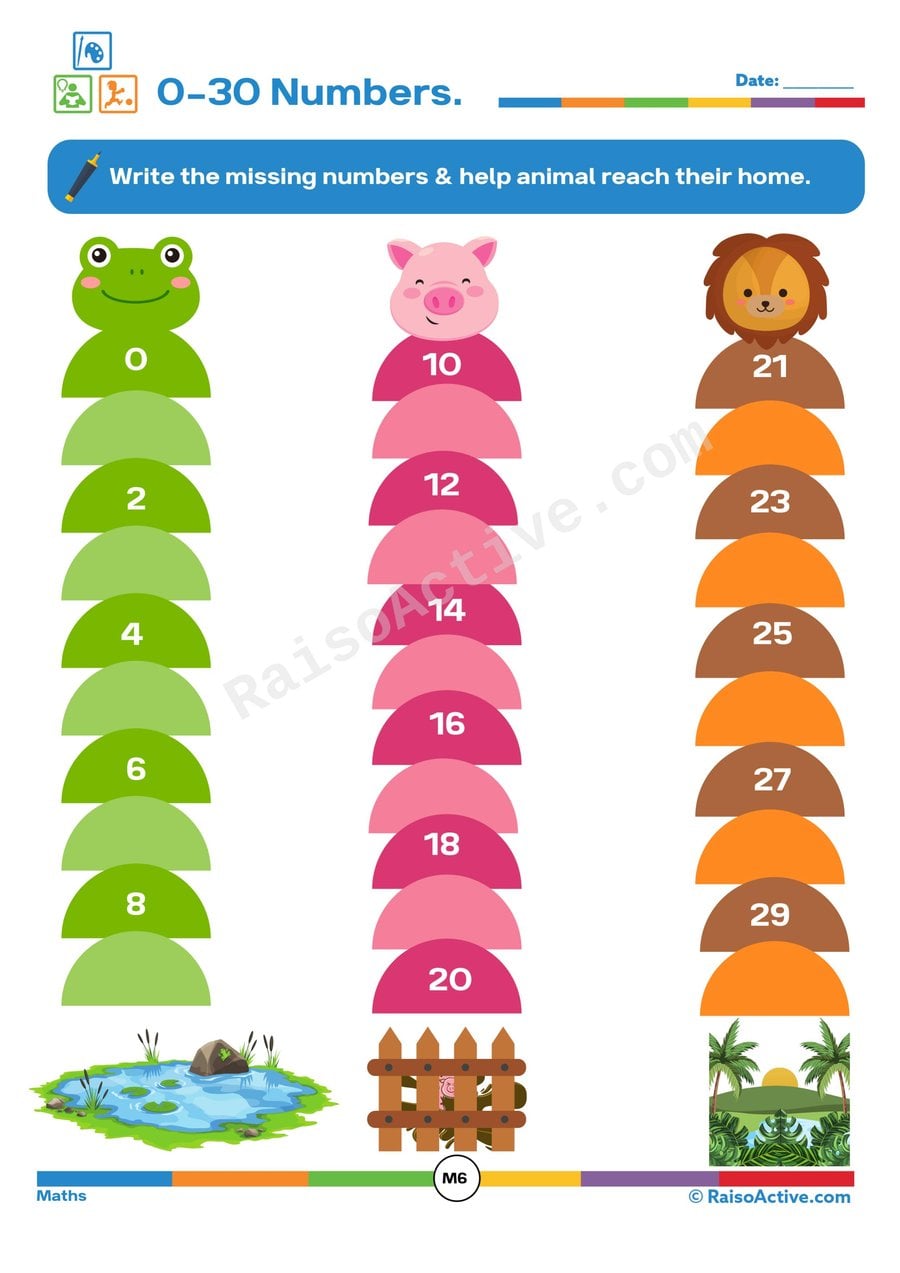
Number Fun: Missing Numbers Worksheet for Kids!
Ages 4-6 · Pre-K–KindergartenAges 4-6 · Reception–Year 1Ages 4-6 · LKG–UKGAges 4-6
Filling in missing numbers from a sequence up to 30 helps children ages 4-6 strengthen number recognition and counting-on, the skill of continuing a sequence without starting over from one each time. Completing the animal path adds a motivating storyline that encourages children to work through the full sequence.
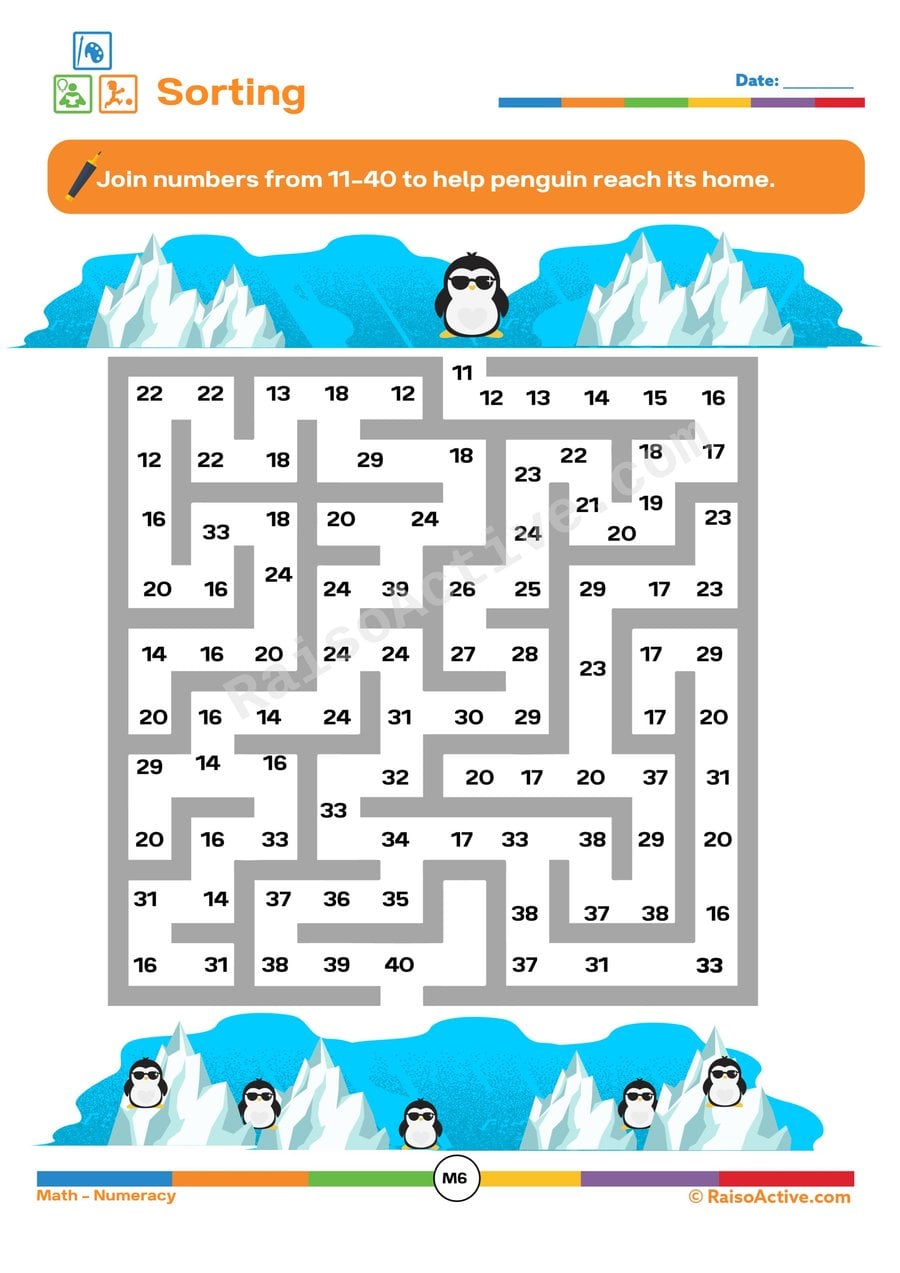
Penguin's Path: A Fun Sorting Worksheet for Kids!
Ages 4-6 · Pre-K–KindergartenAges 4-6 · Reception–Year 1Ages 4-6 · LKG–UKGAges 4-6
This maze worksheet has 4-6 year olds trace a path through numbers 11 to 40, building both number sequencing across a wider range and the fine motor control needed to draw a connected line dot to dot. Because the range spans several decades, your child gets real practice with the trickiest part of early counting — the transitions between decades (19 to 20, 29 to 30) — while the penguin's journey gives the task a clear, motivating goal.

Ascending Order Fun: A Printable Worksheet for Numbers!
Ages 4-6 · Pre-K–KindergartenAges 4-6 · Reception–Year 1Ages 4-6 · LKG–UKGAges 4-6
Arranging numbers from smallest to largest teaches children ages 4-6 to compare quantities and understand relative magnitude, a skill that underlies later work with number lines, place value, and basic operations. It also reinforces number recognition, since children must correctly identify each numeral before they can decide where it belongs in the sequence.
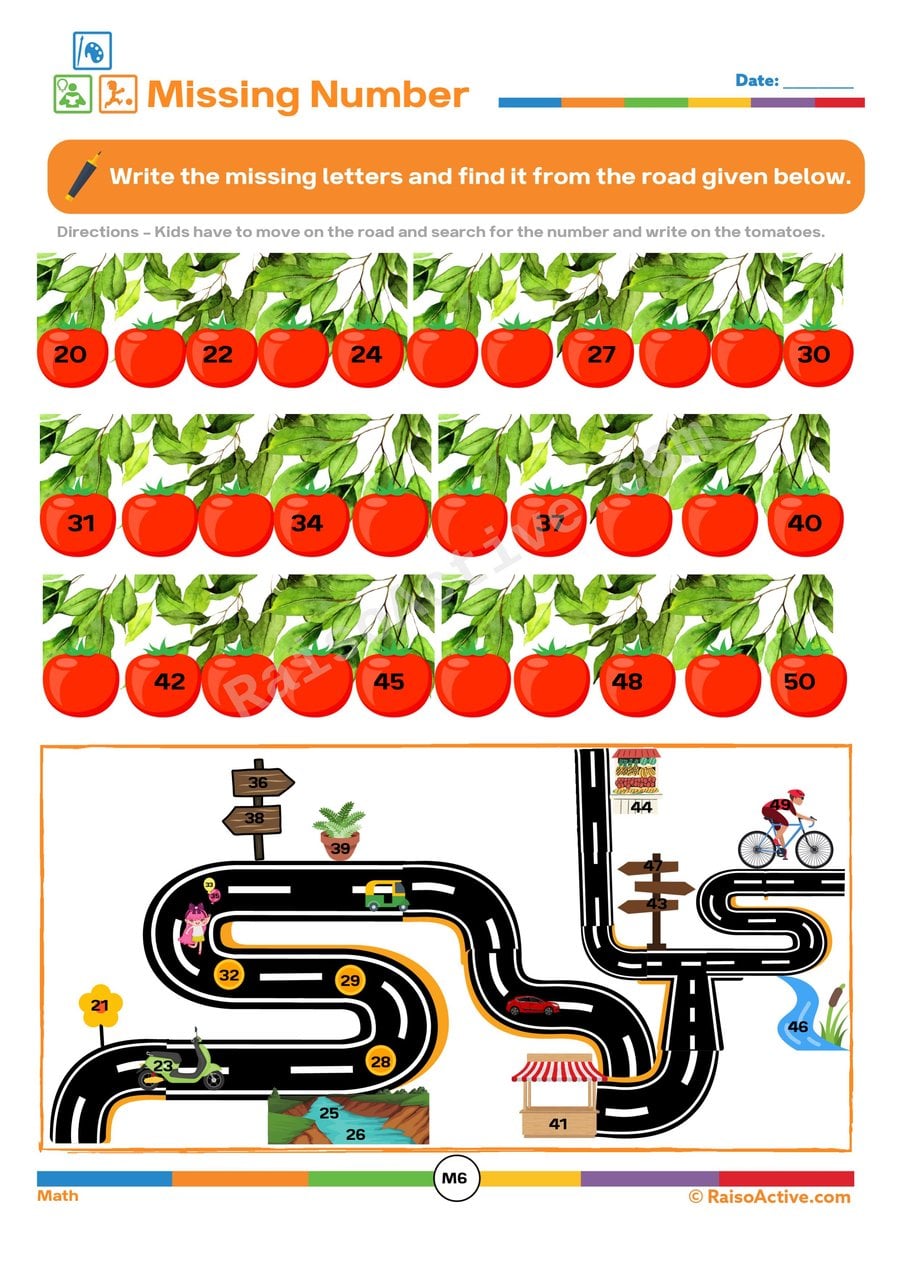
Missing Number Road Trip Worksheet for Kids
Ages 4-6 · Pre-K–KindergartenAges 4-6 · Reception–Year 1Ages 4-6 · LKG–UKGAges 4-6
Children ages 4-6 practice number sequencing by identifying which numbers are missing from a road of tomatoes, a skill that requires understanding what comes before and after a given number in counting order. This strengthens number recognition and prepares children to count confidently without needing to start from one every time.
Guides for this topic

Number Formation Rhymes 0–9 and How to Fix Reversals
Original number formation rhymes for 0–9, the correct stroke order for each digit, why 3, 5 and 7 get reversed most often, and multisensory fixes that work.

Christmas and Winter Activities That Combine Fun and Learning: Creating Magical Educational Experiences
Discover Christmas and winter activities that combine festive fun with real learning. Crafts, counting, literacy, and printable worksheets for ages 2 to 8 — perfect for home and school.
Age-Appropriate Halloween Learning Activities: Balancing Spooks and Skills for Young Learners
Discover fun, age-appropriate Halloween learning activities for young children. Spooky crafts, counting games, literacy ideas, and printable worksheets for ages 2 to 8.
Reviews
Every worksheet for ages 4–6, no watermark
Members download the full library of 1,000+ worksheets and every activity pack without watermarks or daily limits. One year costs ₹999 in India or $20 elsewhere.
See membership plansOr download any worksheet free with a watermark (5 a day).