Blend Words Worksheet: Practice Blending Sounds!
This worksheet gives children ages 4-6 focused practice blending initial consonant sounds, like 'cl' or 'fr,' with the rest of a word to complete a picture-labeled word. Unlike simple picture matching, writing the missing blend requires children to actively produce the correct letter combination from memory, which is a more demanding and valuable phonics skill than recognition alone.
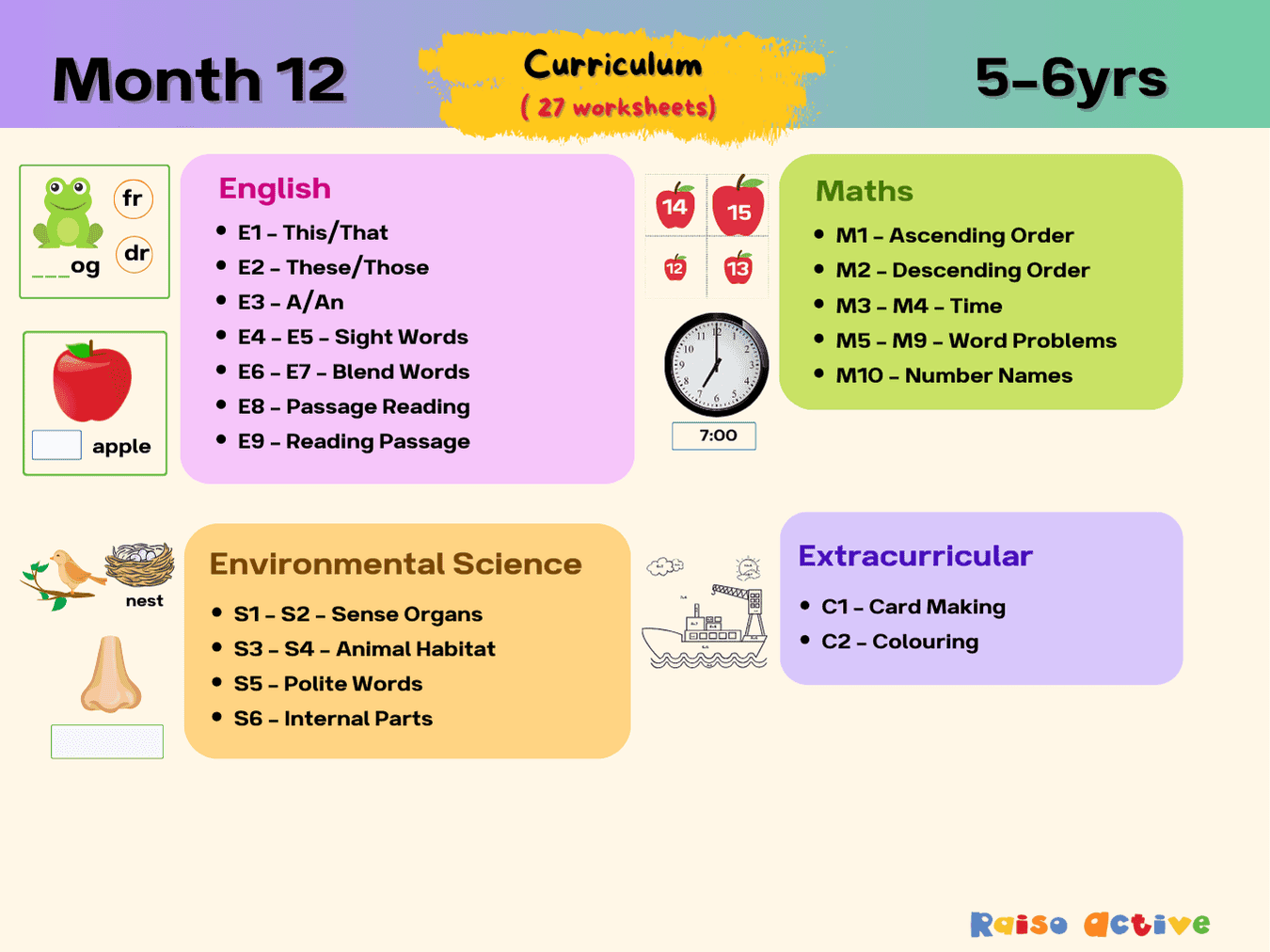
Part of the pack
Month 12: Learning & Development | Ages 5-6
This is page 9 of the pack. Ages 5-6 · KindergartenAges 5-6 · Year 1Ages 5-6 · UKGAges 5-6
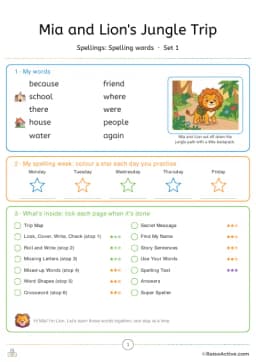
Made for your child
Spelling practice, made for your child
Their own spelling words turned into a pack: trace or look-cover-write-check, roll and write, a secret picture code, a word search, a crossword and a test, with their name in it.
Make a spelling packFree preview · free for members
Or start free: a word search with sight wordsCurriculum
- Phonics - Blends > Consonant Blends
How to use this worksheet
Look at the picture together and say its full name slowly, listening carefully to the two consonant sounds blended at the beginning. Look at the blend options provided and have your child choose the one that matches those beginning sounds. Have them write the correct blend in the blank space to complete the word beneath the picture. Continue through each picture the same way, reading the finished word aloud together once each blank is filled in.
Materials needed
- Pencil
- Eraser
Extension activities
- 1Have your child write the complete words on a separate sheet for extra spelling practice.
- 2Encourage your child to draw pictures representing each of the completed blend words.
- 3Play a blend sorting game, grouping objects or pictures by their beginning blend.
- 4Create new words by swapping the ending of a blend word, like changing 'clap' to 'clip' or 'clop.'

Written by
Hemsweta Jain · Teacher Cheena
MBA and Early Childhood Educator, teaching since 2014 · Founder of RaisoActive, Mumbai
Every RaisoActive worksheet is designed and checked by the founder before publishing.
Published · Last reviewed
More from Month 12: Learning & Development | Ages 5-6

Card Making Worksheet: Create a Heartfelt Valentine's Day Card!
Ages 3-5 · Preschool–Pre-KAges 3-5 · Nursery–ReceptionAges 3-5 · Nursery–LKGAges 3-5
Cutting along the card's outer lines strengthens scissor control and hand strength, while folding the card in half builds the bilateral coordination of holding with one hand and creasing with the other. Composing a short message inside also introduces children ages 3-5 to early written expression tied to a real feeling.

Animal Homes Matching Worksheet for Preschoolers
Ages 3-5 · Preschool–Pre-KAges 3-5 · Nursery–ReceptionAges 3-5 · Nursery–LKGAges 3-5
Children ages 3-5 practice matching animals to their correct habitats, like a bird to a nest or a fish to water, building early science knowledge about how different animals are suited to different environments. This kind of habitat matching lays groundwork for later ecosystem and adaptation concepts in school science.

Word Problem Fun: Solving Burger and Bird Problems!
Ages 4-6 · Pre-K–KindergartenAges 4-6 · Reception–Year 1Ages 4-6 · LKG–UKGAges 4-6
Solving addition and subtraction word problems featuring burgers and birds gives children ages 4-6 practice applying arithmetic to playful, concrete scenarios, strengthening the link between story context and the correct math operation.

Farm Animals Reading Comprehension Worksheet for Preschoolers
Ages 3-5 · Preschool–Pre-KAges 3-5 · Nursery–ReceptionAges 3-5 · Nursery–LKGAges 3-5
Reading a short passage about farm animals and answering questions about it builds early reading comprehension for children ages 3-5, teaching them to recall specific details from a text rather than just recognizing individual words.

Word Problems Worksheet: Addition Practice for Kids
Ages 4-6 · Pre-K–KindergartenAges 4-6 · Reception–Year 1Ages 4-6 · LKG–UKGAges 4-6
Children ages 4-6 practice applying addition to real-life scenarios by reading short word problems and figuring out what numbers to add together, a skill that bridges basic number facts with reading comprehension and problem-solving. Solving word problems teaches children to translate language into math, a step beyond simply adding numbers already given.

Sense Organs Worksheet: Circle the Objects We Use!
Ages 4-6 · Pre-K–KindergartenAges 4-6 · Reception–Year 1Ages 4-6 · LKG–UKGAges 4-6
Children ages 4-6 practice connecting each of the five senses to real objects and experiences, like identifying what they might see, hear, smell, taste, or touch. This builds early science vocabulary and body awareness while reinforcing that different body parts are used to experience the world in different ways.

Word Problem Fun: Balloon and Mango Math Worksheet for Kids
Ages 4-6 · Pre-K–KindergartenAges 4-6 · Reception–Year 1Ages 4-6 · LKG–UKGAges 4-6
Solving addition word problems featuring balloons and mangoes teaches children ages 4-6 to translate a short story into a number sentence, practicing both reading comprehension and basic addition in a playful, visual context.

Word Problems Worksheet: Solving Addition and Subtraction
Ages 4-6 · Pre-K–KindergartenAges 4-6 · Reception–Year 1Ages 4-6 · LKG–UKGAges 4-6
Solving a mix of addition and subtraction word problems trains children ages 4-6 to decide which operation a story calls for, based on whether it describes combining groups or taking something away, a key reasoning skill before formal equation writing.
Related worksheets

Blend Words Worksheet: See the Pictures and Write the Correct Blend!
Ages 4-6 · Pre-K–KindergartenAges 4-6 · Reception–Year 1Ages 4-6 · LKG–UKGAges 4-6
Children ages 4-6 practice identifying missing consonant blends by looking at a picture, saying the word aloud, and writing the correct blend to complete it. This task requires children to isolate the blended sound at the beginning of a word and match it to its written letter combination, a more advanced phonics skill than single-letter sounds. Successfully completing each word strengthens both spelling accuracy and reading fluency with blended sounds.
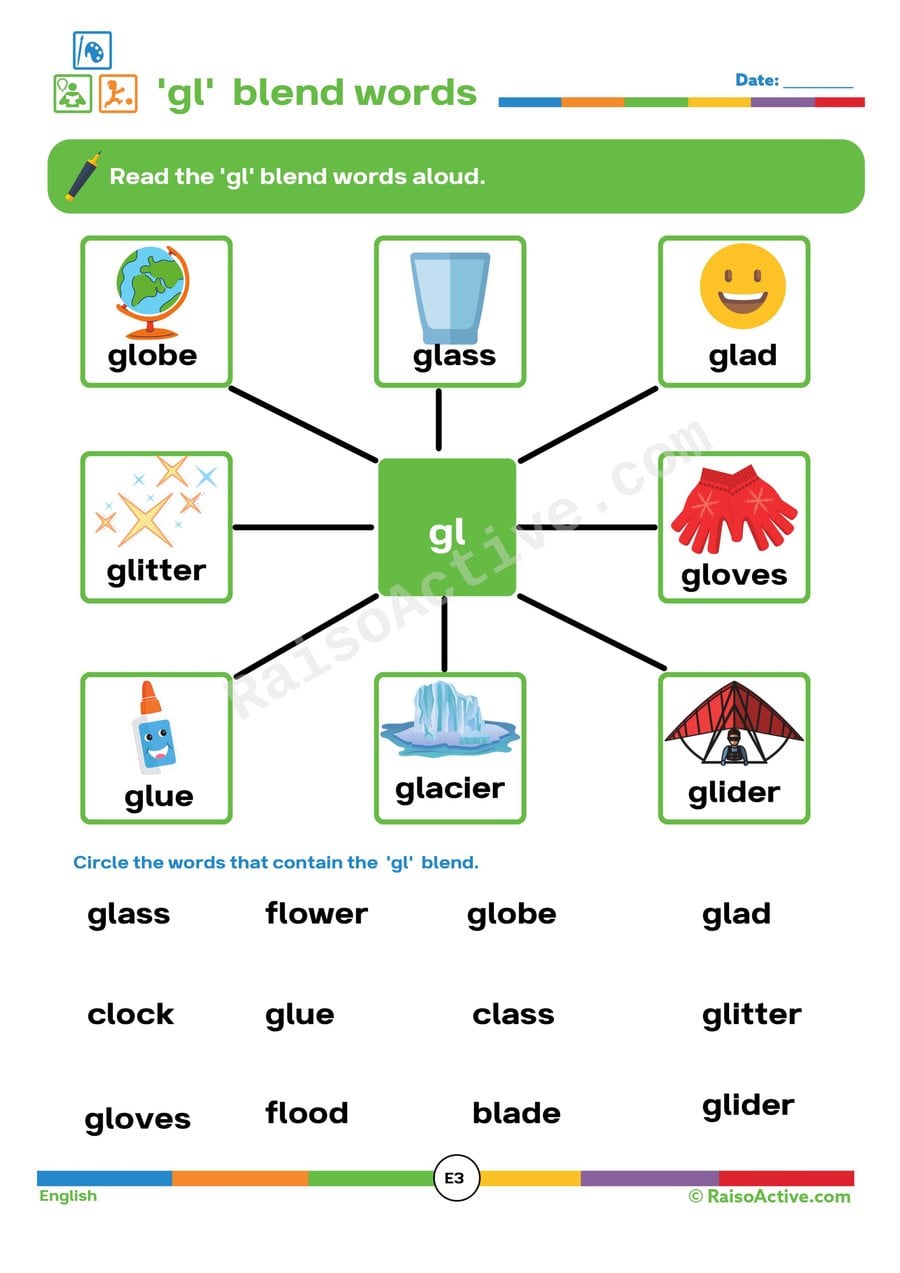
Gl Blend Words Worksheet: Read and Circle!
Ages 4-6 · Pre-K–KindergartenAges 4-6 · Reception–Year 1Ages 4-6 · LKG–UKGAges 4-6
This worksheet builds phonics skills around the 'gl' consonant blend, helping children recognize and read words like 'glass,' 'glue,' and 'glow' where the sounds of g and l combine at the start of a word. For ages 4-6, practicing blends like gl strengthens the sound-segmentation skills needed to decode increasingly complex words as reading develops.
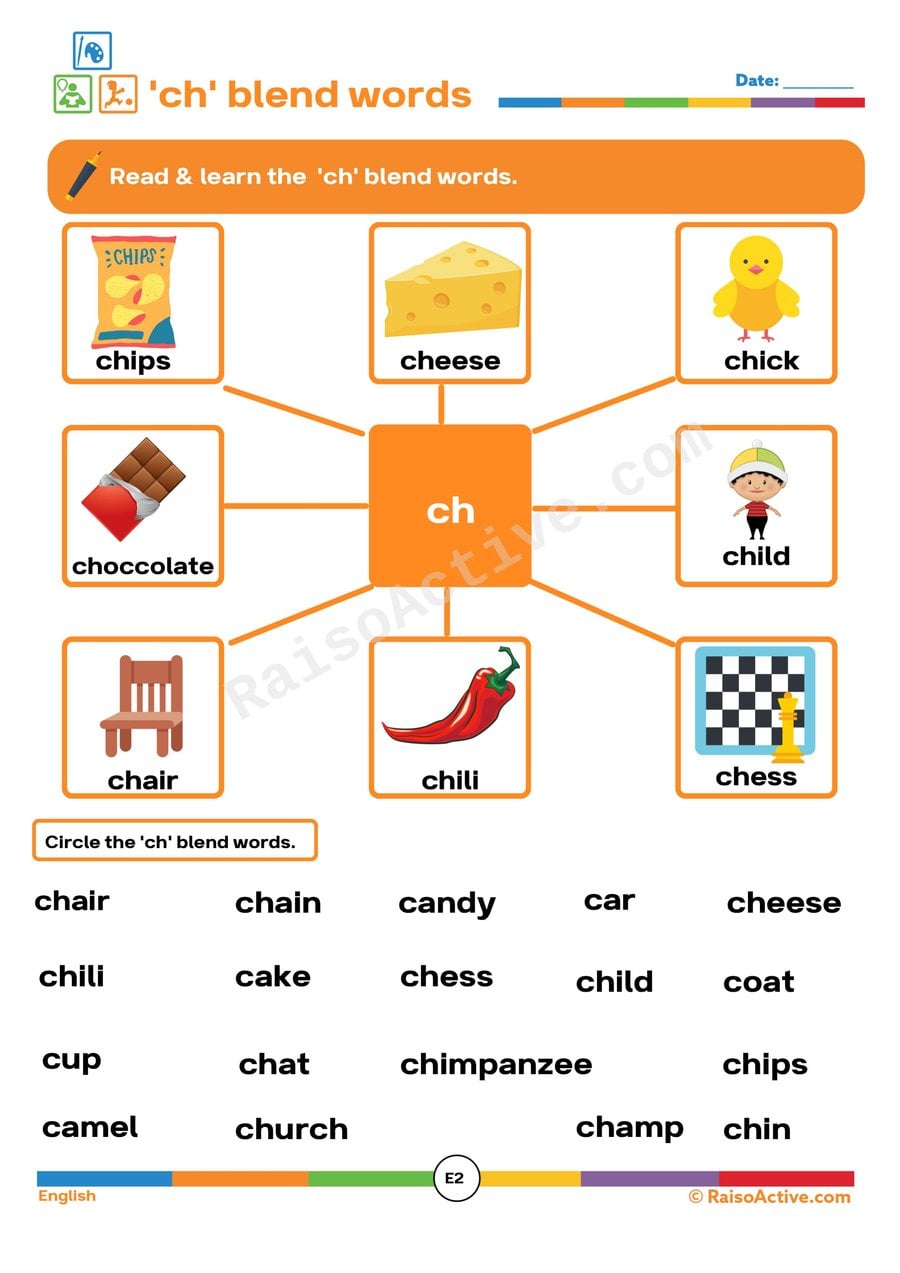
Ch Blend Words Worksheet: Read, Learn, and Circle!
Ages 4-6 · Pre-K–KindergartenAges 4-6 · Reception–Year 1Ages 4-6 · LKG–UKGAges 4-6
This worksheet focuses children ages 4-6 on recognizing words that begin with the 'ch' digraph, like 'chair' and 'cheese', asking them to read and then circle matching words. Because 'ch' represents a single new sound rather than two blended consonants, mastering it teaches children an important phonics rule: some letter pairs combine to make one brand-new sound entirely.
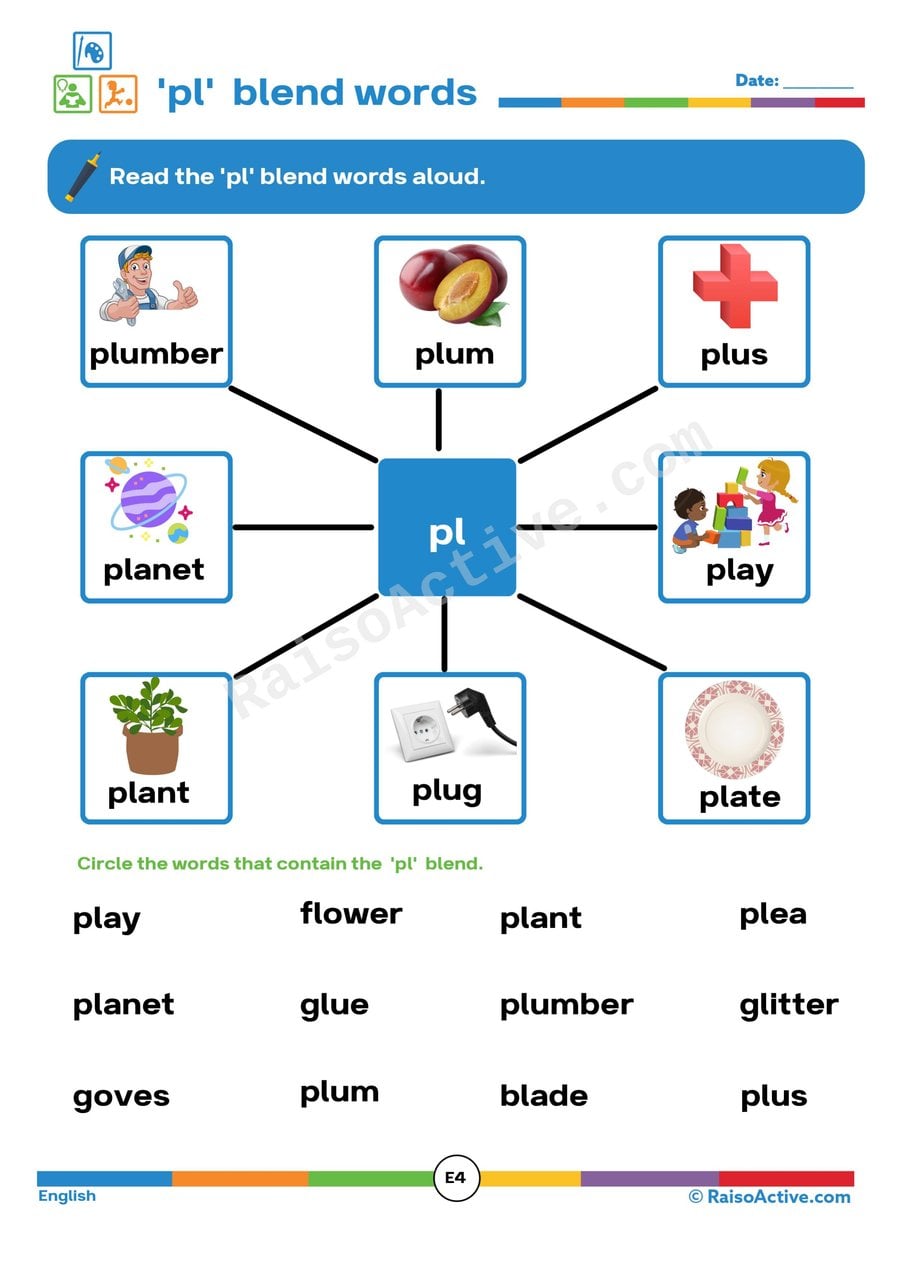
Pl Blend Words Worksheet for Preschoolers
Ages 4-6 · Pre-K–KindergartenAges 4-6 · Reception–Year 1Ages 4-6 · LKG–UKGAges 4-6
This worksheet targets the 'pl' consonant blend, helping children recognize and read words like 'play,' 'plane,' and 'plant' where two consonant sounds combine at the start of a word. For ages 4-6, mastering blends is a key phonics milestone that comes after single letter sounds, since blending two consonants together requires more advanced sound segmentation skills.

Blend Words Matching Worksheet: Read and Circle the Picture!
Ages 4-6 · Pre-K–KindergartenAges 4-6 · Reception–Year 1Ages 4-6 · LKG–UKGAges 4-6
This worksheet gives children ages 4-6 further practice reading consonant blend words and connecting them to their matching picture, this time by circling rather than cutting and pasting, which keeps the focus purely on reading and visual scanning. Repeated blend practice across different formats — matching, circling, and later independent writing — helps these two-consonant sounds become automatic rather than something a child has to sound out every time.
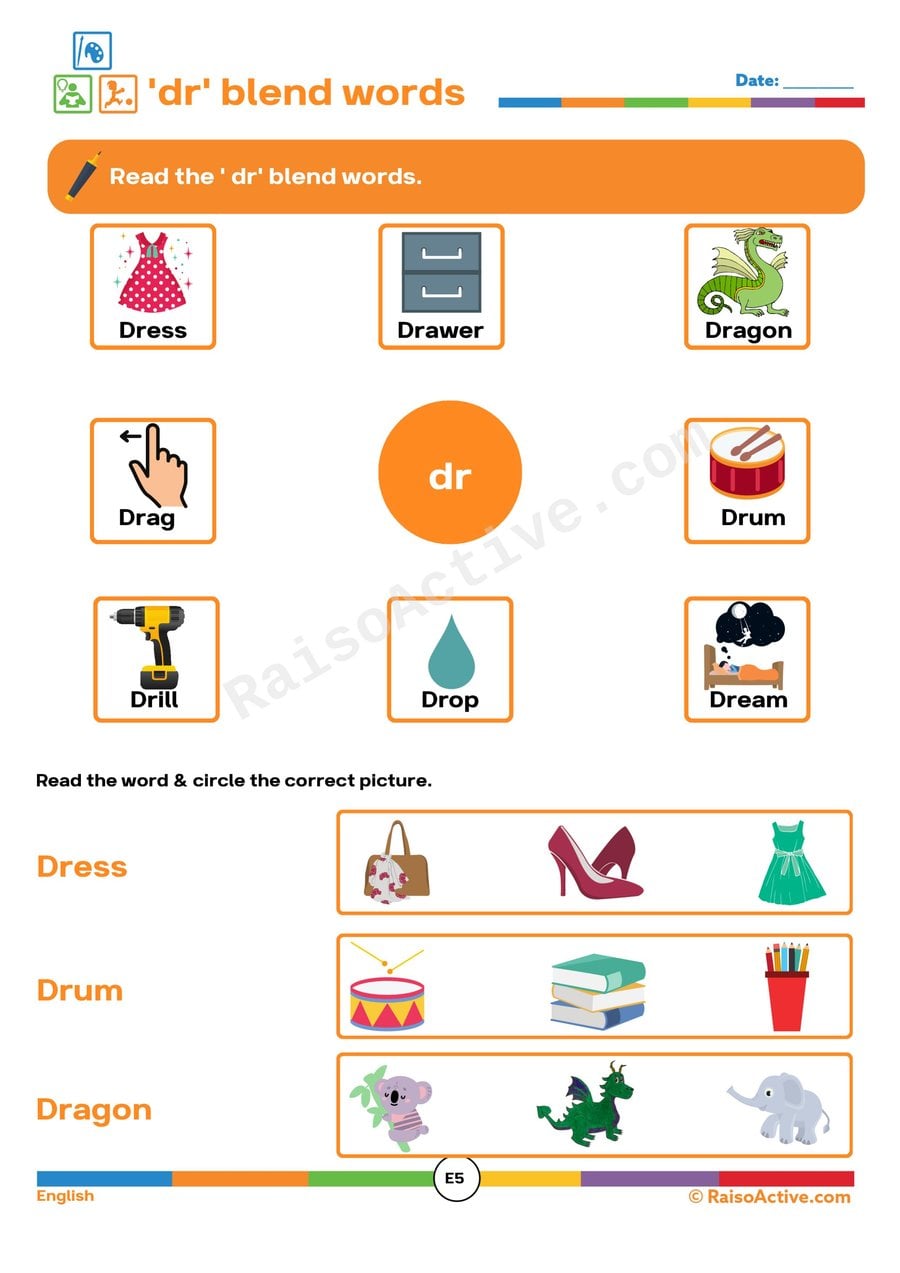
Dr Blend Words Worksheet: Read and Match!
Ages 4-6 · Pre-K–KindergartenAges 4-6 · Reception–Year 1Ages 4-6 · LKG–UKGAges 4-6
This worksheet focuses on the 'dr' blend, as in 'drum' or 'dress,' asking children to read the word first and then find its matching picture, which reverses the more common picture-first phonics approach and pushes children to truly decode the word rather than guess from an image. For ages four to six, reading the word independently before checking against a picture builds real decoding confidence.

Read and Learn 'tr' Blend Words Worksheet for Preschoolers
Ages 3-5 · Preschool–Pre-KAges 3-5 · Nursery–ReceptionAges 3-5 · Nursery–LKGAges 3-5
This worksheet gives children ages 3-5 practice reading and recognizing words that begin with the 'tr' consonant blend, like 'tree' and 'truck', by circling matching words from a list. Blending two consonant sounds together at the start of a word is a genuine reading challenge, and repeated practice with one specific blend builds the muscle memory needed to eventually recognize it instantly in new words.

Blend Words: Color the Correct Picture Worksheet for Preschoolers
Ages 4-5 · Pre-KAges 4-5 · ReceptionAges 4-5 · LKGAges 4-5
This worksheet gives children ages 4-5 practice reading consonant blend words — words that start with two consonant sounds blended together, like 'bl' or 'sn' — and coloring the picture that matches each one. Consonant blends are trickier to decode than single-letter sounds, so this focused, low-pressure coloring format lets children practice blending without the added challenge of writing at the same time.
Guides for this topic

How to Teach CVC Blending: A Step-by-Step Method That Works in Two Weeks
A step-by-step method for teaching CVC blending, covering continuous sounds, word families, common errors, and a 14-day plan that most children finish reading CVC words.
Phase 2 Phonics at Home: Sound Order, Blending Games, Worksheets
Phase 2 phonics at home: the five sound sets in order, oral blending, tricky words, a two-week routine, common mistakes, and free worksheets.

Reception Year Explained: EYFS Learning and How to Help at Home
A teacher's plain-English guide to the Reception Year: the seven areas of learning, Early Learning Goals, Phase 2/3 phonics, the RBA and home routines.
Reviews
Every worksheet for ages 4–6, no watermark
Members download the full library of 1,000+ worksheets and every activity pack without watermarks or daily limits. One year costs ₹999 in India or $20 elsewhere.
See membership plansOr download any worksheet free with a watermark (5 a day).