Read and Match: Sentence Matching Worksheet for Early Readers
This worksheet moves children ages 4-6 beyond single words into reading whole simple sentences and matching each one to the picture it describes. Comprehending a full sentence — not just recognizing individual words — is a genuine leap in reading skill, since it requires holding several words in mind together and connecting their combined meaning to an image.
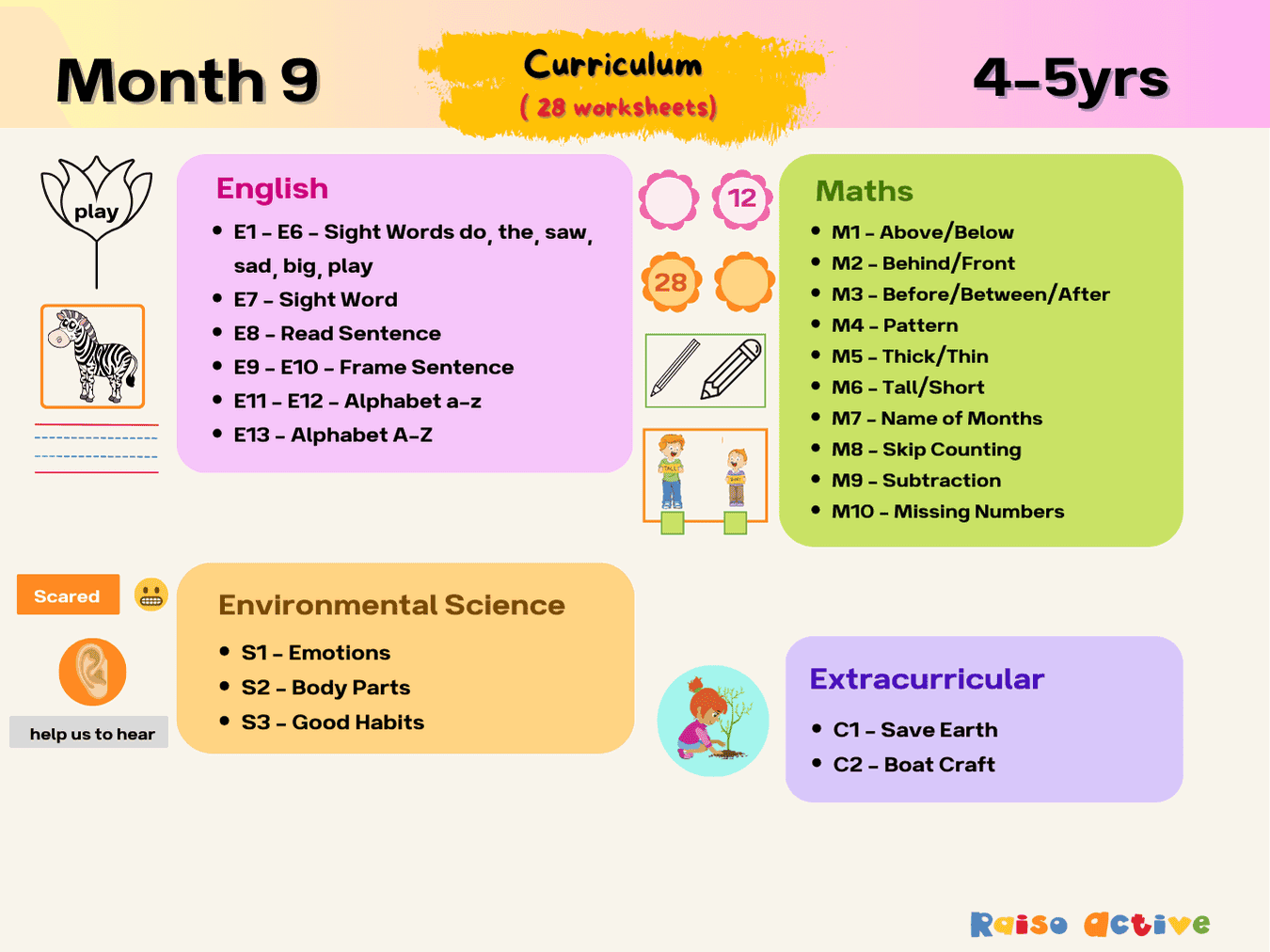
Part of the pack
Month 9: Play-Based Preschool Foundational Skills | Ages 4-5
This is page 11 of the pack. Ages 4-5 · Pre-KAges 4-5 · ReceptionAges 4-5 · LKGAges 4-5

Made for your child
Numbers to 20, made for your child
A maths pack with your child's name in it: pictures that explain, practice at three levels, puzzles and story sums about them. Print a new set whenever they finish.
Make a maths packFree preview · free for members
Curriculum
- Fluency > Sentence Reading
How to use this worksheet
Read each sentence aloud together slowly, pointing to each word as you say it. Ask your child to look at the pictures below and decide which one matches the meaning of the sentence they just read. Have them cut out and paste the matching picture into the box next to the correct sentence, then reread the completed sentence-and-picture pairs together.
Materials needed
- Pencil
- Scissors
- Glue or Tape
Extension activities
- 1Have your child draw their own picture to match one of the sentences instead of using the provided images.
- 2Write a brand-new simple sentence together based on one of the pictures on the page.
- 3Play a 'what happens next' game, inventing a follow-up sentence for one of the matched pairs.
- 4Practice rereading all the completed sentences aloud at the end of the day to build fluency.

Written by
Hemsweta Jain · Teacher Cheena
MBA and Early Childhood Educator, teaching since 2014 · Founder of RaisoActive, Mumbai
Every RaisoActive worksheet is designed and checked by the founder before publishing.
Published · Last reviewed
More from Month 9: Play-Based Preschool Foundational Skills | Ages 4-5

Help the Hen! Alphabet Worksheet: Writing Missing Capital Letters
Ages 4-5 · Pre-KAges 4-5 · ReceptionAges 4-5 · LKGAges 4-5
This maze-style worksheet asks children ages 4-5 to fill in missing capital letters in alphabetical order to help a hen find her way to the coop, turning alphabet sequencing practice into a small story-driven challenge. Recalling which capital letter comes next in the sequence — without a full alphabet chart to copy from — builds genuine alphabet mastery rather than passive letter recognition. The path-following format also adds a light visual tracking element that keeps the activity from feeling like a plain fill-in-the-blank drill.
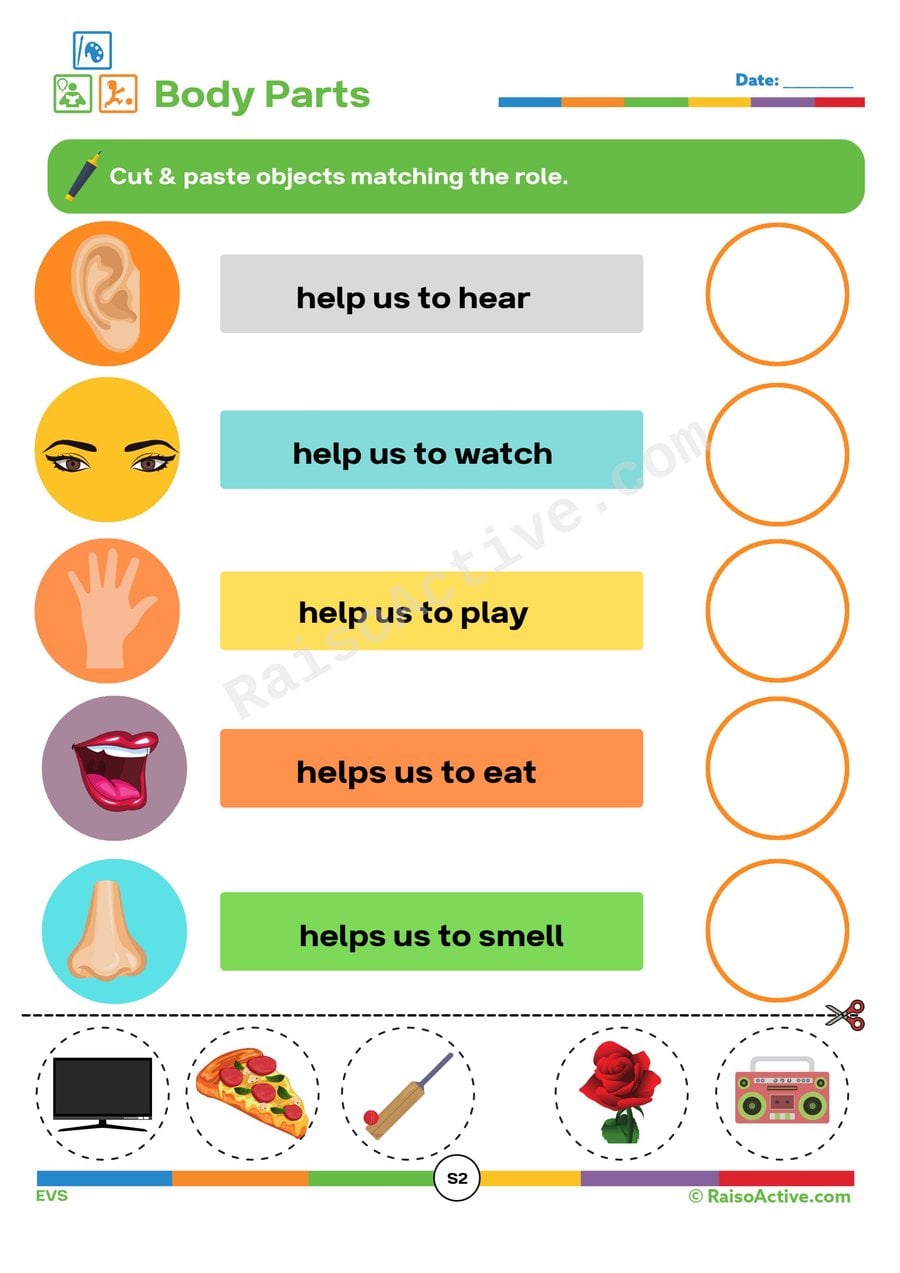
Body Parts Matching Worksheet for Preschoolers
Ages 3-5 · Preschool–Pre-KAges 3-5 · Nursery–ReceptionAges 3-5 · Nursery–LKGAges 3-5
Learning the names of body parts builds early vocabulary and body awareness for children ages 3-5, helping them describe their physical experiences and follow instructions that reference specific parts of the body. This cut-and-paste worksheet asks children to match pictures of body parts to their correct location on a figure, which reinforces spatial understanding of the body alongside vocabulary. Because children physically cut and glue each piece into place, the activity also builds fine motor control at the same time as the science and language content.

Subtraction Worksheet: Count and Subtract for Preschoolers
Ages 4-6 · Pre-K–KindergartenAges 4-6 · Reception–Year 1Ages 4-6 · LKG–UKGAges 4-6
This worksheet introduces children ages 4-6 to subtraction by having them count a group of objects, take away the indicated amount, and write the resulting difference. Grounding subtraction in physical counting rather than abstract number facts helps children build real number sense, understanding subtraction as 'taking away' rather than just memorizing symbols and answers.

Thick and Thin Worksheet: Identifying Object Thickness
Ages 3-5 · Preschool–Pre-KAges 3-5 · Nursery–ReceptionAges 3-5 · Nursery–LKGAges 3-5
This worksheet asks children ages 3-5 to compare objects and identify which is thickest and which is thinnest in each set, building early comparative reasoning and size-based vocabulary. Comparing objects along a specific dimension like thickness — rather than just overall size — sharpens observational skills and introduces the kind of precise descriptive language children will need for later measurement concepts.

Good Habits Worksheet for Kids: Identifying Good and Bad Behaviors
Ages 3-5 · Preschool–Pre-KAges 3-5 · Nursery–ReceptionAges 3-5 · Nursery–LKGAges 3-5
This worksheet asks children ages 3-5 to evaluate everyday scenarios and judge whether they show a good habit or a bad one, which builds early moral reasoning and social awareness alongside color recognition. Coloring the thumbs-up icons green and thumbs-down icons red also reinforces the ability to follow a two-step instruction and connect a symbol to a category.

Learn the Sight Word 'Do' - Tracing and Practice Worksheet
Ages 3-5 · Preschool–Pre-KAges 3-5 · Nursery–ReceptionAges 3-5 · Nursery–LKGAges 3-5
Sight words like 'do' can't be sounded out using regular phonics rules, so children ages 3-5 need repeated visual exposure and active practice to memorize them by sight — exactly what this multi-part worksheet provides through tracing, highlighting, filling blanks, and even dot-marking the word. Because sight words appear so frequently in early readers, automatic recognition of a word like 'do' removes a major stumbling block that would otherwise interrupt a child's reading flow on nearly every page. Practicing the same word in several different formats within one worksheet builds the strong repetition that sight-word memorization requires.

Learn the Sight Word 'Big' - Fun Worksheet for Preschoolers!
Ages 3-5 · Preschool–Pre-KAges 3-5 · Nursery–ReceptionAges 3-5 · Nursery–LKGAges 3-5
Focused entirely on one high-frequency word, this worksheet helps children ages 3-5 build automatic recognition of 'big' - a word too common and irregular to sound out letter by letter, which is why early readers must memorize it by sight. Tracing and writing the word also develops the pencil control and letter-formation memory needed for independent writing, while the fill-in-the-blank step introduces the idea that words carry meaning inside a sentence.
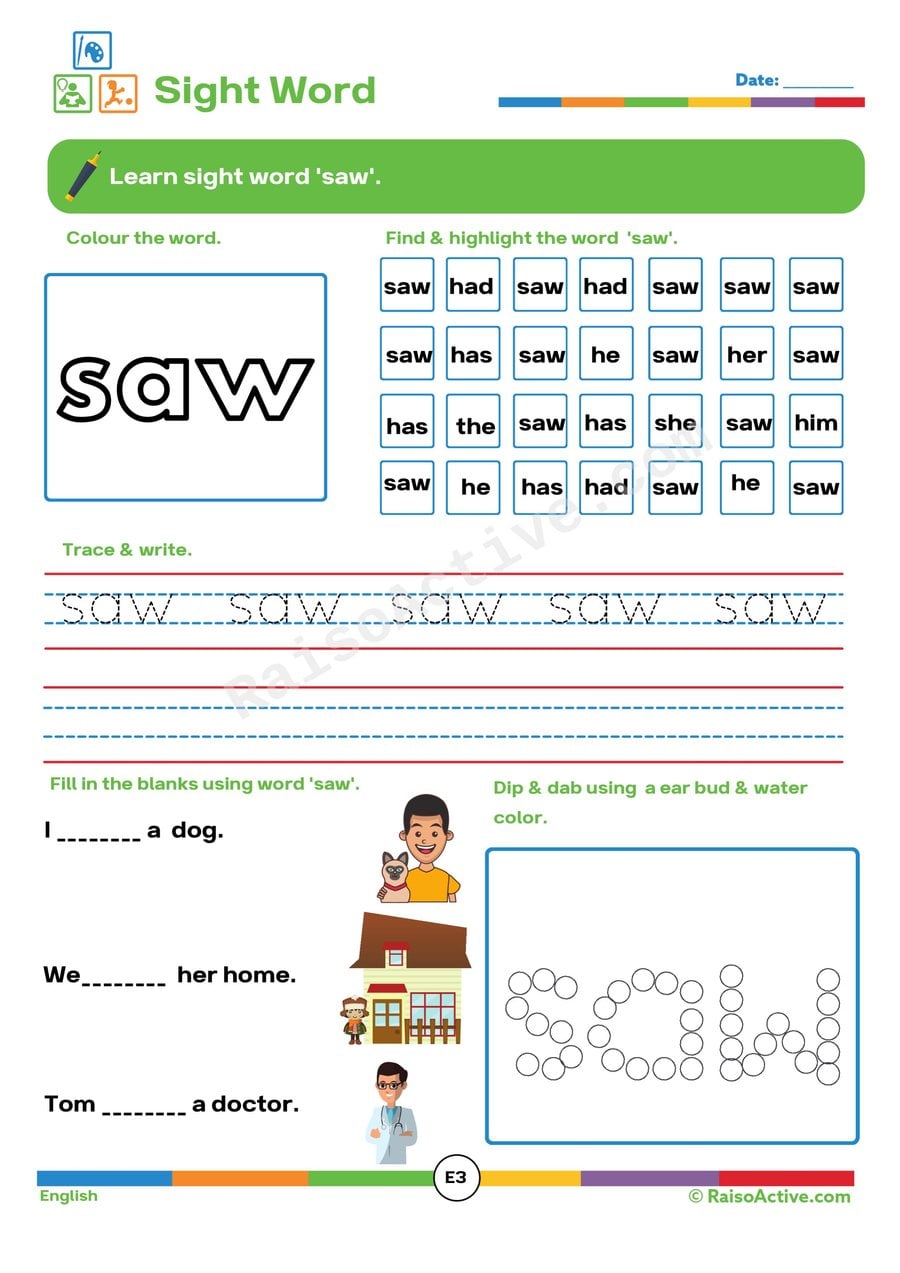
Sight Word 'Saw' Worksheet: Trace, Find, and Color!
Ages 3-5 · Preschool–Pre-KAges 3-5 · Nursery–ReceptionAges 3-5 · Nursery–LKGAges 3-5
The word 'saw' is another high-frequency sight word that doesn't follow standard phonics patterns, so children ages 3-5 need this kind of layered, multi-format practice — coloring, tracing, searching, and sentence completion — to build automatic recognition. Repeated exposure to the same word through different activities strengthens the visual memory needed for instant sight-word recall, which is essential since sight words make up a large percentage of the words in early beginner books. The variety of formats here also keeps a young child's attention across a longer practice session than a single repetitive task would.
Related worksheets

Read and Paste: Matching Sentences with Pictures Worksheet
Ages 4-5 · Pre-KAges 4-5 · ReceptionAges 4-5 · LKGAges 4-5
Reading a sentence and then finding its matching picture builds comprehension for children ages 4-5, teaching them to process the full meaning of connected words rather than recognizing them in isolation. The cutting and pasting component also strengthens the fine motor precision needed to place text accurately next to its correct visual match.

Cut and Paste Reading Worksheet: Matching Sentences with Pictures
Ages 4-5 · Pre-KAges 4-5 · ReceptionAges 4-5 · LKGAges 4-5
This worksheet gives children ages 4-5 practice reading short simple sentences and connecting the meaning of the words to a matching picture, an essential bridge between decoding words and comprehending what they say. Cutting and pasting the correct picture next to its sentence, rather than just answering verbally, requires children to hold the sentence's meaning in mind while searching for a visual match. This strengthens both reading comprehension and vocabulary at once.
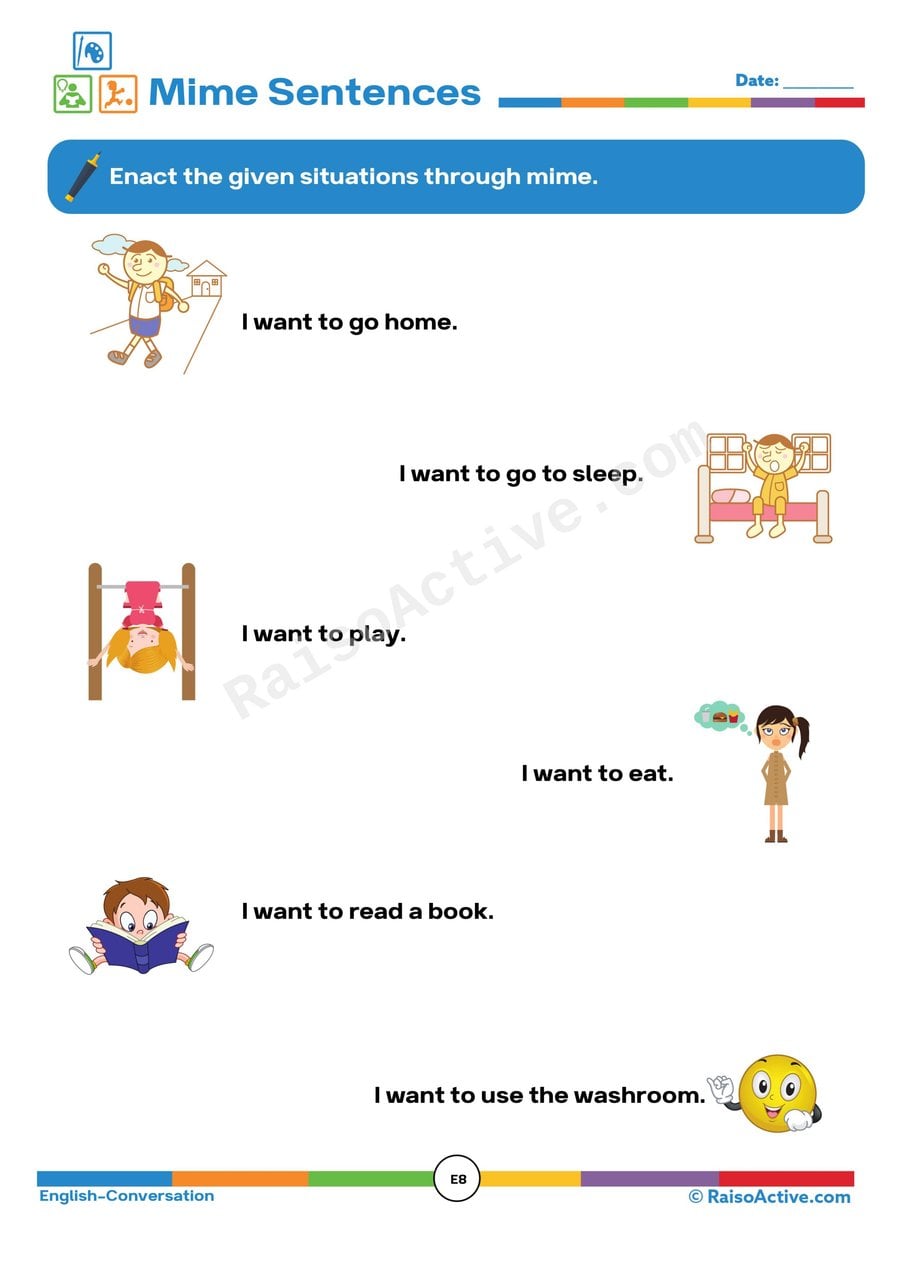
Mime Sentences Worksheet: Act Out Actions!
Ages 3-5 · Preschool–Pre-KAges 3-5 · Nursery–ReceptionAges 3-5 · Nursery–LKGAges 3-5
Reading a sentence and then acting it out through mime teaches children ages 3-5 to connect written or spoken language with physical expression, deepening comprehension of action verbs in a memorable, embodied way. This kind of kinesthetic practice also builds confidence with performance and body awareness alongside early reading skills.

Read and Circle: Matching Sentences to Pictures Worksheet
Ages 4-5 · Pre-KAges 4-5 · ReceptionAges 4-5 · LKGAges 4-5
Children ages 4-5 build reading comprehension by reading a short, simple sentence and then identifying which of several pictures actually matches its meaning, rather than just decoding words in isolation. This step — connecting written language back to a real scene — is what separates true reading comprehension from mechanical word-calling, making it an important milestone activity for early readers.

Read and Match: Sentence Matching Worksheet for Preschoolers
Ages 4-5 · Pre-KAges 4-5 · ReceptionAges 4-5 · LKGAges 4-5
Reading a simple sentence and finding its matching picture teaches children ages 4-5 to connect written words directly to meaning, an essential comprehension skill that goes beyond simply decoding individual words. The cut-and-paste format also adds fine motor practice, requiring children to select the correct image from several options and place it precisely next to its sentence.

Read and Match: Fun Sentences and Pictures Worksheet for Kids!
Ages 4-6 · Pre-K–KindergartenAges 4-6 · Reception–Year 1Ages 4-6 · LKG–UKGAges 4-6
Reading simple sentences and matching them to the correct picture helps children ages 4-6 practice decoding text and checking their understanding against a visual clue, an important step in building true reading comprehension rather than picture-guessing. Coloring the pictures afterward adds a rewarding finishing touch that keeps young readers engaged through the whole page.

Read & Match Worksheet: Matching Sentences to Pictures
Ages 3-5 · Preschool–Pre-KAges 3-5 · Nursery–ReceptionAges 3-5 · Nursery–LKGAges 3-5
Matching a sentence to its picture through drawing a line or coloring builds reading comprehension for children ages 3-5, requiring them to process the sentence's full meaning rather than recognizing familiar words in isolation. Following this with coloring keeps the activity engaging while giving repeated visual exposure to each completed sentence-and-picture pair.

Sentence Matching Worksheet: Read and Match the Sentences!
Ages 4-6 · Pre-K–KindergartenAges 4-6 · Reception–Year 1Ages 4-6 · LKG–UKGAges 4-6
Reading a short sentence and pasting it beneath its matching picture builds reading comprehension for children ages 4-6, requiring them to understand the full meaning of a sentence rather than recognizing isolated words. This task also reinforces fine motor precision as children position and glue a small strip of text accurately within a defined space.
Guides for this topic

Best Worksheets for 3-Year-Olds: What Works and What to Avoid
What works on worksheets for 3-year-olds: short sessions, crayons, tracing lines, matching, cutting, a free weekly plan, and signs one is too advanced.
Documenting Learning Without Drowning in Data: A Practical Guide for Parents and Teachers
Learn practical ways to document your child's learning without overwhelm. Simple portfolios, observation tips, and printable trackers for ages 1-8.

When Should My Child Learn to Read? Is Kindergarten Too Early? A Complete Guide to Reading Readiness
Discover the research-backed optimal age for reading, key readiness signs, and why pushing too early can backfire. A complete guide for parents of children aged 3-8.
Reviews
Every worksheet for ages 4–6, no watermark
Members download the full library of 1,000+ worksheets and every activity pack without watermarks or daily limits. One year costs ₹999 in India or $20 elsewhere.
See membership plansOr download any worksheet free with a watermark (5 a day).