Thick and Thin Worksheet: Identifying Object Thickness
This worksheet asks children ages 3-5 to compare objects and identify which is thickest and which is thinnest in each set, building early comparative reasoning and size-based vocabulary. Comparing objects along a specific dimension like thickness — rather than just overall size — sharpens observational skills and introduces the kind of precise descriptive language children will need for later measurement concepts.
Part of the pack
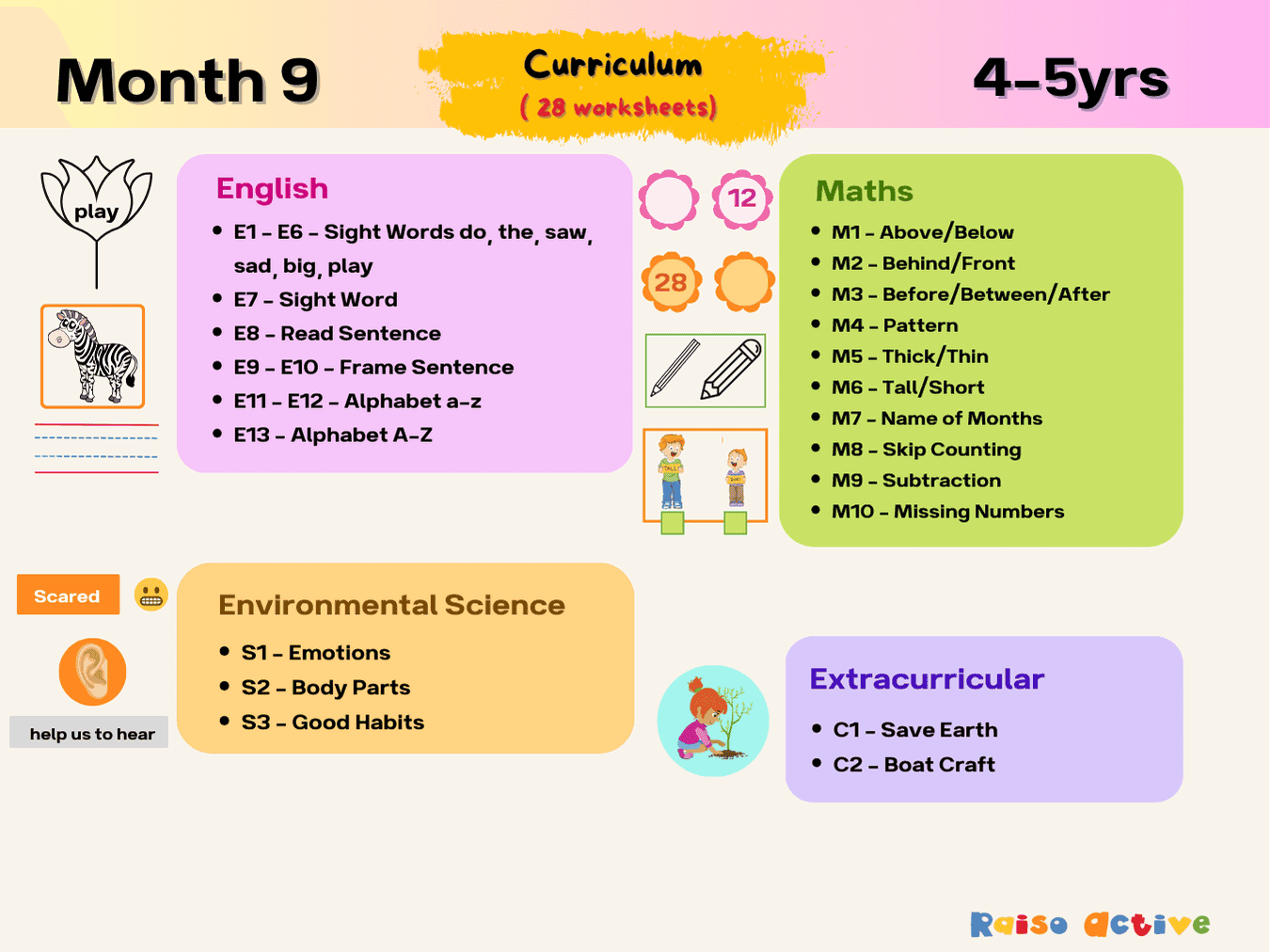
Month 9: Play-Based Preschool Foundational Skills | Ages 4-5
This is page 21 of the pack. Ages 4-5 · Pre-KAges 4-5 · ReceptionAges 4-5 · LKGAges 4-5
Made for your child
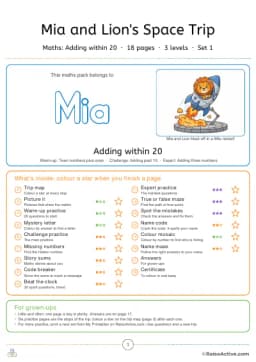
Counting to 10, made for your child
A maths pack with your child's name in it: pictures that explain, practice at three levels, puzzles and story sums about them. Print a new set whenever they finish.
Make a maths packFree preview · free for members
Curriculum
- Number Sense > Comparing Numbers
How to use this worksheet
Look at each box of objects together and talk about their differences before marking anything. Ask your child to point out which object looks thickest and which looks thinnest, explaining their reasoning out loud. Have them circle the thickest object in each box, then color the thinnest object as instructed, checking each choice together before moving to the next box.
Materials needed
- Pencil
- Crayons
Extension activities
- 1Gather household items like books, ropes, or crayons and sort them from thinnest to thickest.
- 2Draw your own pair of thick and thin objects, like a fat marker versus a thin pencil.
- 3Compare thickness using play dough by rolling it into a thick snake and a thin snake.
- 4Play a describing game where your child chooses an object and explains whether it's thick or thin and why.

Written by
Hemsweta Jain · Teacher Cheena
MBA and Early Childhood Educator, teaching since 2014 · Founder of RaisoActive, Mumbai
Every RaisoActive worksheet is designed and checked by the founder before publishing.
Published · Last reviewed
More from Month 9: Play-Based Preschool Foundational Skills | Ages 4-5
Sight Word Coloring Worksheet: Read and Color!
Ages 3-5 · Preschool–Pre-KAges 3-5 · Nursery–ReceptionAges 3-5 · Nursery–LKGAges 3-5
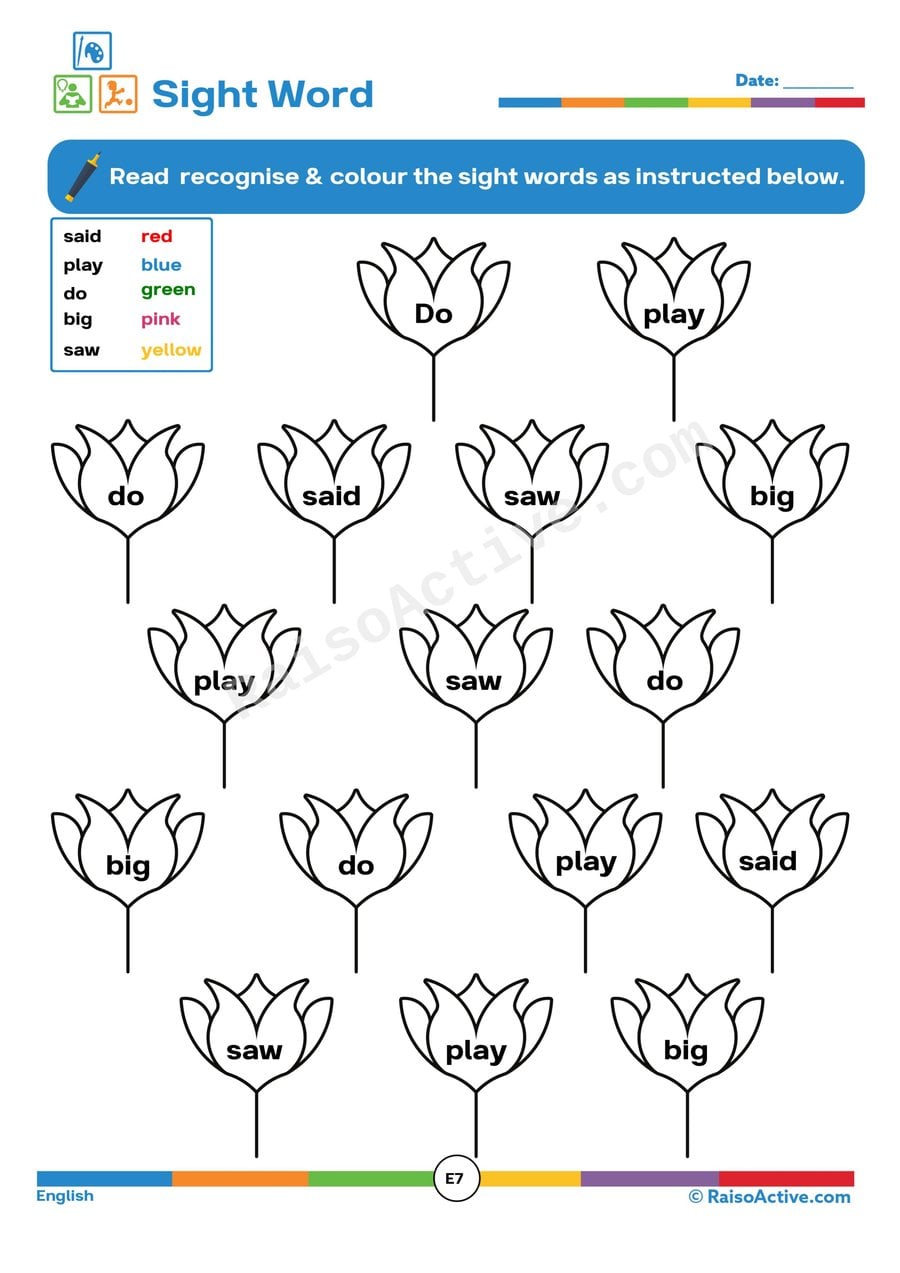
This worksheet combines sight-word recognition with a coloring activity, asking children ages 3-5 to read a list of common sight words and then find and color matching words hidden inside flower images. Turning word-hunting into a coloring task keeps young children engaged far longer than flashcard drills alone, while still delivering the repeated exposure that sight words require to become automatic.

Alphabet Adventures: Write the First Letter - Small Alphabet Worksheet
Ages 4-6 · Pre-K–KindergartenAges 4-6 · Reception–Year 1Ages 4-6 · LKG–UKGAges 4-6
This worksheet strengthens phonemic awareness by asking children ages 4-6 to isolate the very first sound in a spoken word and match it to its lowercase letter - a skill that sits at the heart of early decoding and spelling. Because it uses small (lowercase) letters specifically, it also reinforces letter-case recognition, since children encounter lowercase print far more often than capitals once they begin reading books.

Match the Patterns: Fun Worksheet for Preschoolers
Ages 3-5 · Preschool–Pre-KAges 3-5 · Nursery–ReceptionAges 3-5 · Nursery–LKGAges 3-5
By connecting each picture to its matching pattern, children ages 3-5 practice visual pattern recognition - the ability to notice a repeating sequence of colors, shapes, or objects - which is an early building block for both math reasoning and reading, since reading also relies on recognizing repeated letter patterns. The worksheet also builds fine motor control as children draw connecting lines with a pencil or crayon.
Body Parts Matching Worksheet for Preschoolers
Ages 3-5 · Preschool–Pre-KAges 3-5 · Nursery–ReceptionAges 3-5 · Nursery–LKGAges 3-5
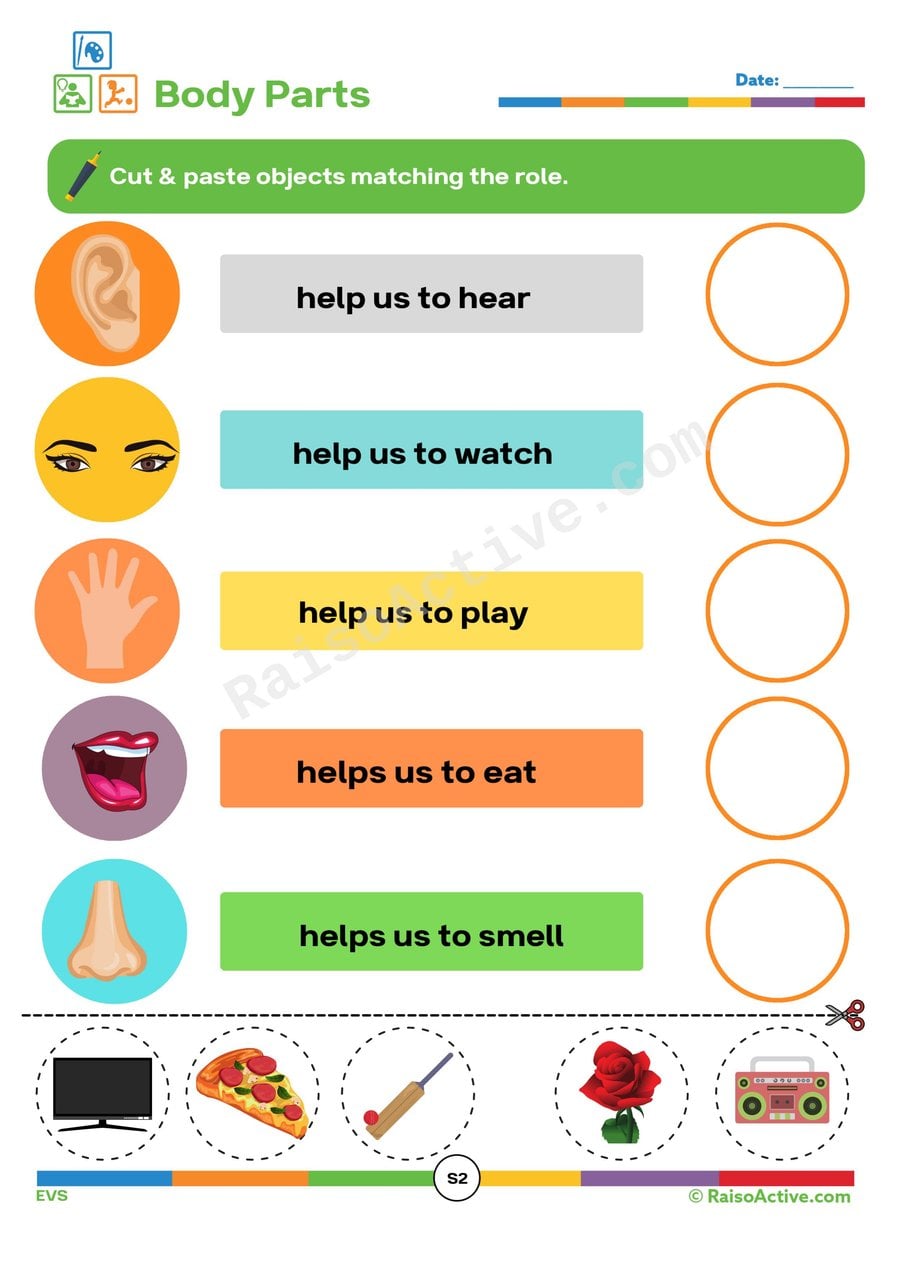
Learning the names of body parts builds early vocabulary and body awareness for children ages 3-5, helping them describe their physical experiences and follow instructions that reference specific parts of the body. This cut-and-paste worksheet asks children to match pictures of body parts to their correct location on a figure, which reinforces spatial understanding of the body alongside vocabulary. Because children physically cut and glue each piece into place, the activity also builds fine motor control at the same time as the science and language content.

Sight Word 'Said' Worksheet for Preschoolers: Tracing, Reading, and Writing Fun!
Ages 3-5 · Preschool–Pre-KAges 3-5 · Nursery–ReceptionAges 3-5 · Nursery–LKGAges 3-5
The word 'said' appears constantly in early readers, especially in dialogue, but its spelling doesn't match how it sounds, which makes it a classic sight word that children ages 3-5 must memorize by sight rather than decode. This worksheet reinforces that memorization through multiple formats — coloring, searching, tracing, filling in blanks, and even a dot-to-dot — giving the word repeated exposure in different contexts. Building instant recognition of high-frequency words like 'said' is one of the most efficient ways to boost a young reader's fluency.
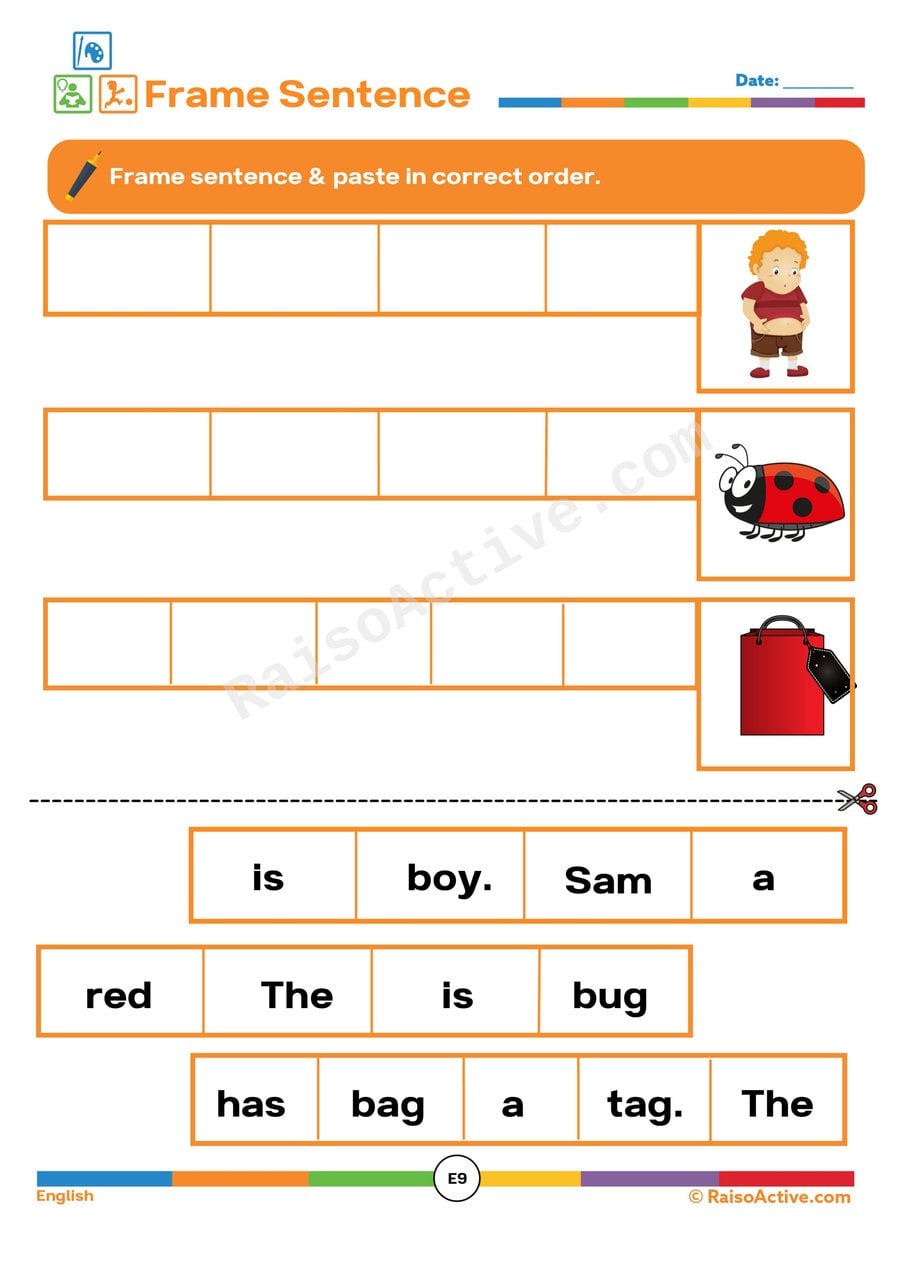
Sentence Building Worksheet: Sam is a boy!
Ages 3-5 · Preschool–Pre-KAges 3-5 · Nursery–ReceptionAges 3-5 · Nursery–LKGAges 3-5
This worksheet has children ages 3-5 practice constructing a simple sentence by cutting out individual words and pasting them in the correct order to complete a sentence frame, like 'Sam is a boy'. Physically arranging separate word pieces makes the abstract concept of sentence structure — subject, verb, object — tangible and manipulable for a young child.

Help the Hen! Alphabet Worksheet: Writing Missing Capital Letters
Ages 4-5 · Pre-KAges 4-5 · ReceptionAges 4-5 · LKGAges 4-5
This maze-style worksheet asks children ages 4-5 to fill in missing capital letters in alphabetical order to help a hen find her way to the coop, turning alphabet sequencing practice into a small story-driven challenge. Recalling which capital letter comes next in the sequence — without a full alphabet chart to copy from — builds genuine alphabet mastery rather than passive letter recognition. The path-following format also adds a light visual tracking element that keeps the activity from feeling like a plain fill-in-the-blank drill.
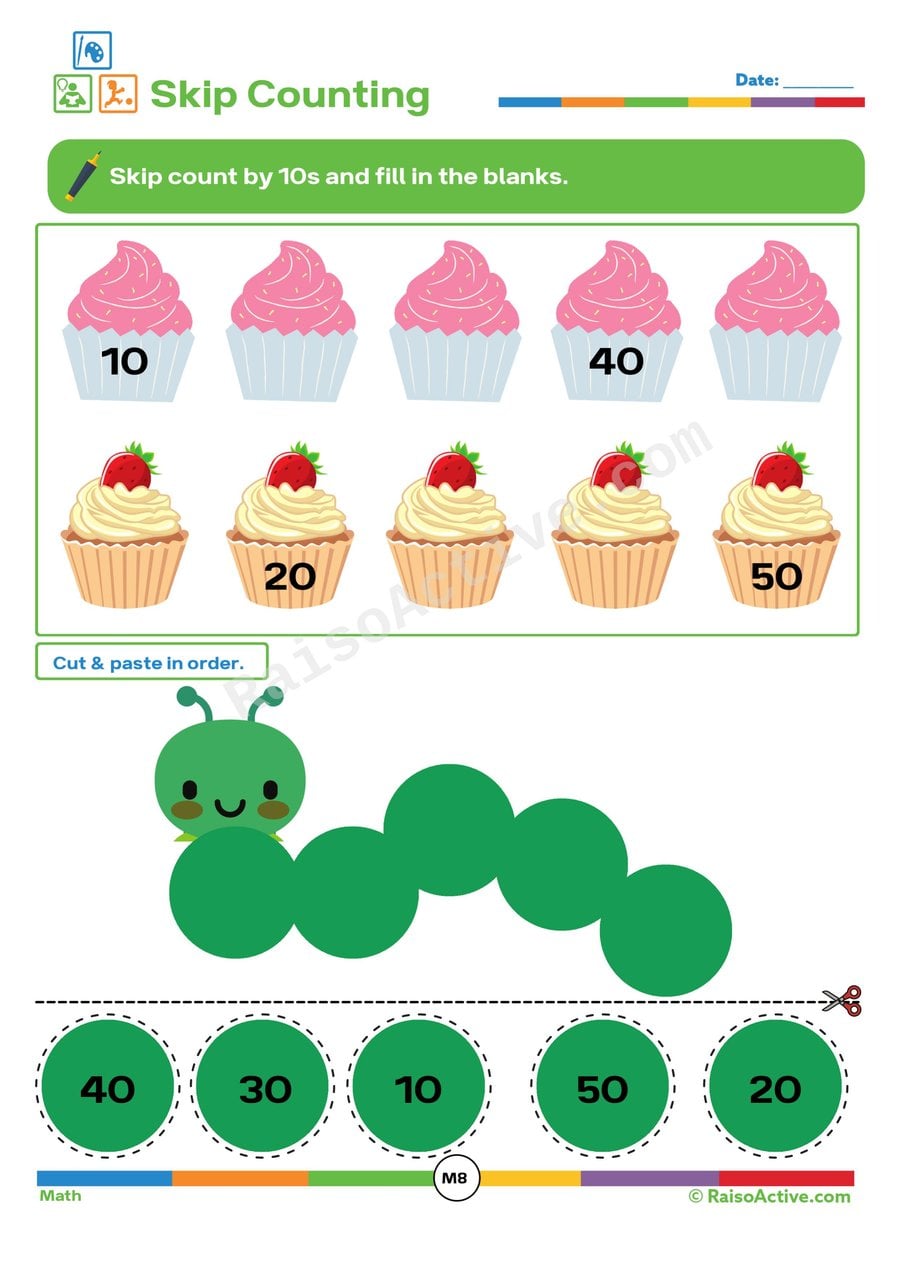
Skip Counting Cupcake Worksheet: Count by 10s!
Ages 4-5 · Pre-KAges 4-5 · ReceptionAges 4-5 · LKGAges 4-5
This worksheet has children ages 4-5 fill in missing numbers while skip counting by tens, then cut and paste the numbers onto a caterpillar in the correct sequence. Skip counting by tens is a crucial stepping stone toward place value and mental math, since it helps children see numbers in efficient groups rather than counting one by one.
Related worksheets
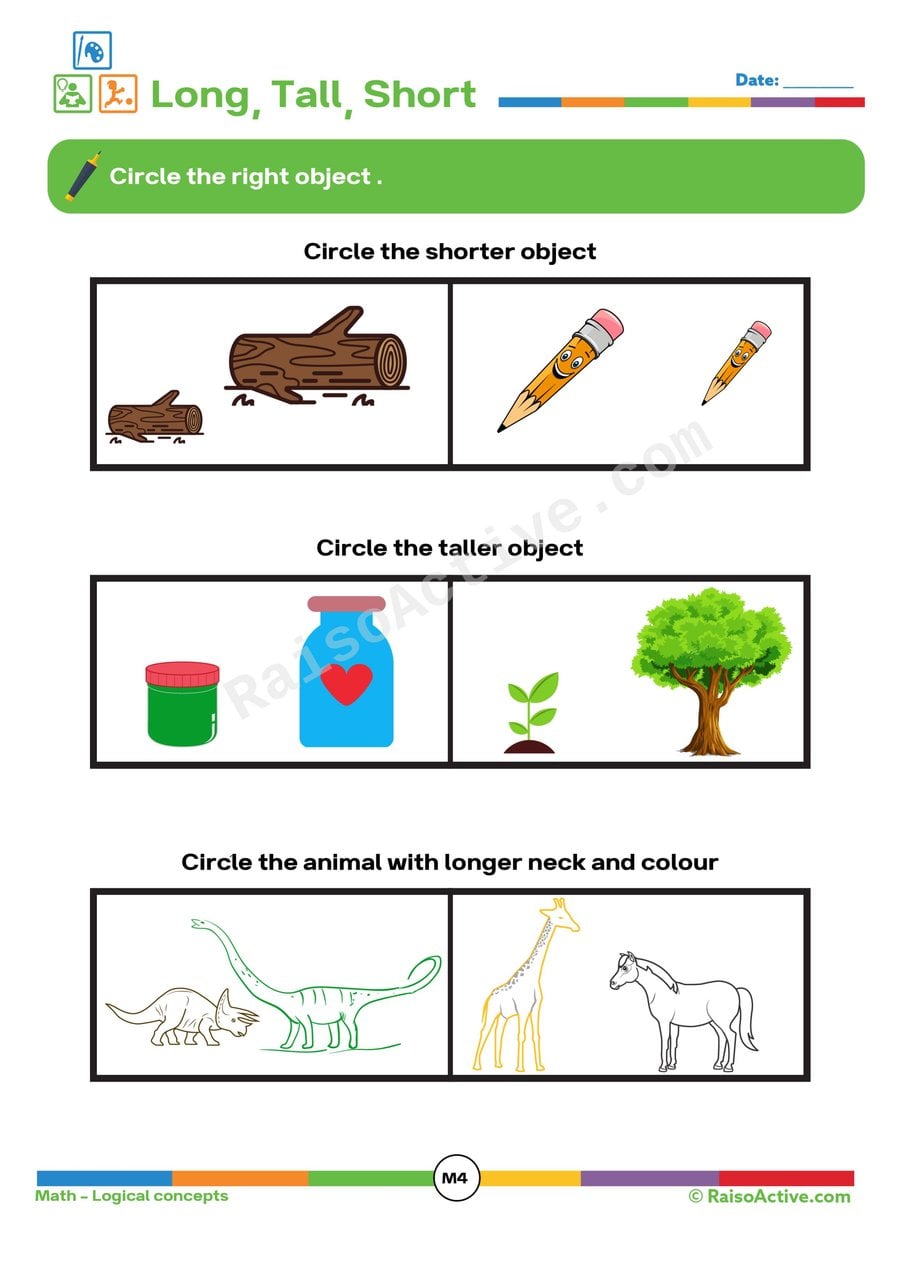
Long, Tall, Short Worksheet: Comparing Objects!
Ages 3-5 · Preschool–Pre-KAges 3-5 · Nursery–ReceptionAges 3-5 · Nursery–LKGAges 3-5
This worksheet guides your child in visually comparing objects based on their length and height, using terms like "long," "tall," and "short." By matching items with specific size descriptions, children aged 3-5 build essential observation skills and foundational pre-math understanding of attributes. This practice helps develop their vocabulary for describing the world around them and strengthens critical thinking as they distinguish subtle differences.

Comparing Objects: A Fun Counting Worksheet for Preschoolers!
Ages 4-5 · Pre-KAges 4-5 · ReceptionAges 4-5 · LKGAges 4-5
This worksheet has 4-5 year olds count two groups of objects and then compare the totals using the greater-than, less-than, and equal-to symbols — an early but genuine step into formal math notation that goes beyond simple counting into representing a comparison symbolically. Because your child has to count accurately before comparing, this worksheet also reinforces that math symbols stand for real relationships between quantities, not arbitrary marks to memorize.

More or Less Worksheet: Comparing Quantities for Preschoolers
Ages 3-5 · Preschool–Pre-KAges 3-5 · Nursery–ReceptionAges 3-5 · Nursery–LKGAges 3-5
This worksheet helps children ages 3-5 understand the concepts of 'more' and 'less' by counting and comparing different groups of pictured objects, like eggs in a nest or fruits in a basket. Comparing quantities visually and numerically builds early number sense that supports later addition, subtraction, and greater-than or less-than reasoning.

Counting and Comparing: Greater Than, Less Than, or Equal To Worksheet
Ages 4-6 · Pre-K–KindergartenAges 4-6 · Reception–Year 1Ages 4-6 · LKG–UKGAges 4-6
This worksheet builds on basic counting by asking children to compare two separate groups of pictures and decide whether one group has more, fewer, or the same number as the other, then represent that relationship with the correct symbol. For four- to six-year-olds, this task combines accurate counting with comparative reasoning, both of which are essential building blocks for later mathematical problem solving.

Comparing Numbers Worksheet: Greater Than, Less Than, and Equal To!
Ages 4-6 · Pre-K–KindergartenAges 4-6 · Reception–Year 1Ages 4-6 · LKG–UKGAges 4-6
Children ages 4-6 learn to compare two numbers and choose the correct symbol — greater than, less than, or equal to — building an essential foundation for later work with inequalities and algebra. Comparing quantities and representing the relationship symbolically is a more abstract skill than simple counting, so this worksheet stretches children just past straightforward number recognition into true numerical reasoning.

Cut and Glue: Comparing Quantities Worksheet for Preschoolers
Ages 3-5 · Preschool–Pre-KAges 3-5 · Nursery–ReceptionAges 3-5 · Nursery–LKGAges 3-5
Comparing quantities using the greater than, less than, and equal to symbols is an early step toward formal mathematical notation for children ages 3-5, building on the counting skills they already have. This cut-and-paste worksheet asks children to count two sets of objects, decide which set is larger, smaller, or the same, and then physically select and glue the correct comparison symbol between them. Handling the symbol pieces themselves, rather than writing the symbols freehand, lets younger children engage with this abstract math concept before their fine motor skills are ready for symbol writing.

Comparing Numbers: Apples, Soccer Balls, and More! - Math Worksheet
Ages 4-5 · Pre-KAges 4-5 · ReceptionAges 4-5 · LKGAges 4-5
This worksheet teaches children to compare two quantities using the symbols greater than (>), less than (<), and equal to (=) by counting groups of everyday objects like apples and soccer balls. For four- and five-year-olds, learning to read and use comparison symbols is an early step toward understanding mathematical relationships beyond simple counting.

Count and Compare: Fun Math Worksheet for Preschoolers
Ages 3-5 · Preschool–Pre-KAges 3-5 · Nursery–ReceptionAges 3-5 · Nursery–LKGAges 3-5
Counting two groups of objects and then choosing the correct greater-than, less-than, or equal-to symbol introduces children ages 3-5 to comparative reasoning, a step beyond simple counting that asks them to judge relationships between quantities. This worksheet turns an abstract math symbol into something concrete by grounding it in objects they've just counted themselves, rather than presenting the symbol in isolation. Learning to compare quantities this early builds the number sense needed for later addition, subtraction, and general mathematical reasoning.
Guides for this topic

Best Worksheets for 3-Year-Olds: What Works and What to Avoid
What works on worksheets for 3-year-olds: short sessions, crayons, tracing lines, matching, cutting, a free weekly plan, and signs one is too advanced.

Age-Appropriate Problem-Solving Activities: Building Critical Thinkers from the Ground Up
Discover fun, age-appropriate problem-solving activities for children ages 1-8. Build critical thinking, logic, and reasoning skills through play-based learning.
Critical Thinking Activities That Actually Work for Young Children: Building Tomorrow's Thinkers Today
Discover proven critical thinking activities for young children. Age-wise logic games, questioning techniques, and hands-on ideas to build thinking skills at home.
Reviews
Every worksheet for ages 3–5, no watermark
Members download the full library of 1,000+ worksheets and every activity pack without watermarks or daily limits. One year costs ₹999 in India or $20 elsewhere.
See membership plansOr download any worksheet free with a watermark (5 a day).