Sentence Building Worksheet: Sam is a boy!
This worksheet has children ages 3-5 practice constructing a simple sentence by cutting out individual words and pasting them in the correct order to complete a sentence frame, like 'Sam is a boy'. Physically arranging separate word pieces makes the abstract concept of sentence structure — subject, verb, object — tangible and manipulable for a young child.
Part of the pack
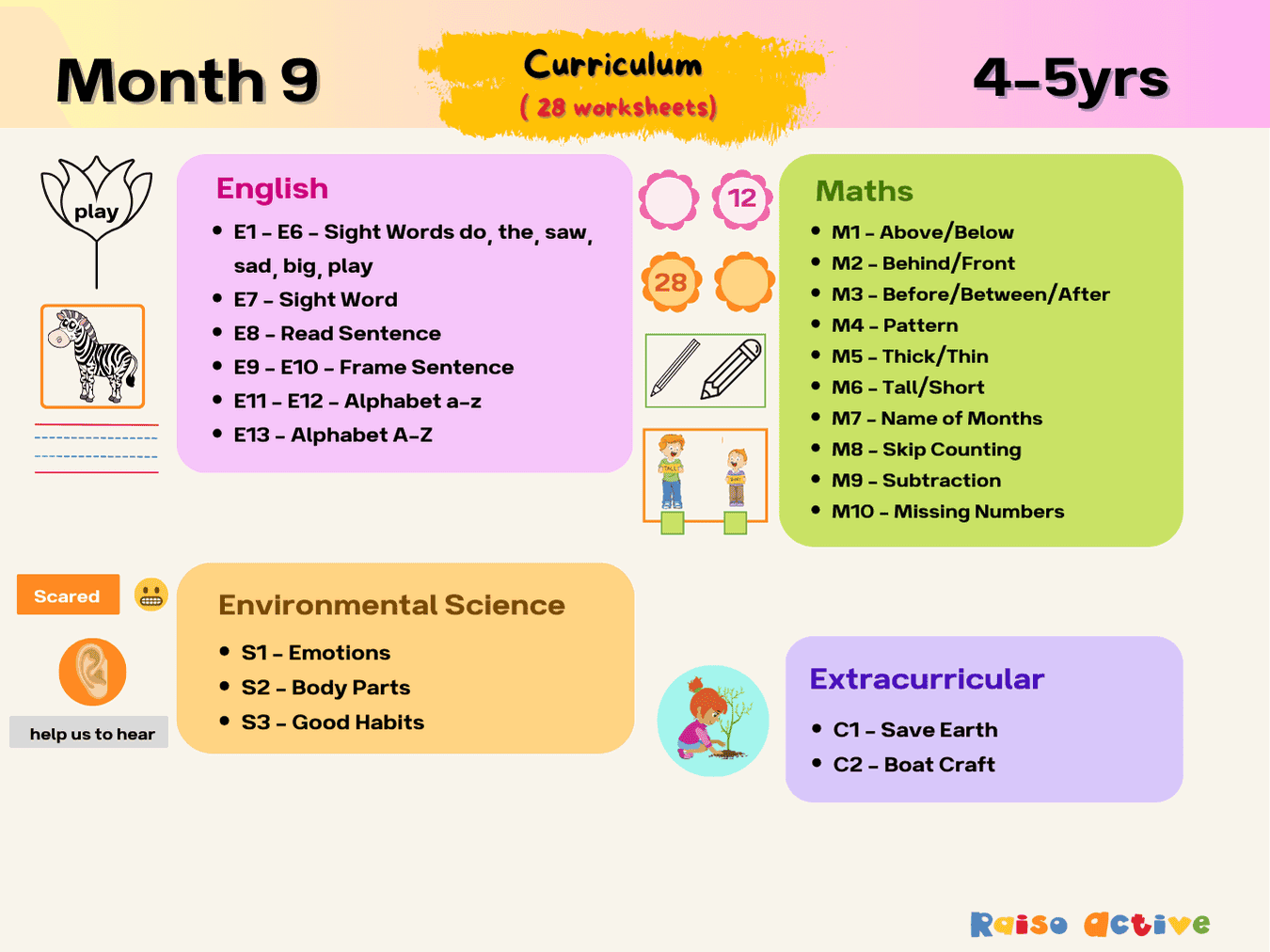
Month 9: Play-Based Preschool Foundational Skills | Ages 4-5
This is page 12 of the pack. Ages 4-5 · Pre-KAges 4-5 · ReceptionAges 4-5 · LKGAges 4-5
Made for your child
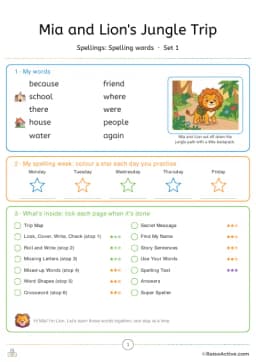
Spelling practice, made for your child
Their own spelling words turned into a pack: trace or look-cover-write-check, roll and write, a secret picture code, a word search, a crossword and a test, with their name in it.
Make a spelling packFree preview · free for members
Or start free: a word search with sight wordsCurriculum
- Fluency > Sentence Building
How to use this worksheet
Read the sentence frame together first so your child knows what the finished sentence should say. Have them cut out the individual word cards at the bottom of the page along the dotted lines. Guide them to arrange and paste the words in the correct order to complete the sentence, then read the finished sentence aloud together to confirm it makes sense.
Materials needed
- Scissors
- Glue stick
- Pencil
Extension activities
- 1Create your own simple sentences using different names and objects, then cut and rearrange word cards to build them.
- 2Have your child draw a picture to match the completed sentence.
- 3Play a 'mixed-up sentence' game where you scramble word cards and challenge your child to put them back in order.
- 4Practice saying the completed sentence from memory without looking at the pasted words.

Written by
Hemsweta Jain · Teacher Cheena
MBA and Early Childhood Educator, teaching since 2014 · Founder of RaisoActive, Mumbai
Every RaisoActive worksheet is designed and checked by the founder before publishing.
Published · Last reviewed
More from Month 9: Play-Based Preschool Foundational Skills | Ages 4-5
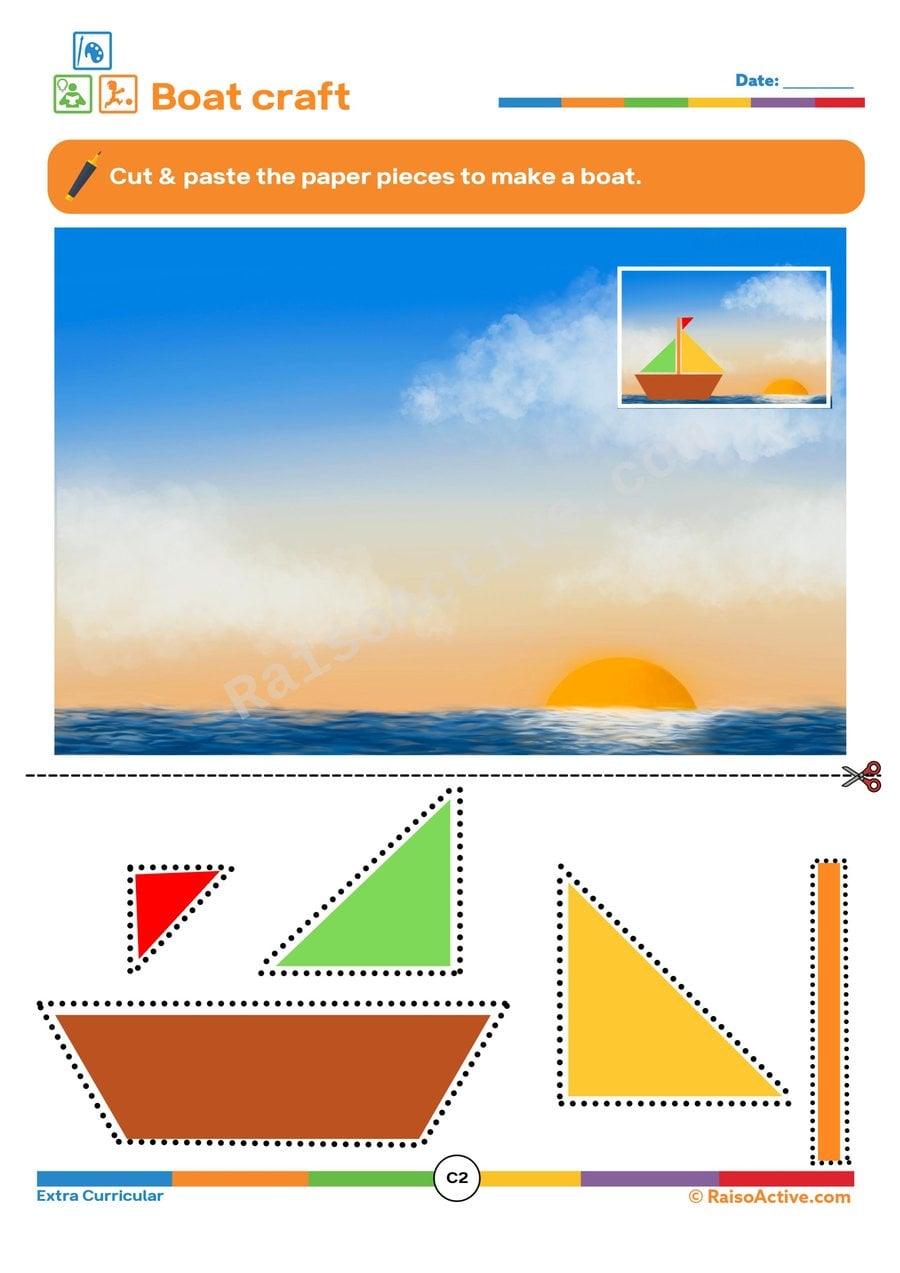
Boat Craft Worksheet: Cut and Paste a Boat!
Ages 3-5 · Preschool–Pre-KAges 3-5 · Nursery–ReceptionAges 3-5 · Nursery–LKGAges 3-5
This cut-and-paste craft asks children ages 3-5 to cut out individual shapes and assemble them into a complete boat scene, building fine motor control through scissor use and precise gluing while also reinforcing basic shape and color recognition along the way. Assembling a picture from separate cut pieces requires spatial reasoning too, since your child has to figure out where each shape belongs relative to the others to make the finished boat look right. Craft-based worksheets like this one turn fine motor practice into a creative, open-ended activity rather than a repetitive drill.
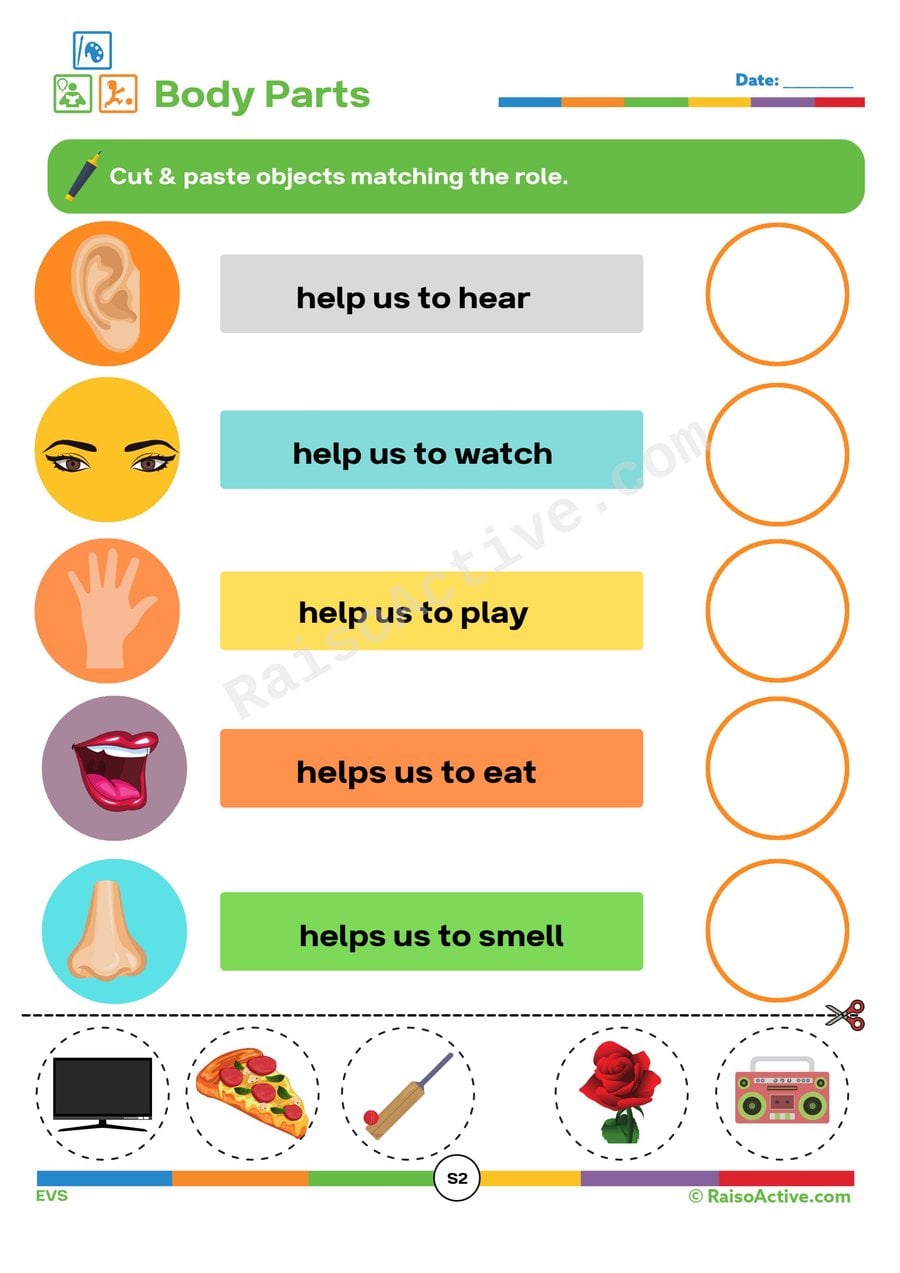
Body Parts Matching Worksheet for Preschoolers
Ages 3-5 · Preschool–Pre-KAges 3-5 · Nursery–ReceptionAges 3-5 · Nursery–LKGAges 3-5
Learning the names of body parts builds early vocabulary and body awareness for children ages 3-5, helping them describe their physical experiences and follow instructions that reference specific parts of the body. This cut-and-paste worksheet asks children to match pictures of body parts to their correct location on a figure, which reinforces spatial understanding of the body alongside vocabulary. Because children physically cut and glue each piece into place, the activity also builds fine motor control at the same time as the science and language content.

Learn the Sight Word 'the' - Fun Worksheet for Early Readers!
Ages 4-5 · Pre-KAges 4-5 · ReceptionAges 4-5 · LKGAges 4-5
'The' is one of the most frequently occurring words in the English language, and because it doesn't follow regular phonics rules, children ages 4-5 need to learn it by sight rather than by sounding it out. This worksheet builds that instant recognition through several different modes — coloring, tracing, searching, and using it in a sentence — which research on early literacy shows helps sight words stick more firmly than a single repetition. Mastering 'the' specifically gives children a huge boost in reading fluency, since it appears in nearly every simple sentence they'll encounter.

Read and Match: Sentence Matching Worksheet for Early Readers
Ages 4-6 · Pre-K–KindergartenAges 4-6 · Reception–Year 1Ages 4-6 · LKG–UKGAges 4-6
This worksheet moves children ages 4-6 beyond single words into reading whole simple sentences and matching each one to the picture it describes. Comprehending a full sentence — not just recognizing individual words — is a genuine leap in reading skill, since it requires holding several words in mind together and connecting their combined meaning to an image.

Save Earth: A Cut and Paste Sorting Worksheet for Kids
Ages 3-5 · Preschool–Pre-KAges 3-5 · Nursery–ReceptionAges 3-5 · Nursery–LKGAges 3-5
This cut-and-paste activity introduces children ages 3-5 to the practical concept of waste sorting by having them classify pictured items as 'wet' or 'dry' waste - an early, hands-on entry point into environmental responsibility. Cutting along the lines and gluing each piece into its correct bin also builds scissor control and precise hand placement, both important fine motor milestones at this age.

Above and Below Worksheet: Identifying Objects' Positions
Ages 3-5 · Preschool–Pre-KAges 3-5 · Nursery–ReceptionAges 3-5 · Nursery–LKGAges 3-5
Understanding positional words like 'above' and 'below' helps children ages 3-5 build the spatial vocabulary that later supports following multi-step directions, reading maps, and even understanding math concepts like number lines. This worksheet asks children to look closely at a scene and judge the position of different objects relative to one another, which sharpens visual observation alongside language development. Marking each object with a tick or a cross also introduces early symbol-based recording, a small step toward more formal worksheet conventions used in later grades.
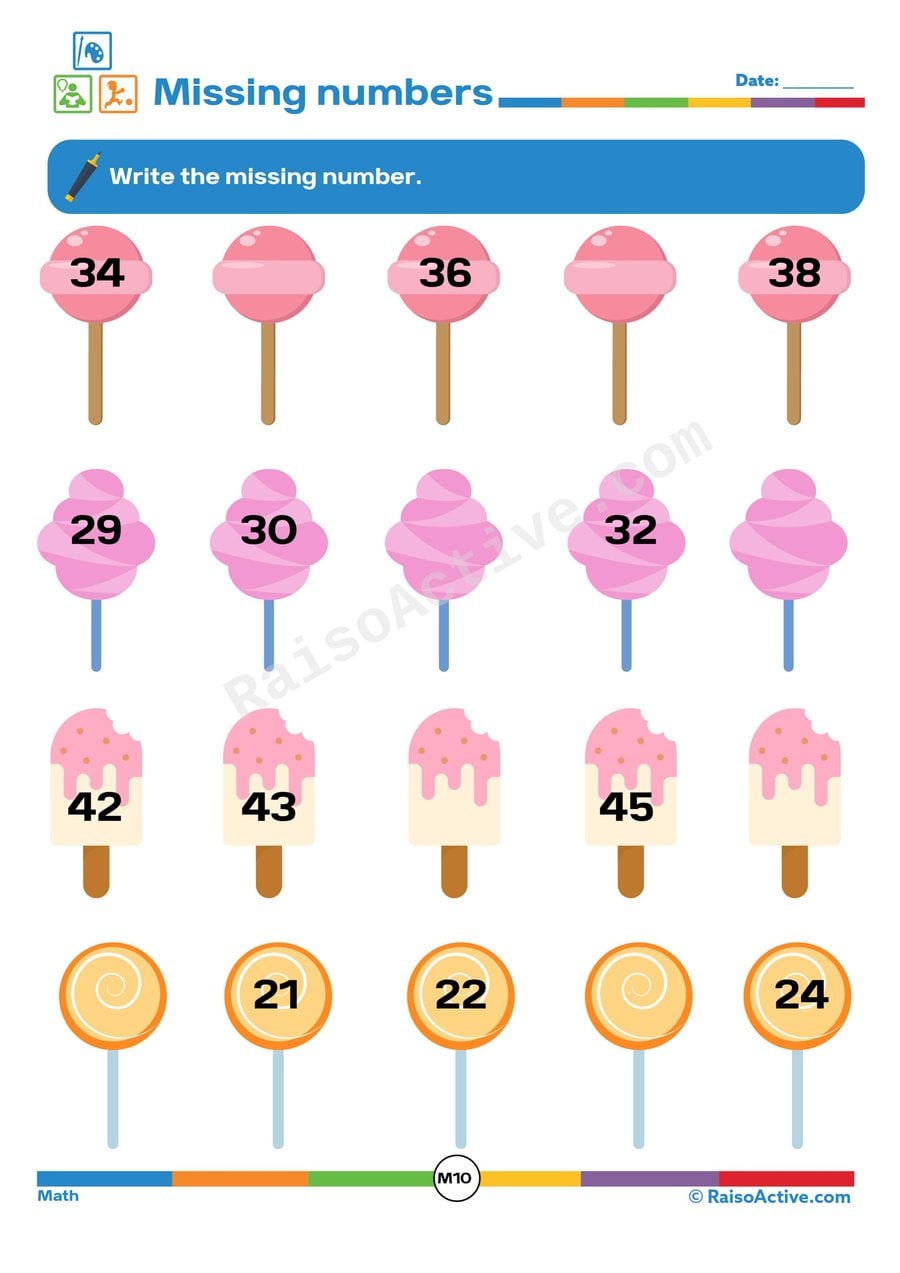
Missing Numbers Worksheet: Sweet Treats!
Ages 3-5 · Preschool–Pre-KAges 3-5 · Nursery–ReceptionAges 3-5 · Nursery–LKGAges 3-5
Set against a row of illustrated sweet treats, this worksheet gives children ages 3-5 practice with number sequencing - recognizing what comes before or after a given number in the counting order. This is a key early step toward understanding that numbers have a fixed, predictable order, which children need before they can count reliably or perform simple addition.
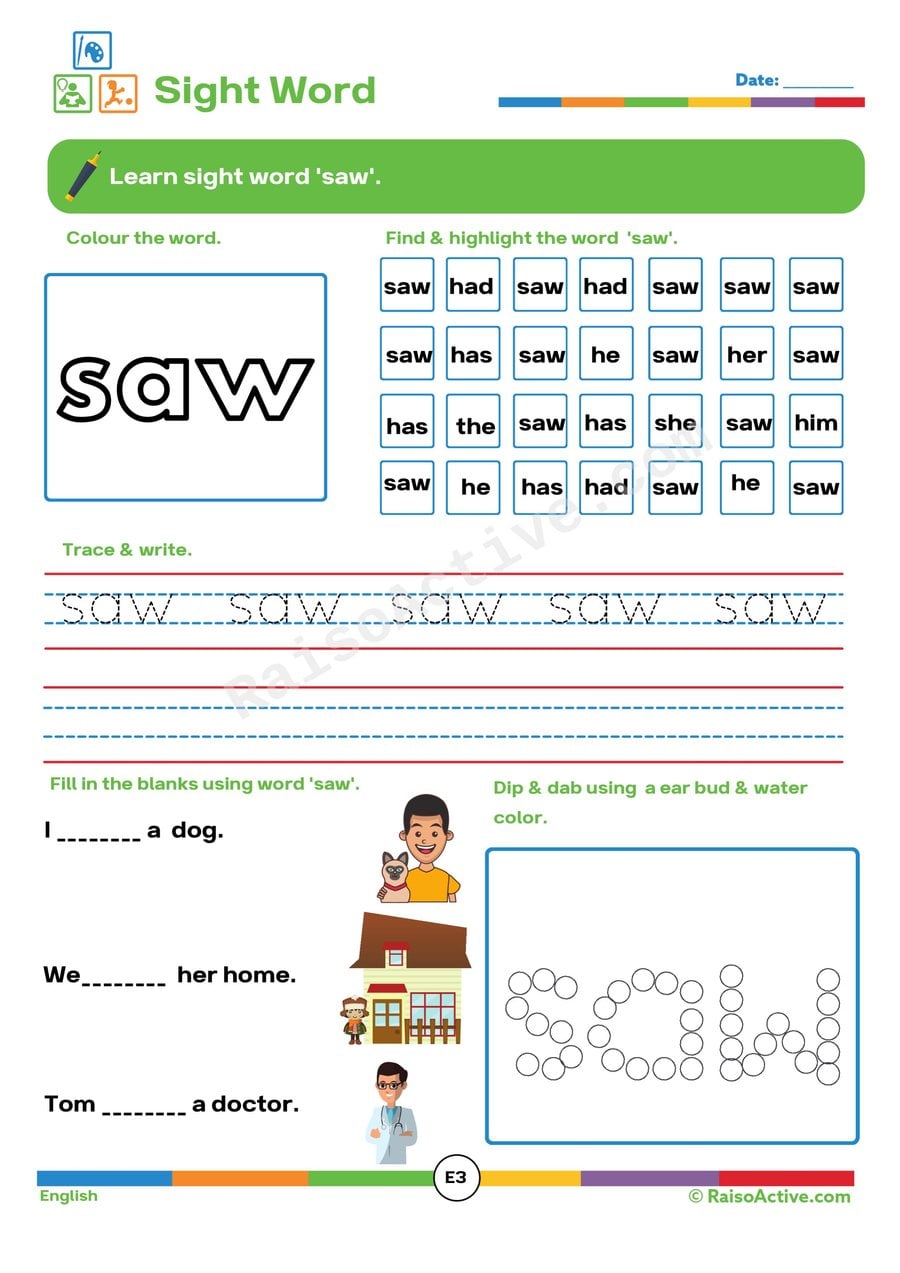
Sight Word 'Saw' Worksheet: Trace, Find, and Color!
Ages 3-5 · Preschool–Pre-KAges 3-5 · Nursery–ReceptionAges 3-5 · Nursery–LKGAges 3-5
The word 'saw' is another high-frequency sight word that doesn't follow standard phonics patterns, so children ages 3-5 need this kind of layered, multi-format practice — coloring, tracing, searching, and sentence completion — to build automatic recognition. Repeated exposure to the same word through different activities strengthens the visual memory needed for instant sight-word recall, which is essential since sight words make up a large percentage of the words in early beginner books. The variety of formats here also keeps a young child's attention across a longer practice session than a single repetitive task would.
Related worksheets

Sentence Sorting Fun: Speak Sentences with Words! (Ages 3-5)
Ages 3-5 · Preschool–Pre-KAges 3-5 · Nursery–ReceptionAges 3-5 · Nursery–LKGAges 3-5
This worksheet builds oral sentence construction for children ages 3-5 by having them place a cutout Pacman piece on a word and then speak a full sentence using that word aloud. Because the task requires generating spoken language on the spot rather than selecting a pre-written answer, it strengthens expressive vocabulary and sentence-building skills in a playful, low-pressure format.
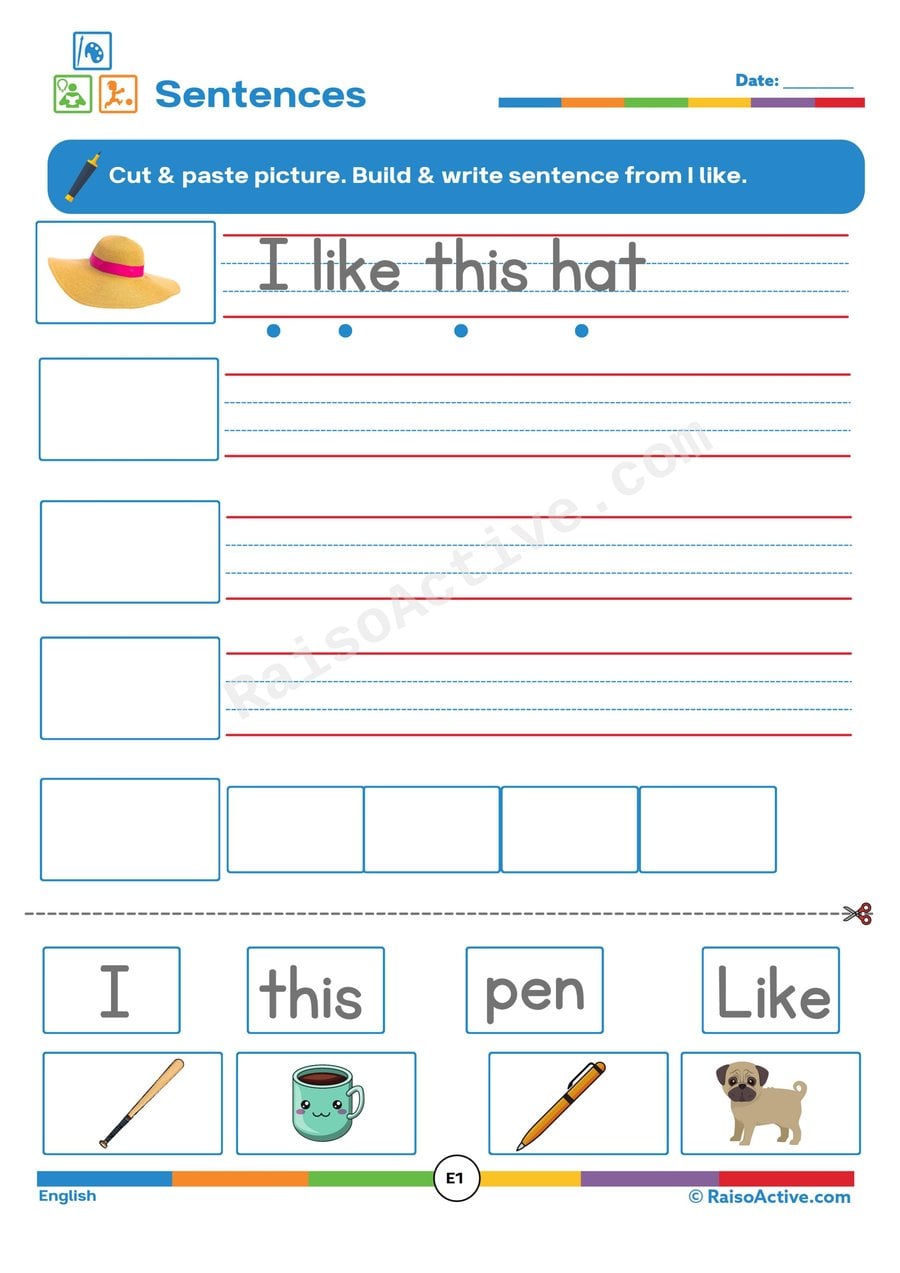
I Like Sentences Worksheet: Cut, Paste, and Write!
Ages 4-5 · Pre-KAges 4-5 · ReceptionAges 4-5 · LKGAges 4-5
This worksheet builds early sentence construction and fine motor skills together, having children cut out a picture and word cards, paste them into a simple 'I like ___' sentence frame, and then copy the full sentence in their own writing. For ages 4-5, physically assembling a sentence from separate word pieces before writing it independently helps children understand that sentences are built from individual words in a specific order.

Words Worksheet: Unscramble, Capitalize, and Choose the Best Word!
Ages 4-6 · Pre-K–KindergartenAges 4-6 · Reception–Year 1Ages 4-6 · LKG–UKGAges 4-6
This multi-part worksheet challenges children ages 4-6 to unscramble jumbled letters into real words, identify correctly capitalized sentences, and choose the most fitting word to complete a sentence. Combining these three tasks on one page builds spelling, sentence-level grammar awareness, and vocabulary precision together, pushing children to apply several early literacy skills in a single sitting rather than practicing them in isolation.

Sentence Building Fun: Join the Sentences Worksheet
Ages 4-6 · Pre-K–KindergartenAges 4-6 · Reception–Year 1Ages 4-6 · LKG–UKGAges 4-6
Children ages 4-6 practice combining two short, simple sentences into one longer, connected sentence using a spinning-wheel format, building an early understanding of how sentence structure works and how ideas can be joined together. This hands-on approach to sentence combining lays groundwork for more complex writing later on.

My Name is: Sentence Building Worksheet for Early Learners
Ages 3-5 · Preschool–Pre-KAges 3-5 · Nursery–ReceptionAges 3-5 · Nursery–LKGAges 3-5
This sentence-building activity asks children ages 3-5 to cut apart puzzle pieces of words and arrange them in the correct order to form a complete sentence, giving hands-on practice with sentence structure before they write full sentences independently. Physically manipulating word pieces lets children experiment with word order and self-correct by reading the sentence aloud, which is more forgiving than committing straight to writing. Copying the assembled sentence onto lines afterward then bridges the gap from arranging words to writing them from scratch.

Punctuation Practice Worksheet for Early Learners
Ages 4-6 · Pre-K–KindergartenAges 4-6 · Reception–Year 1Ages 4-6 · LKG–UKGAges 4-6
Children ages 4-6 learn to distinguish between statements and questions by deciding whether each sentence needs a period or a question mark, an early step in understanding how punctuation changes meaning and tone. Recognizing the difference between a question and a statement also supports reading fluency, since readers naturally use rising or falling intonation depending on the punctuation at the end of a sentence.
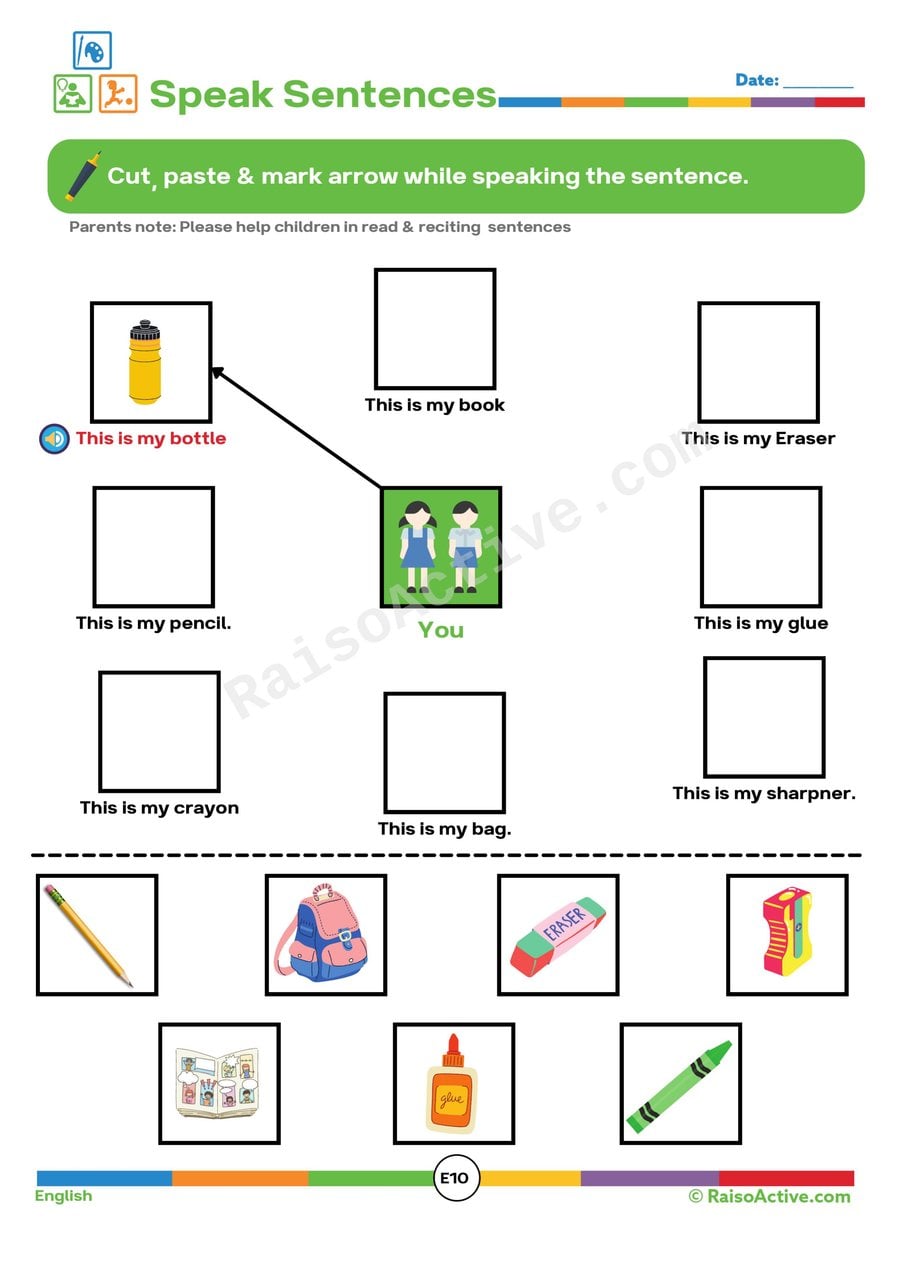
Speak Sentences Worksheet: Cut, Paste, and Match!
Ages 3-5 · Preschool–Pre-KAges 3-5 · Nursery–ReceptionAges 3-5 · Nursery–LKGAges 3-5
Children ages 3-5 practice matching spoken sentence meaning to pictures by cutting out images and pasting them next to the correct simple sentence, building early reading comprehension. This task requires connecting written or read-aloud words to real-world meaning, a critical step before children can read independently for understanding. The cutting and pasting also continues building the fine motor precision needed for handwriting and other classroom tasks.

Capitalization Worksheet: Practice Writing Sentences Correctly!
Ages 4-6 · Pre-K–KindergartenAges 4-6 · Reception–Year 1Ages 4-6 · LKG–UKGAges 4-6
This worksheet teaches children ages 4-6 the rule that sentences begin with a capital letter, along with an introduction to capitalizing proper nouns like names and places. Rewriting sentences correctly, rather than just circling errors, gives children active practice applying the capitalization rule themselves, which builds the habit more effectively than passive correction exercises.
Guides for this topic

Documenting Learning Without Drowning in Data: A Practical Guide for Parents and Teachers
Learn practical ways to document your child's learning without overwhelm. Simple portfolios, observation tips, and printable trackers for ages 1-8.

How to Help Your Child with Letter Reversals: A Complete Guide for Parents and Teachers
Letter reversals are normal until age 7-8. Learn the best multisensory strategies, anchor letter tricks, and activities to help children write b, d, p, and q correctly.

Activities That Help with Pencil Grip Development: A Complete Guide for Parents and Teachers
Discover fun, research-backed activities to develop pencil grip in young children. Age-wise exercises, play ideas, and expert tips for parents and teachers.
Reviews
Every worksheet for ages 3–5, no watermark
Members download the full library of 1,000+ worksheets and every activity pack without watermarks or daily limits. One year costs ₹999 in India or $20 elsewhere.
See membership plansOr download any worksheet free with a watermark (5 a day).