Save Earth: A Cut and Paste Sorting Worksheet for Kids
This cut-and-paste activity introduces children ages 3-5 to the practical concept of waste sorting by having them classify pictured items as 'wet' or 'dry' waste - an early, hands-on entry point into environmental responsibility. Cutting along the lines and gluing each piece into its correct bin also builds scissor control and precise hand placement, both important fine motor milestones at this age.
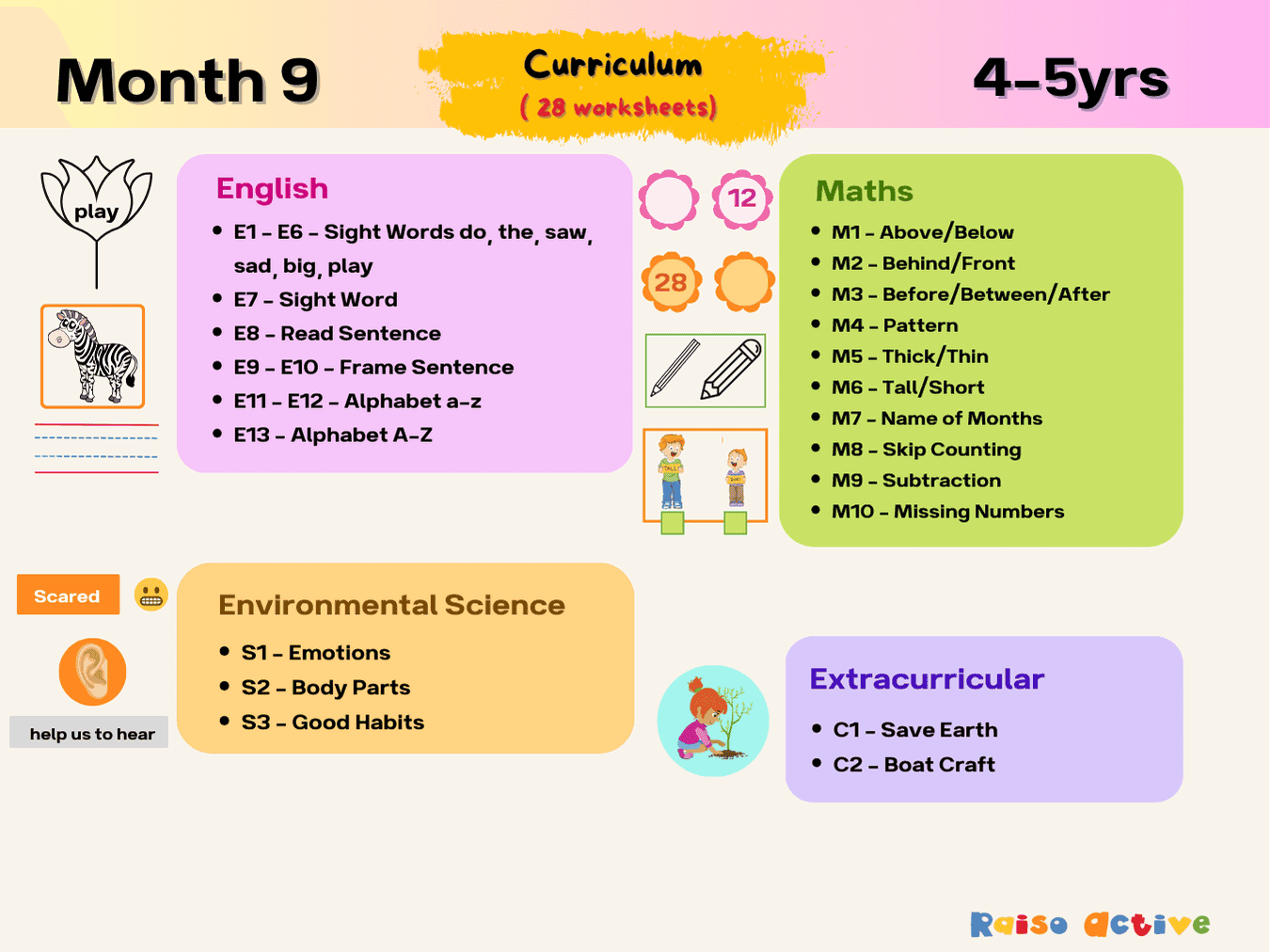
Part of the pack
Month 9: Play-Based Preschool Foundational Skills | Ages 4-5
This is page 30 of the pack. Ages 4-5 · Pre-KAges 4-5 · ReceptionAges 4-5 · LKGAges 4-5
Curriculum
- Earth & Environment > Seasons & Weather
How to use this worksheet
First, help your child cut out each small picture of a waste item from the bottom or side of the page, guiding their hand if scissor control is still developing. Look at each picture together and talk about what it is and whether it's wet waste, like food scraps, or dry waste, like paper or plastic. Once your child has decided, have them apply glue to the back of the picture and paste it into the matching bin printed on the page. Continue until every cutout item has been sorted and glued in its correct place.
Materials needed
- Scissors
- Glue
- Pencil
Extension activities
- 1Set up two real bins or boxes at home labeled 'wet' and 'dry' and let your child practice sorting actual household items into them for a day.
- 2Take a walk outside and point out any litter, discussing together whether it would count as wet or dry waste.
- 3Draw three new waste items your child can think of and ask them to say which bin each belongs in.
- 4Read a simple story or watch a short video about recycling and talk about why sorting waste helps the planet.
- 5Turn a clean recyclable container, like a cereal box, into a craft project instead of throwing it away, showing reuse in action.

Written by
Hemsweta Jain · Teacher Cheena
MBA and Early Childhood Educator, teaching since 2014 · Founder of RaisoActive, Mumbai
Every RaisoActive worksheet is designed and checked by the founder before publishing.
Published · Last reviewed
More from Month 9: Play-Based Preschool Foundational Skills | Ages 4-5

Alphabet Adventures: Write the First Letter - Small Alphabet Worksheet
Ages 4-6 · Pre-K–KindergartenAges 4-6 · Reception–Year 1Ages 4-6 · LKG–UKGAges 4-6
This worksheet strengthens phonemic awareness by asking children ages 4-6 to isolate the very first sound in a spoken word and match it to its lowercase letter - a skill that sits at the heart of early decoding and spelling. Because it uses small (lowercase) letters specifically, it also reinforces letter-case recognition, since children encounter lowercase print far more often than capitals once they begin reading books.

Sight Word 'Said' Worksheet for Preschoolers: Tracing, Reading, and Writing Fun!
Ages 3-5 · Preschool–Pre-KAges 3-5 · Nursery–ReceptionAges 3-5 · Nursery–LKGAges 3-5
The word 'said' appears constantly in early readers, especially in dialogue, but its spelling doesn't match how it sounds, which makes it a classic sight word that children ages 3-5 must memorize by sight rather than decode. This worksheet reinforces that memorization through multiple formats — coloring, searching, tracing, filling in blanks, and even a dot-to-dot — giving the word repeated exposure in different contexts. Building instant recognition of high-frequency words like 'said' is one of the most efficient ways to boost a young reader's fluency.

Good Habits Worksheet for Kids: Identifying Good and Bad Behaviors
Ages 3-5 · Preschool–Pre-KAges 3-5 · Nursery–ReceptionAges 3-5 · Nursery–LKGAges 3-5
This worksheet asks children ages 3-5 to evaluate everyday scenarios and judge whether they show a good habit or a bad one, which builds early moral reasoning and social awareness alongside color recognition. Coloring the thumbs-up icons green and thumbs-down icons red also reinforces the ability to follow a two-step instruction and connect a symbol to a category.

Help the Hen! Alphabet Worksheet: Writing Missing Capital Letters
Ages 4-5 · Pre-KAges 4-5 · ReceptionAges 4-5 · LKGAges 4-5
This maze-style worksheet asks children ages 4-5 to fill in missing capital letters in alphabetical order to help a hen find her way to the coop, turning alphabet sequencing practice into a small story-driven challenge. Recalling which capital letter comes next in the sequence — without a full alphabet chart to copy from — builds genuine alphabet mastery rather than passive letter recognition. The path-following format also adds a light visual tracking element that keeps the activity from feeling like a plain fill-in-the-blank drill.

Read and Match: Sentence Matching Worksheet for Early Readers
Ages 4-6 · Pre-K–KindergartenAges 4-6 · Reception–Year 1Ages 4-6 · LKG–UKGAges 4-6
This worksheet moves children ages 4-6 beyond single words into reading whole simple sentences and matching each one to the picture it describes. Comprehending a full sentence — not just recognizing individual words — is a genuine leap in reading skill, since it requires holding several words in mind together and connecting their combined meaning to an image.

Above and Below Worksheet: Identifying Objects' Positions
Ages 3-5 · Preschool–Pre-KAges 3-5 · Nursery–ReceptionAges 3-5 · Nursery–LKGAges 3-5
Understanding positional words like 'above' and 'below' helps children ages 3-5 build the spatial vocabulary that later supports following multi-step directions, reading maps, and even understanding math concepts like number lines. This worksheet asks children to look closely at a scene and judge the position of different objects relative to one another, which sharpens visual observation alongside language development. Marking each object with a tick or a cross also introduces early symbol-based recording, a small step toward more formal worksheet conventions used in later grades.

Learn the Sight Word 'the' - Fun Worksheet for Early Readers!
Ages 4-5 · Pre-KAges 4-5 · ReceptionAges 4-5 · LKGAges 4-5
'The' is one of the most frequently occurring words in the English language, and because it doesn't follow regular phonics rules, children ages 4-5 need to learn it by sight rather than by sounding it out. This worksheet builds that instant recognition through several different modes — coloring, tracing, searching, and using it in a sentence — which research on early literacy shows helps sight words stick more firmly than a single repetition. Mastering 'the' specifically gives children a huge boost in reading fluency, since it appears in nearly every simple sentence they'll encounter.

Before, After, and Between Numbers Worksheet for Preschoolers
Ages 4-5 · Pre-KAges 4-5 · ReceptionAges 4-5 · LKGAges 4-5
This worksheet extends basic number sequencing for children ages 4-5 by adding the concept of 'between,' which requires holding two numbers in mind at once and figuring out what falls in the middle — a more demanding mental task than simple before-and-after questions. Along with number fill-ins, the worksheet includes a picture identification task and a simple drawing exercise, giving children practice applying ordinal thinking ('comes after') beyond pure numerals. Together these tasks build the flexible number sense children need before tackling addition and subtraction.
Related worksheets

Preservation Worksheet: Complete the Sentences for a Greener Earth!
Ages 3-5 · Preschool–Pre-KAges 3-5 · Nursery–ReceptionAges 3-5 · Nursery–LKGAges 3-5
This worksheet helps children connect specific actions, like turning off a tap or planting a tree, to the bigger idea of protecting the environment, building early environmental vocabulary and cause-and-effect thinking. For ages 3-5, completing sentences with picture clues also supports beginning reading and writing skills in a meaningful, real-world context.

Pollution Awareness Worksheet for Kids: Circle the Correct Answer!
Ages 4-6 · Pre-K–KindergartenAges 4-6 · Reception–Year 1Ages 4-6 · LKG–UKGAges 4-6
This worksheet introduces children ages 4-6 to the idea that pollution comes in different forms — air, water, and land — and asks them to connect each type to a picture, building early environmental science vocabulary alongside visual reasoning. Sorting items into recycling categories afterward extends the lesson from simply naming a problem to practicing a real-world solution, which helps young children start to see themselves as capable of taking action. This blend of identification and hands-on sorting suits a preschooler's concrete way of understanding abstract ideas like 'the environment.'
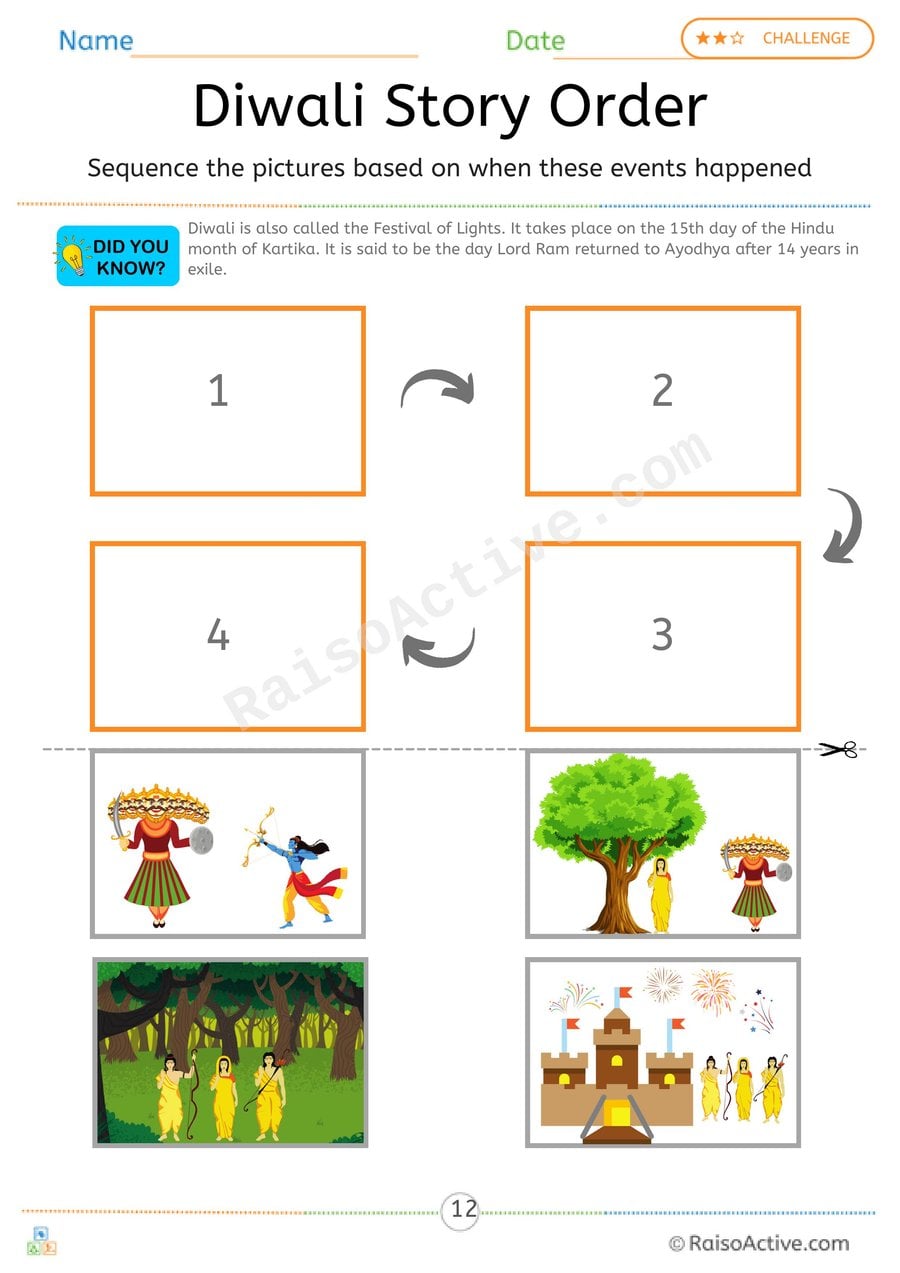
Diwali Sequencing Worksheet for Kids
Ages 4-8 · Pre-K–Grade 2Ages 4-8 · Reception–Year 3Ages 4-8 · LKG–Class 2Ages 4-8
Children learn that Diwali, the Festival of Lights, marks Lord Ram's return to Ayodhya, and put four pictures of the story in the right order.

Identify Flags Worksheet: Cut and Paste Matching Activity
Ages 4-6 · Pre-K–KindergartenAges 4-6 · Reception–Year 1Ages 4-6 · LKG–UKGAges 4-6
This worksheet helps children ages 4-6 practice matching a country's flag to its written name, building both visual discrimination and early geography vocabulary. Pairing a flag's specific colors and pattern with a country name strengthens the same visual-matching skill children later use for letter and word recognition.

Ganesha Puzzle Worksheet for Kids: Cut and Paste Fun!
Ages 4-8 · Pre-K–Grade 2Ages 4-8 · Reception–Year 3Ages 4-8 · LKG–Class 2Ages 4-8
Children colour Ganesha, paste the page on card and cut out the jigsaw pieces, then put the puzzle back together, building spatial reasoning.

Diwali Rocket Craft: Cut and Paste Worksheet for Kids
Ages 4-8 · Pre-K–Grade 2Ages 4-8 · Reception–Year 3Ages 4-8 · LKG–Class 2Ages 4-8
Children make a safe paper Diwali rocket by decorating, cutting, rolling and gluing, practising scissor skills and following steps.
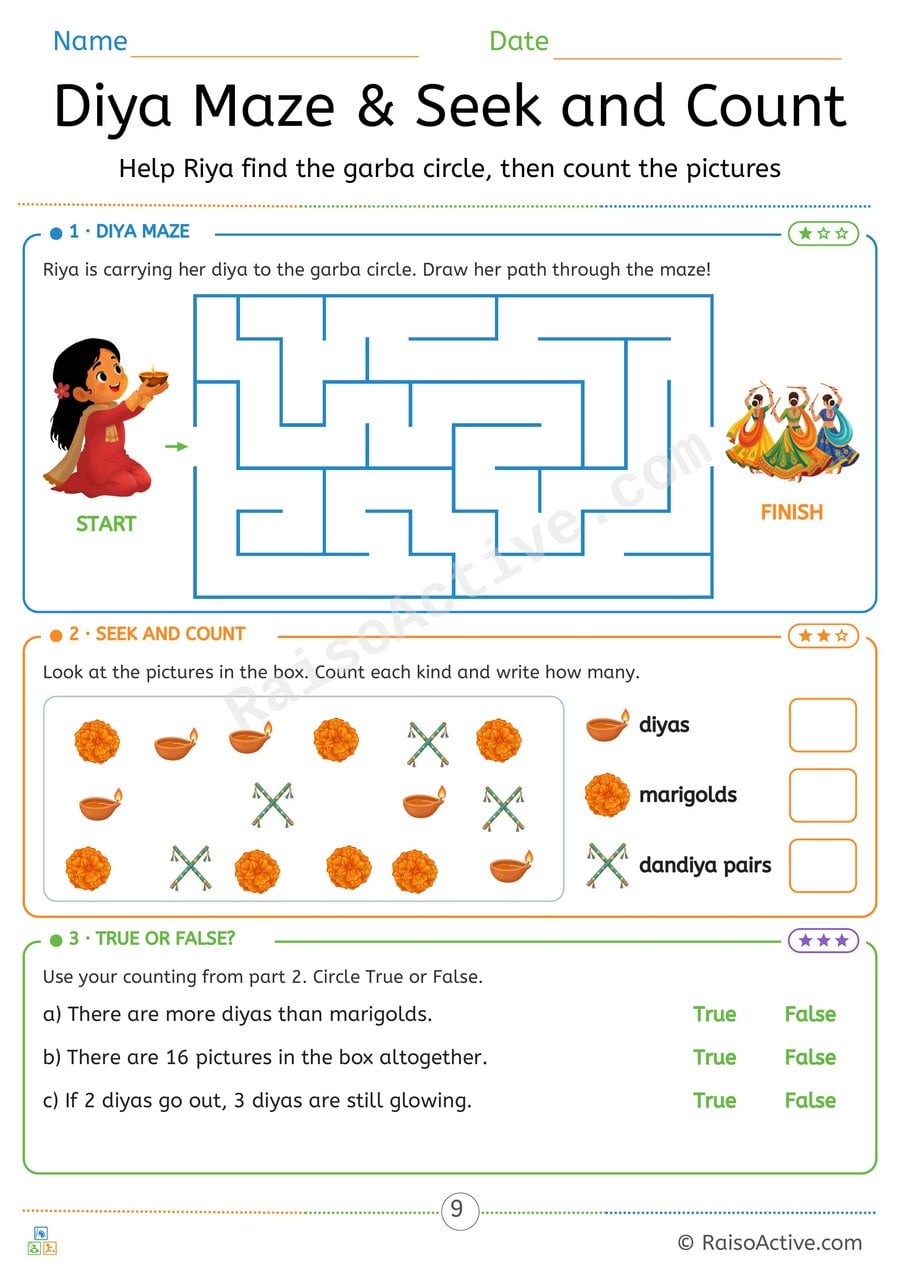
Navratri Diya Maze and Seek-and-Count Worksheet
Ages 4-6 · Pre-K–KindergartenAges 4-6 · Reception–Year 1Ages 4-6 · LKG–UKGAges 4-6
Children plan a path through a maze, count and sort mixed pictures by kind, and use their counts to decide if sentences are true or false.
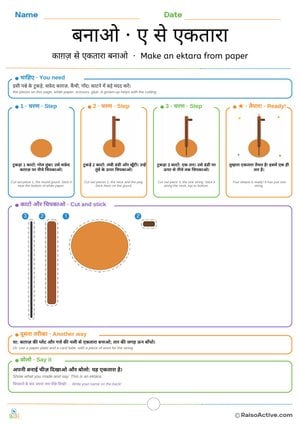
Make a Paper Ektara: Hindi Letter ए (e) Cut and Stick Craft | बनाओ · ए से एकतारा
Ages 4-7 · Pre-K–Grade 1Ages 4-7 · Reception–Year 2Ages 4-7 · LKG–Class 1Ages 4-7
Children cut out the numbered pieces and stick them in order to make a one-string ektara from a gourd, a neck and a single string, then show it and say a full sentence about it. It links the letter ए with a real picture word, एकतारा, and practises scissor control and following steps.
Guides for this topic

Age-Appropriate Problem-Solving Activities: Building Critical Thinkers from the Ground Up
Discover fun, age-appropriate problem-solving activities for children ages 1-8. Build critical thinking, logic, and reasoning skills through play-based learning.

Growing Green Hearts: A Comprehensive Guide to Teaching Environmental Awareness to Preschoolers
Practical guide to teaching preschoolers ages 2-6 about nature, recycling, water conservation, and Earth Day with Indian context and simple home activities.

Discovering Wonder: Nature-Based Learning Activities That Captivate Young Children
Explore nature-based learning activities for children ages 2–7 — leaf rubbings, bug hunts, nature journals, and seasonal Indian outdoor ideas that spark wonder.
Reviews
Every worksheet for ages 3–5, no watermark
Members download the full library of 1,000+ worksheets and every activity pack without watermarks or daily limits. One year costs ₹999 in India or $20 elsewhere.
See membership plansOr download any worksheet free with a watermark (5 a day).