Preservation Worksheet: Complete the Sentences for a Greener Earth!
This worksheet helps children connect specific actions, like turning off a tap or planting a tree, to the bigger idea of protecting the environment, building early environmental vocabulary and cause-and-effect thinking. For ages 3-5, completing sentences with picture clues also supports beginning reading and writing skills in a meaningful, real-world context.
Part of the pack
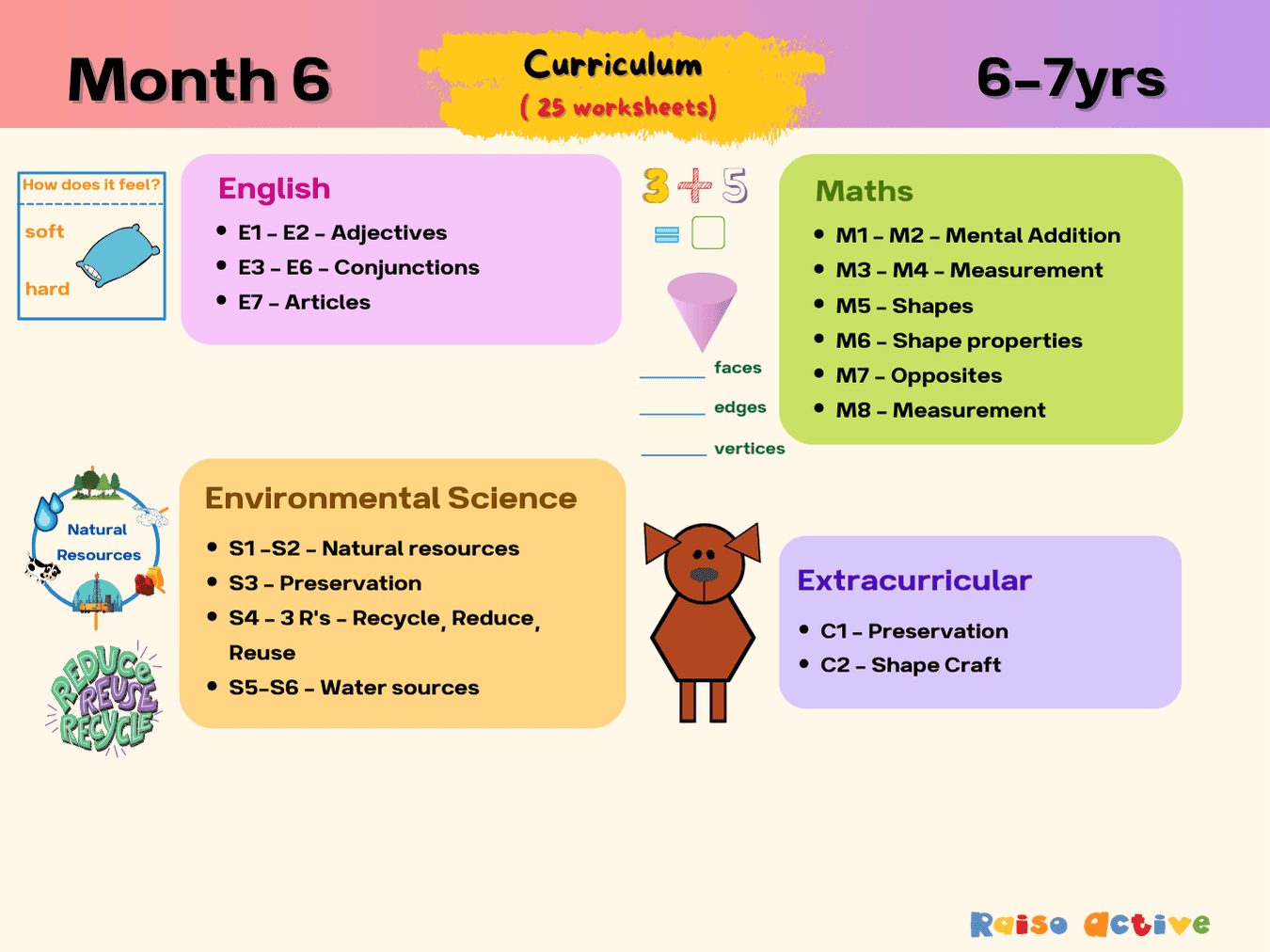
Month 6: Grammar, Math, Environmental Science | Ages 6-7
This is page 21 of the pack. Ages 6-7 · Grade 1Ages 6-7 · Year 2Ages 6-7 · Class 1Ages 6-7
Made for your child
A whole activity pack made with their name
60 pages to spot, build, trace and write their own name, plus pages about their favourites, feelings and family. See a free preview with their name.
Make an All About Me packFree preview · free for members
Or start free: a name tracing sheet with their nameCurriculum
- Earth & Environment > Environment Awareness
How to use this worksheet
Look at the first sentence together and read it aloud, pausing at the missing word. Point out the picture clue next to the sentence and ask your child what it shows, helping them connect the image to the word that completes the sentence. Have your child write the missing word in the blank, sounding out letters as needed, then read the finished sentence aloud together. Repeat this process for each remaining sentence on the page, checking that every completed sentence makes sense and matches its picture.
Materials needed
- Pencil
- Crayons
Extension activities
- 1Draw a picture of one way your child personally helps take care of the environment, like turning off lights or recycling.
- 2Take a short walk together and point out examples of people caring for or harming nature.
- 3Create a family pledge listing three small actions everyone will do to help the environment, based on the worksheet.
- 4Act out each completed sentence, like pretending to turn off a faucet or plant a seed.
- 5Read a picture book about caring for the Earth and connect it to the ideas in the worksheet.

Written by
Hemsweta Jain · Teacher Cheena
MBA and Early Childhood Educator, teaching since 2014 · Founder of RaisoActive, Mumbai
Every RaisoActive worksheet is designed and checked by the founder before publishing.
Published · Last reviewed
More from Month 6: Grammar, Math, Environmental Science | Ages 6-7

Parent's Guide: Fun Activities for Adjectives, Conjunctions, and More!
Ages 3-5 · Preschool–Pre-KAges 3-5 · Nursery–ReceptionAges 3-5 · Nursery–LKGAges 3-5
This parent's guide bundles hands-on activities around adjectives, conjunctions, measurement, and recycling, giving children ages 3-5 exposure to both language concepts and early science-adjacent skills within everyday, low-prep activities. Combining grammar practice with physical tasks like measuring height or building a planter helps abstract concepts, like what a conjunction is, become grounded in something concrete and memorable.

Mental Addition Worksheet: Add Dots and Find the Total!
Ages 4-6 · Pre-K–KindergartenAges 4-6 · Reception–Year 1Ages 4-6 · LKG–UKGAges 4-6
This worksheet bridges concrete counting and mental addition by having children count visible dots, add them to a given number, and then draw missing dots to complete equations, reinforcing that addition means combining quantities together. For ages 4-6, physically drawing the missing dots makes the abstract equation tangible, helping cement the connection between a math symbol and what it actually represents.

Natural Resources Worksheet for Kids: Fill in the Blanks!
Ages 3-5 · Preschool–Pre-KAges 3-5 · Nursery–ReceptionAges 3-5 · Nursery–LKGAges 3-5
This worksheet introduces young children to the idea that everyday materials like water, wood, and air come from the natural world, building early science vocabulary around natural resources. For ages 3-5, matching a picture to its correct word also reinforces beginning reading skills and the idea that objects around them have specific names tied to where they come from.

Conjunctions Worksheet: Practice with 'and', 'but', 'so', and 'yet'
Ages 4-6 · Pre-K–KindergartenAges 4-6 · Reception–Year 1Ages 4-6 · LKG–UKGAges 4-6
This worksheet introduces four common coordinating conjunctions, teaching children to notice how 'and,' 'but,' 'so,' and 'yet' each connect ideas differently, whether adding information, showing contrast, or indicating a result. For ages 4-6, this is an early step toward writing compound sentences and understanding that word choice changes the meaning and flow of a sentence.

Mental Addition Worksheet for Kids: Practice Adding Numbers!
Ages 4-6 · Pre-K–KindergartenAges 4-6 · Reception–Year 1Ages 4-6 · LKG–UKGAges 4-6
This worksheet builds mental math fluency by asking children to solve simple addition problems in their heads rather than relying on counters or drawings, strengthening the internal number sense that supports faster, more confident arithmetic. For ages 4-6, moving from concrete counting toward mental calculation is a significant milestone that sets the foundation for later multi-digit addition.
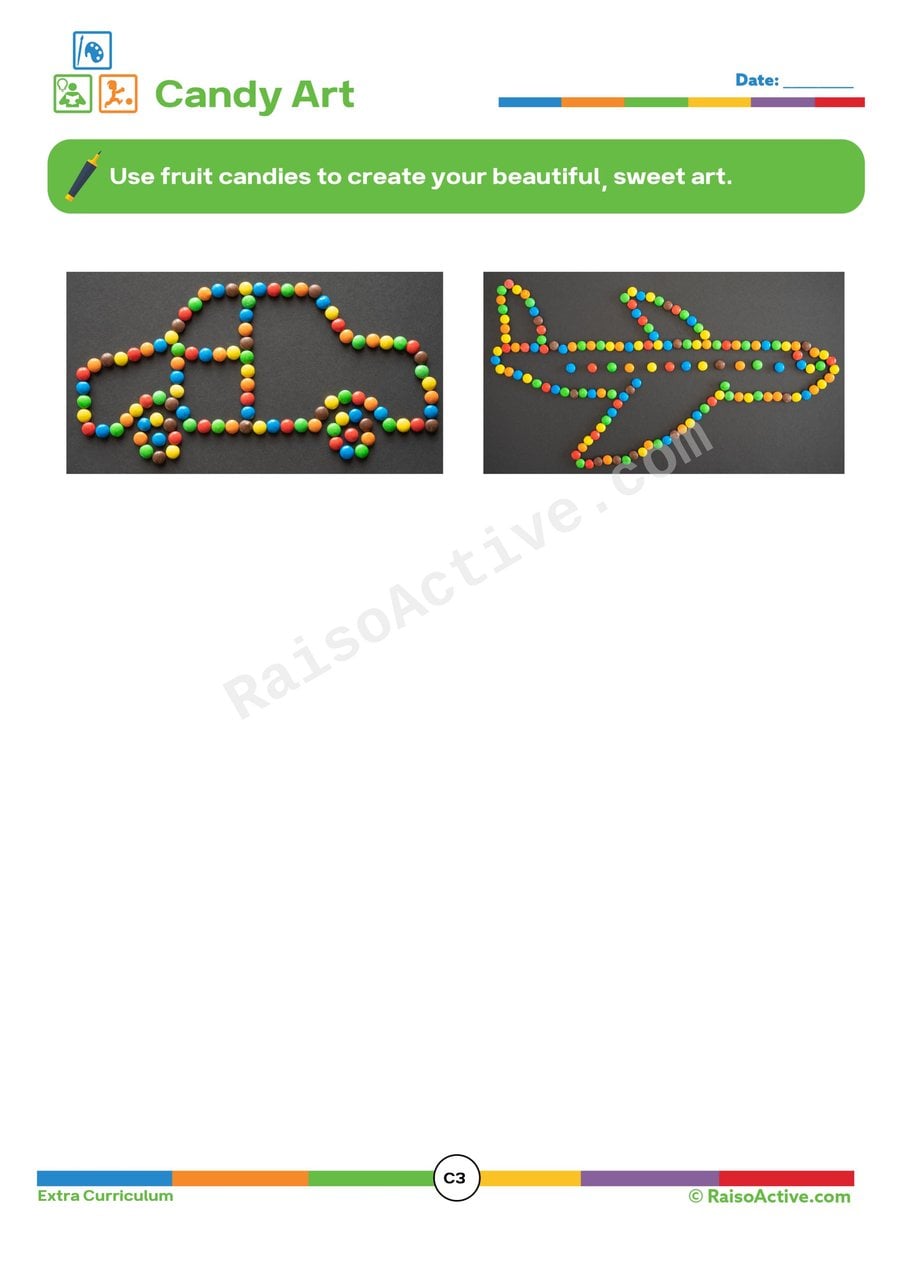
Candy Art: Create Sweet Art with Fruit Candies!
Ages 3-5 · Preschool–Pre-KAges 3-5 · Nursery–ReceptionAges 3-5 · Nursery–LKGAges 3-5
Arranging fruit candies into the outline of a car and an airplane gives children ages 3-5 a playful, sensory way to practice fine motor precision and pattern-following, since each candy must be placed carefully to build the recognizable shape. This open-ended art activity also builds early spatial reasoning, as children figure out how small individual pieces combine to form a larger, specific picture. Because the medium is candy rather than paper, it adds a multisensory, highly motivating twist that keeps younger children engaged longer than a typical craft.

Conjunctions Worksheet: Expanding Sentences (Ages 4-6)
Ages 4-6 · Pre-K–KindergartenAges 4-6 · Reception–Year 1Ages 4-6 · LKG–UKGAges 4-6
This worksheet moves beyond simple conjunction identification to active sentence expansion, asking children to use conjunctions like 'but,' 'when,' 'until,' 'because,' and 'if' to add new information and build longer, more sophisticated sentences. For ages 4-6, this kind of guided sentence-combining is a key step toward more complex, connected storytelling in both spoken and written language.
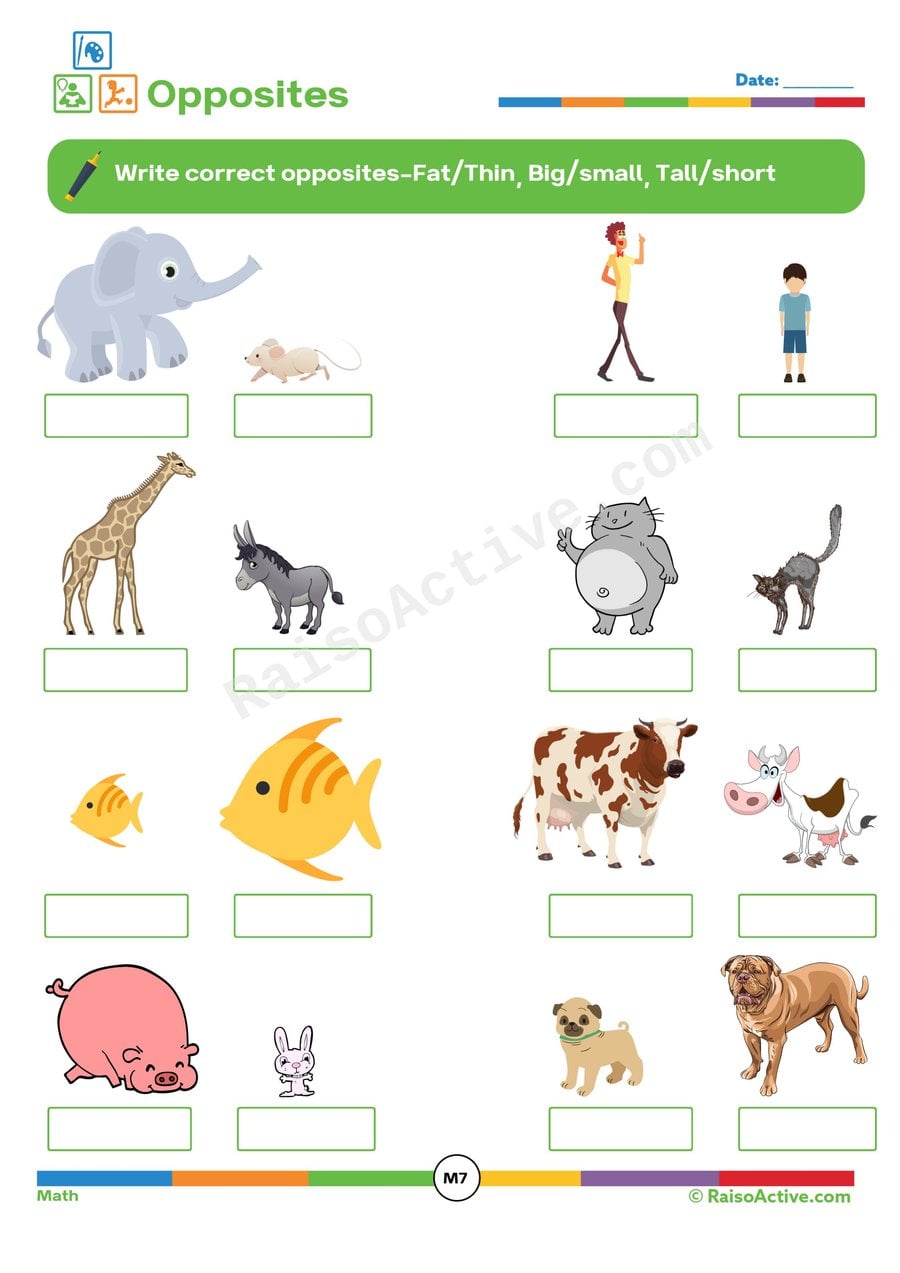
Opposites Worksheet: Fat/Thin, Big/Small, Tall/Short
Ages 3-5 · Preschool–Pre-KAges 3-5 · Nursery–ReceptionAges 3-5 · Nursery–LKGAges 3-5
Identifying opposite pairs like fat and thin, big and small, and tall and short teaches children ages 3-5 to think comparatively, recognizing that these descriptive words only make sense in relation to something else. This early vocabulary work also builds the reasoning skills needed to compare and contrast, a thinking pattern that shows up across science, math, and language throughout their schooling.
Related worksheets

Save Earth: A Cut and Paste Sorting Worksheet for Kids
Ages 3-5 · Preschool–Pre-KAges 3-5 · Nursery–ReceptionAges 3-5 · Nursery–LKGAges 3-5
This cut-and-paste activity introduces children ages 3-5 to the practical concept of waste sorting by having them classify pictured items as 'wet' or 'dry' waste - an early, hands-on entry point into environmental responsibility. Cutting along the lines and gluing each piece into its correct bin also builds scissor control and precise hand placement, both important fine motor milestones at this age.

Pollution Awareness Worksheet for Kids: Circle the Correct Answer!
Ages 4-6 · Pre-K–KindergartenAges 4-6 · Reception–Year 1Ages 4-6 · LKG–UKGAges 4-6
This worksheet introduces children ages 4-6 to the idea that pollution comes in different forms — air, water, and land — and asks them to connect each type to a picture, building early environmental science vocabulary alongside visual reasoning. Sorting items into recycling categories afterward extends the lesson from simply naming a problem to practicing a real-world solution, which helps young children start to see themselves as capable of taking action. This blend of identification and hands-on sorting suits a preschooler's concrete way of understanding abstract ideas like 'the environment.'
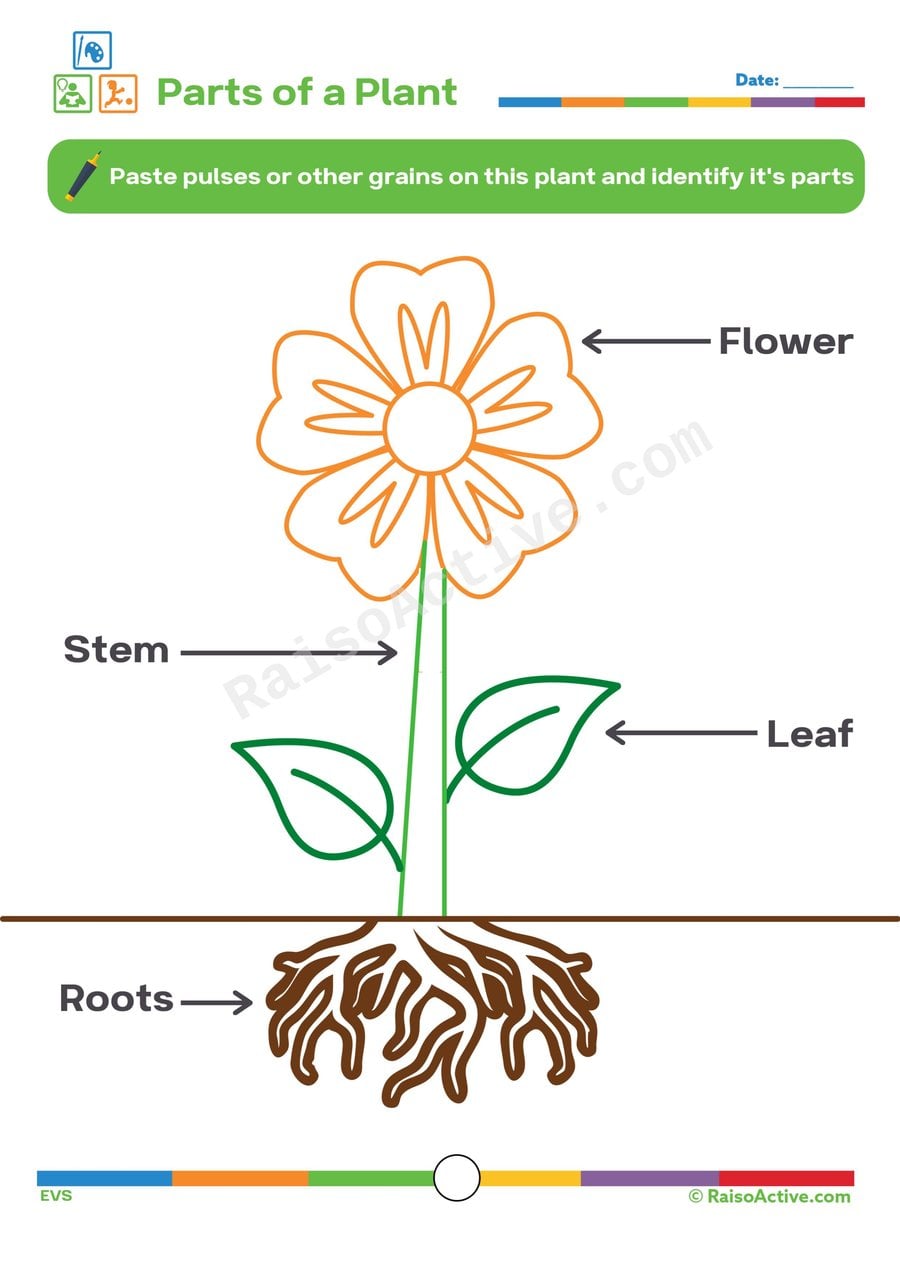
Parts of a Plant Worksheet: Identify and Label!
Ages 3-5 · Preschool–Pre-KAges 3-5 · Nursery–ReceptionAges 3-5 · Nursery–LKGAges 3-5
This activity teaches children ages 3-5 the basic parts of a plant — flower, stem, leaf, and roots — by having them label a diagram and add texture using real pulses or grains glued onto the plant shape. Combining a tactile material with each labeled part helps young children retain the vocabulary better than labeling alone, since touch and sight reinforce the same information.

Parts of a Leaf Worksheet for Preschoolers: Learn and Play!
Ages 3-5 · Preschool–Pre-KAges 3-5 · Nursery–ReceptionAges 3-5 · Nursery–LKGAges 3-5
This hands-on activity teaches children ages 3-5 the parts of a leaf — tip, blade, veins, midrib, petiole, and stem — by having them shape a leaf from playdough while comparing it to a real leaf. Building a physical model alongside a real specimen helps children connect abstract vocabulary to tangible features they can see and touch, which is especially effective for this age group.

My Address Worksheet: Color the State and Fill in Your Details!
Ages 3-5 · Preschool–Pre-KAges 3-5 · Nursery–ReceptionAges 3-5 · Nursery–LKGAges 3-5
This worksheet introduces children ages 3-5 to their personal address as a piece of core safety knowledge, while the map-coloring task builds early geography skills by having them physically locate and color their home state within India. Practicing house number, street, city, and PIN code also gives meaningful, motivated handwriting practice since the words are personally relevant.

Taste Bud Sorting Worksheet: Identify and Sort Foods by Taste!
Ages 4-6 · Pre-K–KindergartenAges 4-6 · Reception–Year 1Ages 4-6 · LKG–UKGAges 4-6
This worksheet introduces children ages 4-6 to four basic taste categories — salty, sour, bitter, and sweet — by having them sort pictured foods into the correct group. Beyond taste vocabulary, sorting foods by an invisible property like flavor (rather than an obvious one like color or shape) pushes children to draw on memory and prior experience, building more advanced classification skills.
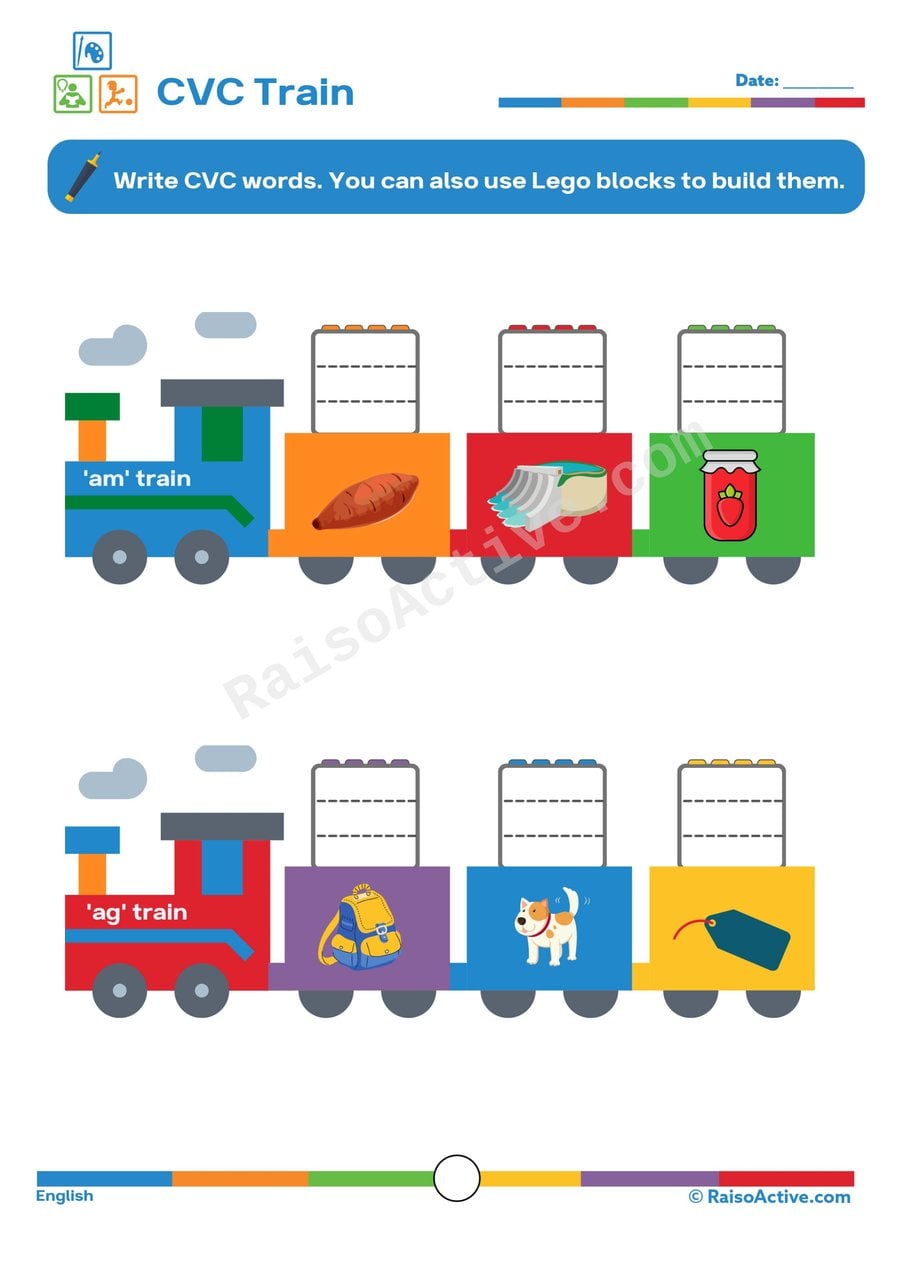
CVC Train Worksheet: Write and Build CVC Words!
Ages 4-6 · Pre-K–KindergartenAges 4-6 · Reception–Year 1Ages 4-6 · LKG–UKGAges 4-6
This worksheet gives children ages 4-6 focused practice blending letter sounds into consonant-vowel-consonant words, using train-car pictures as clues for words like 'dog,' 'hen,' or 'cup.' Because children both write the word and can optionally build it with Lego blocks, this worksheet reinforces the same phonics skill through two different physical actions — handwriting and hands-on construction — which helps the spelling patterns stick.
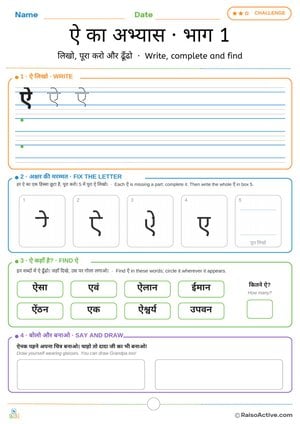
Hindi Letter ऐ (ai) Practice 1: Write, Fix the Letter and Find | ऐ का अभ्यास · भाग 1
Ages 4-7 · Pre-K–Grade 1Ages 4-7 · Reception–Year 2Ages 4-7 · LKG–Class 1Ages 4-7
A challenge page: write ऐ between the lines, complete four letters that are each missing a part and then write the whole ऐ in box 5, find ऐ in words such as ऐसा, ऐलान, ऐंठन and ऐश्वर्य, and draw a picture. ऐ is a different vowel from ए, not a long version of it.
Guides for this topic

Documenting Learning Without Drowning in Data: A Practical Guide for Parents and Teachers
Learn practical ways to document your child's learning without overwhelm. Simple portfolios, observation tips, and printable trackers for ages 1-8.

Growing Green Hearts: A Comprehensive Guide to Teaching Environmental Awareness to Preschoolers
Practical guide to teaching preschoolers ages 2-6 about nature, recycling, water conservation, and Earth Day with Indian context and simple home activities.

Discovering Wonder: Nature-Based Learning Activities That Captivate Young Children
Explore nature-based learning activities for children ages 2–7 — leaf rubbings, bug hunts, nature journals, and seasonal Indian outdoor ideas that spark wonder.
Reviews
Every worksheet for ages 3–5, no watermark
Members download the full library of 1,000+ worksheets and every activity pack without watermarks or daily limits. One year costs ₹999 in India or $20 elsewhere.
See membership plansOr download any worksheet free with a watermark (5 a day).