Parent's Guide: Fun Activities for Adjectives, Conjunctions, and More!
This parent's guide bundles hands-on activities around adjectives, conjunctions, measurement, and recycling, giving children ages 3-5 exposure to both language concepts and early science-adjacent skills within everyday, low-prep activities. Combining grammar practice with physical tasks like measuring height or building a planter helps abstract concepts, like what a conjunction is, become grounded in something concrete and memorable.
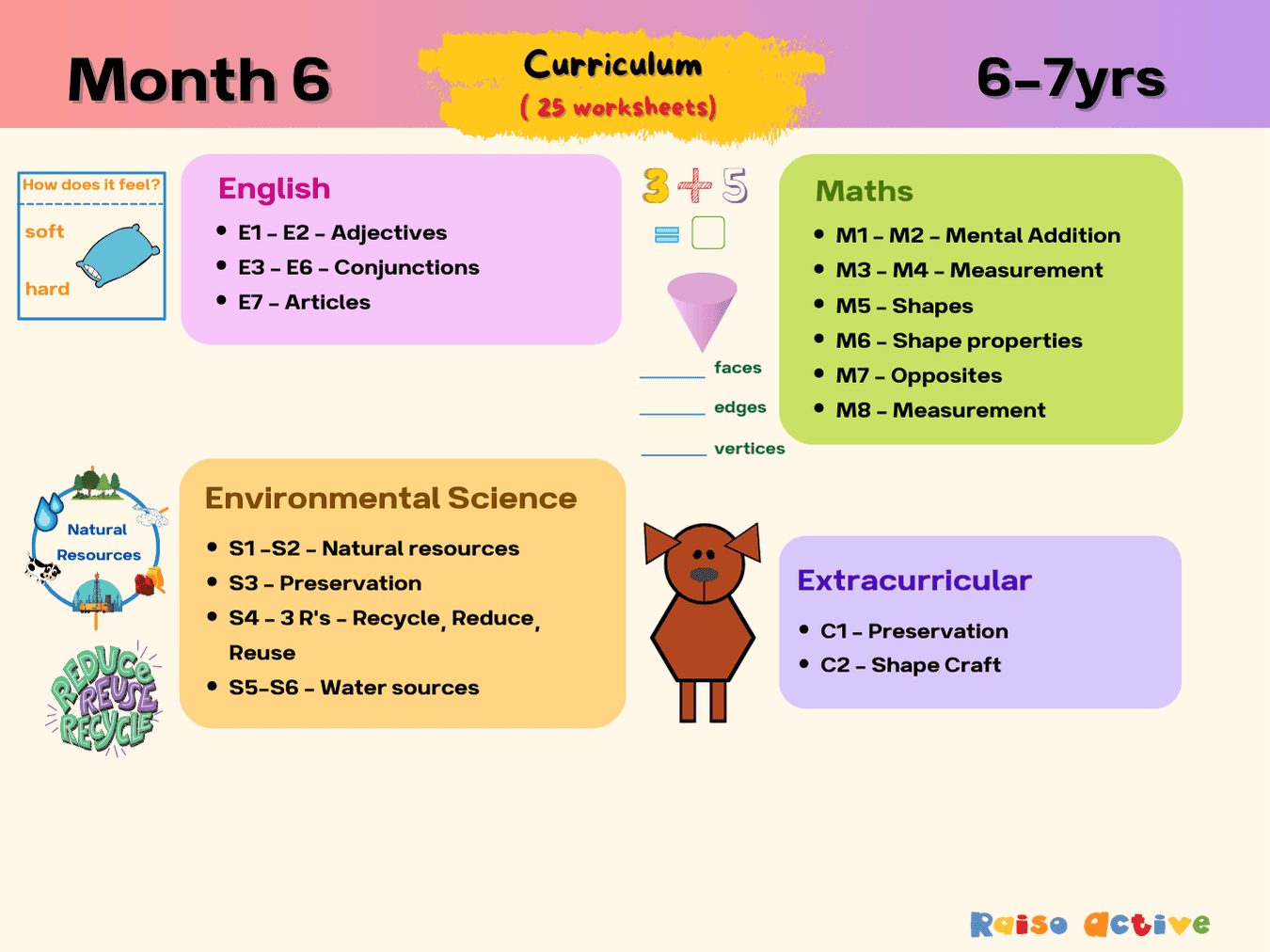
Part of the pack
Month 6: Grammar, Math, Environmental Science | Ages 6-7
This is page 2 of the pack. Ages 6-7 · Grade 1Ages 6-7 · Year 2Ages 6-7 · Class 1Ages 6-7
Curriculum
- Grammar > Adjectives
How to use this worksheet
Read through the guide together and choose one activity to try first based on your child's current interest, whether that's describing words, connecting words, measuring, or a recycling craft. Gather any simple materials needed, like paper, a measuring tape, or a clean plastic bottle, before starting. Follow the guide's instructions for that activity step by step, encouraging your child to do as much of the hands-on work themselves as possible. Once completed, move to a different activity from the guide on another day, working through the full set gradually.
Extension activities
- 1Create flashcards with different adjectives and have your child use them to describe favorite toys or foods.
- 2Read a storybook together and pause to identify conjunctions, like 'and' or 'but,' whenever they appear.
- 3Make a height chart on a wall and measure and mark your child's growth every few months.
- 4Turn a clean plastic bottle into a small planter as a hands-on recycling project.
- 5Combine two skills at once, like describing the planter's parts using adjectives after building it.

Written by
Hemsweta Jain · Teacher Cheena
MBA and Early Childhood Educator, teaching since 2014 · Founder of RaisoActive, Mumbai
Every RaisoActive worksheet is designed and checked by the founder before publishing.
Published · Last reviewed
More from Month 6: Grammar, Math, Environmental Science | Ages 6-7
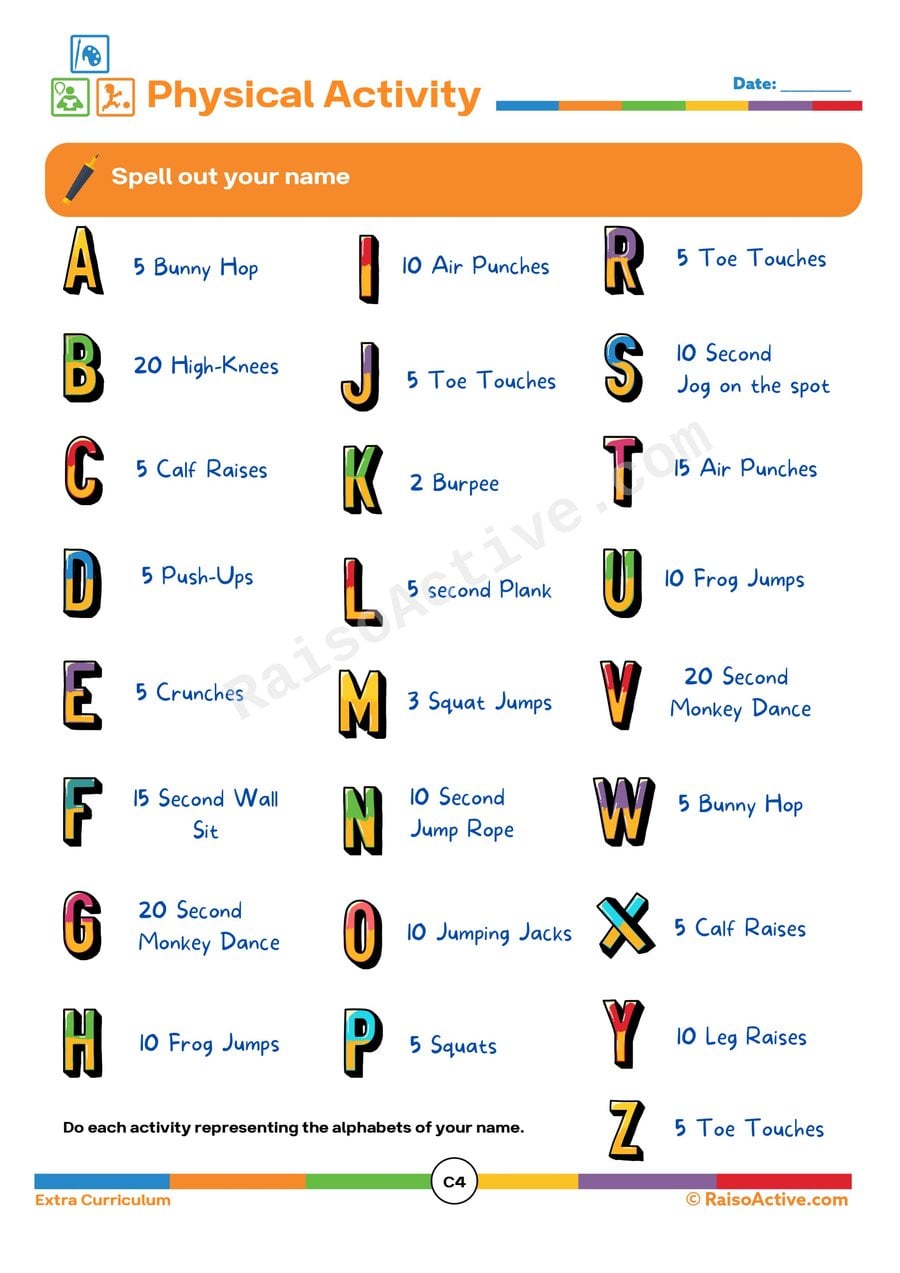
Physical Activity Worksheet: Spell Your Name!
Ages 3-5 · Preschool–Pre-KAges 3-5 · Nursery–ReceptionAges 3-5 · Nursery–LKGAges 3-5
This worksheet turns spelling practice into a physical activity by pairing each letter of the alphabet with a specific exercise, so children spell their name while getting active movement in between. For ages 3-5, connecting letter recognition to gross motor movement supports both early literacy and physical development at once, appealing especially to kinesthetic learners.

Water Sources Flashcards: Learn About Natural Water Bodies!
Ages 4-6 · Pre-K–KindergartenAges 4-6 · Reception–Year 1Ages 4-6 · LKG–UKGAges 4-6
Sorting natural water into distinct types — a river that flows, a lake that's still and enclosed, an ocean that's salty and vast — introduces a 4-6 year old to early classification skills in earth science, well before they'd encounter these terms formally in school. Writing a short description on the back of each card also gives early writers a low-pressure reason to put a few words on paper about something they've just learned.
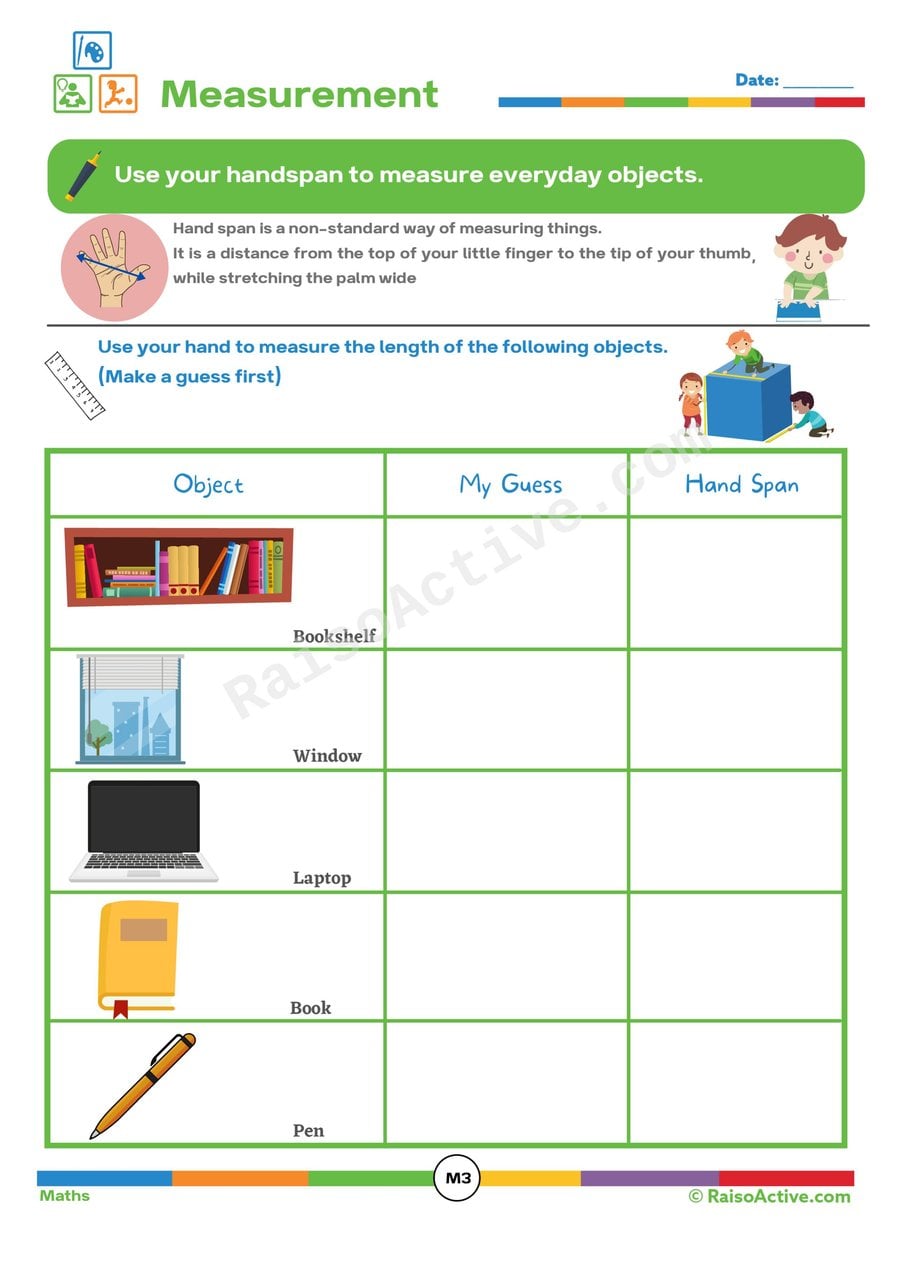
Hand Span Measurement Worksheet for Kids
Ages 4-6 · Pre-K–KindergartenAges 4-6 · Reception–Year 1Ages 4-6 · LKG–UKGAges 4-6
This worksheet introduces measurement using a non-standard unit, a child's own hand span, teaching that length can be measured with tools other than a ruler while also building estimation skills. For ages 4-6, comparing a guess to an actual measurement helps develop number sense around length and distance in a hands-on, personally meaningful way.

Articles Adventure: A, An, and The Worksheet for Preschoolers
Ages 4-6 · Pre-K–KindergartenAges 4-6 · Reception–Year 1Ages 4-6 · LKG–UKGAges 4-6
Choosing between 'a,' 'an,' and 'the' teaches children ages 4-6 one of English grammar's trickier rules — that 'an' is used before words starting with a vowel sound while 'a' comes before consonant sounds — building an ear for language patterns that native speakers often absorb through repetition rather than explicit rules. Practicing these small but frequent words also smooths out overall sentence fluency, since articles appear constantly in everyday speech and writing.
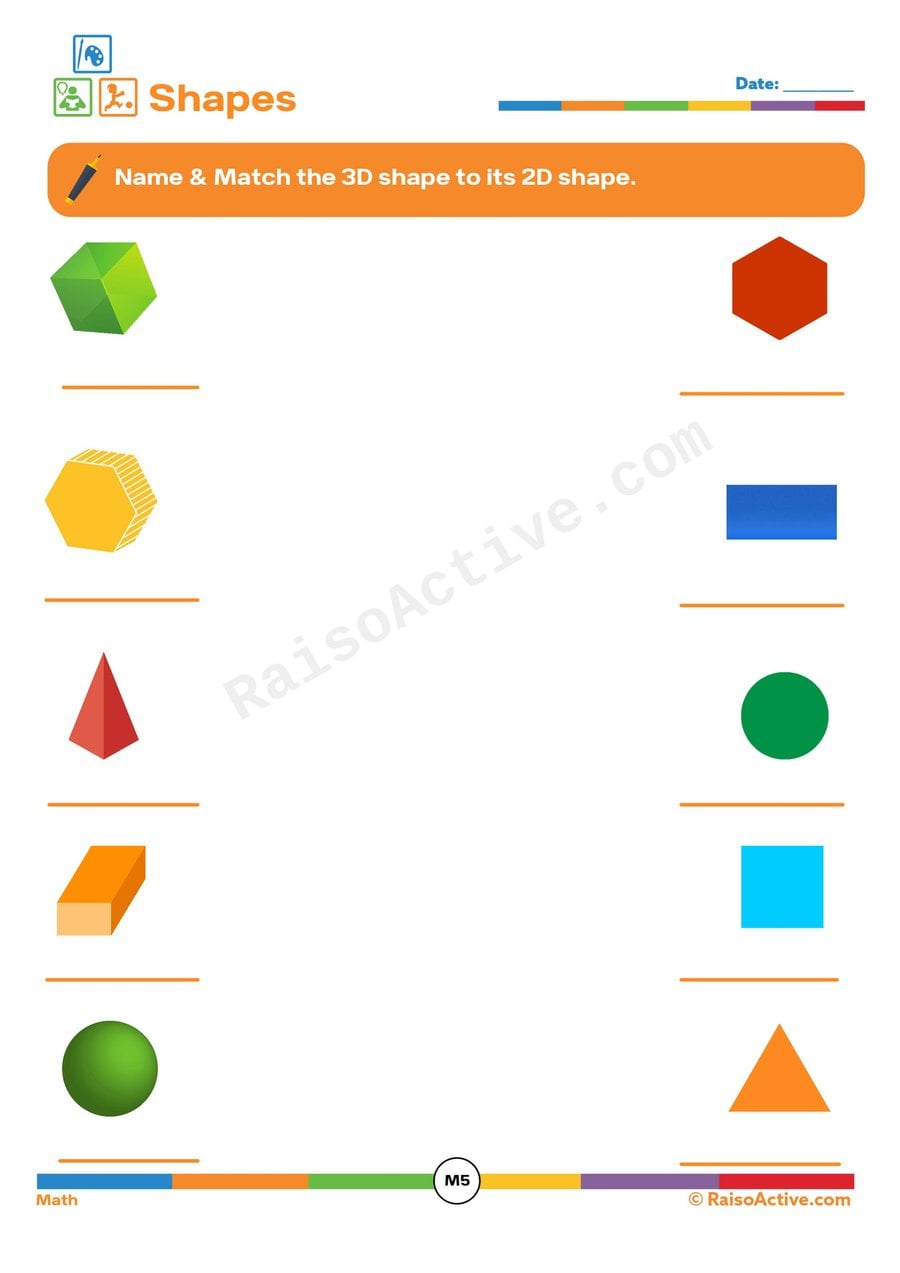
Shape Match: 3D to 2D Shapes Worksheet
Ages 4-5 · Pre-KAges 4-5 · ReceptionAges 4-5 · LKGAges 4-5
This worksheet builds an important geometric connection by asking children to match 3D shapes, like a cube or sphere, to the 2D shape that appears on their flat faces, such as a square or circle. For ages 4-5, understanding that solid shapes are made up of flat shapes is a foundational geometry concept that bridges basic shape recognition with more advanced spatial reasoning.

Conjunctions Worksheet: Expanding Sentences (Ages 4-6)
Ages 4-6 · Pre-K–KindergartenAges 4-6 · Reception–Year 1Ages 4-6 · LKG–UKGAges 4-6
This worksheet moves beyond simple conjunction identification to active sentence expansion, asking children to use conjunctions like 'but,' 'when,' 'until,' 'because,' and 'if' to add new information and build longer, more sophisticated sentences. For ages 4-6, this kind of guided sentence-combining is a key step toward more complex, connected storytelling in both spoken and written language.

Non-Standard Measurement Worksheet for Kids: Comparing Objects
Ages 4-6 · Pre-K–KindergartenAges 4-6 · Reception–Year 1Ages 4-6 · LKG–UKGAges 4-6
This worksheet extends measurement practice using multiple non-standard units, cubes, buttons, and paper clips, so children see that the same object can be measured different ways depending on the tool used. For ages 4-6, comparing capacity by counting how many glasses fill a bottle adds an early introduction to volume alongside length, broadening their measurement vocabulary.
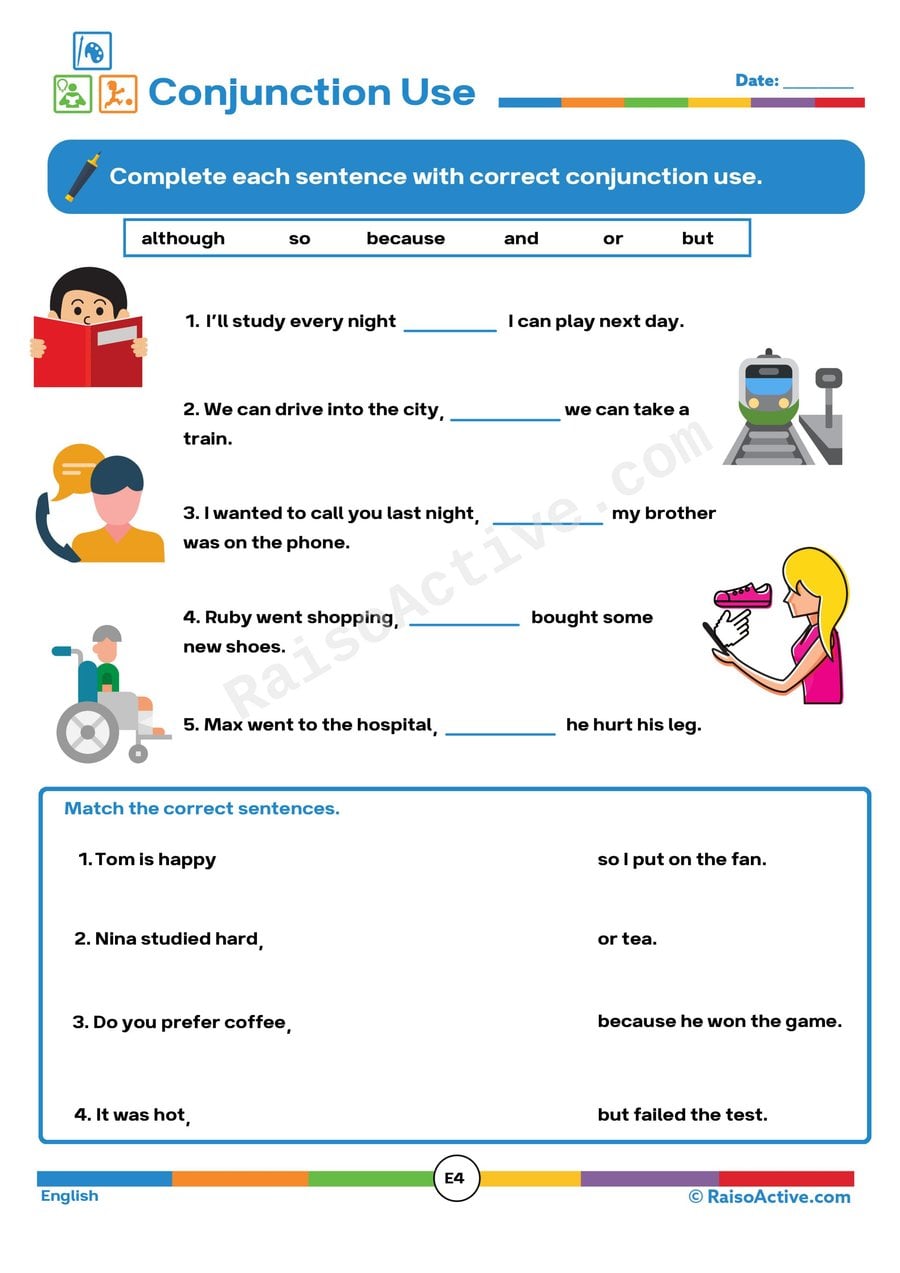
Conjunctions Worksheet: Complete the Sentences!
Ages 4-6 · Pre-K–KindergartenAges 4-6 · Reception–Year 1Ages 4-6 · LKG–UKGAges 4-6
Choosing the correct conjunction to complete a sentence teaches children ages 4-6 how small connecting words like 'and,' 'but,' and 'or' link two ideas together into one longer, more complex thought. Practicing this helps move children from simple, short sentences toward the more sophisticated sentence structures they'll need for both reading comprehension and their own writing.
Related worksheets

Fun Activities for Kids: Parent's Guide to Learning Through Play
Ages 3-5 · Preschool–Pre-KAges 3-5 · Nursery–ReceptionAges 3-5 · Nursery–LKGAges 3-5
This parent's guide gives caregivers of children ages 3-5 a set of play-based activities focused on phonics and sentence-building, translating early literacy concepts into hands-on games rather than seated worksheet time. Learning through play, such as storytelling or naming body parts during movement, helps young children absorb language concepts without the pressure of a formal lesson. Covering both phonics and sentence-building in one guide gives caregivers flexibility to match the activity to their child's mood and energy level.

Parent's Guide: Fun Activities for Early Learning
Ages 3-5 · Preschool–Pre-KAges 3-5 · Nursery–ReceptionAges 3-5 · Nursery–LKGAges 3-5
This parent guide brings together five activities spanning punctuation, moon phases, subject and predicate, the solar system, and counting and addition, giving children ages 3-5 a broad sampler of language arts, science, and math concepts through hands-on materials like Oreo biscuits and a flashlight. Working across such different topics in one guide helps children practice shifting attention between subjects, a skill that supports the more structured subject-switching they'll encounter in school.

Parent's Guide: Fun Activities for Letter Recognition, Conversation & More!
Ages 3-5 · Preschool–Pre-KAges 3-5 · Nursery–ReceptionAges 3-5 · Nursery–LKGAges 3-5
This guide is a collection of hands-on activities parents can use to build letter recognition, phonics awareness, basic conversation skills, and spatial vocabulary in three- to five-year-olds through everyday play rather than worksheet drills. Because it's built around games like hiding letters or setting up a pretend shop, it teaches these early literacy and language skills through movement and imagination, which holds young children's attention far longer than seated tasks.

Measurement Worksheet: Big to Small & Hand Measurement Fun!
Ages 3-5 · Preschool–Pre-KAges 3-5 · Nursery–ReceptionAges 3-5 · Nursery–LKGAges 3-5
Ranking objects from biggest to smallest teaches children to make and justify comparative judgments, while the hand-measurement activity introduces the idea of using a non-standard unit, their own hand, to measure length, both foundational concepts before children move on to rulers and standardized units. This combination suits ages three to five well, since it keeps measurement concrete and physical rather than abstract.
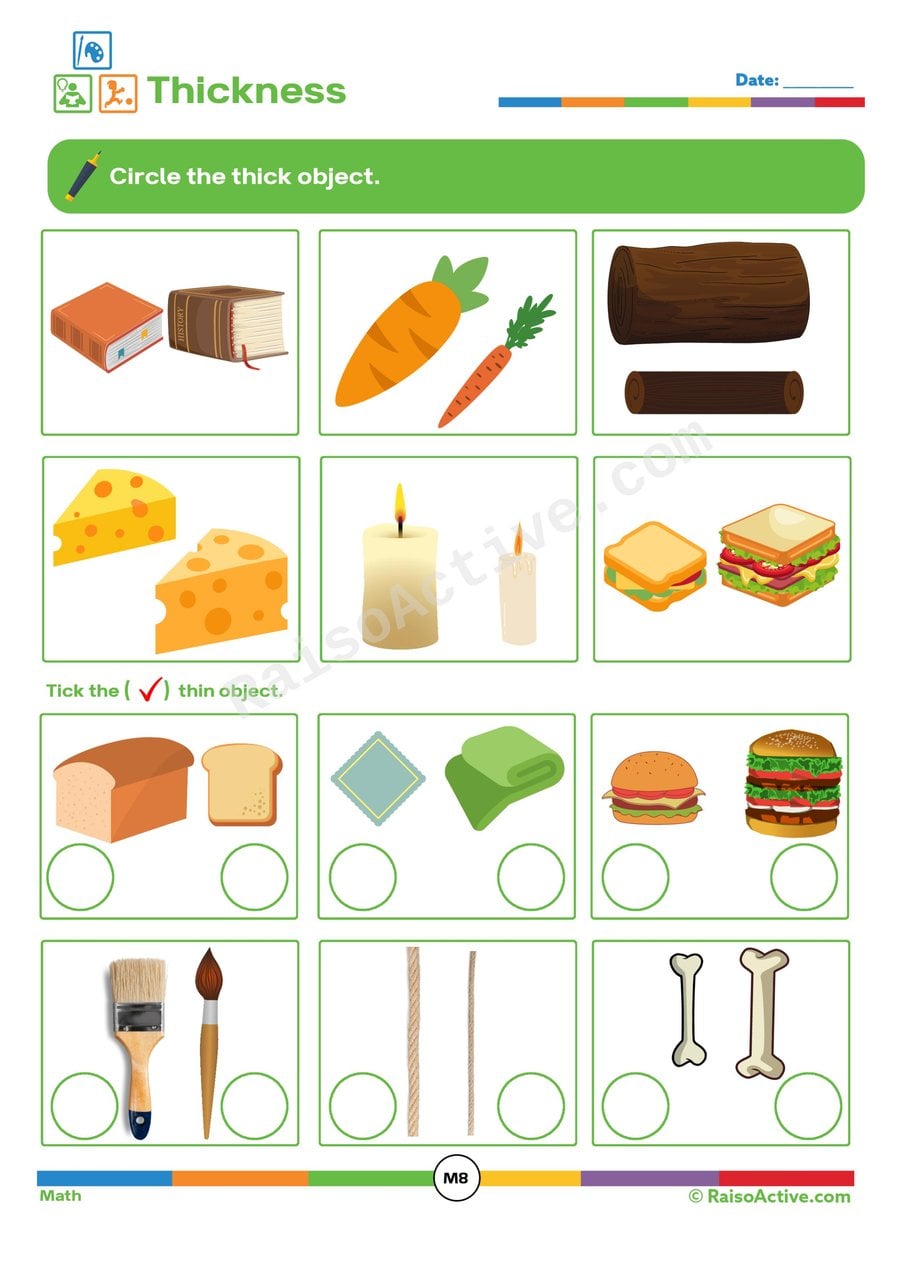
Thickness Worksheet: Circle the Thick Objects!
Ages 3-5 · Preschool–Pre-KAges 3-5 · Nursery–ReceptionAges 3-5 · Nursery–LKGAges 3-5
This sorting worksheet introduces children ages 3-5 to the comparative concept of thickness, asking them to distinguish thick objects from thin ones within paired pictures. Comparing physical properties like thickness, rather than just size or color, sharpens observational vocabulary and prepares children for later measurement concepts involving width and volume. Requiring two different responses — circling the thick object and ticking the thin one — also reinforces that opposite concepts can appear side by side in the very same picture.

Adjective Adventure: Matching Sentences Worksheet for Kids
Ages 4-6 · Pre-K–KindergartenAges 4-6 · Reception–Year 1Ages 4-6 · LKG–UKGAges 4-6
This worksheet teaches 4-6 year olds that adjectives are the words that describe nouns, asking them to fill in a missing adjective in a sentence and then physically mark the noun and adjective separately by underlining and circling. That separation step — telling apart which word names a thing and which word describes it — is a genuinely useful grammar distinction that most children haven't consciously noticed before, even though they use adjectives constantly in speech.

Measuring Objects with Paper Clips Worksheet for Preschoolers
Ages 4-5 · Pre-KAges 4-5 · ReceptionAges 4-5 · LKGAges 4-5
This worksheet introduces children ages 4-5 to non-standard measurement by having them line up paper clips end-to-end to find the length of different objects, building an early understanding that length can be measured and compared using a repeated unit. This hands-on approach lays the groundwork for using rulers and standard units later on.
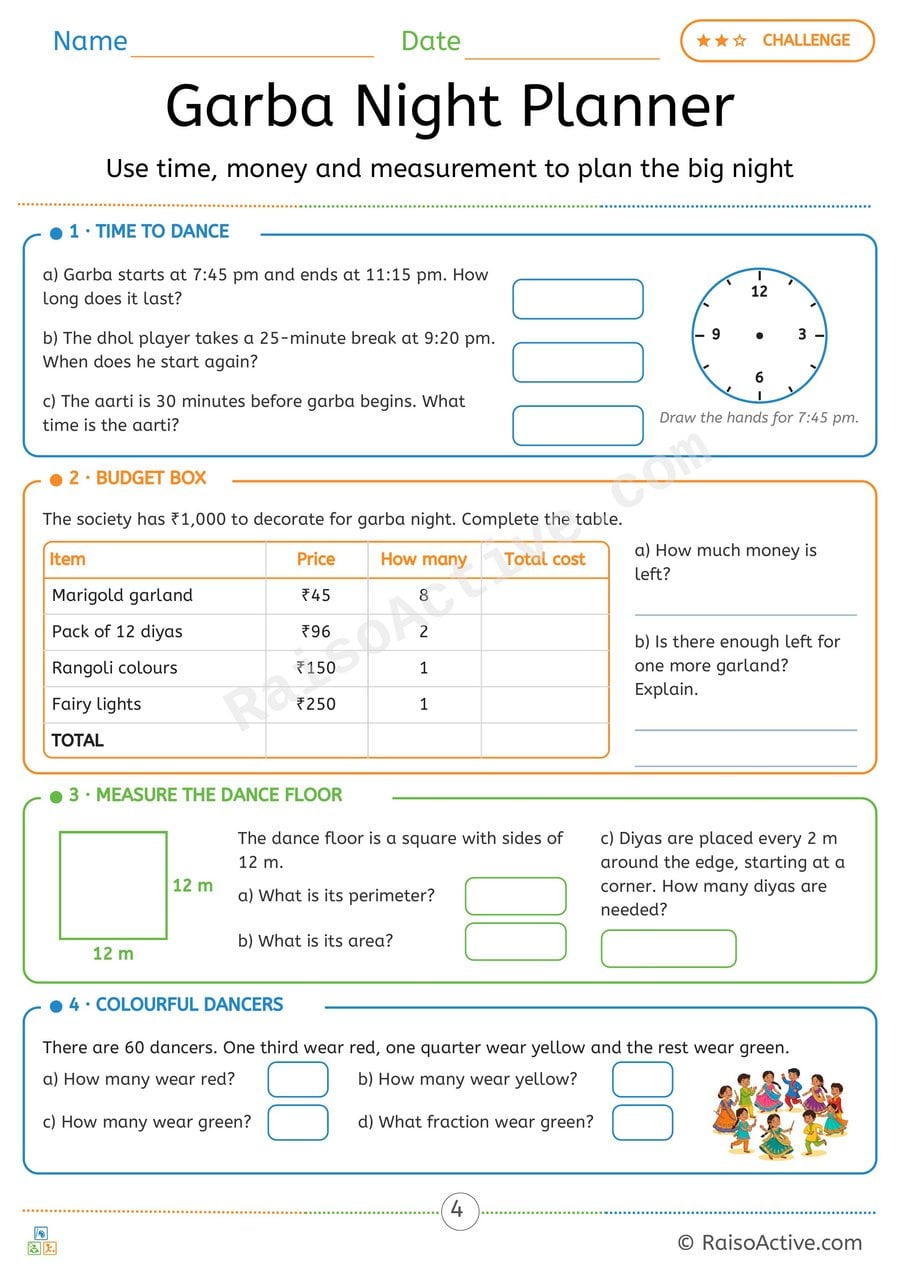
Garba Night Planner: Navratri Time, Budget and Area Word Problems
Ages 7-11 · Grade 2–Grade 3Ages 7-11 · Year 3–Year 4Ages 7-11 · Class 2–Class 3Ages 7-11
Children work out how long garba lasts and when breaks end, draw clock hands for 7:45 pm, complete a decoration budget table, find the perimeter and area of a square dance floor, and find a third and a quarter of 60 dancers.
Reviews
Every worksheet for ages 3–5, no watermark
Members download the full library of 1,000+ worksheets and every activity pack without watermarks or daily limits. One year costs ₹999 in India or $20 elsewhere.
See membership plansOr download any worksheet free with a watermark (5 a day).