Hand Span Measurement Worksheet for Kids
This worksheet introduces measurement using a non-standard unit, a child's own hand span, teaching that length can be measured with tools other than a ruler while also building estimation skills. For ages 4-6, comparing a guess to an actual measurement helps develop number sense around length and distance in a hands-on, personally meaningful way.
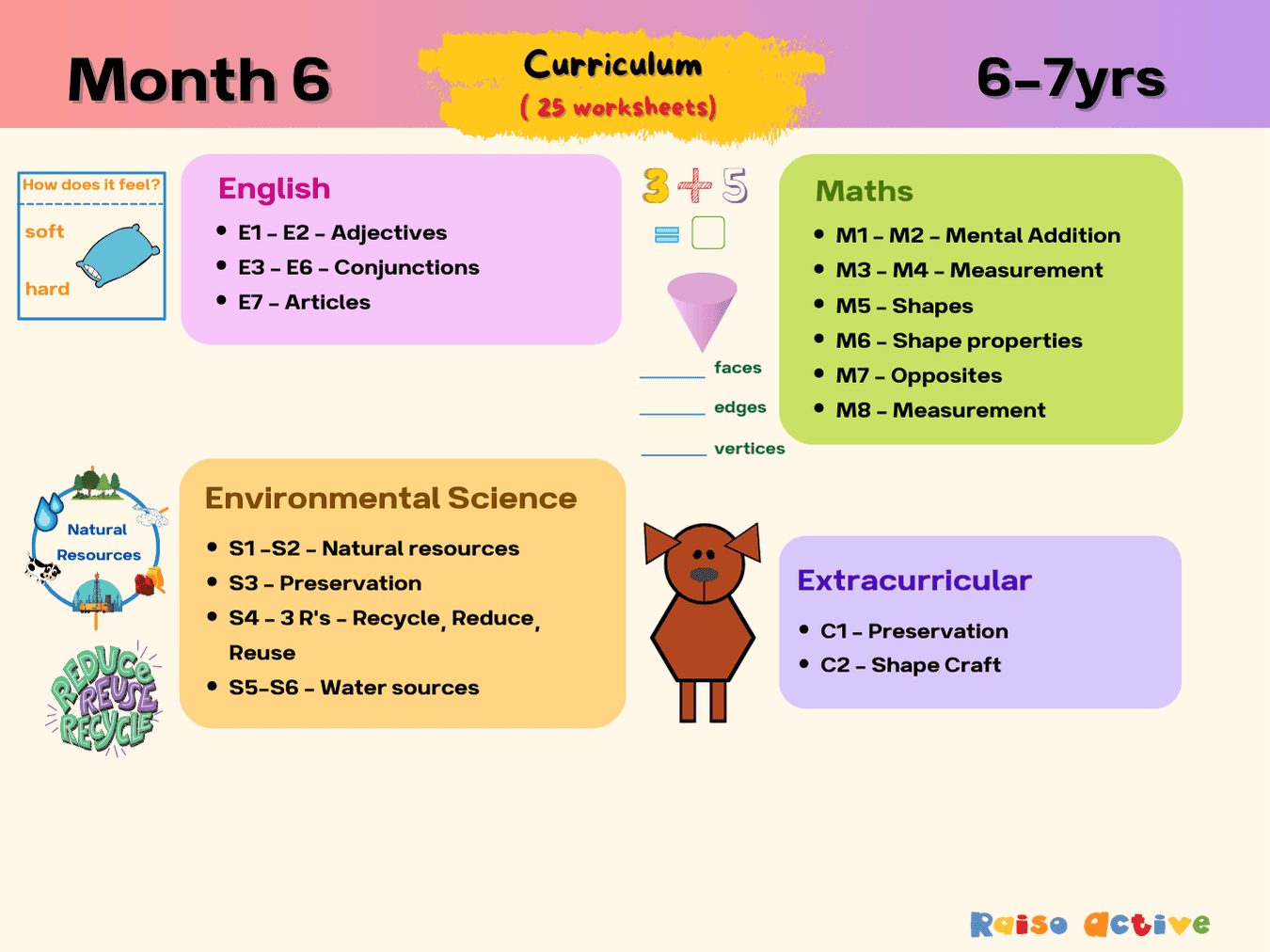
Part of the pack
Month 6: Grammar, Math, Environmental Science | Ages 6-7
This is page 13 of the pack. Ages 6-7 · Grade 1Ages 6-7 · Year 2Ages 6-7 · Class 1Ages 6-7
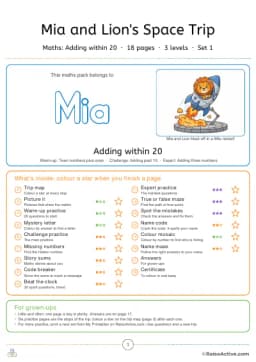
Made for your child
Numbers to 20, made for your child
A maths pack with your child's name in it: pictures that explain, practice at three levels, puzzles and story sums about them. Print a new set whenever they finish.
Make a maths packFree preview · free for members
Curriculum
- Measurement - Length > Measurement Basics
How to use this worksheet
Look at the first object pictured on the worksheet and ask your child to guess how many hand spans long they think it is, writing their estimate in the space provided. Have your child place their hand, fingers spread, at one end of the object, or a real version of it if available, and 'walk' their hand span across its length, counting each span aloud. Have them write the actual measured number next to their guess. Repeat this estimate-then-measure process for each remaining object on the page, comparing guesses to real measurements as you go.
Materials needed
- Pencil
- Hand
Extension activities
- 1Measure other objects around the house using hand spans, like a table, a book, or a doorway.
- 2Compare your child's hand span to an adult's or sibling's, noticing how measurements differ between people.
- 3Try measuring the same object using a different non-standard unit, like footsteps or paperclips, and compare the results.
- 4Keep a simple chart recording hand span measurements of several favorite toys or objects.
- 5Talk about why hand spans might not always give the same answer between different people, leading into why we eventually use standard units like inches.

Written by
Hemsweta Jain · Teacher Cheena
MBA and Early Childhood Educator, teaching since 2014 · Founder of RaisoActive, Mumbai
Every RaisoActive worksheet is designed and checked by the founder before publishing.
Published · Last reviewed
More from Month 6: Grammar, Math, Environmental Science | Ages 6-7
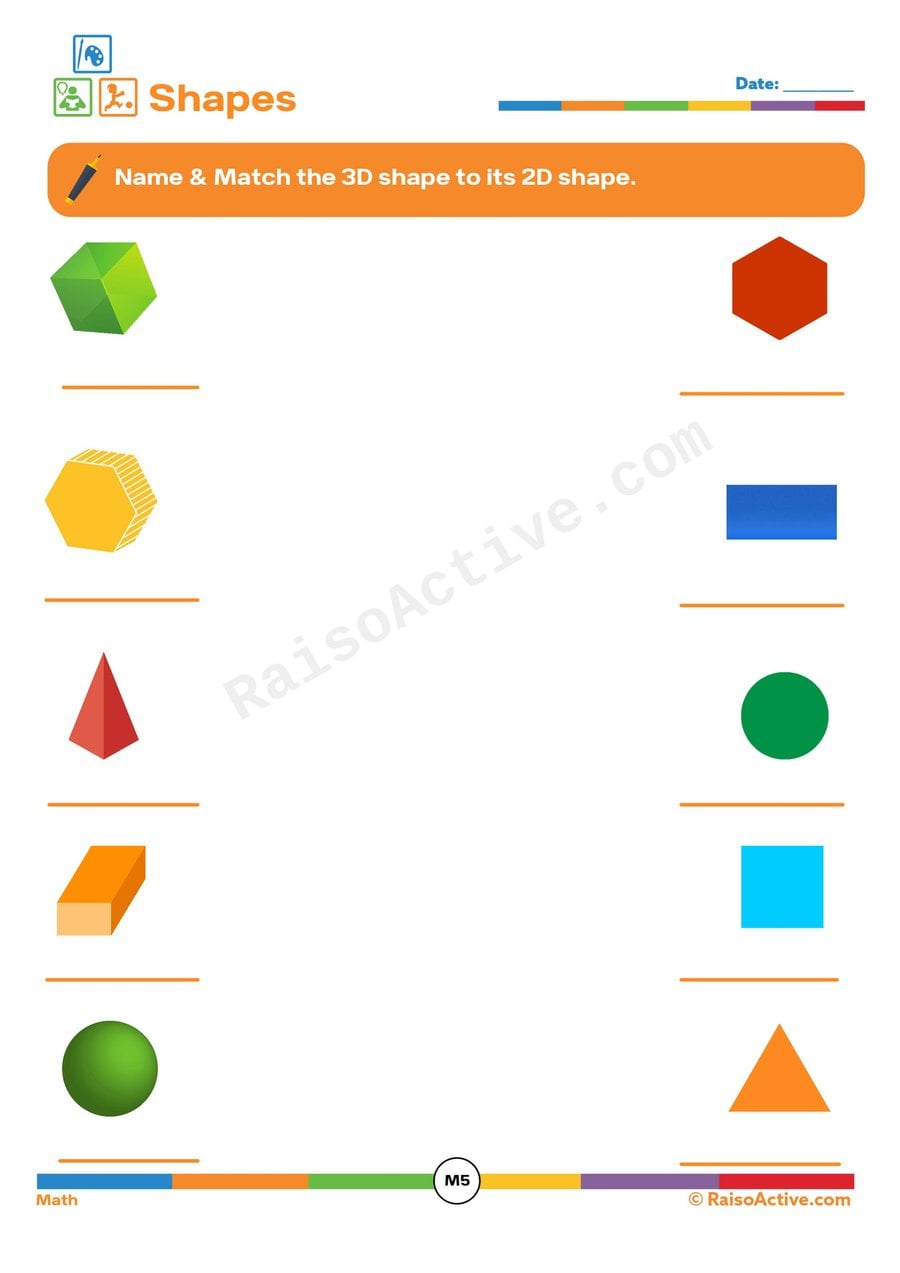
Shape Match: 3D to 2D Shapes Worksheet
Ages 4-5 · Pre-KAges 4-5 · ReceptionAges 4-5 · LKGAges 4-5
This worksheet builds an important geometric connection by asking children to match 3D shapes, like a cube or sphere, to the 2D shape that appears on their flat faces, such as a square or circle. For ages 4-5, understanding that solid shapes are made up of flat shapes is a foundational geometry concept that bridges basic shape recognition with more advanced spatial reasoning.

Adjective Adventure: Circle the Adjectives Worksheet for Kids
Ages 4-6 · Pre-K–KindergartenAges 4-6 · Reception–Year 1Ages 4-6 · LKG–UKGAges 4-6
This worksheet introduces the concept of adjectives as descriptive words that tell us more about a noun, asking children to identify and circle words that describe pictured objects. For ages 4-6, recognizing adjectives builds richer, more expressive vocabulary and lays groundwork for more descriptive writing and speaking later on.

Shape Properties Worksheet: Identify Faces, Edges, and Vertices!
Ages 4-6 · Pre-K–KindergartenAges 4-6 · Reception–Year 1Ages 4-6 · LKG–UKGAges 4-6
This worksheet introduces the specific vocabulary of 3D geometry, faces, edges, and vertices, asking children to count each feature on shapes like cubes, cones, and spheres. For ages 4-6, learning to describe shapes by their properties rather than just their names builds an early foundation for more formal geometry later in school.
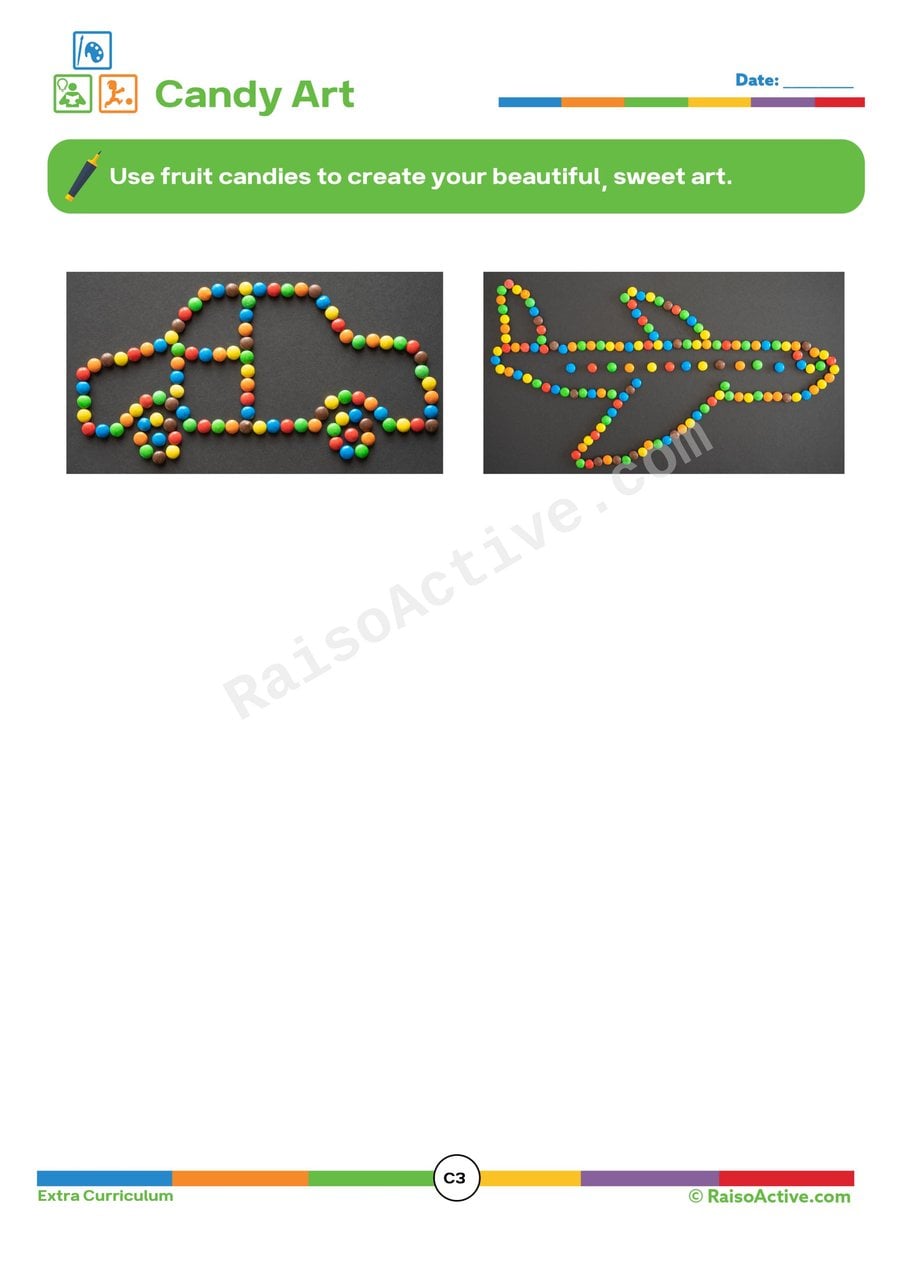
Candy Art: Create Sweet Art with Fruit Candies!
Ages 3-5 · Preschool–Pre-KAges 3-5 · Nursery–ReceptionAges 3-5 · Nursery–LKGAges 3-5
Arranging fruit candies into the outline of a car and an airplane gives children ages 3-5 a playful, sensory way to practice fine motor precision and pattern-following, since each candy must be placed carefully to build the recognizable shape. This open-ended art activity also builds early spatial reasoning, as children figure out how small individual pieces combine to form a larger, specific picture. Because the medium is candy rather than paper, it adds a multisensory, highly motivating twist that keeps younger children engaged longer than a typical craft.

Natural Resources Worksheet for Kids: Fill in the Blanks!
Ages 3-5 · Preschool–Pre-KAges 3-5 · Nursery–ReceptionAges 3-5 · Nursery–LKGAges 3-5
This worksheet introduces young children to the idea that everyday materials like water, wood, and air come from the natural world, building early science vocabulary around natural resources. For ages 3-5, matching a picture to its correct word also reinforces beginning reading skills and the idea that objects around them have specific names tied to where they come from.

Shape Craft Dog Worksheet: Count, Write, Colour, Cut & Glue!
Ages 3-5 · Preschool–Pre-KAges 3-5 · Nursery–ReceptionAges 3-5 · Nursery–LKGAges 3-5
Building a dog out of separate shape pieces gives children ages 3-5 hands-on practice recognizing basic shapes like circles, triangles, and squares while also strengthening the fine motor control needed for cutting and gluing. Counting and writing the number of each shape before assembling the dog adds an early math layer, connecting shape recognition directly to quantity. This kind of multi-step craft — count, write, color, cut, glue — also builds the sequencing and attention span children need for more complex classroom projects later on.
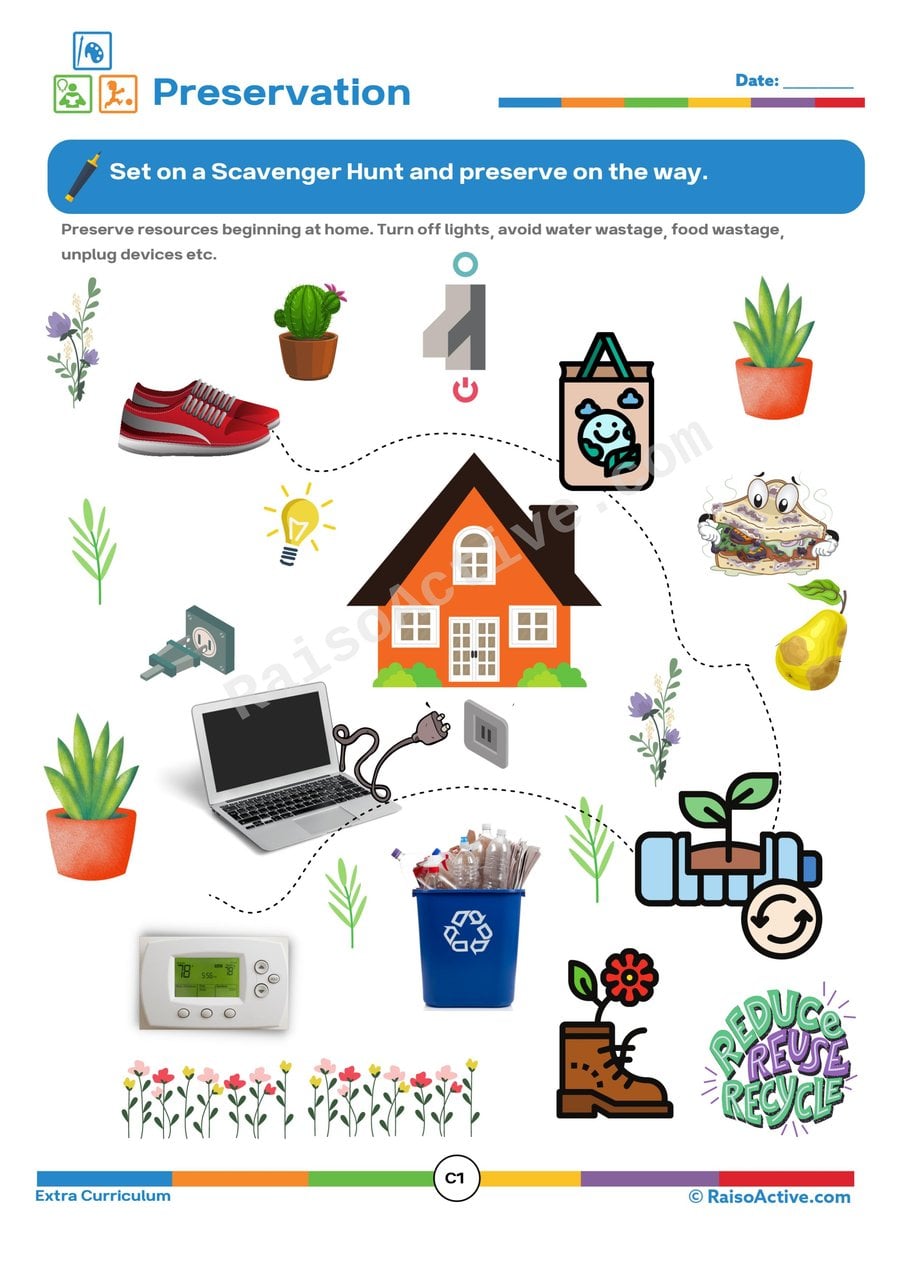
Preservation Scavenger Hunt Worksheet for Kids
Ages 3-5 · Preschool–Pre-KAges 3-5 · Nursery–ReceptionAges 3-5 · Nursery–LKGAges 3-5
This worksheet teaches children to connect specific pictured items to preservation actions, like recycling or saving water, by tracing dotted lines between related images. For ages 3-5, a scavenger-hunt style format makes the abstract idea of conservation feel like an engaging visual puzzle rather than a lecture, while still building genuine environmental vocabulary.
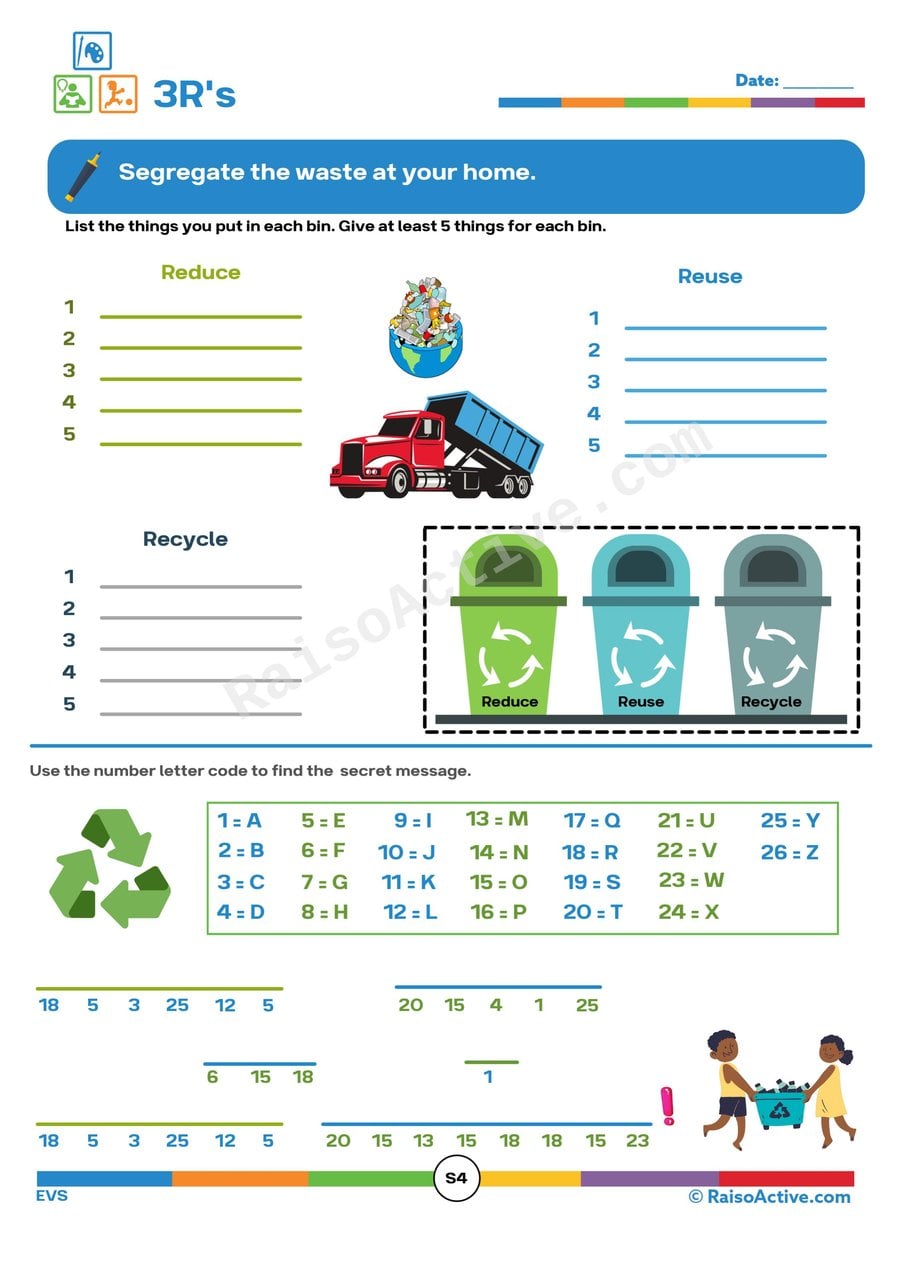
3 R's Worksheet: Reduce, Reuse, Recycle!
Ages 4-6 · Pre-K–KindergartenAges 4-6 · Reception–Year 1Ages 4-6 · LKG–UKGAges 4-6
This worksheet introduces the three R's, reduce, reuse, and recycle, as concrete categories for sorting everyday actions, helping children ages 4-6 build environmental vocabulary and classification skills. Decoding a secret message using a number code adds a layer of early math and logic practice, linking numeral recognition to problem-solving.
Related worksheets

Tall and Short Objects Worksheet for Preschoolers
Ages 3-5 · Preschool–Pre-KAges 3-5 · Nursery–ReceptionAges 3-5 · Nursery–LKGAges 3-5
Children ages 3-5 build early measurement vocabulary by comparing pairs of objects and identifying which one is taller and which is shorter, practicing both circling and ticking as response formats. Comparing height between two objects at a time, rather than sorting a whole group, keeps the comparison task simple and direct, which is developmentally appropriate before children move on to comparing three or more items at once.

Measuring Objects with Paper Clips Worksheet for Preschoolers
Ages 4-5 · Pre-KAges 4-5 · ReceptionAges 4-5 · LKGAges 4-5
This worksheet introduces children ages 4-5 to non-standard measurement by having them line up paper clips end-to-end to find the length of different objects, building an early understanding that length can be measured and compared using a repeated unit. This hands-on approach lays the groundwork for using rulers and standard units later on.
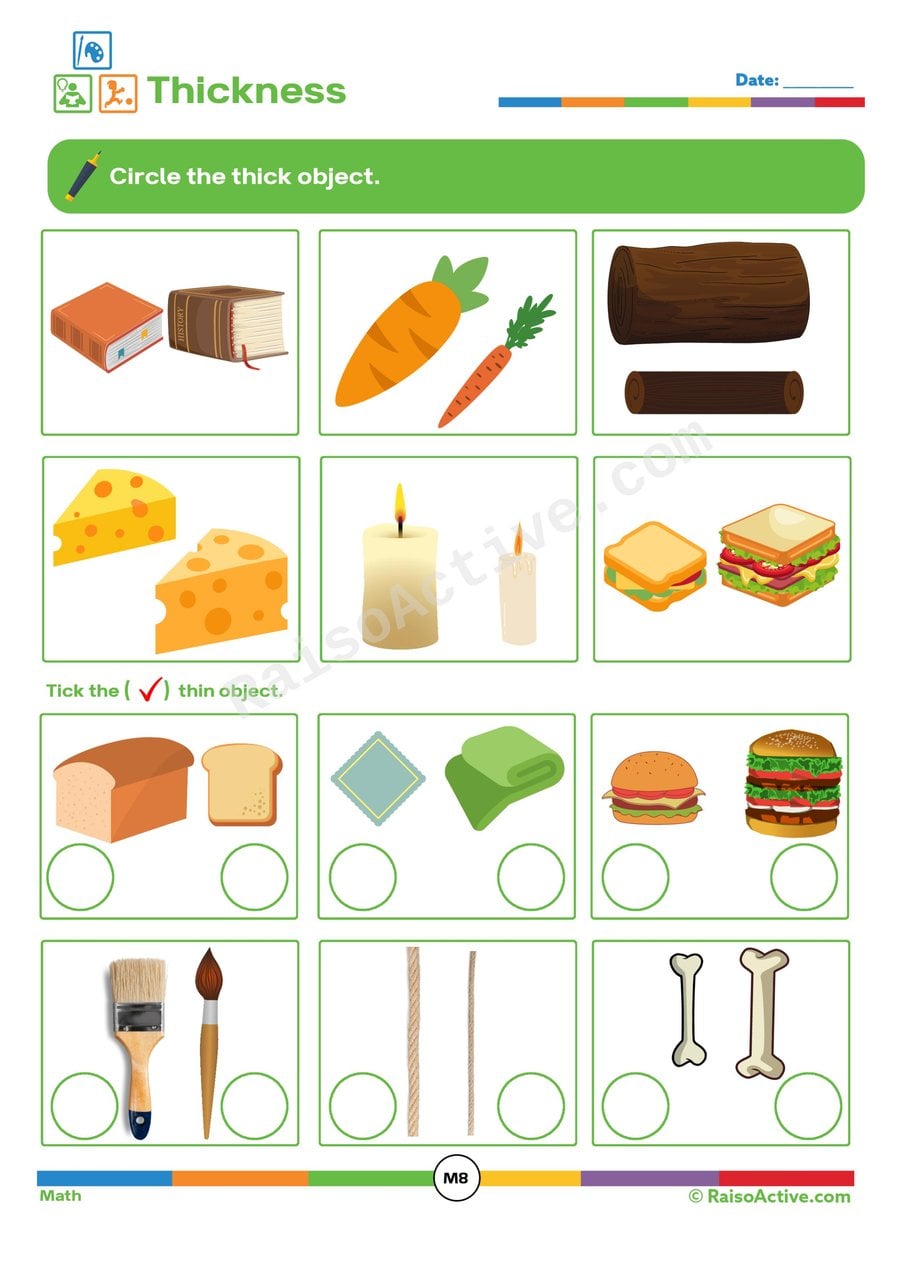
Thickness Worksheet: Circle the Thick Objects!
Ages 3-5 · Preschool–Pre-KAges 3-5 · Nursery–ReceptionAges 3-5 · Nursery–LKGAges 3-5
This sorting worksheet introduces children ages 3-5 to the comparative concept of thickness, asking them to distinguish thick objects from thin ones within paired pictures. Comparing physical properties like thickness, rather than just size or color, sharpens observational vocabulary and prepares children for later measurement concepts involving width and volume. Requiring two different responses — circling the thick object and ticking the thin one — also reinforces that opposite concepts can appear side by side in the very same picture.

Soap & Pepper Science Experiment Worksheet for Preschoolers
Ages 3-5 · Preschool–Pre-KAges 3-5 · Nursery–ReceptionAges 3-5 · Nursery–LKGAges 3-5
This simple experiment introduces children ages 3-5 to the basic science of surface tension and how soap breaks it, using pepper flakes sprinkled on water as a visual demonstration. Watching the pepper scatter away the instant soap touches the water gives children a concrete, memorable example of cause and effect, an early building block for scientific thinking.
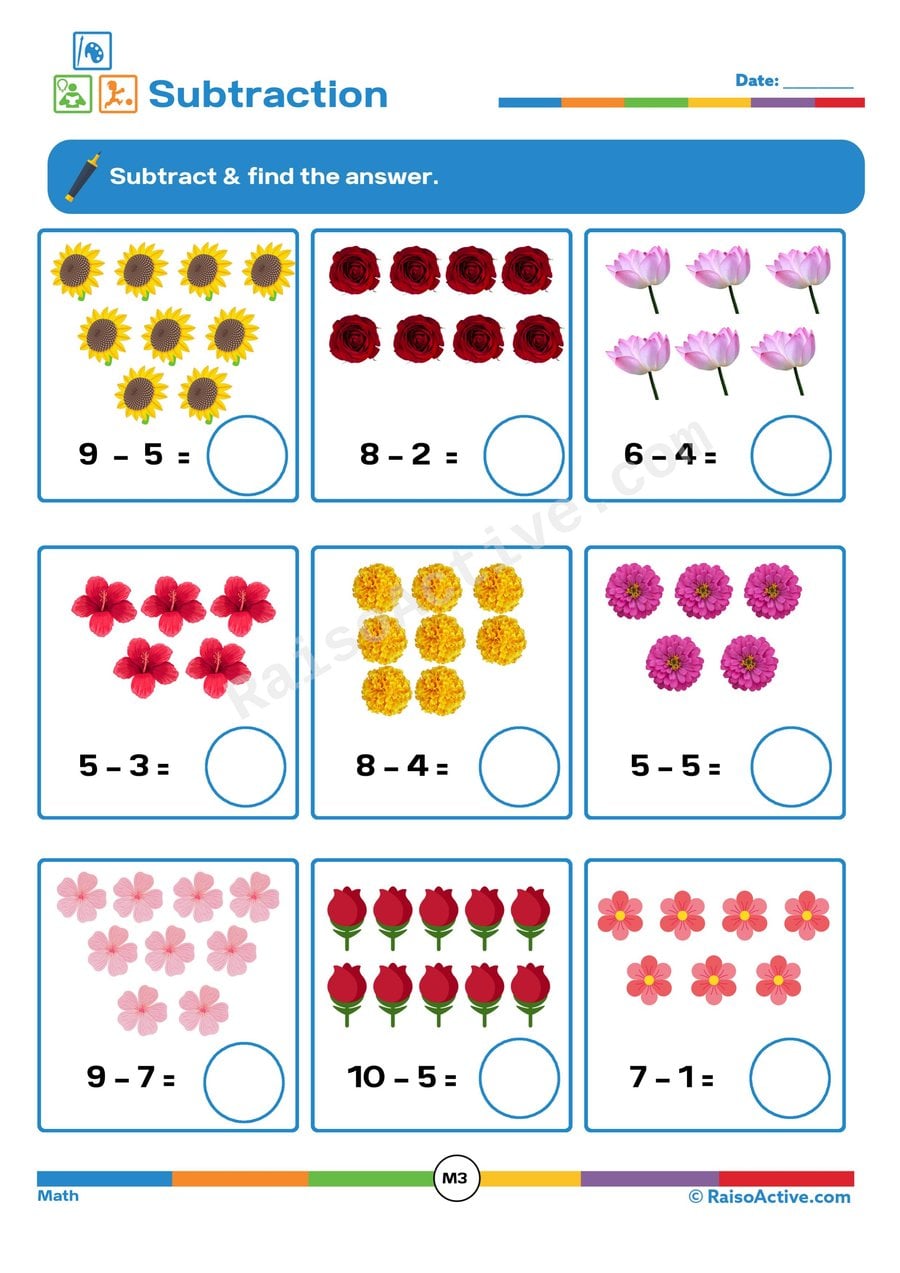
Flower Power Subtraction Worksheet for Kids
Ages 4-6 · Pre-K–KindergartenAges 4-6 · Reception–Year 1Ages 4-6 · LKG–UKGAges 4-6
This worksheet gives children ages 4-6 hands-on subtraction practice using a flower-themed counting context, asking them to count pictured objects, subtract a given amount, and write the difference in a circle. The visual, countable format helps make subtraction concrete rather than abstract, reinforcing that 'taking away' reduces a group's total in a way children can see and verify by recounting.
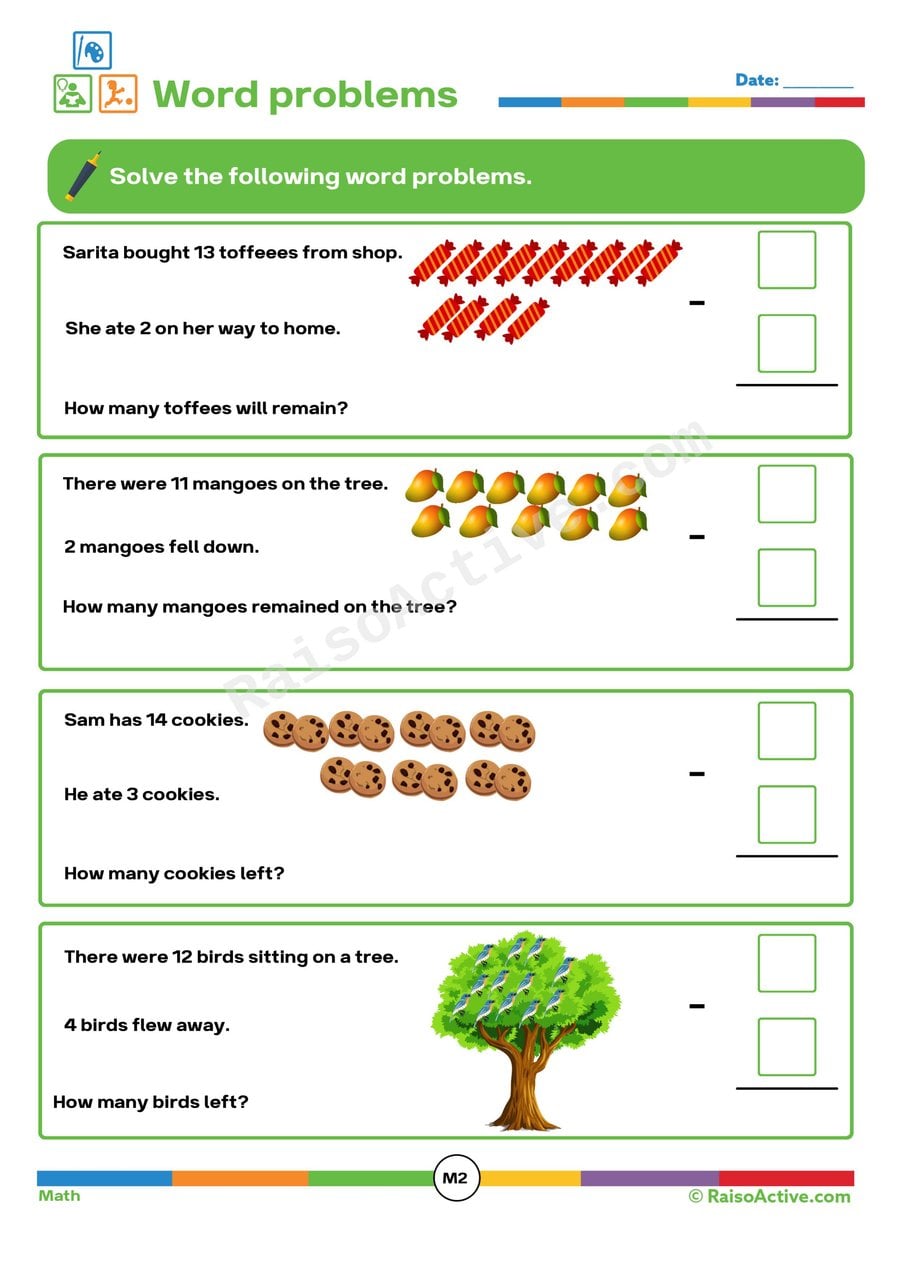
Word Problems Worksheet for Early Learners
Ages 4-6 · Pre-K–KindergartenAges 4-6 · Reception–Year 1Ages 4-6 · LKG–UKGAges 4-6
Children ages 4-6 practice applying subtraction to real-life scenarios by reading short word problems and figuring out how many items remain after some are taken away, connecting basic subtraction facts to reading comprehension. Translating a written story into a subtraction problem is a more advanced skill than solving bare number sentences, since it requires understanding what the story is actually asking.

Solve & Color: Fun Addition and Subtraction Worksheet for Kids!
Ages 4-6 · Pre-K–KindergartenAges 4-6 · Reception–Year 1Ages 4-6 · LKG–UKGAges 4-6
This worksheet combines early arithmetic practice with a color-by-number format, as children ages 4-6 solve simple addition and subtraction problems and then use a color key to fill in each shape based on their answer. Because getting the coloring 'right' depends on solving the math correctly, children get built-in, self-checking feedback on their arithmetic while also practicing shape recognition and staying within lines.

Addition Fun: Count and Add the Pictures Worksheet!
Ages 4-6 · Pre-K–KindergartenAges 4-6 · Reception–Year 1Ages 4-6 · LKG–UKGAges 4-6
Counting two separate groups of pictured objects and combining their totals introduces children ages 4-6 to the core concept of addition as joining quantities together, before they ever see an addition sign written out. Writing the final sum in the answer box connects this hands-on counting process to numeral writing, reinforcing that a math answer is a specific, countable quantity rather than an abstract symbol. This picture-based approach to addition builds a concrete foundation that supports later work with number-only equations.
Guides for this topic

Age-Appropriate Problem-Solving Activities: Building Critical Thinkers from the Ground Up
Discover fun, age-appropriate problem-solving activities for children ages 1-8. Build critical thinking, logic, and reasoning skills through play-based learning.

Fostering Creativity in Structured Learning: The Perfect Balance for Young Minds
Learn how to blend creativity with structured learning for children ages 1-8. Practical strategies, activities, and printable worksheets for parents and teachers.
Critical Thinking Activities That Actually Work for Young Children: Building Tomorrow's Thinkers Today
Discover proven critical thinking activities for young children. Age-wise logic games, questioning techniques, and hands-on ideas to build thinking skills at home.
Reviews
Every worksheet for ages 4–6, no watermark
Members download the full library of 1,000+ worksheets and every activity pack without watermarks or daily limits. One year costs ₹999 in India or $20 elsewhere.
See membership plansOr download any worksheet free with a watermark (5 a day).