Adjective Adventure: Circle the Adjectives Worksheet for Kids
This worksheet introduces the concept of adjectives as descriptive words that tell us more about a noun, asking children to identify and circle words that describe pictured objects. For ages 4-6, recognizing adjectives builds richer, more expressive vocabulary and lays groundwork for more descriptive writing and speaking later on.
Part of the pack
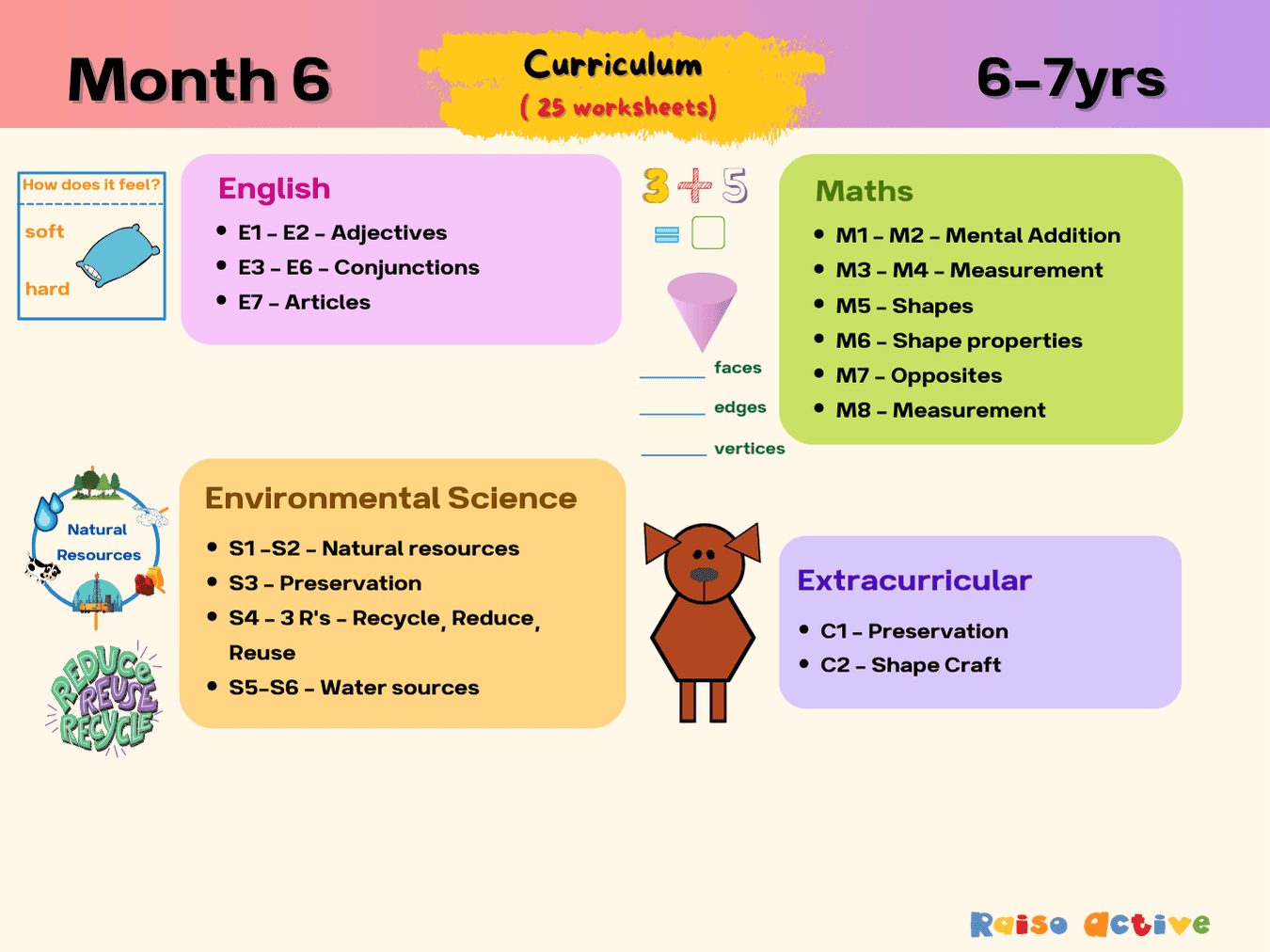
Month 6: Grammar, Math, Environmental Science | Ages 6-7
This is page 4 of the pack. Ages 6-7 · Grade 1Ages 6-7 · Year 2Ages 6-7 · Class 1Ages 6-7
Made for your child
A whole activity pack made with their name
60 pages to spot, build, trace and write their own name, plus pages about their favourites, feelings and family. See a free preview with their name.
Make an All About Me packFree preview · free for members
Or start free: a name tracing sheet with their nameCurriculum
- Grammar > Adjectives
How to use this worksheet
Look at the first picture and its accompanying words together, reading each word aloud with your child. Ask your child which words describe a quality of the picture, like its size, color, or shape, rather than naming the object itself. Have your child circle each word that functions as an adjective, describing the noun shown in the picture. Continue through the remaining pictures and word sets, discussing what each circled adjective tells us about the object each time.
Materials needed
- Pencil
- Crayons
Extension activities
- 1Play a describing game where your child picks an object in the room and lists three adjectives to describe it.
- 2Take turns adding one adjective at a time to build a silly, increasingly detailed description of an object.
- 3Draw a picture based on a set of adjectives you give your child, like 'big, red, bumpy,' and see what they create.
- 4Look through a picture book and find adjectives the author used to describe characters or settings.
- 5Create adjective flashcards paired with simple pictures illustrating each descriptive word.

Written by
Hemsweta Jain · Teacher Cheena
MBA and Early Childhood Educator, teaching since 2014 · Founder of RaisoActive, Mumbai
Every RaisoActive worksheet is designed and checked by the founder before publishing.
Published · Last reviewed
More from Month 6: Grammar, Math, Environmental Science | Ages 6-7
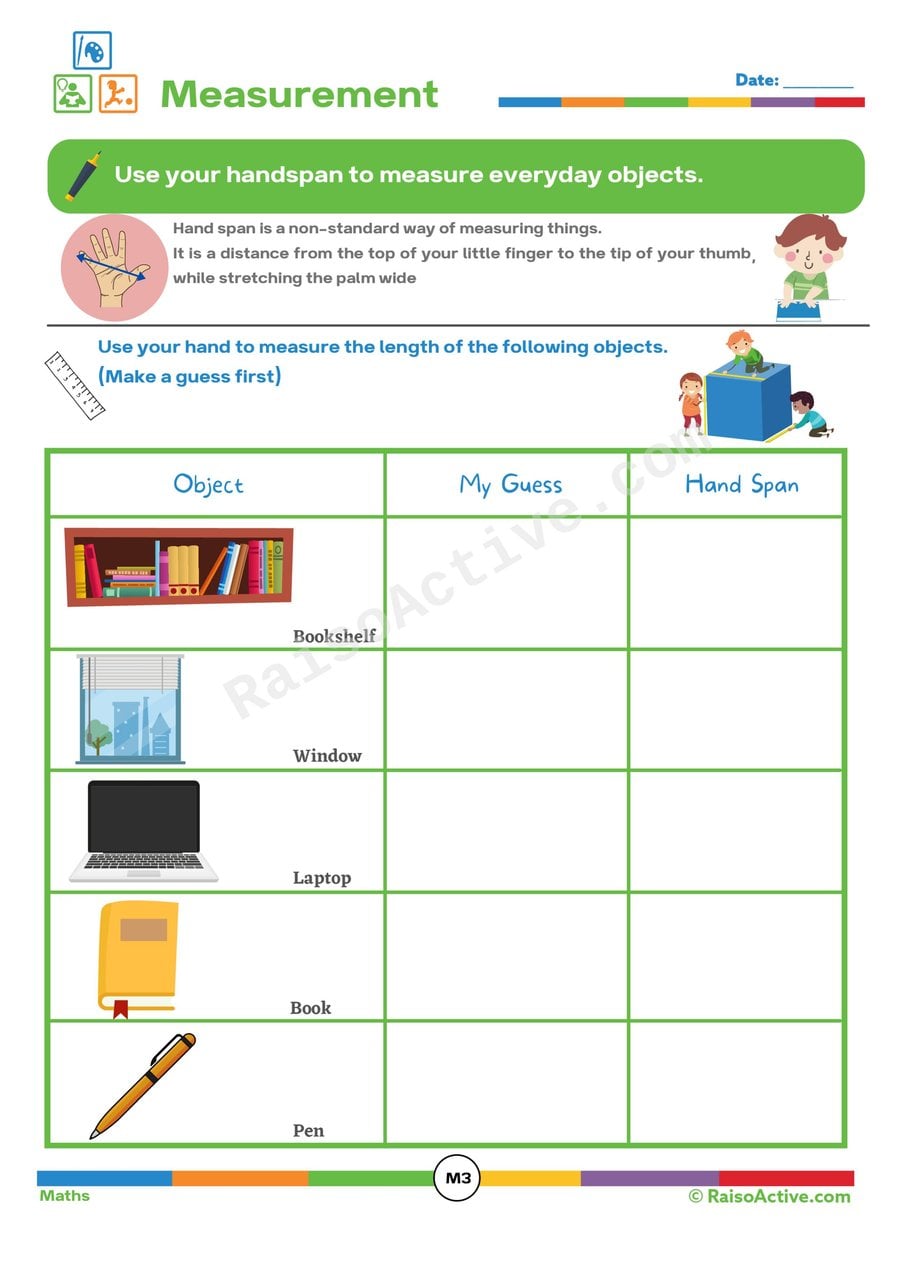
Hand Span Measurement Worksheet for Kids
Ages 4-6 · Pre-K–KindergartenAges 4-6 · Reception–Year 1Ages 4-6 · LKG–UKGAges 4-6
This worksheet introduces measurement using a non-standard unit, a child's own hand span, teaching that length can be measured with tools other than a ruler while also building estimation skills. For ages 4-6, comparing a guess to an actual measurement helps develop number sense around length and distance in a hands-on, personally meaningful way.

Mental Addition Worksheet: Add Dots and Find the Total!
Ages 4-6 · Pre-K–KindergartenAges 4-6 · Reception–Year 1Ages 4-6 · LKG–UKGAges 4-6
This worksheet bridges concrete counting and mental addition by having children count visible dots, add them to a given number, and then draw missing dots to complete equations, reinforcing that addition means combining quantities together. For ages 4-6, physically drawing the missing dots makes the abstract equation tangible, helping cement the connection between a math symbol and what it actually represents.
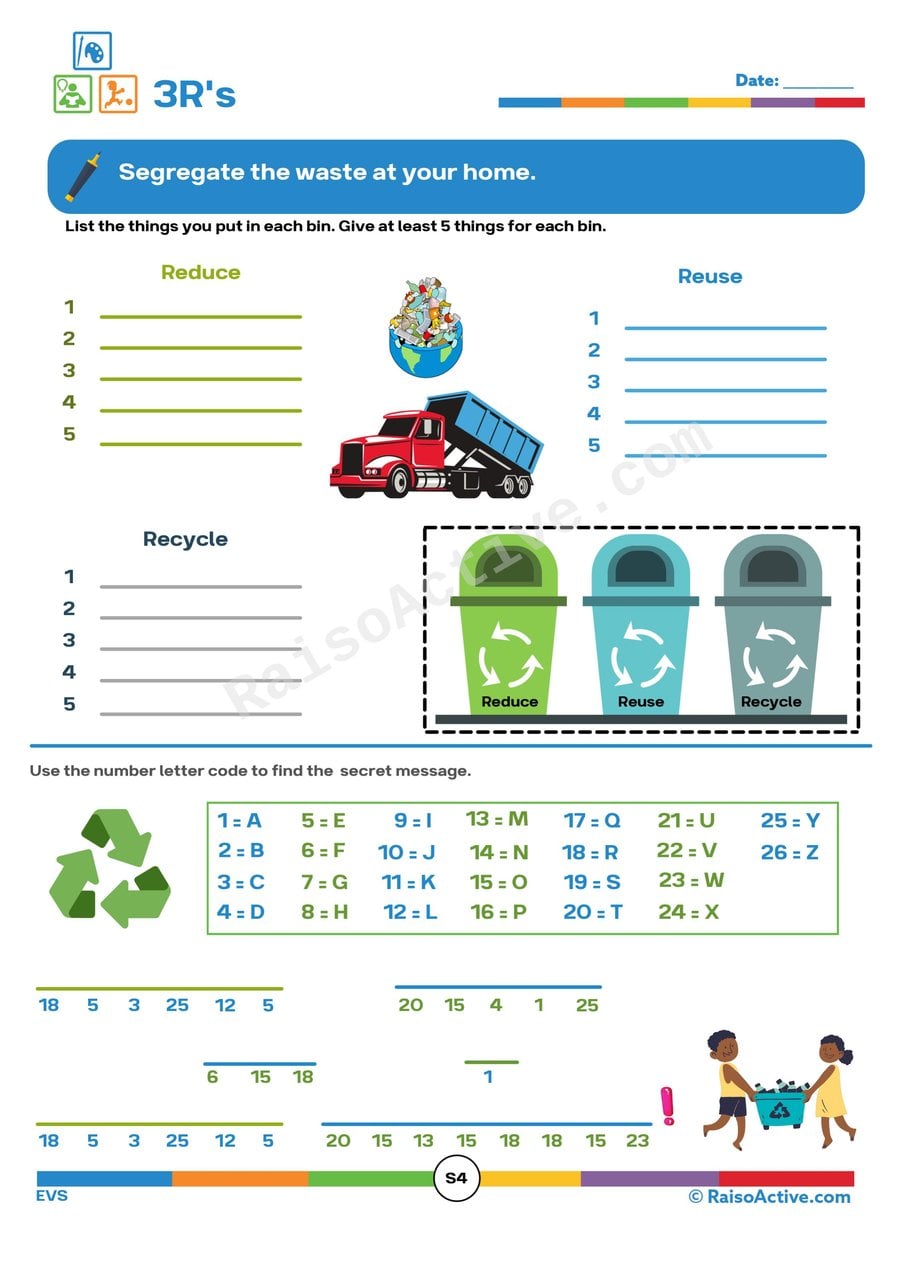
3 R's Worksheet: Reduce, Reuse, Recycle!
Ages 4-6 · Pre-K–KindergartenAges 4-6 · Reception–Year 1Ages 4-6 · LKG–UKGAges 4-6
This worksheet introduces the three R's, reduce, reuse, and recycle, as concrete categories for sorting everyday actions, helping children ages 4-6 build environmental vocabulary and classification skills. Decoding a secret message using a number code adds a layer of early math and logic practice, linking numeral recognition to problem-solving.

Mental Addition Worksheet for Kids: Practice Adding Numbers!
Ages 4-6 · Pre-K–KindergartenAges 4-6 · Reception–Year 1Ages 4-6 · LKG–UKGAges 4-6
This worksheet builds mental math fluency by asking children to solve simple addition problems in their heads rather than relying on counters or drawings, strengthening the internal number sense that supports faster, more confident arithmetic. For ages 4-6, moving from concrete counting toward mental calculation is a significant milestone that sets the foundation for later multi-digit addition.
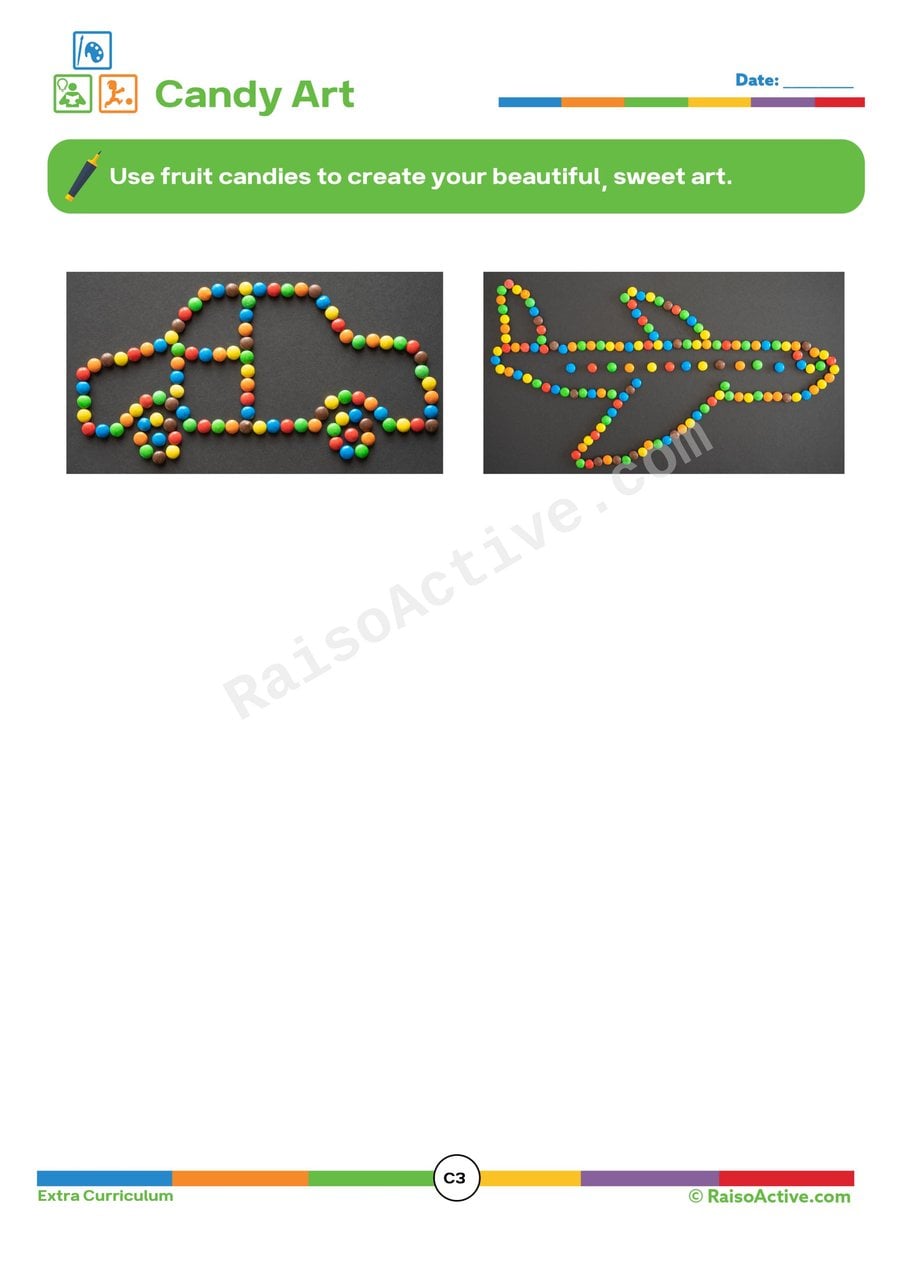
Candy Art: Create Sweet Art with Fruit Candies!
Ages 3-5 · Preschool–Pre-KAges 3-5 · Nursery–ReceptionAges 3-5 · Nursery–LKGAges 3-5
Arranging fruit candies into the outline of a car and an airplane gives children ages 3-5 a playful, sensory way to practice fine motor precision and pattern-following, since each candy must be placed carefully to build the recognizable shape. This open-ended art activity also builds early spatial reasoning, as children figure out how small individual pieces combine to form a larger, specific picture. Because the medium is candy rather than paper, it adds a multisensory, highly motivating twist that keeps younger children engaged longer than a typical craft.
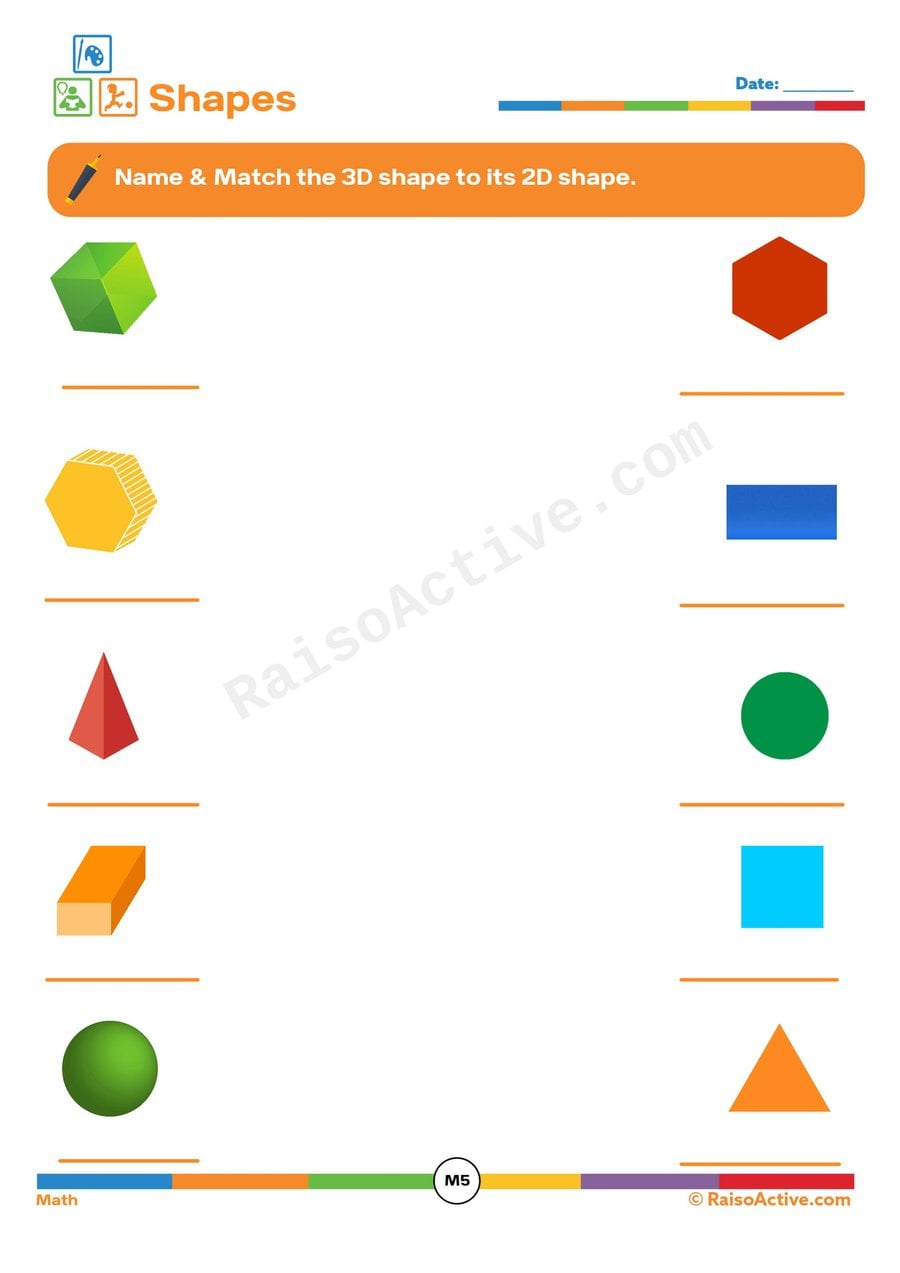
Shape Match: 3D to 2D Shapes Worksheet
Ages 4-5 · Pre-KAges 4-5 · ReceptionAges 4-5 · LKGAges 4-5
This worksheet builds an important geometric connection by asking children to match 3D shapes, like a cube or sphere, to the 2D shape that appears on their flat faces, such as a square or circle. For ages 4-5, understanding that solid shapes are made up of flat shapes is a foundational geometry concept that bridges basic shape recognition with more advanced spatial reasoning.

Articles Adventure: A, An, and The Worksheet for Preschoolers
Ages 4-6 · Pre-K–KindergartenAges 4-6 · Reception–Year 1Ages 4-6 · LKG–UKGAges 4-6
Choosing between 'a,' 'an,' and 'the' teaches children ages 4-6 one of English grammar's trickier rules — that 'an' is used before words starting with a vowel sound while 'a' comes before consonant sounds — building an ear for language patterns that native speakers often absorb through repetition rather than explicit rules. Practicing these small but frequent words also smooths out overall sentence fluency, since articles appear constantly in everyday speech and writing.
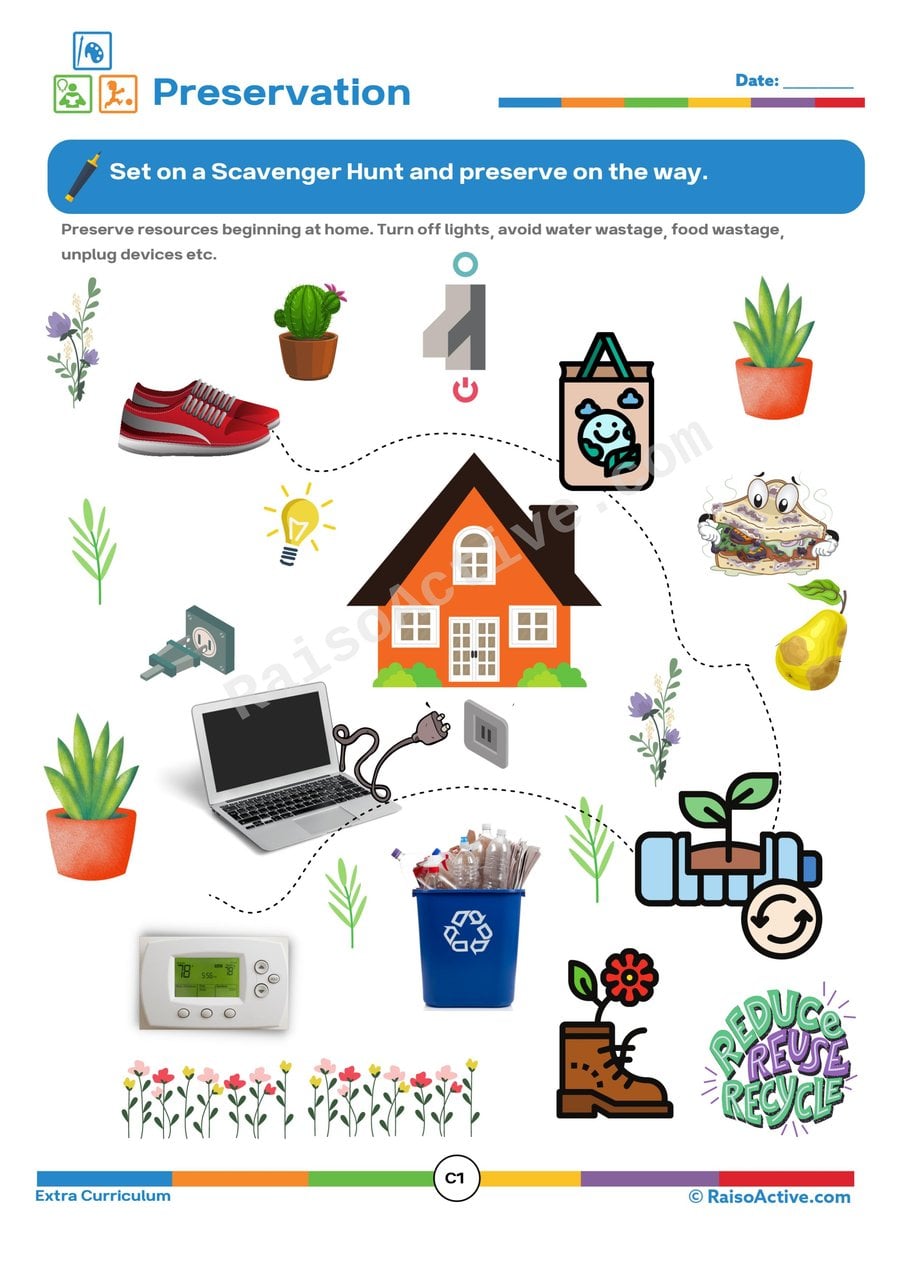
Preservation Scavenger Hunt Worksheet for Kids
Ages 3-5 · Preschool–Pre-KAges 3-5 · Nursery–ReceptionAges 3-5 · Nursery–LKGAges 3-5
This worksheet teaches children to connect specific pictured items to preservation actions, like recycling or saving water, by tracing dotted lines between related images. For ages 3-5, a scavenger-hunt style format makes the abstract idea of conservation feel like an engaging visual puzzle rather than a lecture, while still building genuine environmental vocabulary.
Related worksheets

Adjective Adventure: Circle the Correct Words Worksheet
Ages 4-6 · Pre-K–KindergartenAges 4-6 · Reception–Year 1Ages 4-6 · LKG–UKGAges 4-6
Children ages 4-6 practice identifying adjectives, the describing words that tell more about a noun, by reading sentences and circling the word that adds detail or description. Learning to spot adjectives is a foundational grammar skill that also helps children add more vivid, specific description to their own writing and speech.

Adjective Adventure: Cut and Paste Worksheet for Early Readers
Ages 4-6 · Pre-K–KindergartenAges 4-6 · Reception–Year 1Ages 4-6 · LKG–UKGAges 4-6
This cut-and-paste worksheet has 4-6 year olds fill in the blanks of a short story using adjectives, then reread the finished story to see how those descriptive words change and enrich the meaning — a more advanced application of adjective knowledge than isolated sentence work, since it shows how word choice affects a whole narrative. Choosing which cut-out adjective fits best in context also builds reading comprehension alongside vocabulary.

Adjective Worksheet: Circle and Fill in the Blanks!
Ages 4-6 · Pre-K–KindergartenAges 4-6 · Reception–Year 1Ages 4-6 · LKG–UKGAges 4-6
Working from a picture and a sentence together, children ages 4-6 practice choosing an adjective that accurately describes what they see and then writing it into the sentence - a skill that strengthens both vocabulary and the understanding that descriptive words add detail and meaning to a sentence. This bridges picture comprehension with written language, an important step as children move from purely oral vocabulary to using descriptive words in their own writing.

Adjective Adventure: Matching Sentences Worksheet for Kids
Ages 4-6 · Pre-K–KindergartenAges 4-6 · Reception–Year 1Ages 4-6 · LKG–UKGAges 4-6
This worksheet teaches 4-6 year olds that adjectives are the words that describe nouns, asking them to fill in a missing adjective in a sentence and then physically mark the noun and adjective separately by underlining and circling. That separation step — telling apart which word names a thing and which word describes it — is a genuinely useful grammar distinction that most children haven't consciously noticed before, even though they use adjectives constantly in speech.
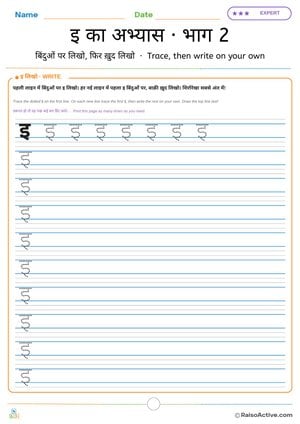
Hindi Letter इ Practice Part 2: Trace and Write on Your Own | इ का अभ्यास · भाग 2
Ages 3-7 · Preschool–Grade 1Ages 3-7 · Nursery–Year 2Ages 3-7 · Nursery–Class 1Ages 3-7
Children build writing fluency by tracing the dotted line इ on the first line and then writing the letter on their own, line after line, as the dotted help fades. The headline (शिरोरेखा) is drawn last, as in Hindi handwriting.
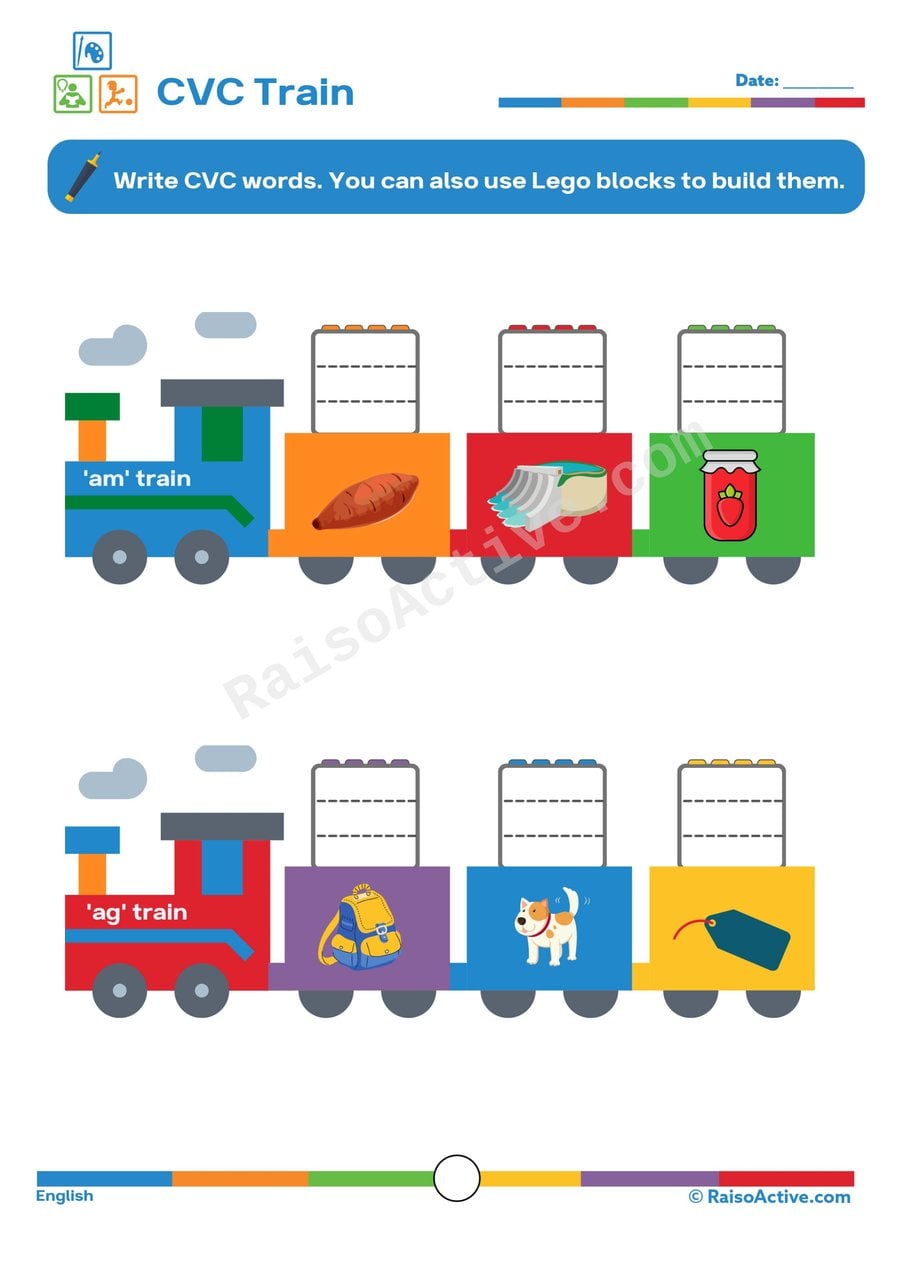
CVC Train Worksheet: Write and Build CVC Words!
Ages 4-6 · Pre-K–KindergartenAges 4-6 · Reception–Year 1Ages 4-6 · LKG–UKGAges 4-6
This worksheet gives children ages 4-6 focused practice blending letter sounds into consonant-vowel-consonant words, using train-car pictures as clues for words like 'dog,' 'hen,' or 'cup.' Because children both write the word and can optionally build it with Lego blocks, this worksheet reinforces the same phonics skill through two different physical actions — handwriting and hands-on construction — which helps the spelling patterns stick.

When Do We Celebrate? Indian Festivals and the Months of the Year
Ages 4-8 · Pre-K–Grade 2Ages 4-8 · Reception–Year 3Ages 4-8 · LKG–Class 2Ages 4-8
Children connect each festival to the month it falls in and learn that some festivals follow the moon, so their dates change each year.
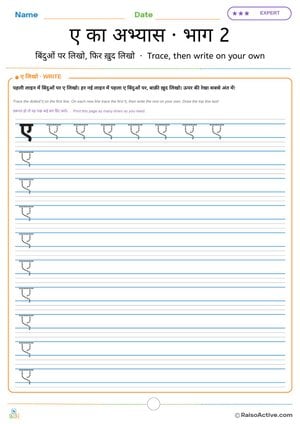
Hindi Letter ए (e) Practice 2: Trace, then Write on Your Own | ए का अभ्यास · भाग 2
Ages 5-7 · Kindergarten–Grade 1Ages 5-7 · Year 1–Year 2Ages 5-7 · UKG–Class 1Ages 5-7
An expert page for confident writers: trace the dotted ए on the first line, then on each new line trace the first ए and write the rest on your own, adding the top line last.
Guides for this topic

Documenting Learning Without Drowning in Data: A Practical Guide for Parents and Teachers
Learn practical ways to document your child's learning without overwhelm. Simple portfolios, observation tips, and printable trackers for ages 1-8.

How to Help Your Child with Letter Reversals: A Complete Guide for Parents and Teachers
Letter reversals are normal until age 7-8. Learn the best multisensory strategies, anchor letter tricks, and activities to help children write b, d, p, and q correctly.

Activities That Help with Pencil Grip Development: A Complete Guide for Parents and Teachers
Discover fun, research-backed activities to develop pencil grip in young children. Age-wise exercises, play ideas, and expert tips for parents and teachers.
Reviews
Every worksheet for ages 4–6, no watermark
Members download the full library of 1,000+ worksheets and every activity pack without watermarks or daily limits. One year costs ₹999 in India or $20 elsewhere.
See membership plansOr download any worksheet free with a watermark (5 a day).